Wednesday, December 17, 2014 

Unpleasant reading for all concerned.

In keeping with recent events, reading the Al-Sweady report by Sir Thayne Forbes is not a pleasant experience.  It reaches almost the exact opposite conclusions of the previous inquiry into alleged mistreatment in Iraq by British forces, finding that while some of those detained after the Battle of Danny Boy were mistreated, they were certainly not subjected to the beatings that led to the death of Baha Mousa.  Unlike Mousa, Forbes also finds beyond doubt that all 9 of those detained and whom subsequently alleged they were mistreated were either members of or volunteers with the Mahdi army, as were the 28 Iraqis killed by British forces that day following the ambush.  Forbes additionally finds Leigh Day solicitors knew as early as September 2007 that their clients were insurgents, having obtained a document from the Office of the Martyr Al Sayyed Al Sadr which detailed their positions within the Mahdi army.

Whether the inquiry would have came into being had the document been disclosed early we can't know.  Certainly, it's likely the detainees would not have received legal aid for their original claim in the administrative court had the full truth been in the open.  That doesn't however excuse the Ministry of Defence's failure to disclose their own documentation on the events of the 14th and 15th of May 2004 fully back in 2009, which led to then defence secretary Bob Ainsworth setting up the full independent inquiry.  Had that happened the allegations could have been disproved far sooner, with the cost of the inquiry, estimated at £31m, much reduced.

It's easy nonetheless to understand why so many ordinary Iraqis believed the claims that rather than being killed on the battlefield, some of those who died that day were tortured and then executed back at the British base, Camp Abu Naji.  Tensions had risen in the area following an incident that resulted in the Imam Ali mosque in Najaf being damaged, allegedly by US forces engaging the Mahdi army.  The ambush at Danny Boy (as the checkpoint on the road between Basra and Al Amarah was known by call sign) was in apparent direct retaliation for the attack, despite British forces not having been involved.  Forbes notes the assault was responded to with exemplary courage, resolution and professionalism, with only injuries to the British side despite the ferocity of the attack.  The Iraqis were also not subject to a bayonet charge as had been claimed, with all injuries to the attackers a result of either bullet or shrapnel wounds.

Had the bodies of the attackers been left where they fell, it's likely fewer local civilians would have believed the claims subsequently made.  Instead, a highly unusual order came through for the soldiers to identify the bodies.  The original intention was for the bodies to be photographed, but this apparently then morphed into taking them back to the base, as this would be the best way of doing so.  The idea was to check whether one of the men thought responsible for the killing of six Royal Military Police the previous year, Naseer Zachra Abd Rufeiq, was among the dead, as it was believed he could be.  Predictably, he wasn't.

How much in the way of further damage was caused to the bodies by the transfer isn't clear.  Forbes accepts it was possible some was done, not least as due to the room taken up by the corpses some had to be stood on for the soldiers to be able to take up the usual "top cover" positions.  Once unloaded, they were then moved again before they were photographed.  Blood samples were additionally taken, leaving puncture wounds which could also have given the impression of abuse.

Arrangements were made for the bodies to be handed over to the Iraqis the following day.  For reasons Forbes wasn't able to properly ascertain, some of the medics and ambulance drivers at the Al Majar al’Kabir hospital came to believe they were also to collect some Iraqis merely injured.  After the handover, the bodies were first taken to Al-Sadr Hospital, where footage was recorded showing in Forbes' words how "clearly even before the bodies had been properly examined, conclusions were being reached about how some of the deceased had sustained their injuries".  The bodies were then moved again, to Al Majar al’Kabir hospital, where they were examined by Dr Adel Al-Shawi and Dr Jafar Nasser Hussain Al-Bahadl.  Death certificates were issued, some of which observe the bodies show signs of torture, beatings and mutilation.  Even taking into account the bodies may have been further damaged in transit, the evidence, including the photographs taken at Abu Naji, discount those observations.   Forbes concludes the doctors "were so caught up in the emotional turmoil and hostility to the British Military then prevailing" that they failed  "to apply the professionally rigorous and objective judgment" expected of them.

The one part of the report the MoD won't be pleased with is on how those detained on the battlefield were subsequently treated during their detention.  Despite the death of Baha Mousa the previous year, it finds three of the detainees were forcibly strip-searched, and kept blindfolded for too long; they were not expressly authorised as being healthy enough to undergo "tactical questioning"; the soldier undertaking the questioning was poorly trained, and believed throwing a chair during interrogation was authorised behaviour; and that the training itself was still lacking.  Taken out of context, some of the ill-treatment Forbes identifies seem minimal; these were insurgents after all, are we really meant to be shocked or appalled by how they had their necks blown on?  When you learn the blowing comes in a sequence of events, which began with the detainee entering the room blindfolded, left seemingly alone for a while until suddenly the interrogator either drummed his fingers or whistled, before circling the detainee, blowing on his neck and banging a metal peg on the table, only then removing the prisoner's plastic handcuffs and blindfold, it's a little different.  Forbes also finds the men were sleep deprived, again like Mousa, as well as being denied adequate food and water.

Phil Shiner in a piece for the Graun claims there are a further 30 Baha Mousa-type cases and that by January the high court will have heard of up to 1,100 cases of mistreatment or worse by UK troops.  The obvious question following the Al-Sweady inquiry is how many of these are similarly based on deliberate lies.  Not all of the claims are however purely one side against the other: Forbes deals a number of times in the report with soldiers themselves alleging they were witness to mistreatment, or having concerns about what they saw or heard.  He discounts each one, but that doesn't alter the fact.  It could be the response of the defence secretary Michael Fallon, angrily denouncing the lawyers involved, is based less on the particulars of this inquiry and what might still be ahead.  It could also be that Public Interest Lawyers, having found one horrific example of abuse in the case of Baha Mousa went to see if there were others, and has been misled by the Iraqis themselves.  This doesn't explain why the document in the possession of Leigh Day proving the 9 men were insurgents didn't come to light earlier though.

Whatever the case, it doesn't excuse the MoD for its failures to anticipate exactly the kind of conditions and situations the military were going to have deal with once tasked with maintaining security in the south of Iraq.  The Al-Sweady report while debunking the most serious claims against the military underlines how much was still the same almost nine months on from the death of Baha Mousa, with the recognition something had gone badly wrong in that instance only dragged out by a similar public inquiry.  One hopes the recommendations made by Sir William Gage in his report have been implemented, as will be the additional ones made today by Forbes, if they haven't already.  We also still await the Chilcot report and its conclusions on Iraq in general, now highly unlikely to be published before the election.  It's probably best we don't mention how by then UK military personnel will be officially back in the country.

Labels: , , , , ,

Share |

Friday, September 09, 2011 

Scum-watch: What a difference 4 years makes.

The Sun's editorial the day after the collapse of the court martial against six of the men accused of being involved in the abuse of Baha Mousa:

COMMON sense prevailed when two British soldiers were cleared of abusing Iraqi prisoners.

Major Michael Peebles and Warrant Officer Mark Davies served with courage and bravery in the most difficult conditions.

This ludicrous show trial ? which has already seen four other soldiers cleared on the judge’s orders ? has been a waste of time and money.

These men risked their lives in Iraq but were repaid by being hung out to dry.

Every aspect of investigating so-called crimes within the military needs to be re-examined.

Our servicemen and women deserve nothing less.

Today's Sun editorial following
Sir William Gage's report into Baha Mousa's death:

NOTHING can excuse the savagery that led to the death of an innocent Iraqi prisoner at the hands of British squaddies.

As David Cameron says, it was shocking and appalling. And it must never happen again.

There are vital lessons for the Army over the scandal of hotel worker Baha Mousa, who died of 93 injuries inflicted by brutal captors in a detention centre.

The Sun's security expert, Andy McNab, points out that squaddies on active service are pumped up and highly aggressive. In war, their lives depend on it.

Responsibility for channelling that aggression, and enforcing rules on treating prisoners, falls to senior commanders and top brass at the Defence Ministry.

Yesterday's public inquiry report condemned a shameful failure of leadership. It also hit out at the conspiracy of silence over the killing of Mr Mousa.

Defence Secretary Liam Fox must act decisively with sackings — although he is right to insist that firm interrogation techniques remain an option.

Most Service personnel are fine men and women doing a tough job.

Yesterday the latest soldier to die in Afghanistan was brought home, a tragic reminder of the perils our brave troops face daily.

A handful of bad apples must not be allowed to tarnish the whole Army.

Whatever happened to common sense? And perhaps the Sun can also elaborate on whom outside the military contributed to the "conspiracy of silence" following the "savage" treatment meted out to Baha Mousa. After all, a handful of bad apples must not be allowed to tarnish the whole of the British media.

Labels: , , , , , , , ,

Share |

Thursday, September 08, 2011 

Justice at long last for Baha Mousa.

When the Saville inquiry into Bloody Sunday finally reported, I asked whether the forthcoming report into the death of Baha Mousa, coming just 7 years after his death could shine a similar light onto the excesses of the military. To the great credit of Sir William Gage and the team whom worked with him both on the report and during the inquiry, it does. It also asks a lot of questions which have yet to be properly answered.

To call Gage's conclusions devastating and his report meticulous in its dedication to getting as close to the truth as any investigator coming up against what was described at the previous court martial as an "obvious closing of the ranks" possibly could would not quite capture the true essence of what is an indictment of the state of the military prior to going into Iraq. It's a story of very young, often naive men being thrown in at the deep end, into a city (Basra) where security was rapidly disintegrating with the population turning against them, often expected to work 16 to 20 hour days in temperatures of between 40 degrees at night and 59 during the day, all with inadequate training, most especially when it came to the arresting of both "regime loyalists" and just general criminals, and all for dispiritingly low levels of pay.

This doesn't however even begin to explain why Baha Mousa and the others who were arrested with him on the 14th of September 2003 were treated with such a staggering level of brutality by some of the members of the 1 Queen's Lancashire Regiment. Gage also doesn't a reach a single overriding reason: he does however suspect, as had long been suggested, that the soldiers who took Mousa into custody and then subjected him to prolonged beatings, "stress positioning" and sleep deprivation for the next 36 hours believed he and his friends were responsible either for the deaths of six military police killed by a mob a couple of months earlier, or for the death of the popular Captain Dai Jones, a month before, pointing to it as the "principal cause". The only evidence they had which even suggested there were possibly insurgents was a cache of weaponry found at the hotel they worked at, which included a couple of grenades without fuses, pistols, two assault rifles and a large quantity of Iraqi dinars. There's nothing to suggest that during the conditioning and "tactical questioning" they subsequently underwent that they admitted, or even alluded to being involved in either of the incidents.

He also pinpoints exactly why the ranks closed during the previous court martial: far from this being the work of two or three out of control, revenge seeking servicemen, he names 19 separate soldiers as having some role in the violence meted out to the detainees. This doesn't include those who either witnessed what was going on, heard about it, or subsequently minimised what happened. One of these was 1QLR's padre, Father Peter Madden, who Gage found to be a "poor witness". Madden it seems found nothing untoward when he visited the detainees on the Monday, by which point the conditions in which they were being held should have spoken for themselves. Likewise, while the unit's regimental medical officer, Dr Derek Keilloh, was not criticised for his attempts to revive Mousa, it seems remarkable that at the time he maintains he had noticed no injuries on the body other than blood under his nose. The photographs of Mousa which have since been published were taken just after he was pronounced dead; they clearly show the extent of the beating he had received, let alone the 93 separate injuries which were subsequently identified.

All of which brings into sharp context the response of some following the court martial. One strutting, preening cock was Colonel David Black, who said soldiers had to be able to "work without looking over their shoulders, inhibited by the fear of such actions by an over-zealous and remote officialdom", while the local Tory MP Ben Wallace accused the then attorney general Lord Goldsmith of conducting a witch-hunt. The Sun, which considers itself the forces' paper to the great embarrassment of many serving in the army, referred to it as a "show trial" and the allegations, despite the very real death of Mousa and the extensive injuries to the other men detained as "so-called crimes".

The 73 separate recommendations made by Gage will hopefully address most of the problems identified. The one thing it doesn't comment on, and which the Chilcot inquiry must is the politicians who put them in such a desperate position in the first place, just about prepared for the initial conflict but not for what came afterwards. Ultimate responsibility must as always reside at the very top.

Labels: , , , , , , , ,

Share |

Wednesday, June 16, 2010 

Bloody Sunday and never wanting to believe anything bad about our country.

It's a rare occasion when the establishment finds itself genuinely shaken by the discombobulating attack of unambiguous, unequivocal truth. It's an even rarer occasion when it's the establishment itself which delivers the blow. Of all the inquiries set up by Tony Blair, it's almost certainly an indication of how the establishment protects itself that it was the one dealing with events in the recent past, rather than those dealing with the controversies and tragedies of our own time that delivered the most damning of assaults on the representatives of the British state.

The Saville inquiry had become a media by-word for the extravagance of New Labour's conscience when it came to things which it had no responsibility for, while it found it so terribly difficult to investigate, let alone apologise for almost anything post-May 1997. We now know why it took 12 years - this is almost certainly the most extensive documentation of the events of just a few hours outside of the 9/11 commission's report, and that was the work of a panel of politicians rather than one judge with the help of two other panel members. The very nature of its length and depth gives extra weight to its findings, which otherwise might have been questioned and attacked far more than they have been. Saville's repudiation of the Widgery report is total: the word unjustifiable runs through his findings, a hammer blow against those who continued for years afterwards to perform apologia for the actions of 1 Para on that day, and for the families who conversely campaigned for their relatives and loved ones to be proved completely innocent, the sweetest and most liberating of terms.

Faced with the staunchness of Saville's conclusions, David Cameron had no option other than to deliver the well judged address to the Commons, complete with an apology which was cheered and welcomed in Derry itself. The government is however only one part of the establishment; how the country's media responds and reacts to a new orthodoxy is worthy of equal analysis. And on any reasonably impartial one, especially one predicated on the reaction of the "popular" press, it's one that's equally revealing of the importance, or in this case lack of importance of the recognition that a nation's own armed forces committed a massacre of its own people. We should accept there are some justifications for not dwelling on Bloody Sunday: admittedly, some of the tabloid press is catering for an audience which can't remember what happened yesterday, less care about what happened 38 years ago, and it's also true that Northern Ireland itself has been so transformed from those days that some of those growing up there now are almost oblivious or don't want to learn about their shared past.

Regardless, that a newspaper with the history of the Daily Mirror couldn't find a single patch of space on its front page to report on the Saville report ought to be a source of shame to its current owners and journalists. We expect such from the Daily Star, which instead devoted its front page to the riveting news that vuvuzelas will be coming to this country, but not from the paper of Hugh Cudlipp. Inside it had two pages and a leader comment, more than the Sun's one page and editorial, but at least the Sun found space on the front to mention it, even if some women in orange dresses at the World Cup were considered more important for the main story. The Express had a box referring to the inquiry on its front page, whereas the two faces of the Daily Mail were on full display. A crude piece of moral relativism from Max Hastings, something it usually fulminates against, with Blair and Saville "betraying their responsibilities almost as grievously as those who fired the fatal shots", along with the "true face" of our soldiers, those who sacrificed their lives in Afghanistan having previously served in Ulster. Changing the subject, stressing the difference, hand-wringing over a tiny minority wholly unrepresentative of their comrades, all the signs of complete denial. Not that you would have thought so had you picked up a copy of the Irish version of the paper, as that dispenses with Hastings altogether, and has a front page with the legend "Finally, an apology for Bloody Sunday...but is it enough?"

It's hardly worth arguing with a newspaper which headlines its editorial, at least online, with "No excuses ..." and then goes onto to quibble with how Saville could be so certain that it was the soldiers who fired the first shots, as well as how reliable evidence given to an inquiry which started over a quarter of a century after an event could be, something which not even the Sun does, accepting in full Cameron's own formulation that "nothing can justify the unjustifiable". It should be just left to get on with disagreeing with something that it was always going to reject purely on the basis of its political prejudices.

We should though be alive to the mindset which allows such abuses of state power to happen in the first place. Again, David Cameron articulated it in his statement:

I am deeply patriotic; I never want to believe anything bad about our country; I never want to call into question the behaviour of our soldiers and our Army, which I believe to be the finest in the world.

It's this refusal to accept on an almost atavistic level that anything bad could have been done by those you identify yourself with which is so potentially dangerous. This not wanting to believe anything bad, and never wanting to call into question easily translates when such things do happen, as they always will, into the wilful acceptance of excuses, into cover up and bogus justifications, the finding of scapegoats, the defending of the indefensible that Cameron refused to do only when the full impact of the actualité was impossible to deny.

And let's not pretend that the army is this completely reformed entity, incapable of committing similar mistakes today: in so many ways, the death of Baha Mousa in British custody in Basra is chillingly familiar. Soldiers, acting out of the belief that those they had arrested were responsible for the death of a comrade, without proper instruction from senior officers, using techniques which were outlawed decades ago, inflicted 93 injuries on Mousa within 36 hours. At the initial court martial the words "I don't remember" were used over 600 times, and it concluded with only Corporal Donald Payne convicted, after he had the decency to admit to his role in beating the detainees, which he was recording doing, beating them in turn, with the screams from the men referred to as "the choir". The judge blamed a complete closing of ranks for the failure to find anyone else responsible, which the army completely ignored, with Colonel David Black demanding that soldiers needed to be able to operate "without looking over their shoulders inhibited by the fear of such actions by over-zealous and remote officialdom”. The tabloid press meanwhile either ignored the case, or in the Sun, referred to the death of Mousa and beatings which the other men arrested with him suffered as "so-called crimes" and described the court martial as a "show trial". It was only later that the government paid out £3 million in compensation for these "so-called crimes", forced at the same time to hold an independent inquiry into what happened, which is still on-going. It remains to be seen whether the establishment is capable of holding itself to account after just 7 years, or whether it requires almost two generations to pass before it can finally admit to and accept the truth.

Labels: , , , , , ,

Share |

Thursday, July 10, 2008 

A form of justice at last for Baha Mousa.

These are not just so-called injuries, these are the Sun's so-called injuries.

It's wonderful news that the family of Baha Mousa and 9 other innocent Iraqis who were viciously beaten and tortured by British soldiers are to be paid almost £3m in compensation.

More interesting though is how this news is going to be communicated to readers and others by certain media organisations that did their best to either ignore our personal Abu Ghraib shame or to play it down. As you might have known, the biggest, most unquestioning supporter of "Our Boys" was at the forefront of it. After all but one of the soldiers court martialled was cleared, a result of what the judge described as a complete closing of ranks, with the words "I don't remember" being used over 600 times by the various witnesses according to one of the lawyers involved, the Sun published this following leader comment:

COMMON sense prevailed when two British soldiers were cleared of abusing Iraqi prisoners.

Major Michael Peebles and Warrant Officer Mark Davies served with courage and bravery in the most difficult conditions.


This ludicrous show trial — which has already seen four other soldiers cleared on the judge’s orders — has been a waste of time and money.


These men risked their lives in Iraq but were repaid by being hung out to dry.


Every aspect of investigating so-called crimes within the military needs to be re-examined. Our servicemen and women deserve nothing less.

These "so-called crimes" have now been recognised by the Ministry of the Defence, but only after being forced into holding an independent inquiry by lawyers acting for the Iraqi men. The MoD, in the form of Colonel David Black, was also dismissive after the court-martial collapsed in such ignominy:

[Our Boys needed to be able to work] “without looking over their shoulders inhibited by the fear of such actions by over-zealous and remote officialdom”.

Such over-zealous and remote officialdom has now apologised "for the appalling treatment that you suffered at the hands of the British army. The appalling behaviour of British soldiers made us feel disgusted." Not so those within the army and the media however that did everything they possibly could to pretend that that such appalling treatment had either never taken place or had been the work of one lone soldier who bravely owned up to his part in beating Baha Mousa and two of the other men detained with him. Donald Payne's punishment for his role amounted to a year in prison, a discharge from the army, and the loss of his pension. No one else is now likely to charged or prosecuted in connection with the incident.

Comparisons will doubtless be drawn with the compensation payouts to those who have lost limbs and suffered other injuries while in service in both Iraq and Afghanistan, often derisory settlements which are an insult to their commitment and sacrifice, but they do know what the consequences of their decisions are when they join up. Baha Mousa and the other men were simply in the wrong place in the wrong time, and mistreated by soldiers that had not been trained properly and whom were under the impression that such techniques had been authorised. Whether they were or not is still open to question, but the payments to the men will help to close the chapter on what went wrong. The independent inquiry, which will hopefully get to the very bottom of what did, although putting too much faith in it would be unwise, should provide the lesson on how this is to be avoided in the future. Perhaps the real blame should however lie with the politicians that signed us up to the illegal, murderous folly of the war in the first place.

Labels: , , , , , , ,

Share |

Saturday, January 26, 2008 

Aitken report: the rusty sword and shield of British fair play.

The Aitken report (PDF) on the mistreatment of Iraqi prisoners by British forces is typical of almost all of the inquiries ordered by New Labour since it came to power, and especially those ordered post-the Iraq war. With the exception of the Hutton report, which was the most crude whitewash, most of the other reports have been critical of the government, but in their conclusions found that no one in particular was personally to blame.

So it continues here. Aitken finds that there were serious failings in army leadership, planning and training, but no one is personally responsible, and the Ministry of Defence are able to trump loudly that all the recommendations made by Aitken have either been implemented or that the lessons have been learned. After all, there have been no cases of ill-treatment reported since 2004, says the report on page 5, but that might because since then they haven't personally been involved in running prisons or detaining suspects.

The report makes much of how the soldiers had not been trained adequately in how to handle detainees prior to their deploy to Iraq, or how the rules and practices on interrogating detainees set out in the MoD's policy document still doesn't make unambiguously clear that the "five techniques" (wall-standing; hooding; subjection to noise; deprivation of sleep; deprivation of food and drink) are illegal under international law and proscribed by the Human Rights Act, but most astounding is this paragraph from page 13:

22. We need also to be clear about a different but related form of training, given to some members of the Army, in Conduct After Capture (CAC). CAC training simulates the sort of treatment that our people might receive from an enemy that does not comply with international humanitarian law, and therefore introduces participants to illegal I&TQ techniques; and in 2003, attendance on CAC training qualified an individual to conduct I&TQ. In 2005, the Army revised that policy, arguing that exposure to illegal I&TQ methods was not a sensible way to prepare an individual for conducting lawful I&TQ.

Really? What could have possibly made them come to such a conclusion? Oh, this:


Even considering the above, what still isn't explained by this report is how the "five techniques" and beyond became to be apparently authorised by the chain of command. Colonel Jorge Mendonca, one of those charged over the death of Baha Mousa, happened upon prisoners being "conditioned" by soldiers, and understandably concerned, checked with Major Anthony Royle that such practices had been authorised. Royle said they had been, and gave evidence at the court martial that it had been. Nothing in this report explains whether this is accurate or a lie by Royle. What we do know is that US commanders had criticised British forces in 2003 prior to Mousa's death because of the failure to "extract sufficient intelligence from detainees". Whether this lead to a change in the policy, which quickly resulted in the abuses we're now all too aware of or not is still unknown.

What is known, is that for whatever reason, soldiers took it upon themselves to mistreat Iraqi prisoners, whether they were looters or alleged looters in the case of those photographed at Camp Breadbasket, or alleged insurgents in the case of Baha Mousa. You don't need to be trained in interrogating or holding prisoners to know that almost any mistreatment of them is in breach of the Geneva convention - and the beatings administered to Mousa, resulting in 92 separate injuries, went far beyond mistreatment into out and out torture. His death cannot be put down to an understandable mistake in the fog of war; this was manslaughter at best, murder at worst, and the beating went on in front of the noses of all ranks and none. At the court martial it was even suggested that soldiers and officers from across the base came to witness Donald Payne, the only person convicted after pleading guilty, of "playing" the detainees, taking it in turns to beat them, relishing and mocking their cries. A video recording of Payne forcing the three into stress positions and shouting at them was shown to the court.

To add insult to manslaughter, almost all of those called to give evidence or asked for their account of what happened on that day claimed that they "couldn't remember", a term according to Payne's lawyer which was used over 600 times in total during the hearing. The judge was forced into clearing all the others charged down to what he called a "closing of ranks". Some of the ferocity of the soldiers' treatment of Mousa and the other two detainees can be put down to the belief that all three were insurgents and had been involved in the death of one of their popular comrades, something that was later found to be baseless on both counts.

Make no mistake though: imagine that this had been "yobs" in this country carrying out a similar crime where they beat a father to death and recorded some of it on their mobile phones, or the police trying to force a confession out of someone through violence that they had arrested who was entirely innocent. If it had been the former and only one person was ever convicted and then sentenced to only a year in prison, there would have been outrage. If it had involved the police, there would have been similar investigations to that of the death of Jean Charles de Menezes, and probably someone actually being held to account, unlike in that particular case. Instead, as Jeremy Vine described when introducing the Panorama investigating Mousa's death, to go by some of the reporting of the court martial you would have thought that no one had died, that beatings had not taken place and that the soldiers involved, whether they were those who were tried or not, had been wrongly maligned. Nothing could be further from the truth, yet now the defence secretary Des Browne has stated that no one else is likely to be charged, and that the only thing Mousa's family can look to draw solace from will be an inquiry that will be set-up into his death. This was our Abu Ghraib, and while only the grunts in that scandal were ever convicted while the higher-ups that authorised the "Gitmoisation" got off scot-free, in our case, everyone may as well have escaped without almost a blemish on their character. This report has done nothing whatsoever to correct that.

Labels: , , , , ,

Share |

Saturday, January 19, 2008 

Scum-watch: Vengeance, redemption and hypocrisy.

The Scum is in full hyper-ventilating rage about the beating administered to Susan Collins by Nicholas Hague, who the paper says was "freed early" but who had actually served the usual amount of time that someone jailed for 18 months does, due to the time he had spent on remand. The image of her in hospital is indeed sickening, and it seems that Hague is likely to serve far more time than the minimum of three and a half years that was recommended, as he was also given an indeterminate sentence.

The leader is typically brazen and sneering of "liberal values":

Liberals argue there is good in everyone. Well, good luck finding it in Nicholas Hague

...

There is no hope for such monsters, or the snivelling trio who murdered loving dad Garry Newlove only three miles away.

The Sun then condemns immature men to a permanent life sentence. Such sentiments reject and ensure that there is no chance of redemption or reform. Our urge for vengeance, because that's what it is, is strong, and is it also righteous; what is not however, is always right. If we decided there was no hope for such people, then there wouldn't be Erwin James, John Hirst or all the other countless men that have committed terrible crimes but whom have repented and then spent their lives either making amends or living peacefully. The three boys who killed Newlove have not yet reached twenty; who's to say that when they are released, in 15 to 20 years time if not longer by a rough estimate, that they won't have been completely changed by their experience? Nothing that we do to them will bring back Newlove, but why should more lives be abandoned and institutionalised through condemning them until the day they die?

I'm opposed to capital punishment on principle, but I sometimes think that you might as well put those sentenced to life imprisonment when it actually means life to death: when there's no hope for redemption, or any chance of freedom for them, why should they bother to seek it and why should we then in turn provide the funds that keep them fed and alive? It's a pointless exercise all round, and the reason why Ian Brady should have been allowed to die long ago and why Myra Hindley should have been released before she died in prison.

Of course, when someone actually does show signs of forgiveness and reform, the Sun declines to believe it, as the recent case of Learco Chindamo showed, with its attempt to smear him on the basis of the words of another ex-con. It's also selective of those cases of which to chose. Here's another picture of someone who was beaten, except this time to death:


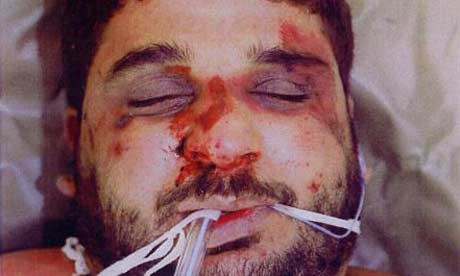
However, when some of those charged in connection with his death were found not guilty, the Sun said that "common sense had prevailed," and also that the "every aspect of investigating so-called crimes had to be re-examined." Baha Mousa wasn't beaten to death by yobs but by British soldiers who had been torturing him, the same heroes that the Sun never has a bad word to say against. How hollow the last two sentences of the Sun's leader are once you're aware of such callousness:

It is important, though, that Britain does not become blasé about the inhuman violence meted out to Susan or Garry.

A society immune to such savagery will not be worth living in.


The Sun is though at the forefront of making sure that savagery and inhuman violence committed by British forces overseas
is treated in such a blasé manner.

Labels: , , , , , ,

Share |

Monday, September 03, 2007 

Imperial bodybags.

The contrast, to repeat a cliche, could not really be more stark. Just as the commander in chief himself flies into Iraq, giving every jihadi and insurgent a day of priapism, prompting them to spend the rest of the day watching the sky, just in case the plane with him on board comes into view, "Our Boys" finally come to the end of their own long potential suicide mission, leaving behind a population which had long abandoned its grudging admiration for their role in removing Saddam, instead replaced by a distaste which threatened to descend into a visceral loathing.

If you want to go into "victory or defeat" territory, it may come down to which newspaper you read. The Scum's account of the handing over of Basra palace to the Iraqis could have been written by a faceless MoD spin doctor, a report so at odds with reality that Mike Power rightly suggests it could have come from a parallel universe. In this bizarro world Basra, select soldiers are quoted as having achieved so much, and the Mahdi army halted their attacks because:

It is thought months of fighting tenacious British troops showed the rebels they would never win military victory.

Nothing to do then with the release of around 30 Iraqi prisoners, or indeed al-Sadr's call to his supporters/fighters for a six-month ceasefire.

Then again, if you read the Daily Mail, it seems this was a humiliating disaster, with the Iraqis overjoyed at the departure of the hated occupier. The Mail's stance on the Iraq war has always been confusing: supporting it only to quickly change tact once it became something to beat Blair with, in the best traditions of the newspaper's opportunistic and sniping nature.

Back here in the real world, the retreat, for it almost certainly is one, is not just militarily and politically logical, but also the only realistic option. The soldiers on the ground not given a sheen of Sun gloss have long known that Basra was a lost cause, where they were in fact only making the security situation worse, putting the population of the city under threat for no good reason, which was more than half the reason why the initial relaxed attitude towards the British forces quickly dissipated. Regardless of what some of us think about the continuing war in Afghanistan, the army itself still believes that is achieving something there, rather than just hanging around for the purpose of giving support to a failed American foreign policy.

It would be wrong to pretend though that our motives or our actions in Basra have been always been either altruistic or above reproach. It's easy to forget that we should have never been there in the first place, and while we have a number for the amount of servicemen who have died, we have no way of knowing how many Iraqis have died as a direct result of British army action. Abu Ghraib may not have happened in the south, but the death of Baha Mousa, which has never been acceptably resolved, along with the abuse of other prisoners were a serious of shaming incidents brushed as much under the carpet as possible.

Much of the debate will be based around whether this could have occurred under Blair, and whether this is the start to a quicker, faster than expected withdrawal, and the answers to that appear to be no and yes, or at least with the latter you would hope so. While you sympathise with the idea that the training of the Iraqi forces should continue, the remaining reasons for staying more than another day are less than convincing. We'll never know how many lives on both sides have been lost for little to no fathomable reason, but the one thing we should all agree on now is that not a single drop more should be spilled, and that means taking those Iraqis employed by the army in any capacity, potentially the target of insurgents, back with us.

Labels: , , , , , ,

Share |

Thursday, June 14, 2007 

One step closer to the truth.

Yesterday's landmark ruling by the House of Lords that the Human Rights Act does apply in detention centres abroad over which British soldiers have effective control brings a full public inquiry into how Baha Mousa came to die while in UK captivity in Iraq one step closer.

This is a grim prospect indeed for the government. Lord Goldsmith, the supposedly independent attorney general, is once again caught up in the mire. He advised that British troops were not bound by the Human Rights Act, which explicitly bans inhuman or degrading treatment or punishment. The question is whether he knew at the time that the army had apparently decided to completely disregard the 1972 commitment by Ted Heath to prohibit the use of the "five techniques", and if he did, how the man could possibly believe that something that was considered illegal in 1971 could suddenly be acceptable again in 2003 in Iraq?

The treatment meted out to Mousa and the men detained with him went far further than the "five techniques". Mousa suffered 93 separate injuries; another of the men nearly died from renal failure after being beaten so badly. Both the military, as well as the soldiers present that day except for Donald Payne, who had the decency to admit to being involved in the mistreatment, conspired in a cover-up, with the judge at the court martial making clear that he had been unable to get to the truth because of a "closing of ranks". The questions that need answering are obvious: who in the army/MoD authorised such brutal tactics in obvious breach of the Geneva conventions, let alone the Human Rights Act, and why? Were government ministers involved in the decision? If not, did they know what was going on at the time? If they didn't, when did they find out?

Rather than forcing those representing Mr Mousa's family to go back to the high court to argue that the current investigations into what happened were inadequate, which they clearly were, the government ought to have the decency to order an immediate independent inquiry, with those summoned to give evidence having to do so under oath, so that anyone who tries pulling the same "I can't remember" trick can be prosecuted for trying to pervert the course of justice. As it seems increasingly likely that the government itself will be found complicit in either ignoring or actively being involved in authorising ill-treatment tantamount to torture, that's about as realistic as this generation of politicians ever admitting they lied about weapons of mass destruction.

Labels: , , , ,

Share |

Tuesday, May 01, 2007 

War crime? Smore crime!

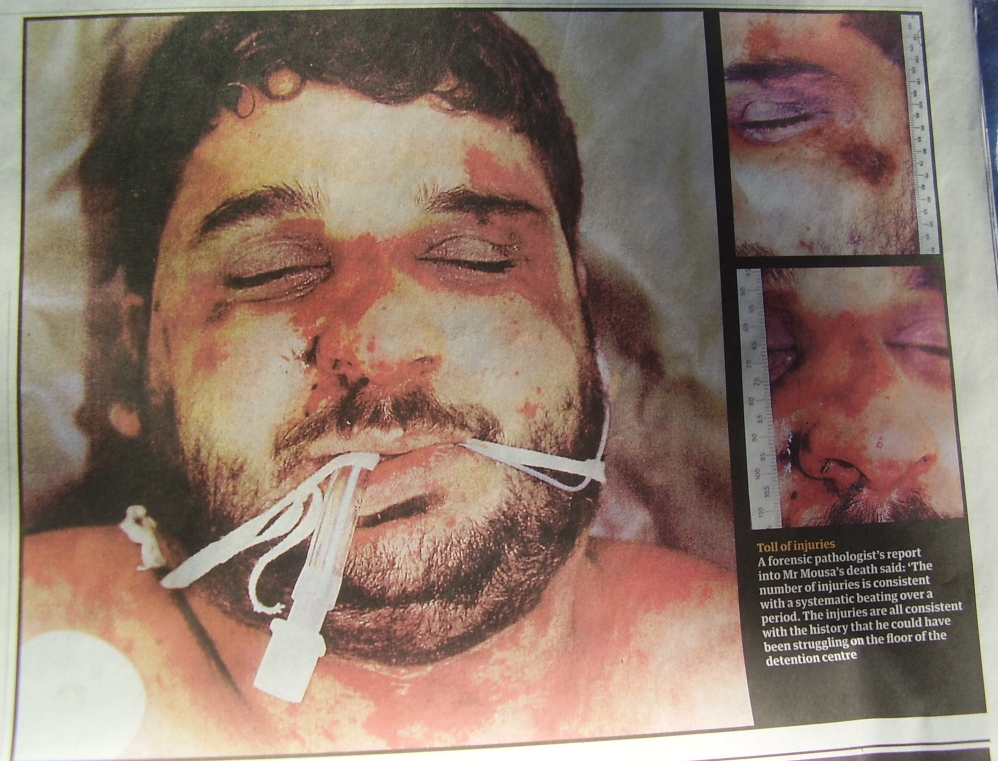
Images of the injuries sustained by Baha Mousa, lying dead after being beaten to death by British soldiers. Photographs taken from the Guardian.

Buried by the reporting on the fertiliser plot, the only soldier with the dignity to admit to taking part in the beatings which led to the death of the Iraqi hotel receptionist Baha Mousa, was yesterday sentenced to a year in prison and dismissed from the army.

Yep, you read that right. Even though Corporal Donald Payne was convicted of a war crime, as defined by the International Criminal Court Act of 2001, his punishment, apart from losing his pension, is a whole year of imprisonment for taking part in the abuse. He was cleared of manslaughter, as it was not proved that his blows had personally lead to Mousa dying. Payne was identified as one of the soldiers' who took it upon himself to conduct the Iraqi detainees like a choir, who had been mistakenly identified as potential insurgents and possibly the men that had killed a popular young captain, Di Jones, battering them one at a time, relishing the groans and pleas coming from the prisoners, while entertaining his fellow comrades who at no time did anything to stop the blatant breaking of rules on treatment of detainees that had been introduced over three decades previously.

In a way, it's hard not to feel sorry for Payne. He was honest enough to come forward and admit that he was in the vanguard of attacking the prisoners, even though by all accounts the evidence against him, unlike that against the others tried during the court martial, was damning. Rather than being protected by the other soldiers involved and by the higher-ups who authorised the re-introduction of conditioning in the first place, he's been left to hang out to dry, a sacrificial lamb designed to appease those who demanded justice for Baha Mousa and those who suffered with him. Instead, Payne's treatment is more than representative of the way both the government and the army have dealt with allegations of abuse by British soldiers: cover it up, deny anything really shameful happened, and move on.

If Payne hadn't admitted his guilt, then the army might have entirely got away with it. The closing of ranks which took place during the trial, the endless repetitions uttered by witnesses of "I don't remember" and the lack of interest in much of the media other than to damn the government for daring to bring the court martial in the first place has meant that much of the British public probably think that the only real abuses by British troops in Iraq were those photographs of Iraqis being forced to simulate sex for the cameras. The photographs above, and the diary of a soldier reproduced in the Grauniad at the weekend tell a far different story.

Payne is now considering whether to sing like a canary about what he knows. One can only hope that he does: the authorities who OK-ed the use of conditioning need to be exposed and brought to account, as do those soldiers that took part in the beating of four ordinary Iraqis who were in the wrong place at the wrong time. It all seems very different from the speech that Colonel Tim Collins gave on the eve of war:

It is a big step to take another human life. It is not to be done lightly. I know of men who have taken life needlessly in other conflicts, I can assure you they live with the Mark of Cain upon them. If someone surrenders to you then remember they have that right in international law and ensure that one day they go home to their family.

From there we go to "the fat bastard" who couldn't be revived, which was "what a shame".

It's therefore difficult to take seriously Sir Richard Dannatt's claim that they don't know who was responsible for the death of Baha Mousa. As Panorama pointed out, they know the regiments that were there, the know the soldiers who were in the base where they taken, and they know who took part in the conditioning. It's just that they haven't been brought to justice.

Finally, as you might expect, today's Sun has absolutely no mention of the sentencing of Payne. Then again, we shouldn't have expected one, for Payne's imprisonment is only for a so-called crime. For Mousa's family, the Sun is only a so-called newspaper.

Labels: , , , , ,

Share |

Saturday, April 28, 2007 

All our heroes are dead or corrupt.

If we're to go by the diary of a soldier from the months after the beginning of the occupation of Iraq, Harry doesn't so much have the insurgents chopping his ears off to look forward to, but rather the intense pleasure of throwing "Ali Babas" into the Shat al Arab, killing two others and getting a beer as a reward, battering an Iraqi who threw a punch from head to toe, beating up more "Ali Babas" with sticks while filming it and finally referring to the death of a man who they tortured as "what a shame".

This was of course what the Sun referred to as a "so-called crime". Truly, these men are heroes.

Labels: ,

Share |

Monday, April 16, 2007 

Baha Mousa: the injustice continues.

For the family of Baha Mousa, the man beaten to death by British troops in Iraq, the injustice continues unabated. His father was today meant to attend a press conference at the House of Commons, to present 46 previously unseen photographs further detailing the 93 separate injuries that were inflicted on him.

Instead, he was absent. According to Mousa's lawyer, Phil Shiner, he had suffered "visa issues", having been unable to obtain one from the British embassy in Damascus.

One can only speculate as to why.

Labels: , ,

Share |

Saturday, April 07, 2007 

Losing the moral high ground.

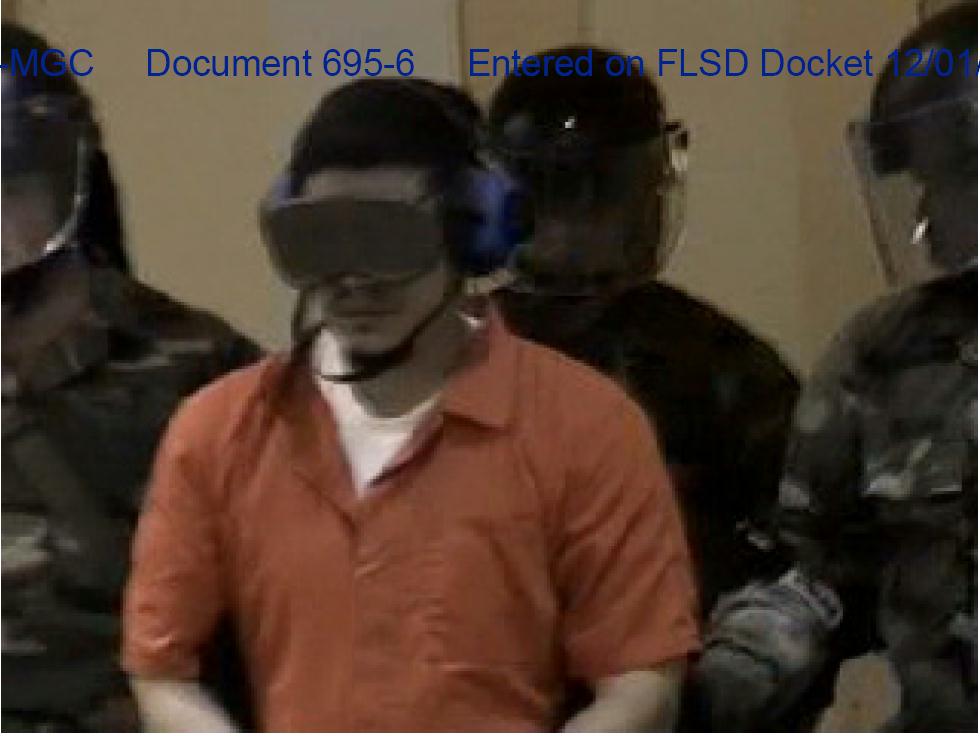
Sensory deprivation, as practiced on US terrorism suspect Jose Padilla.

We shouldn't play down the apparent ill-treatment suffered by the 15 captured British sailors while in Iranian custody. By any measure, a mock execution, whether authorised by those in charge of "looking after" those arrested or simply the guards themselves messing around, is a traumatic and unpleasant experience. Being blindfolded, especially for a long period of time, leaves the mind to fill the visual gap, replaying images which the brain would normally suppress. Separating Faye Turney from her comrades and telling her they had been sent home was an odious psychological trick, whether she believed it or not. Sleep deprivation quickly leads to hallucinations, lethargy and compliance.

And yet, it's difficult or even impossible to fully denounce such treatment as inhumane, degrading and illegal purely as a result of this government's very own record and our general complicity in far worse acts of torture and ill-treatment. We learned
earlier in the week of how MI5, having been rebuffed by Jamil el-Banna after attempting to recruit him to spy on Abu Qutada, then told the CIA that he and his business partner Bisher al-Rawi were carrying bomb parts. This resulted in them being swooped on in Gambia and then being rendered, first to Bagram airbase in Afghanistan and then on to Guantanamo Bay. While al-Rawi has finally been freed after his help in keeping tabs on Abu Qutada for MI5 had come to light, el-Banna, despite being a British resident, is still being denied any help by the authorities here. Amnesty International additionally reported this week that if anything, conditions in Guantanamo are getting even worse. The sensory deprivation that is enforced both at Guantanamo Bay and other CIA-run black sites is designed to send the detainees mad, and in many cases it seems to have succeeded.

We have to remember that our own treatment of those arrested in Iraq has been at times less than exemplary, without even mentioning what our coalition partners get up to. For a time in the aftermath of the invasion, "conditioning", a practice banned by the army since the early 70s, was authorised as being acceptable. This involves the use of stress positions, forcing prisoners to stand with their arms outstretched and hands cuffed, as well as hooding and sleep deprivation. The most notable victim of this decision by the military hierarchy was Baha Mousa, who died after 36 hours in British custody in Basra. A post-mortem found that he had 93 separate injuries. The one person to admit to being involved in the abuse meted out to Mousa and those arrested at the same time, Corporal Payne, was accused of playing the detainees like a choir, kicking and punching them one after another, relishing their cries. Others were involved in the ill-treatment which led to his death, but a closing of ranks and an outbreak of amnesia has meant that everyone else has for now escaped justice.

The other open sore is our role in extraordinary rendition. Our elected representatives continue to either deny all knowledge or play down the fact that over 100 CIA flights landed at airports in the UK, whether to refuel or otherwise. Those unlucky enough to be on those planes, under the same sensory deprivation techniques used at Guantanamo so that they have no idea where they are or where they're being taken, would soon be welcomed either at CIA-run black site prison or by the security services in friendly (and sometimes unfriendly, as some have been rendered to Syria) countries who would then carry out torture, such as that performed on Benyam Mohammed, who had his penis slashed multiple times. He may well have been one of the lucky ones, as he doesn't seem to have undergone such other notorious methods as waterboarding.

This is why such predictably angry responses to yesterday's press conference, exemplified by Iain Dale, seem out of place. Our servicemen did indeed suffer, and they are now likely to be reimbursed for it as the MoD has lifted the ban on the selling of their stories. For those with British residence/leave to remain still languishing in Guantanamo Bay, there will be no such compensation.

Labels: , , , ,

Share |

Wednesday, March 14, 2007 

Britain's Abu Ghraib.

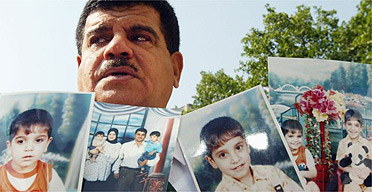
Daoud Mousa with photographs of his son and grandchildren.

Last night's Panorama, which was moved forward as a result of the last two soldiers on trial over the abuse of Iraqi prisoners being cleared, was as depressing as it was damning. It made clear that there had been an obvious closing of ranks amounting to a cover-up over the death of Baha Mousa while he was in British custody in Basra, having suffered 93 separate injuries within 36 hours of being arrested.

As Not Saussure notes, the reason for Colonel Jorge Mendonca's acquittal has now been made public. It seems the evidence of Major Antony Royce was crucial: he contradicted the prosecution's claim that "conditioning" - the use of stress positions, forcing prisoners to stand for long periods with their arms outstretched and hands cuffed, hooding and sleep deprivation, had not been cleared by the "chain of command". Royce told Mendonca that it had been, and it seems he was very much relieved. The judge notes that Mendonca seems to have been a fall guy: he did not do anything that he should have done, and he did not do anything which he shouldn't have done.

Panorama alleged that those other than Corporal Payne, who was forced to admit to being involved in the beatings and other mistreatment which lead to Mousa dying, had not been brought to justice due to both failings in the investigation by the SIB, and through a systematic failure of memory suffered by other soldiers called as witnesses. Payne's lawyer, who sat through this joke of a court martial, confirmed that the words "I don't remember" were used over 600 times during the trial, and commented that he had never seen anything on that scale in a court room.

Mousa and 6 other men were arrested at a Basra hotel in September 2003, a number of weeks after Captain Di Jones, a popular young soldier from the Queen's Lancashire regiment had been killed by an IED. Following a tip-off that weapons were being stored in the hotel, British troops stormed in at 6am, only to find the man who they were really looking for, the hotel's owner, had already fled. Having apparently being informed that those arrested were involved in the death of their comrade, and finding weapons stored (All of the men arrested were later cleared of any involvement in the insurgency, simply being hotel workers. Mousa was the receptionist.), their treatment was from the beginning little short of brutal. This continued throughout their detention: evidence was given that Corporal Payne had "played" the detainees like a choir, kicking and punching them one at a time, relishing the cries and groans his blows brought from the captives. Video footage of Payne shouting and forcing detainees into stress positions was shown to the court. What is not in dispute is that Payne was not the only soldier who took part in the abuse; we know the regiments that were in Iraq at the time, and even some of the soldiers who were involved. That they have not been brought to trial, and now seem unlikely to be is just one of the major injustices of this case.

The other main question is just who did authorise the "conditioning" of detainees. With Abu Ghraib, it went all the way to the top, to Rumsfeld, although his signing off of certain techniques didn't involve the sexual humiliation which was routinely inflicted on those who passed through the American-run jail; that was likely implemented by the CIA officers who were also involved. Brigadier Euan Duncan gave evidence that US commanders had criticised British forces for failing to "extract sufficient intelligence" from those arrested, which presumably led to someone up the chain of command authorising the conditioning practices which had been banned since 1972. Whether this was at the army level or the political level we simply don't know. In relation to the death of Baha Mousa, Antony Royce was told by Major Mark Robinson, a brigade "intelligence adviser" to condition prisoners. Royce, worried this contradicted the firm and clear prisoner-handling training given back in Britain, consulted the brigade's legal adviser, Major Russel Clifton, who assured him that conditioning was permitted.


As Jeremy Vine states at the opening of the programme, from some of the reporting you'd think that no one had died, that beatings had not taken place and that the soldiers involved, whether they were those who were tried or not, had been wrongly maligned. The arrogance and refusal to admit that crimes had been committed was exemplified by the behaviour of Colonel David Black, who emerged from the court to deliver a statement which was brimming with pompous unrighteous anger, eyes flashing beneath spectacles, his every word underlined by a sharp flick of his head. He was in effect suggesting that soldiers shouldn't be held to account, even when the evidence of abuse is as strong as it was in this case. The Scum quotes him as saying:
[Our Boys needed to be able to work] “without looking over their shoulders inhibited by the fear of such actions by over-zealous and remote officialdom”.

The Sun's leader is even worse:

COMMON sense prevailed when two British soldiers were cleared of abusing Iraqi prisoners.

Major Michael Peebles and Warrant Officer Mark Davies served with courage and bravery in the most difficult conditions.

This ludicrous show trial — which has already seen four other soldiers cleared on the judge’s orders — has been a waste of time and money.

These men risked their lives in Iraq but were repaid by being hung out to dry.

Every aspect of investigating so-called crimes within the military needs to be re-examined.

Our servicemen and women deserve nothing less.


No mention that the Iraqis who were the victims of these "so-called crimes" too deserve nothing less than those responsible being brought to justice.

If anything, this farce is worse than the treatment meted out to those responsible for the abuses at Abu Ghraib. While they were the scapegoats for the decisions made higher up the command chain, in this case it appears that the army itself has gone completely into denial. No one apparently saw anything, or it's strangely slipped their mind. No one knows who authorised the outlawed techniques in the first place. Only Payne, who was unfortunate enough to be the only one who could not escape from justice due to the evidence presented, has so much as admitted that abuses even took place. Hopefully this will be taken into account when he is eventually sentenced. As for the rest of those involved, they can take pride in the way their actions have brought the British army down to the same level as their coalition partner.

Labels: , ,

Share |

About

  • This is septicisle
profile

Archives

Powered by Blogger
and Blogger Templates