Thursday, June 26, 2014 

Crucifixion is an easy life.

Knuckle deep within the borderline.  This may hurt a little but it's something you'll get used to.

Just this once, can we hear it for the Jordanian justice system?  Theirs is a country where freedom of speech is heavily restricted and torturers are able to operate with impunity, and yet even with such things in their favour they still couldn't manage to convict Abu Qatada on terrorism charges.

For those who've (sadly) followed the entire sorry process, this doesn't exactly come as a surprise.  With the tainted testimony from those tortured expunged, the evidence for everyone's favourite Uncle Albert lookalike (stretching it a bit here) being involved in the 1998 bombings in the country was wafer thin.  In fact, there was such a lack of almost anything incriminating against Qatada it could be said to mirror the trial of the al-Jazeera journalists in Egypt.  Jihadica (not exactly the most neutral source) reports that few if any of the witnesses called knew Qatada personally, and rarely even touched on the charges he was facing.  Going by this it seems equally unlikely he will be found guilty of involvement in the "Millennium plot", despite there being a smidgen more circumstantial evidence linking him to it, at least according to SIAC.

It bears repeating then that if it hadn't been for the courts, both here and in Strasbourg repeatedly blocking the attempts by successive governments to deport Qatada back to Jordan without receiving adequate assurances he wouldn't face "evidence" acquired as a result of mistreatment, an innocent man would now most likely be enjoying the hospitality provided at the Jordanian king's finest prison establishments.  Qatada is without doubt an utterly repellent individual, a supporter and apologist for terrorist groups, as proved by his defence of the al-Nusra Front in Syria, but just as he never faced any charges in this country, managing to stay on the right side of the law, he is not a terrorist himself.

Our determination to get rid of Qatada also leaves Jordan with the problem of what to do with him if he is indeed also found innocent of the remaining charges.  While here he was relatively limited in his ability to propagandise, with leaked interviews from prison about the only way he had of communicating with supporters.  In Jordan journalists have spoken to him at the end of court sessions, while simply being in the dock has given him the opportunity to speak out.  Not that this bothers our politicians, far more concerned with making clear there is no possibility he could return if found innocent.  Might it have been an idea to try and build a case against him back here, rather than just wash our hands of the man we gave asylum in the first place?

Don't be silly.

Labels: , , , , , , , , , ,

Share |

Tuesday, February 18, 2014 

The hope or possibility of release returns.

Say what you like about judges, and many, especially the tabloid press often do (as an aside, it's worth noting a certain Brian Leveson, in his role as President of the Queen's Bench division, was one of the presiding judges in this case), there are times when they are remarkably ingenious. Almost everyone thought the appeal court would accept the reasoning of the European Court of Human Rights' Grand Chamber, and duly find that those given whole life sentences must have some sort of body to which they could apply to have their sentence reviewed after a defined period of time. The Conservatives certainly did, floating the option of allowing judges to impose American style hundreds of years sentences, which could then be reviewed without release being any real possibility.  It seemed a great, typically Tory ploy: adhering to the ruling, if not the spirit of it, in much the same way as parliament has attempted to defy the court over giving the vote to some prisoners.

One indication that perhaps the government knew some sort of compromise was forthcoming, or had some faith in the case it was due to make to the appeal court, was that it suddenly seem to drop the above proposal, almost as quickly as it had raised it. The appeal court's rejection of the ECHR's ruling is based on what it says is a misinterpretation of the current laws: the grand chamber failed to take properly into account what section 30 of the 1997 Crime (Sentences) Act allows. Although previously it has only been used to release prisoners who are terminally ill, it can allow release in other circumstances on compassionate grounds also. The judges can't say what these circumstances might be, except that they will have to be exceptional given the fact a whole life term was considered necessary in the first place, but it still amounts to the "hope or the possibility of release" required, and to compatibility with Article 3.

Whether this is evidence of the perceived new attitude among some judges to the ECHR, no longer taking direction from Strasbourg as unquestionable, is more difficult to tell.  What it has done is both gotten ministers out of a problem, and given them a new one.  Had the appeal court agreed with the ECHR the easiest and best solution would have been to reintroduce the old system where whole life terms were reviewed after 25 years, only giving the power to the parole board or a judge rather than to a politician as was previously the case.  Instead the onus has been put back on the justice secretary, who now faces not just the likes of Ronnie Biggs applying for compassionate release on the grounds of ill-health, but the most notorious murderers and serial killers asking for the same, if that is they can point towards exceptional circumstances that have arisen since they were sentenced.  Nor will it be possible to simply dismiss such requests out of hand when the ECHR will be watching, even if it might well be a while before any such attempts to test out section 30 are made.

This itself depends on whether or not the ECHR accepts the appeal court's reasoning, should another appeal to Strasbourg be made.  It could for instance suggest that still more clarity is needed around section 30, precisely why it reached its decision in the first place, saying the appeal court hasn't in its view disproved its own analysis.  The other thing the ruling has done though, as Joshua Rozenberg notes, is to somewhat take the wind out of Chris Grayling's sails over the upcoming Tory manifesto plan for the reforming/dumping the convention.  No longer able to point to the court saying we can't lock up the worst of the worst for life, although it never said anything of the sort in the first place as both the appeal court and the QC for the government accepted, it leaves just the Abu Qatada palaver and votes for prisoners as the main grievances. A strong enough case for the Pavlovian anti-Europe Tories and tabloids certainly, but not for anyone who bothers to take an interest.  Judicial lawmaking or not, the appeal court's ruling could yet have far wider political consequences.

Labels: , , , , , , ,

Share |

Wednesday, July 10, 2013 

The usual posturing on the ECHR.

If nothing else, the ruling by the European Court of Human Rights' grand chamber that those sentenced to whole life terms must have at the least a slight hope of one day being freed, has thrown up an somewhat heartening statistical comparison.  We might lock up far more people than most of the rest of Europe, with 83,902 in prison or immigration centres last week (a figure that doesn't include those in either maximum, medium, or low secure mental health wards) but only 49 of those will definitively never be released.  Obviously, some of those given life terms with a minimum period they must serve before being able to apply for parole will also never be released, while others will die in prison, but it can't be said that judges lightly pass sentences that deny the convicted any chance of reform and rehabilitation.

It's understandable then that some have been angered by the ECHR ruling, unusual in that the grand chamber disagreed with the judgement handed down by the court itself, which found against Douglas Vinter, Jeremy Bamber and Peter Moore.  Politicians and commentators alike have made the point that in abolishing capital punishment, the compromise was that life sentences that meant life for the most serious offences would be the replacement.  In actuality though, it was only back in 2003 that all discretion was removed with the passing of that year's Criminal Justice Act, when the power to increase the minimum term of life sentences was rightly taken out of the hands of politicians.  With it also went the appeal after 25 years that those sentenced to whole life terms could make.  Oddly however, those who are considered terminally ill or incapacitated still make their appeal for release on compassionate grounds to the justice secretary, hence the controversy over the release of both Ronnie Biggs (still alive, although definitely incapacitated) and al-Megrahi (dead).  The system is also different across the UK: Scotland doesn't have whole life tariffs, while Northern Ireland still has the 25-year system.

The very existence of the whole life sentence poses problems which have never been fundamentally answered.  When there is no hope of release, there is little reason for the prisoner to cooperate with the system except to make what life they have slightly easier for themselves, and in turn, the prison officers.  We saw this just last month with Ian Brady's appeal to the mental health tribunal: whether he genuinely wants to return to prison in order to starve himself to death only he really knows.  What he definitely likes doing is challenging the system, which is what his "hunger strike" protest has long been about.  It's also possible it can have even grimmer side-effects: we can't know whether Dale Cregan's motivation for killing two police officers having already murdered two members of a local crime family was, as he said when he gave himself up, for the hassle the police had caused his family, or that he knew full well the net was closing in and he was likely to spend the rest of his life in prison anyway.

As Joshua Rozenberg points out, it wouldn't take much for the government to meet the court's ruling, whether it amended the 1997 act that provides for compassionate release, or established a system through which whole life terms could be reviewed either by the parole board or a judge after 25 years. It seems extremely unlikely that any of those currently on a whole life tariff would be deemed suitable for release, precisely because they have been used so sparingly. The real issues are two-fold: that a whole life term doesn't seem like one if there is the possibility of release, however remote, the same problem there is with the life sentence which really means life on licence rather than actual life in prison; and that this is in the view of some, another example of the ECHR interfering in laws that should be left to the discretion of member states.

However much it does go against decent liberal sensibilities, that there is always the possibility of redemption and reform, there are some cases where life has to mean life.  That doesn't mean there shouldn't be a system where even the hardest cases should be reviewed, but getting the message across that this won't mean the most depraved criminals could still walk free after 25 years is going to be incredibly difficult if not impossible.  This said, the idea this is going to be legislated on swiftly is laughable: it's now 8 years since the ECHR first ruled that some prisoners should get the vote, and as yet there still hasn't been an act facilitating it.

Instead we will get plenty of posturing.  Chris Grayling we're told wants further reform of the ECHR rather than the exit, while Theresa May apparently wants us out.  It doesn't matter that however often scrapping the human rights act is discussed or leaving the ECHR is proposed, we never hear specifically what it is about the convention that makes it beyond the pale.  We hear complaints about the right to a family life preventing the deportation of criminals as well as the whole Abu Qatada fandango, when the reality is that the objection is to the way judges, both British and at the ECHR interpret the law.  Getting rid of the HRA and replacing it with a "British" bill of rights which will almost certainly contain the exact same protections is not going to change things without the legislation being so specific as to be discriminatory itself.  Unless the Tories win a majority in 2015, and they're certainly not on course for one at the moment, we might eventually get round to putting back in place a system that until very recently wasn't regarded as beyond the pale.

Labels: , , , , ,

Share |

Monday, July 08, 2013 

So. Ta ta then.

Abu Qatada is gone.  Not, despite the attempts at further myth making and spin from the Home Office, because he had finally ran out of legal options, but almost certainly down to him realising that even if he had appealed again and delayed his deportation for another couple of years, he was never going to be able to live free (and die hard? Ed.) in this country.  It's worth remembering that with the exception of a short period when he went "missing" after 9/11, Qatada spent the vast majority of the past decade either in Belmarsh or Long Lartin, or during the periods he was released on bail/control order, under the kind of curfew and restrictions that would rid life of pretty much all enjoyment.

Moreover, Qatada never faced a single charge in this country.  If he had appealed, it's possible he could have been charged with some sort of offence over the material allegedly found in his home when he was last arrested which breached his bail conditions, but that's now rather moot.  It might have taken 8 years for Qatada to be deported, longer if you include the time he spent detained without charge between 2002 and 2004, yet it's surely just as unacceptable that someone should spend that period of time under effective detention with charge.  Babar Ahmad suffered a similar fate, despite it being unclear at best whether he had committed any offence whatsoever under UK law.

Qatada then went of his own accord, giving at least as his public justification that he now felt assured he wouldn't face a trial in his home country where the evidence against him would be tainted by torture.  This in itself is an indictment of successive governments, rather than it is of Qatada, or an outrage that human rights laws prevented us getting rid of him at the first opportunity.  For most of that time period ministers were perfectly happy for someone, however unpleasant, dangerous or even murderous, to be deported back to an authoritarian state where torture has long been endemic and trials by the same token are unfair.  We would protest bitterly were a UK citizen subject to such abuses, or we would if it happened in a nation state we aren't friendly with, considering the prevarication over those accused of bombings in Saudia Arabia.  Just look at the campaigns, both successful and unsuccessful, to stop the deportation of the Natwest Three and Gary McKinnion, and that was to the US.

Grudgingly, successive home secretaries were forced to take the legal route.  However it came about, the end result has been for the judicial system in Jordan to be made at the very least fairer, benefiting the population there greatly as a by-product.  Rather than celebrate this as an example of soft power, of the way that diplomacy can result in reform, the government naturally has presented this triumph as exactly why we should consider scrapping the Human Rights Act and even possibly withdrawing from the European Convention on Human Rights altogether.  They can't explain why this needs to happen now, as there isn't a similar case waiting in the wings, and even if there was, it clearly wouldn't take as many years now that it's apparent that people can't be deported back to countries where the evidence against them was the product of torture.  If you want to get rid of someone in such circumstances, either the evidence has to be dropped, or they can't be sent back.  It isn't difficult.

Indeed, considering some of the wilder estimates and that it took 8 years, the reported bill to the taxpayer of £1.7m seems relatively slight.  Quite why it was deemed necessary that a private jet had to be charted for his journey back to Jordan is unclear, especially when security was so lax that Qatada was not handcuffed at any point.  Considering the way in which asylum seekers who have had their request rejected are dealt with, often travelling on commercial flights, his departure could surely have been arranged in a similar way had it been desired.  That wouldn't however have provided the pictures that politicians clearly wanted, of Qatada not quite being carted off but certainly being sent on his merry way.  Regardless of their supposed anger, it summed up what the Qatada case became: not about the rights and wrongs, but about being "tough". 

Labels: , , , , , , , , , ,

Share |

Wednesday, April 24, 2013 

Abu who? Never heard of him.

At times, it's an utter joy (read: torment) to see how politics works. Normally the idea behind briefing the media that you're thinking of doing something popular with your backbenchers and the right-wing press, regardless of how reprehensible it is, is that when you don't you've left it long enough that they're let down gently. When instead you dash their hopes within a matter of hours, it tends to ever so slightly agitate them.

You also might have thought that someone unlucky enough to be bestowed with the name Reckless might be used to unfunny gags being made about it. Not our Mark though, who reacted to Theresa May suggesting that to break the law as he suggested would be, err, reckless, by raising a point of order and then going on TV to continue to complain.

Plenty of politicians you see have a blind spot when it comes to everyone's favourite heavily bearded fanatical cleric, the mysterious Mr Abu Qatada. Not for these heirs of Thatcher such piffling things as the rule of law, which she and her cabinet often invoked when it came to the miners, although they rather overlooked it when the police took to kicking the shit out of them. No, we should put Mr Qatada straight on a plane, or failing that temporarily withdraw from the European Convention on Human Rights so we won't face any repercussions should we do so.

There isn't of course even the slightest possibility of the Tories doing so, not least because the Liberal Democrats would never go along with it.  It's also completely and utterly ridiculous: the only way to temporarily withdraw from the ECHR is by arguing that there is a severe and direct threat to the very life of the nation, which is exactly what the law lords decided there wasn't when they ruled that Labour's detention without charge of foreign terror suspects was unlawful. Can you imagine the government seriously arguing before even the lowest court in the land that one man is that dangerous?

Quite why the Tories swung so far from one point to the other in such a short space of time is unclear, unless there were still negotiations going on with Jordan right up until May's statement after PMQ's. It doesn't help that as much as you'd like to welcome the continuing attempts to ensure Qatada doesn't face a trial where the main evidence against him was almost certainly obtained through torture, the new treaty still doesn't look as though it's water tight. As Labour have pointed out, it doesn't seem on the surface as though it requires Jordan to actually change the code of criminal procedure SIAC ruled had to be altered for them to be satisfied torture evidence wouldn't be used. After all, the previous changes to the laws in the kingdom were meant to have solved the problem originally. They didn't.

To be fair to May, and as pointed out umpteen times previously, the real damage was done when ministers under Labour decided that Qatada was better off out of sight and out of mind than prosecuted and imprisoned for his preaching here.  The evidence against him in Jordan, including that apparently obtained through torture, is flimsy at best.  This doesn't however excuse either May or her department for crowing last year that Qatada was as good as gone, especially when even the slightest glance at their claims suggested they were being extremely optimistic if not outright disingenuous.  It seems a pretty safe bet that Qatada will still be here come the next election, and that augurs well for what's likely to become a fight between the parties over whether we should repeal the Human Rights Act, a debate simply guaranteed to be conducted in a fact-based and civil manner.  Can't wait, can you?

Labels: , , , , , , , , , ,

Share |

Tuesday, November 13, 2012 

Yet another post on Abu Qatada.

Well, who could have predicted that?  Abu Qatada winning his latest appeal against deportation to Jordan?  This has never happened before!  Oh, except it has.  Twice, in fact.  And when even a keyboard monkey like me with no real legal knowledge whatsoever could pick holes in Theresa May's trumping of how this time Qatada really was as good as on a plane, it suggests both she and her predecessors have been receiving incredibly bad advice for quite some time.

The judgment by the Special Immigration Appeals Commission (PDF) is essentially a rehash of the ECHR's decision earlier in the year, that Qatada doesn't personally face the prospect of mistreatment or torture, but he does face the prospect of a trial where the main evidence against him is confessions from men who almost certainly were tortured.  Regardless of the change to the Jordanian constitution to explicitly prohibit the use of evidence obtained via torture, Mr Justice Mitting and his team reached the conclusion that, based on expert evidence from Jordanians who gave written and in person testimony, the statements that incriminate Qatada may well be used against him, and that the burden of proof is likely to fall on the witnesses to prove they were tortured, rather than for the prosecution to prove that they weren't.  As the torture happened over a decade ago and the Jordanian courts previously rejected the notion that torture took place, the likelihood of them being able to do so, even in front of three civilian court judges, is dubious in the extreme.  Barring a further change to the Jordanian code of criminal procedure or a definitive ruling from one of two courts on the ambiguities in the code, Qatada is staying here.

Unless that is May manages to convince the Court of Appeal that SIAC is being unreasonable in its demands of the Jordanians, something that seems highly unlikely considering SIAC has come to effectively the same conclusion as the ECHR did.  In the meantime, ol' bird nest face is free for 8 hours a day, if your definition of free is being tagged, followed by security officers the moment you step out of your front door and being denied access to pretty much everything that makes life pleasurable.

If all this seems a bit much for someone whose motivations have often seemed opaque, then SIAC also obtained new information on the nature of the evidence against Qatada.  To say some of it is thin is an understatement: all that links Qatada to the "Reform and Challenge" case is that one of the defendants says he suggested the targets and then congratulated him afterwards; in addition, three of the defendants had copies of a book by Qatada.

The evidence against him for the Millennium plot isn't much thicker: Qatada gave one of the defendants money, although not ostensibly towards the plot, gifting him 800 Jordanian dinars with which he bought a computer, while the defendant admitted discussing the "issue of jihad" with Qatada, although not specifically about any plot.  Another defendant claimed Qatada had given a further $5,000 to the same man, while the money he had been promised to marry the first defendant's sister never arrived.  Otherwise, the evidence again amounts to possession of books by Qatada, and the discovery of messages between the two men.  SIAC additionally comments on this that "[T]he record of the evidence produced at the trial does not clearly support the prosecutor’s case", although it's presumed that in the case file there will be statements from investigators that will.

All is likely to depend on whether the Jordanians are prepared to move further, or whether a case comes before either court that irons out the disagreement between the experts consulted by the commission.  SIAC accepted that the Jordanians had moved significantly from their initial position, and also noted their awareness of how this was a potential opportunity for them to show they were capable of trying a man notorious internationally with scrupulous fairness.  If SIAC was making its decision on that basis alone, as indeed had the ECHR, Qatada would be long gone.

In a different world, this entire case might be seen as showing the best of the British state.  Despite the contempt often shown towards the Human Rights Act and the ECHR by politicians from both main parties, successive governments have abided by the decisions made in line with it, refusing to countenance ignoring the rule of law in this specific case, and have gone so far as to push Jordan towards making genuine judicial reforms.  Pushing any authoritarian state in the direction of respecting basic human rights is something to be proud of, regardless of the circumstances.

Unfortunately, we're stuck with this world, and it's one where judges are traduced by tabloid newspapers for doing their job.  By all means criticise the judiciary if they get basic decisions wrong, or apply the wrong tests when they sentence someone, but not when they've delivered a judgment as in-depth and cogently argued as Mitting has.  


The real responsibility for this 7-year-long slog lies with the last government.  The decision to simply get rid of Qatada rather than attempt to prosecute him has never been explained adequately: we don't know whether there simply isn't enough evidence against him, whether the evidence is mainly phone intercepts, whether his involvement with MI5 goes too deep, whether it was made impossible by the rendering of Bisher al-Rawi who reported on Qatada to MI5, or whether deportation was felt to be the easiest option.  Where this government has failed has been to fall into the same trap as the previous one, of boasting to the media that the deportation is all but done and dusted, only to find it still hasn't got its legal arguments in order.

One suspects that Qatada will eventually get sent to Jordan, if only down to how successive governments have backed themselves into a corner.  Should further changes to the Jordanian law not be forthcoming, then Qatada's bail restrictions will have to be either loosened or dropped entirely.  The only other option is to impose a TPIM, and they can only last for two years.  Even at this late stage there's still time for a potential prosecution to be looked at, however embarrassing that might be either for the previous government or the security services.  It can't be any worse than the prospect of someone built up to be Osama bin Laden's right-hand man in Europe mooching free around London.

Labels: , , , , , , , , , , , , ,

Share |

Thursday, April 19, 2012 

From bean to cup, they fuck up.

Omnishambles. The more time that goes by, the more I'm convinced that The Thick of It is the best comedy of 00s; yes, Peep Show is superb and the first series at least of Nighty Night is great, but neither compare with the sheer majesty of Peter Capaldi as Malcolm Tucker and the virtuosity of the writing. The great irony is that even as the language of the show is apparently being used in Number 10 to describe the budget fiasco of their own making, the show itself didn't manage to come up with something as farcical as the latest twist in the Abu Qatada saga.

In truth, the last minute appeal by Qatada's canny lawyers to the European Court of Human Rights's grand chamber shouldn't really make any difference. It was going to take months if not another year or more for his deportation to take place as he would have almost certainly appealed to the ECHR again anyway. Theresa May in her statement to the Commons on Tuesday said as much; those briefing the media however said that the hope was to deport him by the end of this month, something that was never going to happen. If rather than appearing completely triumphalist on Tuesday she had instead made clear that this was simply the next stage but that the end was in sight, the whole thing would not have blown up in her face as completely as it has.

As Carl Gardner writes, it's not immediately clear who's right on whether the deadline for an appeal was the Monday or the Tuesday, although it looks more likely at this moment that it's the court and not the government. Assuming that it is the court, the cock-up would still have been the equivalent of a semi-on if May and the briefers had not gone so to town on how this meant Qatada was as good as on a plane being manhandled by the finest from G4S. Instead it just feeds wholly into the narrative of how this government currently can't do anything right, that like Nicola Murray, from bean to cup, they fuck up.

Or at least this appeared to be the case. According to Justice Mitting's SIAC ruling (PDF) revoking Qatada's bail, if the ECHR's rule 39 injunction against deportation had been lifted as neither side appealed, then the process could have been a relative formality. May could have "short-circuited" the process by declaring an attempt by Qatada to quash the original deportation order as clearly unfounded, leaving his only avenues of appeal the Divisional Court and then the Court of Appeal, without the process having to start all over again at SIAC. Any further appeal to the ECHR would then apparently have to be conducted from Jordan. While it's still dubious this could have all been accomplished in 10 days, Qatada may well have been gone within "a few short weeks" rather than months.

If accurate, and again this isn't certain, then it really has been a colossal balls-up. The grand chamber might well rule that Qatada's appeal was out of time, or alternatively dismiss it as there is no danger that he personally will be tortured in Jordan, as the court ruled. This though will take at least at least a couple of months, or potentially if it does decide to hear it much longer. In the meantime, Mitting may well decide that while the process rumbles along Qatada can be safely bailed again. Having all but waved him goodbye, Qatada is left once again having the last laugh, or at least smirk. May, meanwhile, is looking like this.

Labels: , , , , , , , , ,

Share |

Tuesday, April 17, 2012 

Abu Qatata, finally?

Credit where credit is due then: the government could have taken the advice of the head bangers on the Tory backbenchers (and head banger is the only way you can possibly describe Peter Bone, whose surname seems to be lacking something) or followed the wonderful example set (allegedly) by the French and Italians, and just stuck your friend and mine Abu Qatada on a plane to Jordan (the country, not the model, although they could perhaps be the ultimate odd couple in a sitcom: she's had more surgery than Michael Jackson and Joan Rivers combined; he's never had a shave).

Instead, if we're to believe Theresa May, our need to deport an unwanted extremist has struck a blow for human rights in general in the country. In practice, this doesn't look quite so clear cut. The European Court of Human Rights ruled Qatada couldn't be deported in the main because the evidence of his co-defendants, which would make up the majority of the case against him, was obtained as a result of torture. May states that as they have since been pardoned, and that whatever they say will no effect upon those pardons, "we can therefore have confidence that they would give truthful testimony". This is dubious in the extreme. Their pardons might not be affected, but this hardly means that an authoritarian state can't put pressure on them in other ways.

May also seems to contradict herself. She said in her statement that Qatada will be able to challenge the original statements made against him, then states "[I]ndeed, one of the more significant recent developments is the change to the Jordanian constitution last autumn that includes an explicit ban on the use of torture evidence". Presumably if there's an explicit ban on the use of torture evidence then Qatada won't need to challenge the original statements as they won't be admissible? And in any case, there are plenty of vile regimes that in their constitutions have explicit restrictions on certain practices that they nonetheless indulge in. As nit-picking as this might look, these are exactly the sort of doubts that should Qatada appeal again to the ECHR will have to be addressed and answered.

On the whole though it's difficult not to applaud. As there seems to be no chance whatsoever that the government will reconsider and instead decide now that Qatada should be prosecuted here, especially after it's gone to all this effort to persuade the Jordanians to in turn persuade the ECHR that they can be trusted to try him fairly, this is undoubtedly the second best option. It not only shows, as pointed out previously by Maajid Nawaz, that we will not succumb to the very thing that the government's counter-extremism strategy defines as being unacceptable, the undermining of the rule of law, it also indicates that when really pushed we can work with countries such as Jordan to help them improve their systems of government without then in turn selling them weapons as a reward. It does mean that it's doubtful we'll ever learn exactly how intertwined Qatada was with the security services, and there's plenty of reasons why we shouldn't believe that MI5 only had contact with him three or so times prior to 9/11, but if it means we are rid of one of the main reasons for why the tabloids so loathe the ECHR and in turn the Human Rights Act, although there are plenty of others, then it'll at least somewhat make up for it.

Labels: , , , , , , , , , , , ,

Share |

Tuesday, April 10, 2012 

The past scratching of backs.

The one major thing that has to be kept in mind about today's ruling by the European Court of Human Rights that Abu Hamza and five others, including Babar Ahmad, can be deported to the US is that, in part, this is about previous governments on both sides of the Atlantic scratching each others backs. Our fanatical, hook-handed friend had become tabloid shorthand for how, despite everything, the government was failing to keep the public safe. It didn't matter if Hamza's actual links to terrorism were relatively minor, or his supposed powers of indoctrination were much exaggerated, he was the symbol of what was soon to be known as Londonistan. When Hamza was first detained under the 2003 Extradition Act in May 2004, it looked as though he was going to escape charges here, the Crown Prosecution Service having twice decided evidence against him was insufficient. It was only a couple of months later that finally they decided there was enough to proceed with a trial.

In any case, the charges of soliciting to murder and inciting racial hatred were not going to result in a sentence that would keep Hamza off the streets long enough to appease the papers that were demanding his deportation. The Americans stepping into the breach was therefore incredibly helpful. It also followed the pattern of the time, where the authorities massively preferred just getting rid of extremist clerics, such as the on-going attempts to deport Abu Qatada, as well the declaration that Omar Bakri Muhammad's presence was not conducive to the public good, rather than going through the frightful process of proving that they had actually committed criminal offences.

Whether Babar Ahmad was directly involved in the discussions around the extradition of Hamza or not we don't know. While it's clear that we ourselves were interested in him, as it takes quite a lot for MI5 to install a bug in your house, it also rather puts charges in doubt when the arresting officers are accused of brutality, allegations that the Met paid out over but which the officers themselves were subsequently cleared of any wrongdoing over, the jury uninformed of the damages. In any event, the CPS again decided there was insufficient evidence against Ahmad, and the US once again came to the rescue. While the charges against Hamza are fairly detailed, they're flimsy at best against Ahmad, especially on whether or not any offence was committed in the US at all; Azzam.com was hosted in the US, but this was when law over jurisdiction on the internet was still developing, while the other charge of Ahmad having a disc in his possession with the movement times of the US fifth fleet through the Strait of Hormuz is laughably thin.

There's also a double standard an inch thick running through the indictment over Azzam.com. It's all well and good for the likes of Evan Kohlmann to describe it as one of the most important jihadist propaganda sites, and crucial for the building of consciousness over the insurgencies in Chechnya and Bosnia, which it was, but it's also the case that without it there now wouldn't be as many of these private security companies and experts like Kohlmann to pontificate on how dangerous those running them are or were. Ahmad doesn't deny that he himself fought in Bosnia, and was supportive of the other insurgencies going on prior to 9/11; the real issue should be whether what he was doing was a crime in this country at the time. The CPS decided there wasn't enough to put before a jury.

All this said, the ECHR was never going to block extraditions to the US, barring all five of those challenging being subject to the same treatment as say, Bradley Manning was. However ghastly the super-max prisons are, and the ECHR in its ruling seems more inclined to believe the authorities than the critics, there wasn't much chance the conditions were going to amount to inhuman or degrading treatment. The ECHR have though quite rightly adjourned their decision on Haroon Rashid Aswat until they've had further assurances on the treatment those with mental health problems receive, as Aswat is currently being held at Broadmoor. Much as you can't begrudge Ahmad going down every avenue, Hamza on the other hook won't be held at a super max as they can't deal with the fact he's an amputee, which rather brings the ECHR into disrepute. Lawyers: the ECHR needs as much help as it can get at the moment, so please don't do the work of the tabloids and Tory backbenchers for them. Thanks in advance.

Labels: , , , , , , ,

Share |

Tuesday, February 07, 2012 

Abu Qatada: same shit, different month.

One of the problems of doing much the same thing creatively over a long period is that you can fall into the trap of repeating yourself to the point where it not only turns off those who previously paid something approaching attention, it also leaves you thoroughly dispirited with how you can't seem to get out of the same old routine. While this is obviously not a problem for Liam Gallagher, and with slight modification seeming repetition can in fact launch an institution (see Private Eye, The Fall, George A. Romero), it's not quite the same with politics and commenting on it. I'd go so far to say that it's only in politics that quite so many otherwise dead subjects can be resurrected, whether because they never go away, or due to how they can be reanimated and gone over yet again, the same arguments rehashed and then ignored just as they were the last time.

So it is with Abu Qatada, the hirsute Islamic fanatic everyone loves to hate. It seems only last month that we were discussing why he should or shouldn't be deported for the umpteenth time, because it, err, was. It would be nice to think that the topic has been done to death: the government of whichever hue convinced of its righteousness in trying to deport him back to Jordan, with those few on the other side quietly pointing out that we could have avoided all this palaver had we attempted to put him on trial here in the first place, rather than sending him back into the welcoming arms of the authoritarian state he fled from. We did after all grant him asylum back in the care-free 90s, unconcerned as we were then of the phantom of exploding Muslims. Why, even those happy spooks in residence at Thames House believed they had him in their pocket, and that he wouldn't do anything to harm the state that had given him shelter.

Reacting though with weary resignation to Qatada's imminent release on "bail", if you can call a curfew of 22 hours bail, simply wouldn't suffice. We must instead go through the same cycle of outrage as last time, whether it's the Sun's take on the matter, with "evil Qatada sniggering at our humiliation and weakness", or the home secretary saying it "simply isn't acceptable" that he can't be deported, despite our diligence in attempting to ensure he won't be mistreated. It doesn't seem to matter that the danger from Qatada, such as it is, isn't that he will personally launch an attack: it's rather than he's provided theological guidance and motivation to jihadists in the past, and given the opportunity possibly will again. This makes the threat he poses under a 22 hour curfew, accompanied by surveillance, a tag and a ban on anyone visiting him who doesn't receive Home Office approval almost negligible. If anything he probably poses more of one where he currently is in HMP Long Lartin, where he can at least mix with the other detainees in the special immigration unit being held in similar circumstances to his (PDF), hardly improving the chances of any of the men having a change of heart over their extremist views.

It also doesn't matter that as Qatada's lawyer Gareth Pierce pointed out, he has been under both a control order and similar bail conditions previously, and on neither occasion was it found that he had breached those terms. He was taken back into custody the last time purely on the grounds of "national security reasons" which could not be disclosed, having embarrassed the government by shopping in broad daylight for kitchen roll and Diet Coke. Even if it turns out that the government can't reach agreement with Jordan over evidence potentially derived from torture being used against him, and the most likely outcome on that score seems to be Jordan dropping proceedings against him altogether, it hardly means he's going to be free to do whatever the hell he feels like: a TPIM, the coalition's replacement for control orders is only very slightly less rigorous.

There is a very obvious double standard at work here: regardless of what British citizens are accused of, we would refuse to send them to a country to face trial where the death penalty would definitively be sought should they be found guilty. Likewise, the outcry would be massive should the evidence they face be potentially tainted by or even be wholly the product of torture, as the ECHR has ruled in Qatada's case. You only have to look at the example of the Natwest Three, where a high profile and incredibly misleading PR campaign was launched on their behalf to see the difference when it's "our criminals" that are being sought. Despite all the scaremongering, they were back here within four years of their deportation. By comparison, and without being convicted of any crime here, Qatada was described today in parliament by the home secretary, however obliquely, as a terrorist.

As sympathetic as I am to the well articulated points of Michael White, who reasonably sets out why we have discharged our responsibilities to Qatada and indeed other non-citizens who attempt to avoid deportation to potential justice in a similar fashion, it remains the case that the whole venture has been doomed from the start. It's been a well established point of law for a long time now that you cannot deport someone back to a country where they will face the threat of mistreatment or a trial where the evidence is likely to be based on mistreatment; the House of Lords surprisingly overturned Qatada's successful court of appeal bid on that score, so it was always likely that his subsequent appeal to the European Court would succeed. Richard Norton-Taylor suggests that this whole course was supposedly chosen on the grounds that it would be easier than taking him through the courts, even though evidence of his extremist preaching, potentially amounting to inciting racial hatred, murder or terrorism is available.

Distasteful as it is that we should have dedicated such efforts and expense in protecting the rights of a man who would presumably like to see the imposition of Sharia law, this is exactly what makes us democracies. To steal wholesale from a comment posted by GuyStevenson on Eric Metcalfe's piece at the Graun, quoting
Aharon Barak, former head of the Supreme Court of Israel:

This is the destiny of democracy, as not all means are acceptable to it, and not all practices employed by its enemies are open before it. Although a democracy must often fight with one hand tied behind its back, it nonetheless has the upper hand. Preserving the Rule of Law and recognition of an individual's liberty constitutes an important component in its understanding of security. At the end of the day, they strengthen its spirit and its strength and allow it to overcome its difficulties.

It might save some time to remember this when we do have to put Qatada under that less strict regime. Except, of course, we won't.

Labels: , , , , , , , , , , , ,

Share |

Friday, January 27, 2012 

We must stay bound by the "shackles of the human rights court".

Despite the briefing it received in advance, David Cameron's speech to the Council of Europe on reforming the European Court of Human Rights was fairly tame stuff. With the exception of his promotion of a "sunset clause", which it has been rightly pointed out could result in a denial of justice, the exact thing the ECHR is meant to prevent, it certainly wasn't the "savaging" the Sun described it as, nor did the elite seethe. The real problem we have is the "lively debate" Cameron referred to over human rights in this country, which translated means the insistence of the tabloids that we should have the right to send anyone back to wherever they came from if they're considered a threat - even if that means depositing them in a country in the middle of a civil war, or in the case of Abu Qatada, to face a trial where the evidence against him was in the ECHR's opinion overwhelmingly the product of torture.

The real danger of the Sun wanting to free us from the "shackles of the human rights court", a ironic sentence if there ever was one, is that if it were to come to that we would be doing the biggest disservice to those in the less free nations in eastern Europe. Figures compiled today show that comparatively, the decisions that go against the UK at the ECHR are relatively few. Indeed, more were dismissed than allowed. Turkey, by contrast, had 159 out of 174 decisions go against her, while Russia had 121 out of 133. Both France and Germany also had far more cases heard and go against them than the UK did, with the courting finding there had been a violation in 23 and 31 of the applications respectively. If those on the right got their way and we withdrew from the convention, then it can be guaranteed that Russia would do the same and point towards our decision in justification.

As right as Sir Nicolas Bratza was in criticising politicians for using "emotion and exaggeration" when taking on the ECHR, it also bears pointing out how they ignore cases which don't fit into the standard tabloid "'uman rights madness" archetype. It was only after the family of Christopher Alder went to the court that the government admitted they had been initially denied a proper independent investigation into his death, as well as accepting that the neglect he suffered at the hands of the police was so serious that it amounted to inhuman or degrading treatment, breaching article three of the convention. By all means reform the court so the backlog it currently has can be swiftly dealt with - what must not be allowed to happen is any dilution of its right to intervene in cases which "have been dealt with properly in the national courts", something liable to be highly subjective.

Labels: , , , , , ,

Share |

Tuesday, January 17, 2012 

The man who knows too much.

There's something about Abu Qatada that truly terrifies the authorities in this country. Fast approaching the tenth anniversary of his initial arrest, he's spent the past decade either in Belmarsh, first under the notorious law introduced after 9/11 that allowed for the indefinite detention with charge of non-British citizens; at his home under a control order with a 14 or 22 hour curfew; and latterly, having been accused of trying to escape from this purgatory purely on the back of secret evidence which he couldn't challenge, held at Long Lartin. Unlike Babar Ahmed, who has now been held without charge awaiting deportation to America for the last 8 years and has had a high profile campaign calling for his trial in this country, hardly anyone has been prepared to speak up for the man also known as Omar Othman.

This is not exactly surprising. Having been described as Osama bin Laden's right-hand man in Europe by a Spanish judge, something noted at the beginning of almost every report on the latest legal movement in his case, and as a spiritual leader to al-Qaida when that detail is overlooked, you don't tend to receive much in the way of positive press. His case certainly isn't helped by his proximity to those other notorious Islamists, Abu Hamza and Abu Bakri Mohammed, nor by the speeches and lectures he gave which were favourites among those who went on to take part in terrorist attacks. His interview with Panorama back in 2001, reposted today, is deeply ambiguous and can be taken by both critics and those (very few) speaking in his defence as being either evidence of his general extremist views or his limiting of what is permissible under certain circumstances. Far easier to interpret is a supposed statement from him published on jihadist forums in 2009, where he makes reference to meeting Bilal Abdullah, convicted of the Glasgow airport and Tiger Tiger failed bomb attacks:

"Dr. Bilal Abdullah is a true man of Islam from all points of views; for he is knowledgeable, proficient, and resolute. I was humbled when I heard him say to me: "I was very influenced by your taped lectures.'"

The prison service for its part denied that Qatada was managing to smuggle out or issue any such communiques, although how reliable that claim is when there's a whole interview that was conducted with him also online is debatable.

Nonetheless, described by the reliable Will McCants as one of the most influential jihadi ideologues and having played a huge role in the development of contemporary takfirism, what is clear is that he was in the past an important figure to many involved in extremist Islam. Entirely opaque by contrast is his past involvement with the security services. Along with Abu Bakri, there is much debate about just how far his dealings went with MI5. Bakri has always claimed that he had a deal, described either as a covenant of security or a covenant of peace, whereby as long as he and his groupings did not advocate attacks in this country itself they would be left relatively alone. The only documentation we have which describes Qatada's interactions with MI5 is in the first ruling by SIAC (PDF), where the officer records in the second of his interviews with Qatada that "he came the closest he had to offering to assist me in any investigation of Islamic extremism", following it up by saying he would ‘report anyone damaging the interests of this country’. The officer came away from the third interview believing he had intimated that he "expected him to use that influence, wherever he could, to control the hotheads and ensure terrorism remained off the streets of London and throughout the United Kingdom". According to SIAC there were no further meetings.

This seems doubtful, especially when we consider the highly related cases of Bisher al-Rawi and Jamil el-Banna. Al-Rawi had become friends with Qatada, and following 9/11 agreed to help MI5 keep tabs on him. When Qatada went into hiding after the passing of the indefinite detention bill, al-Rawi was one of the few who knew where he was, and attempted to arrange a meeting between the two, Qatada pulling out at the last minute. His usefulness apparently over, MI5 said he could leave the country and go to Gambia, only for them to pass on fabricated material to the CIA saying they had taken bomb parts along on the journey. The result was their incarceration in Guantanamo Bay for 4 years.

At best then, it seems reasonable to believe Qatada has information which would highly embarrass MI5 should he have to be tried in the UK. At worst, he could be able to sing like the proverbial canary: if his meetings went far beyond what has so far been disclosed, it could well make the previous accusations of Londonistan look tame. As Richard Norton-Taylor also points out, and as was highlighted by the search for relevant documents following the bid for compensation by those who claimed they had been rendered to Guantanamo Bay with the connivance of MI5 and SIS, it will also be both extraordinarily expensive and time-consuming. Only last week it was announced that no one would face prosecution over their role in that policy. Avoiding a repeat of even the chance of that unpleasantness starting all over again, with all it involves for the reputation of the security services must be high on the list of priorities.

Moreover, it seems incredible considering the amount of material available that a prosecution couldn't be brought against Qatada here. The aforementioned SIAC ruling mentions that "he is reliably reported as having made a speech at a gathering in the Four Feathers Mosque in which he gave a blessing to the killing of Jews", the kind of incitement to racial hatred, or even incitement to murder which enabled the conviction of Abu Hamza. Ahmed Faraz was recently successfully prosecuted and jailed for selling books which included Sayid Qutb's Milestones, albeit apparently in a special edition "developed specifically to promote extremist ideology". If such a case can be made which could potentially affect both freedom of speech and freedom of the press, why can't one be made against the man many seem to believe was directly connected with al-Qaida? It seems to only be Qatada and the also loathsome, if not anywhere near as potentially dangerous Anjem Choudary who seem to be able to escape the law here.

This is the light in which today's ruling by the European Court of Human Rights that Qatada cannot be deported to Jordan has to be seen. While dismissing the notion that he would be liable to face torture, the court accepting the dubious promise of an authoritarian state that it will refrain from mistreating this one particular special prisoner, they upheld his claim that any trial would not be fair as the evidence against him would be overwhelmingly based on the confessions of two men, both of whom were tortured. Despite the disagreements of consecutive courts, Qatada having gone through the full process of SIAC to the Court of Appeal to the House of Lords to finally the ECHR, the government must have always known it was unlikely that he would ever be deported, whether on the worthlessness of the memorandum of understanding or as, it has turned out, under the right to a fair trial of Article 6.

What then do they do with Qatada now? Any further appeal seems liable to fail. The most obvious response from the government would be to put him under a TPim, the replacement for control orders, but this can hardly hold up in the courts indefinitely. Sooner or later, the authorities are going to have to face up to the fact that the person they fear knows much about their shady dealings is going to have to be prosecuted. They ought to start preparing for that rather than continuing to try desperately to do anything other than the decent and right thing.

Labels: , , , , , , , , , , ,

Share |

Tuesday, May 10, 2011 

Injunction hysteria and the failure of Max Mosley.

It's difficult to shake the feeling that this week's latest outburst of injunction outrage on the behalf of the tabloids and certain sections of what was once the broadsheet press wasn't so much to do with the mysterious InjunctionSuper tweeter (twatterer?), although they provided the excuse to clear the front pages, and much more to do with the fear that Max Mosley would triumph with his case at the European Court of Human Rights. Having so firmly established that philanderers and blackguards are effectively subverting democracy itself by stopping the popular press from reporting on their exploits, had Mosley won we would now be drowning in a veritable sea of anti-European, anti-liberal, anti-'uman rites venom, the death knell of the British media as we currently know it all having been all but sounded by an unelected elite sitting in judgement from afar.

Happily, and just to confound the caricature of the judges in Strasbourg as often depicted as interfering, foreign lunatics and incompetents, they quite rightly decided that Mosley's Article 8 rights had not been breached by this country lacking a mechanism through which newspapers must inform prior to publication those individuals they plan to run an expose or similar about. This wasn't because in Mosley's personal case there hadn't been a quite despicable breach of privacy, it was more that the circumstances were something approaching unique. As Justice Eady made clear in his ruling back in 2008, the supposed "Nazi element" of Mosley's spanking orgy was a construct aimed at giving the story a public interest defence, even while he accepted that the paper's editor and Neville Thurlbeck thought there was such a flavour, not least because they saw what they wanted to see. Had the paper simply gone with the spanking story and informed Mosley prior to going to press, an injunction would almost certainly have been granted had he taken legal action. Relying instead as the paper did on the story being totally in the public interest as it exposed the son of the fascist leader Oswald Mosley involved in sadomasochism with Nazi overtones, the ECHR's reasoning is that even if there had been a stricture where the press have to inform those they intend to write about he would have been unlikely to fall under its terms.

The Guardian, which while not exactly rallying to the side of the tabloids has been quietly concerned over the recent supposed spike in injunctions, made a third-party submission to the court which made the obvious argument against just such a requirement as Mosley was asking for: that rather than covering only cases where personal privacy was involved, it would apply across the board. While it's mainly standard journalistic practice to inform individuals or companies that they're about to have a report on them published, not least to give them an opportunity to comment, the Trafigura scandal makes plain just how some will seek to have the most destructive, illegal behaviour swept under the carpet. The ECHR in its conclusion made clear that what Mosley was asking for has the potential to have a "chilling effect" on the right to freedom of expression. Along with doubts over just how effective it would be and how such a "public interest" mechanism would work, there was really no other option than for the court to make clear Article 8 does not demand a legally binding pre-notification requirement.

There is no doubting however just how successful the tabloids have been in turning their woes into a matter of seeming immediate national importance. Away from the very few number of cases where the granting of an injunction has been questionable, or where the terms have been arguably far too broad, most have just been typical tabloid tales where the person involved is as much being humiliated and embarrassed because of their fame rather than down to the heinousness of their actions.

Take for example the supposed "world famous" actor, who if he is who we're led to believe I had never heard of before (he's not Ewan McGregor, despite initial rumours) and his dalliance with Helen Wood, the sex worker who did a number on Wayne Rooney. One of his pleasures apparently, again for the reason that we don't unequivocally know, involved a dildo being "used" on him. Such a detail, while not exactly out of the ordinary, is the kind of fact that people remember and snigger about. It is the sort of thing that leads to children and relations being bullied and similarly humiliated. This person is not any kind of direct role model to children, as the tabloids claim footballers and other prominent stars are, nor does he make money out of selling his image as such. He's simply a man who because of his acting work is considered fair game and is grist to the mill. As prostitution itself is not illegal (soliciting is) he's committed no crime other than one of stupidity. There is no public interest in him being exposed in such a way, yet we apparently "know" about it regardless of the injunction.

Let's not pretend either that Twitter, blogging, social networking or the internet on their own make such injunctions and potentially a privacy law untenable and unenforceable, as has been claimed. The rumours about the applicants all have to begin somewhere, and it's more than fair to say that the newspapers themselves have been getting incredibly close to breaching them on their own, dropping almost excessive hints in some cases. Private Eye, which always faces both ways when it comes to the tabloids and their obsession with the sex lives of the rich and the famous ran a "lookalike" in its last issue in which Wayne Rooney was compared with the man alluded to above. Elsewhere it all but named the footballer involved with Imogen Thomas, while reiterating how the papers had covered the injunction involving the TV man who had an affair with a co-star, described more than once as "shameless".

What is apparent is that even if they end up not being able to publish a story which might shift a few extra papers, the tabloids seem to be determined that it gets out there somehow. As some predict, this latest outbreak of belly-aching about how unfair it is not to be able to ruin lives will probably peter out. No one seriously expects the government, even this one, to legislate, not least because it would have to almost certainly draw up some privacy protections which the tabloids would complain bitterly about even while removing the wider threat to their profit model. Judges will continue to cop the flak for making nuanced decisions which politicians are too cowardly to get involved with. Who though could possibly blame them when we have such a wonderful, law-abiding media?

Labels: , , , , , , , , , , , , ,

Share |

Wednesday, November 11, 2009 

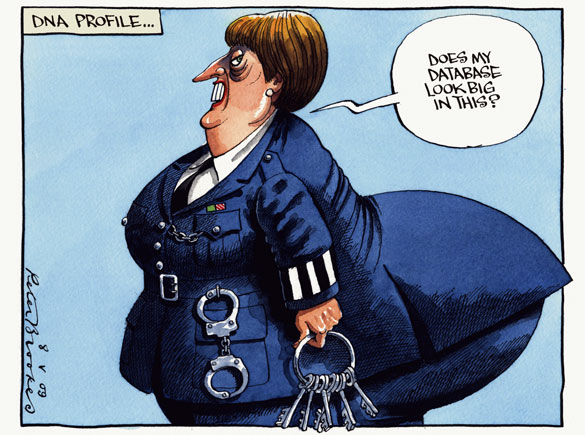
The DNA database fudge.

One of the motifs of the past few months has been that politicians of all colours "just don't get it". Ironically, when it comes to the continuing debacle over the DNA database, you rather imagine that they did get it and now they're utterly bewildered at how things have turned out. Here, after all, is what ought to be a standard tabloid outrage scandal: because of the "unaccountable" European Court of Human Rights, the government is having to change its policy on keeping all the DNA profiles of those arrested but not charged indefinitely, potentially raising the spectre of the guilty getting away with their crimes. The Sun, that flag-bearer of social authoritarianism, did originally raise its voice, but has since barely made a peep about the S and Marper case and its implications.

For a government that has so often treated with contempt the concerns of civil libertarians, with the full connivance of the vast majority of the tabloid press, the Daily Mail only recently deciding that it's time to join the other side, it must be wondering where all those who believe if they've got nothing to hide they've got nothing to fear have disappeared to. As it happens, the majority are still probably on the side of mass DNA retention, just as they were on the side of extending the detention limit for terrorist suspects, even if the numbers fell away once the full implications of 42 or 90 days were properly explained.

It is therefore encouraging, that just this once, it's the other side making all the noise. On the one hand, you do have to recognise that if the government were to implement the the S and Marper ruling to the letter and destroy the DNA profiles of those not charged and found not guilty, on the very first occasion that someone then went onto commit a far graver offence and as a result was not brought to justice immediately, you can bet that those who are currently quiet would be screaming blue murder. A more confident, and indeed, more liberal government, would however make the argument that we cannot create a completely secure society without making the kind of sacrifices that would reduce the amount of freedom which each and every one of us currently enjoys. As it is however, we instead have a government that is terrified both of the power of the press in one of its "fits of morality" and which knows that such woolly-thinking is hardly a vote-winner. Even so, keeping an innocent person's profile for 6 years is completely unjustifiable, and quite clearly breaches the S and Marper ruling. The main hope from ministers has to be that by the time any challenge to it winds its way through the courts again, they'll ever not be in the same job, or they won't even be in government. The Conservatives are promising to emulate the more enlightened Scottish system, but again, whether it will be one of their first priorities is unclear.

The overall result though is classically New Labour. They would like to go further, without being able to, while also privately doubtless wishing they could do the exact opposite. Such are the constrains by which we have been governed, and likely will continue to be under Cameron's "new" Tories.

Labels: , , , , , , ,

Share |

Thursday, May 07, 2009 

A profile of an contempible government.

For a decision made by the European Court of Human Rights, which the tabloids habitually love to portray as a foreign entity imposing liberal madness on this unspoilt land despite our leading role in its establishment, there was surprisingly little apoplexy at the judgement concerning the retention of genetic profiles on the DNA database, especially considering the Sun had scaremongered about the case on a couple of occasions. Partly this was due to being distracted at the time, as Karen Matthews had just been convicted, but also partially down to a gradual changing of views on the general question of civil liberties. After more than a decade where the belief that if you had nothing to hide you had nothing to fear became so entrenched that almost anything, with the exception of the death penalty, was considered as a potential policy to deal with the hysteria over crime, even as crime itself fell off a cliff, sanity has finally begun to make something of a return.

Sanity however is not something that comes naturally to the Home Office under Labour. Despite the hilarious complaints from the Sun, and indeed from Jack Straw that "the criminal justice lobby" have the ear of ministers more than newspaper editors do, the facts, not least a prison population which requires an early release system which actively undermines justice but without which they could not even begin to function, speak for themselves. Admittedly, the DNA database makes for an easy populist cause: while few will still openly call for a "complete" database, the idea that everyone convicted of a crime should be on it indefinitely is still a difficult position to argue against, even if it is as illogical a position as arguing for a full one. At least on one point the government does seem to be willing to be reasonable, or something approaching it: those over 10 and under 18 will have their profiles removed, regardless of whether they are convicted of a crime or not, unless for a violent or sexual offence, when they turn 18, as long as they are not arrested again during their teenage years. Youthful indiscretions it seems will not matter for life as they currently do.

If however being convicted of any offence that carries a potential prison sentence means that your profile should remain on the database indefinitely is indefensible, as the government proposes despite the ECHR's damning verdict, then the idea that those found completely innocent should remain on the database for either 6 or 12 years, depending on the gravity of the offence, is bordering on a complete mockery of justice. While everyone has become acquainted with the example of Mark Dixie, who was convicted of the murder of the photogenic Sally Anne Bowman (who we most likely would never had heard of had she looked more like Susan Boyle), after he was arrested for being involved in a minor scuffle outside a pub, it isn't really an apposite example in this instance because no one is arguing that profiles should not be created from all those arrested and checked against unsolved cases as a matter of course; he would have been caught red-handed regardless. The "consultation" document (PDF)does however contain a more troubling one for those of us who believe those found innocent of what they are accused of should instantly have their profiles removed from the database: Kensley Larrier was arrested in 2002 on suspicion of possessing an offensive weapon and had his profile taken and loaded onto the database, but no charges were brought. Three years later Larrier was successfully convicted of rape after his DNA was matched with that left at the crime scene.

It doesn't necessarily mean of course that Larrier would not have been convicted through good old fashioned police work, and the suspicions of the police confirmed once they had arrested him, but it does leave those of us advocating a complete wiping of the profiles of the innocent from the database with the uncomfortable position of knowing that undoubtedly some will get away with subsequent crimes, including the most serious, which they would otherwise have been brought to book for, or at least brought to justice for far sooner than otherwise. The key argument to make in response is that a few "bad eggs" should not mean that all those unfortunate to come under suspicion should be considered potentially guilty until proven innocent, but even that is far from being wholly convincing. Even if we then point out that no system is infallible, and that unless we are prepared to go down the previously mentioned path of everyone being on the database, some would still always escape justice, it still leaves us open to the accusation that we're prepared to put principles, however noble, before the rights of those to have justice seen to be done.

More indicative though of how the government seems determined to still eventually build such a complete database by stealth, is that all those given just a caution, a warning, or a reprimand will also have their profiles kept indefinitely. The number of cautions given in recent years has sky-rocketed, although it's not clear whether this is due to the huge rise in new offences created by this government, the fact that any offence, however minor, is now also an arrestable offence, or an increasing tendency for "summary justice" rather than court proceedings to deal with those minor offences, but it effectively means that only those officially found to be guilty of no offence whatsoever, which is also increasingly rare, will have their profiles removed.

The government claims that its proposals will not just mean that it will comply with the ruling in the S and Marper case, but that they will go substantially further than the requirements. Whether the court will agree may well depend on a further case being brought, but considering the time it will take for it wind its way first through our court system, where S and Marper failed in their attempts, and to the ECHR to consider again, it will doubtless be years before we find out. Certainly there needs to be a challenge, not just to the 6 and 12 years retention for those found completely innocent, but to the blanket retention of those given just a caution, let alone those convicted and given either a fine or a suspended sentence. Both the Conservatives and the Liberal Democrats talk a good game on doing the right thing, but whether the former can be trusted to keep their word, the LDs hardly likely to be in a position to put theirs into action, remains to be seen. In any event, the government has as usual done as little as it feasibly could to not be held in further contempt. It ought to be another thing for which it should be held to account, but even if the mood is slowly changing, there are few votes in giving in to those barmy Europeans.

Labels: , , , , , , ,

Share |

About

  • This is septicisle
profile

Archives

Powered by Blogger
and Blogger Templates