Thursday, July 19, 2012 

No alarms and no surprises redux.

Hearing today of the verdict in the Ian Tomlinson case, it was difficult not to be reminded of Blackstone's formulation. William Blackstone, the 18th century author of the Commentary on the Laws of England, had it that it was better that ten guilty persons escape than that one innocent suffer.

This is not to say that PC Simon Harwood was guilty of anything more on the 1st of April 2009 than common assault. The jury more than understandably decided that it was not proven beyond reasonable doubt that Harwood caused the manslaughter of Tomlinson, and we have to respect that decision. You really can't envy those chosen to serve on this particular case, thanks to the incompetence of Freddy Patel, the pathologist who carried out the first autopsy on Tomlinson. They had to reach their decision based on conflicting accounts: Patel continues to maintain that Tomlinson died of natural causes, coincidentally just a matter of minutes after he was pushed over and struck by Harwood, while the two other doctors who subsequently carried out a re-examination decided the cause of death was internal bleeding caused by trauma associated with a blow to the abdomen. The material that would have established the cause beyond all doubt was poured away by Patel, who when giving evidence continued to insist that the bloody fluids found within Tomlinson's stomach cavity were ascites stained with blood, rather than just blood. The Crown Prosecution Service's initial decision not to bring charges was justified on this irreconcilable difference of medical opinions. The jury was not told that Patel had been suspended last year by the General Medical Council after similar failings in the autopsy he carried out on Sally White, who he found had died of natural causes. Her body had been discovered in the house belonging to Anthony Hardy, who later pleaded guilty to the murder of White and two other women.

In fairness to Patel, he wasn't aware when he conducted the post-mortem of what had happened to Tomlinson just a few minutes before he died, the footage not being uncovered until it was sent to the Guardian a week after the protests. New evidence was also presented during the trial which hadn't been given during the inquest, with trauma specialist Alastair Wilson hypothesising that the internal bleeding could have started before Tomlinson came into contact with Harwood. All the same, it still raises the question of why it was decided that Patel's suspension was considered to be prejudicial, and so withheld from the jury. It may not have made any difference, just as it's doubtful that had they known of Harwood's chequered disciplinary record, including his resignation from the Met following a road rage incident and subsequent rejoining of the force with Surrey police it would have changed their decision. When it was a majority decision of 10 to 2 though, after four days of deliberations, it could potentially have led to a retrial instead of a not guilty verdict.

All this considered, it was clearly the right decision by the CPS to change their initial decision and bring the manslaughter charges following the unlawful killing verdict of the inquest's jury. While both verdicts were delivered under the same burden of proof, beyond reasonable doubt, there's clearly a massive difference between a jury deciding a police officer was guilty of unintentionally killing a man through inappropriate use of force and a jury deciding that the police officer should potentially go to prison for doing so. Harwood's behaviour, though reprehensible as there was no reason whatsoever for him to push Tomlinson, would have been unlikely to have done lasting damage to someone who was in good health. Indeed, as I previously noted, it's a wonder there weren't far worse injuries on the day considering the number of protesters who were hit repeatedly on the head with batons.

In this respect, as much as Harwood on the day was lashing out anyone who got in his way following the humiliation he felt after failing to arrest a man who vandalised a police van, Duncan Campbell is right to lay the blame at the feet of those who authorised the completely counter-productive tactic of kettling protesters, to say nothing of the storming of the Climate Camp, later ruled to have been an abuse of power. Regardless of whether there had been violence or not, and much of it on the day was limited to the smashing of windows and spraying of grafitti rather than attacks on police, who were in any case mostly watching as it went on, officers had been briefed that a bunch of black flag wielding anarchists were coming from across Europe to lay waste to the City, while senior officers were telling the media of how ready they were for just such an eventuality.

Unlike some others, I'm not so sure that this verdict will make police officers feel that they're above the law: while it's true that there has still not been a officer convicted of murder or manslaughter while on duty since 1986, it only hasn't in this case thanks to the disagreement between pathologists. With recording equipment now ubiquitous, the chances of abuse going unchallenged have also never been slighter. Just as the police are so keen on recording us, so on protests from now on we should be recording their every move. And considering what's happened, they can hardly complain.

Labels: , , , , , , ,

Share |

Wednesday, May 04, 2011 

No alarms and no surprise revisited.

If it wasn't apparent before, it ought to be now. The real reason why it's such a rare occurrence for police officers who've killed members of the public while on duty to face trial is because when the facts of similar cases are laid out before juries, whether in the form of health and safety prosecutions or inquests, they have this irritating habit of finding either the defendants guilty or that the victim was unlawfully killed.

This isn't to suggest that the director of public prosecutions, Keir Starmer, who made his name as lawyer working on human rights cases conspired with the police when he decided that PC Simon Harwood would not face any criminal charges over his assault on Ian Tomlinson. Rather, it seems he fell into the trap of believing that it would be too difficult to convince a jury beyond reasonable doubt that the actions of the officer lead directly to the Tomlinson's death. Considering the differences of opinion between the pathologists, with the first, Dr Freddy Patel ruling that Tomlinson had died from a heart attack rather than internal bleeding caused after he fell following being pushed, it would have hardly been an easy case, and one on which there would have been much media attention.

Nonetheless, and indeed exactly because as the Guardian puts it there is nothing more serious than the state taking the life of one of its subjects with the exception of agents of the state covering just such an incident up, Starmer ought to have erred on the side of letting a jury hear all the evidence. Such a case would have been clearly in the public interest. The virtues of taking just such a nuanced approach could hardly have been more vindicated than by the inquest into Tomlinson's death, helmed by Judge Peter Thornton QC. Unlike in the inquest into the death of Jean Charles de Menezes where the coroner disgracefully decided that the jury could not reach a verdict of unlawful killing, Thornton gave the jury the option, while stressing that they had to be certain beyond reasonable doubt, the same legal distinction as that required in a criminal trial. Having expected a longer wait, the court was relatively startled when the jury took just under three and a half hours to decide that Tomlinson had been unlawfully killed.

Considering the evidence presented, this wasn't exactly surprising. PC Simon Harwood himself was almost the definition of an unreliable witness, repeatedly changing his story when it was challenged, not just by the lawyers for Tomlinson's family, but also by the quality and quantity of the material shot on the day of the G20 protests. Having initially claimed to investigators that Tomlinson had been defiant and resisting orders when he pushed him, he still maintained that the strike and push which felled him were justified in the circumstances, rather than say prodding him, taking him by the shoulders and physically moving him away, or, heaven forfend, forcefully but politely asking him to move faster. Whether or not Harwood, who in the minutes before pushing Tomlinson had swung a coat at a protester, knocked over a BBC cameraman and used a "palm strike" against someone else, was acting out his anger and embarrassment following his failure to arrest a man who had vandalised a police van is known only to him.

Similarly, Dr Freddy Patel was left with little option than to change his original opinion faced with the three other pathologists and other medical experts all deciding that Tomlinson's cause of death was abdominal bleeding. Patel was admittedly put at a disadvantage from the very beginning, the police having told him when he was brought in to perform the post-mortem that Tomlinson had not been involved in any public disorder and that he had sleeping rough for the last 20 years, just one of the many untruths originally put out to the media by the Met, along with the claim that they had been assaulted with missiles while tending to Tomlinson. Even so, Patel erred in not retaining or sampling the three litres of intra-abdominal fluid blood or intra-abdominal fluid with blood which had collected in Tomlinson's abdomen, which would have proved the key to whether he had died from internal bleeding as the other pathologists believed. In any case, that Patel had previously been criticised for discussing confidential details in public, as well as being involved in the failings concerning Anthony Hardy ought to have disqualified him from any possibility of carrying out the autopsy.

As wearingly familiar as this sad tale of changing stories, incompetence and abuses of power is, the real outrage is that the overall cause remains the same. Just as the officers on the morning of the 22nd of July 2005 were briefed that those they were after were "up for it" and ready to commit acts of mass murder, giving the impression that lethal force was permissible even when it hadn't been authorised, so the police prior to the G20 had made clear just how determined they were to crack down hard on those who were out to smash up the City. We duly saw police medics brandishing batons, those without the first idea how to "safely" use a truncheon flinging it around, and of course, the storming of the entirely peaceful Climate Camp, since found to have been illegal. Ian Tomlinson died both as he was in the wrong place at the wrong time and because he was vulnerable to just such an injury as he received; dozens of others got cracked heads or worse just for daring to take part in a demonstration. It would be nice to think that following such regrettable incidents that future policing would have been rethought, but no, as the example of Alfie Meadows so pungently demonstrates.

Whether Simon Harwood will now face a manslaughter charge following the CPS review remains to be seen. Doubtless his representatives will argue that the inquest and the coverage of it has damaged his chances of receiving a fair trial. What hopefully will change is the giving of the benefit of the doubt to the police and the authorities when such prosecutions are first considered, something which has gone on for far too long, as does the condescending view that juries are incapable of following or making a judgement on complicated, conflicting medical evidence. Justice, even if it involves the throwing out of cases by judges or acquittals which result in questions over whether a prosecution should have been brought, has to been seen to be done.

Labels: , , , , , , ,

Share |

Friday, September 03, 2010 

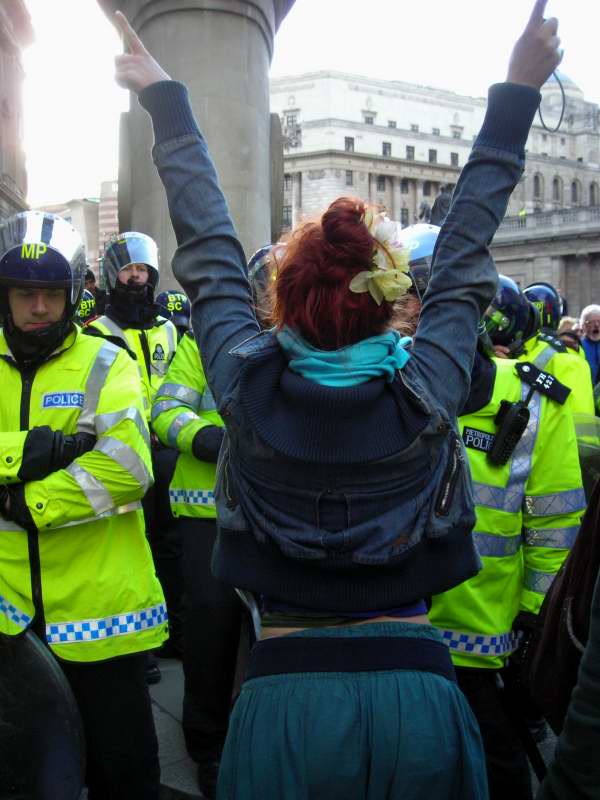
G20 Woman.

Congratulations to Harpymarx on her brilliant photograph taken during the G20 protests last year, which I used at the time, being nominated for this competition. Was more than worthy of winning.

P.S. New post by myself over at The Sun - Tabloid Lies on their latest piece of BBC bashing.

Labels: , ,

Share |

Thursday, July 22, 2010 

No alarms and no surprises.

Hands up those surprised in the slightest that the Crown Prosecution Service has decided that no charges will be brought against the Metropolitan police over the death of Ian Tomlinson? None of you? Jolly good. Finally, maybe, the message is now starting to get into the thick skulls of everyone that whenever the police, either accidentally or in the most brutal manner imaginable kill members of the public that it's only in incredibly rare circumstances that the officers themselves face prosecution. The only example in recent memory of a police officer facing a charge of both murder and manslaughter as a result of their actions while on duty was in the case of James Ashley, who was shot dead in his bedroom during a botched police raid back in 1998. The officer was acquitted of both charges when the judge agreed that he had acted in self-defence, believing he was about to be shot himself. This was despite Ashley being naked, acting in a daze as he had just been woken up, and having no weapon to hand. Last year Sussex police apologised to Ashley's family, admitted negligence and paid compensation.

Since then, no further charges in similar cases have been forthcoming. There were none when 10 bullets were pumped into the head and shoulder of Jean Charles de Menezes, the end result of an operation which was memorably described by a Met source as a "complete and utter fuck-up", although there was the small matter of the successful prosecution against the Met on health and safety grounds. There were none when Harry Stanley was shot dead, a Scotsman described to the police as an Irishman carrying a shotgun in a plastic bag which turned out to be a chair leg. Indeed, even though no officer was actually charged with a criminal offence, when the second inquest into his death resulted in a verdict of unlawful killing and the officers responsible were suspended from duty, their colleagues in other armed response units took umbrage and handed their weapons in. Happily, the High Court later overturned the second inquest's result, reinstated the first's open verdict and everything was right with the world again. There were also none when a CO19 officer shot dead Azelle Rodney, despite the Independent Police Complaints Commission agreeing that he was not holding a weapon when the car he was in was surrounded.

In all of those cases the evidence was far more clear-cut than that against the officer who pushed over Ian Tomlinson. True, they all claimed they were acting in self-defence, believing in the case of de Menezes that he was a suicide bomber about to detonate his explosives, while the others believed they were in mortal danger from armed men, something which PC Simon Harwood, as he has been named, clearly couldn't, threatened so visibly as he was by Tomlinson walking away from him and the other officers with his back turned and hands in his pockets. It was always going to be difficult to prove beyond reasonable doubt in a court that the baton strike and push unequivocally led to Tomlinson's death and so justify a charge of manslaughter against Harwood. That was without the conflicting evidence of the 3 post-mortems.

Here's where it gets murky. Dr Freddy Patel, the pathologist who carried out the first autopsy, had previously been criticised by the General Medical Council for discussing confidential details about a man who died in police custody outside of an inquest. He had also performed the post-mortem on Sally White, a 38-year-old woman whose body was found in a locked bedroom in the home of Anthony Hardy, a death initially deemed by the police as suspicious. Patel's verdict was White had died from heart disease, and the investigation was dropped. Hardy subsequently pleaded guilty to the murder of three women, including White. Patel has since been charged with misconduct by the GMC over three other post-mortems he is alleged to have conducted incompetently.

He may eventually face a fifth, if he isn't struck off at the conclusion of the current hearing. Crucially, while concluding that Tomlinson had died from natural causes as a result of coronary artery disease, Patel recorded but did not retain or sample 3 litres of either intraabdominal fluid blood or intraabdominal fluid with blood which had collected in Tomlinson's abdomen. His first report suggested the former, but in a second submitted on the 6th of April this year he settled on the latter. If it was blood, according to the Crown Prosecution Service's statement, that would have been highly significant indicator as to the cause of death. However, when meeting the prosecution team, Patel maintained it mainly consisted of ascites, having formed in Tomlinson's damaged liver, which had been stained with blood. He didn't retain or sample it as he had handled blood his entire professional life and was convinced it was ascites stained with blood rather than just blood. Moreover, he had found no internal rupture which could have led to such a level of blood loss. The doctors who conducted the second and third post-mortems, while acknowledging that Tomlinson had a partially blocked artery, concluded that he had died as a result of abdominal haemorrhage from blunt force trauma to the abdomen, in association with alcoholic cirrhosis of the liver. They believed that when Tomlinson had fell following being pushed, his elbow had impacted in the area of his liver causing an internal bleed and leading directly to his death a matter of minutes later. The only way to be certain would have been to re-examine the fluid initially found by Patel and which he had removed without retaining. For Tomlinson to have died so quickly from blood loss there would have had to have been some kind of internal rupture, something found by none of the doctors. Since Patel was the only doctor to examine Tomlinson's intact body, he was in the best position to have considered the fluid and found a rupture, leaving the CPS to decide the differences between the doctor's opinions was irreconcilable.

The key question is why Patel was chosen to conduct the post-mortem in the first place. It's believed he didn't have a police contract at the time, yet instead of an accredited team of 9 pathologists who more usually deal with suspicious deaths, he was picked by City of London coroner Paul Matthews. At the time the City of London police were handling the investigation rather than the Independent Police Complaints Commission, who despite the circumstances of the death during the G20 protests let them get on with it, not getting involved until the Guardian posted the footage of Tomlinson being pushed over online. Proving there was an active conspiracy to chose an incompetent pathologist will be next to impossible; even if the City of London police were willing to overlook the shortcomings of their colleagues in the Met, and already knew about what was likely to have happened, would their coroner have took part in a cover-up too? The trusty blade of Occam's razor would instead suggest it's more likely to have been incompetence and cock-up, especially when they would have had to depend on Patel either playing along or performing his usual shoddy job, not always guaranteed. That's not to say it couldn't have happened, just less plausible than the alternative.

Clearly, the IPCC should have been in charge from the beginning, although their record is hardly sparkling either. Even so, as the Guardian argues, even with the inherent difficulties in a prosecution case it should have been up for a jury to hear the contradictory post-mortem evidence and make a decision, especially when Patel's standing as a pathologist is so under question. That not even an attempt has been made to prosecute Harwood with assault on the grounds the legal limit for doing so had long since passed is disgraceful. How many other cases involving members of the public are lost each year due to the incredibly short six month timeframe for charges being brought? The pathologist who carried out the second post-mortem has also disputed the CPS's justification for not bringing charges of assault occasioning actual bodily harm saying the injuries which they called minor were in fact more serious, involving a large area of bruising.

This is without considering the crucial test of turning the tables. If a member of the public had hit and then pushed over an on-duty police officer who had their back turned to them, who subsequently died a matter of minutes later, would the CPS then be so reticent in bringing charges, even if there was a similar dispute over the cause of death? While the inquest is still to come, it seems for now that yet again the police have got away scot-free after being involved with a death of an entirely innocent bystander. Public confidence in the police, the CPS and the IPCC relies on their best practice and independence. When on so many separate occasions they seem determined to ignore what is staring them in the face and accept in good faith everything they're told by the police while casting doubt on anything that contradicts those statements it starts to look like collusion. And then the media, police and all right-thinking people wonder how Raoul Moat could possibly be sympathised with, let alone lionised.

Labels: , , , , , ,

Share |

Wednesday, March 31, 2010 

The more things change, the more they stay the same.

If, like me, you occasionally find yourself thinking that this is an uncertain world and that there's very little we can be sure of, both in a mental and physical sense, then the last couple of days have provided a wonderful counterpoint. First up turns Tony Blair, as large as life itself and twice as ugly, still performing the same old shtick about how the Tories are vacuous and the Labour party is an intellectual behemoth that continues to be right about everything, then we have Gordon Brown's latest speech on immigration, treading the sensitive line between common sense and racism, telling all those thousands of layabout migrants that they can fuck off (I may have paraphrased this slightly), next there's the usual Britain's gone mad story which doesn't dwell on the finer details, and lastly, we have a police officer acquitted of assaulting a protester, in a turn of events that absolutely everyone predicted.


You could really leave the video itself to do the talking in the versus match which was Sergeant Delroy Smellie against benefits claimant Nicola Fisher, which in terms of fairness was even more unbalanced than Ricky Hatton against Manny Pacquiao. That's never stopped me from spitting out hundreds of words in the past though, so no reason to do that now. The footage really does set the scene: at a protest hastily arranged in the memory of Ian Tomlinson, the police had decided that their actions of the previous day, pushing over people who were daring to walk in front of them with their backs turned and sending in riot cops against an completely peaceful environmental camp hadn't already blackened their name enough, and so they were refusing to let those attending the vigil leave. One man remonstrating with the police for refusing to let him exit their cordon is grabbed and pushed back twice for no apparent reason; meanwhile, the supremely threatening Ms Fisher, not using the most diplomatic of language and not perhaps behaving in a completely helpful manner but nonetheless hardly likely to suddenly slash Smellie's throat is first slapped and then hit twice with a baton for her intransigence.

The prosecution's case, it has to be admitted, was not helped by Fisher herself deciding not to give evidence. Having already sold her to story to, of all papers, the Daily Star, with the help of Max Clifford, as well as claiming that the attack was completely unprovoked, which as the video evidence shows it clearly wasn't, she probably also wouldn't have made the most credible of witnesses. She claims to be suffering from depression, which she might well be, but I think even if I was in the pits of despair I would have made the effort to attend court to try to get someone who had attacked me in such a way convicted. It's also hard not to wonder just how hard they were trying though when the prosecution itself, according to the Graun, called witnesses that were hardly helpful to their case, emphasising that Fisher was "hyperactive", "erratic" and "playing up to the cameras". All probably true, but again, the level of Smellie's reaction is difficult to justify.

The most ridiculous evidence was however given by Smellie himself, which seems to have varied from the embarrassing for a man of his size, claiming that no video or photographs came close to "reflecting the fear" he felt as the crowd got closer to him and the officers, of which there is no indication whatsoever in the video, through to the myopic, having failed to identify that rather than carrying "weapons" she was in fact holding those deadly tools a camera and a carton of orange juice, the utterly fanciful, like his apparent thought that Fisher was deliberately coming at him from his blind spot, and then finally the smugly boastful which was presumably his attempt at showing just how restrained he was, telling the court that he could have broken Fisher's jaw if he'd used an "authorised" elbow strike, or if he'd instead hit her arm rather than her thigh how he could easily have "snapped it".

Ultimately, it's difficult to disagree with the judge when she ruled that the prosecution had failed to prove that Smellie had not used lawful self-defence. It's also equally difficult though to imagine someone who isn't a police officer being acquitted on similar lines when they had been provoked in exactly the same way in a town or city centre on a Friday or Saturday night and responded with a smack in the face and then a couple of kicks or punches. That to me seems the test to which the police in such circumstances should be tested. Smellie acted in the way he did because he was certain, despite the emergence of citizen journalism, that there was no way he would ever be reprimanded for resorting to violence when there was no real need to do so. He's been incredibly unlucky in being prosecuted, as undoubtedly some of his colleagues on the previous day behaved in an even less justifiable way and have completely got away with it. No police officer has even been disciplined for failing to show their badge numbers on last year's G20 protests, something which tells you all you need to know to about the lessons learned and how the police will conduct themselves in the future, safe in the knowledge that they can beat up anyone who steps even slightly out of line while exercising their democratic right to protest and face no consequences whatsoever.

Labels: , , , , , , ,

Share |

Thursday, November 26, 2009 

Adapting to protest and adapting to the government's position.

It's an increasingly rare thing these days for an organisation to conduct a review into itself and actually find that not everything is as good as it could be. For that alone, Denis O'Connor and Her Majesty's Inspectors of Constabulary, with their report "[A]dapting to protest", undertaken following the police riot at the G20 protests, deserve recognition. While hardly a blistering assault upon the piecemeal way in which the different forces police protests, it also doesn't pull its punches. O'Connor finds that there are no clear standards regarding the use of force for individual officers when it comes to policing protests; that there is little attention paid to the use by individual officers of batons or "distraction techniques"; that different forces have a different understanding of the "proper use" of public order police powers, as demonstrated by the climate camp protests in 2006 and 2008, and also at the G20; that some forces cannot even provide a "minimal accredited public order command structure"; that training and guidance is out of date; that there is inadequate training in law, especially human rights, and when it comes to the use of Forward Intelligence Teams; and that inappropriate use of public order powers is widespread.

Equally, O'Connor's recommendations are difficult to fault. He proposes that the police adopt a fundamental set of principles on the use of force that runs as "a golden thread" through all policing, not just that of protests, based around the minimum use; that public order policing across the board should be codified so that the use of powers, equipment and tactics is consistent; that public order training be improved, especially since individual officers are themselves legally accountable for their actions; that the Association of Chief Police Officers should have its status reviewed, especially considering its role in policy making, most notoriously of late designating legitimate protesters as "domestic extremists"; and probably most significantly, keeping communication open constantly with protesters and the public, especially with protest groups' representatives.

All this is meant, in O'Connor's mind, to ensure that the historic principle of policing by consent, as philosophised and introduced by Robert Peel, does not break down. The obvious problem with this is that while it's difficult to pin down exactly when this compact irrevocably broke when it came to the policing of protests, although the report itself notes that the clashes between the blackshirts and anti-fascists in the 30s were far more significant breakdowns in public order than many of our modern equivalents, irrevocably break down it did long ago. Policing by consent does still exist when it comes to the average bobby on the beat, but when it comes to protests, especially those that occur on the relative spur of the moment and when they concern relative matters of life and death, it's difficult for a good-natured and friendly relationship between protesters and those that are in control of them to exist, and to pretend that it can be maintained is relatively naive. Often on these occasions relative control can still be exercised, but it depends on those who are pushing their luck either being told in no uncertain terms to calm down, or on them being arrested, potentially both for their own good and to ensure that the protest as a whole doesn't embarrass both sides. For all the times when the police are rightly criticised for their actions, sometimes even protesters recognise that those amongst them are just out to cause trouble: this was the case back in January, during the protests in London against the Israeli attack on Gaza. Some of the trouble can be put down to both sides underestimating the numbers who were going to turn out, but also down to the police failure to separate those out who were determined to attack the police or property early enough. As much as protesters loathe the Forward Intelligence Teams that indiscriminately film protests for their own records, some of it is justified, if only so that the idiots can be filtered out to the benefit of both sides.

While O'Connor himself can hardly be blamed for focusing on the present, it's instructive that the policing of protests is only now considered controversial, mainly because of how the internet and modern media has ensured that the police (and indeed, the protesters themselves) can be held to account. After all, it's not as if the police have only suddenly disgraced themselves with how they treat legitimate protests; it's been going on for decades, whether you go back to the 70s marches where the National Front was often favoured against those protesting against them, to the Battle of Orgreave, the poll tax riots, the May Day protests of the 90s and early 00s, right up to the Countryside Alliance protest outside parliament during the pass of the fox hunting bill and more recent examples. It's also not just these more notorious cases, but the other, smaller marches, where outrageous police behaviour has often gone completely unnoticed by the national media. One thing O'Connor fails to address is that often it's been the very officers that are dedicated to control protests that have been amongst the very worst offenders; whether the Special Patrol Group or the modern equivalent the Territorial Support Group, these officers often seem to be selected not because of their powers of mediation, but because of their very obstinacy, quickness to use of force and general disdain for protesters of every hue. It may be that officers drafted in to control large protests aren't trained properly, and as a result of probably being as frightened and as uncertain as the protesters themselves can lash out and act defensively, but it's often those who have been specially trained that are the very worst. A special review of those in these groups and an emphasis on facilitating the right to protest would have been especially welcome as an additional recommendation.

The largest hole in O'Connor's report though has nothing to do with the police themselves; it is the influence of government itself upon the policing of protest. It's easily forgotten that this government has been one of the most ruthless at suppressing protest in living memory, that as well as banning protests within a mile of Westminster without prior permission, it attempted and almost succeeded in banning the biggest protest march in this country of all time, the Feb 15th 2003 anti-Iraq war protest, by claiming that to do so would damage the grass of Hyde Park. More recently it has connived with those being targeted by the likes of Climate Camp, directly handing over intelligence on individuals to the companies running the power stations. The support the government has given to the police, on almost every single thing they have done or been criticised over, has been total. Even Ken Livingstone, hardly a prior fan of the Met, defended Ian Blair and his force to the hilt after the execution of Jean Charles de Menezes. When you give such total, unconditional support, and shrink from criticising anything, you invite them to believe themselves unaccountable. To be fair to New Labour when it doesn't deserve it, it's not that this is new; the Tories did much the same, but not to the same extent. Every single new power which you give to the police is abused, most recently uncovered that the granting of the power of arrest for any offence has resulted in the taking of DNA profiles to continually enlarge the database, almost certainly by stealth and without any debate. Unless the government itself decides that protest as a whole is legitimate, and should be facilitated rather than something which it has to put up with, there's little hope of the police themselves introducing such an enlightened stance.

Labels: , , , , , , ,

Share |

Wednesday, April 08, 2009 

Accidental death of a non-protester.

Both Shuggy and Chris Dillow are right in pointing out that the police treatment of Ian Tomlinson was far from shocking, as some others have claimed. If anything, the officer who violently pushed him over when there was no need whatsoever to do so was taking part in some of the less dangerous action with the protesters that day. As long as Tomlinson didn't hit his head, and from the video it seems that he didn't, a push like that is only likely to result in grazed or cut knees and hands, along with the temporary shock that comes from being bundled over when you're not expecting it. The cracking of heads which other officers were engaged in all day, causes far more potential for concern. If however you have a weak heart, as it seems Tomlinson did, the sort of altercation which he was involved in with the police can quite easily lead to the complications which he seems to have subsequently suffered.

The entire slow emergence of what actually happened as opposed to the police version of events is also not shocking; rather wholly predictable, following the same pattern as that of earlier events where the police have been involved in inflicting either serious injuries or even death on completely innocent bystanders. The first obvious example is Jean Charles de Menezes, where the misinformation if not outright lies which emerged from the Metropolitan police before leaks from the Independent Police Complaints Commission inquiry established that much of their story was entirely false. Confusion and different accounts of what happened are always likely to be the order of the day to begin with, and we should expect that over time that the story will change. Once the police realise however that their original statements about what happened are inaccurate, they should be quick to correct them. This was what they completely failed to do in the case of de Menezes, hence the continuing myths that he had run from the police and had leapt the barriers, amongst others. It's hard not to conclude that half of the reason why the police fail to do this is because they know full well that first impressions and reports colour people's attitudes and are hard afterwards to shift, meaning that those who defend them will have a far easier job. They must have known full well, for instance, that they had not been showered with missiles, let alone "bricks", as the Evening Standard had it while they tended to Tomlinson; as video has subsequently showed, at most two bottles were thrown in their general direction, and the protesters quickly demanded that be stopped. Equally, some of the officers must have known full well that Tomlinson had at least been pushed, if not further assaulted before or after then as others are also alleging. Instead all we heard was that his death was "natural causes", and even up until 6pm yesterday the BBC was still denying that there was any news in his death whatsoever, treating the Guardian footage as a parochial "London" story.

Perhaps even more instructive though as to how far the police will go in denying their involvement in occasionally brutal tactics is the treatment that was meted out to Babar Ahmed when he was arrested. Medical examination showed quite clearly that he had been seriously assaulted despite putting up no resistance, but the Met completely denied any wrongdoing, right up until six years later in the High Court when the commissioner had to shamefacedly admit what had happened so that the officers themselves did not have to give evidence. Perhaps unsurprisingly, the officers involved had a cache of complaints made against them, overwhelmingly from Asian and black men, the letters of which had mysteriously gone missing. None of the officers involved appears to have been disciplined.

Nice as it would be to establish a complete pattern, it still doesn't entirely fit. For while the policing at last Wednesday's protest was almost inevitable after the police themselves and the media had repeatedly hyped up the idea there would be violence, at other demonstrations it has been a different story, possibly because of the short notice the police have had of them rather than actual tactical differences. The Gaza protests in January for example were for the most part poorly policed, as well as poorly organised, as clearly no one had expected the numbers which turned up, and the disorder which happened could have been nipped in the bud if the police had stepped in sooner to arrest the troublemakers, for which they would have had overwhelming support to do. At the continuing Tamil protests in central London, the police yesterday foolishly rushed in to confiscate flags which they claimed were emblems of the Tamil Tigers, a proscribed terrorist organisation, when they were instead the normal Tamil flag. On the Gaza protests, the flags of Hizbullah, Hamas and some even claimed al-Qaida were swung, draped over backs and flown with no such intervention from the police. The lack of consistency is striking, and it has to be assumed that the police do what they do when they can get away with it and when they can't they fall back. Tamils it seems are easier targets than potentially hot head young Muslims.

Once you have stripped everything away, the responsibility for the policing of the protests does not however fall on the heads of the cops themselves: it rests with the state, or the government, itself. The practice of kettling, of riot police attacking protesters who were either sitting down or involved in the entirely peaceful Bishopgate climate camp is not just down to the police hierarchy but to the politicians who authorise or even encourage such tactics. As Shatterface pointed out last week on Liberal Conspiracy, during the 80s the left routinely referred to the police as Thatcher's shock or storm troopers. That applies just as much today if not more so, except now they're New Labour's first line of defence. Can the casual deprivation of liberties and the right to protest, such as the continuing ban on demonstrations within a mile of parliament really be separated from the actions of the police last Wednesday and across the country over the last few years? Last Wednesday was just the most visible demonstration of the contempt for the right to protest which has continued to develop. Those watching the scenes, whether of the lone band of idiots who smashed up the RBS branch or of those bleeding from their heads after accidentally coming into contact with police batons will have only taken one message from such pictures: that registering your anger in such a way is wrong, and that if you continue to do so regardless of that fact, then you've only got yourself to blame if you're left with a few bruises. Those who might have wanted to do something similar will have been deterred by the deprivation of liberty they would have undergone, unable to leave when they wanted to, and likely to be hit if they looked as though might be about to do something that they police arbitrarily decide is verboten. For both the government and police, it's a win-win situation.

The one very weak bright spot to take from the emergence of the video showing what happened to Tomlinson is that it has fatally undermined the supposed ban on taking photographs and video of police officers. No one can now argue that such measures are necessary when without such material the truth would have never been exposed. True, it won't stop individual officers from continuing to demand that material be wiped, but such abuse of power is still likely to be given short shrift. The video should also put pay to the idea that protesters with masks are inevitably up to no good; if they are, then the police who cover their faces, as Tomlinson's attacker did, should be subject to the same scrutiny. There needs to be a full, independent inquiry before blame is apportioned, but the Met is once again looking like scoundrels and blackguards, simply because it and the government can neither tell the truth or explain their true motives.

Labels: , , , , , ,

Share |

Wednesday, April 01, 2009 

Just give me a black mask.


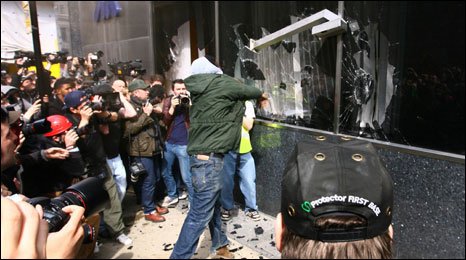
Two images sum up the G20 protests: the first superb one from HarpyMarx, and the other flashing all over the place showing the photographers lining up to snap the guy smashing the window of the handy local RBS building. Class them as hope and cynicism, if you like.

For the media got their riot, if you can call what was instead more of a skirmish along with the rather counter-productive looting of a bank a riot. The police and media warned for nigh on two weeks that the protests were potentially going to be extremely violent or very violent, with black flag brandishing anarchists from abroad coming to smash up our British streets. There was violence no doubt, but most of it was the police cracking the heads of crusties and assorted malcontents rather than the great unwashed stringing up bankers from the lampposts. Just as there are those on these protests that go along intent on causing trouble, there are some police officers who also live for these marches; most no doubt loathe them and wish that they were doing some proper police work like filling in paperwork back at the station, but there is a distinct minority who are overjoyed at the prospect of whacking jumped-up hippies and others whom they intensely loathe. It's not a new thing: it's been going on for decades, whether during the miner's strike, the poll tax protests or even the more recent pro-hunting demonstration where some officers showed that when it comes to protests, it doesn't seem to matter what the actual issue is, it's a wonderful opportunity to get your baton out and swing it through the air satisfyingly.

The media of course also adore it. Hence we have the by no means hysterical Daily Mail claiming that the City had been ransacked and that hordes of anti-capitalists were rampaging, when they were instead being mostly held against their will by the police who were intent on photographing and identifying everyone. As soon as around 20 protesters succeeded in smashing up RBS, all of whom had their collars felt, they'd got their story and started to lose interest, which was helpful, considering the Guardian reports which suggest that the police themselves then started some mini-riots of their own, attacking a sit-down protest and then sending fully-fledged riot police into the entirely peaceful, almost tranquil Climate Camp which was a world away from what was happening at Threadneedle street.

If I hadn't had work and then long ago had tickets reserved for the Young Knives tonight (who were as tight as could have been anticipated, even if they didn't play Counters), I might have gone, mainly to observe and perhaps shout the odd silly slogan. That seems to be what the vast majority were out to do, and also have fun at the same time as putting a message across; you can argue about the coherence of the message being sent, and also the quality of it, but both are always going to compromised when so many disparate groups and individuals join together. Fundamentally, demonstrations are for sending these messages; putting "messages" into law, as both main parties in this country are intent on doing, is not so laudable.

The Daily (Maybe) has easily the best round-up of all the reporting and bloggage, so I won't bother doing that, except to point you in the direction of a few that he's missed, such as Craig Murray, Laurie Penny, The Green Room, Derek Wall, the inimitable Daily Quail, Justin's more than humourous tweets and Abu Muqawama on how to properly use a baton.

Labels: , , , ,

Share |

About

  • This is septicisle
profile

Archives

Powered by Blogger
and Blogger Templates