Tuesday, July 22, 2014 

It's so fucking funny.

Supposedly, the older you get, the more right-wing you become.  It's strange then that at least when it comes to foreign policy, the more I age, the more to the left I shift.  Perhaps it's because the propaganda accompanying those shilling for war becomes ever more egregious; maybe it's because those selling leaden death are about as plausible as a pig dressed as a chicken; or it could be that as my anger on much else has dimmed, and boy has it dimmed, if anything it still hasn't peaked when civilians are massacred by the "most moral" army on the planet, supported and backed to the hilt by our own wannabe bombers.

We must start though with the shooting down of flight MH17.  Here is the worst example imaginable of what happens when you give heavy weaponry to amateurs, or as could be the case, when professionals are made to answer to dilettantes.  As soon as the news emerged a civilian plane had came down in the area where the eastern Ukrainian rebels have been pushed back to it was apparent what had happened.  Regardless of how the Donetsk People's Republic fighters got their hands on a Buk, whether supplied directly by Russia or captured from the Ukrainians, they couldn't have kept fighting this long without the tacit, barely disguised support of Putin.  He bears a heavy responsibility for the tragedy, and the fact he either refused or failed to pressure the rebels into allowing immediate access to the crash site so investigators could carry out their work speaks of the inhumanity of the Russian president.

This said, there is little many in the west like more than the certainty of past battles.  To hear some commentators and politicians over the last few days you could be forgiven for imagining the Russians themselves had carried out the most heinous, despicable atrocity of recent times.  The strike on MH17 apparently occurred in a vacuum, few of the reports setting out how the Ukrainians had carried out air strikes in the area before last Thursday, at least one missile destroying a house and killing those inside.  Nor have there been such shootings down in the past, it would seem, neither the Korean flight brought down by the Soviets in 1983 or indeed the USS Vincennes incident of 1988 being recalled.

Those quite rightly demanding justice and the handing over of those responsible might well reflect on the punishment given to the US navy crew whom unintentionally killed 290 civilians on Iran Air Flight 655: they received their medals, while the captain got the Legion of Merit.  Few have considered the irony either of the media traipsing all over what would normally be a crime scene, access carefully controlled so as not to lose evidence or contaminate the area.  Indeed, if the scene had been quickly handed over to investigators, it's possible the bodies of the victims could have stayed where they landed just as long if not longer than they did; that was certainly the case with Lockerbie.

Watching last Friday's session at the United Nations Security Council was an instruction in how diplomacy does and doesn't work.  The anger of US ambassador Samantha Power was palpable, her words at times mawkish.  "We now all know the letter I stands for infant," she said.  It doesn't of course when it comes to Gaza, where instead it must stand for irrelevant.  If the same politicians who have barely been able to contain their contempt and rage at Russia over MH17 directed even a tenth of that feeling at Israel, the pressure would have almost certainly already told on Netanyahu.

Israel instead is held to different standards, always has been, always will be.  "No one understands Israel but Israel," as the Israeli prime minister apparently told John Kerry.  It's the story taken up by apologists, as well as those who don't bother to sugar the pill.  When we highlight the disparity in the number of casualties between the two sides, the context is we want more Israelis to be killed to even things up.  It's also extremely distasteful to share pictures of dead children, because doing so "devalues the currency of shared humanity", while if we do it for the Palestinians, we should also do it for the children of every other conflict or disaster.  God forbid that we see the victims of a war where one side has rudimentary rockets and rifles and the other has tanks and the finest weaponry the west can supply.

If it wasn't apparently designed to infuriate, the IDF Twitter account could be taken for satire.  We're told the ground invasion is to destroy the tunnels Hamas hides its missiles in, but they conceal them in every civilian building too.  Israel is threatened by Hamas fighters using the tunnels to attack settlements just outside the Strip, despite them being obliterated the moment they step out of them, yet when Hamas kills Israeli soldiers inside Gaza they're still terrorists, rather than resisting an invading force.  The media can't repeat enough the great lengths the IDF goes to avoid civilian casualties, despite multiple incidents every day that suggest at best either lack of care or at worst a complete indifference, yet similar statements from Hamas never make the cut.  When civilians don't leave despite being warned to flee, they're either human shields or Hamas wouldn't let them go.  That nowhere in Gaza is safe doesn't matter.  Hamas is responsible.

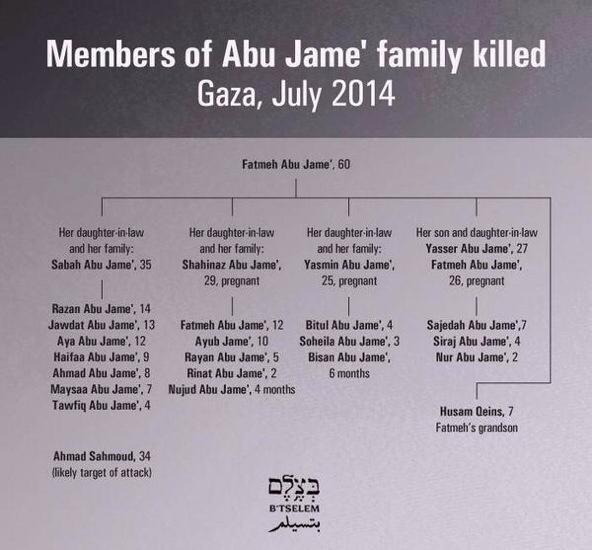
We've heard it all before, and no doubt we'll hear it again.  One thing we do seem to have been spared this time is the Palestinians don't feel pain such is their martyrdom ideation line, perhaps because the grieving for those killed has been there for all to see.  So too we've seen more reports from the "Sderot cinema" or other vantage points where an extreme, tiny minority of Israelis go to watch the carnage being wreaked on Gaza, cheering it on, just as vengeful and filled with hate as we're so often informed Palestinian children are brought up to be.  Whether they really approve of the horrific consequences on the ground, when 19 children were killed in a single strike, apparently just as guilty as the solitary target, we can't know.  They surely however demand justice just as much as the infants on board the MH17 did.

Labels: , , , , , , , , , , , ,

Share |

Friday, July 18, 2014 

A pound of flesh.


Three branches of the Entez family, around 60 people, were sheltering in a house in Zeitoun when it was struck by an artillery shell shortly after 8.45pm. Three of the family were killed – Abed Ali, 24, Mohamed Ibrahim, 13, and Mohamed Salem, two – and four injured. Three of the exterior walls were destroyed in the blast.

In the wreckage of the home on Friday morning, Salem Entez, 29, Mohamed Salem's father, approached the Guardian with a plastic bag, which he opened to reveal pieces of flesh he was collecting for burial. "This is my son," he said.

Labels: , , , , , , , , ,

Share |

Wednesday, July 16, 2014 

You will be buried in the same box as a killer.

Back in the good old days of the Cold War, the estimated time between the warning a Soviet ICBM was heading towards your area and the actual strike itself was four minutes, although most think even that was a tad optimistic.  It certainly didn't leave long to get to anywhere that might be safer, unless say you lived within running distance of an underground station and weren't knocked over and trampled to death by all the others with the same idea.

Fortunately, our good friends the Americans remain the only people to have decided to go nuclear.  Less fortunately for the Palestinians, the latest humanitarian gesture on the part of the IDF is to fire a "warning" missile at houses they intend to destroy, not just leaving it to chance the occupants will answer the phone.  Caught on film is one house getting a "knock on the roof", then being struck by the following, far more destructive projectile.  The time between the warning and the attack? Four minutes.

We shouldn't feel sorry though for the owner and his family, or indeed any others living in the building as multiple families usually do in the crowded Gaza strip.  The owner's sons are apparently Hamas members, therefore completely justifying the razing of his house.  Moreover, as the Israeli prime minister Binyamin Netanyahu said, since Hamas rejected the terms of the proposed Egyptian ceasefire everything that happens in Gaza from now on is solely their responsibility.

Not that it wasn't already.  A hospital struck by an Israeli missile was clearly a Hamas hospital, while the 55 UN installations either damaged or destroyed (since June 1st) were UN/Hamas installations.  The water supply infrastructure the UN warns is in danger of collapse due to the damage inflicted on it is a Hamas water supply.  How can it not be when Hamas members use it? The four cousins between the ages of 9 and 11 killed by an Israeli shell today were on a Hamas beach, inside a Hamas fishing shed, and it was witnessed by Hamas journalists who treated the survivors.  All 47 of the children killed so far have been Hamas children, still terrorists, just smaller.

Israel doesn't just have the right to defend itself, it has a responsibility to do so. The Palestinians by contrast don't just have the right to die, they have a responsibility to.  Hamas might rule the Gaza strip, and they might be responsible for everything that happens there, but they don't have the right to defend their territory, to resist.  Their use of rockets is a war crime, as they are too indiscriminate to properly target anything or anyone that could be considered as legitimate, not that there is anywhere in Israel that could be considered a legitimate military target anyway.

To step back from rocking the snark for just a second, Hamas was far too hasty in dismissing the Egyptian ceasefire proposal.  You can understand why they did; it only offered further talks rather anything substantive.  When we've been here twice before, Israel making promises to loosen the siege of Gaza that have subsequently come to nothing, it's not a surprise Hamas wants something this time they can hold the Israelis to.  In both previous examples it was also Israel rather than Hamas that broke the fragile peace.  Nonetheless, when the option is on the table to halt the suffering of the people Hamas claims to represent, to not at least give it a chance is close to unconscionable.

True, it's far easier to sell a ceasefire when the number of casualties on your side is 1, rather than 200 as it was yesterday for the Palestinians and there's little to show for it.  It doesn't however absolve Hamas of continuing with a policy which failed in the past and is going to again this time.  Israel has no intention of lifting the siege of Gaza, nor does Egypt under Sisi have any intention of making life easier for a movement that grew out of the Muslim Brotherhood.  The only way of putting Israel under pressure over the Palestinians is to threaten and if necessary introduce boycotts, just as John Kerry warned Netanyahu were on the horizon if he continued to refuse to countenance even the slightest gestures needed to keep the talks with Fatah on track.  Netanyahu's response was to "wag his finger" at the US secretary of state.  Responsibility, as we've seen, is something only the Palestinians fail to exercise.

Labels: , , , , , , , , ,

Share |

Monday, September 16, 2013 

The slightest of silver linings.

Much (including by yours truly) was written in the aftermath of the coalition losing the vote that would have led, supposedly, to a second vote on whether the UK should join potential military action in Syria.  This understandably focused on why it was that a government with a more than healthy majority by historical standards could manage to lose a motion on foreign policy, something that had the anoraks digging in their books to find the last example of, and what it meant for the main three parties.

Almost three weeks on, and with a deal having been reached between the US and Russia over Syria documenting and then handing over their chemical weapon stocks for destruction, the vote has become even more significant.  In their rush to get on board with what looked to be imminent US military strikes, the deadly duo of Cameron and Hague recalled parliament without so much as having the basics of a case for war.  True, they just about managed to get the joint intelligence committee and attorney general on their side, even if the reports from both were fairly pitiful, but as for why we had to intervene now and whether we could avoid being drawn into a protracted civil war, answers came there none.  Fingers of blame were pointed at Ed Miliband for his supposed preference for party politics over the "national interest", when the real reason the vote was lost was the prime minister's failure to convince his own backbenchers.

Thanks then to the miserable failure of Cameron, Hague and Clegg, you can make a reasonable case that another Middle Eastern adventure was avoided.  Without Cameron immediately granting a vote, apparently confident he would win it, there wouldn't have been the demands on Obama to consult Congress.  Obama, unlike Cameron, realised reasonably quickly that he was unlikely to win a vote, and unprepared to either ignore Congress or suffer the humiliation of such a loss, he and John Kerry sought out a Plan B.  Whether Obama ever truly wanted to get involved militarily in Syria is open to question; he had to be persuaded to act in Libya.  It would though have been an even bigger loss of face to not do something having seen his "red line" breached.  By focusing on chemical weapons rather than the removal of Assad or an increase in help for the rebels, there was always the possibility of a compromise, and that seems to have just about been reached.

As for whether or not Cameron will be thanked by the president is far more difficult to ascertain.  On the surface, it looks like a good deal if all goes as agreed.  Assad loses the weapons that sort of deterred Israel from interfering too heavily in the country, and which also struck a certain amount of fear into the rebels; it doesn't stop the US from increasing aid to the rebels, and there are reports that the long promised weapons have started to arrive; and the US avoids "owning" another sectarian conflict, having successfully engineered one that continues to rage in Iraq.  It could even lead to a break in the impasse over the Iran nuclear programme, if a splash in a certain liberal newspaper is to be believed.

Not everything looks quite so rosy, though.  Should the deal either fall through or Syria attempt to prevaricate, the US has all but boxed itself in to some sort of military action.  All the same problems with an attack on Syria as there were when it looked imminent will still apply.  Moreover, regardless of how it came about, backing down after it looked as though they were only days away from strikes will be seen as weakness at home.  It doesn't matter that the majority of the US public were against intervention, or indeed that the Republicans had just as much of a role as anyone else in making a vote seem unwinnable, we're already seeing the usual suspects whining, having believed they were going to get another notch on their "countries attacked" bedpost.  That it was done with the loathed Russians and while the even more despised Putin lurked in the shadows, having last week dared to suggest the US is anything but an "exceptional" nation, won't have improved their mood.

It feels especially incongruous when the UN inspection team has confirmed definitively that sarin was used in the attack on Ghouta in Damascus on the 21st of August.  Their report doesn't say it in as many words, but the inference is clear that the attack was carried out by the military, rather than the rebels.  This doesn't of course mean that the use of chemical weapons was ordered by Assad himself, or that the attack wasn't a "mistake", with those who prepared it getting the mixture wrong, although obviously the president is ultimately responsible.  It does though bring further into focus just how foolish the mad rush towards intervention was; why could the US, French and UK not wait until the inspectors had carried out their work?  The conflict in Syria has been so coloured with lies and propaganda from both sides that relatively unbiased evidence was crucial.  Like it or not, our own intelligence agencies simply aren't trusted any more, and for good reason.  It's difficult to believe that had any vote on action been delayed until now that a majority still wouldn't have been found, misgivings about another intervention in an Arab country or not.

In truth, it's a fitting sort of end to our entire policy on Syria.  From the very beginning William Hague and the coalition have been either unclear or deliberately misleading in what they've been trying to achieve, recognising the rebels, supplying them with "non-lethal" aid, all while refusing to put pressure on them to attend negotiations which the regime was prepared to enter into.  We say we want a diplomatic solution, yet we make no effort whatsoever to get one.  Instead, we allowed or tacitly supported the arming of the rebels by Qatar and Saudi Arabia, then acted surprised when they went to Salafists and other Islamists.  Now we seem to be hoping the "moderate" rebels will fight the likes of al-Nusra and the ISIS, and are training some to do so.  We cry crocodile tears about children and refugees, while seemingly not doing anything to alleviate the suffering of the Syrian people.  The best that can be said is that thanks to the US-Russia agreement, things are unlikely to get any worse for the moment.  They won't however get any better.  Hague and Cameron have however succeeded in making themselves look like idiots, as well as the most unreliable of allies.  The very slightest of silver linings.

Labels: , , , , , , , , , , ,

Share |

Monday, September 09, 2013 

The PPE approach.

From the inestimable Flying Rodent:
 

And we'll finish with a minor point - our politicians are so keen to cast their own actions as vitally important and historic that it's difficult to avoid concluding that they're victims of narcissism.

Without wanting to completely disagree, I'd argue that politicians constantly invoke yesterday's battles because it's one of the few things they do know about.  We get all the references to appeasement and the comparisons of today's dictators to Hitler not just because WW2 is the gold standard for the "good war", but due to how the PPE graduates who reign over us seem to imagine that such talk is impressive.  It doesn't matter how outrageous the allusions are when you examine them, with John Kerry daring to make a connection between Hitler, who was responsible for the deaths of millions, Saddam Hussein, who presided over the deaths of (probably) hundreds of thousands and gassed around 5,000 Kurds (with either US support or acquiescence) and Assad, who may have given the orders for the use of chemical weapons that killed either hundreds or in the region of 1,000, it's that you create the image in people's heads that the only way to deal with such leaders is force.

By the same token, to draw back or think again is to be pitifully weak, to set a precedent that every enemy or potential enemy will never forget.  To do nothing is to be Neville Chamberlain, to allow the destruction of a country far away of which we know little.  That this doesn't make even the slightest logical sense, especially when you set the "red line" yourself is rarely brought up in response because on the international stage we must always walk tall.  It's why David Cameron had to respond to a Russian minister referring to the UK as a small country with a Love Actually-esque riff instead of just dismissing it as unworthy of response.  As a letter writer in the Graun noted, the irony of claiming to have defeated fascism while in the nation that did the most to destroy the Nazi war machine couldn't have said more about the ridiculous way our politicians continue to puff themselves up.

It wouldn't be so bad if humanitarianism genuinely was at least one motivation behind the proposed US strike.  I was against intervention in Libya, but I always recognised that the desire to protect Benghazi was real.  With Syria, as Shuggy alludes to, what we're getting is pro-war moralism.  If you're against or undecided, dead children will be shoved under your nose.  I can remember during the Lebanon war the Evening Standard openly claiming that children were being used as shields; this time round, when we know for a fact that the rebels have used children as fighters, and when children's bodies are placed together for maximum effect (and I have no objection to that, but it should at least be recognised that's what's being done) we're meant to regard the use of chemical weapons as a unique evil that cannot be tolerated.  We could ask the average Vietnamese what he or she thinks about the United States suddenly discovering the inhumanity of the use of unconventional weapons, but they'd probably be too busy laughing.

In reality, this long stopped being about the plight of the average Syrian, and it's not about chemical weapons either.  In descending order, it's about Obama having to do something because of his dumb red line, about attempting to undermine Iran and about ensuring the civil war continues.  As Juan Cole writes, the concern is that Assad could fall too quickly rather than too late, with the jihadists amongst the opposition the beneficiaries.  Seeing as even some of those we consider not to be aligned with the ISI or al-Nusra want a caliphate, it's little wonder they apparently wish to repeat the Awakening experience of Iraq.  Far from wanting an end to the violence, we seem to be hoping the conflict gets bloodier.

Such is the low we've reached that this speech by Samantha Power, US ambassador to the UN, is described as being the case for intervention without moralising or confusion.  In her second paragraph she brings Iran and Hezbollah into it, and already you don't need to read any further.  While the overriding reason for public opposition to a strike is war-weariness, whether here or in the US, it also has to be the case that many are fed up with being taken for fools.  You don't have to so much as followed the conflict in Syria to know that Hezbollah intervened only after the conflict had been turned sectarian by the Qatari and Saudi funded rebels, in turn supported and funded by our good selves.  You don't need to be even slightly astute to see much of the coverage, including in the broadsheets and on the BBC, to be hopelessly biased or heavily influenced by the most base propaganda.  And when you've been lied to on such a scale as we were over Iraq and WMD, it takes a lot to convince that we should get involved in a conflict where it looks as those both sides are equally caked in blood.  The Russian/Syrian offer of being putting chemical weapons under international control offers very slight hope, but only that.  Our leaders might be able to spin war, but spinning a climb down after all this?  It would be the most abject display of weakness.  We can't have that.

Labels: , , , , , , ,

Share |

Monday, September 02, 2013 

Syria: the coalition is officially butthurt.

The coalition is exhibiting all the symptoms of what the internet has come to define as "butthurt".  Either unwilling or unable to bring itself to admit that the failure of the Syria vote was all down to them, whether due to the piss poor case they made, the apparent failure to detect massive opposition within their own parties or just plain old fashioned messing up, they've instead decided to pin all the blame on Ed Miliband.  Doncha know, if it hadn't been for the "cynical partisanship" of the Labour leader then Cameron and Hague could now be getting their war on.  According to George Osborne, Red Ed now looks even less like a future prime minister, and Osborne ought to know, considering he's about as likely to follow on from Dave as I'm to be next Pope.

It's fairly pointless looking to opinion polls now, as the results show the public to be as hopelessly confused as usual on who's come out of it well, meaning that they either don't know or don't care, but even before the vote there looked to be a fairly massive majority against any strike on Syria.  Taking this into account, it seems just a little bit silly to be presenting Miliband as the one who put a stop to our taking part in an intervention, as, err, that could just increase his popularity.  The whole partisan argument doesn't even stand up to the slightest scrutiny in any case: the motions were all but identical for goodness sake, just that Labour's asked for more time.  If the coalition had read the situation properly, they could have switched to the Labour motion and still gotten their war.  As it was, both were defeated.

The problem for Cameron and Hague, but Hague especially, is this shows that apart from the keyboard warriors online and the bomb flingers of Fleet Street, his approach to Syria is incredibly unpopular.  If there was widespread opposition to arming the rebels, as there was, why did either think that inconclusive reports of the use of chemical weapons, horrific images from the scene or not, would change people's minds so drastically?  Their policy hasn't made any sense for months, and it's actually got even more ridiculous as time has gone by.  As Simon Jenkins writes, you don't punish a country's government for using chemical weapons by killing more innocent people on the ground, as such an intervention inevitably would.  You either don't get involved at all and push for a diplomatic solution, or you plan an assault that will make a genuine difference.

Which is precisely why John Kerry's sermon last Friday was so incongruous.  There he was making this great moral case for how the world couldn't ignore a crime against humanity, when there isn't the slightest evidence that what's actually being proposed would prevent another such use of gas.  If he was personally persuasive, the intelligence released alongside his speech was almost identical to that produced by our own spooks, and raised just as many questions as it answered.  He also gave the game away when he brought Iran and Hezbollah into it, those other actors in Syria who were mentioned while Saudi Arabia and Qatar were ignored.  If Hezbollah did want chemical weapons, they most surely could have got them by now, while the JIC briefing last week said rebel groups did want to get their hands on them.  Personally, I'm far more concerned about what al-Qaida and its friends could do with Sarin or VX than I am Hezbollah, but then al-Qaida only kills anyone it feels like while Hezbollah, err, defends Lebanon against Israel.  Israel, meanwhile, continues to neither confirm or deny it has nuclear weapons, while it most likely has chemical/biological weapons programmes too.

One conclusion to be reached is that rather than wanting to bring the civil war to an end, we actually want it to continue.  Israel, we are told, remains ambivalent, not surprisingly considering the lack of trouble Assad has caused the country, in spite of the continuing occupation of the Golan Heights.  It doesn't like his support for Hezbollah, but he's probably preferable to either the instability of what would come after, or indeed the Islamist regime that would be the most likely outcome.  We ourselves might follow Saudi policy in the region, but we don't particularly want the jihadis to have another potential safe haven, even if it means a dilution of Iranian power.  The conflict might have led to around 2 million people fleeing, but for now they mostly haven't tried to reach our shores, instead going to either Lebanon, Jordan or Turkey.  And as long as they're fighting each other, they're less concerned about targeting the West.

It would certainly explain why we favour only minimally striking Assad for the use of CW, when we went after Iraq not having the first idea how the war there would pan out.  It would also mean that despite all the rhetoric of how something must be done and the use of the most emotional language, we really couldn't care less about the Syrians themselves, something I've felt has been the case from the very beginning.

Labels: , , , , , , , , , ,

Share |

About

  • This is septicisle
profile

Archives

Powered by Blogger
and Blogger Templates