And they say Corbyn's the disrespectful one.
One of the lesser noticed pieces of anti-Corbyn bluster from the dog end of his idiosyncratic first week as leader was from a general in the Sunday Times. The general wasn't named, naturally, but we were assured he had served in Northern Ireland, part of the reason he felt such ire for Corbyn and John McDonnell's dealings with Sinn Fein. Should Corbyn come to power and "jeopardise the security of this country", such as by scrapping Trident or emasculating the army, although it's not exactly clear just how much more there will be to emasculate once the Conservatives are through, then "people would use whatever means possible, fair or foul to prevent that".
Many took this as the general threatening a full scale mutiny, or worse, understandably. It didn't seem to occur to the general that the only way Corbyn could come to power would be through a general election, where presumably at the very least the policy of dispensing with our nuclear weapons would be in the Labour manifesto. If it did, then it made no odds, reminding of Henry Kissinger's remarks about Chile: "I don't see why we need to stand by and watch a country go communist due to the irresponsibility of its own people".
Now, if I were prime minister, the very fact a general was so much as discussing the idea of a mutiny, let alone hinting it could go further even than that would be enough for me to want to know who this general was and to pull him in for an extremely frank discussion about the nature of democracy. If his answers weren't suitably reassuring, I would want him either sacked or demoted to the ranks. There is much said about slippery slopes and logical fallacies, but once anyone in a position of military authority starts talking about "using whatever means possible" to defy a prime minister, it's gone beyond asking for a rethink or warning about the potential consequences to somewhere quite different. If I was David Cameron, I would be deeply concerned about a general talking in such a way regardless of his remarks being directed at the leader of the opposition.
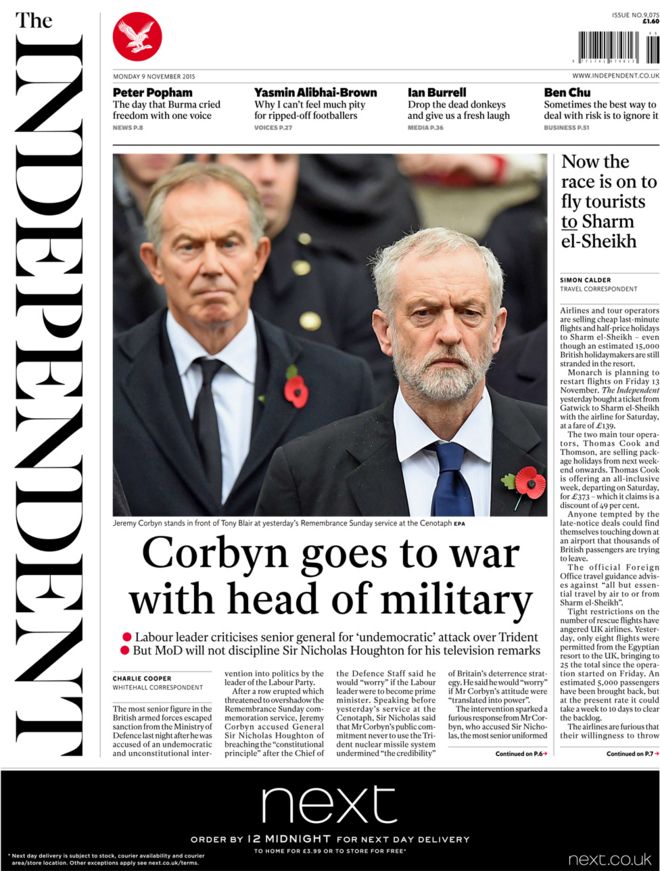
If Downing Street was alarmed by the reports, then any concerns were presumably addressed prior to yesterday's appearance by General Sir Nicholas Houghton on the Andrew Marr show. Whether or not Houghton was the general with the hotline to the Murdoch press, he decided that on Remembrance Sunday of all days he should answer a question about Trident. If Corbyn's stance on never using Trident was "translated into power", then Houghton would be concerned, as "you use the deterrent every second of every minute of every day". Apart from the conjuring up of the potential incineration of millions on the day set aside to remember the fallen, reason enough for Houghton to decline to answer the question, this was about as blatant an intervention into party politics and indeed politics in general as can be imagined. Nor was he content with just talking about Trident, also commenting on Sky News on how the lack of a decision on bombing Islamic State in Syria was "letting down our allies".
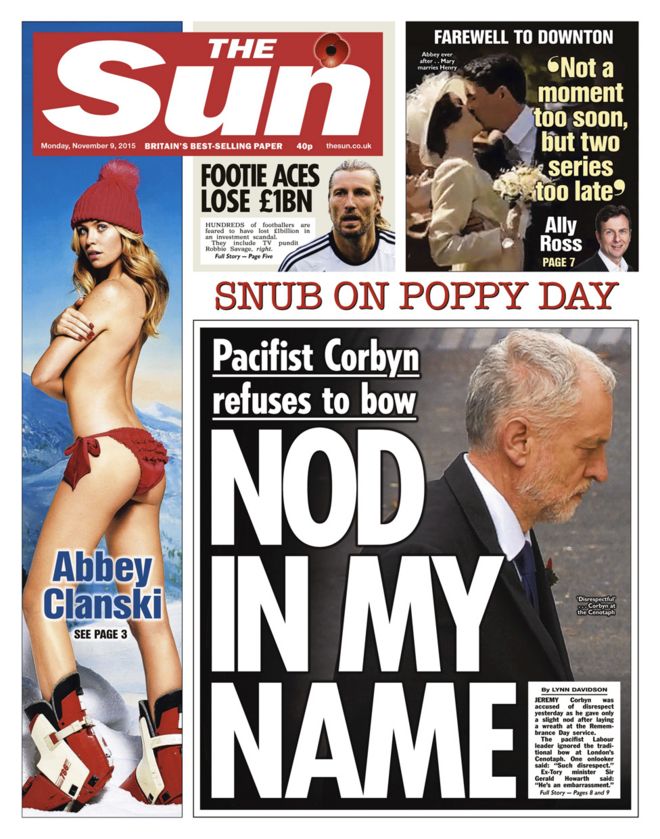
It's hard not to conclude that Houghton's comments were part of the general "get Corbyn" sentiment of the entire day, a view only encouraged by the government backing the general. Had Corbyn bent over double at the Cenotaph he would have been accused of mocking the entire ceremony; as it was, his nod rather than "protocol-following" bow instead landed him the brickbats that had been in preparation ever since he committed the crime of not singing the national anthem. Corbyn was nothing other than respectful and respectable in everything he did yesterday, from laying his wreath to then attending a further ceremony in his constituency. All the pieces had been written beforehand, waiting only to be altered according to what could be gotten away with.
If there ought to be one day a year free from agitating from yet more war, it should be Remembrance Sunday. Instead, we had the general and ministers once again saying how desperately unfair and immoral it is that parliament won't let them bomb whatever the hell they like. Standing directly behind Corbyn was a past Labour leader whom, whatever you think of the rights or wrongs of his wars, has many questions still hanging over him. His patriotism, his respect for the dead is not questioned. Nor is that of David Cameron, whose media team felt it would be a good idea to photoshop a poppy onto a stock photo of the prime minister, hoping no one would notice.
Precisely what it is the Tories or the Sun and Telegraph think it is they're trying to achieve with all this is not clear. If the aim is to try to frame Corbyn as this disrespectful, anti-military peacenik, then they can surely leave that in the safe and reliable hands of the Anyone But Corbyn ranks on the Labour backbenches, within the party and on the wider left. Nothing they've could do, will do, will live up to the claims of Corbyn handing over policy to the Stop the War coalition, to give just one example.
What this continued abuse of remembrance to make political points will do is further the distaste increasing numbers have for the entire period, which is far from now only affecting those inclined towards such feelings. The Royal British Legion claim 80% wear a poppy; by my entirely unscientific measure of walking through the odd crowd in shopping centres, my guess would be nearer 50%, if that. The bullying, as that's what it is, of public figures who for whatever reason are seen without a poppy leaves an ever more unpleasant taste in the mouth. When you make a practice all but compulsory, as remembrance is in distinct danger of becoming, there are always those who are going to resist. The only people who will suffer from this behaviour in the long run are those whom require the help of the RBL and other military charities, the same individuals whom the the Sun and politicians affect to care so deeply about. Such considerations are apparently secondary to short-term political gain.
Many took this as the general threatening a full scale mutiny, or worse, understandably. It didn't seem to occur to the general that the only way Corbyn could come to power would be through a general election, where presumably at the very least the policy of dispensing with our nuclear weapons would be in the Labour manifesto. If it did, then it made no odds, reminding of Henry Kissinger's remarks about Chile: "I don't see why we need to stand by and watch a country go communist due to the irresponsibility of its own people".
Now, if I were prime minister, the very fact a general was so much as discussing the idea of a mutiny, let alone hinting it could go further even than that would be enough for me to want to know who this general was and to pull him in for an extremely frank discussion about the nature of democracy. If his answers weren't suitably reassuring, I would want him either sacked or demoted to the ranks. There is much said about slippery slopes and logical fallacies, but once anyone in a position of military authority starts talking about "using whatever means possible" to defy a prime minister, it's gone beyond asking for a rethink or warning about the potential consequences to somewhere quite different. If I was David Cameron, I would be deeply concerned about a general talking in such a way regardless of his remarks being directed at the leader of the opposition.
If Downing Street was alarmed by the reports, then any concerns were presumably addressed prior to yesterday's appearance by General Sir Nicholas Houghton on the Andrew Marr show. Whether or not Houghton was the general with the hotline to the Murdoch press, he decided that on Remembrance Sunday of all days he should answer a question about Trident. If Corbyn's stance on never using Trident was "translated into power", then Houghton would be concerned, as "you use the deterrent every second of every minute of every day". Apart from the conjuring up of the potential incineration of millions on the day set aside to remember the fallen, reason enough for Houghton to decline to answer the question, this was about as blatant an intervention into party politics and indeed politics in general as can be imagined. Nor was he content with just talking about Trident, also commenting on Sky News on how the lack of a decision on bombing Islamic State in Syria was "letting down our allies".
It's hard not to conclude that Houghton's comments were part of the general "get Corbyn" sentiment of the entire day, a view only encouraged by the government backing the general. Had Corbyn bent over double at the Cenotaph he would have been accused of mocking the entire ceremony; as it was, his nod rather than "protocol-following" bow instead landed him the brickbats that had been in preparation ever since he committed the crime of not singing the national anthem. Corbyn was nothing other than respectful and respectable in everything he did yesterday, from laying his wreath to then attending a further ceremony in his constituency. All the pieces had been written beforehand, waiting only to be altered according to what could be gotten away with.
If there ought to be one day a year free from agitating from yet more war, it should be Remembrance Sunday. Instead, we had the general and ministers once again saying how desperately unfair and immoral it is that parliament won't let them bomb whatever the hell they like. Standing directly behind Corbyn was a past Labour leader whom, whatever you think of the rights or wrongs of his wars, has many questions still hanging over him. His patriotism, his respect for the dead is not questioned. Nor is that of David Cameron, whose media team felt it would be a good idea to photoshop a poppy onto a stock photo of the prime minister, hoping no one would notice.
Precisely what it is the Tories or the Sun and Telegraph think it is they're trying to achieve with all this is not clear. If the aim is to try to frame Corbyn as this disrespectful, anti-military peacenik, then they can surely leave that in the safe and reliable hands of the Anyone But Corbyn ranks on the Labour backbenches, within the party and on the wider left. Nothing they've could do, will do, will live up to the claims of Corbyn handing over policy to the Stop the War coalition, to give just one example.
What this continued abuse of remembrance to make political points will do is further the distaste increasing numbers have for the entire period, which is far from now only affecting those inclined towards such feelings. The Royal British Legion claim 80% wear a poppy; by my entirely unscientific measure of walking through the odd crowd in shopping centres, my guess would be nearer 50%, if that. The bullying, as that's what it is, of public figures who for whatever reason are seen without a poppy leaves an ever more unpleasant taste in the mouth. When you make a practice all but compulsory, as remembrance is in distinct danger of becoming, there are always those who are going to resist. The only people who will suffer from this behaviour in the long run are those whom require the help of the RBL and other military charities, the same individuals whom the the Sun and politicians affect to care so deeply about. Such considerations are apparently secondary to short-term political gain.
Labels: Army, Jeremy Corbyn, Labour, media analysis, media stupidity, Nicholas Houghton, politics, Remembrance Sunday, Royal British Legion
| Permalink