Learned nothing and forgotten nothing.
The civil service is, as we know, politically neutral. It's therefore implausible, not to mention offensive to suggest that the Forfeiture Committee was in any way lent on or obliging towards the government in deciding that Fred Goodwin should lose his knighthood. Just as David Cameron has been made to look weak and vacillating in his refusal to say Stephen Hester shouldn't be receiving a bonus (and wasn't it also curious that the day after Cameron said if Hester was to get a bonus, it should be under a million, he was awarded one of just under that figure?), here comes Queenie herself, ripping up the honour she bestowed on everyone's least favourite banker on behalf of the last government.
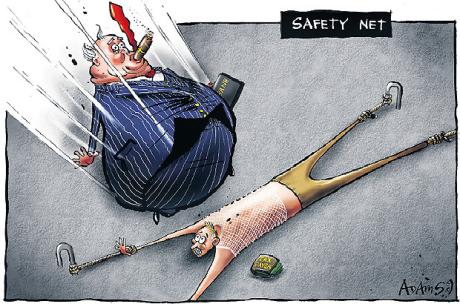
While we can all agree that Goodwin's continuing to hold a knighthood on the basis of "services to banking" was rather rum, the decision to strip him of it is a wonderful example of the dangers of political consensus and contemporary thinking. After all, Goodwin could not have been instrumental in the rise and then fall of the Royal Bank of Scotland had he not been encouraged and received acquiescence from those around him, whether it was from the Labour government, the Financial Services Authority, or indeed the bank's board and its shareholders. All of them signed off on the takeover of ABN Amro, believing that the bubbles in housing and credit would never burst, while not giving too much thought to what would happen should a bank become so big that bailing it out would cost tens of billions of pounds, or become so large as to be too big for some governments to even part nationalise.
Goodwin is undoubtedly primarily culpable, and his reputation as "Fred the Shred" and then his initial decision to take his £700,000 a year pension in full made him the pantomime villain of the sort that has seen him appear twice as a character in Viz, yet his failure was nothing compared to that of the entire system. As Aditya Chakrabortty writes, the idea of rewarding CEOs extra millions on top of their basic salaries was not thought up by the boards themselves, but by academics, who wrote papers claiming that providing extra incentives achieved enhanced results; politicians and indeed most ordinary people thought this was perfectly acceptable, at least while the economy itself was growing, regardless of the yawning disparities in pay. Labour's increased spending on health and education was underpinned by the tax receipts the financial sector was providing, giving ministers no reason whatsoever to suggest that the system was unsustainable. The opposition, for their part, were suggesting slashing regulation still further, while George Osborne made it known that he was considering a flat tax.
By taking Goodwin's knighthood we are then both repeating the pattern, as there hasn't been a single politician who has dared to suggest that this is an unprecendented step (Update: not quite unprecedented, see comments), considering he hasn't been convicted of any crime, nor is he a head of state murdering his own citizens, with the FSA report into RBS admitting that Goodwin didn't break any rules in his dealings, and also implying that it was one man alone who helped to trigger the "financial crisis of 2008-9", the Cabinet Office's statement relegating everything else that brought about the worst recession since the 1930s as "other macroeconomic factors". We have it seems, like the Bourbons, learned nothing and forgotten nothing.
While we can all agree that Goodwin's continuing to hold a knighthood on the basis of "services to banking" was rather rum, the decision to strip him of it is a wonderful example of the dangers of political consensus and contemporary thinking. After all, Goodwin could not have been instrumental in the rise and then fall of the Royal Bank of Scotland had he not been encouraged and received acquiescence from those around him, whether it was from the Labour government, the Financial Services Authority, or indeed the bank's board and its shareholders. All of them signed off on the takeover of ABN Amro, believing that the bubbles in housing and credit would never burst, while not giving too much thought to what would happen should a bank become so big that bailing it out would cost tens of billions of pounds, or become so large as to be too big for some governments to even part nationalise.
Goodwin is undoubtedly primarily culpable, and his reputation as "Fred the Shred" and then his initial decision to take his £700,000 a year pension in full made him the pantomime villain of the sort that has seen him appear twice as a character in Viz, yet his failure was nothing compared to that of the entire system. As Aditya Chakrabortty writes, the idea of rewarding CEOs extra millions on top of their basic salaries was not thought up by the boards themselves, but by academics, who wrote papers claiming that providing extra incentives achieved enhanced results; politicians and indeed most ordinary people thought this was perfectly acceptable, at least while the economy itself was growing, regardless of the yawning disparities in pay. Labour's increased spending on health and education was underpinned by the tax receipts the financial sector was providing, giving ministers no reason whatsoever to suggest that the system was unsustainable. The opposition, for their part, were suggesting slashing regulation still further, while George Osborne made it known that he was considering a flat tax.
By taking Goodwin's knighthood we are then both repeating the pattern, as there hasn't been a single politician who has dared to suggest that this is an unprecendented step (Update: not quite unprecedented, see comments), considering he hasn't been convicted of any crime, nor is he a head of state murdering his own citizens, with the FSA report into RBS admitting that Goodwin didn't break any rules in his dealings, and also implying that it was one man alone who helped to trigger the "financial crisis of 2008-9", the Cabinet Office's statement relegating everything else that brought about the worst recession since the 1930s as "other macroeconomic factors". We have it seems, like the Bourbons, learned nothing and forgotten nothing.
Labels: Conservative-Liberal Democrat coalition, economics, Fred Goodwin, politics, Royal Bank of Scotland
| Permalink