Thursday, January 23, 2014 

It's all multiculturalism's fault. Again.

Horror of horrors!  Britain becoming more multicultural is leading to a "growing reluctance" to troops being deployed on the ground in areas which some of the population either called home or has connections with, says the Ministry of Defence, via the Graun.  It's yet another example of the fallout following the failure of the Commons to go along with the plan to "punish" Assad for using chemical weapons in Syria, and also yet another example of ministers and the wider government failing to point the finger of blame at themselves.

While it's no doubt true that "war weariness" played its part in MPs opting to vote against the motions of both the coalition and Labour which looked set to lead to yet another strike on a Middle Eastern country, the main reason why the vote went against the government was because it didn't even begin to make the damn case for an attack on Syria.  All that was presented was shaky intelligence which pointed towards chemical weapons having been used, along with the argument that such an act could not be allowed to go unpunished, despite the fact that previous chemical weapons attacks on a far worse scale had been.  It wasn't explained how launching a few hundred cruise missiles at Syria would prevent further such attacks, or how doing so would prevent us from getting sucked even further into a civil war we have nothing to gain and much to lose from getting involved in.  Public opinion was firmly against, and MPs for once represented their constituents in rejecting it, at that point.  Whether David Cameron was right to then rule out any action whatsoever is another question entirely.

Rather than take a look at whether the case for war was as strong as they believe it was, almost everything else has been held responsible.  Only the latest is multiculturalism, with Alistair Burt having previously said the decision had left a "constitutional mess", as it seemed MPs could now declare themselves against something that was previously the prerogative of the executive, without it being considered a vote of no confidence.  Originally it was all Ed Miliband's fault, while now there's also much wailing and gnashing of teeth over how we might not be able to be a "full spectrum" partner to the Americans unless we join them in every such conflict and ensure our army has the very latest devices of mass death at its disposal.

All this ignores that if you put a case forward that's considered convincing by a majority of the public, have the support of most of the media and also know that you have can rely on most of your party and the opposition, wars which are opposed by a large, vocal minority can still be fought, as Iraq proved and would still be the case today.  Our participation in the NATO action in Libya went ahead as well after all.  If instead you try to bounce the country into a conflict because an especially barbarous crime is carried out in a country in which 100,000 have already died without such action being considered previously, mainly due to how the American president foolishly set a "red line" which he didn't expect to breached, then you should no longer be surprised that MPs won't just march through the yes lobby no questions asked.  That still the government seems to be ignoring what ought to be staring it in the face is far more concerning than any of the calamities our supposed sudden aversion towards war has thrown up.

Labels: , , , , , , , , , ,

Share |

Tuesday, June 07, 2011 

Radicalisation and the ideologues.

It's Tuesday, which means it must be time for another government review to publish its findings. Having yesterday demonstrated muddled thinking and a complete unwillingness to confront the real fundamental problem when it comes to the supposed commercialisation and sexualisation of children, so today we have a report on the Prevent strategy of countering radicalisation which demonstrates muddled thinking as well as an apparent determination to potentially make things much worse.

For this we have the prime minister to principally thank. Where Tony Blair once told the country that the rules of the game were changing, and the prospect of 90 days detention without charge followed shortly after, David Cameron back in February in Munich of all places informed the nation that the time had come for a muscular espousal of our values. In what was meant to be a speech on terrorism he decided the time was right to pronounce on both integration and the failure of "state multiculturalism", when even if the issues are hardly mutually exclusive he had not even begun to exercise the proper level of caution before making sweeping statements of fact. His key new point was that no longer would the government tolerate organisations which hold "extremist" points of view being either funded by the state (which they weren't in the first place) or consider them as useful in combating extremism. Why, you wouldn't expect a fascist political party to help in steering followers away from a violent white supremacist grouping. Why should it be the same when it comes to groups with an adherence to Islamism?

Two months in to a consultation exercise then and the findings of the review had already been set out. As well as being heavily influenced by the personal biases of Michael Gove, he of such remainders as Celsius 7/7, along with Policy Exchange, they of such fine reports as the one which was undermined somewhat by the forging of receipts from mosque bookshops, it also draws heavily from the work of the Quilliam Foundation, the counter-extremism think-tank which is err, mainly funded out of the Prevent budget, and has, err, Michael Gove on its non-executive advisory board. Having started out promisingly, the think-tank has since settled on a course of annoying almost every other Muslim organisation it's come into any sort of contact with, and last year singled out a good number of them as being the kind the government should have little or nothing to do with, among them the Muslim Safety Forum, a grouping which has been praised for its work with the police in helping to understand the concerns of the community.

Not that this closeness has stopped Quilliam from today being highly critical of the end result. The criticism is also rather rich, and more than a little self-contradictory: having previously set out in a secret document which Muslim organisations had extremist leanings, it now finds that Prevent's definition of what Islamism is is flawed. To quote from their press release (PDF):

The Prevent strategy’s definition of Islamism as ‘a philosophy which, in the broadest sense, promotes the application of Islamic values to modern government’ shows a complete misunderstanding of the nature of Islamism and why it is problematic. This current definition downplays the negative aspects of Islamism and ignores the fact that most non-Islamist Muslims also believe in combining Islamic values and modern government. The Prevent strategy’s definition therefore risks smearing ordinary, non-Islamist Muslims as Islamists and thus falsely identifying them as being part of the problem while also implying that Islamism is one of the aspirations of every Muslim.

Yes, smearing ordinary, non-Islamist Muslims as Islamists is something Quilliam would never do, would it? The point however is a sound one, even it comes from those with plenty of baggage. For however much we want to espouse and define ourselves by our values, it's those very values that those at risk of radicalisation and turning to terrorism are either unmoved by or are actively opposed to: the best hope of turning them away from such a path isn't to imply that the entirety of Islamic-influenced political thinking is reactionary and opposed to Western values, especially when much of it isn't, but for such ideology to be recognised as perfectly legitimate. This is exactly why Cameron's analogy of not relying on fascists to be part of the solution to violent white nationalism is so fatuous: those inclined towards Islamism are not going to be suddenly converted to the joys of Western democracy as it stands overnight. Moreover, if we regard the likes of Hizb-ut-Tahrir or the remnants of al-Muhajiroun to be stepping stones towards full on radicalisation in the takfirist jihadist mould, shouldn't we also consider that Islamist groupings opposed to violence but not able to pass the new "extremism" test are viable steps on the road to recovery?

Quilliam is also, notably, critical of the new definition of "extremism" as laid out in the new Prevent strategy, this time for the reason that it isn't tight enough to contain all the awful Islamist groups:

For instance, the definition’s description of extremism as being opposition to ‘democracy, the rule of law, individual liberty and mutual tolerance’ is far too open to interpretation. For instance this overlooks that both far-right and Islamist extremists are authoritarians who want more ‘rule of law’ rather than less.

This is besides the fact that governments themselves often have a rather hazy concept of the rule of law and individual liberty. The last one certainly did, whether it was ordering the end of an investigation into corruption or deciding that the threat to the country post-9/11 was so massive that it meant foreign nationals could be detained indefinitely without charge.

It is that threat after all that this entire document is meant to be about thwarting. Just how serious is the threat, though? There hasn't been a major terrorist plot in this country prevented now since the "liquid bombs" ring was broken up, and to tempt fate, there's no sign of one on the horizon. Yes, the threat remains at severe as we are endlessly informed, yet for the most part the last few years have seen the rise of the "lone wolf" attackers, operating alone or with minimal if any contact with the base organisations overseas. Just how these individuals can be prevented from becoming so disillusioned with society that they feel impelled to attack it is almost impossible to prescribe, and this document doesn't really even begin to provide any answers. Yes, some vulnerable individuals have been identified through the Channel programme, along with dozens of others it's reasonable to surmise who had nothing other than temporary interest in the subject of jihadism. Much depends then on the groups the strategy seems intent on all but proscribing at worst and dismissing at best.

This isn't to suggest that all of the changes to the strategy are bad: belatedly it's been decided that it will cover not just Islamist extremism but also what it terms as "Northern Ireland-related terrorism", as well as extreme right-wing ideology, although it massively plays the latter down, something that seems curious when it's the radicals of the English Defence League that currently pose the biggest threat to community cohesion. It's also discarded the previous combination of work on integration along with tackling radicalisation, something that David Cameron could have learned from. So much else though is either counter-productive or worrying: the document applauds the "No Platform" stance of the National Union of Students, something that continues to shut down debate, while urging universities to keep closer tabs on their charges, even if it doesn't say so in as many words. The section on the internet also appears to suggest that the Internet Watch Foundation's role in blocking "extremist" content will be stepped up, as if its completely unaccountable work wasn't already raising more than legitimate concerns.

Counter-terrorism policy is far too important to be left to ideologues, as we saw under the last government. Instead what works has to be prioritised, however much that potentially offends our political sensibilities. For all the nonsense spoken today about "extremist" organisations being funded out of the public purse, the review itself fails to name a single one which was, only saying that groups it would now define as "extremist" had previously picked up public funds. It might well have been some of those small organisations that helped those on the path to outright radicalisation to step back and reconsider; after all, there were no successful attacks over the period it was in operation. We'll have to wait and see if that remains the case in the years to come.

Labels: , , , , , , , , ,

Share |

Monday, February 07, 2011 

Assimilate or you don't belong.

The formation of the coalition government has in many ways relatively spoilt those of us of a socially liberal bent. While there was never much danger of the Tories rolling back the many advances New Labour made on the equality front, it seemed certain that they would continue to pursue the authoritarian policies on law and order which had been the consensus since the days of Michael Howard. Down to a mixture of the forced inclusion of the Liberal Democrats, the defenestration of Chris Grayling and the pairing of Ken Clarke and Theresa May as justice and home secretary respectively, instead of bubble economics and illiberal triangulation we now have austerity and nominal but welcome defiance of red-top "solutions" to crime and disorder.

We have perhaps then been heading for a challenge to that arrangement, although it seemed more likely to come from a scandal/debacle similar to that which did for Charles Clarke than from the prime minister himself. David Cameron's speech in Munich was unexpected precisely because the coalition has done its best to take the politics out of the debate on the terrorist threat, having with the exception of the reforms to the control order system managed to successfully scale back Labour's excesses in legislating while causing the minimal amount of fuss from those who had previously screamed and demanded ever further impositions on liberty for the illusion of more safety. As others have pointed out, it's all the more puzzling because so much of what he said he's dealt with before, albeit it in opposition. Was it too much to expect that he would drop his shallow critique of "state multiculturalism" along with his constant references to the "broken society"?

For whatever reason, and it's difficult to dismiss that it has more than something to do with the increasing problems the coalition is facing as the cuts begin to bite and the economy flatlines, it's time to once again return to exactly what it is that motivates some Muslims to become so disengaged from society that they are willing to kill their fellow citizens. Why else indeed would he conflate terrorism, which those in Munich at the security conference were doubtless expecting him to speak about, with multiculturalism and integration as a whole? It certainly wasn't intended that he would give the speech on the same day as the English Defence League paraded through the boarded up streets of Luton, yet through not offering any overt criticism of the organisation and by all but echoing their message that the only real issue facing us is the refusal of Muslims to engage in wider society he will have certainly provided them with all the encouragement they need to keep bringing disruption to towns and cities across the country. It has only been thanks to supreme patience and the community leaders that Cameron has effectively impugned that there hasn't been a recurrence of the full scale riots of 10 years ago.

It is after all worth taking a step back and examining the supposed threat and just how large it really is. If we take the probably exaggerated estimates of the security services at face value, there are around 2,000 people in this country actively dedicated to what Cameron describes as the violent element of political Islam, a number which even considering the potential harm and suffering they could cause is tiny. As Jamie argues, there really has been relatively little to prevent given even those numbers post 9/11, thanks to a mixture of old-fashioned intelligence work and the stupidity of many of those involved. Nonetheless, Muslims as a whole have found themselves threatened, told to inform on those in their midst, been widely disparaged for failing to do just that and now find that even if they don't hold views defined as being extremist, they're being informed by none other than the prime minister of the country that they don't "belong".

This is the massive flaw in Cameron's Michael Gove/Policy Exchange inspired analysis. Even if we accept that the problem fundamentally is the attraction of violent political Islam as an all encompassing ideology, rather than his straw man of "soft left" compiled grievances, the idea that the solution is a new British identity built around a "muscular" promotion of "our" values is laughable. Cameron's example of communities being allowed to live apart, with white racism condemned while practices such as forced marriage are allowed to go ahead is muddled thinking at its worst, even if it was accurate. How would extremism be dealt a blow if we managed to stop every such arrangement from going ahead? Surely the opposite might well be the case? He goes on to talk of "groups and organisations" and "non-violent extremists" having first influenced those who have gone on to plot or carry out attacks, to which he can only be referring to either Al-Muhajiroun and its successor organisations, all since banned, and/or Hizb-ut-Tahrir, the organisation the Tories previously promised to ban. None of these groups have ever received government funds, and as Sunny points out, those organisations which hold views Cameron now says should proscribe them from direct involvement with the government stopped receiving it in around 2006.

While there is then more than a element of posturing to some of Cameron's points, he often isn't comparing like with like. If political Islam is a perversion of the faith, it requires those that share that faith who may potentially have some views we find abhorrent in order to properly fight against it; this isn't the equivalent of expecting a fascist party to fight a violent white supremacist moment. Some of those who have become radicalised simply won't be convinced by the arguments of the likes of the Quilliam Foundation, however much we would like it to be so. Cameron does in fact all but say this, then instantly contradicts it. This isn't to say that such groups or individuals should receive government funding, but it is counter-productive in the extreme to tell them to their face that they don't belong. Not only is this, as others have again argued, completely alien to the exact concepts of liberal democracy which Cameron wants to espouse and "muscularly" promote, nothing seems more calculated to breed resentment and disillusion with our society. It is exactly what the extremists would and will play on. Assimilate or you're not one of us is a disastrous message to send.

It could well be that this is just another speech that won't be properly followed up with action, or that in reality it just means that Labour's Prevent strategy of showering counter-radicalisation groups and organisations regardless of their provenance with money is coming to an end, as could be expected as the funding for almost everything else dries up. Tony Blair declared the end of state multiculturalism in a similar fashion, and little has changed. Alternatively, and with the announcement of the replacement for ASBOs following a similarly illiberal path, it could mark the end of the one reason to cheer the formation of the coalition.

Labels: , , , , , ,

Share |

Friday, February 15, 2008 

How churnalism works over the RUSI report, and other thoughts on it.

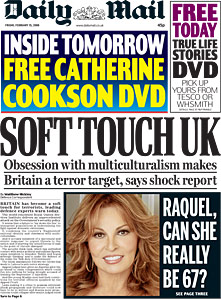
I keep trying not to return to Nick Davies' Flat Earth News (review tomorrow, hopefully) but another of its main accusations, that journalism is increasingly reliant on PR, is borne out by the rather hefty coverage given to an otherwise reasonably unremarkable essay in the Royal United Services Institute journal. Written by Gwyn Prins and Robert (formely Lord) Salisbury, it opens with the statement (PDF) "[T]he security of the United Kingdom is at risk and under threat" and continues on, tediously and with little sublety, to its conclusion. As I said, unremarkable. If it had been published without being presumably sent, either to the Press Association or to the newspapers themselves, only defence or security correspondents would have been likely to have noticed it, let alone reported it.

To be fair to Daniel Sherman, who appears to be RUSI's "media inquiries" person, or aka, most likely the PR head, the word "multiculturalism" doesn't appear in the press release. Neither does "soft touch". Both however, made the headline splash on the front page of the Daily Mail. Having been provided with the release, the Mail hack responsible likely sped-read through the essay, saw the word multiculturalism, with features only around three times and isn't one of the main points of the article, then soft-touch, which features once, and from there the front page loomed. It after all made a change from earlier in the week, when the tabloids almost as a whole have been going crazy about how our youth are going to hell in a handcart, Britain is binging itself to oblivion and how we're all going to die. That it's been half-term week, when kids themselves are more likely to be taking notice of the media makes this especially repellent.

This was then from one hardy perennial to another. As Davies in FEN writes, these sort of press releases and articles are perfect for the lazy journalist or the time-stretched hack alike. They enable them to use large amounts of copy and paste, add very little of any other real substance, and they don't have to bother to check any of the information. If they had, they might have noticed that the essay notes onerously about the threat posed by Russia, especially the "unprecedented 2007 cyber-attack on Estonia, in which state resources were apparently complicit." Sorry to break it to the Russiaphobes and pessimists scaremongering about a new cold war, but the attack on Estonia has been traced back to the almost cliched just out of teenage years man within Estonia itself, who commanded what must have been a huge botnet.

Debate has then revolved around the two things that the essay doesn't really dwell on. Yes, it talks about "the United Kingdom presenting itself as a target, as a fragmenting, post-Christian society" with that "fragmentation worsened by the firm self-image of those within it who refuse to integrate" with the problem worsened still "by the lack of leadership from the majority which in mis-placed deference to multiculturalism failed to lay down the line to immigrant communities" but this isn't within the section where the authors outline the threats to security as they see them. The simple reply to that in any case is that we are presenting ourselves as a target, not because we're a post-Christian society or a soft-touch, but because we've involved ourselves in wars where some blowback was inevitable. Even the most ardent of those warning about the extremism in our midst admit that certainly prior to 9/11 and even up until the Iraq war there was something approaching an unwritten article of understanding where we allowed "them" to get on with it as long as Britain itself was not the target. If 9/11 changed everything, then so did the Iraq war. It's not as if this extremism is contained only in countries where the multicultural approach is always in evidence; an increasing number of attacks have been foiled in both America and in Europe, mainly targeting American installations if the country itself isn't involved in the operations in either Afghanistan or Iraq. The underlying point of the essay is that we haven't beaten into the lousy immigrants that they can't do whatever the hell they like here, which is errant nonsense.

The essay also says that "[7/7] exposed the weakness of the ‘multi-cultural’ approach towards Islamists", but did it really? Sure, to those already opposed in principle to "multiculturalism", which is and has never been an actual policy but something that has occurred naturally over time, it enabled them to point the finger, but wasn't its real message that regardless of race, religion or any other signifer, if someone wants to commit an act of mass murder, for whatever ridiculous, disengenuous and despicable reason, they will do so? As under Brown the government has moved towards, the right approach is to remove whatever pretentious, vacuous title these men give themselves, in Mohammad Siddique Khan's case that he was a "solider", and instead make clear what they are: self-righteous criminals killing innocent civilians for their own selfish, qausi-religious reasons. Of course they're jihadists, but the bottom line isn't Islam, but rather pure hatred, whether it's of modernity or otherwise.

Here's the paragraph on how we're a "soft-touch":

The deep guarantee of real strength is our knowledge of who we are. Our loss of cultural self-confidence weakens our ability to develop new means to provide for our security in the face of new risks. Our uncertainty incubates the embryonic threats these risks represent. We look like a soft touch. We are indeed a soft touch, from within and without.

But there is again no real evidence to back this up. We've long been an apathetic nation; around the only time we ever reach consensus is when we reach the finals of a football tournament, and then it's on what round we'll reach before we lose on penalties. Even that one time that everyone harks back to, the Blitz, has been convienently sanitised, like the occasions when the Queen Mother, touring parts of the East End to offer her supposed morale support, was booed, hissed and even pelted with rubbish. Nationalism in England is dead and racist nationalism is approaching terminal illness, while in Scotland and Wales it's currently living a charmed life that seems unlikely to prosper in the long-term. A better way to describe our existence would be atomised, not fragmented; we're still patriotic, just not in the queasy way America is. Point is, do we want to become that sort of nation? I, for one, hope not (Jeremy Seabrook also expands on this on CiF). It's also ridiculous we're a soft touch on terrorism: the almost unabated battles over the threat to civil liberties posed by legalisation meant to tackle terrorism are testament to that.

What the antics of the press over the essay have somewhat obscured is that while it is on the side of fearmongering over the threats we face, its actual proposals for tackling, isolating and identifying them are reasonably sound. It calls for two parliamentary committes, once including ministers as members, and a joint one of both the Commons and Lords. These committees would

draw together all the threads of government relating to defence and security, whether at home or abroad. It would be ‘somewhere for anyone to go’ in raising concerns. It would draw all parts of government into strategy and planning, as required. Its key function would be strategic: assessing risks and threats, and our capabilities in addressing them, in order to make judgements as to the balance and proportions of policy across the full spectrum of government activity.

This is a both a sensible and welcome suggestion. It should at the least be considered.

Less welcome is one of the other underlying emphasises. It opens with a nod towards the five former chief of defence staffs in the Lords that condemned the government for not spending enough on the military, and references them at least once again. Indeed, one of those who contributed through the "private seminars" that helped to draw up the essay is none other than Lord Inge, also a member of the UK National Defence Assocation and one of those that cried loudly and longly about the behaviour of Gordon Brown especially. Most of the others at these seminars were either ex-spooks, ex-military men or academics. As Garry has identified, it does again all come down to the money. As well as the other interests I noted that members of the UK National Defence Assocation had at the time, Vice Admiral Sir Jeremy Blackham, one of those on the list at the end of the essay, was formely the UK president of EADS, "a global leader in aerospace, defence and related services," and is now a senior military adviser to the company. There's Sir Mark Allen, a retired member of the UK diplomatic service, which is usually code for having been a spook, who's a senior adviser to BP. Garry notes that Robert Salisbury, previously Viscount Cranborne, co-author of the report, "quit" the Lords because of the "onerous" rules on interests. Finally, Baroness Park of Monmouth, who at least admits to formely working for MI6, is the vice-patron of the Atlantic Council, which has this upcoming event advertised on its website:

On April 21st, at the Ritz Carlton, Washington DC, the Atlantic Council will present former British Prime Minister Tony Blair the Award for Distinguished International Leadership—and will also present awards to Rupert Murdoch of News Corporation and Admiral Michael Mullen, Chairman of the Joint Chiefs of Staff, for Distinguished Business and Distinguished Military Leadership respectively.

Richly deserved, don't you think?

There's nothing wrong with calling for increased defence spending of course, especially when we continue to have such damning coroners' reports on those who've been killed in both Iraq and Afghanistan. If you're going to though you ought to at least declare your interests, and those involved in both this and previously the UKNDA have hardly been upfront about it. It's also a handy coincidence that this report about Britian being a soft-touch was published on the same day that the threats made by both BAE and Saudi royals were exposed in court. The government plainly gave in to blackmail over the Serious Fraud Office slush fund investigation, something it would have never done to terrorists. The reality is that we're a soft-touch when it comes to the fabuously rich, the arms dealers and the Sharia-law enforcing Saudi royals, not to those who threaten us in our backyard.

Labels: , , , , , , , ,

Share |

Monday, January 29, 2007 

Multiculturalism, David Cameron and doing the exact thing they're accusing others of.

Amazingly, David Cameron has made something of a better speech on multiculturalism than Blair did back in December. Sure, the belief that multiculturalism has failed is still there, and describing the Muslim Council of Britain as similar to the BNP is not just stupid, it's ignorant, but let's leave it there for the moment.

Some of Cameron's speech was based at least partially on the Policy Exchange's report "British Muslims and the paradox of multiculutralism" (PDF), which this morning created lurid headlines in the tabloids, which Five Chinese Crackers delights in tearing apart. The poll conducted alongside the study is actually far more reassuring than it is frightening or alarming, as Sunny points out on Comment is Free. It's also worth noting that the more radical 16-24 year-olds views would be based on a far smaller sample of the 1,003 who were questioned, which will potentially skew the results. A truly representative survey would sample around 1,000 16-24 year-olds, which would probably alter the results quite substantially.

My problems with the study, which I've flicked through, are also similar to Sunny's. It seems to think that political Islam is one of the main problems, yet their very own poll shows that 51% felt that no Muslim organisation reflected their views, including organisations such as Hizb-ut-Tahrir. The organisation with the highest amount other than their own mosque was the Muslim Council of Britain, with 6%. These are the very same organisations about to be accused by another Tory policy review of promoting victimhood and being as potentially divisive as the BNP. The study also suggests that history lessons can contain an anti-Western bias, which proves that none of the authors have gone near a comprehensive classroom in years, or bothered to actually talk to any history teachers.

The attacks on multiculturalism are similarly wrongheaded. There is no contradiction between multiculturalism and integration; they are interdependent. Where multiculturalism has failed is that there has not been enough of the second. While some on the right regard 7/7 as the end of multiculturalism, others noted just how the people murdered that day were the very embodiment of that very social policy. They may not have known each other, they may have been purposefully avoiding each other's eyes before they were killed, but they showed that we're successfully living together and think nothing of it.

This is where the Policy Exchange is completely right. There has to be an end to seeing Muslims as different, and some on the left are just as guilty of this as the right is. They're neither victims, nor are they the enemy within. This is where the MCB can be criticised, and where the ideas of the New Generation Network come in.

And so how do the Tories intend to stop Muslims being seen as different and potentially a threat? By, err, naming the very organisations which are seeking to represent them (but failing) and saying that they're the problem. Vilifying them by comparing them to the BNP is just as counter-productive as some of the views the more radical of them espouse. Cameron himself says he wants a more calm debate, then he appears to be doing just the thing that's going to bring in the mouth-breathers. As ever, a compromise has to be struck, and neither Labour nor the Tories have managed it yet.

Labels: , , , ,

Share |

About

  • This is septicisle
profile

Archives

Powered by Blogger
and Blogger Templates