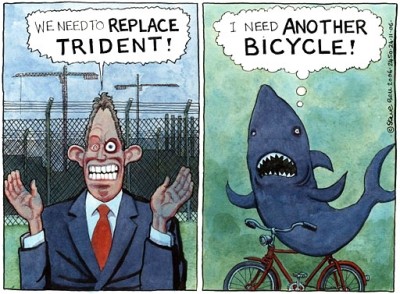
Trident: no alternative.
When it comes to pointless reviews, the Liberal Democrat initiated Trident Alternatives paper has to be one of the most worthless reports authored by government in recent times. Commissioned as part of the phony war between the coalition parties over whether or not our "independent nuclear deterrent" should be replaced like for like, it comes to the surprising conclusion that Trident is superb and you can only be sure it's truly a deterrent if there's continually a submarine at sea. Of course, we don't know whether there actually is a Vanguard out there somewhere right now, doing the equivalent of waiting for Godot, but then neither do our enemies. Then again, we don't currently have any enemies that are capable of launching a pre-emptive nuclear strike, but who knows what the next five years, let alone the next fifty might bring?
It does then strike (ho ho) as just a little rich for Danny Alexander to criticise the Tories who have been belittling him and sending letters to the Daily Holocaust, err, I mean Telegraph, as having failed to get out of a cold war mentality. After all, the preferred option of the Lib Dems isn't to unilaterally disarm, or even to switch the position of say Japan, which has the capability to quickly produce a nuclear weapon should a crisis arise, but err, to reduce the number of submarines by either 1 or 2, and not have one constantly at sea. To be sure, this is far saner and less costly than the position advocated by both Labour and the Tories, where we can't step back an inch from the status quo of the past 50 years, yet it's still surely out of date when you consider the way the threat from nuclear weapons has reduced massively since the collapse of the Soviet Union.
The report didn't even consider complete disarmament or the "nuclear latency" option, so we don't know how much could have been potentially saved by not replacing Trident, although there are plenty of estimates. What we do have is an estimate of how much would be saved by only having 3 submarines and putting an end to the constant at sea presence, which comes in at about £4bn. It sounds like a lot, until you consider that this would be the amount saved over the entire period the authors of the report considered, which goes right up to 2060. Suddenly it doesn't seem such a massive saving.
This isn't to say there aren't a few interesting nuggets in the report. The idea that Trident is in any way independent takes a battering just 6 paragraphs into the executive summary, where it points out that the "deterrent" is also available to NATO as "a contribution to the Alliance's collective deterrent". In other words, if NATO decides that it's time to put the nuclear umbrella up, it's extremely unlikely that the prime minister of the day would decline to do so. Indeed, this has always been the main problem with describing Trident as independent, for in just what circumstances would we use it without our closest allies also using theirs or giving their OK? An attack on a NATO country is still regarded as an attack on all. The reality is that we are completely dependent on America for Trident: the missiles are American; Aldermaston is part owned by Lockheed Martin; and the report makes clear that even the non-nuclear parts are also sourced from the US (paragraph 18).
As to whom Trident is meant to be deterring, we're still none the wiser almost 7 years after Labour first decided it had to be renewed. In fact, nothing has really changed since then. The two main "threats", North Korea and Iran have all but remained in stasis. Iran still doesn't have the bomb, although it has the potential to make one, while North Korea has the bomb but doesn't have a reliable delivery mechanism that can reach the US as yet. Neither country could currently or likely in the near future carry out a first strike on this country, nor is there any reason to imagine they would want to when both have enemies closers to home. It's possible if not entirely plausible that relations with either China or Russia could deteriorate to such an extent that we could re-enter cold war territory, but there isn't so much as a hint of that on the horizon as it stands. The only other threat is from the spectre of nuclear terrorism, but even in the extremely unlikely event that al-Qaida acquired such a device, how would Trident deter them from using it and who would we strike back against it if it was used?
What it all comes back to in the end is the prestige of being one of the main five nuclear states under the non-proliferation treaty. The report itself suggests as much. "Any change ... may have the potential to impact not only on the credibility of the deterrent, but also on our wider national interests and foreign relations." Noted peacenik Tony Blair has said much the same, writing in his autobiography that "the expense is huge" and "the utility non-existent". He only didn't push for disarmament as he thought it would be "too big a downgrading of our status as a nation". Trident isn't so much a deterrent as it is the political equivalent of a medallion round the neck of certain men in the 70s, or the Rolex, Wag and Bentley of the modern day footballer. The same Thatcher lovers who don't have a problem with cutting the rest of the military to the bone imagine that dispensing with Trident would be the ultimate example of accepting decline. We might not be able to defend the Falklands if it came to it, but at least we've got the capability to start a war that would end human civilisation if we so wanted. That means something, doesn't it? Doesn't it?
It does then strike (ho ho) as just a little rich for Danny Alexander to criticise the Tories who have been belittling him and sending letters to the Daily Holocaust, err, I mean Telegraph, as having failed to get out of a cold war mentality. After all, the preferred option of the Lib Dems isn't to unilaterally disarm, or even to switch the position of say Japan, which has the capability to quickly produce a nuclear weapon should a crisis arise, but err, to reduce the number of submarines by either 1 or 2, and not have one constantly at sea. To be sure, this is far saner and less costly than the position advocated by both Labour and the Tories, where we can't step back an inch from the status quo of the past 50 years, yet it's still surely out of date when you consider the way the threat from nuclear weapons has reduced massively since the collapse of the Soviet Union.
The report didn't even consider complete disarmament or the "nuclear latency" option, so we don't know how much could have been potentially saved by not replacing Trident, although there are plenty of estimates. What we do have is an estimate of how much would be saved by only having 3 submarines and putting an end to the constant at sea presence, which comes in at about £4bn. It sounds like a lot, until you consider that this would be the amount saved over the entire period the authors of the report considered, which goes right up to 2060. Suddenly it doesn't seem such a massive saving.
This isn't to say there aren't a few interesting nuggets in the report. The idea that Trident is in any way independent takes a battering just 6 paragraphs into the executive summary, where it points out that the "deterrent" is also available to NATO as "a contribution to the Alliance's collective deterrent". In other words, if NATO decides that it's time to put the nuclear umbrella up, it's extremely unlikely that the prime minister of the day would decline to do so. Indeed, this has always been the main problem with describing Trident as independent, for in just what circumstances would we use it without our closest allies also using theirs or giving their OK? An attack on a NATO country is still regarded as an attack on all. The reality is that we are completely dependent on America for Trident: the missiles are American; Aldermaston is part owned by Lockheed Martin; and the report makes clear that even the non-nuclear parts are also sourced from the US (paragraph 18).
As to whom Trident is meant to be deterring, we're still none the wiser almost 7 years after Labour first decided it had to be renewed. In fact, nothing has really changed since then. The two main "threats", North Korea and Iran have all but remained in stasis. Iran still doesn't have the bomb, although it has the potential to make one, while North Korea has the bomb but doesn't have a reliable delivery mechanism that can reach the US as yet. Neither country could currently or likely in the near future carry out a first strike on this country, nor is there any reason to imagine they would want to when both have enemies closers to home. It's possible if not entirely plausible that relations with either China or Russia could deteriorate to such an extent that we could re-enter cold war territory, but there isn't so much as a hint of that on the horizon as it stands. The only other threat is from the spectre of nuclear terrorism, but even in the extremely unlikely event that al-Qaida acquired such a device, how would Trident deter them from using it and who would we strike back against it if it was used?
What it all comes back to in the end is the prestige of being one of the main five nuclear states under the non-proliferation treaty. The report itself suggests as much. "Any change ... may have the potential to impact not only on the credibility of the deterrent, but also on our wider national interests and foreign relations." Noted peacenik Tony Blair has said much the same, writing in his autobiography that "the expense is huge" and "the utility non-existent". He only didn't push for disarmament as he thought it would be "too big a downgrading of our status as a nation". Trident isn't so much a deterrent as it is the political equivalent of a medallion round the neck of certain men in the 70s, or the Rolex, Wag and Bentley of the modern day footballer. The same Thatcher lovers who don't have a problem with cutting the rest of the military to the bone imagine that dispensing with Trident would be the ultimate example of accepting decline. We might not be able to defend the Falklands if it came to it, but at least we've got the capability to start a war that would end human civilisation if we so wanted. That means something, doesn't it? Doesn't it?
Labels: Conservative-Liberal Democrat coalition, Danny Alexander, Liberal Democrats, military spending, nuclear retention, politics, Trident, Trident replacement
| Permalink