Monday, November 25, 2013 

A rare moment of optimism.

There is something of a danger in overstating what was achieved at Geneva between Iran and much of the rest of the world (excluding Israel and the Gulf states, as we'll come to) early on Sunday morning.  Much can still happen over the next six months to scupper the agreement, not least that Obama has to convince some of those in Congress that not bombing another Middle Eastern state is a good idea, so twisted has foreign policy in the US become.  If the sanctions against Iran are slow to be lifted, as they may well be, the current goodwill in which Mohammad Javad Zarif and Hassan Rouhani, the Iranian foreign minister and president respectively are held by both liberals and hardliners in the country could soon dissipate.  There's also no guarantee that an interim deal where both sides have claimed victory will inevitably lead to a permanent one all can abide by.

Those caveats out of the way, there's also little reason to underplay the significance of the delicately brokered agreement, apparently overseen with great dexterity by Baroness Ashton, who was widely mocked and patronised when named as the EU's foreign policy representative four years ago.  It is almost certainly the most significant agreement between Iran and the "great Satan" since the overthrow of the Shah, far outweighing the short-lived months of detente after 9/11 when Iran co-operated with the invasion of Afghanistan, before the country was named by President Bush as a member of the "axis of evil".  The potential is clearly there if both sides really want it for a wider understanding and de-escalation, including in Syria, where the US and other Western countries have become involved in a proxy war between the Sunni and Shia Muslim states.

How much responsibility for the past decade of what often seemed like a gradual drift towards a strike on Iran's nuclear program can be placed on that Bush speech and the following war on Iraq is difficult to pinpoint precisely.  The previous period of moderation under President Khatami was rewarded with what was seen by the clerical conservatives as the suggestion they were next on the list.  In fact, the overthrow of Saddam Hussein gave Iran further influence, as still manifested through Nouri al-Maliki.  It's only been a result of the ratcheting up of sanctions against the country over the nuclear program that it was seemingly decided by the highest authority in the land for moderation to be given another try through Rouhani, after reasonably free elections (if elections in which dozens of candidates were disqualified from running can be called free) resulted in his victory.

Also crucial it seems, alongside the secret meetings between the US and Iran dating back to March, was the deal on Syria's chemical weapons.  The agreement on their destruction made clear how the US was prepared to step back from the brink when it seemed to be half-heartedly edging towards another conflagration.  If John Kerry and Barack Obama were able to handle the embarrassment and brickbats of not going through on what looked to be a certain attack on Bashar al-Assad, drawing back from sleepwalking to striking Iran was always going to be far easier.  The deal agreed upon also, as alluded to above, allows all sides to look the victor.  Iran has effectively agreed to freeze its program in exchange for being allowed to exercise its rights under the nuclear non-proliferation treaty, to have a power capability but nothing more.  The US is denying that's the case, but that's almost certainly the basis for the deal.

Perhaps just as important is how the deal appears to mark what could be the first sign of both Israel and Saudi Arabia having their bluff called. Binyamin Netanyahu has repeatedly overplayed his hand since once again becoming prime minister, at times treating the Obama administration as though the US was the minor partner in the relationship.  Rather than tone down the rhetoric with the ascent to power of Rouhani, the Israelis have carried on as though nothing has changed, only to find Obama in his second term determined to take full advantage of the shift in Iranian leadership.  Saudi Arabia meanwhile, still smarting from the US backing down over Syria, now finds its sworn enemy apparently having its role in the Middle East if not accepted, then at least recognised.  It would be lovely to think this was down to the US finally realising that much of the funding for jihadists can be traced back to the country, as has been proved beyond any doubt in Syria, but one suspects it's more that drawing back from the threat of a strike was in everyone's interests.

This isn't to underestimate how solving the stand-off between the West and Iran is just one part of the current crisis in the Middle East.  Regardless of how Assad now seems to have the upper hand in the civil war in Syria, the war there signifies how intractable and dangerous the Sunni-Shia conflict is, while the always with us issue of Palestine remains a problem for the world.  The deal in Geneva does however give cause for optimism, the merest suggestion that the second decade of the 21st century won't be as disastrous or self-defeating as the first was.  There's still a long way to go, but it's a start.

Labels: , , , , ,

Share |

Monday, January 31, 2011 

Egypt and the green revolution.

Like many others, I've been scrabbling around for a reference point to the tumult in Egypt. Abu Muqawama wisely and humbly requests that we stop reaching immediately for the great European revolutions as analogies, whether of 1789, 1848 or 1989 when we are after all attempting to comment a nation that has been around for a couple of thousand more years than the territory more familiar to most of us.

He's right of course. But while we've got the revolution in Tunisia as part influence and catalyst for the uprising against Mubarak, I can't help but keep thinking back to the "green" protest movement in Iran now nigh on two years ago. That short lived taking to the streets, viciously snuffed out by the authorities was in response to what most agreed was the blatant rigging of the presidential poll in Mahmoud Ahmadinejad's favour. Curiously gone mostly unmentioned is that Egypt also had elections back in November. As has always been the case under Mubarak they weren't even close to free or fair, yet in a sign of just how sure the regime was of its hold on power just two short months ago, where Muslim Brotherhood candidates standing as independents were allowed to win 88 seats in 2005, they were left with nothing this time round. Mubarak's National Democratic party won 97% of the seats in the Egyptian parliament, something which resulted in either no comment from most of the European nations which now feel they have to say something, and in a statement of "dismay" from the US. "Dismay" translated from the diplomatic means "carry on".

Another reflection of the Iranian protests is that the young and the secular have overwhelmingly taken the lead, although it's also true that the protesters themselves have been determined to show that they're united in wanting Mubarak out regardless of their personal differences. The opposition forces which have either been semi-tolerated or remained organised regardless of the repression, whether it be the MB, or the National Progressive Unionists refused to take part in last Tuesday's "day of anger", and have been playing catch up ever since. It's only now that all the forces for change have begun to come together, calling for a million to march tomorrow.

The key difference is that while the Egyptian army is now making clear that it won't put into action any demand for a Tiananmen style crackdown, the key subsections of the Iranian state, nurtured and funded by those opposed to any return to the years of relative liberalism under President Khatami remained completely loyal. The Basij especially were crucial in crushing the protests themselves, the leaders and student radicals either arrested or murdered, while the Revolutionary Guard waited in the wings if it was needed. In Egypt it's clear that while the police, widely loathed for their corruption and addiction to beatings and torture have remained relatively loyal to Mubarak, they've either disappeared in the face of the protests or drawn back, at least for now, with the army having stepped into their role. Those opposition figures that were rounded up or had been arrested prior to the elections have either been released or escaped following the breakdown in law and order. The best the police have managed in the instilling fear and terror stakes is, if we're to believe the theories of those in the major cities, their involvement in the looting and criminal damage which has resulted from the very security vacuum they created.

With the protests now affecting everyday life across the country, something is going to have to give, and with the army apparently refusing to countenance any violent crackdown, everything points towards Mubarak either being forced into standing down, perhaps by his newly appointed vice president or into a similar, humiliating dash for the exit, ala Ben Ali. Even if those now protesting repeat the mistakes made by those who fought for the overthrow of the Shah, the events, slogans, passion for freedom and heroism of the past week will reverberate for decades to come.

Labels: , , , , ,

Share |

Monday, June 22, 2009 

A new media martyr.


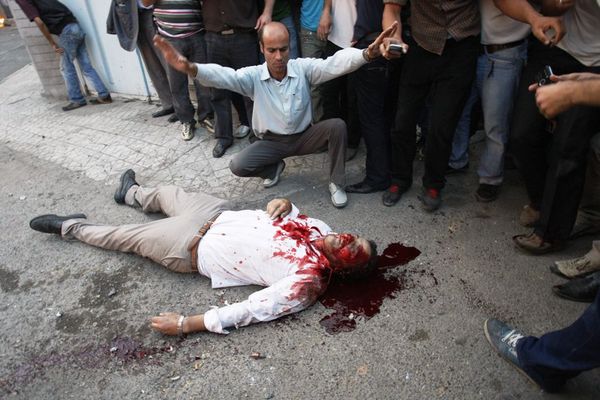
If the events in Iran are the first time that "citizen journalism" has truly come into its own, helped undoubtedly by the fact that the foreign media have for the most part been successfully banished from the streets, then Neda Agha-Soltan(i), a young protester apparently shot dead by a Basij militiaman has become the first most visible martyr, not just of the uprising, but also of the new media age.

Partly this is because the video of her death is both so horrifying and with it, so cathartic. Unlike many of the other videos which litter the internet which show death and violence, few if any so vividly show a life ebbing away, the soul breaking free of the corporeal body. As her eyes glaze over and as the blood, filling her lungs, is breathed out of her nose and mouth, there are few ends that could so disturb, galvanise and ensure that she will be mourned for years to come. It helps that we don't actually see her murderer, or the moment when she was actually shot; that would diminish the empathy that comes naturally, and instead direct the anger at the individual responsible rather than the state that he or she represents.

Undoubtedly, many will be uncomfortable with the fact that this revolution in filming and writing to the bottom means that we get the sort of material, such as the death of Neda, that broadcasters themselves will not generally show. The BBC have only shown grabs of her on the ground, and before the blood begins to pour from her mouth and nose. Some will argue that such censorship, or rather moderation, is not something to object to: after all, not everyone wants to see such material, even on the news, especially when children also might be watching. Yet it also means that we don't have the full picture, or see the brutality and violence at first hand which such crackdowns bring. Even when such material was more carefully veted however, some of the most iconic images of war remain from the Vietnam era: the execution of Nguyễn Văn Lém, and the naked Phan Thị Kim Phúc running from a napalm attack still have the power, even today, to shock and awe.

Others will object that someone's death could be used in ways in which that person may not have wanted, or even how her family would want. Whether she was actually protesting may be in doubt; latest reports say that she left a car she was in for only a period of minutes, but that those minutes turned deadly does only illustrate just what those protesting are defying in order to demand that their votes count. It can't be denied that dying in such a way means that it becomes public property, by definition. Most would rather want their final moments to be private, but no one also would wish to die in such a way. When we lose the choice in how we pass from this world, we can only hope that our deaths are not prolonged and that we are surrounded by friends, although it remains a truism that everyone dies alone, regardless of method or cause. Neda's was not a lonely death, and the power of it may well yet further help the protests towards a brighter future for Iran as a whole. The idea of martyrdom and sacrifice is highly ingrained in both Shia and Persian culture, and despite our reservations, we can only hope that it further denies moral authority from both Ahmadinejad and Khamenei. Regardless of how the next days and weeks pan out, she is unlikely to be forgotten.

Labels: , , , , , , , , ,

Share |

Monday, June 15, 2009 

An open letter to the Iranian youth: one solution, revolution.

Dear friends,

Very few of you are likely to actually read this, what with many internet sites being blocked by the authorities and with the language barrier, but those of us watching overseas with trepidation at the turmoil on the streets of your capital and other cities are both worried and optimistic in equal measure at the sudden eruption of what appears to the beginning of a movement against the lack of freedom which has become all the more burdensome since the election of Mahmoud Ahmadinejad in 2005.

That result was partially sparked by apathy. After two terms of the reformist inclined Khatami, his liberalising measures stymied and stopped in their tracks by the Guardian Council and your supreme leader, Ayatollah Khamenei, it was little wonder that some of you were dismayed and simply didn't turn out. During that time there were protests against the rigidly conservative social mores and censorship imposed upon you, both in 1999 and 2003, both of which ended with more repression and the rounding up of the ringleaders, whilst the candidates who wanted change were denied the opportunity to stand in elections. You had seen what the response was to the slightest call for change, and no one will blame you for temporarily taking the eye of the ball.

It sometimes takes a polarising figure to set off in motion movements which have the potential to lead wherever you want to take them. If you'll forgive the already rather hackneyed comparison, Bush inexorably led to Obama. Ahmadinejad, a Holocaust denier, serial liar, economic disaster and general buffoon, but highly appealing to those who have nothing to whom he offers much, similar perhaps to Hugo Chavez, also attractive but undoubtedly a centralising and double-edged personality, is what led you to coalesce around Mir Hossein Mousavi, someone previously unknown in the West, although our attention span at the best of times is not the greatest. Mousavi was not the most liberal and reformist inclined candidate, but was a happy medium; you knew that Mehdi Karroubi simply couldn't win. For those of us who have recently had to put up with everyone talking about "snouts being in the trough" because their MP claimed a few dinners with taxpayers' money, which it seems is all that we care about, the sight of the vast crowds turning out, the almost party atmosphere as the "morality police" stayed out of the way for the first time in years was inspiring and made us believe that you too were about to choose change.

Doubtless many of you were worried that Ahmadinejad would sneak home, Mousavi having only towards the end of the campaign gained the support that he needed, and if he had, similarly you would have almost certainly accepted it. We can't know for certain, but your response above all suggests that the vote was stolen. Why, the cynics will suggest, would the Guardian Council have allowed Mousavi and Karroubi to stand if they weren't prepared to potentially let them become president, when they could have denied them to begin with, but it seems simply that your rulers didn't expect you to turn out in numbers similar to 1997. How though could Mousavi have been beaten in his home state? Why was the result announced within 2 hours? Why did the Mousavi campaign believe, and indeed have been told that they had been the run away winners by the interior ministry only for it subsequently turn out the Ahmadinejad had won with 67% of the vote?

Your thoughts will almost certainly be turning back to 1979, or rather what you have been taught about it. The overthrowing of the Shah, supported to the hilt by the CIA, with his departure still recently bemoaned by the likes of Donald Rumsfeld, was without doubt a wonderful thing. Sadly though, like many other revolutions, from the French to the Russian to the Chinese, the replacement has turned out to be little better than what came before, if not in some cases worse. While 1979 occurred because the people were united, whether they were religious or atheists, together they triumphed. It was then that those who objected to the establishment of a theocracy were purged, imprisoned and broken. Since then change has had to be incremental, and slight, and you have worked within those imposed boundaries, respecting what your parents and elders had achieved.

Isn't it now clear however, that those very constraints have become intolerable? They allowed you to vote for reform, and then they denied those elected to implement it the opportunity to do so. Now they have denied you the opportunity for your vote to even be counted. In its way, this has turned out to be to your advantage: the change that most of you want would probably have been denied had Mousavi been allowed to ascend to the presidency. Those of you who want to have the choice whether or not you wear the hijab, let alone other far more radical changes, would have almost certainly been left disappointed.

Even when it seems this clear, you are almost certainly scared and hesitant about the conclusion which you have independently reached. Would overthrowing the theocracy be not just disrespecting, but spitting in the face of your relatives and those who fought for that initial freedom, and also then while the West supplied Saddam Hussein with weapons during the war with Iraq, resulting in the deaths of a million? Certainly, there are millions within your country who are happy with the way they are ruled: otherwise no one would have voted for Ahmadinejad, or his even more conservative opponent. This will lead to fissure and disputes, almost certainly within your own families.

Yet the reward which you can now potentially acquire is worth both enduring the above and the lives of those who will fall and have already fallen in pursuit of the freedom you want. Some of you will wonder whether Ayatollah Khamenei's unprecendented offer of a inquiry into the vote is worth waiting for. You have now though a similarly unprecendented opportunity: the government is uncertain of how to react, even as reports come in of the shootings in the middle of the night. You may not have this chance again for years. Whether you want simply Mousavi to be president, or for this to be the end of the theocracy, you need to take to the streets in the same or even higher numbers as today, and stay there until you get what you want. Further action may well be required; you may well have to take arms up to defend yourselves, but you can be safe in the knowledge that the world is watching. It's unlikely now that another Tienanmen could take place: use that to your advantage. And remember, even if despite everything, the authorities win, you carry a new world in your hearts. That is what matters.

With fraternal love,
septicisle.

Labels: , , , , , ,

Share |

About

  • This is septicisle
profile

Archives

Powered by Blogger
and Blogger Templates