Wednesday, July 31, 2013 

This is our last gasp.


There's been a lot of snarky comment on the Sun's deeply odd wrap-around front page, and for good reason: it makes those splashes the Independent used to run look subtle.  THIS IS OUR BRITAIN it screams, and it might mean something if it wasn't just a promotional exercise to inform the paper's readers that, err, they're now going to be charged to access the paper's website and apps.  To be fair, as a commenter points out over at the New Statesman, it's difficult to draw pictures of non-material things, so what we get instead is an amalgamation of the centrepiece of Danny Boyle's (deeply overrated) Olympic opening ceremony and a lot of err, stuff pasted on the top of it.  There's the Shard, that famously British eyesore, a Routemaster, naturally, a power station, Mr Bean, the Queen's head peaking over an S, and well, every other cliche and landmark you can think of.

Taken altogether, it comes across as being spectacularly insincere. Is this an idealised Britain, or is it the Sun's Britain? It is of course lovely to think of a field that is forever England, or Britain, but when the vast majority of us live in urban areas rather than out in that green and pleasant land, planking everything down in something resembling Elysium is just a trifle odd. The Sun is nothing if not an embodiment of national stereotypes, despite having been born in the 60s, but even if this it's meant to say we might be changing but our values aren't, it just seems lazy and hackneyed. Obviously that's never bothered the paper in the past, yet you might have thought that under a new editor and to encourage readers to pay extra for what they used to get for free they would have gone that extra mile.

More pertinently, the Scottish edition, while keeping much of the editorial, goes for a cleaner and sharper look. The less said about A NEW DAWN the better, but it doesn't make your brain hurt from just looking at it. As Stuart Campbell also notes, the Scottish edition drops some of the harsher language from the statements on politics, in particular on welfare. The paper's stance on benefits and immigration can be summed up in that they're in favour of both for those they deem deserving and are against for everyone else.  Labour also gets it in the neck repeatedly despite the paper saying they're not slavish supporters of any party: who knew that a "culture of entitlement exploded" under the last government which destroyed entire communities, or that they papered over the cracks in education while standards fell measured against the rest of the world.

The problem the Sun faces is that it simply isn't as influential as it once was.  Whether down to the defenestration of Rebekah Brooks as chief executive of what was News International and the whole phone hacking scandal, or changes in the way politicians now attempt to engage the public, the Sun almost certainly comes behind the Mail as the first port of call for the Tory side of the coalition.  Rather than attempt to fight back, the paper has instead gone down the paywall route.  Paywalls can be viable if you provide content that isn't available anywhere else, as the FT has demonstrated; even with the new "not quite Sky Sports" programming promised for subscribers, it's difficult to see exactly what the Sun will have that other free sites won't.

One positive is that regardless of its execution, it's at least a change to see the Sun provide a picture of the country that has some sort of relationship with reality.  A bit of a difference with the paper under the aforementioned Brooks:


Labels: , , , , ,

Share |

Tuesday, May 15, 2012 

You can take the woman out of News International...

Last Friday it was difficult not to feel at least a quiver of sympathy for Rebekah Brooks. As well as being asked some faintly irrelevant questions by Robert Jay during her appearance at the Leveson inquiry, such as whether she had swam with Rupert Murdoch (she did at least recognise complaining about such trivialities was the height of hypocrisy), she is also as far as I can recall the only witness whose choice in the sartorial department has been commented upon. The right-on Guardian ran an wonderfully enlightening piece by their fashion editor ("A white Peter Pan collar sends the most unambiguous of fashion messages"), while on Newsnight Charlotte Harris's first sentence was on how amusing it was that Brooks had chosen to dress up as a puritan. There admittedly was more than enough newsprint spent on what she actually said, but did we honestly need to know that her dress cost £475 from an online boutique?

To which the answer today might be yes. Those who've so much as read a single post here on phone hacking will know it was a certain Rebekah Brooks who stated back in 2009 that the Guardian's coverage had "substantially and likely deliberately misled the British public" (PDF). As public relations goes, it must rank up there as one of the most stupid, reckless and foolhardy missives in recent memory. It still isn't quite as moronic though as today's ejaculation from Mr and Mrs Brooks:

We deplore this weak and unjust decision after the further unprecedented posturing of the CPS.

Jonathan Aitken might not have been facing a charge of perverting the course of justice, but swords of truth and trusty shields come to mind. And we all know how that ended up.

(P.S. Pity poor David Cameron.)

Labels: , , , , , ,

Share |

Friday, May 11, 2012 

A liar or an idiot.

Apart from the new email showing further proof of the closeness between Jeremy Hunt and Fred Michel, the most crucial piece of evidence given by Rebekah Brooks today at the Leveson inquiry was that she didn't believe her publishing of the details of sex offenders in the News of the World in the aftermath of the kidnap and murder of Sarah Payne would lead to reprisals. There are only two conclusions you can draw from such apparent insouciance: either Brooks is a liar, or she's an idiot. Her entire campaign was designed to force politicians to do something, and she and her staff knew that the precise way to do that was to get into the public domain information that would almost certainly lead, if not to vigilante action, than at the very least abuse and protests against those named. She perhaps didn't anticipate a paediatrician being targeted by mistake, but she absolutely knew what she was doing.

It's through this prism that you have to view the rest of her evidence, which was mostly mind-numbing in the extreme. Despite the fact she has been close to the last three prime ministers, we're meant to believe that this was all down to sheer friendliness on her part. Yes, obviously they thought they could get something by almost drawing her into their inner circle, but never once did she compromise her position as a journalist and never once did they compromise their position as a politician through their relationship.

Thankfully, Robert Jay was on far better form today than he was against the stonewalling Andy Coulson yesterday. He also seemed far better briefed. Brooks had to deny, unconvincingly, that she had variously demanded that Downing Street order a reopening of the investigation into the disappearance of Madeleine McCann, else Theresa May would be appearing on the front page of the Sun every day until they did; that she did not, as widely reported, tell Andy Coulson that the Sun would not support the Conservatives until Dominic Grieve was moved from his job as shadow home secretary, having had the temerity to say to Brooks's face the Sun's coverage of crime and the Human Rights Act was hysterical; and that she did not in a phone call to Ed Balls demand the sacking of Sharon Shoesmith following the Baby Peter case, else they would "turn this thing on him".

Funny, isn't it, that there all these stories, all apparently untrue, about Brooks using her power and influence to demand things of politicians and yet she didn't believe there was anything inappropriate about the level of contact between the then editor of the biggest selling newspaper in the country and those making the law. She also didn't believe that politicians were trying to get to Rupert through contact with her, which is just about as obtuse as her evidence got. It was fascinating to learn though that David Cameron spoke to her repeatedly about the phone hacking accusations against the Screws, and yet he apparently never spoke to Andy Coulson about it. Very strange.

In spite then of how apparently little they discussed the BSkyB bid, which Brooks knew of two months before it was announced (it just so happens that it was almost in line with the Tories coming to power), it was mostly just Tories who commiserated with her when she was forced into resigning. It was done indirectly, naturally, and some of the reported words are not exact, but it is true that Cameron more or less said that he was sorry he couldn't show her the same loyalty she had shown him, as Ed Miliband had him on the run. He needn't have been concerned. Brooks today was loyalty personified. One suspects however that it won't save her from a short stretch in either Styal or Holloway.

Labels: , , , , , , , , , ,

Share |

Friday, July 15, 2011 

The cancer remains.

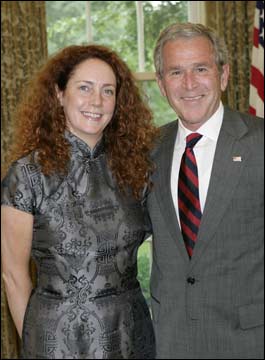
So. Farewell then to Rebekah Brooks. When someone described by the Graun as a "ruthless, charming schmoozer", the kind of individual who previously considered prime ministers past and present to be friends is only paid tribute to by a couple of Murdochs and err, Giles Coren, you know there's been a very sudden sea change in attitudes to those at the top of the media pile.

Despite everything, we still don't really know why Keith was so intent on keeping dear Rebekah at the top of NI. It's true he feels a special affinity with those who have dragged themselves up from under-privileged backgrounds and share his love of newspapers, qualities which Kelvin MacKenzie and Andy Coulson both had in common with Brooks. It still doesn't explain though just how she came to be seen as being part of the extended family, or how someone on the surface so ill-suited to the job of chief executive came to helm his UK operations. Brooks, like most tabloid editors before her operated a policy in the newsroom of apparent friendliness combined with moments of fury and extended bawling out of those judged to have failed in some way, the latter of which it seems increased as she approached the end of her tenure. Inspiring fear in those you come across while chief exec simply doesn't work, nor does telling lies which can be easily found out, as she did when she claimed the Guardian had "likely deliberately misled the British public".

Last week the obvious thing to have done would have been to accept Brooks's resignation and keep the News of the World open, even if last Sunday's edition was to be an extended mea culpa with those involved in the cover up also falling on their swords. The Murdochs not only did the opposite, sacrificing a paper and loyal workers in a desperate attempt to save both Brooks and the BSkyB bid, Rupert then went on his bizarre walkabout at the weekend, saying to the press that his first priority was his flame-haired CEO. Even if propping up Brooks was a ploy to direct flak away from Murdoch junior, the very person who authorised the payment to Gordon Taylor in a failed attempt to hush up the spiralling scandal, then subsequent events and the failure to get a grip meant that her departure was an inevitability, later if not sooner.

Her resignation letter, decoded by the Graun, says it all. She says she feels a "deep sense of responsibility for the people we have hurt", yet only last week she was blaming a BBC-Guardian witch-hunt instead of her own failings for the closure of the Screws. Unlike the hacks left without a job, it's apparent that she'll remain on the NI payroll, although in what capacity it remains to be seen. Equally clear is that falling on her own sword now solves absolutely nothing: the attention has immediately shifted to James. The investigations now under way in America suggest it could soon move to KRM himself. After suggesting only "minor mistakes" had been made by News Corp, to then issue such a craven apology as will be published in newspapers tomorrow indicates that those who have never felt the need to say sorry before still don't genuinely mean it now. Brooks may be gone, but the cancer remains.

Labels: , , , , , , , , , ,

Share |

Wednesday, July 06, 2011 

The phone hacking threat to Cameron.

In a week of astonishing developments on phone hacking, the one which poses the most immediate threat to David Cameron himself has been somewhat understated. Without a shadow of the doubt, News International, in an attempt to shield both Rebekah Brooks and Murdoch junior, is abandoning any previous attempt to protect Cameron's former chief media adviser Andy Coulson. By stating entirely openly that it's passed over emails which indicate he was aware or even gave the OK for payments to be made to serving police officers, presumably in exchange for information, it's surely only a matter of time before he's called in to help the Met with their current inquiries.

Likewise, that NI today has been at pains to point out the amazing coincidence by which Brooks, then Wade was absent from the NotW offices both at the time Milly Dowler's phone was hacked and while the search was going on for Holly Wells and Jessica Chapman, putting the blame squarely on her deputy at the time Coulson has been an indication of just how terrified they now are at the potential implications, not just for Brooks, but for James Murdoch also. As Tom Watson today pointed out in the Commons during the emergency debate on the allegations, it was the heir apparent who signed off on the settlement with Gordon Taylor, the one Nick Davies got wind of and which restarted the whole affair two years ago. No wonder then that Daddy today gave Brooks his full backing to carry on the investigation into herself; she might have become "family" as it were, but if Brooks goes then so also must sonny boy.

Neither Brooks or junior face a potentially imminent knock on the door from Inspector Knacker though. Coulson has another reason to fear he might soon be visited by the Met's better late than never division. Having given evidence to the Tommy Sheridan perjury trial where he completely denied having any sort of relationship at all with Glenn Mulcaire, he also denied there was a "culture of phone hacking at the NotW", something that it's safe to say is now looking just ever so slightly shaky. If either NI themselves or the Met's latest investigation should come across something that suggests Coulson did indeed know about Mulcaire beyond his consultancy cover story, then he could well find himself following in the footsteps of such luminaries as Jeffrey Archer and Jonathan Aitken. While Coulson resigned as Cameron's chief aide not long after giving evidence, stating that he couldn't continue in the position while his old job still hung over him, it's not overly dramatic to suggest that should Coulson go down, he could take Cameron with him. You after all employ a spin doctor to tell lies for you; telling them under oath is taking it a little too far.

Labels: , , , , , , , , , ,

Share |

Tuesday, July 05, 2011 

Finally hacked off.

This must be a seriously strange, discomforting time to work for the News of the World. For so long the paper that alongside its stablemate the Sun has done more than any other to help foment and then target often misdirected public outrage, to have it screamed down your own phone line must come as a shock. It isn't entirely fair of course, as those most responsible for the phone hacking scandal have either resigned, been summarily dispensed with, sent on gardening leave or err, elevated to chief executive of the parent company. It must be difficult though to get hold of a number for Rebekah Brooks herself, although she could possibly give us peons some advice on just how to achieve it.

To say that News International as a whole must now be genuinely terrified of the consequences of the actions of a number of out of control hacks on a Sunday shag sheet is not to put it too dramatically. The Independent advises that the Times went into crisis mode after the Guardian's revelation yesterday afternoon, the paper's executives agonising over what it could and couldn't write about the story and their flame-haired ultimate boss. In the end they opted to give it some of the front page, although Brooks went unmentioned. The Sun, having far more recently divested itself of Brooks' controlling hand, had a token tiny piece on page 2. Not that such an attempt at burying the story was unique amongst the tabloids, which have played down phone hacking since the beginning: the only one which featured it on the front page at all was the Mail, with the early editions going with something else entirely.

It's a reflection of how overwhelming and unanimous the reaction has been to this new low that the only newspaper tomorrow which has no reference whatsoever to it on its front page is, naturally, the Sun. As stomach turning as it is to hear David Cameron describe actions which respectively his former chief spin doctor and close personal friend had overall responsibility for as "shocking", it's nothing on either the apology from Glenn Mulcaire himself or Brooks's latest attempt at buying time. Mulcaire doubtless was under "relentless pressure" while working at the Screws, but then he must have decided remuneration of over six figures for his trouble was more than adequate compensation for the risks he was taking.

Brooks likewise plays the innocence card. It's simply "inconceivable that I knew or worse, sanctioned these appalling allegations" as her memo to NI staff reads. It's worth remembering a previous statement, released a couple of years back which Brooks personally signed. The Guardian's reporting on phone hacking had "substantially and likely deliberately misled the British public" she wrote (PDF). As it turns out, the Guardian's reporting then wasn't even the half of it. While Brooks and others at the top of News International conceivably didn't know about every single act of phone hacking senior figures at the News of the World commissioned and which are being extracted painstakingly from Mulcaire's notebooks, she knew all about the "dark arts" and the private investigators involved, as the Independent and previously Private Eye have disclosed. In any case it's an odd defence to take that like Coulson she was completely ignorant of what was going on right under her nose. Coulson after all resigned despite not knowing about Clive Goodman and Mulcaire's antics, an unfortunate precedent to have set. By not at the very least removing herself from helming the on-going inquiry at the company, she's decided it's perfectly legitimate to carry on investigating err, herself.

The other side to this is that it's shown exactly just what journalists can get away with before politicians and public alike decide that a line has to be drawn. Invading the privacy of celebrities, z-listers and the Royals is fine, as is targeting the police, politicians and other journalists. It's only when the victims of horrific crimes become involved that it becomes truly too much to bear. The truly shocking thing ought to be that the police had all the information they're currently working through back in 2006, when Mulcaire and Goodman were first arrested and their material seized. For some reason, and the police and the CPS continue to battle over why it might have been, it was mostly left as it was, potential victims uninformed and the easiest to prove case prosecuted so the unpleasantness could be brought to a swift end.

No one in a position of power wanted it to go any further. Coulson swiftly became David Cameron's chief media adviser, the then Rebekah Wade carried on schmoozing with the Blairs and Brown, before quickly cuddling up with Cameron, the Met continued to have a good working relationship with the News of the World and the Sun, and Fleet Street, although stung, could carry on using such "dark arts" to get stories, the Press Complaints Commission convinced of the "one bad apple" defence. Only the persistence of Nick Davies and the Guardian ensured we're now where we are, in a situation which some are claiming is analogous with that of MPs and their expenses. I'm not sure it's as serious as that, although the way in which advertisers have reacted shows how quickly this could turn into a critical situation for the Screws.

Moreover, it exposes the true nature of the corruption at the heart of our democracy. It isn't financial, except in the sense that no politician in their right mind will ever oppose a Murdoch takeover. Whether it's Cameron dining with Brooks over Christmas while Jeremy Hunt tries desperately to find a way not to refer the BSkyB bid to the Competition Commission, or Blair journeying to Sydney all those years ago, the relationship between media and politicians has become such it deserves an inquiry of its own. It used to be that newspapers were used by their owners to provide propaganda for their own political prejudices; we're now at the stage where the power of certain media owners is such that their workers can break the law repeatedly and almost get away with it, safe in the knowledge that failing a public outcry their friends in both government and police will do the bare minimum required of them. Let this be the beginning of the end of such cosiness.

Labels: , , , , , , , , ,

Share |

Monday, July 04, 2011 

The grim calculus of tabloid crime reporting.

There's a great contradiction at the very heart of tabloid crime reporting - much as they obviously want those who have gone missing to be found safe and well, or for a murderer to be caught - they also know that the longer the ordeal goes on for the relatives, the greater the potential revenue for the paper. Crime and violent deaths have always driven sales of newspapers, but it wasn't until the disappearance of Madeleine McCann that it became quite so clear how the stymieing of the decline was driving editors to demand their journalists keep filing stories, even if there was nothing new to report: the Daily Express with its day after day of "MADELEINE" front pages, leading to the eventual libel settlement with the McCanns, was previously considered the nadir of such abuses.

Now it seems we have a new low. Finding out everything about the relatives of someone who's gone missing, regardless of any suspicions they may have been involved has long been routine practice in such cases, and hacking their phones is a logical progression of that, especially as it's bound to lead to one sort of "exclusive" or another. Hacking into the voicemail of the victim however, well, it really does take the breath away. It's voyeuristic and distressing as it is to hear the heartfelt appeals which are often made for the missing person to come home or for anyone with information to come forward; for a newspaper to listen in to the unbelievably personal pleas which must have been left on Milly Dowler's phone would have been bad enough. For Glenn Mulcaire to then delete some to free up space, ostensibly so more would come in that he could then pass on to the News of the World, surely realising that it would suggest to her parents and friends that she was the one who had done so, even if they were to be disabused later of such a notion is as her family's lawyer has said, heinous. Whether or not Mulcaire himself was cynical enough to do it knowing exactly what it would suggest, giving a new angle to the story as Jamie puts out there is something we'll never know.

The tabloids themselves may well argue that even if they occasionally go too far in their reporting on such stories, they make up for it through campaigns against crime or through providing a space for the relatives themselves to speak out, as the Sun and the News of the World often have. It's difficult though to disagree with Gerry McCann, when he said to the parliamentary media committee that his daughter "was made a commodity and there were profits to be made". Regardless of the help and support the media, and through them the public provide, it's the harsh reality of having someone they love dehumanised twice over, first by the perpetrator and then by those they thought were on their side that often stays with them. Rebekah Brooks, who for so long fought for Sarah's law and for the public's right to know where convicted sex offenders live surely cannot stay silent this time round.

Labels: , , , , , , , , ,

Share |

Thursday, June 09, 2011 

Scum-watch: The libelling of Sylvia Henry.

For those of you who want to cast your minds back to the deeply depressing days of late 2008 and the furore following the conviction of the three individuals found guilty of causing the death of Peter Connelly, you might remember that shortly afterwards the then Sun editor Rebekah Brooks gave the Hugh Cudlipp lecture, in which she defended her paper's "campaign for justice". She certainly had no regrets:

Campaigns provide a unique connection to the public especially when the subject matter is of a serious nature. For me, nothing can illustrate this connection better than our recent Baby P campaign.

The public outcry was deafening. And we began our fight for justice with a determination to expose the lack of accountability and responsibility for Baby P’s brutal death.

...

We received many many thousands of letters at The Sun about our Baby P coverage.

I’d like to read you one: ‘I have never been a huge fan of The Sun, however I thank you for the coverage of Baby P. I am so grateful for the campaign. This is not a modern day witch-hunt but a petition for justice. Please, please do not relent.'

In contrast, I’d like to quote from an article in... The Guardian.

“Full of fury and repellent hysteria, but isn’t that part of the game? This is less about the creation of public emotion and more about its manipulation."

This knee-jerk tabloid kicking reaction is just dull.

But total disregard and respect for public opinion never ceases to amaze me.

They demanded accountability.

And as a result of the campaign, some, just some, of those responsible were removed from office without compensation.

Or as this Sun reader wrote: ‘The tabloid press, which the arty-farty press like to look down on so much, has shown that it prides morality over political correctness.’

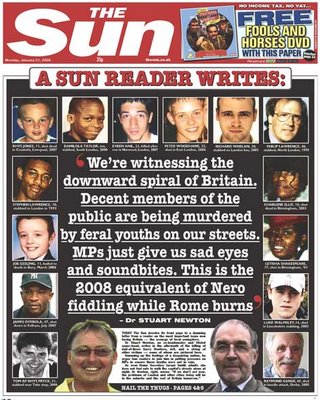
Brooks is now spending most of her time as chief executive of News International trying desperately to contain the ever growing phone-hacking scandal, having first claimed with a straight face that it was all lies and that the Guardian had likely deliberately misled the British public. Even then though her approving quoting of a reader who described her campaign as "morality over political correctness" was questionable: she knew full well that her determination to target not those genuinely responsible for Peter Connelly's death, who couldn't at the time be named, but instead the social workers at the centre of the case had led to two of them becoming suicidal. Her paper's website had allowed readers to leave comments encouraging Maria Ward to take their own life, such was the hatred the paper was well aware it was helping to whip up.

Today in the High Court the Sun had to admit that its targeting of Sylvia Henry, one of the Haringey social workers who had worked on Connelly's case, was based on completely inaccurate information. Henry was one of the five individuals the paper demanded be immediately sacked for having failed to prevent Connelly's death. The paper's campaign continued even after the BBC's Panorama had disclosed that Henry had wanted Connelly taken into care in 2006, following his admission to hospital with what she suspected was non-accidental injuries. She was overruled, and had no further role in Connelly's case after that point.

The paper however was absolutely certain of her culpability. In around 80 separate pieces over four months she was described as "grossly negligent", "shameless", to "blame for his appalling abuse and death", "lazy" and that she had "generally shown an uncaring disregard for the safety of children, even in cases where they obviously required urgent protection". It really doesn't get any more potentially libellous but the paper couldn't have cared in the slightest, not only of the damage to Henry's reputation, but also of the potential danger their vituperative articles posed to her personally: both Sharon Shoesmith and Maria Ward received death threats, with Shoesmith advised to avoid tube stations in case someone recognised her and pushed her under a train.

For once, the paper's apology is about right, both in length, its clarity and hopefully also in prominence, although it will be interesting to see where it appears in tomorrow's paper. She should never have had to pursue such a lengthy libel action though: if the Sun had bothered to investigate the case anything approaching properly in the first place they would have found, like Panorama, that she had worked conscientiously and with Connelly's best interests at heart throughout. Instead it was far too concerned with painting a picture of Haringey as a whole as out of touch and unaccountable. As the paper's leader had it at the time, "a price must be paid for his little life". That price could well have been paid in blood. Morality never even began to enter into it.

Labels: , , , , , ,

Share |

Tuesday, April 12, 2011 

The ties that bind.

Tom Watson, whom in hindsight I was more than a little harsh on last year, has called on Rebekah Brooks to do the decent thing and resign as chief executive of News International. The appointment of Brooks a couple of years back wasn't a surprise, as it had long been rumoured that she was being groomed for a management role, yet it's only now that Brooks' unwillingness to take any responsibility for her actions has come back to haunt Murdoch. It's more than pathetic for the editor of the biggest selling newspaper in the country to repeatedly refuse to defend her decisions in front of the cameras, instead leaving it to her underlings, the same people incidentally that she once berated for failing to get an interview with err, Pete Doherty. Then again, when Brooks' two main forays into the limelight involved a night in the cells and the unfortunate admission that journalists had formerly paid the police for information, it was clear that when confronted and put under pressure she wasn't exactly Kelvin MacKenzie.

Which makes it all the more mysterious why Brooks was allowed to put out such mendacious nonsense as the press release discussed on Friday and the statement to the parliamentary media committee which went with it, claiming that the Guardian had "substantially and likely deliberately misled the British public", until you realise that this was precisely what James Murdoch had also authorised when he signed off the compensation payment to Gordon Taylor. This wasn't just the hubris of being certain that through brazening it out the entire affair would be forgotten, as News International continued to hope; Brooks was being full supported by another Murdoch given to ranting and raving about the injustice of a world when everything had been handed to him on a plate. If Brooks must go, then so should junior. Completely unconnected, last week the heir apparent was promoted, just as Brooks and the Screws were preparing to come clean. Blood, as it goes, is thicker than water.

Labels: , , , , , , , ,

Share |

Monday, April 11, 2011 

Phone-hacking: and now?

There's a lovely insight provided by the exchange of letters between Keith Vaz and Rebekah Brooks as to just how important parliament felt the revelation that the press had previously paid the police for information was. It's taken a mere eight years before the chairman of the media select committee felt it was the time to ask the then editor of the Sun to clarify her remarks. Presumably not wanting to deal with two scandals at the same time, the ever fragrant Brooks has now made clear, just as clear as those who previously appeared before the committee from News International and denied phone-hacking had ever been committed by anyone other than Goodman and Mulcaire, that she was speaking in the historical sense.

Not that many police officers often need to be paid for giving information; most hacks, especially on local newspapers, will cultivate a source amongst the constabulary who can be relied upon to provide accurate background, often only in return for the occasional drink, as has been the case since time immemorial. Anyone though can plainly see that the Sun and News of the World often outdo all their rivals when it comes to crime exclusives, and not all of that is just the product of mutual scratching of backs. It did however hold News International in especially good stead when Goodman went too far by picking on royalty: as we have now seen, it seems politicians up to the very highest level were perfectly fair game, while accessing the most mundane and banal details about the lives of William and Harry was ultimately their undoing.

If you want to take it as far as some commentators, this could be our Watergate; if anything though, it's the exact inverse. Watergate was a plot uncovered by two journalists helped massively by an inside source who consequently managed to bring down the most powerful man in the world. This by contrast is a case of a far too powerful media organisation exerting its influence over politicians who were prepared to overlook anything if it meant they would continue to be nominally supported, while the police, mindful of the co-operation and good relationship that had been nurtured over a long period didn't want it to come to an end over something so seemingly petty.

This isn't to suggest that the tabloids or their parent companies and owners are more powerful than our politicians, a trap it's easy to fall into. At the very least they certainly shouldn't be. It's instead that politicians are terrified even now of being repeatedly crudely abused in the popular press, or doing anything which angers them more than just the day to day business of governing does. Not all politicians adhere to the belief that they have to be slavish in their toadying to the tabloids, but the great majority are, or at least give the appearance of it in order to make life easier for themselves. One who doesn't is Ken Clarke, currently being attacked on an almost daily basis in the Sun for his law and order policies, and whom you wouldn't bet on remaining as justice secretary come a reshuffle.

For one thing, we shouldn't pretend that such behaviour was only going on at News International titles. While it's difficult to be certain enough to be able to make sweeping statements about what was going on across the whole of what used to be Fleet Street, we have the What Price Privacy? reports from the Information Commissioner on the private investigator Steve Whittamore and his records, which more than suggest that journalists were making industrial use of blagging to gain access to private information on their targets. Some of those were requests which could well have been ultimately in the public interest, as phone hacking itself could be in the right circumstances; politicians in my view could quite legitimately have their voicemails listened in to if it was to prove wrongdoing other than sexual transgressions, which is of course what the tabloids were most interested in exposing.

The response to the scandal then ought to three-pronged: firstly, there should be a judicial inquiry with a remit going far beyond just the News of the World, which should set out to establish how the "dark arts" of blagging and phone-hacking became so widely used and abused; secondly there should be a royal commission or equivalent into the press, as the Press Complaints Commission has once again shown itself to be worse than useless, as self-regulation almost always is; and lastly, there needs to be a thorough, far-reaching debate into just what we ourselves want from a media that is more a part of our lives than ever before. The latter will almost certainly pose more intractable questions than the former.

Labels: , , , , , , , ,

Share |

Friday, April 08, 2011 

They lied and lied and lied.

Worth rereading in full following today's announcement is the press release put out by News Corporation back in July of 2009 following the Guardian's resurrection of the phone-hacking scandal. This part though fairly summarises it:

From our own investigation, but more importantly that of the police, we can state with confidence that, apart from the matters referred to above, there is not and never has been evidence to support allegations that:
  • News of the World journalists have accessed the voicemails of any individual.
  • News of the World or its journalists have instructed private investigators or other third parties to access the voicemails of any individuals.
  • There was systemic corporate illegality by News International to suppress evidence.

Despite today's claims, they of course knew that the above was mendacity epitomised. Rebekah Brooks (nee Wade) herself after all, according to Private Eye, asked the private investigator Steve Whittamore personally to gain access to information while she was the editor of the News of the World. Brooks, now chief executive of News International, was personally responsible for the pack of lies the company released, and also claimed in a letter to the parliamentary media select committee released on the same day (PDF) that the Guardian had "substantially and likely deliberately misled the British public". The British public can now decide for themselves just who it was that deliberately set out to mislead them.

Embarrassing as today's apology is, News International has still not yet dropped its "one rogue reporter" defence, although it can only surely be a matter of time, nor has it made any comment on just what Andy Coulson knew, as the cases the Screws hopes to settle all occurred under his watch. Coulson of course completely denied he knew anything about phone hacking back in December when giving evidence at Tommy Sheridan's perjury trial, even going so far as to claim he had no knowledge of Glenn "Trigger" Mulcaire, the private investigator being paid over £100,000 a year for his services to the paper. It really would be awful if the prime minister's former chief media adviser was to end up in the cells himself, wouldn't it?

Labels: , , , , , , , ,

Share |

Thursday, April 22, 2010 

Media empires and the rise of the Liberal Democrats.

Very occasionally an incident takes place which tells you absolutely everything about the organisation which those involved represent. When James Murdoch and Rebekah Brooks decided yesterday to storm into the offices of the Independent to remonstrate with editor Simon Kelner over a series of fairly innocuous adverts which the newly relaunched paper had been running, which involved the legend "Rupert Murdoch won't decide this election. You will" it can hardly fail to illustrate not just the self-importance and arrogance of the pair, but also the power which the likes of News International can and will wield if you deign to step even slightly out of line.

Their justification for confronting Kelner concerns the old Fleet Street rule that dog doesn't bite dog, and that proprietors especially are meant to be off limits. In practice, this rule is nonsense, and always has been: newspapers attack each other on a regular basis, especially if one publishes a piece felt to be overly critical or which hits too close to the bone. There might well be separate "non-aggression" pacts between the likes of the Mail and Express, and there was a wonderful example of newspapers closing ranks when the former executive chairman of News International Les Hinton phoned round all the other titles asking them not to cover Rebekah Brooks' (nee Wade) separation from Ross Kemp, but for the most part, and especially highlighted by the Guardian's coverage of the phone-hacking at the News of the World, while it isn't a free-for-all, testy criticism is regularly made.

What then did Murdoch and Brooks think they were doing? Did they seriously expect to just waltz onto a paper's editorial floor, berate the editor in strong language, with Murdoch alleged to have shouted "[W]hat are you fucking playing at?" and for none of the hacks that witnessed this to not instantly get on the phone to other titles? NI and the Independent have, predictably, made no comment, but then they didn't need to. This was, as Murdoch's biographer Michael Wolff has it, one way for empires to end. What was a mild advert for anyone else, pointing out the obvious, was for a former editor of the Sun, the paper that claims to follow its readers' views and not enforce its own upon them, the kind of truth which couldn't go without a response.

The empire symbolism is even more pertinent when it comes to the uniform right-wing press smearing and attacks on Nick Clegg this morning. Here is an entire section of the press, fully behind either the Tories or small c conservative in nature, all deciding that Clegg and the Liberal Democrats need to be brought down to size after a week in which they've threatened to bring the old two-party system crashing down. A press, whose true level of influence has always been difficult to ascertain, and all increasingly having to follow rather than lead as a new media which no one can control lets loose, which knows full well that if the polls become reality in two weeks then they're in a place which they haven't experienced in half a century, having little to no control on one of the major parties of government, that simply can't afford or allow that to happen. And this isn't just about their favoured masters not strolling to victory as they had predicted and hoped for, but in the case of the Sun it comes down to their personal dignity and decision to back the Tories so early; it comes down to Brooks and Murdoch personally persuading Murdoch senior to back Cameron, to the Sun always backing the winner while under Murdoch ownership. The humiliation of the Sun especially if Cameron doesn't get his majority is going to be total, and they will get the blame just as they claimed the victory for Major's win in 1992. That the support for the Tories has dropped ever since the Sun came out for Cameron is a happy coincidence more than being the reason, but it's one the paper must be incredibly touchy about.

Who knows whether there was the hand of Andy Coulson behind some of this morning's front pages, as the Prince of Darkness himself suggested, who knows whether, despite the denials, Murdoch junior and Brooks were at the offices of the Mail to see someone other than Kevin Beatty, what we do know is that the right-wing press is speaking, unusually, with one voice. What needs to be remembered is that this is the same right-wing press that has been so outraged and disgusted by various Labour attempts at smearing its opponents. Yet here we are, only two weeks from election day, and the Telegraph runs with a story which fell apart under the very slightest of examination which made incredibly damaging personal allegations against Nick Clegg, while the Daily Mail splashes on an article which Clegg wrote 8 years ago which was perfectly reasonable and which only the Mail could have any deep objection to. The Express, as usual, ties itself in knots by complaining that the Liberal Democrats want asylum seekers to work while there's 2.5 million unemployed at the same time as it bangs on alarmingly about scroungers, while the Sun at least decided to go on other policies even if they were weak beyond belief.

When even Iain Dale thinks that the campaign, coordinated or not, to get Clegg or to "kill Klegg", is likely to lead only to the opposite, and that the media is only showing itself up for what it is, then you know that it's in trouble. Never could this have been expressed better than by the Mail itself, via Alix:

There can be only one credible explanation for the utterly irrational outpouring of support for the Liberal Democrats after a mere 90 minutes of X Factor-style TV politics: the public, disgusted by the near moral bankruptcy of the last Parliament, is looking for revenge.

Yes, that's just what it is: an irrational response rather than a thoroughly rational one to two parties whose policies are almost indistinguishable, both led by individuals who were shown up by an insurgent in the first round. It couldn't possibly be a public deciding that it's time, once shown what a third party has to offer, that it's time they were given an opportunity rather than returning to the dead end of a duopoly. It couldn't possibly be an electorate deciding that it's time a fetid, overblown, parasitical and poisonous press stopped forcing their own opinion down the throats of both the readers and the public in general. Never has a part of the media been so terrified of what its own customers and readers seem to want, and how desperate they are to ensure that they turn them round before it's too late, regardless of how it's done. Empires may depend on it.

Labels: , , , , , , , , , , ,

Share |

Wednesday, August 26, 2009 

With baited breath...

The waiting then is finally over. The moment the nation has been looking forward to has arrived. After months of tension, irritation and terrible puns, not to mention writing, the next editor of the Sun, taking over from Rebekah Wade will be... Dominic Moron (surely Mohan? Ed.).

Who he? Well, he's probably best known for being a former editor of the Sun's Bizarre showbiz pages, which is increasingly becoming a signifier for going on to "greatness", with Piers Morgan and Andy Coulson both formerly helming the columns. More recently he's been the deputy editor for the last couple of years, although even the sad individuals like myself who "watch" the Sun will have been hard pressed to see any of his personal influence on the paper. Indeed, he's even been editing the paper for the last month while Wade, sorry, I mean Brooks, has been getting to know her new husband even better, when not flying to Italy in a private jet and back in a single day of course, and I doubt anyone has noticed any difference whatsoever. Mohan did for a time have a comment page all to himself, a success so huge that he was swiftly recognised by Private Eye as the World's Worst Columnist.

None of this will be seen as a surprise. Wade's appointment as editor was the one which caused the most comment and controversy since Kelvin MacKenzie's days, both because (durr) she was a woman on what has always been a distinctly laddish paper, and also due to her role as the nation's paedofinder general while editor of the News of the World. Murdoch's choices prior to that had actually been far more conservative, perhaps with the exception of the young and relatively untested Morgan, and also more anonymous. Mohan might have had his photograph taken with every "star" going while editor of Bizarre, but that was quite a while ago by modern standards. Murdoch's apparent predilection for showbiz reporters to gradually become editors of his tabloids can be explained easily: they rarely have defined political views, let alone ones which are likely to be counter to his (read Morgan's anguished and fevered political revision prior to meeting Murdoch in his "diaries"), hence leaving all that tiresome stuff to either him or his trusted lieutenants like Trevor Kavanagh, and secondly, considering that most of the nonsense printed in them now is either about who's shagging who and who currently has the biggest pair of tits, it makes good business sense that someone who understands that first and foremost has their hand on the tiller.

As it happens, the editor of the Sun has probably never mattered less, with the exception of when the paper was transformed from the Daily Herald into (gradually, with Murdoch's purchase of the paper in 1969) the super soaraway form which we now know and loathe. No editor since MacKenzie has ever fully stamped their own personality all over it: sure, Wade has stepped up the campaigning slightly, and her continuing emphasis on saving children from the evil all around them has never wavered, while it has probably become slightly more liberal, in line with society in general, but the politics have remained exactly the same. Up the arse of Blair, less up the arse of Brown, and now up the arse of Cameron, all dictated by the true management. The lies, laziness and obsessions will all remain the same under Mohan, and Sun-watching will be just as necessary as before.

Labels: , , , , , , ,

Share |

Thursday, July 02, 2009 

Toothless, useless, the Press Complaints Commission strikes again.

To get an idea of just how useless the Press Complaints Commission is, you only have to look at its non-investigation into the Alfie Patten disaster. You would have thought that they might just have something to say about how the Sun, the People and the Sunday Mail had almost certainly paid his family for personal interviews which led to some of the most invasive and potentially damaging intrusion into the private lives of children for some years, only for it to subsequently turn out that, oops, Alfie wasn't the father after all.

Today the Commission announced that it is to do, well, nothing. To be fair, that isn't quite what it's done. Because of the restrictions imposed by the High Court, which prevent the families of both Patten and Chantelle Steadman from being approached, the PCC supposedly has been unable to determine exactly what was paid, what was expected in return for that payment, how the families intended to use the money, how concerned the newspapers were about the children's welfare and the circumstances surrounding the original mistaken identification of Alfie as the father. It has instead elaborated on its guidelines on payments to parents for material about their children, which while welcome, is not for a moment going to stop this happening again.

While it's unfortunate that the families themselves cannot tell their side of the story, this is letting the opposite side completely off the hook. Is the PCC a regulator or is it not? A regulator with any teeth would have demanded that the newspapers themselves reveal what was promised, and just how, if the reports of the Sun setting up a trust fund for the child are accurate, it was intending to deliver the payment. It isn't clear that this information was sought at all; instead, it seems the PCC was relying purely on the families to inform them of what deals were made.

What the papers did provide the PCC with, predictably, was their arguments on how it certainly was in the public interest for them to claim that a 13-year-old who looked more like 8 had fathered a child:

The newspapers argued that the articles involved the important issue of the prevalence, and impact, of teenage pregnancy within British society. By identifying the principals involved and presenting them in a particular way, the story dramatised and personalised these issues in a way that stimulated a wide-ranging public debate, involving contributions from senior politicians (which included the Prime Minister and Leader of the Opposition). The newspapers said that they were fulfilling an important duty in publicising to a large audience a social problem that is perceived to be widespread. Their position was that the case was, on the evidence available at the time of publication, an exceptional example of the problem.

This is all true. This however doesn't take into account the fact that it was not in either Patten or Steadman's best interests for the entire world to know intimate details about their lives, with their parents making the decision for them based presumably on the fact that there was money offered in exchanged. There was only a story because of how Patten looked; 13-year-olds being fathers is rare, but not that rare. 15-year-olds being fathers and mothers however, is not a story at all, as in this case it subsequently turned out to be. Some might think it should be a story, and that it's a sad reflection on society at large when it isn't, on which they might have something approaching a point, but that isn't the issue here. Most damningly, the newspapers don't seem to have taken any real interest in how their stories would affect the children, and in the case of the People, doesn't seem to have decided that how Patten had to be begged, almost forced to come and speak to them might have suggested that they shouldn't be running such reports.

The Sun especially must be laughing at the weakness of the PCC. To say they profited from the story would be an understatement: almost purely down to the Patten report, which went around the world at the social horror of a baby himself becoming a father, they sky-rocketed to the top of the ABCe tables, becoming the most popular UK newspaper website for Feburary, with over 27 million unique visitors. However much they promised to pay the Patten family, they must have surely more than made their money back. For a newspaper editor who has dedicated herself to campaigning for child protection, either for Sarah's law or for "justice" for Baby P, Rebekah Wade seems to have completely lost her moral compass over Patten, and the only organisation which could have punished her has spurned its opportunity.

Labels: , , , , , ,

Share |

Tuesday, June 23, 2009 

Scum-watch: So, farewell then, Rebekah Wade...

Good riddance then to Rebekah Wade (or, according to the Graun, Rebekah Brooks, as she is now apparently calling herself since her recent wedding), who will be moving "upstairs" in News International in a long mooted move and one that she herself has long been lobbying for.

This isn't the place as yet for a long consideration of her time as editor of the biggest selling newspaper in the country, but it remains the case that for the most part Wade proved to be a less controversial editor than her time at the News of the World suggested she would be. The main bungles which did happen during her watch, which included her "BONKERS BRUNO LOCKED UP" front page splash, to say nothing of the time she was arrested after drunkenly slapping her former husband are not much to write home about when you consider the Sun's history, especially while Kelvin MacKenzie was editor.

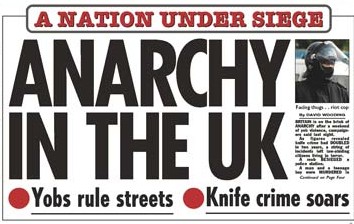
That's not to say that Wade was a non-entity as editor, far from it. She kept up her campaign for "Sarah's law", legislation which children's charities themselves oppose as either unproved or potentially putting them further at risk as paedophiles head even further underground. Other campaigns have included almost yearly rages against the Human Rights Act, which it has repeatedly lied about and slandered, repeated demands that the detention limit for "terrorist suspects" be extended, whether to 90 or 42 days, with the paper the first time round denouncing those who voted against as "traitors", constant moaning that sentences are not long enough and that more prison places are essential, even when Labour has vastly lengthened and expanded both, and more recently, hysterical scaremongering, both about knife crime and Britain being "broken", as well as a horrendous campaign "for" Baby P, which resulted in two of those involved in his case considering suicide. That isn't to mention other quite wonderful journalistic successes, such as the claim back in January that "radical Muslims" were targeting Jews such as Alan Sugar, which led to legal action being taken, or last year's "IVF twins were dumped because they're girls", which was untrue on almost every count.

All this said, the Sun has certainly become to an extent more liberal during Wade's tenure. Whether this is down to her or because in general society is becoming more tolerant is unclear, but the paper which not so long back was leading campaigns against the possibility of Julian Clary becoming host of the Generation Game because of his sexuality, or which asked on its front page whether the country was being run by a "gay mafia" has moved on. During the Big Brother racism scandal it ran a front page, which although somewhat hypocritical, was the sort of thing it would have never done only a few years ago. It still loathes asylum seekers, failed or otherwise, but that's hardly unique in the tabloid world. Both the Daily Mail and Express are far more reactionary than the Sun on almost all of these matters.

The Sun still matters most though because of its sale and its influence. While the Mail may be catching up, or even caught up, the Sun is still courted by politicians looking for the nod of approval from Rupert Murdoch. He is, after all, the real power behind the throne, and any editor of any of his papers is only following the rules put down by him. His recent comments about David Cameron, that he has to be a second Thatcher if he's to gain his full approval, showed just how politicians have to portray and present themselves to get support. It should be remembered that this is a man who has no vote in this country, who has in the past made it his task to pay as little tax in this country as possible, and who is fundamentally unaccountable to anyone other than himself. Whoever becomes the next editor of the paper, and no one seems to have any idea who it's likely to be, the real power will not lie with he or she.

Update: Stan points out the in comments that I forgot about the Alfie Patten non-story, which also should go down as one of her worst moments.

Labels: , , , , , ,

Share |

Friday, January 30, 2009 

Investing in quality journalism News International style.

Invest in journalism or die, said the ginger ninja Sun editor Rebekah Wade on Monday in this year's Hugh Cudlipp lecture. It was therefore inevitable that News International would do the exact opposite:

News International is poised to make a series of editorial job cuts across its tabloid and broadsheet newspapers in the next two weeks and cut the rates it pays some agencies for stories.

Production staff are likely to be heavy casualties as the Sun, News of the World, the Times and Sunday Times seek to further integrate subbing in print and online, MediaGuardian.co.uk understands.

It is believed that the cuts could affect as many as 200 staff, 10% of News International journalists. However, other sources say the number could be far lower, with fewer than 100 jobs expected to be at risk.

Sources close to the plan say that the Times could bear the brunt of the cuts, while the more profitable Sun will see more protection. ... Further savings are also expected as the publisher reduces the amount it pays some independent news agencies for stories and pictures.

Press Gazette explains what the new rates are going to be:

The new rates are: £20 for a one or two paragraph story; £35 for three to five paragraphs; £50 for six to eight paragraphs and £70 for nine paragraphs.

The rates for small, medium and large page-lead stories are £100, £110 and £135 respectively.

The day rate for commissioned work is £110 and the rate for a page lead in the showbiz section Bizarre is £600.

Napa treasurer Chris Johnson, from Mercury Press agency, said: "They are shaving £5 and £10 off rates that were set in 1993 – they are the lowest rates on Fleet Street."

The minimum rate for a picture, of up to two square inches, has been set at £70 to £75, rising to £100 for six square inches, £130 for up to 30 square inches and £168 for 30 to 56 square inches.

Johnson said: "People won't be able to supply pictures at these rates – many agencies already set a minimum fee which is higher than this."


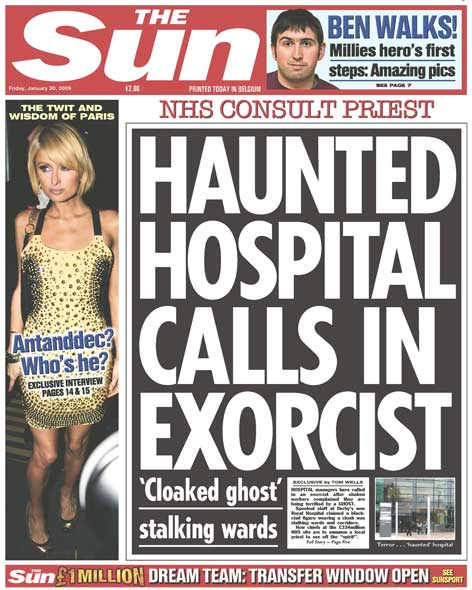
Paying less than in 1993 does indeed seem a lot like disinvesting in journalism rather than supporting it, but then the Sun always has confused things like journalism with propaganda and quality with bullshit. In fairness to Rebekah Wade she's currently on a piss-up with Murdoch at the World Economic Forum, so isn't responsible for today's completely supreme front page splash:
That's an interview with a cunt, a story about a man walking, and a sub-Daily Sport story about a hospital being haunted. Still, you have to give them some credit: at least they're not currently being as extraordinarily contrary as the Daily Mail, which is supporting a heroin addict over a couple of gay men.

Labels: , , , , ,

Share |

Tuesday, January 27, 2009 

A night to dismember.

Billed as her first major speech in six years, or rather appearance, as the Sun's editor, Rebekah Wade, is notoriously shy of the limelight, the invitation for her to deliver this year's Hugh Cudlipp lecture was a curious one. Although the press is too coy to mention it, the real reason why Wade has not defended her newspaper in person when controversy has surrounded it, instead sending out Grahan Dudman to do it, is for fear that she'd embarrass herself, as she did when she rather unfortunately told the truth to a parliamentary committee by saying that her paper paid the police for information. Then there was of course her arrest and night spent in the cells for whacking her then husband, Ross Kemp, after a night on the booze. Again, interestingly, most of the media connived to cover up her split from Kemp, with Private Eye reporting that Les Hinton had phoned round the papers pleading with them not to report on it. For an editor whom in her speech defends vigorously the right to print whatever the hell she likes about those supposedly in the public eye, this strikes as rather hypocritical behaviour.

There is perhaps though another reason why Wade has not ventured into the public gaze for the past few years, which quickly becomes apparent when you read the actual content of her speech: she has nothing of any great interest to say. You don't need to be an intellectual to edit an newspaper, and Wade is probably excellent at what she does, but an orator or a debater she is obviously not. Compared to Paul Dacre, who likewise is supposedly shy of the limelight, his speeches, which included the very same lecture a couple of years back, are furious and infuriating by equal measure. He might be completely wrong, and arrogant and insulting with it, but he can argue his point well enough. Wade however lacks the courage or self-belief to adequately cover the contradictions throughout, leaving gaping holes in her material.

She might well have been then as Roy Greenslade suggests, charming in person, but none of that comes across in the somewhat disjointed full text offered by both the Guardian and the Press Gazette. Starting on somewhat surer ground, she illustrates that those cutting costs without reinvesting the savings back into journalism itself are the ones that are losing the most sales. Unsurprisingly, the Mirror and the Daily Star are the ones that have lost the most sales over the past year. Even this though leaves out some other much needed explanatory detail: Wade doesn't mention that her own paper has reignited the vicious price war, with the paper selling for just 20p across London and the south-east. As has been noted time and again, because of Murdoch's other vast interests, he can afford to do so; his competitors simply can't, and attempting to compete is beyond stupid. Naturally, Richard Desmond has therefore slashed the cost of the Star to... 20p. Although December is always a quiet month for newspapers sales, the Sun fell below 3 million last month, just as it did in 2007. Across the board though all of the tabloids are declining, and falling at far faster rates than their broadsheets rivals and sisters. It indicates the inevitable: that as the internet increasingly takes over as the main source for the celeb tittle-tattle, scandal-mongering and populist wittering which they specialise in, the tabloids are facing the end of their business models. The broadsheets, by contrast, although still giving away their content, can survive thanks to their quality and reader dedication, which simply isn't there among the red-tops and middle-market.

Wade's rallying cry then, that it will be "the quality of our journalism [that] makes or breaks our industry, not the recession", is one of those statements that makes you wonder if she really knows what she's saying. Just the recent Glen Jenvey incident, when the paper splashed on a complete untrue concocted story which accused completely innocent Muslims of being extremists, shows how much it cares about accuracy. It's no surprise to learn that a new poll found that only 19% of those questioned in this country had trust in newspapers. This is a direct consequence of the tabloids' often irresponsible and downright untrue journalism, which unfairly infects opinion of other newspapers and broadcasters, yet still editors like Dacre and Wade defend their "quality" despite its effects.

Wade's second theme, campaigning journalism, offers us her insight into both the recent Baby P affair and the more notorious "naming and shaming" of paedophiles she directed while editor of the News of the World, but first she mentions the paper's continuing support for the Help for Heroes charity, including her own trip to a base in Helmand. She describes a warm welcome and how everyone was wearing the wristbands, but this jars somewhat with the far more cynical views of the newspaper on the Army Reserve Rumour Service message board in response to the paper's Military Awards, which Wade also mentions, and which readers themselves also seemed less than overwhelmed with. She takes credit for the increasing support for the army and turnout at parades, without providing any evidence whatsoever that it was the Sun "wot did it". Similarly, while she calls for more reporting of the war in Afghanistan, she doesn't mention that her paper's own coverage of it never for so much of a second doubts that it's for a good cause or that the battle is being won. Whenever the topic is discussed in the paper's leader column, it inevitably turns to the argument that fighting the Taliban makes us safer, when again there is evidence to suggest the opposite is the case. Blind loyalty is all that it has to offer, when constructive criticism is always the best policy.

Moving on to Sarah's law, what becomes clear is Wade's utter refusal to take responsibility, both for her own actions, and also for the actions of those who read her newspaper and decide to take the law into their own hands. Illuminating firstly is that it came about after she arrived unannounced on Sara Payne's doorstep; not apparently concerned about whether either she or her husband were in a fit state to be interviewed, or to set in motion what became a crusade which if implemented would most likely have the opposite effect to that which is intended, Wade immediately had her witch-hunt. Her own contempt for the truth is also apparent when she castigates the other media for its reporting of what happened on one Portsmouth estate:

Parts of the media went on the attack with a blatant disregard for the facts of the campaign or more importantly their readers’ opinions on the matter.

After we published the first list, a group of mothers from an impoverished housing estate in Portsmouth took to the streets to protest. The BBC described them as ‘an angry lynch mob’.

What the BBC did not report was that the mothers had just discovered that Victor Burnett, a paedophile with 14 convictions for raping and abusing young boys between the ages of four and nine, had been rehoused amongst them unmonitored by the authorities.

Totally unaware of his background, the residents had complained for years about Burnett’s inappropriate behaviour towards their children but their voices, until then, had remained unheard.


How else should the media have described protests such as these, as reported by the Telegraph:

The torch paper was lit by the naming of Victor Burnett, a convicted serial child abuser, in the News of the World: he was a resident of Paulsgrove and was hounded from his home by a chanting mob. Events moved out of control: the rest of Britain looked on in horror and fascination as windows were smashed, cars burned, and angelic, banner-waving five-year-olds happily chanted words that sounded ugly falling from childish mouths. "Sex case, sex case. Hang 'em, hang 'em, hang 'em." Five families were moved from the estate: the police said that none had links with sex offences.

There was no evidence that Burnett had re-offended while on Paulsgrove, but at least he was correctly identified: others had their houses burgled, windows smashed and their cars set on fire. Wade calls the "naming and shaming" her responsibility, which it was. She however hides behind the readers themselves, critical of how others disregarded "readers' opinions", as if readers' opinions are always unimpeachable or always right. As Nick Davies pointed out in Flat Earth News, one of the rules of production is giving the readers what they want, but what
you think the readers want is not always the same thing. The key is that it's cheap, while challenging orthodoxy is expensive and unpredictable.

That Wade has no interest in the ultimate consequences of her own actions could not be more illustrated by the end result of the paper's Baby P campaign. Here's how she describes it:

Campaigns provide a unique connection to the public especially when the subject matter is of a serious nature.For me, nothing can illustrate this connection better than our recent Baby P campaign.

The public outcry was deafening. And we began our fight for justice with a determination to expose the lack of accountability and responsibility for Baby P’s brutal death.

We delivered 1.5 million signatures to Downing Street and the collective power worked.

Children’s Secretary Ed Balls was forced to use emergency legislation to ensure that those responsible were held to account. We received many many thousands of letters at The Sun about our Baby P coverage.

I’d like to read you one: ‘I have never been a huge fan of The Sun, however I thank you for the coverage of Baby P. I am so grateful for the campaign. This is not a modern day witch-hunt but a petition for justice. Please, please do not relent.'

In contrast, I’d like to quote from an article in... The Guardian.

“Full of fury and repellent hysteria, but isn’t that part of the game? This is less about the creation of public emotion and more about its manipulation."

This knee-jerk tabloid kicking reaction is just dull.

But total disregard and respect for public opinion never ceases to amaze me.

They demanded accountability.

And as a result of the campaign, some, just some, of those responsible were removed from office without compensation.

Or as this Sun reader wrote: ‘The tabloid press, which the arty-farty press like to look down on so much, has shown that it prides morality over political correctness.’


Again, there's the lack of evidence that Shoesmith and others wouldn't have been suspended or sacked if the Sun hadn't ran its campaign. Some sort of action was always going to be taken. Again, Wade hides behind supposed public opinion: it's what "they" want, not what she wants or what's good for Murdoch's bank balance. It's not about directing the blame onto other people because those actually responsible for Baby P's death couldn't be named and demonised themselves because the cogs of justice are still whirring in connected cases, it's about so-called justice, or even morality. The result? A new boss has been installed in Haringey, on double what Sharon Shoesmith was earning, while the borough is now so desperate for social workers that the head of the department made an appeal across London for some to be lent him. Children less safe, those who worked on the case who were already likely distraught had their lives ruined, and now the service, what's left of it, costs more. A more ringing endorsement of a Sun justice campaign could hardly be imagined, and yet still Wade feels fit to quote a reader who invokes morality. This so-called morality was presumably what lead the comment sections on the Sun's articles to be shut down, where previously already suicidal social workers had been encouraged to kill themselves. The only more immoral paper in this country is the Daily Mail.

Filled with such chutzpah, it's little wonder that Wade then goes on to make an even more outrageous statement, this time involving press freedom:

This country is full of regulators, lawyers and politicians eager to frame and implement legislation that would constrain freedoms hard won over centuries.

We are already losing those freedoms. Privacy legislation is being created by the drip, drip of case law in the High Court without any reference to parliament.


This from the editor of an newspaper which as the Heresiarch has already pointed out, has never so much as raised its voice once against this government's incessant attacks on civil liberties. In fact, on nearly every occasion it's supported them, whether it be ID cards, detention without trial or its constant bugbear, the Human Rights Act, which it opposed while the government introduced it. She's also completely wrong: parliament passed the HRA, which now so apparently threatens the tabloids' and their dying business model by potentially restricting the scandals they can report. This is also an issue on which public opinion is not necessarily on their side: few cared about Max Mosley, or even knew who he was until the News of the World exposed him while blackmailing the women who spanked him. The HRA doesn't affect real scandal, like the already monikered "Erminegate", which is why no one other than the tabloids and their editors care, and why the Guardian was completely right to print Mosley's own views on press freedom, which she criticises, no doubt intending to be humourous, as "self-flagellation". When she talks about quality, a old man being spanked by prostitutes is the sort of story she means.

Having regaled stories about how much the Sun listens to its readers, she concludes with a few questions which can be happily answered:

We need to ask ourselves: Can we unite to fight against a privacy law that has no place in a democracy?

Obviously not, as firstly there isn't one, isn't going to be one, and even if there was, it wouldn't be supported when it would only cover sex scandals involving celebrities. Next!

Can we agree that self-regulation is the best way to deal with the occasional excesses of a free press?

No, not when the regulator is completely toothless and cannot impose financial sanctions or front page apologies on newspapers when the "excesses" are serious enough, as they often are.

Can we have a press that has the courage and commitment to listen to and fight for its readers?

Not when no thought is put into whether the consequences of that courage and commitment will actually result in a positive outcome.

Can we survive this economic climate if we keep investment in journalism at the heart of what we do?

Not if what you call journalism is whatever's on the front page of tomorrow's Sun (Jade Goody and a footballer being interviewed about a rape).

Labels: , , , , , , , , , ,

Share |

About

  • This is septicisle
profile

Archives

Powered by Blogger
and Blogger Templates