Wednesday, June 03, 2015 

Coulson: merely a liar, not a perjurer.

Andy Coulson is a liar.  Indeed, he is not just your simple, run of the mill, garden liar, telling his wife that hideous dress really does look fabulous, continuing to maintain that ex-lover Rebekah Brooks is innocent, etc.  He has repeatedly lied under oath.  He lied under oath at the phone hacking trial, before finally the biggest lie of them all, that he had no knowledge of hacking whatsoever and it had all been conducted, authorised and paid for by his underlings collapsed in his third day in the witness box.  Yes, he had listened to recordings of then home secretary David Blunkett's voicemails as played to him by chief reporter Neville Thurlbeck, but he didn't know such a thing was illegal and he immediately put a stop to such a disgusting abuse of a secretary of state's privacy, honest injun.

The jury saw through it, as did everyone else.  Coulson's peformance at the Old Bailey was not however his first instance of telling the most outrageous of lies while under oath.  Called by Tommy Sheridan at the Scottish politician's own perjury trial, Coulson denied having any knowledge whatsoever of Glenn Mulcaire, the News of the World's private detective phone hacker-in-chief.  At the time I asked if there had ever been an instance of someone facing a charge of perjury as a consequence of giving evidence at a perjury trial, and lo, so did it come to pass.  The case was repeatedly delayed, first by all the investigations in England into phone hacking, then by the election, lest the potential conviction of the prime minister's former head of communications for perjury while still in his employ have any desperately unfair impact on the result, but did eventually begin three weeks ago.

Coulson's acquittal today, which is of a piece with the aforementioned acquittal of Rebekah Brooks and many of the Sun journalists on charges of misconduct in public office, is not that surprising given the Scottish definition of precisely what perjury is.  What is surprising is that as with so many of these cases, the prosecution itself was unutterably lacking.  The Crown had over four years to get its case against Coulson in order, or rather, potentially, to realise that it didn't have one despite the blatancy of Coulson's untruths.  At every point Lord Burns, the presiding judge, appears to have given the Crown the benefit of the doubt: the case proceeded despite Coulson's defence lawyer, Murdo MacLeod QC advancing the exact same arguments that belatedly saw his client acquitted in closed court before the trial began.  Burns let the prosecution make its case, then decided that it had indeed completely failed to prove that Coulson's evidence in Sheridan's perjury trial had been relevant to his conviction.  In fact, it didn't really even begin to do so.

As Burns summed up, in Scotland at least, "not every lie amounts to perjury" (PDF) .  Despite what some were quick to claim, Coulson was not cleared of lying under oath.  He without a shadow of a doubt did lie under cross-examination from Tommy Sheridan.  That Coulson was prepared to risk not just his own career but also that of the man he chose to serve by doing so is a measure of his hubris and eventual nemesis.  His lies were not however integral to Sheridan being found guilty; despite Sheridan advancing the claim that he had been hacked by the News of the World, evidence given by a Metropolitan police officer contradicted the notion.  Sheridan did indeed feature in one of Glenn Mulcaire's notebooks, filled with the phone numbers and PIN codes of so many other phone hacking victims, but no further evidence was discovered to prove Sheridan was among them.  Sheridan in his summing up painted his calling of Coulson as potentially irrelevant, but justified it as necessary as part of "other issues that have to be considered, not for you, but other issues…about conduct in public life, about power about who can do things and who can break the law and get away with it". He also argued it was "a public service and a public duty to try and expose wrongdoing".

The Crown was rather in a bind.  It could hardly call Sheridan to expand on precisely what his intentions were and why in fact his questioning and Coulson's answers were relevant to the conviction.  As the Graun points out, it was the Crown's case in the original trial that any use of the dark arts against Sheridan, of which there hadn't been any anyway, was irrelevant.  To then admit that, err, perhaps there had been would be a contradiction too far and provide further ammunition to the review of his conviction.  Incompetence does still rear its head: Burns was not given the rulings made prior to and during the Sheridan trial over the admissibility of hacking evidence, which deemed it was relevant.  And while Sheridan may well not have been hacked, his associate Joan McAlpine definitely was.  There's also the question, as raised over the non-prosecution of Lord Janner, of whether it should have been left up to the jury to decide if they felt Coulson's evidence had been relevant.

Lord Burns' highlighting of the Scottish law on perjury does nonetheless all but suggest that north of the border the oath isn't to be taken literally.  Apparently you only need tell the truth up to a point; juries can distinguish between evidence from a witness that is clearly fanciful while still accepting other things they say as fact, as Burns writes.  It's quite true that if everyone who lied under oath was prosecuted the courts would do little else, and yet it seems perverse that a judge can accept that someone who was in such a position of authority and power as Coulson can treat the oath with contempt and walk free, claiming vindication no less.

What matters however is the law, and regardless of whether or not the case was pursued competently or with total dedication, with perjury being so narrowly defined it was always going to be difficult to achieve a conviction.  The same could be said of many of the prosecutions of Sun journalists in England, which have in the main seen the journalists acquitted while their sources, disgracefully, have often been convicted and imprisoned.  These prosecutions, which are all the more questionable after a Court of Appeal ruling that a judge had misdirected the jury in one trial, resulted from the handing over to the Met of a massive cache of internal documentation, as provided by News Corp's Management Standards Committee.  If the purpose, as critics have long suspected, was to focus attention on the misdeeds of individual journalists rather than on those commissioning their stories and paying their wages, then it seems to have gone entirely according to plan.

Nor does the performance of the CPS inspire confidence should charges eventually be forthcoming over the phone hacking at the Mirror group of newspapers.  Just as News International maintained its "one lone reporter" line until it could no longer do so, such was the weight of evidence, so too Trinity Mirror denied any wrongdoing until finally the logjam was broken by the case brought by a group of celebrities.  Former chief executive Sly Bailey almost certainly lied to the Leveson inquiry, while current CEO Simon Fox, who previously took HMV to the brink of collapse, claimed once they were convinced hacking had taken place they acted.  Mr Justice Mann in fact had to order the company to make clear exactly what it was it was admitting to last September, rather than just in the "general terms" it had.  His ruling also made clear that he accepted the evidence of James Hipwell (one of those imprisoned following the City Slickers affair) on hacking at the Daily Mirror, and how it "implicates the newspaper at levels above the journalists investigating the stories".  Let's hope Alison Saunders and friends have more success with Piers Morgan than her predecessor did with Rebekah Brooks, eh?

Labels: , , , , , , , , ,

Share |

Wednesday, June 25, 2014 

The prerogative of the harlot throughout the ages.

Killers view themselves like they view the world, they pick at the holes.

Nick Davies, as usual, is right.  When it came down to it, the phone hacking trial wasn't about crime conducted on an industrial scale in the offices of a newspaper; it was about power.  Had Rebekah Brooks also been convicted, it wouldn't have just caused David Cameron further embarrassment over all those cosy country suppers, it would have also implicated his two predecessors, both of whom got close to the tabloid editor.  As for Rupert Murdoch, it would have meant the person he installed at the top of his UK operation and treated like a surrogate daughter had broken the law repeatedly, either with or without his knowledge, bringing a potential corporate charge all the nearer.

The relief was palpable also in the quarters of Fleet Street where they've always downplayed just how out of control newspapers for a time were.  Had Brooks been sent down there would have been no denying the moral vacuum that had dominated and still remains in certain newsrooms.  One editor gone bad can be portrayed as a rogue, just as one reporter once was; two would have destroyed any such posturing.  It wouldn't have revived the demands for statute, but it would have shown just how inadequate the reheated PCC in the form of the Independent Press Standards Organisation is.

Instead all got the result they both prayed and paid for.  Brooks' acquittal meant they could focus on her rather than the conviction of the prime minister's chosen one and their former colleague.  To read the leader columns of the Times and Telegraph is to be beamed into a world of make believe, one where the establishment overreacted to a few unfortunate breaches of privacy by a handful of journalists on what was always a downmarket rag.  The orchard was not rotten, says the Torygraph, the trial failed to live up to its billing and there is "some truth" in Charlie Brooks' statement that there was a "witch-hunt" against his wife.  "There has not been a vast criminal conspiracy by the press against the public," it solemnly goes on.

It makes you wonder how the paper's editorial writer would describe the largest player in another major industry found to have broken the law on at least 1,000 separate occasions, with it possible there are up to 5,000 victims of phone hacking in total.  As the BBC summarises, this is far from the end of the saga: 59 people are awaiting trial over corrupt payments, mostly from the Sun, while investigations continue into alleged hacking at the Mirror.  A fact you also won't see bandied about by the apologists is Glenn Mulcaire's files show he was tasked 600 times during Brooks' editorship at the Screws.  Her defence managed to whittle this figure down to just 12 occasions when it was absolutely certain the notes corresponded with a known hack rather just "blagging", and as there was nothing to personally connect any of these hacks with Brooks, the one major question being over the Milly Dowler intercept itself, the jury simply wasn't convinced she had conspired with those she worked alongside.  The idea she didn't have a case to answer however, or that this was a witch-hunt, is absolutely ridiculous.

They can't just focus on Brooks' innocence though, and so the story is already being moved on to the cost.  £100m, as the Telegraph already reported today on its front page, and as the Times does tomorrow.  Some £60m of this is down to the no expense spared approach of News Corp; Brooks' lead QC and his team were pulling in 30k a week, while the lead prosecutor by contrast was on £570 a day.  All that just to convict "one" individual, ignoring those who admitted their guilt at the outset, as though there are some investigations just too costly to bother with, especially when they involve figures at the very heart of the establishment.  Then we have those once again deploying the "no one cares" argument, or this doesn't tell voters anything they didn't already suspect line.  On the latter perhaps not, but voters don't care about the prime minister having to apologise for either being a knave or a tool?  Please.

If there's one specific irony that overwhelms here, it has to be how different sides of the elite while seemingly in conflict are desperately working towards the same goal.  The majority of the press professes to stand up for Mr and Mrs Average in their battle with the out of touch career politicians of Westminster while in actuality caring only for their own interests, namely profit.  Any threat, however small or risible, must be countered with derision, special pleading and hyperbole.  The press statute, regardless of merit, was the biggest threat to freedom of speech since our ancestors first developed language.  Of course they were going to mock and pick as many holes as possible in the "trial of the century", regardless of the outcome.  Those in power meanwhile, still believing they need the fourth estate to get their message across, are anxious to reset everything before the election gets any closer.

Hence all of this was settled by Leveson.  Cameron was cleared.  He was misled, just as Coulson misled everyone.  Do you really want the cretin opposite to be prime minister?  Can't we go back to Murdoch sneaking in the back door of Downing Street now?  There's nothing more to see here folks.


All I preach is extinction.

Labels: , , , , , , ,

Share |

Tuesday, June 24, 2014 

Emptiness, thy name is Coulson.

When you've been writing about one subject for so long, aren't you meant to feel something when finally, beyond any dispute it's confirmed you were right to do so? Even if it's simply something as petty, as paltry as schadenfreude? I don't know.  I just don't feel anything.

Which is probably the exact same emotion Andy Coulson is currently experiencing.  He must have known this was how it was always likely to end.  You can tell lies for years, you can even tell them on behalf of the government, and if we're to take David Cameron seriously then also to the government, but when you start telling them in the law courts there's always a fair chance they will catch up with you.  Coulson's biggest mistake by far was to imagine he could remain Cameron's chief media adviser once his boss had become PM, believing the phone hacking story had once again gone away.  He then compounded the error by having the hubris to give evidence at Tommy Sheridan's perjury trial, denying under oath he had even so much as heard of Glenn Mulcaire, again without apparently considering for a second how his mendacity could come back to haunt both him and Cameron.

He wasn't to know Nick Davies would discover Mulcaire had been tasked with hacking the phone of Milly Dowler, or that the revelation would shake almost the entire establishment, at least for a short while.  By then Coulson had at last realised the net was closing in; as the Graun is reporting, a week before he resigned he was called by Rebekah Brooks to an urgent breakfast meeting, apparently to be told of incriminating emails about to passed over to the police.  Not that his reason for resigning, coming on the same day as Tony Blair's second appearance before the Chilcot inquiry, offered a hint: he just couldn't give "110%" while "events connected to his old job" continued to receive coverage.  This may well have made him the only person in history to resign twice over something he professed to have never known about.

Coulson did of course know about hacking.  He was up to his neck in it, he authorised it and in the end it consumed the News of the World whole.  While the Crown seems to have characteristically bungled the case against Brooks, failing to convince the jury beyond reasonable doubt that she also conspired to intercept voice messages and pervert the course of justice, the evidence against Coulson was just too overwhelming.  Unlike the other senior figures at the paper who had the sense to plead guilty, realising they couldn't deny the story told by the copious notes kept by Glenn Mulcaire, Coulson gambled on the complexity of the case overwhelming the jury.  The moment it became apparent his ploy had failed was when he had to admit in the witness box to listening to the voicemails intercepted from David Blunkett's phone, the same ones Neville Thurlbeck had pleaded guilty over.  All the previous attempts to present himself as an honest, unfairly traduced operator in a world where grey rather than black or white was the dominating colour were ruined in a matter of minutes.

It was always a fantasy, but it was one sections of the press and the Conservative party did their utmost to continue to maintain.  They ignored the employment tribunal ruling in favour of Matt Driscoll, claimed the Guardian was misleading the British public and only when a murdered schoolgirl was found to have been a victim did the tone very temporarily change.  The Augean stables had to be cleaned out.  Once the Dowler moment had passed, the tact altered to crying press freedom risked being permanently curtailed.  It doesn't matter the only newspaper threatened with being closed down recently has been the, err, Guardian, with most of the right-wing press sagely agreeing how irresponsible it had been over the Snowden files, we simply have to believe the likes of David Woodring when they say there's a climate of fear in Fleet Street post-Leveson.

This is why it's so utterly irrelevant to concern ourselves with whether Cameron should have been more careful in choosing his director of communications, demanding to know if Coulson was telling the full truth when he insisted it was all just one rogue reporter.  Had Cameron given even the shortest, most prematurely concluded fuck about phone hacking or indeed ethics at all he would have steered clear not just of Coulson but tabloid journalists in general.  He didn't because the only thing on his mind was following what he and George Osborne saw as the path to power: get in with the Murdochs and their clingers-on, and everything else will be fine.  Build it and they will come.  The allegations against Coulson were a nuisance, but the fear of Murdoch and his papers was such that it kept Labour quiet.  Besides, they were only celebrities.  Who cares about privacy in this day and age anyway?

Listening to Cameron tell us all how desperately sorry he is that he believed Coulson's lies reminds of Father Jack's apology from a certain priest sitcom.  To give Cameron and the Tories credit, they've always presented his mistake in the best possible light.  After all, who doesn't deserve a second chance?  Coulson had never done anything wrong in the first place mind, but still.  Cameron might have been warned multiple times taking Coulson with him into Downing Street was asking for it; he still did it.  How could he not?  He'd made all these rash promises about abolishing Ofcom, keeping the BBC in check and the rest of it.  Should these things not be as easy as thought thanks to the coalition he needed Andy n' Becks close by lest Keith and James get the wrong idea.  And he might have gotten away with it had it not been for the pesky Graun.  We could quite easily be sitting here now with Sky fully under the yoke of News Corporation, Brooks in charge of a triumphalist News International, the Sun even more scathing about Red Ed and his failings to eat bacon sandwiches while looking vaguely human.

The worst could also be yet to come.  Coulson still faces the perjury charge for his evidence at the Sheridan trial, an appearance it seems Cameron must have been intensely relaxed about.  It's one thing to be such a pleb you take the word of a tabloid editor at face value; it's quite another for them to be in your employ when they tell those fibs to the beak.  Should Coulson be found guilty a second time, can he really just deploy the "I was lied to as well" defence again?

Probably.  Looking at tomorrow morning's front pages, it's difficult to see exactly what's changed since July 2011.  Only the Mail goes for objectivity, while the Times' splash could have been set by Murdoch himself.  In fact it probably was.  For all that's altered, there's much that's still the same.  Almost exactly the same system of regulation.  The same biases.  The same changing of the story.  The same emptiness.  Oh, that last one's just me.

Labels: , , , , , , ,

Share |

Thursday, February 20, 2014 

Blair today, gone tomorrow.

When it comes to getting advice on how to deal with a crisis, not many people would think a certain ex-PM would be the best option. Hardly anyone would be able to afford him in the first place, before you start to factor in how Mr Tony handled the loans for peerages so effectively he became the first party leader to be questioned by Inspector Knacker since Jeremy Thorpe. Not many people though are Rebekah Brooks, who sought out the wisdom of the great man the day after the News of the World published its final edition, as the phone hacking trial heard yesterday.

Not for Blair any qualms about continuing to advise the people the new Labour leader was calling to be investigated, with many thinking the Screws had been sacrificed both to save Brooks and also the News Corporation takeover of Sky. Indeed, he was more than happy to be an "unofficial adviser" to James, Keith and Brooks, so long as the arrangement remained just between them.


More interesting though is precisely what Blair recommended. He suggested an independent inquiry, although whether he specifically mentioned the Hutton report as a model or that was more a flourish on Brooks's part we don't know. Also unknown is whether, as Brooks put in her email, he suggested this independent inquiry would clear them, but he apparently did say they should release the first part of the report just as the police finished their inquiries. For those who remember the curious way a whole range of government reports and interventions took place on the same day as the Old Bill came to visit Downing Street, this might sound more than a little familiar.


While it isn't the most startling revelation that internal corporate reviews are often a complete and utter stitch-up designed to save the bosses while deputy heads roll, it's more that this email marks the last knockings of the nexus between not just Labour and the Murdochs, but "Yes he Cam!" Dave as well. Even more tragic is that the relationship between Tone and Rupe has since broke down completely, in the main due to Wend's apparent crush on the globetrotting behemoth. Whether it was just a spell of unrequited lust on the part of Murdoch's third, much younger wife or something more serious no one seems willing to tell, although naturally there is much speculation.  As those good people over at B&T also note, this break down of connivance between the Murdoch press and the establishment was in the main thanks to a certain Ed Miliband, who also, intentionally or not, had a major hand in stopping our involvement in another wretched Middle East adventure.  Not bad for someone still often mocked rather than respected.


Nor did Blair's advice do much for Keith, Jim and Becca.  While the latter is still putting on a stiff upper lip, continuing to deny today in her first day in the witness box that she had ever heard of Glenn Mulcaire, News International (as was) did through solicitors Hickman and Rose ask the "great and good" Ken Macdonald to review the previous investigation by Harbottle and Lewis into Clive Goodman's accusation that the News of World had "full knowledge" of his actions and also supported them.  Macdonald promptly informed the board of News Corp that while Harbottle and Lewis's review seemed fair, the emails they trawled through contained clear evidence of the paying of police officers, something that had to be reported to the Met at once.  Brooks, lest we forget, continues to face a charge of making unlawful payments to public officials.

Labels: , , , , , , , , ,

Share |

Thursday, July 04, 2013 

The Murdoch tape: weak, weak, weak.

It remains surprising just how often stories that first appeared in Private Eye aren't followed up until rival organisations then suddenly decide to claim them as their own.  A case in point is the Murdoch tape: Private Eye published extracts from it 2 issues ago.  3 weeks later and Exaro News along with Channel 4 claim the tape as their own scoop.  True, they've made available the full tape, apparently recorded by embittered Sun journalists who didn't trust Keith meant what he said at their meeting, but without giving the Eye any credit for having obtained it first.

What's more, for the most part both Keith and the Sun's hacks have good reason to be embittered.  Murdoch's comment that "news tips from cops" in exchange for money have been going for over 100 years is right, nor is it just the Sun or the late Screws guilty of such payments.  That only the Sun has been turned over by the Met does give more than a hint of how this is in some way vengeance for how the Met were themselves caught in the phone hacking fallout.  The handing over of the archive by News Corporation's Management and Standards Committee helped immensely, but don't underestimate the desire of the police to get even, for which see the continuing revelations about how they attempted to smear the family of Stephen Lawrence.

Nor should anyone underestimate the desire of Murdoch to strike back.  That he promises they will "hit back" when they can is a wonderful insight into how his papers have always worked.  They might not wreak revenge immediately, but they will.  Just look at how the Sun last week almost unbelievably highlighted how the police smeared Liverpool fans after Hillsborough without mentioning its own abhorrent role.  The message was clear: the police, who used to be able to rely on the Sun to back them come what may, have at least temporarily lost one of their closest media allies.

The other insight provided is just how loyal Keith remains to Rebekah Brooks, which understandably continues to anger the rest of the staff on his papers.  He whinges not just about how the police came into her office, despite being told they wouldn't find anything, but also about how she was arrested on a Monday morning by about "15 or 16 officers", which is "ridiculous, quite openly".  Considering the number of times Sun hacks have been in tow when the police have raided celebrity targets, or how the Scum recently entrapped Tulisa Contostavlos and then rejoiced when she was picked up, excuse me if I don't empathise with Brooks' sad predicament.

The point is, neither do the hacks.  They don't believe Keith when he says that even if they're found guilty and imprisoned that News Corp will look after them, as he did Brooks when she walked away with an astonishing £10.8m in compensation for in effect screwing over his company.  If they did commit misconduct in public office, then surely so did their editors and those who signed off the payments.  Never before has Murdoch been anything other than trusted, and never before has he been so weak while still trying to give an image of strength.

Labels: , , , , , , , , ,

Share |

Thursday, May 02, 2013 

The Sun ain't gonna shine (anymore).

If you're ever in need of a good laugh, and happen to share my often bizarre sense of humour, you can't really go wrong with recalling the very first editorial published in the Sun following Murdoch's takeover. We will be politically independent it said, amongst other highly amusing statements of how it meant to go on ("the new Sun will be the paper that CARES ... about truth, beauty and justice", went the leader the Saturday before the new paper emerged).

To be fair, for the first few years of its existence and while Keith was still finding his feet as a proprietor in the UK, it was pretty much independent or at the least, undecided. 10 years on though, and the paper's shift was complete. It still didn't pledge allegiance to either Labour or the Tories; rather it supported whoever Murdoch decided was both likely to win and wouldn't threaten his business interests. This has been the case ever since, only with politicians ever more willing to do obeisance before him.

Well, at least it was up until the Graun uncovered a little local difficulty at the News of the Screws. Since then only Boris Johnson and Alex Salmond have impressed the Dirty Digger, both being willing to ignore things like mass law breaking while Murdoch temporarily smiles on them.

It's hardly surprising then that the Sun hasn't endorsed anyone for today's local elections. David Cameron might have been "our only hope" 3 years ago, but he's close to being a no hoper now, such has been Murdoch's ire at the prime minister's support for the agreement between the parties on the press charter. Ed Miliband burned his bridges at the outset of the phone hacking scandal, and as for the Lib Dems and Nick Clegg, well. It does however signify that we may well have reached the point when Keith's power or rather assumed power has finally begun to dim. And if that isn't something worth celebrating, there isn't a whole lot that is.

Labels: , , , , , ,

Share |

Wednesday, May 01, 2013 

We might deserve it, but we're not complicit.

One of the arguments made in the aftermath of the extent of the phone hacking at the News of the World becoming clear was that, to a certain extent, those who had bought the newspaper or tabloids and gossip rags in general had in some way contributed to the pressure on journalists to do whatever it took to uncover new scandals or affairs.  It's not an argument that can be completely dismissed, as increased competition or sales cleary have driven journalists in the past to ever greater lows (see the entire Madeleine McCann disgrace, or the Sun in the 80s under Kelvin MacKenzie), but it's absolute nonsense that readers would ever have wanted hacks to break the law in order to provide them with them the type of stories hacking generally produced.

Although it's not necessarily hacks themselves that made the point (although some of the more egregious definitely alluded to it), the effect is the same: it takes the whole of the blame away from those actually responsible and places it on those who buy a newspaper in the morning for any number of reasons. One of the most obvious examples is the panic over the MMR vaccine, and the consequences now playing out in Swansea. The more than slightly sheepish way the Daily Mail has reported the outbreak of measles hasn't gone unnoticed, the paper having been the foremost national champion of Andrew Wakefield's study claiming that the MMR vaccine could lead to autism.

This isn't to play down the fact that Wakefield's study was published in the Lancet, or indeed that the Mail was far from the only publication to repeatedly draw attention to Wakefield's claims, local newspapers and Private Eye having also dedicated campaigns and column inches to demanding answers, yet no other media outlet went so far out of its way to attack politicians over the scare, or has such a large circulation.  Certainly, the media can't be held responsible for parents deciding not to let their children have the jab, but they most definitely can for continuing to claim there's a link years after Wakefield's research was discredited and the man himself struck off.

The idea that we are all in some way guilty or responsible for the media we have especially sticks in the craw when it comes to the coverage given to sensational murder cases.  Andrew Gumbel, reviewing Amanda Knox's memoir of her time in Perugia, suggests that all those "who feasted on her story contributed in some way to the hysteria".  Gumbel most certainly has, considering he co-authored Knox's co-accused Raffaele Sollecito's own account of what happened following the murder of the British student Meredith Kercher.  While the case was bound to lead to substantial media interest considering the circumstances in which a young woman away from home in a foreign country was found dead, what almost immediately commenced was a free for all, the normal restrictions and holding back on reporting that would follow a murder in this country completely ignored.  Even before Knox and Sollecito were charged, the Mail for one was running pieces such as this, all but saying outright that she was guilty of whatever it was she would be accused of.

In a week when the 50-year-old Profumo scandal is once again making the headlines, it's not surprising that sex and violence in the sun should have led to such lurid reporting. What should be is that so soon after the Portuguese police had been denounced, their Italian counterparts' every word was believed. They never came up with a motive for Knox's involvement beyond the utterly risible claim that she and the others killed Kercher because she refused to join in their sex game, yet down to how Knox had already been reported as having a voracious appetite for casual sex, whether true or not, this was deemed enough.

Knox as it turns out was a thoroughly typical student: she had a liking for parties, smoked cannabis and horror of horrors, had sex. She was also on her own in a country where she had only slight knowledge of the language, as well as being young and naive. She responded as many others would in the same situation, although not all would have tried to pin the blame on another innocent.  As a result she was presented as a devil with an angel face, a conniving, murderous whore, an American harlot who snuffed out a virtuous British flower.  They ignored that the real killer had already been convicted as the fiction was easier to sell.

There is perhaps something to be said for how, back in America, Knox was thought innocent from the beginning and how her family attempted to influence the coverage, reminiscent of how Louise Woodward was regarded in this country.  It can't possibly be the case though that it was readers as opposed to the media and the Italian prosecutors who contributed to the hysteria, as the narrative from both was there from the very beginning.  We might have the media we deserve because we don't protest or complain enough about what they publish, but we most certainly aren't complicit as a result.

Labels: , , , , , ,

Share |

Monday, March 18, 2013 

The vilest thing.

So, err, what exactly did David Cameron's chucking of his toys out the pram on Thursday achieve?  As many expected, we woke up this morning to discover that a deal had been reached overnight, although it came sadly too late for the Mail and the Sun to redo their hysterical front pages predicting today would be The End of Press Freedom as We Know It.  The agreement, which Cameron is now introducing in the Commons, makes pretty damn plain that on all the major points, the very temporary Lib Dem-Labour alliance has been victorious.  We already knew that all three parties had accepted there would be a charter rather than statute, so although Cameron and the Tories will say they've won on that score, that wasn't what was being fought over when Cameron walked out on Thursday.

On the disagreements which supposedly led Cameron to call it quits, he seems to have simply caved in after some further reflection.  While the new regulation system won't then have statutory underpinning, it will only be able to be disbanded through majority vote in the Commons, although this doesn't necessarily apply to future parliaments.  More fundamentally, Clegg and Miliband also succeeded in ensuring the press won't be able to veto appointments to the new board of the regulator, something that could have made the replacement to the PCC almost exactly the same as its predecessor.  They've also ensured the regulator will be able to "direct" where papers have to print prominent apologies, rather than "require", although frankly you still to have to wonder if such measures will be abided by.


Which will be the ultimate test of the new system.  Leveson and everything that's gone with it will be meaningless if what we end up with is a system which still isn't followed.  You'd like to think that all the caterwauling from some sections of the media about the end of free speech means they genuinely do fear that the new regulator will have teeth, and the news that the Newspaper Society has issued a statement on behalf of the press barons that they are yet undecided as to whether to endorse the charter might encourage this view.  It's difficult to see them rejecting it outright though at this point, especially as public pressure for them to sign up is likely to be high.
 

Especially when, once they've reflected properly on it, all the charter will do is put in place regulation similar to that in Ireland, and which most of the newspapers operate under through their specific editions for the country.  The one thing they may well legitimately fear is the exemplary damages proposed for those who remain outside the regulator, although it remains to be seen what publishing "with reckless disregard for a claimant's rights" will mean in practice.  If it means that Private Eye or similar small publications could potentially be ran out of business for libelling the powerful, as indeed James Goldsmith tried to achieve back in the 70s, then this is a system which deserves to be boycotted.

The point remains that however much the likes of the Telegraph now complain about the imposition of regulation, they did nothing whatsoever to attempt to rein in the excesses of the tabloids while the PCC was in operation.  Murdoch's Times was similarly blind for the most part, however much it has since attempted to signal its independence.  The news today that the Sun was supplied with the stolen phone of Siobhan McDonagh, which it subsequently "lost" after accessing the text messages on it, all of which happened back in 2010 during the current editorship of Dominic Mohan, makes clear that all is still not well.  


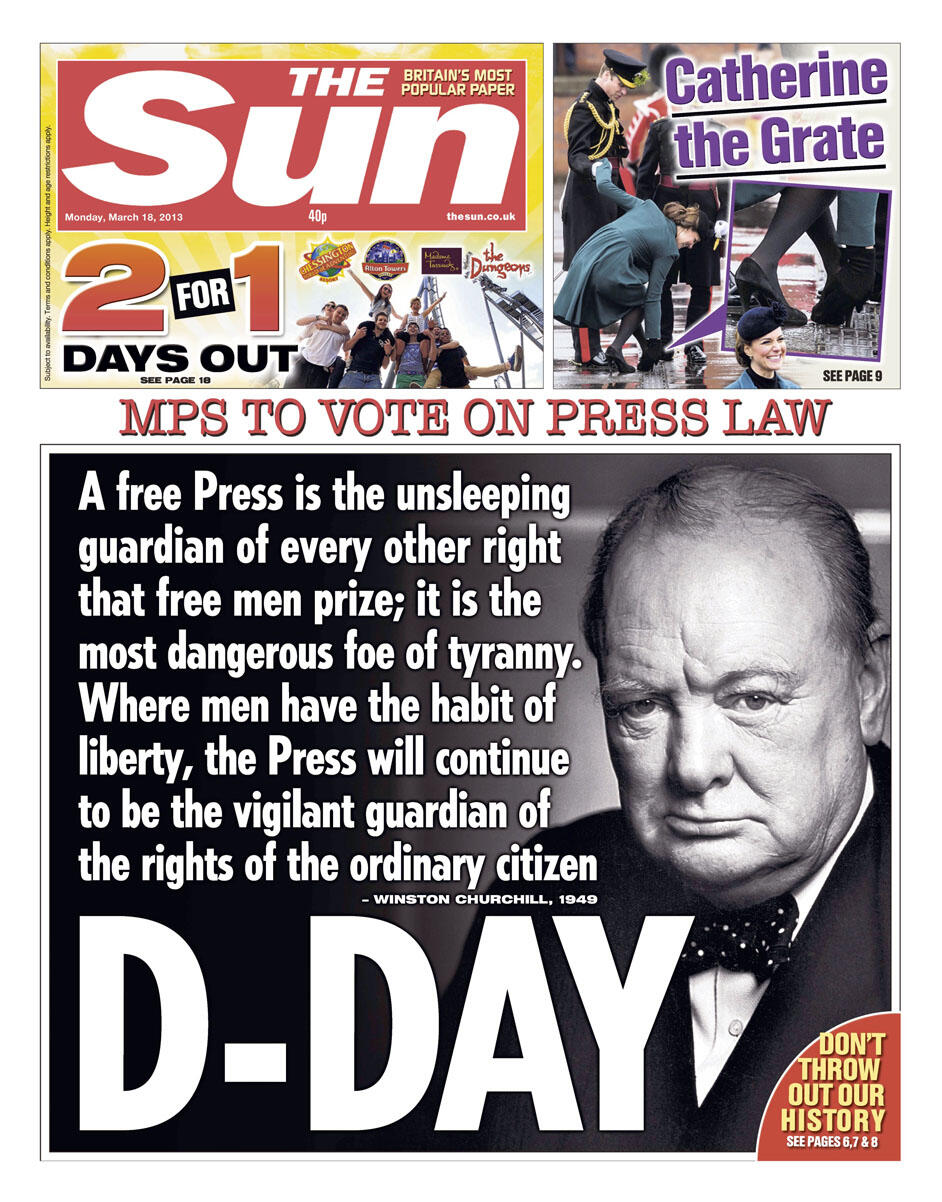
This makes it all the more incredible that the Sun splashed today with the words of Churchill, that "the press will continue to be the vigilant guardian of the rights of the ordinary citizen".  This is of course the same Sun newspaper which supported Blair and then Gordon Brown in their attempts to introduce 90 and then 42 days detention without charge, and which has never so much as once opposed the attempt of any government to limit civil liberties with the supposed aim of preventing crime.  Murdoch only cares about press freedom as much as it enables him to make money, as demonstrated when he dropped the BBC from his satellite operations in China following criticism from the authorities.

The same silliness emanates from Iain Martin and his stated view that it's "terrifying how quickly we've slid from a free press to politicians stitching up press regulation".  Quite apart from how the press have had decades to get self-regulation right and have either refused to or failed at every attempt, his claim that the Americans would be bewildered by the idea of regulating the press is daft when you consider the fact that their press long since moved away from the sensationalist model we're so used to, and that they've also long been sycophantic towards power rather than anywhere near as boisterous as our newspapers.  This said, nothing voted on today is going to make the powerful less accountable: the idea that this is revenge by politicians simply doesn't stand up. Some obviously would like the press to be weaker, but power is shifting in any case.  Newspapers might still break the news and run campaigns, yet increasingly it's genuine public outcry rather than media manfactured outrage that achieves results, as indeed led to Leveson in the first place.


As for how this affects the various party leaders, much depends now on how the media responds.  If they decide that Cameron has essentially acquiesced to the demands of the other side, then it's hardly going to increase their already low opinion of him. They may in time thank him for heading off full statutory underpinning, but plainly not right now.  Similarly, Miliband and Clegg can continue to expect hostile coverage, although whether either care at this point is dubious.  Cameron also looks weak: after all but saying bring it on on Thursday, prepared to lose a vote as long as he did so while defending press freedom, it looks as though he backed down, afraid to lose it so soundly.  He must also be concerned at how Clegg and Miliband worked together when there's surely potential for them to do the same in the future.

Only time will tell whether today really does signal the point at which the press in this country finally realises that it can no longer get away with doing exactly as it pleases, with no regard for privacy, the law, or for the feelings of those whose lives they intrude into.  It is though the point at which our politicians have finally called the bluff of the barons.  In that sense, and considering our past, it's a change to savour.

Labels: , , , , , , , ,

Share |

Thursday, March 14, 2013 

Press regulation: is anyone still paying attention?

As an indication of just how interminable the almost four month long talks on implementing the Leveson report have been, you'll note I haven't dedicated a single post to the report since it was published. When even I find a section of politics I'm normally fascinated by so unutterably tedious, the sheer boredom that emanates from it must surely be sufficient to kill small mammals unlucky enough to be in earshot.

On this level alone, it's difficult to begrudge the decision by David Cameron to bring the cross-party discussions to a close and force a vote on the proposal for a royal charter as it stands. It's also doubtful just how much of a difference there now is between the parties: they all seem to have accepted the establishment of a new regulator via charter rather than statute, and only appear to disagree on ensuring that the charter can't be picked apart by politicians in the future, as well as just how independent the new board will be.

There is definitely then an element of cynicism in Cameron's pulling of the plug now, regardless of the claims otherwise.  He's had a miserable couple of weeks since his party came third in Eastleigh, and yesterday took the equivalent of a sound thrashing at prime minister's questions from a mocking Ed Miliband. By claiming to be defending press freedom he's quickly won the support of the press barons, with only the Graun, Independent and FT concerned at how once again there seems to have been a stitch-up between the government and the same old guard who've never accepted reform in the past.

Indeed, Cameron has played an extremely weak hand with greater political skill than on almost anything comparable of late.  He's apparently succeeded in stopping statute, has courted a press that for the most part has always been suspicious of him and has now forced a vote that could help to reinforce his authority.  And again, it's difficult to criticise him for much of this: no government would or should tolerate the hijacking of multiple bills in an effort to force the issue.  Lord Puttnam's sabotaging of the defamation act is especially enraging when it should be complementing Leveson rather than damaging the chances of either becoming law.

For as much as Cameron went back on his word to implement Leveson as long as what was recommended wasn't "bonkers", far more foolish was Labour's pledge to enshrine it in full when they couldn't possibly have read the thing.  Also counter-productive has been the Hacked Off campaign, which hasn't seemed to know when to stop, always saying that anything less than statute would be an effective betrayal of the victims of intrusion and hacking. The barons might well deserve statute, but all the other publishers and media groups don't.  My position has always been that we need a genuinely independent regulator, able to investigate both complaints and initiate their own if necessary, as well as one that can impose fines and order where corrections and apologies should be printed.  If all this can be achieved with a charter, as it seems it can, then statute simply isn't needed.

On some measures, Leveson and the government in fact want to go too far.  The idea of exemplary damages for those who refuse to join the new regulator if they are then taken to court sounds fine if it's Richard Desmond's Northern and Shell that once again decides not to join, but not if it also means that Private Eye is potentially put in peril, as the magazine has up to now always been outside the PCC and seems unlikely to join this time either.  The last thing we need at the moment is the kind of law that could make new papers or weeklies completely uneconomical, especially as newspaper circulations continue to plummet.

Cameron's gamble is that this has now become a zero sum game.  If it comes a vote and he wins, then he can expect at least some gratitude from the Tory press, while it will also show he can still unite his party on some issues.  If he loses, then he can blame the perfidy of the Lib Dems and say that they and the Labour party want to dilute press freedom for their own political advantage.  What though if Cameron is wrong, and a loss is instead seen as the ultimate evidence that his authority is ebbing away, or, if they manage to scrape through, the public sees it as more proof of politicians wanting to suck up to media proprietors rather than doing the right thing?

In all likelihood, one suspects that Cameron believes his move will force Nick Clegg into moving towards his position, not wanting to vote against the government so soon after his party refused to back the boundary review in revenge for the dropping of Lords reform.  It may instead come down to who blinks first, and I can't help but feel there's likely to be some sort of compromise reached before Monday is out.  Whether it means we will finally have regulation worthy of the name remains to be seen.

Labels: , , , , , , ,

Share |

Thursday, November 29, 2012 

Free press with all four volumes.

Despite everything that was said beforehand and will no doubt be bellowed from the editorials of the majority of the press tomorrow, Sir Brian Leveson's report is both cautious and carefully calculated.  When he started chairing the inquiry, he made clear that he had no intention of doing so if his final recommendations were to be ignored as the previous 6 commissions into the press more or less had been.  The almost 2,000 pages he's served up, and in such a relatively short period of time, itself extraordinary considering how long we've waited for other inquiries to report, reflect this precisely.  Politicians and the police are criticised, but for the most part in lawyerly language which declines to condemn them outright.  The tabloid press by contrast is excoriated, and considering that Leveson was limited in what he could write on phone hacking due to the upcoming trials, he couldn't have gone much further.

They can hardly say they weren't warned, and they also can't complain that it wasn't pretty much apparent from early on that statutory underpinning would be one of the key recommendations.  It cannot be stated often enough, and Leveson himself makes this point repeatedly, that the media as a whole have had plenty of opportunities to institute an effective, genuinely independent form of self-regulation.  They flunked the test in 1992, they failed again following the death of Princess Diana, and they refused to even admit there was a problem after both the jailing of Clive Goodman and Glenn Mulcaire and the publication of the What Price Privacy? report.  Indeed, the Press Complaints Commission all but guaranteed its own extinction when rather than criticise the News of the World, it chose to attack the Guardian for supposedly exaggerating its reports on the scale of hacking at the now closed paper.

Even after all this, some sections of the press have devoted their time to attacking Leveson personally rather than accepting that for too long there was a complete lack of ethics and morals in old Fleet Street.  Away from the News International stable, which has for the most part kept quiet, recognising if they were to get too involved in the "Free Speech Network" it would be taken even less seriously than it has been, the Daily Mail has upped the ante in their stead.

Long ago alerted to how heavily he would be personally criticised by Leveson, Paul Dacre gave the go-ahead for a fantastically amusing 12-page long hatchet job on adviser to the inquiry Sir David Bell, variously linked by the paper to the Bureau of Investigative Journalism, Common Purpose, the Media Standards Trust and the Orwell Prize, which dared to give an award to Johann Hari before it was rescinded.  Common Purpose for those not aware is one of the conspiratorial right's favourite organisations, as they deign to see its machinations behind everyone and everything vaguely on the left.  You expect the likes of James Delingpole to fall for such crap, but not Dacre, for the simple reason that he's not an idiot.  When he then splashes with a piece that describes CP as "a giant octopus" and "a quasi-masonic nexus", the only explanation has to be quite how rattled he is at the potential for a change in tabloid culture.

It's on this culture that Leveson is at his strongest.  His identification of the "aggressive defence" often made by the tabloids when they are subjected to even the merest criticism is spot on (pages 481-2 of Volume II), as is his noting of three separate parts to this defence, both the overt types of intimidation, such as the messages sent to Richard Peppiatt and the mother of Hugh Grant's child, the fear of or actual retaliation in the papers themselves, such as when JK Rowling's daughter was pictured in the press after she asked them not to publish her address, and lastly ad hominem criticism on third parties, such as the attacks on Justice Eady after he ruled in favour of Max Mosley.  Paul Dacre notably described Eady as "amoral" in a speech to the Society of Editors, a lecture he concluded with a whine about Nick Davies' Flat Earth News and how criticism of the "popular press" was doing huge, unjust harm to it.  There's been no suggestion Dacre has changed his mind since.

Where Leveson fails to do himself justice is in those half-hearted criticisms of both politicians and police.  David Cameron crowed in the Commons about how his party had been cleared of doing a deal with News International over the takeover of Sky in exchange for support at the election, something the judge was never going to be able to prove when any such deal was hardly going to be written down and all those involved would always strenuously deny any such thing took place.  Such deals are almost always conducted with a nod and a wink, not with a paper trail.

Cameron additionally claimed Jeremy Hunt had been cleared of all wrongdoing, which isn't quite the full truth.  Yes, Leveson does find there wasn't "any credible evidence of actual bias on the part of Mr Hunt", but he is highly critical of the role played by Hunt's special adviser Adam Smith in his dealings with News International's lobbyist Fred Michel, which do give rise to a "perception of bias".  As Labour argued at the time, ministers are responsible for their SpAds, and the idea that Hunt didn't know what Smith was doing is absurd.  If it hadn't been for the Graun's exposure of the Milly Dowler hacking, News International would now almost certainly be in full control of BSkyB, with all that would have entailed for press plurality.  Hunt would have been more than happy had the takeover gone ahead.

Much as Leveson's recommendations were expected, so was David Cameron's refusal to countenance any form of statutory regulation, including that of a simple underpinning.  To be fair to Cameron, he is in an almost impossible position: go along with legislation and he enrages a media which is already none too enthusiastic about him, as well as the Tory right; reject it and he risks being defeated by an unholy alliance of the Liberal Democrats, Labour and rebel Tories, while also going back on a pledge he made to support Leveson's proposals unless they were "bonkers".

The recommendations are not bonkers, but Cameron is right to be extremely wary.  The current form of press self-regulation has never been anything of the kind, and it's also the case that the current proposals for reform from Lords Hunt and Black are nowhere near good enough.  They are the continuation of the failed cartel of the past, as the Independent, Evening Standard, Guardian and Financial Times have also recognised.  Leveson's recommendations on how they can be improved are excellent, and to judge from Trevor Kavanagh's appearance on Newsnight, even the old Fleet Street die-hards seems to realise that nothing less than their implementation will be sufficient.  If an agreement can be reached between media groups, then Leveson's proposed statutory underpinning might not be necessary, as the judge himself makes clear.

If this banging of heads together fails to result in an improvement, however, there seems little option other than to implement the statutory part of Leveson's proposals.  For all the hysterical bawling about Mugabe and Iran, and how even the merest form of legislation could lead to a slippery slope, something that isn't always a fallacious argument, we really should try everything other than statute.  The point surely though is that we've been here before.  To descend into the clichéd analogies of the day, much as we don't want to cross the rubicon, staying in the last chance saloon for one more round isn't going to cut it either.  


Unless a personal intervention from a cross-party delegation can convince the press groupings to put aside their personal differences and hang-ups to organise a truly independent form of self-regulation, then the government is going to have to step in.  This might be horrendously unfair on the former broadsheets, most magazines and the regional press, but it's been the hubris of the populars and their editors that have led inexorably to this point.  Nemesis has duly followed.  The least Dacre, Desmond, Murdoch and Trinity Mirror can do now is ensure that their failures and abuses don't lead to restrictions across the board.

Labels: , , , , , , , ,

Share |

Friday, August 24, 2012 

Yes, they were so in terror of Leveson, weren't they?

Ah yes, so it was fear of Leveson stopping the papers from publishing the pictures of Harry, wasn't it? Poor old Neil and Kelvin, it's always sad when it's your former employer that knocks your claims into a cocked hat. The Sun's editorial justifying their decision doesn't so much as mention Brian, for the reason this was all the doing of the PCC and royal aides.

Not that the Sun's reasoning is anything other than specious. The Sun, and Murdoch for that matter, have never cared a jot for press freedom, only for publicity and profit, the former of which this latest move has certainly brought. The Sun claims there was a need to publish the pictures in order "for the debate around them to be fully informed". This is, frankly, crap, and the paper knows it is. Anyone who wanted to see them had already done so, and anyone else has certainly read the descriptions of what they show. The Sun's public interest reasoning amounts to 23 words, or 2 whole sentences, that there are questions of his security and how his position in the army might be the affected. Soldiers have done far worse and kept their jobs, while we hardly needed to see the pictures to be able to talk about his security.

As for Harry having compromised his own privacy, can the Sun really have forgotten about Sienna Miller so quickly? By any yardstick, Miller's partying a few years back with a married man in full public view looked a far more open and shut case, and yet she still won a number of privacy actions. We already have reports that Harry's security detail asked his guests not to take photographs, more than suggesting that consent was not given. Lastly, the Sun claims that a previous ruling by the PCC makes their stance this time round a mockery. Back in 2010 they ruled that Loaded magazine had not invaded the privacy of "epic boobs" girl by reprinting images of her as they had been so widely disseminated online. The differences though are apparent: even though Loaded hadn't taken them from the young woman's Bebo page (she was 15 when they were posted), she had made them available herself. Moreover, there had been four years between the images being posted and Loaded republishing them, a period of time over which they had gone viral and become a meme. In this case we are talking about three days, not years.

All this said, this is hardly an issue worth getting out of your pram about, as some of the usual suspects have decided to. If Lord Leveson decides that it's further evidence of how certain sections of the press, despite everything, will continue to do whatever the hell they like, then the Sun has no one to blame but itself. And let's leave it at that.

Labels: , , , , , ,

Share |

Thursday, August 23, 2012 

It's the end of the free press as we know it!

Neil Wallis is, Kirsty Wark reminded us on Newsnight last night, still on bail after being arrested in connection with phone hacking. Rather than being humbled by this chastening experience (and Wallis is of course completely innocent of any involvement with what went on at the News of the World until proven otherwise), Wallis, alongside the ubiquitous Kelvin MacKenzie was everywhere yesterday claiming that the only reason that no newspaper had taken it upon themselves to republish the naked photographs of Prince Harry enjoying a game of strip pool in Las Vegas was terror of Lord Brian Leveson and what he might say should they do so. The end of a free press they warned! The triumph of the "unpopular" press over the popular! What delight for the BBC! The same BBC, it should be said, which invited both Wallis and Max Clifford (and Vanessa Feltz) on to discuss this latest journalistic crisis.

Instead, as we learned today, fear of Leveson played only the very slightest of roles, if one at all. As anyone could have guessed, it was St James's Palace that had the real chilling effect. Relying on the Press Complaints Commission's code of conduct, the same code which has remained unchanged on privacy since long before Leveson was convened, royal aides pointed out that the code prohibits the publication of photographs where individuals have a reasonable expectation of privacy, especially when photographs have been taken without the person's consent. A hotel room is clearly a private place, and we simply don't know whether or not Harry consented to the taking of the photos; one suspects he may not have even known, as they look to have been taken without flash and are extremely blurry. The Daily Mail reports that a "minder" told one of those taking photographs not to, and they may well have even asked them to delete them, underlining the apparent lack of consent.

The rules on expectation of privacy are not new. The News of the World was reprimanded by the PCC way back in 1995 when it ran photographs of Charles Spencer's then wife walking in the grounds of a clinic, leading an embarrassed Rupert Murdoch to chastise then editor Piers Morgan. It's also hardly the first time that royal aides or their lawyers have stepped in to ask newspapers to moderate their behaviour, although this might be the first time they've issued a pre-emptive strike as it were. The media were asked to respect Kate Middleton's privacy when the paparazzi were making a habit of following her around every day, as they were more recently when the same treatment was being meted out to her sister, Pippa.

The real "villains" of this piece then are Harbottle and Lewis, as are the PCC, who passed on their view that publication of the photographs would be a breach of part 3 of the editor's code. Indeed, while the Mail and the Sun both complain that they've been in effect "banned" from publication, neither has put any direct blame on Leveson, even if both have quoted certain figures claiming the inquiry has had a role. The Mail doesn't so much as mention the furore in today's leader column, while the Sun merely makes a joke of the whole thing. And this isn't out of fear of Brian, either: representatives from both the Sun and Mail complained during the inquiry that they risked being scooped by the internet should privacy restrictions be made even more draconian. In this case, they've been stopped by the old PCC code they've long been signed up to.

In any case, by the time today's papers went to press the whole thing was already old news. TMZ posted the pictures up early on Wednesday morning our time, meaning the vast majority of people who would have wanted to see them had already done so by last night. Any additional revenue they might have brought in would have been through advertising clicks, not extra sales, had editors decided to be publish and be damned before they heard from the palace. There also isn't any real great scandal here which would have warranted publication through the public interest defence: much as I resent the fact that it's our tax money allowing Harry to live the high life, protected as he is by Scotland Yard's most lucky, it's not as if he's been caught in flagrante in the middle of an orgy, just stark bollock naked having a bit of fun. The sad reality is that the vast majority of our fellow citizens are perfectly happy for the monarchy to continue to function in the style to which it has become accustomed, and it's the institution that remains objectionable, rather than the inbreds that represent it. Oh, and drop the nonsense about Leveson meaning the end of press freedom Neil and friends, yes?

Labels: , , , , , ,

Share |

Tuesday, July 24, 2012 

Leveson and the crumbling of empires.

And so it ends, not with a whimper but a bang. In a perfect coincidence, the Crown Prosecution Service announced its decision to charge some of those arrested over alleged phone hacking on the same day as the Leveson inquiry's last public hearings. For those like me who were sceptical of the inquiry to begin with, wondering whether it would be turned into a circus by the celebrity witnesses, something that looked more than plausible when Hugh Grant was the one of the first called to give evidence, it's more than safe to say that we were wrong to be.

If nothing else, it finally provided a platform for those who have held power without responsibility for so long to be held to account. We didn't just have the Murdochs giving evidence under oath (and what evidence), but also Paul Dacre, Richard Desmond, Rebekah Brooks, Andy Coulson and many others from the Street of Shame asked to account for the rubbish they serve up day after day after day in their papers. On occasion it wasn't so much the answers they gave as their mere presence, so many being shy and retiring types when not ordering about their underlings. Dawn Neesom, editor of the Daily Star does exist, it turns out, while Paul "double cunting" Dacre seethed his way through his appearances, unused to having to suffer such indignities.

Not that these were anything to those the first group of witnesses to the inquiry had went through. Again, for those like me who felt that the McCanns had brought some (not all by any means, I must stress) of the subsequent bad coverage on themselves through the way they went about enlisting the media in the search for their missing daughter, we were delivered the equivalent of a hefty slap around the chops. It's easy to forget that the likes of the Express and Star really did carry stories claiming that the McCanns had been swingers and took part in orgies, that they had sold Madeleine to help pay off mortgage debts, or that the News of the World published Kate's personal diary despite the McCann's press adviser telling them not to do so. That it was a bastardised English to Portuguese to English translation didn't put them off one bit; indeed, Colin Myler at one stage rang Gerry after the couple had given the an interview to Hello! magazine, righteously wounded that they had gone somewhere other than the Screws after the paper had helped raise £1.5m for the Madeleine fund. Similar horror stories came from Sienna Miller, Anne Diamond, Charlotte Church, the Dowlers, and Mary-Ellen Field, who lost two jobs thanks to the NotW's obsession with Elle Macpherson.

When it was the turn of the politicians to shed some light on their relationship with the press, it was a case of who knew least: was it the elected leaders of the nation, or our self-appointed representatives? David Cameron, according to the BBC, said a variation on he couldn't remember or recall 49 times during his 25,890 words of evidence, while his old pal Andy Coulson did the same on 28 occasions during just 10,531 words of testimony. Cameron at one point had to call on glam Sam to remember just how often he met with dear Rebekah and Charlie; once every six weeks or so according to his wife's social diary. While Jeremy Hunt might not have been brought down directly through the inquiry, despite it being apparent to everyone other than the compromised leader himself that he had broken the ministerial code, he surely can't survive the coming reshuffle. And despite the continuing outpourings from Rhodri Davies, QC for News International, everyone now knows that there was a shadow policy being conducted through Hunt's SpAd Adam Smith in favour of the BSkyB bid. There may not have been prima facie evidence of a pact between News International and the Conservatives, but we did learn of how Cameron knew three weeks in advance that the Sun was to plump for the Tories over Labour the day after Gordon Brown's 2009 conference speech.

We must then return once again to poor Dave's choice of mates. It was bad enough when Rebekah and Andy were charged with attempting to pervert the course of justice and perjury respectively; for them to now also face trial on the specific charge of conspiring to intercept the voicemail of Milly Dowler is just about as bad as it gets. Let's give Dave the widest benefit of the doubt: that he genuinely did want to give Coulson a second chance, and he took George Osborne's advice to employ him as his chief spin doctor purely because of his ahem, array of skills, rather than his closeness to the key players at News International. Why then, when the evidence was mounting up and the warnings from numerous individuals were coming in thick and fast did he insist on taking Coulson into Downing Street with him? Consider the nightmare scenario, that both Brooks and Coulson are found guilty of all they've been accused of; is there any possible way that Cameron could remain prime minister when his director of communications was not only involved in the hacking of the voicemail of a missing schoolgirl, but also lied under oath about having no knowledge of phone hacking whatsoever?

As Alan Rusbridger told Leveson today, the fundamental reason why phone hacking happened is because News International was allowed to become too powerful. At the height of his hubris Kelvin MacKenzie honestly believed that he had the power to help a party to election victory, if only through the constant slurring and smearing of the opposition. Murdoch himself was far more subtle: he joined the winning team when their victory was inevitable, while still maintaining his influence through the menace of what he could unleash should his chosen side drift too far from his own views. MacKenzie's values were passed down through the subsequent editors of the Sun even if they altered their views as the public's own changed, while the News of the World tried to one up the daily paper, and often succeeded. What MacKenzie started, Rebekah Wade renewed and Andy Coulson then perfected. If it hadn't been for Nick Davies and the support he received from the Graun, not to forget the court cases brought which exposed further evidence, then Rupert Murdoch would almost certainly still be a director of NI and cock of the walk. He might not have been telling the truth when he told the culture committee that his appearance before them was the most humble day of his life, but he has been humbled. It's a much needed reminder that no matter how big, powerful and influential, all empires eventually begin to crumble.

Labels: , , , , , , , , ,

Share |

Thursday, June 14, 2012 

No, he Cam't!

Yo, Blair! Two little words that seemed to express everything that had gone wrong between our last but one prime minister and the US president he had decided to affix himself to. Far from being equals, or even keeping up the pretence where others might hear, here was how the president really addressed his UK counterpart: much like he might his dog. For those who decided this was merely one of Bush's eccentricities, evidence of how you can take the boy out of Texas but not Texas out of the boy, what followed was if anything more humiliating. Offering to go out on a peace tour in an attempt to reach a ceasefire between Israel and Hizbullah, he was first rebuffed and then uttered "[B]ecause obviously if she [Condoleezza Rice] goes out, she's got to succeed, if it were, whereas I can go out and just talk." Just talk, not necessarily succeed. Such was Blair's reduced status in 2006.

Six years on, and while the text from Rebekah Brooks to David Cameron sent on the eve of his 2009 conference speech is not quite as succinct, it ought to be just as damning. Having just dumped Labour in the most humiliating fashion possible, here's the former editor of the Sun and newly appointed chief executive of News International saying "professionally, we're in this together", that they should discuss a misunderstanding over a "country supper" and lastly that "yes, he Cam!" give the speech of his life to the Tory conference. Despite no longer being the Sun's editor, the front page of the paper the day after and indeed its leader column used that exact phrase as the headline.

Apart from being toe-curling in the extreme, and away from Rebekah Brooks' transgressing the rules of etiquette (one must never refer to someone as being an Old Etonian, doncha know, hence why glam Sam Cam, daughter of a baronet, always thought Becks was a bit of a prole), it rather explained why Cameron had spent the first few hours of his testimony stressing his emphasis on television news rather than on newspapers. Yes, he explained that politicians of all stripes had gotten far too close to media proprietors and their clingers-on, and the Tories can never remind us enough of Sarah Brown hosting a pyjama party at Chequers that both Brooks and Wendi Deng attended, but you can't quite imagine Gordon Brown exchanging such hideous text messages with Murdoch himself, or indeed Paul Dacre.

Despite this chumminess and talk of professionally "being in this together", there was you must understand absolutely no deal, either overt or covert between the Conservatives and News International. After all, they had only given Andy Coulson gainful employment almost as soon as he had resigned in disgrace for not knowing about his royal editor hacking phones, an appointment that both George Osborne and Cameron admitted they had sought the advice of dear Rebekah on before they made it. No one bothered to independently verify that Coulson was telling the truth when he said he knew nuffink about hacking; why would they? Just as Coulson wasn't hired for his knowledge of politics, although he seemed to be an instinctive Tory, why should they need to worry about past unpleasantness when it was all part of the wooing needed to win back power? It was Coulson, said Cameron, who coined the "hug a hoodie" headline for his speech on understanding and showing more love towards young thugs; that was just the kind of spin doctor he needed.

There was we're informed by multiple sources no smoking gun uncovered during Cameron's evidence, as if there was ever going to be. Dave we're informed went through hours of coaching with lawyers to avoid even the possibility of suggesting that there was something untoward going on; why, he and Sam only met with Brooks and Dave's old mate Charlie every six weeks or so, despite living just down the road from them! Other red herrings also abounded: that Coulson should have received developed vetting is nonsense, and in any case the decision was made by the civil service. Just because every recent director of communications past and since has been developed vetted, including Coulson's deputy, is neither here nor there. Gordon Brown's linking of Conservative policy with support for the BSkyB bid was but an "entirely unjustified and specious conspiracy theory"; just because the Tories promised to freeze the BBC licence fee and abolish Ofcom, one of which they've achieved, and both of which were on James Murdoch's wish list doesn't a plot, understanding or even nods and winks make.

As for Jeremy Hunt, Cameron couldn't remember seeing his memo saying that James Murdoch was furious about Vince Cable holding up the BSkyB bid and that it should be passed through immediately. Anyway, even if he had, then the lawyer on holiday at the time who examined any potential for bias over the phone said that had he known about the memo he still would have said there was no reason why he couldn't act properly in his quasi-judicial role. Which part of he's staying put for now don't you understand?

And besides, no one out there in the real world cares about Leveson. No less a person than Peter Watt, that perpetually wrong contributor to Labour Uncut has said as much. No one gives a toss that the prime minister has had to spend 5 hours looking exceptionally shifty giving evidence under oath at the inquiry he set up, apparently unconcerned at the time that he could be one of the key witnesses. No one thinks that the whole Chipping Norton set stinks, and not just from all the horse shit laying around. Why should anyone spend another second wondering or worrying about collusion at the very top of the establishment between politicians, newspaper editors and police officers? We have to start concentrating on the stuff that really matters to Mr and Mrs Average, and that certainly isn't the old news being served up in front of Lord Brian of Leveson. Privacy? Pah! Deals and skullduggery? Gullyfluff! The prime minister to be and this slightly sinister, slightly strange woman exchanging teeth-achingly sycophantic texts? Nothing to see here. Just forget about it all. It's just froth created by political obsessives and media luvvies who love nothing better than to talk about themselves. That this government's reputation and poll ratings continue to plumb the depths is all about the economy. Nothing more. Really.

Labels: , , , , , , ,

Share |

Tuesday, June 12, 2012 

The neurotic returns.

As someone who a couple of weeks ago finally plucked up the courage to read Andrew Rawnsley's The End of the Party, having not really wanted to bring back all those memories of Tony Blair's last few years, it was ever so slightly difficult to take some of Gordon Brown's testimony at Leveson yesterday seriously. Blair did repeatedly renege on apparent deals or understandings that he would step down as Labour leader, leaving the way clear for Brown, which was partially Brown's motivation for his aides briefing against him; it doesn't however explain Brown's malice against anyone who he felt had either wronged him or was advising Blair to get rid of him, who were also mercilessly targeted. When the tables were turned, such as when Alan Milburn penned an article calling for there to be a contest for leadership of the party rather than a Brown coronation, Brown immediately phoned up Blair blaming him for putting Milburn up to it.

One thing that has defined Leveson so far, the apparent amnesia which afflicts so many once they're under oath, didn't affect Brown, as Andrew Neil noted. The difference was that Brown so often seemed to be trying to tell us that white was in fact black, despite many separate independent sources having previously told us the opposite. He went so far as to say that "he was so obsessed by the newspapers that he rarely read them". This after he had spent much of the first hour of his evidence detailing how the Sun had in his last year of office set out to destroy him, and when as Steve Richards said on Newsnight last night, he was notorious for spending the first half hour he was awake while prime minister reading every newspaper, causing his aides to repeatedly remind him that he was quite possibly the only person in the country to browse all the way from the Daily Star to the FT.

The really sad thing is that this fundamental reliance on being economical with the actualite, as Alan Clark put it, only damaged the rest of his at times gripping testimony. Perhaps his refusal to own up to the briefings or to his role in the attempted coup against Blair is down to keeping something for his still to be written memoirs; if it was instead because he feared that would become the story rather than the other things he wanted to say, then he was deeply mistaken. While most of the sketch writers were sympathetic rather than incredulous as the lobby hacks were, Brown in denial was the overarching theme.

This blunted his attacks on both the Sun and the Conservatives. Despite Tom Newton Dunn tweeting the paper's defence from last year of their story on the then four month old Fraser's cystic fibrosis, it barely bothered today to repeat itself. NHS Fife's statement that a member of staff "spoke without authorisation" of his condition all but confirmed Private Eye's report from last year that it was the partner of a doctor that was the source of the Sun's story, which is not quite the same as the Sun's claim that it received it from a "concerned member of the public". The paper also didn't mention Rebekah Brooks's testimony that she absolutely had authorisation from the Browns to run the story, something repeatedly denied by both Gordon and Sarah, suggesting she is now persona non grata in Wapping.

Brown's highlighting of how the paper repeatedly attacked him over Afghanistan, including notoriously over a condolence letter he sent, was met far more harshly, the Sun calling in a favour from former chief of the defence staff General Dannatt to claim that Brown had to be pushed to increase the troop presence in the country, as though that somehow reflects badly on the former prime minister. Most disgraceful of all is Tom Bower, claiming that because the Browns left Downing Street for the final time arm in arm with their two sons that this use of them as "political props" somehow undermines Brown's evidence on the denied authorisation; how then should they have left? Out the back door that Murdoch was asked to enter through, perhaps?

Regardless of whether or not Brown did tell Murdoch that he was declaring war on his company, and it seems an odd thing for Keith to make up and then tell others had happened, his linking of the Conservatives changing their policy in line with that of News International is hardly the conspiracy theory that George Osborne claimed it was. The Tories' defence that if there was some sort of deal they would hardly have put Vince Cable in charge of authorising the BSkyB bid is laughable: they hadn't expected that they would have to form a coalition, and Cable as business secretary was one of Nick Clegg's few red lines. Osborne was effectively given the benefit of doubt in his often curious evidence purely because he is neither Jeremy Hunt, who squirmed his way through his time under oath, nor his David Cameron, due to give evidence on Thursday. The fact that according to Rebekah Brooks Osborne had been "expressed bafflement" at an Ofcom letter on the BSkyB bid during a dinner in December 2010 was explained by Osborne on the basis that on whatever happened it would annoy some of his pals in the media, therefore he didn't really have a view. This nonsense was allowed to pass all but unquestioned.

As was his evidence on how the Tories came to choose Andy Coulson as Cameron's director of communications. It wasn't that he simply worked for News International and had contacts with those working there; as a "national newspaper editor" he had a wealth of experience, broader than Alastair Campbell, who had never been an national editor. This deserved to be gaped at as some of Brown's testimony had been: Campbell had been a political editor at both Today and the Mirror, whereas Coulson had no speciality in politics whatsoever, hence why he was surprised to be approached by the Tories. Osborne's inquiring into his background also seemed to amount to asking Coulson whether there was anything else to come about the phone hacking, to which he said there wasn't, and asking Brooks whether he was a "good person". She presumably didn't tell Osborne about how Glenn Mulcaire had also been hacking her voicemail, although as we know, Coulson has never so much as met Mulcaire.

Murdoch himself was dealt another blow today when John Major, a man who was clearly fair too humble to ever have been prime minister, confirmed that he was all but offered the support of Murdoch's papers in 1997 if he changed his policies on the European Union. It wouldn't have made any difference to the election result if Major had took up the offer, but it rather punctures Keith's claim that he had never asked anything of a politician. It also led nicely on to Ed Miliband's welcome call for quotas in media ownership, effectively saying that Murdoch should have to either sell the Sun or the Times. The longer this drip drip of allegations and calls for change at News Corp goes on, the more Murdoch is going to hold Cameron's setting up of the inquiry against him. And as Nick Clegg's refusal to support Jeremy Hunt shows, it's getting to the point where the Tories need all the help they can get.

Labels: , , , , , , , ,

Share |

About

  • This is septicisle
profile

Archives

Powered by Blogger
and Blogger Templates