Wednesday, November 19, 2014 

Bringing out the worst.

By-elections in marginal seats always without fail bring out the absolute worst in politicians.  They know full well that in the grand scheme of things i.e., as a guide to what might happen at the general election they're meaningless, and yet still they campaign as though it's the last ballot ever.  Every Conservative MP we're told has been ordered to visit Rochester and Strood 3 times, while cabinet ministers are expected to have made the journey 5 times.  Bizarrely, no one seems to have connected this swamping of the constituency with those lovable rogues from Westminster and the continuing rise in support for UKIP.  Can you imagine just how hellacious it must be to turn one corner and see Michael Gove in all his finery, and then discover Jacob Rees-Mogg further down the road holding forth on the iniquities of EU farming subsidies?  And this has been going on for a month.

24 hours before the vote and the campaign has predictably ended in a battle over whether it's the Tories or UKIP who are going to be nastiest to migrants.  For sure, it's being conducted as though it's truly outrageous Mark Reckless could ever have suggested Poles might be repatriated should the UKIPs' vision of leaving the EU become a reality, while the UKIPs for their part are feigning contempt for Tory candidate Kelly Tolhurst's letter-cum-leaflet which nearly suggests people might not feel safe walking the mean streets of Rochester because of uncontrolled immigration, but let's not kid ourselves here.  The fight over who can move closest to shutting our borders completely without being objectively racist or invoking the old policies of the BNP/National Front has been going on for some time now, and just when you think they've gotten near as damn it, they inch ever nearer.  The "go home" vans were just the start.

Because the by-election is obviously all about immigration, see?  It's all the Tories want to discuss, it's all Labour wants to broach, and err, are the Liberal Democrats bothering to stand a candidate?  Oh, they are.  That's £500 wasted then.  It's also the only topic the media wants to cover, as they can't seem to handle the idea a by-election might be about more than just the one issue, especially when they decided beforehand it was the only thing anyone was interested in.  As Frances Coppola writes, and she's unlucky enough to live in the constituency, even the BBC's local political editor says it's the immigration, stupid, and this in a piece headlined issues beyond immigration and in which she concedes the main topic of discussion on the doorsteps is the local NHS hospital.

Other reporters point towards concerns about the Medway as well and, staggeringly, this might just be why Mark Reckless despite being far less popular than UKIP itself seems to be winning.  It's also no doubt helpful the Conservatives haven't learned anything from the Eastleigh by-election, where it was decided their candidate should try and out-UKIP the UKIPs and came third for her trouble.  Tolhurst if elected will apparently "demand something be done" immediately, although seeing as David Cameron is yet to figure out exactly how to temper free movement without angering business and coming off the worst at the European Commission it's not exactly clear what the tactic will achieve.

Then we have the never knowingly unconfused Labour party.  Last week Ed made great play of how Labour wouldn't pander to UKIP, as once you looked "[at their vision] it is not really very attractive".  This week, first up was Yvette Cooper informing the world one more time it's not racist to be concerned about immigration as she announced yet another new border force, this time complete with shiny uniforms, and then yesterday it was Rachel Reeves' turn.  Apart from the heart sinking at the very mention of the name, it's an odd sort of not pandering to all but agree with the greatest myth of them all, that it's the welfare system attracting EU migrants and not the promise of better paid work, or increasingly, a job at all.

In the name of listening to real concerns people have Labour will prevent migrants claiming out of work benefits until they've paid into the system for two years, an arbitrary period of time if there ever was one, and also stop migrants from claiming child tax credits and child benefit for children back in their home countries.  Reeves also intends to look at migrants claiming tax credits in general, as "it is far too easy for employers in Britain to undercut wages and working conditions ... knowing that the benefit system will top up their income".  The inference seems to be it's fine if Brits have their income topped up in such a way as has become the norm, rightly or wrong, while for migrants it's a subsidy too far.

Quite apart from the obvious problem of basic fairness, one the EU isn't likely to peer kindly on, it once again makes you wonder if the logical next step isn't to extend the same restrictions on JSA to everyone. Small things like how claimants are sanctioned for the slightest alleged "infraction" don't matter, nor does the false economy of reducing so many to relying on food banks, a development Labour has never condemned too loudly, presumably as it has no intention of changing the JobCentre regime.

If as expected UKIP win tomorrow it most likely won't result in the reckoning or further defections some predict.  For a start we're getting too close to next May for there to be any point in more by-elections prior to then, especially when UKIP's real aim has always been to keep the Farage bandwagon rolling on.  Second, if more defections are in the offing, delaying them until nearer the election will damage Cameron and the Conservatives that much more.  Third, it'll go some way towards confirming a pattern: as we saw in Clacton, voters who already favoured their MP aren't too bothered if they move slightly more to the right, especially when most Tory voters are sympathetic to UKIP in the first place.  There was some anger locally at Reckless's betrayal, but if anything Tory support will likely hold up thanks to tactical voting.  Lastly, the sensible will point out how by-elections are always fought on local, rather than national politics.  No doubt however the media and parties both come Friday will be crowing on how it proves immigration is set to dominate next May.

Labels: , , , , , , , ,

Share |

Tuesday, October 21, 2014 

Farage's face, staring out - forever.

In Nineteen Eighty-Four, Orwell through O'Brien offered as a picture of the future a boot stamping on a human face - forever.  It's a visceral, shocking image you want to turn away from, yet it's not as horrifying as the current vision of the future we are presented with.  It still involves a human face, only rather than it being stamped on, there's a rictus grin across its mug, the eyes bright, teeth being flashed for all their worth.  The face, all but needless to add, belongs to Nigel.

Future historians looking back on the coalition government will have plenty to examine and debate over.  They will wonder how a government which insisted it was dealing with a national emergency, the size of the budget deficit, could first choke off the recovery left by the previous government by cutting back capital spending and then conjure to provide a recovery of their own in which the deficit fails to fall.  They will try to reach conclusions over whether it was the emphasis on cuts to the welfare budget by this government that led inexorably to the dismantling of the system of social security as the country had known it post-Beveridge.  Most significantly, they will be forced to consider how despite presenting himself as a strong leader, David Cameron was in fact the embodiment of a weak prime minister, at every step giving in to the worst instincts of his party rather than pursuing what was right for the country.

The evidence for just such a finding is there in abundance.  Most fundamental will be the colossal error Cameron made in January 2013, announcing in a speech that if returned to power in 2015, his government would hold an in/out referendum on remaining in the European Union by 2017, after a successful "renegotiation" with the other member states.  Designed to win over backbenchers complaining about his leadership and the party's standing in the polls, it does for a matter of days.  Having succeeded in pressurising a leader they have never taken to and never will into making one promise, they quickly demanded he move sooner.  They make clear their displeasure at legislation not being present in the Queen's speech preparing for the referendum, and again, Downing Street soon gives in.

Not that it was only backbenchers taking the credit for Cameron's shift.  In another example of Cameron's reckless promises coming back to bite him, prior to the 2010 election he set out how a Conservative government would bring immigration down from the hundreds of thousands to the "tens of thousands".  At first it looked as though he might achieve his aim, only for the continuing economic woes in the Eurozone to result in a surge of migrants from the western European states most affected by austerity coming to the country.  Immigration duly becomes second only to fears over the NHS in people's concerns, not because of it having a personal impact on most, but as a catch-all complaint over the sense of drift, the general feeling of powerlessness most are experiencing as real wages fall and politicians refuse to offer anything resembling a vision of where the country is heading.

So desperate are the public they look anywhere for an alternative.  In any other circumstances Nigel Farage would be an incongruous figure, a deeply boring, petty man who covers up for his party's lack of policies and rigour with an overarching narrative: things ain't what they used to be, and it's all the fault of the European Union.  Nigel smokes tabs, drinks beer, and so delights a media starved by the blandness and sterility of the focus grouped out of existence political elite.  They can't get enough of him, and the publicity combined with the mood of hopelessness leads to his UK Independence Party winning hundreds of council seats, before it comes out on top in 2014's European parliament elections.  Rather than bother to submit Farage himself to anything resembling proper scrutiny, with a very few select exceptions, the media instead focus on those lower down the party structure.  All the while the personality cult of Farage continues to build, to the point where a former DJ imagines the UKIP leader at Number 10 in a calypso inspired song.  It seems and is completely absurd, and yet the main topic of debate is whether Mike Read's appropriation is racist.

Absurd is the word.  Cameron's weakness knows no apparent bounds.  Only a few weeks ago he offered to his party and by proxy the country the promise he would put freedom of movement at the heart of his renegotiation strategy.  He said he wouldn't take no for an answer.  The outgoing president of the European commission, José Manuel Barroso, points out the answer could only be no when the rest of the EU, imposing its own restrictions on benefits or not, has not the slightest intention of curtailing one of the EEC's founding principles and biggest successes.  Panicked further by the prospect of losing the Rochester by-election, and apparently fearing a leadership challenge in the aftermath, we now learn Cameron is set to announce some form of unilateral restriction on low-skilled eastern European migrants, most likely by refusing to issue them with national insurance numbers.  How this will affect the economy he cares not; nor does he worry over the legal implications.

Cameron's gambit has failed on all fronts.  His backbenchers, meant to be sated by his giving them what they want, now realise they have pushed to the point at which they are closer than ever to reaching their goal of getting Britain out of Europe.  Why on earth would they stop now?  UKIP, meanwhile, has had its every argument validated, continues to gain support and still can point out that the only way to truly control the borders is to leave.  All this, and the Conservatives remain behind Labour in the polls.  The only reason Cameron hasn't been called on this disaster is due to the majority of the press sharing the backbenchers' opinion on the EU, and how they can't imagine anything as terrible as Red Ed in Number 10.  I can.  It's another 5 years of Farage's fizzog staring out from every screen, every alternate sheet of newsprint, every billboard, the same silent laugh emanating from his gob.  You're the one he's laughing at, Dave.

Labels: , , , , , , , , ,

Share |

Monday, October 13, 2014 

The UKIPs are coming!

Last week's by-election results told us precisely nothing we didn't already know.  In Clacton, a popular local MP won back his own seat after resigning it as part of a marketing campaigning designed to keep the Nigel Farage beerwagon rolling.  In Heywood and Middleton Labour won back their safe seat, the party's share of the vote holding up.  Only of slight interest is how the party's majority was cut to just over 600 votes, as it shows how people vote differently in by-elections: the Tory, Lib Dem and BNP vote collapsed (the BNP, still in turmoil, didn't stand) and UKIP profited as a result.  Some Labour supporters no doubt switched to UKIP as a protest, with former Lib Dem voters going back to Labour making up the difference.  Moreover, apathy, non-interest or the pox on you all mentality were the real winners, with a turnout of just 36%.

And yet, and yet, because the former meant the UKIPs finally have a seat at Westminster, which hopefully means everyone can now shut up about it, and the latter obviously means the UKIPs could possibly, maybe, have a major impact on the outcome of next year's general election, even if they don't win more than a handful of seats, if that, all we've heard since has been the equivalent of the UKIPs are coming!  The UKIPs are coming!

Yes, just when you thought the why-oh-whying had withered slightly, the number of here's why UKIP is getting so much support articles and think pieces reaches 9,000 again.  The same old points are made over and over: it's immigration stoopid; it's because the political elite are all professionals, never had a real job in their lives; they don't communicate in plain English, can't get their message across with descending into slogans and wonk-speak; they're all the same; and so interminably on.

The fact is there are clearly different explanations for why UKIP has gained support in some areas, hasn't in others and will most likely fall back substantially come next May.  I think John Harris has overstated at times the UKIP "surge", but his piece on Clacton last week nailed why Douglas Carswell was always likely to retain his seat, albeit for a different party.  Telling people just how right-wing Carswell was, the response was one of not caring.  UKIP has become a "safe" protest, an anti-immigration party that isn't racist, merely xenophobic, albeit one fronted by a former metals trader with a German wife.  Carswell's more out there politics were counteracted by his being a good constituency MP, while most former Tory voters were more than happy to support his shifting slightly further to the right.  If there was anger or doubts about the use of public money to stage an unnecessary by-election, those unimpressed stayed at home.  Clacton also fits, as John B has noted, the pissed off at the march of progress demographic as first identified by Lord Ashcroft's polling, and perhaps exemplified by Tilbury.  People who don't properly know why they're angry, who are opposed to change yet also don't want things to remain as they are.

Apart from opposition to immigration there's not much that unites them apart from contempt and a sense of being abandoned.  Hence the desperate search for just why it is they feel this way, with some of the reasons alighted upon saying more about the insecurities of politicians and journalists than getting to the heart.  Voters saying politicians don't understand their lives doesn't mean they want them all to talk like Farage, nor have they've developed an instant aversion to PPE graduates, as Owen Jones seems to believe.  An amalgam of the crash, the resulting austerity, continued anger over the expenses scandal, the belief that London and the surrounding area dominate everything, a "popular" media that focuses on the negative, while the "serious" puts undue emphasis on ephemera and identity politics as opposed to that of the everyday, along with just good old general alienation and the lack of difference between the big three parties is largely how the majority have reached this point.  They've been further encouraged by a media that is enthralled as much as some of it is appalled by UKIP, to the point where certain sections view the party almost as their creation.  The emergence of a fourth party is also exciting, or at least is in comparison with much else of politics, and so the hype feeds itself.

There's danger in both over and under-reacting to all this by the parties.  The Conservative response has been a mixture of not understanding it combined with appeasement: freezing in work benefits at the same time as promising a giveaway to the upper middle is almost precisely how not to win back working class UKIP defectors, while the moves on Europe merely demonstrate how there's little point in voting for a party that only goes halfway towards the exit and has encouraged the Carswells and Recklesses to make their move.  Labour doesn't really want to talk about immigration full stop, whereas it should recognise it made a mistake in 2004 while arguing in reality it's the least of our problems.  The Lib Dems meanwhile have just gone the complete anti-populist route, and it's not exactly won them many friends.

Should Mark Reckless manage to win in Rochester and Strood then it might be worth getting concerned.  The Tories are set to throw everything at it, while in normal circumstances it's a seat Labour should be taking in a by-election.  Even if Reckless fails, the announcement today that Farage has been invited to one of the leader's debates underlines how the media certainly doesn't want to let their little engine that could run out of puff.  If UKIP have won enough support to be represented, then surely the Greens and SNP should be too, especially when either or both genuinely would bring a different perspective to proceedings.  The Graun, lastly, also sounds an ominous note: taxes are going to have to rise after the election, and yet none of the parties have begun to so much as broach the subject.  Should UKIP fall back as some of us believe it will, it or something like it could soon be resurrected when it again turns out a harsh truth wasn't communicated.

Labels: , , , , , ,

Share |

Monday, March 04, 2013 

The Tory malaise.

There's been something almost touching about the way the Tories have reacted to coming third in Eastleigh.  To begin with, despite all the predictions of the party descending into crisis like a Premier League football team that's lost two games in a row, very little in the way of criticism from backbenchers was heard.  After 24 hours some thought better of this and started blaming the usual things: gay marriage, the "Conservative voice" not "clearly project[ing] Conservative core policies or principles", and the more realistic, the lack of organisation on the ground.

Come Sunday, and the panic had finally spread to the leadership.  There was a piece by the prime minister in the Sunday Telegraph, written in boilerplate about how we are in a  "battle to defeat some of the most dangerous challenges in our history" and the only way to ensure victory is to keep doing what we're doing.  There would be no lurch to the right.  Naturally, this means there was instantly a lurch to the right.  Chris Grayling and Theresa May competed on how we would repeal the Human Rights Act, apparently undecided as to whether we should just scrap it or get out of the European Convention altogether, while from out of nowhere came the idea from William Hague that we need to crack down on benefit tourism.  Not that there's the slightest evidence that EU nationals are indulging in such practices (there are legitimate concerns over whether non-EU foreign national are exploiting the NHS), but it makes for a good soundbite and will doubtless appeal to those currently flirting with UKIP.

The funny thing is that this is all a bit late.  It seems to have passed some Tories by, albeit not those who've been blaming Cameron ever since, but they didn't win the last election.  Looking back now, their best chance of a majority may well have been to try to govern as a minority after the election, then gone to the polls again as soon as they thought possible.  They obviously didn't know when they got the Lib Dems on board that the economy would stagnate for the next two years, although there were plenty who warned them their policies would achieve just that, but it was always going to be a uphill struggle to win a majority when you've spent the past half-decade imposing austerity, let alone when you also decide at the same time to go further and faster than Blair ever dared on welfare, education and NHS reform.

This isn't to say that there's no chance they can't turn it around, or indeed that this might prove a moment of false hope for the Liberal Democrats.  The facts are though that the Tories are in a bind: Michael Fabricant can say all he wants that the party hasn't been projecting core policies or principles, but this is utter nonsense.  Apart from the gay marriage bill which some in the party have made so much of for their own reasons, Cameron has for the most part done everything the right-wingers in the party have asked for: they've got their vote on Europe, he's capped benefits and introduced workfare to an extent Labour never dreamt of, free schools are all but the bringing back of selection, the 50p top rate of tax is gone, nuclear power looks to be the favoured way of keeping the lights on, and this has all been achieved with Lib Dem support! It's true that they would have liked to cut inheritance tax, wanted to alter the boundaries to give them a better chance in urban seats and most would rather defence spending was protected instead of international development, but the achievements are hardly inconsiderable.

And yet, and yet, they remain perhaps two further defeats away from wanting rid of the man who remains far more popular than his party. The beginner's mistake being made seems to be to regard UKIP's rise in support as being fundamentally connected with Europe and in turn immigration. In fact if they were to look at Lord Ashcroft's polling it suggests the vast majority of UKIP's recruits are those who've felt disenfranchised for a long time, angry at modern life and change in general rather than newly radicalised by the latest EU outrage. Moreover, they're also irreconcilable, or at least are without at the same time losing the support of almost everyone else.  As the most recent Ashcroft poll also suggested, the vast majority who voted for them in Eastleigh as a protest will return home come the election.  Moving further onto UKIP territory is therefore completely self-defeating, as the result itself suggested.

The real reason for the Tory malaise is far easier to diagnose. Regardless of how there didn't seem to be a protest directly against austerity in Eastleigh, the lack of growth and decline in wages in real-terms is ultimately driving the apathy if not outright hostility towards politics we've become all too accustomed to. Far from offering a solution, Cameron and Osborne tell us all we can do is keep taking the medicine. One thing those apparently ready to challenge Cameron are right about is that this month's budget is crucial.  Osborne is far too like Gordon Brown to not be planning something that will win him and the Tories positive headlines (at least initially) and further tax cuts look the most likely option.

Even if it is enough to stave off those eager to wield the knife, the local elections in May are almost certain to result in a Tory drubbing, as mid-terms invariably do to governing parties.  What Cameron and the Tories need is growth, and there's absolutely nothing to suggest they're going to get it without doing exactly the thing they've said they won't.  And even if they did, they've almost certainly left it too late to reap the benefits if such a change in direction worked.  Then again, what do they have to lose? 

Labels: , , , , , , ,

Share |

Friday, March 01, 2013 

Obligatory what Eastleigh tells us post.

1. Getting your local party in order is vital

There's only one reason the Lib Dems managed to hold on in Eastleigh, and that's down to their organisation in the town.  It certainly wasn't due to any love for the party whatsoever, or for how they've performed in coalition, merely that the voters narrowly preferred what they knew to either UKIP or the Tories.  Which leads to

2. Having the right candidate

Who knows whether the Tories would have done better if they had someone other than Maria Hutchings as their candidate, but they couldn't have done much worse.  Hutchings was fine for the 2010 election when the view of the nation was elsewhere, but out of her depth when in the spotlight.  The Tory campaign was clearly terrified she was going to make even more of a mess of it than she already had with the schools comment, and when you have to tell the media she's essentially a volatile personality to explain why she's not giving any interviews, it reflects badly on you rather than her.  Despite some snide remarks, I think John O'Farrell did a fine job as the Labour candidate; they were never going to win the seat, and his softly softly campaign was a better option than throwing everything at it and still not getting more than a 0.2% swing.

3. Stealing the policies of the insurgent party doesn't work

To all intents and purposes, the Tories and UKIP ran broadly identical campaigns: cap/stop immigration, have a vote on/get out of Europe, kill the first born, etc.  The difference was the voters believed UKIP meant it, while anyone who thought immigration and Europe are pretty irrelevant to a place where neither has much of an impact had to choose between Labour and the Lib Dems.  A leaflet on the day even had the Tories literally using UKIP's colours, to no obvious benefit.  The Tory backbench belief is that if Cameron was a "real" Conservative he'd be able to win a majority.  Rather, it suggests moving onto UKIP territory simply leads to further support for Farage's band and the disillusion of moderates.  Why vote for the imitation when you can have the real thing?

4. But UKIP are still highly unlikely to win a seat

The rise in UKIP support can only be put down to one thing: protest.  It can't be about immigration, which is coming down, unless there really are a lot of people terrified about Romanians and Bulgarians coming over next year, which I don't believe; it isn't about Europe, as not that many people ever place Europe as being a hugely important issue; and it's not about anything else, as UKIP don't have policies on anything else.  Or rather they do, just that if people knew about them they wouldn't like them.  There may be a kernel of truth in John Harris's observation that their bringing up of the loss of manufacturing in Eastleigh struck a nerve, yet this seems like a classic mid-term result rather than the emergence of a competitive fourth party.

5. Bombarding the electorate both works and pisses them off

For a by-election, a turnout of 52% is more than respectable.  You also suspect though that the media and the parties would now do well to get out and stay out for the next couple of years.

6. The "Get Clegg" campaign by the right-wing press failed miserably

Apart from the hilarity of the Mail pretending to care about sexual harassment, the continued splashing on the party's woes over Lord Rennard seems to have had no impact whatsoever.  It's rare that elections are won on anything other than local issues, and in this instance the circumstances of Huhne's resignation also had no impact, as the other by-elections triggered over expenses also proved.

7. Another hung parliament/just about workable Labour majority still looks most likely result come 2015

Eastleigh overall changes very little.  What it does suggest is that the Lib Dems will fare better in their Tory marginals than they will in their Labour ones, which means they could still hold the balance of power come 2015.  The Tories could conceivably win Eastleigh in 2015, as the Ashcroft polling shows, but it would take a gargantuan effort to judge by this performance.  They seem to be keeping a lid on their anger for today, but the Tories as a party are in deep trouble.

8. Michael Gove is still a berk

Yes, Thatcher said she wasn't for turning.  She still did, then denied she had ascribed to monetarism whatsoever.

Labels: , , , , , , ,

Share |

Thursday, February 28, 2013 

The desperate hours.

Not really much point in speculating about the Eastleigh result tonight, although anything other than a Lib Dem win would now be a major surprise.  What is worth discussing though is the reaction of many in the town to the siege laid by both the political parties and the media, who bizarrely have started believing their own hype about this being the most important by-election for 30 years.  Even if the Tories are pushed into third place by UKIP, it's not even close to being an indication of how things will play out in 2 years time; mid-term governing parties are always unpopular, and they haven't helped themselves by picking a candidate liable to go off-piste at any moment.  The popularity of the Lib Dems locally (they hold every council seat in the town) has more or less ensured they haven't suffered the same fate.

The over-the-top campaign has definitely confirmed one thing: that the marginals are going to be the focus more than ever.  My seat is nominally marginal, and yet some wards are obviously considered such rotten boroughs (Tory, in my case) that I have not once seen anyone canvassing here, let alone had the door knocked.  Those in the top target seats might want to start preparing now: May 2015 might be a deeply unpleasant month.

Labels: , , , , , , ,

Share |

Thursday, February 21, 2013 

Eastleigh? Beastly, more like.

It's a miserable, bitterly cold half-term week in February.  There's almost no hard news, except for the Oscar Pistorius bail hearing, which is in the usual style enabling those who know nothing about anything to definitively claim he's either guilty/innocent (although it is great to see that once again the British justice system has convicted three men of conspiring to carry out terrorist attacks when their plans to make explosives out of ammonium nitrate extracted from sports injury cold packs were impossible when said substance had been removed from the ingredients, and they also didn't have anyone other than themselves prepared to be suicide bombers), so it's hardly surprising that the likes of the Graun are trying to make something out of the Eastleigh by-election.  Martin Kettle writes of Crosby and Greenwich, while a previous leader mentions the more recent Brent East and Crewe and Nantwich, somehow forgetting that by far the most surprising recent by-election win was George Galloway's in Bradford West, which only the paper's own Helen Pidd predicted.

Eastleigh is clearly not a Crosby, a Bermondsey, or even close to a Bradford.  There is no indication whatsoever that UKIP are in the running, and Labour's share of the vote in the constituency has been declining ever since 1997, John O'Farrell's candidacy seeming unlikely to change that.  The only real lines of interest are that it's the first straight by-election fight between the two coalition parties, and that the Tory candidate has a long record of putting her foot in it. Considering that a vote for either the Lib Dems or the Tories is effectively one in support of the continuation of the coalition, that Labour or UKIP aren't doing better is the real surprise.

Nonetheless, there are a few things to be drawn from how the contest has played out so far and seems likely to.  First, it suggests that the predictions of a Lib Dem wipeout come 2015 are way off. If ever there was going to be a contest where the incumbent party should lose, this ought to be it. Chris Huhne didn't just keep up a lie for 10 years, he's almost certainly going to prison as a result.  Rather than take advantage of this and do the sensible thing by choosing a moderate candidate more likely to appeal to former Huhne supporters, the Tories have stuck with Maria Hutchings, who seems to regard Nadine Dorries' career trajectory as something to aspire towards. Quite apart from her past remarks on asylum seekers and abortion, claiming that state schools aren't good enough for her 5-year-old cardio-respiratory surgeon son in waiting is just incredibly stupid, even if she wasn't talking about local schools as she claims.

Whether due to Hutchings or by design, the Tories are running a distinctly right-wing campaign, which seems more than a little misguided in Eastleigh.  Pretty much all they wanted to talk about the first week was immigration, implying that the Lynton Crosby strategy that worked so well for Michael Howard in 2005 is back in full effect. Never mind that such a gambit is only liable to work when you're not the ones currently failing to meet your pledge to reduce the numbers to tens of thousands, and that scaremongering about Bulgarians and Romanians only brings more attention to the lack of control over freedom of movement within the EU, the party seemed to think it was a potential winner.  While you shouldn't make sweeping national conclusions from by-elections, should the strategy fail in Eastleigh it might just make the party think twice before making it a major part of their campaign come 2015.

The campaign up to now also reinforces the fact that the Lib Dems' main worry in their marginals with the Tories is not voters going to the right, but how many are likely to defect to Labour or won't be able to bring themselves to vote tactically next time round.  With the by-election unlikely to affect the national picture, this isn't that big a concern right now, but it will be in just over two years' time. The ability of the party to convince waverers to stay with them is what will ultimately decide their and almost certainly Nick Clegg's fate.  Eastleigh won't on either score.

Labels: , , , , , , ,

Share |

Friday, November 16, 2012 

Given the respect they deserved.

It was apparent from the moment Louise Mensch stepped down from her Corby seat that Labour would take the constituency back, such is the nature of the vast majority of by-elections held mid-term in key marginals.  The only question was how big the swing would be, and 12.7% with a majority of 7,791 is a thumping great win.  Grant Shapps (or is it Michael Green?), the Tory chairman, has naturally compared it with their win in Crewe and Nantwich in 2008, which saw a bigger swing of 16.9%, but it's hardly a comfort: the polls currently suggest a nationwide swing of 8.5% to Labour, more than enough for them to win outright if an election was to be held tomorrow.  Anything approaching 12.7% would be a landslide.  The turnout was 44%, more than respectable for a by-election held in November, so no excuses there either.

You of course extrapolate one result to a nationwide picture at your peril, yet the results in the other two by-elections, admittedly both safe Labour seats, were dismal for both coalition parties.  The Tories lost their deposit in Manchester Central, which had a pitiful turnout of 18% (although admittedly only down 26% from the general election itself), while the Lib Dems lost theirs in Corby, coming fourth behind UKIP, in spite of holding up the announcement of the results by about an hour through arguing the toss over it.  While the Lib Dem share of the vote will certainly recover come the election, it's clear that the polls aren't that far out in suggesting UKIP are almost neck and neck with them.  The European elections in 2014 are going to be very interesting indeed.

As for the PCC elections, all the predictions of a dreadful turnout have been proven right.  There were some wards where literally no one voted, which tells you all you need to know about how disgracefully the entire process has been instituted.  The highest turnout from the areas declared so far is 17.75% in Bedfordshire, where the candidacy of the EDL's Kevin Carroll (who came fourth) no doubt boosted it slightly (update: this has since been beaten by 19.15% in Humberside, where John Prescott was pushed into second place.  Don't think it was a good idea to get Tony Blair to canvass for you, John.).  Lowest is Staffordshire, which had the wonderful choice of either a Labour or Tory commissioner, motivating just 11.63% to vote.  Like Hopi Sen, I don't particularly want to believe that the whole point of holding the vote in November and with next to no information available other than on the internet was a specific ploy to depress the vote, and yet beyond the cock-up explanation, which isn't really convincing when all the warning signs were there, there doesn't seem to be any other reason for having done it this way.

The two bright spots are that despite the obstacles set in their way, independents have so far won in 12 authorities (although how independent they will be when some are former police officers is dubious), and that the number of spoilt ballots seems to have been high.  While some will have been down to confusion over the use of the supplementary vote, in Dwfed-Powys where there were only two candidates 4.3% spoiled their papers.  In my authority, where the Tory won after second preferences were counted, 6,413 ballots were spoilt, or roughly 2.8%, not all that far behind the independent who lagged in last with 6.79% of the vote.

Most important is that these were elections the Conservatives felt were theirs to lose.  Instead in the popular vote they're lagging behind Labour, and have lost in areas which are effectively Tory rotten boroughs at general elections: in Kent they were pulverised by a local magistrate and chair of the police authority, while in Gloucestershire a former police officer in favour of restorative justice and against the cuts won after the second round.  Sad as it is that so many party hacks have won, overall the elections and the parties have been treated with the amount of respect they deserved: very little.

Labels: , , , , , , , ,

Share |

Friday, March 30, 2012 

The loveliness of by-election leafletting.

While many have rightly said the highly sectarian letter sent to mosques in Bradford West by George Galloway is very close to being beyond the pale, Political Scrapbook has the almost as ghastly leaflets from the Tory candidate Jackie Whiteley, targeted specifically elsewhere in the constituency. The result? The Tory vote fell by 78%, compared to Labour's 55%. An incredible victory for Galloway, but also an absolute one-off.

Labels: , , , , ,

Share |

Friday, January 14, 2011 

A few things the Oldham East result tells us.

1. Phil Woolas would have won without trying to make the "white folk" angry

Despite increasing their share of the vote by 10.2%, Debbie Abrahams only won 532 more votes that Woolas did back in May last year. The Labour vote in the constituency is remarkably solid: those that stayed at home this time round were almost certainly made up for by a few defecting Liberal Democrats. While Woolas and his team's panic was understandable considering the performance of the Lib Dems in the opinion polls, he would have almost certainly won without resorting to smearing Elwyn Watkins.

2. Don't believe the opinion polls on the Liberal Democrats

Even taking into account the history of the Liberals in Oldham, for the party to increase their share of vote by 0.3%, albeit mainly due to the Tory collapse when they're between around 8% and 12% in the national polls is a brilliant result (although the local polls were about right). Much the same happened on election night: the polls that told us the party was catching up on Labour were utterly wrong. Whether the polls are weak on accurately gauging third party support or those taking part are giving fashionable answers only to change their minds when it comes down to it is worth trying to work out.

3. The only place the Tory vote can go is down

There are plenty of caveats when considering the huge drop in Conservative support, many being made by the party themselves: they hardly bothered campaigning, they wanted to shore up the Lib Dem vote, it was always going to be difficult in a northern seat with the cuts about to bite, their voters themselves didn't believe the party was even in a with a chance this time, etc. Truth is that even in 97 the Tories managed to get 10,000 votes, and over 7,000 in 01 and 05; 4,481, even for a by-election with a lower turnout is a shocking result. If a similar drop occurs in Barnsley Central and at the local elections in May, the party really should begin to worry.

4. The British National Party is in meltdown

When the BNP loses its deposit in a by-election where it centred its entire campaign around "Muslim paedophiles grooming white girls" and its candidate was treated in the usual counter-productive fashion by his political opponents, the party really is in trouble. Add in how Labour didn't dare repeat Woolas's playing of the race card, as well as how well the BNP have performed in the constituency since the 2001 riots, and it suggests the party's rise has been firmly checked, at least for the moment.

5. Spending vast amounts of money and taking the moral high ground doesn't win you elections

You almost have to feel sorry for Elwyn Watkins, although he must have had an inkling that proving his opponent was a liar was hardly going to automatically win him the seat. As it is, he can at least be proud of his performance and for taking out one of the most vile, shameless and opportunistic Labour politicians of the past decade, even if not at the ballot box. Was it worth however much Watkins himself sank into the two campaigns though?

Labels: , , , , , , ,

Share |

Friday, November 13, 2009 

The real story from Glasgow North East.

The story of the Glasgow North East by-election is categorically not that Labour won an overwhelming victory, especially considering the constituency is effectively a rotten borough for the party. A loss certainly would have been, though (a story, that is). It also isn't that the Conservatives received only 1,075 votes, or indeed that the British National Party was only 62 votes behind, although it might be if Chris Dillow's observation that heroin is probably more popular than the Tories was more widely disseminated. Nor is it that unsurprisingly, being a "celebrity", isn't an automatic vote winner: John Smeaton got 258 ballots while Mikey Hughes, a former Big Brother contestant, got 54. It also isn't, although it's again interesting, that the Socialist Labour vote completely collapsed on the 2005 result, when they got an astounding 4,036 votes, down this time to an appalling 47, most likely because Labour was on the ballot when it wasn't previously as a result of Michael Martin standing as the "Speaker".

The real story ought to be the catastrophically low turnout, a derisory 32.9% (Wikipedia has it as 33.2%). This can't be blamed on the lack of choice: all the main parties stood, as well as three various socialist sects, the BNP, three independents, and the Greens. While turnouts at by-elections are usually lower than at a general election, you might have thought it would have been the opposite in this instance, as there was far more choice on the ballot than previously due to the main opposition parties traditionally not standing against the Speaker, with their voters coming out this time when they might not have bothered previously. Instead it dropped from 45.8% in 2005, which was already well below the average of 61%. Did the expenses scandal have any impact? Unlikely. Instead it seems that the people of Glasgow North East, who were already poor before the recession, have lost all faith in politicians of every colour and creed. The only reassuring thing is that the British National Party didn't do better than their 1,013 votes. The current consensus is that the turnout is likely to go up next year when there is an actual, genuine alternative to the current government: Glasgow North East might yet prove to be the rule, not the exception.

Update: Slightly edited after some on Liberal Conspiracy responded with "Eh?" to the first paragraph, which is what happens when I'm trying to write something reasonably snappy and quickly to boot.

Labels: , , , ,

Share |

Friday, July 24, 2009 

Norwich North thoughts.

The best that Labour can say about the result in the Norwich North by-election is that it could have been a whole lot worse. There were suggestions at the beginning of the campaign that they could slip into third, fourth or even fifth place, such was the disenchantment with the party, mainly because of the way that Ian Gibson was defenestrated, not just the government's performance as a whole. To be sure, to go from a majority of over 5,000 to a Tory majority of over 7,000, a swing of 16.5%, is ghastly, but not so terrible when you consider that all three main parties lost votes on the 2005 result.

The Liberal Democrats especially must be bitterly disappointed and wonder what they did wrong. There were no real scandals among their expenses, they could claim to be the true heirs to Gibson's politics and punish Labour for getting rid of their popular incumbent, and yet they lost close to 3,000 votes, mainly to the Greens and possibly Craig Murray, but also probably to the Tories.

As for the Greens, the claims that they could win the seat turned out be hot air, although ordinarily a vote of 3,350 would be a cause for celebration. In truth their main target is Norwich South, which they hope to win next year along with Brighton and Hove. If they do, they'll be overthrowing Charles Clarke, which will be an extra cause for breaking out the (organic) champagne. Similarly, UKIP must be ecstatic with their performance, which must surely be one of their best parliamentary results in terms of votes, if not the best, getting an impressive 4,068. Likewise, although Craig Murray is disappointed with his result, 953 votes is a spectacular result for an independent, especially one who was completely ignored by the media, and to beat the BNP into 7th place is no mean feat. Most amusing though is the Libertarians, who received a grand total of 36 votes, behind the Monster Raving Loonies. Who knew that turning the country into an Ayn Rand style fantasy isn't popular?

It seems fairly pointless to try extrapolating anything from this result, as the chances of it being repeated next year seem doubtful. Voters that won't have bothered turning out for a by-election most likely will make the effort come the general election, and the parties outside the main three will almost certainly be squeezed except in their strongholds, especially as the fury over the MPs expenses is slowly forgotten. The question remains just how badly Labour is going to do, rather than how well the Conservatives will - whether it becomes a 97 style wipeout, or a result which the party can recover quicker from. Frankly, it both deserves and needs a 97 style wipeout for it to come to its senses, but the pain that will cause is still difficult to imagine.

Labels: , , , , , , ,

Share |

Thursday, June 26, 2008 

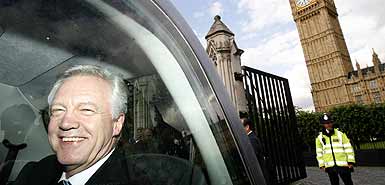
Davis and the other Haltemprice and Howden candidates.

Keeping with the despairing theme, it's hard not to now that we can see who's standing against David Davis, the full list of which is here.

There seems to be a lot of people quite content with throwing £500 away, doesn't there? Anyone having second thoughts is more than welcome to send the cash straight to me, where I can guarantee it will be put to a better use.

With the list now known, it does seem apparent that the chance of a genuine debate over civil liberties has precipitately declined. While it's impossible to know just how many of the independents are serious candidates, the inclusion of David Icke means instantly that the whole thing is just bound to descend into instant farce: great fun for the tabloids, who'll doubtless be following him around the whole time, not so good for anything approaching a defining moment, but I suppose it's possible we could be surprised.

David Davis's decision was always going to be a risk, a noble idea that rested on Labour having the guts to put up a candidate to challenge him. There may be sound political reasons for not doing so, but the cowardice it also displays, regardless of whether the candidate would have had any chance of winning or not is of a piece with Labour's current predicament, unprepared to test the electorate's actual support for almost any of the recent policies to have emerged from No.10. After all, according to the polls the public overwhelming support 42 days, so where's the harm in taking the debate back to the constituencies themselves rather than relying upon the bribery and bullshit of Westminster? The problem is that Labour is absolutely terrified of losing anything, and the partisanship of some Labour-supporting bloggers, mocking the initiative from the beginning even if they opposed 42 days showed the contempt that has arisen over the last few years for the views of the public when not asked specific questions and giving specific answers.

Still, of the other candidates that are standing, it's good to see that the Greens have put up a candidate, which would genuinely make me think twice about voting Davis if I lived in Haltemprice and Howden. It's also good to see that Davis has made clear that he considers them the only serious opposition, which means that some good, however small, still might emerge from the contest itself rather than from the simple principle of giving up your job for something you believe in. Also serious though I would imagine are the Socialist Equality Party, who despite being a tiny far-left ultra-Trotskyist sect punch way above their weight online through their World Socialist Website. They're slightly over-the-top in already claiming that Labour's anti-terror legislation has "established the apparatus of a police state in Britain," and are as hard left as you might imagine, but judging by the apparent dearth of other serious candidates, and the failure of the SWP/Respect/Left List to stand a candidate, are most likely to pick up the few left of Labour votes there are.

After being so enthusiastic to begin with over Davis's decision, it was always likely that reality was going to bite back if Labour abrogated from defending itself. It still does mark a watershed in British politics, and one which still might yet not fall flat on its face.

Labels: , , , , , , , ,

Share |

Monday, June 16, 2008 

Cowardy custard.

Can you say reverse ferret? On Friday Kelvin MacKenzie told the Today programme that he was 90% certain that he was going to run against David Davis in the Haltemprice and Howden by-election; by Monday it appears apparent that neither he nor the Sun have the stomach for such a battle over the policy which they have done the most to support and defend of any newspaper.

Some are ascribing this to the overwhelmingly positive response outside of Westminster to Davis's decision to resign and re-fight his seat on a civil liberties platform. I think that's certainly a factor, and the Sun doesn't want to be seen to be on the wrong side of public opinion, but I also think that it was a daft idea from the start. We know that this was mooted at Rebekah Wade's birthday party, attended by both MacKenzie and Murdoch himself, where doubtless all were well lubricated and tired and possibly emotional, and that MacKenzie then first let slip about it on the This Week sofa which he'd gone straight to from the party, without necessarily being given the go-ahead by Murdoch in anything beyond platitudes.

Firstly it was a strange idea because as we know, Murdoch always wants to back the winner, and one thing's for sure, MacKenzie was not going to win, and going by his completely feeble arguments on This Week on why we shouldn't be afraid of either the state or the police, no one outside of the Monster Raving Loony party circle was going to be convinced. Secondly, how MacKenzie was going to be funded was always going to be difficult: Murdoch himself can't because he's a foreigner, the Sun can't be seen to be funding any candidate, and it was always going to be something questioned as to where his money was coming from. Thirdly, even if Davis has told the Cameron tendency to sit and spin and royally annoyed them by his stand, running a candidate directly against Davis on the measure which they've opposed is not going to make them more amenable when the Sun is likely to be shortly sucking up to Dave and co as the election looms into view. Fourthly, part of the reason as to why Andy Coulson, former editor of the News of the Screws was appointed as Cameron's chief spin doctor was to attempt to woo the Murdoch press which had previously been incredibly sniffy about him. It still is, but it's hard not to believe that Coulson will have been dispatched to attempt to reach some sort of agreement with his old friends so as not for both sides to fully fall out.

More importantly, Murdoch and others at the Sun, when not thinking through alcoholic stupor, would have realised that it set a rather silly precedent. If the Sun is so certain that it is on the side of the public in all its fiercely expressed views rather than the politicians it so lambasts, why doesn't it put its money where its mouth is and formerly stand candidates at general elections? The fact is that it isn't that certain, that its campaigns which it starts and often so frighten politicians are often over-egged and given figures of support from its readers which are unrealistic, and above all, it's lazy. Running a campaign would take effort which certainly doesn't show itself in the pages of its newspaper, and what's more, there's no more certain way to annoy your readers than to keep permanently talking about how you're right and great and that you must pledge complete allegiance to the brand.

Probably most importantly, someone reminded both MacKenzie and the newspaper of that toxic word: Hillsborough. All that was needed was for any of the groups associated with that disaster to turn up at a canvassing, or a debate which would undoubtedly have been held, and all the unpleasantness of MacKenzie's refusal to apologise and the Sun's constant flagellating that will never appease the rightly aggrieved would have been brought back to the surface.

Hence there wasn't a single word published in the paper itself of MacKenzie's apparent fledgling candidacy. After the mauling which Davis received in the paper in Friday's leader, the mood completely changed over the weekend. Today the real ideological power behind the paper, Trevor Kavanagh, called him an "ego-driven maverick" but admitted he had a stuck a cord. Even more amazingly, and signalling the paper has done a full reverse ferret, there's probably one of the biggest attacks on the paper's own repeated leader line that has ever appeared within its own confines tomorrow courtesy of Fergus Shanahan, which will be incredibly handy whenever the paper reminds us again if we have nothing to hide we've got nothing to fear:

Three myths are peddled by Davis’s opponents.

The first is that if you are against 42 days, you are soft on terror.

Rubbish. I have backed capital punishment for terrorist murderers while many of those kicking Davis are against it. How am I soft on terror?

The second myth is that weary old chestnut: “If you’ve nothing to hide, why worry?” That’s what German civilians told each other as they looked the other way while the concentration camps were being built.

The third myth is that there is massive public support for 42 days.

Of course, there's the usual Sun idiocy we've come to expect about executing "terrorist murderers" when most of them will either be dead or want to be martyred anyway, but this is pretty incisive stuff for a paper which usually has no truck with any of these woolly ideals. Even more astonishing is this bit earlier on:

Davis has hit the nail on the head. We HAVE allowed ourselves to be browbeaten by fears of Islamic terror attacks into abandoning too many of our freedoms — something I have said for months. Many Sun readers agree with me.

But Shanahan's own leader line doesn't; it wants to give away even more freedoms. Although as the leader line is directly decided upon by Murdoch himself, Shanahan isn't likely to have done anything to alter it.

All these reasons for MacKenzie rolling his tanks back however though don't hide that most of all, the decision not to stand for something the Sun and he so believe in is cowardice. Davis stands up to be counted, and the Sun sits down. If this really is a victory for the overwhelming opinion being expressed online, then it's something worth celebrating and cherishing. New Labour and the Sun: united in their weakness.

Labels: , , , , , , , , , , ,

Share |

Friday, June 13, 2008 

On the media's response to Davis and the Sun's entering of the fray.

The overwhelming response of the media to David Davis's decision to resign and fight a by-election on 42 days and civil liberties seems only confirm the increasing disconnect, not just between politicians and the public, but also between the media and the country outside the Westminster village. Almost universally, Davis has been insulted, slurred, accused in some cases of succumbing to mental illness, and disparaged. The Guardian, while being sympathetic to his decision, variously throughout its pages calls him an "oddball", "egotistical" and a "loner", suggests his campaign may turn "quixotic" and has "Sir" Michael White saying that "such unpredictability unsettles the trade". At the other end of the spectrum, the Sun is even more vitriolic, headlining its leader "Crazy Davis", asking rhetorically whether he's "gone stark raving mad", and then goes on to declare that his stepping down was an act of "treachery", that he's a second-rate politician, serially disloyal which "provides further evidence of a deranged mind", that this is "petulant grandstanding" and finally, that he's "loopy". And this is before it's even launched its likely campaign for Kelvin MacKenzie.

All of this would be very well if the fourth estate was only catering for the Westminster village; this is almost undoubtedly exactly what they think of Davis and his very different to Ron Davies' moment of madness. The bloody man's resigned over a principle! We can't have that sort of thing going on here! The Conservative front-benchers have been completely flummoxed because they can't get their heads round how someone could do something that so endangers his actual career prospects. When you're as focused and ambitious as some of the filth that passes for the next generation, like Michael Gove and George Osborne, to potentially ruin your chances of getting your hands on the power to run the country seems akin to stripping naked, smothering yourself in butter and running around the houses of parliament with a gag in your mouth and a hedgehog up your backside. They're agog and aghast at the embarrassment and most of all, the difference to what is routinely expected of them. Forget 42 days and terrorists, to them this seems a far more dangerous outbreak of independent thinking and action.

Outside of that prism, even if they don't necessarily agree with Davis over 42 days, most ordinary people seem to respect him just because his decision was both so unexpected and outside of the norm. The online response to it seems to have been mostly positive, apart from those who have voiced their more than valid concerns that Davis is a social conservative rather than a true libertarian, which dulls his stance to an extent. This though seems to me to miss the point. For all those who have suggested that it'll turn into farce, today's coverage does generally seemed to have towards the issues itself rather than the personalities involved, and Davis, pledging to make the case and attempt to turn public opinion over 42 days in a way in which the wider political class has failed to do so is more than admirable, it's essential. At the moment we're stuck in the rut of this being framed as a vital measure that is needed by the police just in case; what it actually is just the most vivid example of the slow dilution of essential liberties which have in some cases, but not in all, been taken away without the slightest of comment and consultation, or where there has been, under the pretence that it's needed because our security demands it and not to do so is to be either irresponsible or "soft" on either crime or terror.

This view could be not more crystallised by the quite brilliant decision by Rupert Murdoch, Rebekah Wade and Kelvin MacKenzie to involve themselves. Never before has there been such a great opportunity to puncture the Sun's claimed stranglehold on the public mood and to make clear that rather than speaking for the people, it tells them what to think in coalition with whichever current politician has made a pact with the Prince of Darkness himself. The Sun doesn't represent the traditionally small-c conservative view on liberty, or the liberal-statist view on liberty as espoused by the Guardian, it represents the chuckleheaded, moronic, complacent and acquiescent view of it. Witness the great oaf of a man, who still can't bring himself to apologise to the people of Liverpool for publishing the most vicious of lies about how they behaved in the aftermath of the worst football tragedy this country has ever seen, telling everyone that he doesn't care whether terrorist suspects are locked up for 420 days, about CCTV cameras or ID cards, not because he actually believes they will make things any better, but because he simply is Kelvin MacKenzie. It doesn't affect him because no one's going to accuse him of terrorism, or follow his movements and spy on him, or attempt to steal his identity, because he's a middle-class opinion-former that's more than comfortably off and has the ear of one of the richest and most powerful men in the world. He doesn't have anything to hide because he couldn't really do anything lower than he's already managed in his tabloid career.

Here's the paradox of the Sun's position on civil liberties and the state. Murdoch and his papers believe in the smallest state achievable, the lowest taxes and the most business friendly environment for himself. When it comes to the actual power of the state over the citizen rather than faceless corporations, then he and his papers are all in favour of it. Give the police what they want! Constant CCTV surveillance! A DNA database containing everyone's fingerprints and blood samples! As tough on crime and thugs and yobs, regardless of the consequences as feasible! You only have to read the shopping list of demands that the Sun drew up in co-operation with the "mothers in arms" to get an inkling of what the paper in its wildest dreams would like the state of civil liberties in this country to look like: everyone a suspect, everyone assumed guilty until proved innocent, and you being strung up in public by the knackers for looking at a kid the wrong way. I exaggerate slightly, but only slightly, as it doesn't support capital punishment; castration of paedophiles, well, that's another matter.

The Sun's arrogance was exposed on Question Time last night. The paper's political editor, George Pascoe-Watson, was going through the usual routine of rather than giving his personal opinion instead using every opportunity to give the paper's view, and to plug it at the same time. Hence he made much of the Sun's "help for heroes" campaign, but came unstuck on one of the later questions when he began with something along the lines of "Well, as you know we on the Sun..." to which David Dimbleby interrupted with "Not everyone reads the Sun, you know", to which the audience heartily applauded. The Question Time audience is hardly representative, but what it did show was that the Sun's positioning is nowhere near as popular as it imagines, even among its readers which devour the sport and the celebrity but couldn't care less about its atrocious politics. This is exactly what Davis's campaign should pick up upon if Kelvin MacKenzie does stand, which will be incredibly interesting purely because of where his funding will come from, considering Murdoch is barred from donating as he's not a British citizen. No doubt some convoluted structure will be found that will be allowed. Instead of listening to people, what the Sun does is decide upon a line and then dictate it, regardless of what anyone else says, and if anyone suitably outspoken comes along and challenges it, then the smearing commences. Its cynical use of those that don't support it, such as the head of the British Muslim Forum, who said the opposite of what the Sun said he had on 42 days, and the completely misleading interpretation of MI5's statement are prime examples.

For if Davis's decision to contest a by-election on 42 days is vanity, then the Murdoch decision to oppose him is a potential disaster for both them and the Labour party. If Labour doesn't stand a candidate, and despite all the nonsense, if the Liberal Democrats aren't standing then Labour's chances will be greatly improved, MacKenzie will be in effect their candidate, making their arguments in an even more inarticulate way than they've managed in parliament, and by God, that's saying something. Gordon Brown can call it a stunt turned into a farce all he likes, but if his party refuses to stand, then it only shows them up as doing what the Sun does: taking the public completely for granted and not seeking their opinion at all, instead telling them what their opinion should be. Even if MacKenzie decides against standing and Davis is up only against a Monster Raving Loony, he's still made his point, and what's more, it just shows the contempt that those who are above the law for the civil liberties of the majority. The more I think about it, the more Davis's stand gives us an opportunity and a chance that we previously didn't have: to make the case for the rolling back of the state's authoritarian but completely ineffective incursion on the daily life of the citizen. When our opponents are either this pipsqueak or the worst the Sun has to offer, it really will be impossible not to force at the least a pause in the slow but consistent momentum towards something resembling a police state.

Labels: , , , , , , , , ,

Share |

Thursday, June 12, 2008 

Davis deserves and needs support.

Apart from "Aha!", the other catchphrase that Alan Partridge bequeathed us was "and on that bombshell...". I'm sure that Steve Coogan won't begrudge us somewhat stealing it to describe David Davis's completely unexpected resignation from the post of shadow home secretary and as an MP to contest a by-election entirely on the Labour government's bonfire of civil liberties.

Let's get the sniping and conspiracy theories out of the way first. Numerous sources are alleging that this was Davis going nuclear: either because Cameron wouldn't commit to repealing 42 days if it reaches the statute book should the Conservatives win the next election, or because he was fed up with the Cameron clique muttering behind his back over his stranglehold on home affairs policy, doing things that were not going down with the all so important Murdoch press, despite the Sun being almost in a minority of one in Fleet Street in supporting 42 days. Others still are suggesting that this is to carve out a niche for the old-school hard right, or even the first step towards Davis launching a bid for the leadership.

It would be naive to dismiss the possibility that it could be all or any of the above, and certainly foolish to not realise that they must have played some role in his decision to step down. What is also clear however is that Davis has been for a while now completely aghast at the casual, crude and populist way in which our ancient liberties have been abused, diminished and now finally, with 42 days, almost taken away entirely. As others have written, Davis doesn't care much for liberties which have been won partially thanks to Europe, such as the Human Rights Act, which despite its shortcomings still offers some protection, but rather out of a patriotic sense of disgust at ancient, uniquely British liberties being sold on the open market and for short-term party political gain. For him, 42 days has been the final straw.

Reading the dismay, in some places verging on despair posts that have been written across the whole spectrum of blogs in this country, many of those online, although hardly being representative, feel exactly the same way. 42 days has been a wake-up call beyond what 90 days was for many because we all knew that not even Blair could possibly get away with such a constitutional outrage. 42 days however is meant to be more reasonable; just look at the safeguards, look at the judicial supervision, looking at us bending over backwards so far that the powers are almost worthless! None of this alters the fact that being held in a police cell for six weeks, only to then be possibly released without charge is quite simply unacceptable in any democracy worth the name. The bottom line is that we don't trust the police, we don't trust the security services and we don't trust the government to use such a power responsibly, only when it is needed and only against those that they say it will be targeted against. All three have lied to us time and time again, all have exaggerated the threat and all are motivated, not out of this benevolent desire to protect the public but out of their own self-interest.

This isn't to suggest that David Davis isn't at least being partially motivated by his own self-interest. If he wasn't, he wouldn't be human. Unlike those in the government however that are pretending to be just that, he is at the very least standing for what he believes in. While legion after legion of Labour MPs yesterday passed through the lobby, not because they believed in the legislation but because they had either been bought off or to support the Supreme Leader, the principled few stood up and said that abandoning civil liberties to those who would remove all our liberties were they to have their way is not just wrong, it is bordering on the actionable.

If this is then a stunt, then it's a stunt that deserves not just applause and praise, but that deserves the most ardent of support. Yes, David Davis is a Thatcherite. Yes, he's a social conservative rather than a genuine social libertarian. Yes, he supports capital punishment. All of that however pales into inconsideration when he makes his case so clearly and so singularly against this shabby Labour government:

But in truth perhaps 42 days is the one most salient example of the insidious, surreptitious and relentless erosion of fundamental British freedom.

And we will have shortly the most intrusive identity card system in the world. A CCTV camera for every 14 citizens, a DNA database bigger than any dictatorship has, with thousands of innocent children and millions of innocent citizens on it.

We have witnessed an assault on jury trials, a bolt against bad law and its arbitrary use by the state.

And shortcuts with our justice system, which will make our system neither firm nor fair and a creation of a database state opening up our private lives to the prying eyes of official snoopers and exposing our personal data to careless civil servants and criminal hackers.

The state has security powers to clamp down on peaceful protest and so-called hate laws to stifle legitimate debate, whilst those who incite violence get off scot-free.

This cannot go on, it must be stopped, and for that reason today I feel it is incumbent on me to take a stand.


The partisan Labour hacks think they've got the most wicked wheeze to respond to Davis's stand: don't stand a candidate at all, and let him stew in his own embarrassment. It is indeed a good position to take; that it is politically bankrupt and therefore typical of New Labour is almost superfluous to mention. If Labour decides not to stand a candidate against Davis, then all it will show is that it is simply not prepared to go to the public and have a one-on-one debate about where it has taken us, with in most cases the slightest of public consultation but with the full support of the most authoritarian parts of the "popular" press. If it declines to defend the obscenity of the cost of £93 for an worthless piece of plastic, to support the notion that innocent members of the public should permanently have their DNA and fingerprints stored on a database simply because they were once arrested, and a system by which individuals can be followed around the country that has been completely built by stealth, and instead presents Davis's stand as a lone individual barking at the moon, then it truly deserves to be absolutely trounced at the next general election. If I lived in Davis's constituency, I would be voting Conservative for the first and probably last time.

Labels: , , , , ,

Share |

About

  • This is septicisle
profile

Archives

Powered by Blogger
and Blogger Templates