Saturday, September 25, 2010 

Worst possible way to win.

Having already been branded "Red Ed" by the tabloids and the Blairites (however laughably), for the younger Miliband to win the Labour leadership on essentially the votes of the unions is not exactly the most auspicious of starts. Least worst option as he was and still is, he's going to be reminded of his debt to the unions, both by his opponents and by the likes of Unite until he wins the support of the public themselves.

(Incidentally, the number of spoilt union ballots was huge, as the breakdown shows. More in Unite spoilt their votes than plumped for Ed Balls and Andy Burnham combined. Whether those are protests or not understanding the voting system is open to question.)

Hardly any better is his winning statement as being distributed by the party:

"Today a new generation has stepped forward to change our party. We are united in our mission to transform Labour so that, once again, we stand up for the hardworking majority who play by the rules and want a less divided and more prosperous Britain. I know we have a lot of work to do. The journey starts today.

It really doesn't get much more Blairite than that. Those of us seeking someone who is prepared to put the case for the indolent minority who sometimes err on the wrong side of the law must go on searching.

Labels: , , , , , , , ,

Share |

Wednesday, September 22, 2010 

New Labour's dead cat bounce.

At long last, the seemingly unending Labour leadership contest has gasped its last, with only the ballots left to count. Congratulations must go to all five candidates: it must take a truly superhuman effort to keep repeating yourself over and over again daily for such an extended period of time and not find yourself going slowly but surely insane (Whoops, I seem to have just inadvertently insulted myself and all bloggers). Expectations at the outset were low, both for the standard of debate and for the potential for full, painstaking examination of why the party lost, and those expectations were more than exceeded. The party has essentially just spent the last three months travelling the country conducting a navel-gazing exercise that hasn't even begun to scratch the surface of how and why it lost, and in Ed Balls has someone who is just as myopic to the changing of the political tide as any of the deeply deluded Blairites. When it's Andy Burnham dropping truth bombs, trying desperately to make Balls realise that some cuts are going to have to be necessary and would have been made by Labour had it remained in power, even if not this year, you know the party's in a bad way.

In fact, Burnham has been the surprise candidate in that he's at least tried to think differently even if still within the Blairite prism: his "aspirational socialism" might be risible intellectually and in practice, yet using the "s" word in the current climate when Vince Cable gets derided for daring to make even the slightest critique of capitalism takes a certain amount of bottle. Embarrassing by contrast has been Diane Abbott, who's ran an invisible campaign and seemingly treated the entire thing as a joke. We have to make an allowance for how it takes money to do anything political these days and she's had almost none pledged in her direction, but that's no excuse for not even seeming to put an ounce of her heart in it. It has to be remembered that John McDonnell stood down in favour of her, who just might have managed to drag the debate leftwards and make the party's apparatus think about those who have been systematically abandoned and marginalised by New Labour. Instead Abbott's acted as the party's false conscience, sitting in yet contributing nothing. When Abbott is the face of the Labour left, that section of the party shouldn't be surprised when it finds itself derided and ridiculed.

The fear from the beginning was that it would be personalities rather than policies which would be the main topic of debate and so it has proved. Admittedly, when the two main candidates are brothers it's always likely that the media, already about as interested in the leadership contest as it has been with the floods in Pakistan, was going to focus on that to the detriment of everything else; the problem has been that it's been their camps which have been playing it up more than anyone else. Their relationship might well have turned poisonous if we're to believe Neil Kinnock, and the interventions by Blair and Mandelson have hardly helped, yet still the entire fixation on it has been dispiriting.

What then, if despite all the speculation surrounding his brother and second preference votes, it does turn out to be David Miliband who becomes Labour leader on Saturday? Having been anointed as the only apparent successor to Blair and Brown, it would be a vote for a continuation of the New Labour project, even in its current decrepit state. Moreover, it would be an endorsement of all that Miliband stood for while he was a cabinet minister, and especially his record as foreign secretary. While much has been made during the campaign of how the elder Miliband continues to support the Iraq war in the obfuscatory Blairite fashion of having made the right decision at the time while Ed apparently opposed it, that ought to be the least of concerns. Far more significant is how he didn't just frustrate the attempts by Binyam Mohamed to find out the contents of the "seven paragraphs", which detailed that MI5 were fully aware of how he was being mistreated by the Americans and their proxies, he authorised Jonathan Sumption to criticise the legal opinion of Lord Neuberger for getting far too close to the truth.

Some of Miliband's actions in blocking the Binyam Mohamed case may have been down to protecting our relationship with the US, supposedly in danger due to our breaching of the "control" principle, whereby another country does not reveal intelligence shared with it without authorisation. The same cannot be said for Miliband's apparent authorisation of intelligence-gathering operations in countries with atrocious human rights records, as revealed by the Guardian today. For Miliband to have apparently returned to the Foreign Office to revisit his decisions is an indication of how serious he himself considers the allegations. It's one thing to defend the actions of your predecessors and the intelligence services they were responsible for at the time; it's something else to potentially give the OK for MI6 to seek access to information obtained via torture.

At the outset of the leadership contest it was clear that Ed Miliband was the best realistic option for leader, as in the potential to actually win, and absolutely nothing has changed since then. None of the candidates has shown a real willingness to take the few things that New Labour achieved and build upon them by revitalising the party's relationship both with its members and the public at large, and none has yet demonstrated anything even resembling a real alternative to the cuts agenda as articulated by the coalition. Ed has done the bare minimum required to deserve to lead the party, as Labour itself so often did when it was in power. Whichever brother triumphs, 2015 remains a year which the party and indeed the country should fear rather than look forward to.

Labels: , , , , , , , , ,

Share |

Friday, July 16, 2010 

Gordon is a great man...

I've been doing my best to avoid the Peter Mandelson/New Labour monster raving ego pantomime, yet this from Mandelson's interview with the Graun is too good not to pick up on:

"I remember Paul Dacre saying to me, 'Gordon is a great man but he has two problems. One he is not on the same wavelength as middle England, and the other is that he is incredibly stubborn'."

The phrase, I think goes, takes one to know one.

Labels: , , , ,

Share |

Monday, June 14, 2010 

Jon Cruddas and numerous unanswered questions.

Why was it again that Jon Cruddas decided that he couldn't be the leader of the Labour party?

"Hand on heart, I do not want to be leader of the Labour party or subsequently prime minister. These require certain qualities I do not possess.

"The role of leader is one of the greatest honours imaginable – but it is not a bauble to aspire for. It is a duty to fulfil. I do not feel that I am in a position to deliver on the hopes and expectations that will be placed in the next leader."


Admittedly, in Cruddas' Guardian article on why he wasn't standing, he also said:

I am determined to play a full role in the re-invigoration of a party that stands as the best hope for the people of this country. But to put it simply, that role of rebuilding and energising the party is a job that doesn't have a vacancy.

I would like to be involved in the debate about the future direction of the party and how we reconnect with our lost voters. But I cannot enter a leadership election just to contribute to a debate; to go into this must be on the basis of running to win and hand on heart I do not want to be leader of the Labour party or subsequently prime minister.

Even so, why just be involved in the debate about the future direction of the party when you can articulate far better than any of the leadership candidates just where Labour went wrong, as he did to quite frankly devastating effect in his speech to the Compass conference at the weekend? Diane Abbott, fine as her oratory has been on civil liberties, has not come close to putting together such an indictment of the party as it was in power, or such eloquent reasoning as to why it lost the election, while John McDonnell could never have won the election even if able to get on the ballot. Jon Cruddas, had he decided to stand and had argued in the same tenacious fashion to the membership as a whole rather than just the likes of Compass, could easily have pulled the debate leftwards and put real pressure on the Milibands; he would have been a real contender.

Why then was Cruddas so convinced that he couldn't lead the party? Is he one of those few in politics content with sitting on the backbenches as he has and just driving debate in the party? Or is it, as his actual voting record suggests, that while he talks left and enthrals and inspires those of us sympathetic to such politics, he stayed loyal to the New Labour values he so rails against when it actually mattered? There's a lot of question marks in this post for the reason that I don't know the answers; what I do know is that Cruddas could have achieved far more through actually running for leader than just coveting the position of chairman.

Labels: , , , ,

Share |

Wednesday, June 09, 2010 

Postponing the inevitable.

It seems that I should make rash predictions more often: after expelling nigh on 1,800 words centred on neither of the "left" candidates getting the required nominations to run for the Labour leadership, Diane Abbott duly did scrape together the 33 required, although only after it seems a number of former ministers felt they had to support her to ensure that they themselves weren't heavily criticised for all but silencing the entire left of the party.

Diane nonetheless wouldn't have got on the ballot if it hadn't been for John McDonnell stepping down, something which, as usual, he doesn't seem to be getting enough credit for. If anything, it was Abbott who should have stood down having 11 nominations at the beginning of the morning to McDonnell's 16, just one of the things which Dave Semple is quite rightly bitter about, but McDonnell perceived, almost certainly rightly, that Abbott's support wouldn't then back him.

You can either view these last gasps from such notable socialists as Chris Bryant, Denis MacShane, Jack Straw and Phil Woolas as noble attempts to allow the left the say, even as they have vehemently disagreed with it in the past and even attempted to crush it, or as a simple way to show that the parliamentary Labour party is representative and a wide church after all, despite all the naysaying. And we shouldn't completely dismiss Abbott as the token candidate. As Don Paskins argues convincingly, it's more likely that Andy Burnham will come last than Abbott will, and it's even possible she could come ahead of Ed Balls, neither of whom have anywhere near the appeal or mass support of the two Milibands, nor are they likely to gain much support from the trade unions. It will also ensure that this will not completely be a leadership election based around the politics and policies of the centre-right, as Diane will inevitably pull the debate leftwards.

None of this will however make up for the fact that yet again a genuine socialist voice with real grassroots support has been completely excluded from the wider leadership debate. It's almost as if the party hierarchy is frightened of even the mention of the "s" word, let alone someone representing those values. As welcome as Diane Abbott's inclusion on the ballot is, and how she will definitely energise it far beyond how it would have been if it was the four white Oxbridge educated middle aged males, there's no getting away from the fact that she's become a media luvvie who is now on the left of the soft left rather than in the ever dwindling socialist grouping. We needed a true left voice with the nous and real courage to take on and attack those only interested in the status quo, as was evidenced by the tensions at the hustings on Monday when McDonnell and the elder Miliband clashed.

We may well have been saved from a debate along the terms of that outlined by John Denham in a speech to the Fabians last night, which was an even harsher and even more deluded take on why Labour lost the election - namely, that through not turning the welfare state into a social insurance scheme Labour lost the support of the comfortably well-off, the "aspirational" voters who were outraged by the inequities of the benefits system, of those beneath them getting something for nothing, of the eastern Europeans claiming tiny amounts of child benefit as is required under EU regulations, when obviously it should be them the state should be helping. Labour is often accused by the right-wing press of envy politics, yet Denham seems to be suggesting that the party should take up the class war waged by the Mail and Telegraph in favour of the middle classes. Equally though, we shouldn't pretend this won't be the ultimate result. The best realistic result we can hope for is Ed Miliband to triumph rather than his brother. All the party has done is postpone the inevitable.

Labels: , , , , , , , , ,

Share |

Tuesday, June 08, 2010 

New Labour is dead. Long live New Labour.

The nominations for the Labour leadership close at 12:30 tomorrow. At the moment, neither Diane Abbot or John McDonnell is even close to gaining enough support from their parliamentary colleagues to stand; whether one or the other decides to acknowledge defeat before then, giving the opportunity for their nominees to swap to the other is uncertain. Even if they do, it's still up in the air whether or not they'll garner the 33 required, as they'll still need another six even if every single nominee changes sides. It's worth remembering that in 2007 Michael Meacher's supporters didn't decamp en masse once he stood down, leaving McDonnell 16 short of the number he needed, with Gordon Brown therefore elected unopposed, in what everyone now acknowledges was little short of a disaster.

To make a rash prediction, my gut feeling is that the same will happen this time, and with Andy Burnham only two nominations from the amount he needs, it seems all but certain that while we will have a contest, it will be a contest based on personalities foremost and policies a very distant second, with the winner almost equally certainly sharing a surname with another candidate. Not, it should be acknowledged, is this much different from what's happened in Labour leadership elections since the fateful 1980 vote which resulted in Michael Foot becoming leader of the opposition. Every contest since then has either been a foregone conclusion, with one candidate winning an overwhelming majority, or has involved a battle of egos rather than beliefs. The key difference is that the Labour party itself then had far more of an influence over policy than it does now, with conferences that mattered rather than being merely either a rubber-stamping session or an opportunity to express a grievance which was then completely ignored by the leadership.

In one sense, the party clearly has no one else to blame than itself for this state of affairs. Despite everything, the parliamentary party is still a relatively wide church: you have the Socialist Campaign Group on the left, the softer left Compass grouping, which if it had wanted to could clearly have stood a candidate whom would have found it much easier to get the nominations required, either a Jon Cruddas or even though he's outside it John Denham; the centrists such as Ed Miliband and maybe Ed Balls if you were pushing it, then the centre-right "Progress" style grouping which encompasses both David Miliband and Andy Burnham. If they had really meant what they'd said, they could have easily decided to tactically vote for someone so that it wasn't just the centre and centre-right of the party yet again monopolising opinion and then making clear that any dissension was back to the 1980s Militant-style bolshiness that simply won't wash in 2010.

The elder Miliband, despite initial murmurings about how much he wanted a wide selection of possible candidates has since shown his clear Blaritie centralising tendencies in his contempt yesterday for John McDonnell at a hustings, while none of the other three have put their words into action. In any case, the debate which has so energised the four likely to be on the ballot has not been about why Labour lost the election and attempting to understand the reasons why the party received 2 million less votes than the Conservatives; the reasons why have already been set in stone. It wasn't seemingly the recession itself, Gordon Brown, the general feeling that it was time for a change, or the stewardship of the economy, let alone Iraq or anything as crass as civil libertarian concerns, but rather immigration first and foremost and which all four have been determined to talk about as much as possible now the election's over, along with anti-social behaviour and the welfare state. Ed Balls went so far at the weekend to criticise his former master and indeed the person that he personally advised on immigration, while also penning a mea culpa that Labour was wrong to impose no controls on the A8 eastern European accession states, which led to the huge flow of migrant workers, arguing in addition that the European Union needs to drop its open borders policy when it comes to unskilled labour.

Even if we accept that immigration was, as Dave Osler says, the number one issue on the doorstep, it still didn't lose Labour the election on its own. If this was the case then the party would have almost certainly lost Rochdale after the Gillian Duffy incident and many other of the seats which it held onto. As has been pointed out so astutely by Jon Cruddas and Jonathan Rutherford, concern about immigration wasn't borne of hatred of foreigners or about the country being full to bursting, but instead because Labour failed to acknowledge the problems which go hand in hand with it, by ignoring the dismal state which social housing was in, by failing to make the minimum wage a living wage, and by letting agency workers undercut those at the bottom by not regularising them, failing as it did to implement the EU agency workers directive, something even Ed Balls now admits was a mistake.

Coupled with these failures were related ones, such as not explaining in simple terms where, as Mrs Duffy put it, all these eastern Europeans were coming from. There was not some grand conspiracy to open the borders and turn Britain into a multicultural paradise where immigration powered economic growth at the expense of the working class, but rather the far more benign mistake of assuming the the other EU countries would open their borders immediately as well, which with the exceptions of Ireland and Spain they didn't. This failure of explanation went along with the refusal to defend the decision. Lastly, the government failed to respond and defend itself against the repeated onslaughts from the tabloids on both immigration and the asylum system, so often packed with falsehoods and distortions; indeed, on numerous occasions it either colluded with them or agreed, regardless of the facts, further encouraging them while leading the readers to believe the absolute worst even if they didn't recognise the picture painted on their own patch. It decided that it couldn't beat them, so it joined them, with the appointment of the ghastly political thug Phil Woolas as immigration minister, whose only regret was that he didn't push the "points system" hard enough.

Through the emphasis on immigration it's all too clear where the leadership debate, or rather lack of it is going to head. Some of this is reflected in Neal Lawson's comment piece for the Guardian tomorrow, although it has to be remembered that Lawson, even if he's since moved somewhat to the left, was just as much a part of New Labour from the beginning as all four of the candidates were. He's right that Labour has lost its purpose, but it lost that long ago; where he's wrong is that the party has not yet hit bottom. We have to separate the party from the leadership, for the crucial reason that despite everything, Labour won councils and increased its number of local government seats last month, something pitifully under-reported. There is still life in the party, just as there always has been; it's the leadership and its refusal to integrate itself into local communities, which was the difference between winning in places like Birmingham Edgbaston and Tooting and losing in broadly similar seats. He says Labour didn't become the nasty party, but that it did become lumbering and arrogant; I beg to differ. It did become nasty, not because it had to, but because it wanted to and because New Labour knew nothing other than triangulation and reacting to headlines. Even now it doesn't know how to react to the new political landscape, where a new government is actually attempting to be something other than rigidly authoritarian, even if it no longer defends ID cards. As Diane Abbott despaired, how did it ever in the first place move to the right of the Conservatives on civil liberties? For the simple reason that it felt it it had to do, because the Sun said so, and because it's fell into the belief that only the chattering middle classes care about such things, not those C2s more concerned with the loutish teenagers hanging around on street corners than their damned right to do so.

More than anything, the real reason to despair at these four men and the contest which awaits is because as could have predicted, even with the Liberal Democrats in tow, the government is already moving to start the slashing and burning in the public sector as soon as is feasibly possible. David Cameron's speech yesterday was what we're going to have to get used to now, Labour being blamed for everything with no regard for what the Conservatives would have done differently had they been in the same position, the public sector being the enemy rather than the private sector which caused the crisis, the "economically inactive" being lined up to take the pain while the originators of the crisis continue to be amazed at how they're getting away all but scot free, first bailed out and then being readied to restart the cycle, while lip service is paid to "rebalancing" the economy, as if Cameron had even the first idea about strengthening manufacturing, when those jobs have sadly gone for good. To be fair, Liam Byrne and Alistair Darling's responses yesterday and today have been reasonably good, but we need the potential leaders of the party to be raising their voices and signalling their opposition to ideologically inclined cuts. We've heard nothing about the cuts, but plenty about irrelevancies.

The reality is that the party itself and its leadership, as well as some of the parliamentary party, are all but completely different entities. If neither McDonnell or Abbott get the required nominees, then they must finally realise that if the MPs won't allow their voices to be heard, it's not because they have nothing to say or offer, but because the elected representatives are actively ignoring the views of the activists that get them elected. As Diane Abbott has again so accurately put it, for a party that is so diverse to be ultimately represented by one of four individuals from the "narrowest gene pool in history" is a joke that simply isn't funny any more. New Labour crushed dissent and centralised itself to such an absurd degree because it felt it had to in order to get itself elected again. As the 97 and 01 results showed, it would have won if its leader had been the clichéd donkey or monkey pinned with a red rosette. Despite this, because it had become so wedded to control freakery and spin it believed had brought it to power, it never let go, and the ultimate conclusion is the four candidates before us today.

Those of us on the left thought we could support the Liberal Democrats as an alternative to a party which had abandoned so many of its principles; now we're effectively disenfranchised, unless Labour changes its ways. It shows every sign of doing the exact opposite. The tragedy is not just one of representation, but also for any real alternative to the current consensus. New Labour is dead. Long live New Labour.

Labels: , , , , , , , , ,

Share |

Saturday, May 22, 2010 

The Labour leadership contest: This is Yesterday.

I know you don't want to, but take a good, hard look at the four main Labour leadership candidates. Go on, force yourself. Like it or not, one of these fine upstanding gentlemen is going to become the focal point of opposition to the shotgun marriage of the Conservative and Liberal Democrats. OK, you can turn away now. Dispiriting, isn't it, to say the least? I'm reminded of both high and slightly lower culture: of Ozymandias by Shelley, looking on their works and despairing, but also of the last ever episode of Blackadder, where Melchett visits the western front and comments on the nature of the troops he will soon be sending to their deaths, to which Blackadder responds with "Yes sir - shortly to become fine bodies of men".

For all the platitudes, especially from the two Milibands, about wanting the widest possible field of candidates, this line-up is the logical endgame of New Labour, the equivalent of a policy akin to Stalin's socialism in one country. Having suffocated all dissent, centralised the party to a ridiculous extent, micro-managed the selections process to parachute in favoured, endlessly loyal apparatchiks and luvvies, these four are the perfect representation of the New Labour project, while also being the finest imaginable illustration of just how the party can no longer even begin to pretend to be representative of the country at large. It's also indicative of just how limited politics in this country has become, another of the ultimate successes of the Blair era: don't like the fact that all three of the party leaders will be male 40-somethings from the white, upper middle classes? Tough.

Just like the Conservatives toiled and struggled to escape from the shadow of Margaret Thatcher, so now will Labour desperately flail in a bid to remove themselves from the legacies of both Blair and Brown. In fact, this process was already started somewhat during the deputy leadership contest back in 2007, when Hazel Blears resorted to claiming that there was no longer any distinction between Blairites and Brownites, there was just Labour. As risible as it was then, it has something approaching a smidgen of truth now: the last three years showed just how few real differences there were between two, but then that also just shows their triumph; having all but completely recreated the party in their own image. As much as David Miliband wants to leave behind the Blairite and Brownite labels, thinking only of "Next Labour", if you remove their adherences and preferences to the two separate leaders then there are even fewer ways of explaining the differences between David, the two Eds and Andy.

In any case, if you want to show that the party has moved on, then you have to come up with policies that are genuinely different and show that you've learned from your defeat. The task facing Labour is nowhere near as unforgiving as the one the Tories woke up to on the 2nd of May 1997, and that itself seems to be shaping the party's incredibly limited post-election thinking. So wedded has the party become to the triangulation strategy it pursued without mercy or hesitation in those 13 years of power that it still believes it only failed at the ballot box because it wasn't right-wing enough on immigration, "anti-social behaviour" and on those omnipresent welfare malingerers. They've adopted the excellent class-based analysis of Jon Cruddas without endorsing his solutions of giving protection to agency workers, introducing a living rather than a minimum wage and a full social housing programme. Instead they still to seem to think the only reason the public didn't appreciate their policies was because they didn't explain them well enough, as Andy Burnham, Ed Balls and ghastly Phil Woolas have all claimed. There's an element of truth in this, but far more damaging was the failure to even begin to challenge the repeated lies and misinformation which was bellowed from the tabloids on an almost daily basis on the subject. Coupled with the decision to not even begin to defend the scale of immigration, which the public will always give credit for even if they don't agree with you, it allowed a whole series of myths to develop which will be all but impossible to shift.

One of the biggest insights into just how warped the party's thinking has become is provided by the continuing obsession with middle class benefits, as elucidated by the supposed left-leaning Ed Miliband and also by Burnham. Rather than being concerned with those losing their jobs, who could presumably be depended upon to vote Labour regardless, they instead worry about the falling disposable income of those in work, embittered that those "who weren't doing the right thing" were being "rewarded" while they had to cut back ever so slightly. Rather than dismiss this as an unreasonable grievance during a recession when everyone's spending power diminishes, the party always seems to believe that the state should do more, regardless of the cost. Labour has become caught in its own trap: why vote for a party that has moved so far to the right on so many policies when you can instead plump for the real thing in the shape of the Tories?

My initial conclusion after the election was that at last Labour could have a real debate, both with itself and the country at large about where it had gone so wrong during its time in office. Instead, it seems to have already decided that rather than oppose the Con-Dem coalition from the left, it's far easier to do so from the right. The party was always going to defend its policies on crime and civil liberties, the latter of which the two opposition parties were always to the left of Labour on, yet the all the other noises being made so far have been in much the same vein. This was where Jon Cruddas could have made such a valuable impact had he decided to stand: he may have been a loyalist with a poor voting record, but he would have pushed the leadership debate leftwards without his candidacy being dismissed as irrelevant or doomed to inevitable failure. As refreshing as Diane Abbott's candidacy is, and important as her rebuttal of the consensus on how immigration lost Labour the election also was, she's now split the left vote just as Meacher and McDonnell did back in 07, making it less likely either herself or John will end up on the final ballot paper.

Labour lost on May the 6th because of a whole myriad of factors: Gordon Brown, the recession, the sheer amount of people wanting a change, and only then because of individual policies. To limit the inquiry to just the same, familiar number of issues which the party so often focused on is a sign of how it has yet to come to terms with the defeat, let alone with how it brought so much of it upon itself through its authoritarian stance on almost any dissent or difference of internal opinion. Only by being open with itself and with its supporters about all of this can it even begin to start the rebuilding work necessary. Not a single one of the four candidates with a chance has expressed anything even resembling such doubt; and as the Con-Dem coalition looks to be far more stable than anyone could ever have imagined it would be, the time the party could have to spend in the wilderness might be far longer than the five years or less which some first thought. The party desperately needs a realistic candidate without the baggage of being a Blair or Brown supporter; it doesn't look as if it's going to get one. Next Labour looks to be a very long way in the future.

Labels: , , , , , , , ,

Share |

Thursday, January 28, 2010 

The party's over.

Unlike a lot of other teenage revolutionaries, I successfully resisted the temptation to join one of the random far-left groupings that still, despite everything, manage to keep themselves going even as the members doubtless inexorably age. It isn't difficult though to still find affection for groups that believe the shrinking proletariat will, despite all the signs to the contrary, eventually become a revolutionary vanguard with the power and means to overthrow the ruling class. Whether a dictatorship of the proletariat will then follow remains to be seen; that's one of those things that modern Trotskyists never manage to agree upon.

Reading Dave Osler's survey of the potential for a far-left breakthrough at the general election is to re-read the annals of socialist sect history over more or less the last 20 years. Without placing the blame at any particular grouping, the failures are obvious: a complete inability to work together when only an alliance could so much as begin to threaten the Labour party, a shocking lack of leadership material, and that which there is tends to be egotistical and controlling beyond belief, an obsession with fighting yesterday's battles while ignoring the changing nature of modern British society, and most importantly of all, thinking that the electorate will connect with you rather than you having to connect with them.

The spectre which once only haunted the socialist left is now hanging over the left as a whole. The left has just failed to take the greatest opportunity to be handed to it in a generation: a crash which many predicted but which it has been unable to take advantage of. Even as governments turned to Keynes, the left's response has been either muted or non-existent. Just when an alternative has been most needed, as those who have never experienced a recession have had to get used to the feeling of being surplus to requirements, the explanation for why this cycle is doomed to repeat has been almost wholly lacking. Left economists may have been those whose advice has been turned to, but no grouping has built upon this to turn it into a critique of where we went wrong and what has to be changed to even limit the effects should it happen again.

Undoubtedly we can put some of the blame upon a Labour party which has never looked so moribund. It seems determined to spend its few remaining days in power, when not sulking about still being lead by Gordon Brown, showing the poverty of thinking which has condemned it to its current position. All it offers now is the chance for you to keep up with the Joneses, the shallowest, most limited vision of aspiration imaginable. This isn't just down to Brown's intellectual inadequacy when he moves off economics, failing to articulate the "good society" which Blair in flashes painted in his famous verb-less speeches. It's a direct result of Labour's obsession with the dead centre, the triangulation which inhibits its every statement.

Who though is waiting for their chance to prove they could do better? Alan Johnson? One of the Miliband brothers? Harriet Harman? Peter Mandelson? Every single one is dedicated to the continuation of the current policies, with slight changes at the edges. This is the biggest problem facing not just Labour, but the left at large: there are no new potential leaders waiting for their opportunity, rather just the same old bunch of either politicos, trade union dinosaurs or uninspiring if competent incumbents.

Take, just as an example, the "Progressive London" conference being held this weekend. Not content with continuing to use the word "progressive" as if it still means something, it's Ken Livingstone also failing to realise that despite all he's done, for which he deserves praise, he's now yesterday's man and ought to put his dreams of returning to the Mayorship behind him. Look at the panel on "the cost of war" and try not to either smash your monitor or throw up on it: what can Galloway, the political editor of the fucking Morning Star, CND and the Stop the War Coalition say which they haven't already and which hasn't already driven away those who once protested? To take one gathering which isn't completely shooting fish in a barrel, there's Stopping the BNP - no concession to the far right, which features such luminaries as that guy out of that band which made that "Heavyweight Champion of the World" song, alongside an union regional secretary and someone from Love Music Hate Racism. When perhaps discussion on why people vote for the BNP should be foremost in the minds of the left, and how to win back supporters that have crossed the political divides, the first people I know I'd turn to would be someone from a good cause which everyone can get behind but which changes nothing and a guy who's made one hit record. There are a couple of promising panels, such as the one on electoral reform and homes and planning for London's future, something which is actually practical, but the rest is the left banging on about the same old things without ever moving forward, which, unless I'm much mistaken, is what progressive is actually meant to mean.

Even if the left and the Labour party separated some time ago, the massive victories of 97 and 2001 resulted in a lengthy period in which minds went unfocused and everyone pretended that much was fine. Since then it has, quite reasonably, focused on foreign affairs but in doing so allowed domestic politics to rot away. The biggest indictment of the left, if over anything, has been the continuing rise of the BNP, and through its refusal, both to even countenance debating the organisation but also in accepting the new orthodoxy that immigration was fine before but it is out of control now and needs to be tackled. The response at this year's European elections to the biggest far-right electoral threat of modern times? To split the vote away from the Greens, with Bob Crow's hopeless and reactionary No2EU organisation and the 80s throwbacks the Socialist Labour Party both on the ballot alongside all the other non-entities. Just when it needed to come together to fight the greater enemy it fractured just as it has in the past.

Where does the left go from here? The best case scenario is that it gets the rude awakening of its life come 6th of May; although a Conservative majority of the size of Labour's first and second terms thankfully seems unlikely, a victory which is large enough to concentrate thinking is the best possible outcome. It doesn't just need to rebuild; it needs to examine whether it has to demolish and start again. The party's over, and whether it starts again depends entirely on the reaction in the coming months. If, as Chris so accurately describes the prospect, of a government run by the children of the rich for the children of the rich doesn't reanimate the corpse of a dying ideological bent, nothing will.

Labels: , , , , ,

Share |

Friday, January 08, 2010 

The real perplexing issue about the snowstorm coup.

Now that the "snowstorm coup" or whatever it's being called has already been forgotten by anyone with half a brain it's always instructive to learn the real reasons behind the attempted putsch. Unsurprisingly, both Hewitt and Hoon had been angling for jobs which they didn't get, hence most likely their fit of pique, although why Hewitt wants another job when she's already got a couple of highly lucrative ones thanks to her previous jobs in government is unclear.

No, the real question is just why Bob Ainsworth is so unhappy about Brown's leadership. Widely if perhaps unfairly judged to be the most useless in a long line of hopeless defence secretaries, does he seriously think that he'll ever have a better offer or job than the one he currently has? The words "ungrateful" and "git" really do come to mind.

Labels: , , , , , , , ,

Share |

Wednesday, January 06, 2010 

The world's worst coup.

It's official: the Labour party is crap at coups. While it's tempting to suggest that's something to do with the fact that the Labour party as a whole is crap, and that wouldn't be far wrong, for some reason no one in the party has ever seemed to have the killer instinct. Certainly not when compared to the Tories, for whom plotting over the years delivered the heads of both Thatcher and Duncan-Smith, and almost Major as well.

Perhaps it's got something to do with how those who finally summon up the courage to go public with their demands for the leader to stand down, or this time round for a "secret ballot" to be held, which certainly isn't a coup attempt, oh no, are either yesterday's men or those with chips on their shoulders, ala James Purnell last year. Seriously, did Geoff "Buff" Hoon and Patricia "most patronising person to ever wear a pair of shoes" Hewitt really think they were going to set the world alight by demanding that it was time for Brown to face the parliamentary Labour party? It's hardly Michael Heseltine or that other least likely individual to rebel, Geoffrey Howe, complaining about finding that the bat had been broken by the team captain once he had gone out to bat, is it?

Oh, but they had such a hard-hitting team behind them, didn't they? The Safety Elephant, Labour's honorary BNP member Frank Field, Barry Sheerman, who no one has ever heard of, and Fiona MacTaggart, who first felt that legalising prostitution in certain zones might be a good idea then changed her mind completely once told sweet little lies about people trafficking. Again, you're not allowed to mention that with the exception of Field, who's always hated Brown because he blocked his "thinking the unthinkable" on welfare reform and possibly Sheerman that they're all Blairites. Not that either Hoon or Hewitt have anything as dignified as differences with Brown on policy, although Clarke and Field do; this is all about the fact that they somehow imagine that simply by replacing the man at the top Labour will instantly reclaim its rightful place at the top of the polls, vanquishing the upstart Cameron and leading them into that historic fourth term.

If it wasn't so desperate and counter-productive it would be hilarious. Oh, all right, it is hilarious, and the only real meaningful response is the one on Liberal Conspiracy, which is to come up with some lolcats. While some backbenchers almost certainly are despairing of Brown leading them into the election, the idea that you can do it now bloodlessly and without laying the foundations for internal fratricide is ludicrous. The very real damage being done is, as it was always likely, to the party as a whole: it gives credence to the continual Tory claim that Labour is hopelessly divided and that the only way to sort it out is to install them instead. Already out is the "we can't go on like this" billboard, now featuring Buff and Hewitt instead of Cameron's hideously airbrushed bonce, and you can't help but imagine it's going to be "bucket of shit" time in the papers tomorrow, even when the coup attempt has been so laughable.

The only real debate within Labour has been between those fearing that Brown and Balls have been brewing up a "core vote strategy" and those around Peter Mandelson who despaired of that when honesty was needed regarding the size of the deficit and the need for cuts. As seen by the first movements in the election campaign, both the Tories and Labour are still in denial when it comes to just how sweeping and deep the cuts are going to be, still squabbling over the small print while completely ignoring the bigger picture. Neither party is offering anything other than the same old, same old. That you could probably replace Brown with Cameron as leader of the Labour party and hardly notice any significant policy differences is the biggest indictment of politics as a whole at the moment; that though would be a coup worth writing about.

Labels: , , , , , , ,

Share |

Friday, November 13, 2009 

The real story from Glasgow North East.

The story of the Glasgow North East by-election is categorically not that Labour won an overwhelming victory, especially considering the constituency is effectively a rotten borough for the party. A loss certainly would have been, though (a story, that is). It also isn't that the Conservatives received only 1,075 votes, or indeed that the British National Party was only 62 votes behind, although it might be if Chris Dillow's observation that heroin is probably more popular than the Tories was more widely disseminated. Nor is it that unsurprisingly, being a "celebrity", isn't an automatic vote winner: John Smeaton got 258 ballots while Mikey Hughes, a former Big Brother contestant, got 54. It also isn't, although it's again interesting, that the Socialist Labour vote completely collapsed on the 2005 result, when they got an astounding 4,036 votes, down this time to an appalling 47, most likely because Labour was on the ballot when it wasn't previously as a result of Michael Martin standing as the "Speaker".

The real story ought to be the catastrophically low turnout, a derisory 32.9% (Wikipedia has it as 33.2%). This can't be blamed on the lack of choice: all the main parties stood, as well as three various socialist sects, the BNP, three independents, and the Greens. While turnouts at by-elections are usually lower than at a general election, you might have thought it would have been the opposite in this instance, as there was far more choice on the ballot than previously due to the main opposition parties traditionally not standing against the Speaker, with their voters coming out this time when they might not have bothered previously. Instead it dropped from 45.8% in 2005, which was already well below the average of 61%. Did the expenses scandal have any impact? Unlikely. Instead it seems that the people of Glasgow North East, who were already poor before the recession, have lost all faith in politicians of every colour and creed. The only reassuring thing is that the British National Party didn't do better than their 1,013 votes. The current consensus is that the turnout is likely to go up next year when there is an actual, genuine alternative to the current government: Glasgow North East might yet prove to be the rule, not the exception.

Update: Slightly edited after some on Liberal Conspiracy responded with "Eh?" to the first paragraph, which is what happens when I'm trying to write something reasonably snappy and quickly to boot.

Labels: , , , ,

Share |

Wednesday, September 30, 2009 

Scum-watch: Don't know what you've got till it's gone.

They must have known it was coming, but the defection of the Sun back to the Tories after 12 years of "supporting" Labour has still quite clearly shook Labour. While the paper's representatives claim that it was yesterday's speech that finally confirmed they could no longer support the party, it's been obvious that the switch has been coming ever since last year's Conservative conference, when it gave David Cameron the sort of positive coverage he must have dreamed of. Since then the paper has been overwhelmingly anti-Labour without necessarily being anti-Brown. Some of the signs have been slight: calling Cameron "prime minister" when he was invited onto the paper's recently launched piss-poor online radio show was one, but the demand for an immediate general election earlier in the year was far less guarded.

The final nail in Brown's coffin was more than likely David Cameron's decision during his speech on quangos to focus almost solely on Ofcom, the regulator which is currently investigating whether Sky has an unfair stranglehold on the pay-TV market. With Cameron's culture secretary making menacing noises towards the BBC, which the Murdochs have all but declared war on due to the fact that their news websites simply can't compete with the far superior corporation offerings, it's clear that the Murdochs can now trust Cameron not to hurt their businesses just as they once trusted Tony Blair not to. That's the first condition of Murdochian support filled; the second is that you're going to win, and few are willing to bet anything other than a Conservative victory come next year.

It's still curious then that the paper has come out so decisively for the Tories when there is still plenty of time for anything to happen. The paper, after all, didn't swap sides until March in 97, when the Labour victory was already in the bag. As unlikely as it currently seems that there could yet be a fourth Labour term, it's not the first time that Murdoch's papers have got it wrong recently: the New York Post endorsed McCain last year. As a comfort, it's unlikely to warm the hearts of the Labour leadership.

More likely to do so is that the Sun is no longer the behemoth that it once was. While gaining the support of the Sun has always been second to gaining the support of Rupert Murdoch, the other major reason why Blair and Alastair Campbell entered into the original pact with the devil was, as Campbell said himself, he was never going to allow the Labour leader's head to be in a light-bulb on the front page on voting day again. While actual support for a political party from a newspaper on voting day has little to no impact whatsoever on the votes cast, it was the constant demonisation, undermining and ridicule which Kinnock was subject to, especially in the tabloid press, that helped to ensure he never became prime minister. The key difference today is that the Sun is no longer the attack dog it once was; while the paper ostensibly supported the Tories up until March 97, Kelvin MacKenzie famously told John Major after Black Wednesday that he had a bucket of shit and that the next morning he was going to pour it all over his head. MacKenzie might still be a columnist, and the likes of Bob Ainsworth might now be the person having a bucket of shit thrown over him repeatedly, but unlike back in 97, the media has now diversified to such an extent that the paper doesn't have the hold it once did. If anything, the paper has overplayed both its hand and its influence: it is still feared and respected mainly because of its former reputation rather than because of what it currently is.

One of the many repeated myths spouted today by those who deal in clichés is that the Sun follows its readers rather than getting its readers to follow it. Perhaps at times they get surprised by the strength of reaction, but this is a newspaper that wraps itself in what it thinks its readers want as defence against criticism, as a reassurance that it's what they want, and finally to tell them that because they're saying they want it, then it must be true. If anything the Sun is probably one of those newspapers which has the least loyal readership: the circulation of the broads, while falling, has not changed hugely since the advent of the internet; the tabloids, with the exception of the Mail and the Daily Star, have seen theirs fall massively. At one point the Sun dropped below the 3 million sales mark, triggering an almost panic-stricken price cut. Even with its lower circulation, the Daily Mail now almost certainly sets the agenda far more often than the Sun does.

This didn't of course stop the love affair between Blair and the paper, which remained to the advantage of both. For Blair, always determined to annoy the left of his party while reaching out to the cherished middle Britain, it served a double purpose. For the paper, it meant exclusives of even the most banal significance: Piers Morgan in his diaries was furious on a number of occasions about the access which the Sun got while the Mirror was shut out, most famously when someone (probably Cherie herself) told Rebekah Wade that the Blairs were having another baby, a story which Morgan believed was to be a Mirror exclusive. It meant obscene cooperation between the two, including policy stitch-ups involving asylum seekers. While New Labour and the Sun's politics may not look close at first examination, both shared, indeed share a contempt for civil liberties and an unaccountable lust for social authoritarianism, even if Blair could never come close to putting the paper's demands into action. On foreign policy, the two were inseparable: the Sun has always believed that might is right, and the fact that Blair dressed up his wars in the language of "liberal interventionism" only made them even more attractive.

Arguably, there have only been two occasions when Labour genuinely needed the support of the Murdoch press. Without the unstinting loyalty of all Murdoch's organs between the Iraq war and up to the end of the Hutton inquiry, there was still a possibility that Blair could have been forced out. In 2005 the paper all but abandoned the party except over Blair's wars. The real reason why remains Murdoch's certainty that the war was going to lead to oil at $20 a barrel, something that has not even come close to reality. The other occasion, is, well, now. Just when the party needs support, it loses it. This was the especially brutal part of the Sun's sudden but long in coming decision, knowing full well that it was not just kicking someone while they were down, it was the equivalent of a desecration of a corpse. Any hope that there might be the slightest boost from Brown's speech has been neutralised. David Cameron really must be delighted with the outcome, and again, this only highlights exactly why he's installed Andy Coulson as his very own Alastair Campbell.

As for the Sun's actual supposed reasons and dossier of "Labour failure", they're mostly so flimsy as to be not even worth bothering with. The dossier puts together often completely irrelevant data, and when it doesn't, it naturally cherry picks the information it relies on. On justice the paper absurdly highlights the cost of legal aid, as if the giving those who can't afford it access to briefs was a bad thing. It highlights the rise in alcohol tax receipts since 97 without pointing out this might be something to do with err, the rise in tax on it and not just increased sales. It compares the spending on police with the rise in deaths by stabbings, without mentioning that last year saw the lowest number of murders since the 80s. It also uses the 2007 figures rather than the 2008 ones, which saw a fall from 270 fatal stabbings to 252. Their data even directly contradicts some of the claims made in the leader, such as here:

But they FAILED on law and order, their mantra "tough on crime, tough on the causes of crime" becoming a national joke. Knife murders are soaring.

Their dossier shows that knife murders between 2006 and 2007 soared by, err, 1. In 2005 they were down to 219, then leapt in 2006 to 269, only two more than there were in 2002. As pointed out above, fatal stabbings were down to 252 in 2008, hence proving the editorial completely wrong. The weapon used should be irrelevant: it's that there are murders, not that one particular weapon is used. The idiocy continues:

Smirking criminals routinely walk free in the name of political correctness, while decent people live in a virtual police state of snooping cameras and petty officials empowered to spy and to punish.

The idea that criminals walk free in the name of political correctness is so ludicrous as to be not worth dealing with, while if there is a virtual police state, it was the Sun that helped create it. When has it ever opposed more CCTV cameras or more state powers? Answer: never.

Most disgracefully of all, Labour FAILED our troops in Iraq and Afghanistan, leaving them to die through chronic under-funding and the shambolic leadership of dismal Defence Secretaries like Bob Ainsworth.

Again, their dossier shows that spending on defence has risen year on year. The real people who failed our troops in Iraq were those who demanded they be sent in in the first place, but the Sun has never pointed its finger at itself. It wasn't those fighting them that left them to die, but then it also clearly wasn't Baby P's parents that killed him. It was instead the system:

Billions blown employing a useless layer of public service middle-managers like those who condemned Baby P to die.

Everything about this leader is backward looking, trying to turn the country back to halcyon days which never existed. Murdoch, despite his Australian-American citizenship, is a nationalist wherever his newspapers are. Loyal in China, neo-conservative in America and anti-Europe here, he somehow imagines that if only we were to spend more on defence and give the troops what they "need", they'd instantly "win". This doesn't of course apply to anyone else, but this is the kind of outlook we're dealing with. The leader concludes with:

If elected, Cameron must use the same energy and determination with which he reinvigorated the Tory Party to breathe new life into Britain.

That means genuine, radical change to encourage self-improvers, not wasting time on internal party wrangling or pandering to the forces of political correctness. It also means an honesty and transparency of Government that we have not seen for years.

We are still a great people and, put to the test, will respond to the challenges we face.

The Sun believes - and prays - that the Conservative leadership can put the great back into Great Britain.

Sub-Churchillian jingoism which turns the stomach. This is the relationship which Labour is crying and angry about losing today, to such an extent that it seems to have almost made Gordon Brown walk out on an interview. Labour never needed the Sun, but now it doesn't know what it had.

Labels: , , , , , , ,

Share |


Farce, then tragedy.

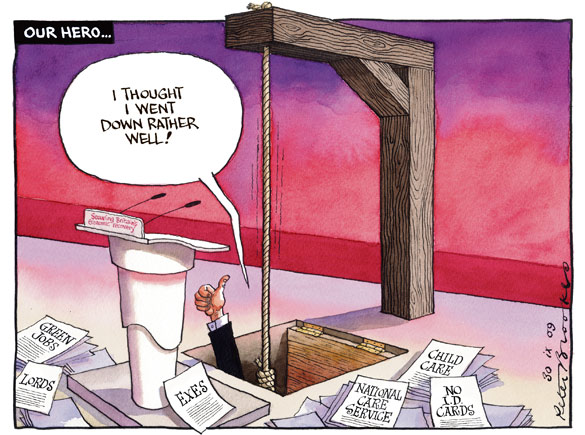
Last year, when Sarah Brown, clearly nervous, stood up in front of the Labour conference and introduced her husband's address, what was clearly an attempt to deflect criticism was viewed sympathetically, mainly as it was still by no means certain that he would be in the job for much longer after it. As it turned out, the speech, probably now best remembered for his put down of both Cameron and Miliband by saying it was "no time for a novice" was just about good enough to secure his leadership, at least until the disastrous local and European election results earlier this year where another major wobble took place.

This year, Sarah Brown's appearance before Brown's speech, far from performing the role it was meant to, simply exaggerated the extended tragedy which has been his reign. What other response could there possibly be to her description of Gordon as "her hero"? Again, she was intended to act as a prophylactic, protecting him from scathing criticism. You can get away with doing this once; do it twice and you start to look cowardly, and this from the man trying to ram books about "courage" down our necks.

You can though understand why they wanted history to repeat. If last year's speech by Brown did just enough, then this year's didn't even come close. You can't deny that Brown delivered it with plenty of brio, hardly falling into the stereotype of someone so depressed and flailing that he needs to be on archaic, strong medication, but it was the content that so bitterly let him down. To call it a speech would, like Nick Clegg's effort last week, probably be insulting the medium itself. There was no theme, no connection. One of the first things you're taught when it comes to writing essays is that they must have an introduction, a middle and a conclusion, something which applies equally to public speaking. The latest innovation it seems when it comes to speeches by political leaders is to throw such outdated notions out of the window: no one other than wonks is going to listen to or read the things in full anyway, so you might as well just talk about one thing after the other, regardless of any connection between them until you've finished. Brown goes from the economy to attacking the Conservatives to the greatness of those ubiquitous "hard-working families" to the public services to back to attacking the Conservatives again, all of it wholly unconvincing.

This conference, if it is about anything, seems to be a collective gnashing of teeth that they have ever saw fit to defenestrate Tony Blair. Yesterday we saw the party finally falling in love with Mandelson, the nearest it now has to the great man himself. Brown, knowing that the last thing he can be is Blair, instead decided to emulate his policies. All those things we thought we'd seen the last of, such as the pointless counter-productive populism on "anti-social behaviour" are suddenly back as if they never went away. Sure, there were a few bones here thrown in an attempt to buy off those who had hoped that Brown would lead the party left-wards, the most obvious and also best example being the great believer in free markets suddenly deciding that the "right wing fundamentalism that says you just leave everything to the market and says that free markets should not just be free but values free" was wrong, but no one believes for a second that Brown intends to act on what he says in this area. Most disturbing was what some have already monikered as "gulags for slags", the shared housing for pregnant 16 and 17-year-olds, rather than putting them up in a council flat. Not only does this buy into a myth, that all you need to do is get pregnant while a teenager and you'll be set up for a life, but that also accidentally becoming pregnant when you're over the age of consent but not yet 18 is something that you should be punished for, not to mention considered to be too stupid or feckless to be able to look after the child either on your own or with the help of your own family without the state barging in. This sense of false victimhood and resentment against those "who will talk about their rights, but never accept their responsibilities" permeated an entire section of the speech. This just illustrates how successful the tabloids have been as painting Labour as friends only of immigrants and single mothers, and how the incredible idea that it's now the white middle classes who are the most discriminated against has become mainstream.

If the idea of "gulags for slags" is chilling, in much the same way was Brown's declaration that "whenever and wherever there is antisocial behaviour, we will be there to fight it." It's worth remembering that the main indicator for so-called antisocial behaviour is not shouting at people on the street or the kind of low-level thuggery over an extended period which the Pilkingtons suffered, but teenagers daring to congregate together in public, doing nothing other than talking to each other. In some senses we've regressed past the Victorian dictum that children should be seen and not heard; now we don't want them even to be seen. Yet this war on childhood in general is, we are told, incredibly popular in focus groups, hence why it's back on the agenda. It doesn't matter that if you focus grouped bringing back capital punishment or permanently chipping sex offenders you'd also doubtless get an immensely favourable response, if a representative sample of the hoi polloi wants it, they'll get it. Or rather, they'll be told they're getting it, as that seems to be just as good as getting it.

On everything other than bringing back the Blair agenda, it was the tiniest most pathetic gestures which were the order of the day. ID cards won't then be made compulsory over the next parliament; MPs guilty of gross misconduct will be able to be recalled; and there'll be a commitment in the manifesto for a referendum on the alternative vote, the most piss-poor non-proportional system of voting other than first past the post. There was no vision here, no adjustment to the world as it is now is, just a repetition of past glories which the electorate are supposed to bask in and so reach the conclusion that the Conservatives would only mess it all up. This was exactly the stance they took in 1997: New Labour, New Danger, you can only be sure with the Conservatives. They were already doomed, but it doomed them even further. In line with that year, tomorrow the Sun declares that Labour has blown it, just as it switched support from the Tories back then. Marx it seems had it backwards: in this instance history is repeating itself, but as tragedy after farce.

Labels: , , , , , , , , ,

Share |

Monday, September 28, 2009 

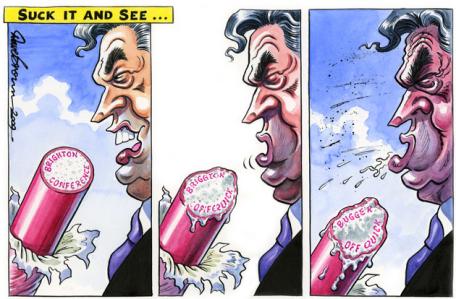
The spirit as weak as the flesh in Brighton

Far be it from me, an inhabitant of a concrete hell which culture seems to have passed by, to suggest that this nation's seaside towns tend to be inclement at best and downright depressing at worst during the autumn and winter months, but perhaps the weather in Brighton, especially at night, is in tune with the Labour party's collective mood. This is, after all, according to no less a person than Alistair Darling, a party that seems to have lost the will to live, which no longer has the fire in its belly, and for which everyone from the top to the bottom, has a responsibility.

This theme, that the party is sleepwalking to a defeat next year which could finish it as an electoral force, has become so familiar that it's almost beginning to border on the cliche, and it's one which this blog has not exactly challenged. It is one however that the opinion polls are hardly contradicting, the latest showing Labour equal pegging with the Liberal Democrats on a shockingly low 23%. It's still worth remembering that Labour took 27% of the vote in 1983, the year incidentally in which both Blair and Brown were elected to parliament. The "longest suicide note in history", although one which deserves reappraisal, delivered a higher percentage of support than Labour would currently receive. Only those most in loathe with the last 12 years would suggest that's all that the party currently deserves.

No one seriously expects that Labour will be fighting with the Liberal Democrats for third largest party status in 12 months time. The threat is however that the party could be reduced to its long established bases of support, but even these, on an extremely pessimistic reading of the runes, seem to be in trouble. Wales, the historic bedrock of Labour support, seems to be within the grasp of the Conservatives. According to a Financial Times poll last week, the Tories have a 4 point lead in the north, while in Scotland the party is instead struggling with a Scottish National Party that despite the al-Megrahi backlash only seems to be growing stronger. This is coupled with as Dave Osler has identified, the party's loss of a generation. Amazing and frightening as it seems, those children and only just teenagers who were marching against the Iraq war alongside those of us who had only just gained the right to vote in 2003 will next year themselves be taking part in their first general election, and if they fight off the apathy, it seems doubtful they'll be putting an x in the box alongside the Labour candidate, nor will they in the years to come. Just as we promised ourselves we would never vote for the Tories, so they will have promised never to vote Labour. This poses a challenge which no one in either the Conservatives or Labour has even began to consider, let alone broach.

Looking at the hall in Brighton, many of the seats empty, even during Alistair Darling's speech (although that perhaps might be half the reason), the clapping lukewarm at best, it's hard not to infer that many don't have the stomach to even turn up, like at a Christmas party for a company that's shutting down in the new year. Then again, when the best that Darling could pull out of his hat was a "Fiscal Responsibility Act", designed to put in legal terms how the government intends to reduce the deficit, you do wonder whether involuntary euthanasia wouldn't be kinder for all involved. It really does sum New Labour up: its mania for legislation where none is necessary, that it is so shorn of trust that it has to do so to make sure that the public believes what it says while also no doubt being an attempt to tie the Tories' hands should they want to put certain areas of spending off limits.

Just when you think that things can't get any more absurd, up pops the former Prince of Darkness, who could now more appropriately be known as the Grand Wizard of Sunlight. Mandelson does not have a natural charisma, but what he does have, along with the self-regard, is the ability to reassure, which is what his role was today. In a way, his speech was about precisely nothing, even though he did announce an extension to the car scrappage scheme, but rather about enthusing those resigned with the unannounced theme of the conference, fighting back. Mandelson might have made the most ultimate of comebacks, but even his bounce back ability is hardly likely to infect the party as a whole. He has though made Brown's task tomorrow even more difficult. Brown's speech of 2003, his "Real Labour" opus, is now little more than the tiniest of memories. To go by the leaks, that Brown intends to go on the attack on crime and promises that most piss-weak of political battles, a live debate or debates with Cameron prior to the election, it seems that even Brown and his speech writers have given up the ghost. No longer is even the spirit willing, seeming to be just as weak as the flesh.

Labels: , , , , , , , ,

Share |

Wednesday, July 29, 2009 

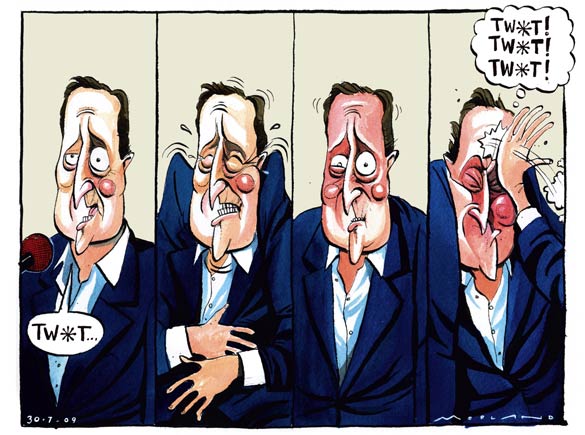
How the Cameroons will govern.

It says something about just how low most assume Labour's chances of victory are at the next election that we're already moving on to wondering how Cameron's Conservatives will govern and whom they'll govern for, although even Peter Mandelson is now admitting that Labour are the "underdogs" as far as next year is concerned. Partially this has been sparked by Simon Heffer, why-oh-whying as he is wont to do, about how Cameron isn't up to snuff as far as he's concerned on his true blue convictions. Both Bob Piper and Dave Osler agree, the latter summing it up with his observation, based on Norwich North last weekend, that the party is submitting to "Chloeification", fairly bog standard Conservatism with a nicer, smoother face. Chris Paul on the other hand, is unsure whether Heffer is being used by Coulson or whether he doesn't mean it, doing the same thing as those who complained that Blair wasn't a socialist, hence nothing to be scared of: if the high priest of Thatcherism says that Cameron isn't a Tory, then there's nothing to be scared of, right? Unconnected but related was Geoffrey Wheatcroft on Monday who thought there something wrong with these Tories, which Jamie says means we're going to have more of a succession next year than an election.

The Blair comparison is apposite, because as Jamie also quotes, we know full well that many of the highest Cameroons, and the other architects of "change" within the Conservatives also deeply admired Blair. They admired him because he won elections, because he wasn't beholden to his party, and because for a time he meant all things to all people. He was Teflon Tony. They even adored his wars, and still do to an extent, especially the true believers like Michael Gove, who share what you can either call his neo-conservative leanings, or his "liberal interventionism", which in the case of both Afghanistan and Iraq was nothing of the sort. The Labour party became so desperate, so the orthodoxy goes, that it turned to someone who was never a natural Labour politician to lead them to victory. The Conservatives, also desperate for victory, have equally turned to someone, who although has an unimpeachable Tory background, doesn't have the natural Tory face, who can do the compassion which Thatcher never had, and who isn't (yet) a laughing stock as John Major became.

As Dave Osler points out though, the Toryism which Simon Heffer yearns for only came into existence in the late 70s, being constantly built upon during the 80s. Whether you call it Thatcherism, Reaganonomics, neo-liberalism, the belief in supply-side economics and the associated trickle down theory, this was what truly made the break from the One Nation Toryism which the post-war party had up till then espoused. The real success of Thatcherism etc is that everyone in the West has pretty much adopted it, or at least the economic side of it. Even now that the ultimate conclusion to Thatcherism has been reached, with the worst recession since the great depression, and when those bastions of neo-liberalism, the banks, have had to be bailed out and either nationalised or nationalised in all but name, all still worship it, as the feeble attempts at reforming regulation shows.

We should however be clear that there was an almost Faustian pact between New Labour and the City. The banks and the hyper-economy provided the tax revenues which overwhelmingly funded the surge in spending on the NHS and education, as well as the sly, feeble attempts at redistribution that made some headway, then failed. Business could do business with Labour, and in return they funded their spending, even if they complained and tried every trick in the book at avoiding the taxman as much as they could. At the last election this philosophy had triumphed so successfully that the Tories were quibbling about amounts of money that Boris Johnson would describe as "chicken-feed". It was on other things, such as immigration and crime on which they was something resembling a difference between the two parties, although doubtless if Michael Howard had won there may well have been a drift from the manifesto, written by someone called David Cameron.

Now we're faced with much the same situation but in reverse. Whoever wins, cuts will have to be made, it's just where and how deep that the argument is over, even if Gordon Brown and others try to deny it. The Tories' promise that both health and international aid will be protected, with possibly education and maybe defence also joining the party. The other promises made were that inheritance tax would be raised from its current threshold to £1 million, and that marriage would be recognised in the tax system, helping to fix our "broken society", but even those now look uncertain, with Cameron maintaining it might well be difficult to achieve. Both of those things are naturally Conservative policies which the left would and should oppose, especially the former when inheritance tax ought to be one of the weapons used in bringing down the deficit. Dave Osler notes that the "Chloe" generation of New Tories tend to defend the NHS in its current state, and there's little to suggest otherwise from a survey the Guardian conducted with 66 prospective candidates in September last year, although it's slightly out of date due to the economic crisis then not being fully developed. What is noticeable though is their social Conservatism: while it has always been Labour that has led social liberalisation, whether it be on abortion, the legalisation of homosexuality etc, the Conservatives have come to accept the changes over time.

What exactly are we facing then, come next June perhaps? To begin with, there probably won't be much difference. They might, as suggested, have an emergency budget with 40 days and bring in cuts quicker than Labour would. What does begin to chill the blood however though is the promise of "austerity", as used by George Osborne, which only brings echoes of the post-war years and the early 50s. Why it should chill is because you know full well that Osborne and Cameron will not be those experiencing their "austerity", just as they have never experienced it before. Secretly, it's difficult not to feel that the Tories are gleeful at getting the opportunity to take a sword to public spending. Like with New Labour, they're unlikely to really hammer away for the first couple of years, but after that it's anyone's guess as to what they'll do, let alone if they get a second term. On crime and law and order, Chris Grayling's recent "nick their sim card and bike" gimmickry reminded everyone of New Labour's similar ideas which were derided. With welfare, they've promised much the same as Labour's plans again, except with bells on. We shouldn't imagine that we're going to return to Victorian values or back to basics, but what we are going to experience is new Blairism, as argued before. The Labour party was there to try to contain Blair's worst excesses, even if it failed miserably most of the time. With Cameron, and with a media already licking its lips in anticipation at the Tories returning, there will be no constraints upon Cameron. With Blair, we had an "ethical" foreign policy, a sop to "wets" like Robin Cook. William Hague has already made clear that they intend to return to realpolitik, and relegate human rights somewhat in their dealings with the likes of the Saudis and China, and with Liam Fox and Michael Gove in tow, it's difficult not to imagine that neo-conservatism proper won't rear its ugly head. We've already seen that Cameron has joined up with homophobes from Poland and other assorted oddballs in the European parliament; if that doesn't embarrass him, what will?

Heffer then is wrong. Cameron and his party will be Conservatives, but then we've had much the same under Brown and Blair. Cameron and co will just turn everything up a notch. It probably won't please the hardline Tory faithful, but they'll get used to it, just as Labour supporters hoping for a turn left did. The challenge will be for the left to create a truly alternative vision, which does offer a difference, something which for now is nowhere in sight, even as the best opportunity ever to make the case for it has appeared and also now seemingly, disappeared just as quickly.

Labels: , , , , , ,

Share |

About

  • This is septicisle
profile

Archives

Powered by Blogger
and Blogger Templates