Tuesday, June 10, 2014 

Our true shared values.

Perhaps it was just me, but as a kid I always got an illicit thrill out of seeing a swear word written down or spoken by an adult you wouldn't normally expect to use an expletive.  You could hear the same word used multiple times a day, and yet still get a tingle of the forbidden from finding it in a book.  At some point we made a visit to a city (I can no longer recall which city or when this was) and went past a theatre where Mark Ravenhill's Shopping and Fucking was being performed. I didn't have the slightest clue what the play was about, just there was something outré, thrilling about seeing it starkly advertised, uncensored and completely unvarnished.

If you're wondering what kind of tenuous connection I'm going to make between this astoundingly banal anecdote and something in the news, then here it is. Amid all the joking and mockery of defining what "British values" are, and the deadly serious politicians who always end up sounding wretchedly po-faced and about as current as Geoff Capes when they attempt to do so, the only true values we honestly share as humans are that we eat, and we fuck.  Sure, we do a lot else as well, and as my dear old nan had it, if you don't eat, you don't shit and if you don't shit, you die, but the two things that drive us as animals are eating in order to stay alive, and procreation in order to pass on our genes.  Some of us do a lot more of one than the other, call it the Russell/Jo Brand dichotomy if you like, but the equilibrium has just about remained in balance.

Yes, it sounds flippant, reductionist, facetious.  Is it any sillier though than trying to instil a set of rigid values on a people for whom abstract concepts such as the rule of law and belief in personal and social responsibility are going to mean different things?  This isn't to get into a redundant debate about relativism, it's more the absurdity of regarding the prime minister's list of values as being intrinsically British, let alone unique to this country.  If anything there is something particularly unBritish about teaching respect for the very institutions we spend so much time either making fun of or complaining about, a view a certain Michael Gove also once shared, at least when it was Gordon Brown commissioning reports "designed to enhance the bonds of citizenship".  We should note that schools will only be meant to "promote" rather than teach British values, but what the difference will be when it comes down to it remains to be seen.

Besides, beyond freedom and tolerance, just what kind of person would ever says Britishness is about responsibility?  Bizarre as it is to discover, it was John Major who almost certainly came closest to the nub of Britain as it sees itself and the world sees it when he described it in 93 as "the country of long shadows on county grounds, warm beer, invincible green suburbs, dog lovers and pools fillers and as George Orwell said “old maids bicycling to Holy Communion through the morning mist”".  He was definitely nearer than either William Hague or Shirley "no revolutions" Williams came in similar remarks.  Strip away the stereotypes, the clichés and the self-hatred/self-love, however difficult that last one is and I'd hazard we're now a nation of cynical, atomised, oblivious, ill at ease, generous when we feel like it, generally tolerant and funny people.  We believe in applehood, mother pie, there being no such thing as privacy, in freedom of speech for ourselves and chain stores of every variety on our doorstep.

The only reason David Cameron can be so assured the policy will have "overwhelming support" is there's not much people like to imagine more than the idea they have some kind of influence over what the next generation will be brought up to think, and as "British values" are such an open book it can mean every thing to every man.  As any parent will soon tell you, it doesn't work out like that.  The same will be the case in this instance: by the time any secondary school gets round to promoting the Govian view on Britishness, most teenagers will already know what they think about our glorious institutions, the quaintness of the traditional sense of fair play and the tolerant way young people are regarded and reported on by the world's finest media.  Gove and pals of course know this, but every education secretary ends up reduced to imagining they will leave some legacy, or indeed scar on those currently growing up.  The difference is Gove came to the job certain in what he wanted, and to hell with the consequences.  It's enough to make you wish for a politician who would break it down to we eat, we fuck, we die.  Or maybe that's just the sadness in me.

Labels: , , , , , , , ,

Share |

Monday, June 09, 2014 

Michael Gove proves his worth yet again.

The idea that Ofsted inspectors can get a true, rounded image of how a school is performing over just two days is a fiction.  In most cases, not even the teachers themselves really know what's going on; the more perceptive kids certainly will, but it's rare they're regarded as being truly reliable or for that matter questioned at length by inspectors.  My old failing comprehensive shouldn't be taken as representative, not least as it's now over a decade since I thankfully left it behind, yet I can't help recalling the story told by one of our teachers about the head asking who she was.  "I'm so and so.  You're the one who conducted my final interview."

This is exactly why we should treat the reports finally released today into the 21 schools in Birmingham at the heart of the "Trojan Horse" allegations with a healthy dose of scepticism.  Considering these reports have been about the worst kept secret since Ryan Giggs' love life, with practically all the findings on the five being placed in special measures leaked in advance, the findings don't come across as the biggest shock.  They additionally don't because, with a few notable exceptions, Ofsted hasn't found prima facie evidence of extremism.  Attempts by governors in some instances to instil a more hardline Islamic ethos on some of the schools yes, success in doing so was mostly more difficult to come across.

Sir Michael Wilshaw was then left with the task of explaining why schools ranked as outstanding two years ago are inadequate now.  The obvious thing was to say all this had happened since the last inspections, despite the fact we know these were not new concerns, and to make the evidence sound a lot more firm and grounded than it actually is, and what do you know, that's exactly what Wilshaw's done.  Compare the reports into Park View and Golden Hillock for instance with that of the inspection of Oldknow Academy, and you soon discover which Wilshaw draws the most from for his letter to Michael Gove.

Oldknow is certainly the school where the evidence of an attempt by governors to exert control is most apparent.  The principal is currently on sick leave, having handed in her resignation in January, with the additional report by the Education Funding Agency (PDF) redacting some of the further information.  Staff said the school had becoming increasingly Islamic over the past year, that the celebration of other religious festivals had been cancelled despite Eid celebrations going ahead, with the most serious allegations involving the Arabic and maths teacher.  He refused to shake the hand of the EFA's female education adviser, while his was the only class they observed where every girl was wearing a headscarf and they were all sat at the back of the room.

At Park View, which has had most of the focus on it, the evidence isn't quite as stark.  Ofsted states externals speakers have not been vetted properly, a reference to how Sheikh Shady Al-Suleiman was invited in as an external speaker.  He isn't named in the Ofsted report but rather in the additional EFA one.  The Graun reported last week this detail may have been dropped after the school complained he had spoken at other universities and schools, wasn't considered an extremist by the Prevent programme, and his talk had been on "time management".  The EFA also notes many classrooms had posters advocating prayer, while some in a maths classroom encouraged pupils to begin and end the lesson with a prayer.  Religious education after Year 9 was also exclusively Islamic, with those children who wanted to study for the Christian GCSE having to "teach themselves".  There was also some evidence of gender segregation, although the EFA again makes more of this than Ofsted.

Mark Easton makes the important point that much as we might recoil from this, and as Ofsted, the EFA and indeed (indeed) Michael Gove apparently do, view such an atmosphere as not being conducive to community cohesion, failing to prepare those attending for life in multicultural Britain, where do you draw the line in a system seemingly devised to be in a constant state of controlled chaos?  If Park View and the rest were designated faith schools rather than "normal" academies in an area where the majority are Muslims, would there be the same problem?  The main finding against Park View and Golden Hillock is that at both too little is being done to raise students' awareness of the threat from extremism, which in practice effectively means teachers and governors haven't received training from the Prevent programme.  Exactly how many other schools could be accused of this failing, one wonders?  In the Park View report, Ofsted state "[S]tudents’ understanding of the arts, different cultures and other beliefs are limited."  You suspect the same could be said of almost every school that isn't ranked outstanding regardless of the area it serves.

Just how far this obsession with extremism is being taken is set out in the Ofsted inspection of Graceland Nursery School.  As a matter of urgency, according to Ofsted, the school should "ensure that key policies such as the child protection policy, anti-bullying and behaviour policies include reference to identifying and minimising extremist behaviour."  The children the school caters for are 3 to 5 years old, for crying out loud.  If this is Michael Gove's idea of "draining the swamp", we can only thank our lucky stars he's not environment minister.

Apart from the Park View schools being taken over, about Gove's only other substantive suggestions are snap, no notice Ofsted inspections and schools being required to promote "British values".  As to what British values are, your guess is frankly as good as mine.  If as suggested it's teaching respect for the rule of law and how the police and army can be held accountable to the people, then it might be a start if the government had the same respect for the former and we made it so that the latter is a reality rather than a lie.  Much as John Harris is right to argue that the overriding issue here is the disarray schools are currently in thanks to Michael Gove's determination for every single one to be an academy, with it being obvious from the outset those with an ideology to push would be first to take advantage, we can't ignore the role of religion in general.  If parents want their children to have a religious education, they're perfectly entitled to provide them with one; the state however shouldn't be in the business of doing so.  It also wouldn't go amiss if the education secretary wasn't someone apparently convinced that behind every decent, honourable Muslim there's another waiting to go off.

Labels: , , , , , ,

Share |

Tuesday, July 27, 2010 

The Con-Dems and the race to legislate.

Whether it's attributed to either Emma Goldman or Ken Livingstone, the idiom that if voting changed anything they'd abolish it/make it illegal has always been one of those pithy statements which sound good but which fall apart under scrutiny, unless you take it as a criticism of so-called liberal democracy itself. Voting does change things, it's the politician's promises which are always broken. One of the things the Tories assured us they would not do prior to the election, with the Liberal Democrats making similar noises, was legislate to the extent which New Labour did, notoriously driving through over fifty criminal justice bills in thirteen years. Something they would also do would be to consult, and not in faux exercises like Labour's Big Conversation, with the whole thing micro-managed by spin doctors. They also wouldn't impose top-down reforms on the public services without doing the above, recognising how they had demoralised and demotivated the NHS especially, as well as wasting valuable time and resources. They even put the last one in the coalition agreement, such was the dedication to learning from the mistakes of the past.

Less than three months after the election and formation of the Conservative-Liberal Democrat coalition, and the one thing which strikes you about this government is just how much of a hurry it's in. On one level this is to be expected: even if for the moment the leadership of the two parties is still dedicated to making this partnership work, the murmurings from the backbenchers on both sides are undeniably getting louder. For six Liberal Democrat MPs to vote for a rebel amendment to the not just rushed through but rammed through academies bill is significant at such an early stage, especially on legislation which was similar to that which they promoted in their own manifesto. While the Lib Dem left is worried, it's the Tory right, not sated by the swingeing cuts yet to come which finds itself marginalised by the Cameroon revolution. Jibes about a "brokeback" coalition might seem relatively frivolous, yet it's little wonder it's miffed when it comes to prison policy and its liberal mushiness, which certainly wasn't hinted at prior to the election or in the manifesto. Their opposition to the AV referendum is less easy to understand, such is its chilling potential affect on Labour rather than them, yet all is certainly not well.

Some of the haste is then undoubtedly down to the potential instability of the coalition. Compared to New Labour's first few months in office, which were reasonably well planned in advance and included the independence of the Bank of England and the imposition of a windfall tax, it didn't really inspire its first proper rebellion against legislation until the revolt against the cutting of single parents' benefit at the end of 97. New Labour did however have the potential luxury of time, such was the disarray in which the Tories found themselves in along with a majority which effectively established an elective dictatorship. It was only later that Tony Blair regretted not pushing harder during his first term for public sector reform, although not when it came to the timidity of following the Tories' budgets for the first couple of years. It also wasn't until the fuel protests of 2000 that Labour found itself behind in the polls for the first time, giving it the kind of security that this current government would all kill for. The Tories find themselves only four points behind Labour in the latest ICM poll, long before the cuts begin to bite in the autumn, and on the back of exceptionally positive economic growth figures.

Even so, the slamming through of the Academies Bill was more akin to Labour's treatment of emergency anti-terrorism legislation than carefully considered and combed over drafting and re-drafting, as Tom Freeman noted. The argument made by Michael Gove in favour of the rush was that the topic had been endlessly debated over the last few years, as if this were an acceptable replacement for the usually more staid parliamentary process. In reality the rush was to be able to ensure that those schools that have applied for academy status can indeed have it when they reopen in September, although if we're to believe Julian Glover almost every aspect of reform which the bill covers is already available under previous legislation; in that case, why do we need a new bill which seems to do so much at the expense of the consultation which this government had previously promised? The big society it seems only works in favour of those that want the change which the Tories have already pre-determined which the public wants; if you'd rather your child's school didn't become an academy, then tough luck, as it's going to become one anyone. You can of course set up your own "free school", but it'll take years and you'll have to do all the work, or rather the private and voluntary sector firms you'll employ will.

More perplexing has been the relative silence over the proposed reforms of the NHS, where at least the legislation itself is at yet still to come. The coalition agreement clearly stated there would be no top-down reorganisations, while the primary care trusts would be reformed and elections held to ensure there was public representation on them. Eight weeks later and this went completely out the window when the health white paper was published: PCTs would be abolished altogether, local authorities instead providing the the democracy previously lacking, while GPs, the biggest winners out of Labour's own reforms with their pay increasing massively, would be given the task of commissioning services and organising themselves into consortia, whether they want to or not. This relies entirely on GPs being the well-informed heart of the health service which they are often assumed to be, knowing who delivers the best services in their area. It doesn't matter that plenty find their work with patients to be stressful enough, and prefer the management to be taken care of by others, and that they often simply don't know which is best locally as they don't have information on which to make such assured decisions upon, as the management side will probably be provided by the private sector firms itching to get a larger slice of the NHS budget, this was what wanted wasn't it? Aren't they pleased the government has been listening to them?

We can't however say we haven't been warned about the policing white paper. Ignore the parts about the setting up of the umpteenth "British FBI" and volunteers picking up the slack and/or patrolling with the actual police, the latter of which is a legal mindfield and almost certainly won't happen, it's instead the election of local police commissioners which has long been promised. This is without doubt the worst possible thing you could do to the police, as similar schemes in America have abundantly proved. At the moment there is at least a smidgen of operational independence between police and politicians, although New Labour first and then Boris Johnson have both tried their best to undermine that. It's not so much that it will open up the opportunity for the likes of the BNP to get themselves onto the boards of police authorities, the possibility for which is exaggerated (more realistic is local independents who'll demand to see more police on the beat and less teenagers on street corners), but more because as much as we complain about them, the police themselves generally do a reasonably good job at determining what the local priorities in their area are. Undoubtedly those who will put themselves forward for election will know what the problems in their very localised area are, but will they over a far larger radius? The opportunities for imposing their own tin-pot ideologies and prejudices on the police at large (and that goes for both right and left) will also doubtless be far more limited than they at first seem, but the potential for them to sack chief constables who will almost certainly disagree with them and instead install someone more amenable is a recipe for disaster and endless disputes that will distract from the police work itself.

As no one can even begin to put an estimate on how long the coalition will last, and few really believe that this is a marriage which can last much longer than a couple of years without major disagreements and fights breaking out putting the entire government in jeopardy, the potential for ill-thought through, badly drafted and overly rushed legislation ending up on the statute books is not much lower than it was under Labour. Of course, that this is all being conducted under the auspices of a government that believes so deeply in individual and community involvement in the political process and change from the talking to the hand which occurred under the last government means that history couldn't possibly repeat itself. They've learned from the past mistakes and are dedicated to transparency above everything else. What could possibly go wrong?

Labels: , , , , , , ,

Share |

Friday, December 01, 2006 

My legacy, my legacy, my legacy!

If there's one thing you can't accuse Tony Blair of, it's giving up. His last few months as Prime Minister are destined to be full of activity. On Monday, he's apparently to announce that we're going to waste billions of pounds on a new nuclear deterrent, for little other reason than to give BAe something to do, and because we couldn't let France be the only EU country with nukes. That would just be too horrible to imagine.

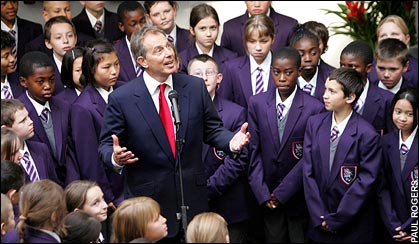
Yesterday however was a return to Blair's stated alleged first, second and third priorities on entering office, other than bombing, banning and bribing. Yes, it was time to go and wind up the teachers with his latest plans for reorganising the school system. As Blair prepares to leave office, the first and foremost thing on his mind, apart from when Inspector Knacker is going to come calling, is his legacy. We know it, he knows it, his advisers know, the media knows it. Every little detail is going to be scrutinised for how it might effect how history judges the 21st century's first prime minister, even though we all know the only thing that he's going to be remembered for is Iraq, unless Knacker steps in and arrests him. In short, unless the situation in Iraq improbably and unprecedentedly turns around, after a few hundred thousand more deaths or so, and Blair's reputation makes the biggest comeback since Lazarus as a result, he's royally screwed.

Making his speech at the Specialist Schools and Academies Trust conference, this was Tony in full Pollyanna mode. Parents are just dying to get in the new academies, according to him, which instantly means that they're a huge success. This ignores how nearly all the new academies either have new buildings or have been extensively refurbished, not to mention how the first load have mainly replaced formerly failing comprehensives, which is going to magnetise parents towards them in the first place. As with the schools being sponsored, the buildings themselves are typically, if not always built under the private finance initiative, meaning that the money for the contractors is off Gordon Brown's books, but leaves the next generation of kids paying for the current generation's brand spanking new halls and computers.

The actual evidence on whether the new academies have improved standards or not is decidedly mixed. A study by Terry Wrigley, a senior academic at Edinburgh university suggested that the number of pupils gaining 5 A-C grades at GCSE compared with the schools the academies replaced had gone up by a whopping 0.2%, equivalent to three pupils per school, which seems like an outstandingly good result from the amount of money put in. By contrast, one academy in Brent in London was given a glowing review by Ofsted. All is also not well with the money given to the academies by the sponsors in exchange for having a major part in setting the curriculum and school ethos. A Guardian investigation showed that of those up and running, only four academies have actually received the full £2 million meant to be handed over. One suspects that business and other benefactors may also be put off by the loans for peerages scandal - any sort of donation which appears to help Labour and leads to an honour of some kind is now likely to be heavily scrutinised.

Then there's the fact that these academies are predictably attracting the attention of religious crazies laying down their own values and rules as part of their control over the school. The Trinity academy at Thorne near Doncaster, part of car dealer, friend of Blair and evangelical Christian Sir Peter Vardy's empire, suspended 148 students within its first six months - leaving parents suspecting that covert selection was taking place with free-thinking being cracked down upon. While Blair in his speech lauded the idea of giving pupils choice, that doesn't seem to extend to pupils challenging authority or deciding whether or not they should be taught creationism alongside evolution.

It's little surprise that Blair sees academies as reflecting his own image. They're new, shiny and pleasing to look at, but underneath they're still suffering with the same problems as before, except with new groups of governors running the show. Despite Blair's claims that 200 will be up and running by 2010, it's a promise that like the existence of God, should be believed when it's seen. Just to make it even more unreachable, at some point in the future Blair wants there to be 400. Where all the sponsors are going to come from isn't explained.

After rejecting Mike Tomlinson's call for GCSEs and A-Levels to be replaced with a diploma, Blair's new wheeze is to expand the International Baccalaureate from being available at a few elite schools to err, being available at a few more elite schools. While some have suggested that academies and trust schools will lead to a two-tier school system, the availability of IB could do something very similar. With universities increasingly having to select from students with a whole ream of A grades in the required A-level subjects, the elite are bound to be more than receptive to those who get the opportunity to take the IB instead. Those privately educated and who are either lucky enough to be near a high performing school, or whom have moved in order to be so, will undoubtedly once again be crowding out the riff raff from the bog-standard comprehensives.

Concerns over A-levels though is perhaps missing the big picture. The proportion of students getting 5 A-C grades at GCSE is stubbornly remaining below 60%, meaning that 40% are still effectively failing. The sad fact of the matter is that by 14 it may already be too late; faced with carrying on in academic lessons that they wish they weren't in, that 40% may well have been better served by Tomlinson's diploma, which would have also have taken voluntary qualifications into considerations. Instead, Blair's new idea is to have an entirely separate diploma at 14, tied in with apprenticeships. It may turn out to be a good start, but it's probably too little. There's also increasing evidence that those at 14 who aren't performing "adequately" in academic subjects are being forced into GNVQs instead of GCSEs, which despite the government's claims aren't anywhere close to being as challenging, purely to help the school's place in the government league tables. The option of being either all academic or all vocational is far too stifling.

Still, what does it matter to Blair? He's tried, he's most likely failed, but at least he'll be remembered for starting off academies and the Tory-loved trust schools which they're itching to get their hands on. Won't he?

Labels: , , ,

Share |

About

  • This is septicisle
profile

Archives

Powered by Blogger
and Blogger Templates