Wednesday, March 04, 2015 

Drugs, sensationalism and paternalism.

I didn't watch Drugs Live, mainly for the reason that like most people my age I know fairly well how cannabis affects those who use it.  It doesn't instantly make you an utter prick, as say cocaine does, nor is it unpredictable in the way alcohol is.  I've also known people who've been smoking it for so long it has almost no effect on them whatsoever, or seemingly doesn't.  David Nutt then ranking hash, as opposed to skunk at the very bottom of his harm index doesn't come as a major surprise.

You can't though have a television programme in this day and age purely discussing the effects of drugs or even just how they impact on the brains of Mr and Mrs Average Punter, as that's boring and not going to get Twitter, err, blazing.  No, instead you must have Jennie Bond and Jon Snow (the other one) getting baked, purely for scientific reasons, of course.  I did happen to catch one moment when the former royal correspondent's "pleasure sections" of her brain lit up while listening to music after taking a good long pull, which was instantly declared as definitive proof that weed does make shit music sound better.  It reminded me and no doubt only me of the Monty Python Planet Algon sketch, or at least the presenting style did, so the more things change etc.

Any chance the programme had of being more than just a typical Channel 4 stunt, coming after the previous show on ecstasy and Mariella Frostrup asking couples who had just finished shagging in a box in the studio how it was for them was rendered all but academic in any case by the advance promotion.  Jon Snow declared he found being on skunk while in the MRI scanner to be more terrifying than when he'd been in war zones, to which one response is he should try it while in any smaller town's excuse for a nightclub.  Post-traumatic stress disorder would no doubt instantly descend.  Regardless of Snow's intentions, this was the cue for the likes of the Mail to declare that if someone as unflappable and worldly wise as Snow could be reduced to such a state, just what is it doing to the immature and less refined?

Coupled with the other new research into psychosis and use of high strength cannabis, the government was quick to declare it had no intention of changing the law, unless of course there's enough of an outcry to think about tightening it further.  What better time for of all people, Richard Branson to renew his call for the government to follow the example set by Portugal's decriminalising of possession, only this time joined by the man who's turned many of his own party to drink if not drugs, Nick Clegg?

Had Clegg been as explicit in his support for decriminalisation earlier in this parliament, as opposed to simply making noises in that general direction he might just have made something approaching a difference.  Leaving it this late invites cynicism that his conversion to the Portuguese model is less out of genuine belief it would reduce drug usage overall and help addicts and more about trying to retain some of the votes his party has lost.  To be fair, the Lib Dems have long called for a rethink on drugs and they did succeed in getting their comparative study published, even if it did little more than just reinforce what most already knew.

We also shouldn't get carried away, just as it was advisable not to after said report.  Branson and Clegg write that as well as remaining illegal drugs should also remain "socially unacceptable", to which the obvious response is why?  Why should it be socially acceptable, even felt to be obligatory in some circumstances to drink fermented vegetables and fruits but not smoke or chew the extracts of a plant, when the effects are often far less damaging?  Why should it be unthinkable that MDMA could ever be legal, when the real danger from "ecstasy" is from adulteration, or when the supplied pill or powder doesn't contain MDMA at all?  Why should someone be arrested for possession of small amounts of cannabis or any other number of drugs we know to pose a low risk and cause little overall harm, let alone then sent for treatment or assessment for a problem the vast majority won't have?  Surely If we're looking towards any model it ought to be the American one, where the effective legalisation of cannabis has taken the trade almost wholly out of the hands of organised crime.  This isn't to deny there will always be problem users, addicts and the potential for harm beyond that measured on a scale, but we have the worst of all worlds at the moment.

The answer to all the above is not just that we have a sensationalist approach to drugs and the harm they can cause, hence why journalists can be felt responsible enough to take them and tell us plebs what it's like, just as The Day Today satirised years ago, but we also have doctors who believe smoking should be banned in parks and squares.  When smoking is to be made socially unacceptable, regardless of your personal view on it, and my own isn't favourable, what chance is there of making any progress on drugs that are illegal but we know to be less harmful?

Labels: , , , , , , , , ,

Share |

Thursday, October 30, 2014 

Prohibition still not working, still set to endure.

There's been much in the way of celebratory noises today following the publication of the Home Office study comparing how other countries fight, or rather don't, the war on drugs.  In one of those wonderful examples of a report just confirming what you already knew, it concludes there is no obvious correlation between a punitive approach and lower overall drug use.  Indeed, while drug use in Portugal has fallen since decriminalisation, it has risen in the Czech Republic, where more draconian legislation was introduced in 2010.  Who would have thought?

Except, oh, everyone.  Let's not mince words here.  Politicians have known for decades that prohibition doesn't work.  While the modern approach in this country can be linked back to the panic over heroin use in the early 1970s, coinciding with the Nixon administration's beginning of the crusade against drugs (more than somewhat based around Nixon's conspiratorial belief left-wingers were trying to destroy the right and society itself through promoting "homosexuality, dope, immorality in general"), let's not forget the lesson of that great American experiment from 1920 to 1933.  Quite apart from the inherent stupidity of making something illegal that you can easily brew yourself with ordinary household items, as prison inmates have been doing with little more than apple cores and orange skin since time immemorial, it resulted in the further rise of organised crime.  Back then it was the likes of Al Capone who benefited; now, if you so wish, you can go and see how the Mexican drug cartels operate.  Just be advised you need a strong stomach.

When the Graun nevertheless urges politicians to study the evidence, the leader writer does so knowing full well they have.  It's why politician after politician has come out in favour of liberalisation - after they've left office.  Nor is the refusal to consider decriminalisation all down to fear of what the tabloids will say, as Tony Blair proved when he took the baby steps of ensuring cannabis was downgraded as the Advisory Committee urged and the licensing laws were reformed.  Come the coronation of Gordon Brown, one of his first acts as prime minister was to suck up to Paul Dacre by upgrading cannabis to Class B again.  Blair more often than not led the tabloids, whereas those who've followed have done the opposite.

Is the tide beginning to turn?  Well, yes and no.  Yes, the weight of evidence is becoming too overwhelming to ignore.  Yes, the Sun, apparently sensing a wind of change (to mix metaphors) now joins the Graun in saying the status quo is not an option.  Yes, the legalisation of cannabis in some American states as well as decriminalisation in Uruguay is as the report itself recognises the kind of development that attracts and interests in equal measure.  All this seems encouraging, until that is you remember that we're still in 2014 criminalising the possession of plants which have "mild stimulative effects", as the coalition has done with the ban on khat.  Then you realise that alongside the warm words of Norman Baker on moving towards decriminalisation, the same report advises putting restrictions on head shops and internet sellers of "legal highs" while possession will remain legal.  Baker apparently wants these shops reduced to selling Rizlas; no word on whether bongs would also be allowed.  Where then exactly will people get their still legal for personal possession highs from?  The same person or sites retailing the illegal stuff, perchance?
 

Forgive me then if I don't get too excited by all this.  For the Lib Dems it's obviously been alighted upon as something that might just get a few of their former supporters to return to the fold, and in truth they deserve credit for continuing to push for change.  When though the first response from a prime minister who previously wanted to liberalise drug laws is to resort to the "sending a message" argument, and the Labour frontbench accuses the Lib Dems of wanting to solve "a problem that doesn't exist" it's still going to be years, if not decades, before we have laws based somewhat even slightly related to the evidence of harm.

Labels: , , , , , , , ,

Share |

Wednesday, February 05, 2014 

The return of bansturbation.

It seems a while since we last had an outbreak of bansturbation.  We have of course had the imposition of opt-out internet filters, which it has now been recognised are not working as they should, but objections to them aside, it isn't exactly the same thing as the outright introduction of censorship.

Yesterday did however see the government re-announcing the banning of retailers selling alcohol at below cost price, thankfully not quite the same thing as the alternative proposals, a minimum cost per unit of alcohol or extra duty on strong lagers and ciders, which even by the standards of we know best policy are either deliberately discriminatory or in the latter instance utterly ignorant.  Still, if it's not booze, it's fags and while for the moment the threat of plain packaging has receded as we wait for evidence on how it's worked in Australia (and if it has had a discernible impact, I could yet be convinced it's as worth supporting as the shrieks from the tobacco companies would normally suggest) into the breach has entered a ban on smoking in cars when children are present.

My objection to a ban is not so much down to it being an intervention into a private place, as cars long haven't been considered one.  Regardless of whether you're driving or not, in law you're considered to be in charge of a motor vehicle, meaning if you're sleeping off a skinful despite having no intentions of driving till you've sobered up, you can still be prosecuted under drink drive legislation. Despite misgivings about the smoking ban, and I continue to see no reason why pubs and clubs should not be able to have smoking rooms/areas so long as staff aren't pressured to work in them against their wishes, not stinking of stale smoke after a night out is a benefit difficult to argue against on its own. Not subjecting children to second hand smoke is similarly something no one wants to be seen as defending; it doesn't matter that very few of those who do smoke while in a car will be doing so without having the window open, or that the vast majority simply don't while they're with children.

It's more that as is so often the case when it comes to legislation which is meant to make people think something is unacceptable more than anything else, there's been absolutely no thought put into how such a ban is going to be enforced.  In her Graun piece defending the attempts to force the ban into law, Luciana Berger doesn't so much as mention how the poor sods in the police would attempt to stamp out the practice.  They already have to look out for those not wearing their seat belt or using a mobile phone; if the amendment becomes law, one presumes they will soon be sitting in lay-bys, eagle-eyed, checking to see if drivers are puffing on coffin nails while ferrying sprogs about as well.  Considering the number of people that still use their phones while driving, something far more dangerous for all concerned than a lit cigarette, it does make you wonder at times about the priorities of those who suddenly decide something must be done.

Then there is the fear that this is just the next step in the move towards banning smoking in the home as well, regardless of how anathema that would currently seem.  The problems of enforcing the ban do though raise the point that if the police are to be empowered to intervene in a car, then what will be the difference with doing so in the home, should a "concerned" neighbour complain about children being made to suffer a smoking parent or relative?  Presumably the police will overwhelmingly act having seen someone smoking with children in the car themselves, but you can't see them not acting if provided with evidence via video of someone flagrantly breaking the law.

My personal worry is that just as we seem to be moving, however slowly, towards the point at which the end of drug prohibition becomes a real possibility, policy on those substances which are legal is becoming ever more reactionary.  If we won't allow adults to make their own decisions on whether they smoke or drink without putting ever more restrictions on the sale and use of their poison of choice, what hope for getting that of cannabis or MDMA into proportion?

Labels: , , , , , , , , , ,

Share |

Thursday, December 12, 2013 

Don't break out the plant food just yet.

You have to suspect that today's Graun piece suggesting the coalition is considering introducing a regulatory regime for new legal highs rather than banning those linked to deaths after the fact is little more than a piece of enthusiastic briefing by Norman Baker. All it amounts to is including a toned down version of the New Zealand approach as an option in a consultation paper. As both Theresa May and David Cameron have repeatedly stated they are against liberalisation, with the Labour leadership also toeing the criminalisation line, the chances of there being even the slightest movement seem remote.

The plan also doesn't make sense. Why regulate drugs we know relatively little about when we could instead do the same for those we are far more familiar with? Apart from the minority who will always try something new, the only reason the legal high scene exists as it now does is precisely because of prohibition. The decline in the quality of ecstasy due to ever further restrictions being placed on its ingredients can be linked directly with the rise in alternatives. Indeed, it was only a few years ago that psilocybin mushrooms were perfectly legal to sell so long as they hadn't been prepared for use, a clearly scandalous state of affairs that New Labour saw fit to put a end to. If we wanted, we could within a matter of months have a situation where the sale of say, cannabis, LSD, ecstasy and shrooms was regulated and controlled, at a stroke decimating both the criminals who currently control the trade and the legal high merchants.

We almost certainly never will, of course, not least due to how the Sun and Daily Mail would respond. As I've previously remarked, it's fascinating how the Sun in particular reacted to the sudden rise of mephedrone in an almost textbook moral panic fashion, yet has barely commented since on the new substances that have replaced it. We've also got hell of a long way to go when it still seems khat will be banned, despite the Home Affairs committee calling on Theresa May to abandon her criminalisation of the plant. As yet there has also been no government response to the Advisory Council's recommendation that ketamine be raised to Class B from C. The last three recommendations from the ACMD have all been disregarded, as they either proposed keeping the status quo or the downgrading of the drug they reviewed. Call me cynical, but I get the feeling this time the government might just follow the ACMD's lead.

Labels: , , , , , , , ,

Share |

Wednesday, July 03, 2013 

Khat fight; evidence loses.

Yesterday, the home secretary Theresa May did something both commendable and liberal.  She stood up in the Commons and made clear it is unacceptable that the police's use of stop and search is still resulting in disproportionate numbers of young black and Asian men being hassled purely for going about their daily business.  Launching a consultation after a pilot study made clear that when threatened with action, the number of searches fell without there being a corresponding rise in crime, it might just result in one of the grievances that helped spark the riots of two years ago being tackled.

There is though a unwritten rule when it comes to being a modern home secretary.  For every apparent liberalising reform you introduce, you have to then do something that makes life that little bit more miserable for one section of society.  Hence the utterly absurd, ridiculously counter-productive and flying in the face of all the evidence decision today to make khat, or qat, a Class C drug.

This is now the third time in relatively quick succession that the Advisory Council on the Misuse of Drugs has seen its expert advice disregarded for entirely political reasons.  First, Labour under Gordon Brown ignored the council's report that said cannabis should remain Class C, with the panel a year later recommending the downgrading of Ecstasy, or MDMA, to Class B from A.  The head of the ACMD, Professor David Nutt, was then unceremoniously sacked by Alan Johnson after he continued to criticise the government for ignoring the council's advice.  Now with the supposedly more government friendly Professor Les Iversen at the helm, the coalition has decided it simply can't accept their view that khat is only a "mild stimulant" and its effects on the community are relatively negligible (PDF). Iversen merely says that he is "disappointed".

Theresa May for her part claimed that as some of the evidence is on the light side, it's possible the ACMD has underestimated the harm caused by khat, and so she pledges she's acting to protect "vulnerable members of the community". This is rather at odds with the coalition's economic policies, but let's take her word for it. That the ACMD had previously looked at khat in 2005 and came to the same conclusion is irrelevant, nor would it apparently make a difference if further research was commissioned.

The real reasoning behind the ban it seems is, err, that everyone else has already made it illegal. Whether the fears are substantiated or not, it seems the government has come under pressure from both the US and mainland Europe lest the UK become the main trafficking hub for the plant. Again, that khat is an extremely minority pursuit seems irrelevant, as the figures quoted in the ACMD report (2,500 tonnes imported in 2011, worth approx. £13.8m with VAT receipts of £2.8m) suggest. Normally the Tories love nothing better than sticking two fingers up at Europe, but it seems on this occasion that it's lobbying from the US that has made the difference. Considering the now wildly divergent laws that different US states have on cannabis, a drug that the ACMD believes is more harmful than khat, and that the US led war on drugs has worked so magnificently so far, a minister with more backbone would tell them where to get off. But no.

Unfortunately, as the ACMD report also sets out, in hardly any of these countries was khat subject to a harm review prior to it being made illegal (pages 57-58).  Indeed, in the Netherlands, where khat has recently been added to the same list of technically illegal but tolerated substances such as cannabis, the government there also ignored a review that found khat was relatively benign (PDF).  The report also makes clear the obvious consequences of putting khat in Class C: at the moment khat costs between £3 and £6 a bundle to the consumer.  Make it illegal though, and the cost will inevitably increase, attracting those already involved in the wider drugs trade who previously saw the market cornered by legitimate traders with low profit margins.  As Transform say, not only is the government ignoring expert advice that says the harm posed by khat is too low for it to be controlled, doing so will almost certainly make the problems there are worse.

For as Dr Alex Klein argues, there's more at work here than simply the positives and negatives of a plant that in Somali communities plays a role somewhat analogous to that of alcohol in our own.  He believes that the campaign to ban khat is led by those who see the "mafrishes", the cafes where khat is chewed, as a challenge to the authority of the mosque and Islamic organisations.  With the plant banned, and those opposed to the mafrishes likely to quickly inform the police if illegally imported khat continues to be chewed there, the potential for conflict is likely to increased rather than decrease.  Instead of regulating khat, for argument's sake similarly to alcohol, making mafrishes apply for licences, the government wants to move in one fall swoop from khat being completely legal to illegal, even if it's likely to be policed in a similar way to personal possession of cannabis now is.

The government though doesn't want to get into a debate where khat is compared to alcohol, for the reason that it's one it would almost certainly lose. As David Nutt comments, "[I]f politicians wish to argue for drug prohibitions on a moral basis, because they think it is obnoxious and dissolute to sit around getting high from leaves or intoxicated by drink, that's fine, let them make the case, and see whether parliament or the electorate have an interest in policing people's personal habits".  It's far easier to instead rely on claims of links to terrorism, just as it's also easier to ban something getting the blame for a problem rather than tackle the real root causes of why Somalis tend to be marginalised.  When the self-appointed leading campaigner against khat claims there is no such thing as a responsible user of the plant, something immediately disproved when the Independent last year visited a number of mafrishes, it's clear that evidence is still always likely to be trumped by emotion.

Labels: , , , , , , , , , ,

Share |

Monday, October 15, 2012 

Want a true legacy, Nick?

Whenever there's a new, in-depth, excellently researched and extremely carefully worded report released which calls for a reform of our increasingly antiquated drug laws, it's always worth going and seeing what the Daily Mail has written about it.  The influence of newspapers may well be in long-term decline, but when it comes to social policy it's still the right-wing tabloids that rule the roost.  If they're against it, it's an incredibly brave government that does the opposite.  

Much as we now spit at the very mention of the name Tony Blair, it's worth remembering that on occasion he did go against the puritanism of the Mail; not on crime, obviously, as that was a battle he was at one with them on, but as for the liberalisation of gambling, the licensing laws and also on the reclassification of cannabis to Class C he ignored Paul Dacre's opposition and pushed the reforms through.  One of Gordon Brown's first acts as prime minister was to ignore the Advisory Council on the Misuse of Drugs and put cannabis back in Class B, in an act that certainly wasn't meant to curry favour with his pal Dacre.  Supposedly meant to "send a message" that use of any recreational drugs wasn't OK, all it did was waste more money and police time.

The UK Drug Policy Commission's final report has then, as you might have expected, been giving the Mail treatment.  Their article, which doesn't feature on the voluminous front page of their website, does the classic trick of misrepresenting the report by picking on one comparison it uses, ignoring a crucial sentence which clarifies their stance, and then asks those opposed to the use of recreational drugs in all circumstances to comment on this calumny.  Hence the Mail's report claims the report says "smoking cannabis is just like eating junk food", when it naturally says nothing of the sort. What it does say is (on page 108, PDF):


A small but significant segment of the population will use drugs. We do not believe that pursuing the goal of encouraging responsible behaviour means seeking to prevent all drug use in every circumstance. This is not to say that we consider drug use to be desirable. Just like with gambling or eating junk food, there are some moderately selfish or risky behaviours that free societies accept will occur and seek to limit to the least damaging manifestations, rather than to prevent entirely.

The Mail quotes the second half of the paragraph, but not the first part which makes clear why they're making the comparison.   Much of the rest of the Mail's report is a fair summing up of the UKDPC's conclusions, but it's the headline and opening sentence that as always set the tone.

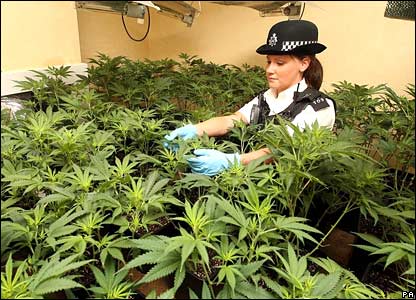
It's a great shame, and shows exactly the hurdles that still need to be leapt through to get anything approaching sensible coverage of calls for drug law reform, especially as the report's conclusions are thoroughly conservative and incremental rather than revolutionary.  It doesn't advocate the decriminalisation of all drugs, let alone their legalisation; what it does suggest is that the possession of a small amount of a controlled drug could be made a civil rather than a criminal offence, leading to fines and referrals to drug awareness or treatment sessions rather than sanctions through the criminal courts.  The report recommends that cannabis would be a good place to start, and if and only if evaluations of the policy suggested there hadn't been a substantial increase in usage or other negative effects, then it could be extended to other drugs.  Similarly, it suggests that either decriminalising or altering the sanctions for the growing of cannabis for personal use could strike a blow against the current situation where empty houses or warehouses are rented or broken into and used by criminal gangs to grow the high-strength strains of the drug that have caused such concern over recent years.

For those who, like me, think we could go relatively quickly from prohibition to the strict regulation and sale of the relatively safe recreational drugs, such as cannabis, MDMA, LSD and "magic mushrooms" with few problems, while decriminalising the harder "Class As", this report is far less radical than it thinks it is.  Where it shines though is in the area which is less sensational: with recommendations for supporting "responsible behaviour", recognising that drug specific education as it stands doesn't work, through to further encouraging the use of needle exchanges up to pill testing services it isn't afraid to say that drug use, like it or not, isn't going to disappear or be eradicated regardless of the apparent fall in use.  It also notes that recovery has to be tailored to the individual, despite what some influential recovered addicts have been given an hour of prime time television to claim.  Most of all, it accepts we need better research into prohibited drugs across the board, something made all the more difficult by their very illegality.

More optimistically, it calls for a cross-party political forum to be set up to examine where drug policy to go from here.  Sadly, even if one were to be created, should it come up with the "wrong" conclusions and proposals then it's highly unlikely it would get us any further.  With both the main parties clearly wedded to prohibition, regardless of how this report has apparently been welcomed even by the likes of Jack Straw, ideally there should be someone from the third party with a high profile who could make a break with the failed policies of the past by being clear about where we've been going wrong for so long.  Want a legacy that could eventually sideline your role in the coalition, Nick?

Labels: , , , , , , , , ,

Share |

Monday, August 06, 2012 

The collected highlights of Louise Mensch's political career.

Labels: , , , , ,

Share |

Thursday, June 02, 2011 

Decriminalisation has to begin somewhere.

Those dreaded words: "celebrities urge". It's an open invitation for mockery, the seeking out of alleged hypocrisy (something this blog would certainly never sink to) and the age-old accusation of the esteemed elite deciding that's what good for them is good for everyone. If those words are enough on their own for the spluttering to begin, then add drugs into the equation and the phlegm* dislodged in the editor's office of the Daily Mail most probably covered the carpet.

There is in fact a time honoured tradition of contemporary figures putting their names to campaigns for the liberalisation of drug laws. Back in 1967, the year of the Redlands bust that saw both Mick Jagger and Keith Richards sent to prison, prompting William Rees-Mogg (for it was he) to write his famous editorial in the Times titled "Who breaks a butterfly on a wheel?", such luminaries as David Dimbleby and Jonathan Aitken added their signatures to an advert paid for by the Beatles which urged a review of the criminalisation of cannabis. A similar collection of the great (Dame Judi Dench) and the not so good (Sting, Richard Branson) have signed today's campaign by Release calling for the decriminalisation of personal possession of all drugs, heralded by an advert in today's journal of the establishment, the Guardian.

As the celebs and the more noteworthy ex-minister and former police chiefs remind us, 40 years have passed since the Misuse of Drugs Act became law, the same year that saw the Nixon administration begin the "war on drugs", a war which puts the more recent one on terror to shame when it comes in terms of blowback. The wonderful thing about the Misuse of Drugs Act is that it brought in prohibition masquerading as something far more laudable, a harm reduction strategy. It introduced the Advisory Council on the Misuse of Drugs, the scientific body we've become far more acquainted with over the past few years, its reports having been serially ignored when they've advocated that cannabis and ecstasy remain downgraded or be downgraded, and followed to the letter when they've hastily decided that mephedrone (meow meow to the kids) be criminalised post-haste. Such dispassionate, rational, evidence-based advice to ministers has delivered the tragically hilarious situation in which magic mushrooms and LSD are considered to be as dangerous in terms of harm as crack cocaine and street heroin, as well giving a veneer of respectability to a law that would otherwise be viewed as shockingly illiberal and out of date.

The politicians of course know all of this. Policy on drugs is almost unique in that every single person involved, with the exception of a tiny minority whom link it back to the decline of civilisation which began in the 60s, understands that what they're doing is futile and self-defeating, and as is also increasingly the case, thoroughly hypocritical. Jonathan Aitken at least was never home secretary, yet some of his successors in the Tory party can hardly claim that they all stayed away either from the devil weed or the more thoroughly bourgeois white powder. The austere Jacqui Smith, having oversaw the reclassification of cannabis as Class B despite sampling the odd marijuana cigarette in her youth, justified her actions on the grounds that she had to protect the public, the same collective presumably that is increasingly turning away from the drug.

It's certainly difficult to understand just how they continue to justify their actions to themselves; perhaps this is why once their careers are over so many of those who have previously either had responsibility for drugs policy or even had to enforce the law try to make amends by campaigning or adding their voices to the calls for a change. This doesn't explain however why there has yet to be a politician with the guts to challenge the prohibition orthodoxy whilst still in power. As stifling as the authoritarian tabloid approach is, and as virulent as the low-level campaign for cannabis to reclassified was, the detritus of the status quo is so massive in terms of those criminalised, the offences committed by those addicted to pay for their habit and the time and money spent to tackle the gangs that control the trade that the legalisation and regulation of "soft" drugs, and the decriminalisation of the highly addictive and destructive likes of crack and heroin isn't radical, it's obvious in it's essential necessity.

The obscenity of the situation the drug war has created is epitomised by the border city of Ciudad Juarez in Mexico, where 3,075 people were murdered last year in the conflict between the cartels and the police. The murder rate in the city has dropped this year to an average of just 4 deaths a day, down from a high of 11, due only to a massive influx of thousands of federal police. The American thirst for drugs, combined with the refusal to countenance any change in the draconian laws that create the climate in which only organised crime can fill the demand means that the situation can only get worse. What's desperately needed is a politician with the bravery to state in public what so many accept in private: that prohibition has not only failed but exacerbated the problem massively, and that the alternatives have to be given a chance. Quite where such a individual will be found when politics in this country at least is dominated by intellectual pygmies is impossible to tell. Until he or she emerges though we really ought to lay off the sneering: someone with power and influence will eventually take up the mantle currently being seized by the revolutionary likes of Bob Ainsworth and the Countess of Wemyss.

*Yes, I originally spelled it flem. Idiot.

Labels: , , , , , ,

Share |

Thursday, December 16, 2010 

A proper, rational debate on drug policy is exactly what we can't have.

Did anyone actually know that Bob Ainsworth was once drugs minister, or more accurately, a under-secretary at the Home Office? I sure as hell didn't. Admittedly, it was in the far off mists of Labour's second term, between 2001 and 2003, when there were more immediately pressing issues than the government's drug policy, yet I don't think anyone really remembered until he reminded everyone today in the most praiseworthy of circumstances.

Whether Ainsworth is the most senior former minister to come out publicly and call for the decriminalisation of all drugs (he hasn't called for the legalisation of heroin for example, legalisation and decriminalisation often being confused when they are completely separate proposals) certainly is debatable. Best known for his recent stint as defence secretary, he's probably held the highest office of state, but is most likely less well known than either Mo Mowlam, who called for legalisation in 2002, or Clare Short, whom I'm fairly certain has also done so although I can't find any authoritative sources backing that up. The real point is more that Ainsworth, probably about as a traditional Labour MP as you could find, has become convinced of the need to end drug prohibition.

Equally uncertain is Professor David Nutt's claim that most politicians are of the same view and are simply too terrified of the potential implications and difficulties of altering almost 40 years of successive government drug policy is much harder to tell. Certainly, the reasons for not doing so could hardly be more vividly shown than by the media coverage of recent years, firstly over the downgrading of cannabis to a Class C substance and the subsequent, successful campaign for it be made Class B again, with not just the likes of the Daily Mail scaremongering over the supposed increased potency of the drug and link with schizophrenia but the broadsheet press also joining in, and secondly this year's short-lived moral panic over meow meow, with apparently almost every schoolchild in the country taking it, necessitating an instant ban as advocated by the Sun. If anything, it's the few journalists that are convinced they're reflecting the views of their readership that are now more opposed to reform than most politicians are, who tend to be much better briefed and acquainted with the consequences of prohibition, not to mention the futility of the revolving-door that exists in the criminal justice system as a direct result of addiction and desperation.

Again, while polls have shown public support for a fairly draconian drug prohibition policy, this is partially the result of ignorance and press coverage, not to mention the role of government in promoting the myth that illegal drugs are inherently dangerous regardless of how and when they're taken. It's also increasingly clear that attitudes towards drugs are generational, with most boomers, despite having been those who first most widely used the now illegal substances being in favour of their current legal status. Few younger people hold the same views, although whether they will turn against liberalisation as they age in a similar fashion remains to be seen. The fact is though that most political discussion of drugs, especially those less harmful, has generally moved on from condemnation and bothering to argue that the use of them in itself a very bad thing to the even more pathetic suggestion that discussing legalisation or decriminalisation in itself is unhelpful because it sends the "wrong message". This was basically the line taken by the government when it ignored the advice of the ACMD to downgrade Ecstasy to Class C, and is also exactly what was spouted today by Ed Miliband when asked his opinion of Ainsworth's view.

The hypocrisy of this is especially apparent when anonymous briefings are given rubbishing Ainsworth for so much as raising the point while the party itself welcomes him for starting a debate, as Hopi Sen does here. It's impossible to have a debate when politicians themselves refuse to consider any alternative to the current policy, which is what both Conservative and Labour spokesmen did today without addressing any of the actual wider points he made, or indeed misrepresenting them as James Brokenshire did.

One of those was that the new government strategy on drugs announced last week wasn't different from what had gone before as claimed except in that it was worse. Rather than reducing harm, which has been the mantra ever since the Misuse of Drugs Act was first passed, the new strategy is built around the three themes of reducing demand, which no government has ever succeeded in doing through criminalisation, restricting supply, which is one of the worst things you can possibly do as it increases prices, leading to more acquisitive crime and to those addicted becoming more desperate and so likely to cause even more damage to themselves and those around them by looking for alternatives, and finally building recovery, which is made all the more difficult by treating addicts as criminals instead of needing help. The current government then doesn't just want to avoid a debate on ending the drugs war, it wants to intensify it. When it's the most unusual suspects calling for an end to the status quo, we might finally be able to start building an effective opposition to just those plans.

Labels: , , , , , , , ,

Share |

Tuesday, January 05, 2010 

Scum-watch: Nutted.

Back in November the Sun decided that it was time to resort to the old tabloid trick of attacking someone by association when they couldn't lay a finger on the target himself personally. David Nutt, a senior adviser on drugs to the ACMD, had just been defenestrated by Alan Johnson for daring to argue again that cannabis isn't as dangerous as either the government claims or its classification suggests, so naturally it was time to go scouting around his children's social networking pages to see if they could find any pay dirt.

The result, an article which accused his son Stephen of partaking in cannabis because he was smoking what was clearly a roll-up and not a normal, honest, cigarette, his daughter Lydia of drinking underage, and the by no means hypocritical sneering at his eldest son for appearing naked in the snow in Sweden, ended up being removed with days of it appearing.

Yesterday the Press Complaints Commission published Stephen Nutt's letter of complaint on their website (h/t Tabloid Watch):

The complaint was resolved when the newspaper removed the article from the website, undertook not to repeat the story and published the following letter:

FURTHER to your article about photographs of me on my Facebook site, (November 14) I would like to make clear the pictures were not posted by me and while I had been drinking I was smoking a rolled-up cigarette which did not contain cannabis as the article insinuated. My younger sister Lydia was not intoxicated, so was not drinking under age. My older brother lives in Sweden where it is custom to use a sauna followed by a ‘romp' in the snow in winter. He was neither drunk nor under the influence of intoxicants. Innocuous photographs were taken out of context in an attempt to discredit my father's work.


Which is about as comprehensive and wounding a clarification as ever gets published in the Sun. The article was so obviously in breach of the PCC's code on privacy, not to mention accuracy, that it should never have been published in the first place though; why then should the paper get away without making anything approaching an apology, only having to print a clarification buried away on the letters page? As long as the PCC remains so toothless in the face of such egregious breaches of its code, the campaigning will continue not just for reform but potentially for independent regulation of the press.

Labels: , , , , , , , , , , ,

Share |

Friday, October 30, 2009 

How government science policy works.

1. In an effort to bring some evidence into a policy often made on the back of scaremongering, hysteria and misinformation, appoint an independent body to examine and advise on what the specific dangers and harms of drugs are, with a view to bringing their suggestions on which drugs should stay legal and illegal, and if illegal, which category they should be in into line with the actual law.

2. Ignore entirely what the board tells you when it doesn't fall into line with you want to hear, and especially so when it completely contradicts what the Daily Mail says.

3. When the chief scientist on the board then complains about this and continues to maintain that his view is right while yours is wrong, demand that he apologises for the "hurt" he caused to the families of those who have died while taking drugs.

4. When the chief scientist then again repeats his argument and accuses you of "devaluing and distorting" the scientific evidence, demand that he resigns for daring to express the opinion which you asked him to provide in the first place.

Labels: , , , , , , , , ,

Share |

Wednesday, February 11, 2009 

The war on drugs marches on.

Partly because the moral panic about Ecstasy has long since died away, and partly because it was well-known that Jacqui Smith and the Home Office would reject any suggestion whatsoever that the drug should be downgraded to Class B, the publication of the Advisory Council on the Misuse of Drugs' report on the harm associated with the drug, and the predicted refusal to accept their advice to downgrade it have been rather underwhelmingly reported. This is a shame, because it's quite clear that when compared to the decision to upgrade cannabis to Class B, the refusal to downgrade Ecstasy is just as outrageous and contemptible.

The problem with our drug laws only gets more and more obvious as the years go by. The Misuse of Drugs Act 1971 is the root of all the problems: it is, to use the horrible cliche, not fit for purpose. The prohibition of drugs has not stopped their use; it has rather only increased it, enriched the criminals that sell them and made it even more difficult to treat those who become addicted. The key problem though is that the 1971 act is blanket prohibition masquerading, with the involvement of the ACMD, as a harm reduction strategy when it is nothing of the sort. This fiction is kept up by the three separate classes of drugs, with the most dangerous and most harmful in Class A, with the least harmful but still illegal in Class C. The classification system is however completely and utterly broken; it has the more or less completely harmless magic mushrooms in Class A, alongside the also relatively benign LSD and Ecstasy, while cigarettes which kill hundreds of thousands across the world every year, is in none of the categories. Likewise, alcohol, which can cause untold misery and precipitates violence, is also completely legal.

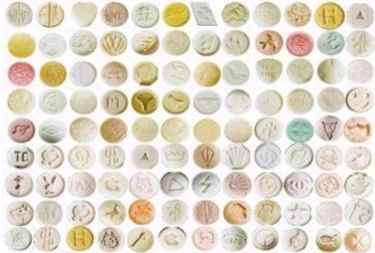
Both should of course remain completely legal; if individuals want to slowly poison themselves, especially with tobacco and nicotine, then they are perfectly entitled to do so as long as they don't harm others at the same time. Our liberated attitude towards tobacco and alcohol is in sharp contrast to that towards cannabis, which although can cause harm, as heavy use suggests that it can induce psychosis, as well as having similar effects on the lungs when smoked to tobacco, remains illegal and demonised by the popular press. Ecstasy is arguably even safer than cannabis: the ACMD report and David Nutt's previous article which compared MDMA use in harm terms to horse riding, both argue that the main danger when using the drug is that users become either dehydrated, from drinking too little while dancing, to becoming too hot, or more rarely, develop hyponatraemia, where too much water is drank, which notably was the actual cause of death in the case of Leah Betts. MDMA itself is only toxic when taken in very high doses, which is rare. It's also not addictive, there is little concrete evidence as yet that it has long-term side effects, although some studies have suggested there may be memory problems in later life, and unlike cocaine, heroin or indeed alcohol, it tends not to lead to violence among those who take it; quite the opposite, in fact. The other main cause for concern is directly associated with its illegality: it's impossible to know what else is in the pill other than MDMA, or indeed whether there is any MDMA in what you've bought at all, or whether it might instead contain its sister, MDA, or other substances. If anything, the levels of MDMA in the pills has declined over time: the pills which became exceptionally popular due to their intensity during the early 90s, named "love doves" after the dove stamped on them, have long gone, as have the similarly well-remembered initial "Mitsubishis", stamped with the car company's logo, from the late 90s. MDMA "powder", which is regarded as more likely to be purer, has increased in popularity as a result.

Compared to the insanity which is the Class A status of magic mushrooms, or Psilocybin mushrooms to give them their proper name, Ecstasy's status looks reasonably rational. That something which grows perfectly naturally of its own accord is illegal is a mind-twister by itself; when you consider that the number of people who have died as a result of taking shrooms numbers between 0 and 10 despite evidence that they have been used since before the earliest recorded history makes it even more ludicrous. The only thing that's going to damage someone from taking magic mushrooms is what a bad trip might do to their psyche, and even then most will get over it with no problems whatsoever.

The government itself knows that once the debate has moved on from the hysteria to the actual scientific evidence regarding harm, the blanket prohibition on drugs is now fast becoming completely untenable. This is why it has withdrawn from so much as bothering to argue their case regarding the softer drugs, and was doubtless ecstatic to be helped along regarding cannabis by the useful idiots in the press that claimed that the cannabis of today was 20 or 30 times stronger than before, when this was demonstrably not the case. Instead, it's had to settle on "sending a message"; it was sending a message that smoking cannabis was unacceptable by raising it to Class B, while emphasising the dangers of the new ultra-strength skunk, just as it is now sending a message that taking Ecstasy is unacceptable by keeping it in Class A. Ever since the initial moral panic over heroin in the 1960s, the press has helped with the idea that most drugs are unpredictably deadly, while public opinion has also stayed in much the same position, supporting prohibition and most recently the raising of cannabis back up to Class B.

The ACMD in essence completely wasted its time in bothering to review Ecstasy, because the government had already made plain and clear that regardless of what their review said, Ecstasy would stay in Class A, as Transform made more than clear in their submission to the ACMD (PDF). At least the policy on ecstasy has been consistent: the downgrading of cannabis, which was in line with the ACMD's recommendation, was then overturned once the government decided that to upgrade it again was politically expedient, regardless of their scientific analysis. If the members of the ACMD had something resembling guts, they would resign en masse, as after all, what is the point of an advisory council which delivers independent advice based on a review of the all the relative literature and evidence if that evidence is going to be completely disregarded because it doesn't fit with the government's pre-defined policy? Instead, David Nutt apologised to Jacqui Smithover his comparison of the dangers of Ecstasy and horse riding after she disgracefully criticised him in parliament. His article ruthlessly exposed the stupidity inherent in our current policy towards drugs, and also ruthlessly exposed our government ministers as being just as stupid, and just as cowardly in the face of the ignorance but deafening noise of the tabloid press. Evidence-based policy has never been such a contradiction in terms.

Labels: , , , , , , , ,

Share |

Thursday, May 15, 2008 

Scum-watch: Chasing Amy.

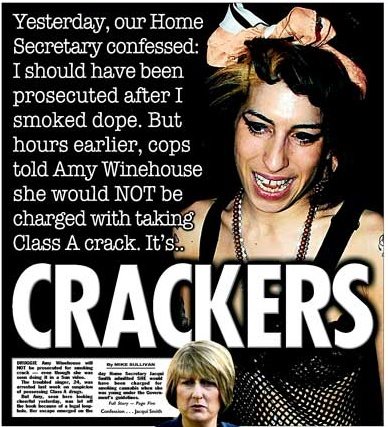
Surprise, surprise, Amy Winehouse is not to be charged over a video which the Scum "obtained" (i.e. purchased from one of Winehouse's "friends" for a no doubt colossal amount of money, much like the video of Kate Moss snorting what might have been cocaine was purchased from one of Pete Doherty's friends), meant to show her smoking crack cocaine. This is of course for the obvious reason that the police cannot prove beyond reasonable doubt in a court that what Winehouse was smoking was crack; the only way in which she could have been charged over the video was if she made the mistake of admitting to the police that yes, she had been inhaling that wonderful rock and getting completely off her tits. Doubtless when interviewed about it she maintained her right to remain silent, as even the most junior law student would have told her to.

According to the Sun, who after all, paid a lot of Rupert Murdoch's money for this footage, it's a front-page worthy outrage. As the learned Mr Power says, the issue with drugs is that it is not illegal to consume them in the privacy of your own boudoir or bedsit, but it is illegal to have them in your possession. La Winehouse, unlike her luminary Mr Doherty, tends not to make the mistake of continuously being caught with them, although she was fined after cannabis was found in her possession whilst in Norway. If Winehouse had been spotted smoking crack on CCTV, then it might be a different matter. My brother whilst on holiday in Whitley Bay made the mistake of going for a late night walk along the promenade while indulging in the wicked weed, only for the police to suddenly come blaring up, alerted by an eagle-eyed CCTV supervisor.

When it comes to weak, absurd and downright draconian arguments, the Sun's leader on why Winehouse should be brought before a court and presumably sent down for a long time takes the biscuit:

THERE cannot be one person who does not believe Amy Winehouse was smoking crack in a video obtained by The Sun.

That's not the issue here. The police have to be able to have a strong enough case for the Crown Prosecution Service to agree that taking the matter to court will both result in the high possibility of a conviction and that it is in the interest of both the public and the public purse. From just a video, especially one as badly lit and difficult to make out as the Sun's, that simply isn't possible.


Yet police will not prosecute her.

They think they could not secure a conviction on video evidence alone.

Which they certainly couldn't. The judge would throw the case out.

The Sun is deeply concerned.

When stars revel in the degradation of drug abuse, there SHOULD be a way to prosecute them.

Amy’s video is encouragement to break the law.


What utter twaddle. If a young, successful woman looking an utter state, in such apparent desperation that she has to take one of the most addictive but also destructive substances known to man is revelling in degradation or an encouragement to break the law, then the eye of the beholder who thinks in such a way is probably themselves already way beyond help. Fact is, no one would have known about Winehouse's taking of crack if the Sun hadn't bought the video off of one of her so-called mates; she's not encouraging people to break the law or revelling in the degradation of drug abuse to the public, but the newspaper that then brings such things to light when there is no public interest in such matters certainly is. All tabloid newspapers have very funny ideas of what privacy is, but none more so apparently than the Sun.

If you’re caught on CCTV using threatening behaviour, you are charged.

It should be the same for taking drugs on video.


The difference is that CCTV can be used to prove that you were being threatening: it cannot be used to prove that you're taking a controlled substance unless they get you completely bang to rights with you talking about what you're doing while injecting yourself or likewise. Even if you're filmed smoking what looks like a spliff you can argue that it's in fact a long roll-up as long as they don't actually catch you before you've finished it, and you can also argue that white substance you were snorting was not actually cocaine but flour, sugar or something else that looks suspiciously like cocaine when filmed in low quality. This ought to be common sense: otherwise we'd have busybody morons reporting every video featured on YouTube that might show someone taking drugs to the police, or even groups like Mediawatch reporting programmes to the police that show actors supposedly taking drugs. That's the kind of territory we're getting into.

We have laws against glorification of terrorism. So why not against the glorification of drug-taking?

Taking crack in private while talking to someone is now considered to be the "glorification of drug-taking". While we're at it why don't we also make glorification of hitting your husband while drunk illegal, or glorification of anything that breaks the law illegal? What the Sun is asking for is a law to be drawn up which means the press can legally justify their invasions of others' privacy.

Home Secretary Jacqui Smith admitted yesterday that she herself SHOULD have been charged for smoking cannabis at university.

Which just proves what a vindictive petty little woman she is. Let's ruin the lives of everyone who dares to enjoy a drug which according to numerous studies is both less dangerous and harmful than either tobacco or alcohol. Incidentally, as we all know, journalists have never personally indulged in drug taking of any kind, and certainly don't snort for Great Britain at the weekend along with a distinct minority of the chattering classes of London. No sirree, they're most certainly not the most loathsome of hypocrites.

The law needs to be upheld in spirit as well as letter.

The Home Secretary accepts that. So let her create a law to save lives.


We're back to the same ignorant and patronising argument used for prohibition in general. The government is putting cannabis back in Class B to protect young people's health, not to placate right-wing ideologues in the so-called popular press who've been running hysterically distorted campaigns demanding just that. This isn't going to save any lives, it's instead crude gesture politics of the worst and most pitiful kind to cover up for the Sun's embarrassment in not getting their own way all the time.

Maybe Amy’s, too.

Oh yes, we have to remember, the Sun is doing all this for Amy's sake you see. It's not because it sells newspapers and brings major attention to the paper in general when it grabs such exclusives, it's because they deeply deeply care about Amy and don't want to see her talent being snatched away through the cycle of drug abuse.

The reality is that the last thing the newspaper wants to happen is for not just Amy, but for any celebrity in general to get off the wagon. After all, that means they don't have anything to write about or splash on their showbiz pages. Celebrity in going home and getting an early night outrage doesn't tend to make the headlines. In any case, just how much the newspaper cares about Winehouse was displayed when it and others crudely invaded and also probably set-up the circumstances in which she was previously photographed in tears in the street during the middle of the night wearing only a bra on her top half. That then was because they cared, not because it made such sensational copy and allowed them to ghoulishly and voyeuristically speculate on what she might have been going through while they profited from her discomfort. This is the legal kind of stalking, and it has no justification whatsoever. The war on drugs will not be won through such idiotic posturing, but through realising that prohibition and indignation go hand in hand in keeping the problem just the way it's been for the last 40 years.

Labels: , , , , , , ,

Share |

Wednesday, May 07, 2008 

You better hope you don't smoke the reefer.

It's incredibly hard to articulate in words just how mindbogglingly stupid the government's decision to reclassify cannabis as a "Class B" drug is. Let's put it this way - if you repeatedly dropped a baby on its head from a height which didn't crack its skull open but did understandably adversely affect its intelligence, then supplied that child throughout its lifetime with only Ayn Rand books, the Daily Mail, and GMTV for intellectual stimulation, then through your connections sent him to work at Goldman Sachs before he progressed to becoming prime minister through freak luck, not even he, so mentally stunted that he couldn't even tie his shoelaces without needing the help of a civil servant, would not think that making cannabis a Class B drug again would be a good idea.

That's the kind of level of abject intellectual poverty we're dealing with here. There's Gordon Brown, the acclaimed brainbox behind Britain's prospering economy, so intelligent that he went to university at sixteen, and he comes out with such insultingly idiotic statements regarding the "lethal quality" of cannabis that it almost makes you wonder if this isn't just him openly prostituting himself to Paul Dacre as bending over and opening himself up so that the entire Mail team can have a go. We have "Wacky" Jacqui Smith, an Oxford graduate, who has herself admitted to use of cannabis back in her care-free youth before she realised that the drug is in fact incredibly dangerous and that one puff can kill you stone-dead, having the audacity to stand up in front of parliament and announce that she's accepting every recommendation of the Advisory Council on the Misuse of Drugs' report - except the one which says the drug should remain at Class C, because "[she] must err on the side of caution and protect the public."

The sort of doublethink this requires would have utterly delighted Orwell. Here's a drug where the links between mental illness are in the words of ACMD "weak but probable", and so it needs to not just be illegal, as it was under Class C, but to be in Class B, where simple possession of the tiniest amount could potentially lead to your imprisonment for five years. The chances of that happening are minuscule, but then we need to err on the side of caution and warn the public, don't we? The ACMD says that cannabis is a "significant public health issue" which is true; but then so is the use of tobacco and alcohol. The links between tobacco and numerous types of cancer are not just weak but probable but firmly established. Likewise, the link between alcohol and liver cirrhosis and other illnesses are not just weak but probable but firmly established, not to mention the link between alcohol and public disorder across towns and cities across the country every weekend. The Lancet's own attempt at drawing up a rational scale to assess the harm caused by drugs found that both alcohol and tobacco should be ranked higher than cannabis. By the same yardstick being used to measure the harm of cannabis, alcohol and tobacco should both be either Class B or even Class A controlled substances, but neither cause is likely to be taken up by the Daily Mail.

Quite how this issue has been resurrected and reanimated time and time again since David Blunkett took the ACMD's advice back in 2004 and downgraded cannabis is in itself bewildering but instructive. Nothing whatsoever has been learned or discovered in the last 4 years that ought to change the status quo - instead, what has occurred has been a hysterical, unbelievably misleading media campaign, led not just by the Daily Mail, but also by those who really ought to know better on the Independent on Sunday. We've been told that the cannabis on the streets today is not the average two and a half times stronger than the traditional "soapbar" Moroccan resin which up until very recently made up the vast majority of the market, but instead 25 times or even 30 times stronger. We've been told that smoking just one cannabis joint increases the risk of developing schizophrenia by 41%, when the actual study in fact found that an "average user" of cannabis faced an increased risk of developing a "psychotic outcome" by 0.4%. We've been told that despite all the evidence to the contrary, that cannabis can be directly linked to the deaths of at least 3 people, ignoring all the side issues and other factors entirely.

Perhaps the most shocking fact about this most egregious of u-turns is that by any standard, the downgrading of cannabis to Class C has worked as it was intended to. The police themselves supported the original decision, having become fed up to the back teeth with having to deal with individuals with tiny amounts of the drug on them when it was a complete waste of time; as a result of their confiscate and warn policy instituted after the downgrading, countless hours have been freed up to go after real criminals. The numbers of those taking the drug over the last few years have dropped according to the British Crime Survey, from 28.2% of 16-24-year-olds who admitted to cannabis use in 1998-9, to 21.4% in 2005-6. The police's new concern, that organised crime is moving in to cannabis production, with Vietnamese gangs being the ones fingered is almost certainly nothing to do with the downgrading but with the economic realities on the ground. It's no longer worth the hassle to import the old resin or different varieties when it can be so easily grown in converted houses, often with the electricity for the hydroponic systems being stolen as well. They can also earn more for the stronger varieties, which is why they are being increasingly grown, although there are also indications that various (incredibly dangerous) ploys are being employed to make it look as if the buds have a higher THC content than they actually do, as it takes longer to grow the plants to their full strength.

That last statistic shows exactly how many young people this change in the law will further criminalise and put in danger of having their lives potentially ruined purely because of their choice to consume a substance which affects absolutely no one other than themselves. 1 in 5 use it; if they don't, then they will certainly know a friend or acquittance who does. The change in the law and the spurious sending of messages will do nothing whatsoever to stop them using it, but what it will do is further disenfranchise them and put them further at risk of having the weight of the law fall on them for no greater purpose except to please Paul Dacre. The hope was that even if the change in classification went ahead that the police themselves would continue with their current policy, something that everyone at the ACMD meeting supported even if they wanted the classification changed. None of them wanted more young people to be criminalised, yet that is exactly what the government is proposing with its system of "escalating penalties" with first-time offenders also increasingly likely to be arrested under Labour's plans.

Let's not pretend however that if even the government had taken the ACMD's advice that it would have been a happy outcome. The entire classification system is a joke, based on nothing more than prejudice and political short-termism rather than actual evidence. How on earth can a system which has MDMA, LSD and magic mushrooms in the same category as street heroin and crack cocaine be taken seriously? The only solution to the entire drugs problem which underpins the vast majority of crime is to abandon the lunacy of prohibition and come to a position where addicts are either treated or provided with the drug by the state in lieu of weaning them off it. Cannabis, and the aforementioned other drugs in Class A should be regulated, age-restricted and taxed, with full education on the dangers of them provided in schools. It's time to take the entire market out of the hands of criminals, end the absurd, doomed to failure drugs "war" and be both reasonable and sensible about our dependency on all chemical highs. The taboos and myths all have to be tackled.

The former is of course a fantasy which couldn't possibly seem further away, and one which we cannot possibly know would work, mainly because we haven't been allowed to try it. The one abiding message about today's reclassification, apart from how it proves that when Gordon said he would listen, he meant he would continue to listen to the tabloids, at least when he wants to hear them, is that it shows just how much both politicians and Labour continue to hate the young. It's to be expected from the Daily Mail, which yearns for the 1950s to return, but this is a government increasingly made up of those who are only just approaching middle age. They surely remember their more hell-raising days, when they binge-drinked, smoked pot and even probably broke the law in more serious ways, yet they only listen to those who seem to have an ever increasing loathing for them. According to UNICEF we're the worst western country for children to grow up in, and it's not because of our addictions to self-fulfilment, but because the young are increasingly regarded as either annoyances, or at the most extreme end of the scale, yobs ready to kick the older generation to death. Is it any wonder when their lives are increasingly miserable for various reasons that they do turn to both alcohol and drugs? Until Labour gets to grips with why we are an unhappy society, and increasing crackdowns on crime and the young for so much as daring to gather on street corners are eschewed in favour of ending the casual criminalisation of an entire generation, then the problems that go hand in hand with them will continue to be false issues flashed up which demand pointless messages to be sent.

Related posts from the ever excellent Transform blog:
Millions quit cannabis following reclassification
Miserable re-classification saga enters its final furlong

Labels: , , , , , , , ,

Share |

Wednesday, February 21, 2007 

Scum-watch: Much ado about smoking.

DEBENHAMS IN DRUG SHAME, shrieks the Sun in what is in fact an utterly shameless piece. In a complete non-story, some berk goes to Prague, sees Debenhams are selling hash-pipes and bongs, phones the Sun, and wham, all sense goes out the window.

MAJOR UK department store Debenhams is today exposed by The Sun selling drug paraphernalia in one of their overseas branches.

Hundreds of bongs, pipes, bud cases and water pipes are for sale at their store in Prague alongside clothing and shoes.

Paul Rushden, from Nottingham, was shocked when he spotted the items whilst on holiday in the Czech capital last week.

He said: "I couldn't believe it when I walked past a major British high street retailer and saw bongs and pipes blatantly for sale in their front window.

"I didn't expect Debenhams to be endorsing drug taking.

Err, they're not. What people get up to with what they buy from a department store is their business, much like how sex shops which sell handcuffs and fetish wear aren't endorsing whatever their customers do with the stuff. There's a store in town that sells every skin you could ever want and has a load of bongs on the top shelf and no one bats an eyelid. Why should it make any difference if a store like Debenhams is selling it?

"One wonders how the shareholders of this public company would feel about profiting from the drug trade."

The store is located in the busy King Wenceslas Square in the centre of Prague.

A spokeswoman for Debenhams thanked The Sun for bringing the matter to their attention and promised action.

She said: "This Debenhams store is managed by our Franchise Partner in Prague.

"This matter is clearly not acceptable and we have instructed our Partner to remove the items immediately and make clear to the vendor that any repetition will not be tolerated."

No mention then of what the drug laws actually are in the Czech Republic, which might explain why Debenhams would be selling them in the first place.


The Czech Republic's lower house last week approved a penal code revision that will decriminalize simple marijuana possession and allow for growing for personal use. The measure is likely to pass the Senate and be approved by President Vaclav Klaus, reports Czech activist and journalist Bushka Bryndova.

The proposed new law draws a distinction between soft drugs (cannabis and psychedelic mushrooms) and hard drugs. While penalties for hard drugs remain practically unchanged, possession of small amounts of marijuana or a limited (the number is yet to be set) number of plants will no longer merit prosecution.

Which sounds to me like the kind of law which ought to be campaigned for here. Congratulations to the Sun on such a brilliant exclusive!

Labels: , , ,

Share |

About

  • This is septicisle
profile

Archives

Powered by Blogger
and Blogger Templates