Tuesday, May 10, 2016 

A microcosm of wider stupidity.

Labels: , , , , ,

Share |

Monday, July 06, 2015 

The beginning of the end.

Deals made in secret are always bad deals.  It's not always instantly apparent which side has come out the loser, but in the instance of the BBC versus a Conservative government, anyone betting on the side of the public service broadcaster is on a hiding to nothing.

Those with long memories might recall this is almost precisely what happened 5 years ago.  Back then, at least Mark Thompson talked a good game ahead of conceding pretty much everything: a pound out of the commissioning budget of the BBC is a pound out of the UK creative economy, he said in his MacTaggart lecture.  Lecture delivered, the then director general accepted a freeze on the licence fee right up until 2016/17 without anyone else being consulted.  In retrospect, thanks more than anything to the world finally noticing that phone hacking had been a thing, kiboshing News Corporation's dreams of swallowing Sky wholesale, it wasn't the worst of deals.  Yes, there have been cuts, but the BBC is pretty much doing what it did in 2010, if not frankly better.

To repeat the process, as DG Tony Hall now has, was asking for it.  Rather than beating his chest ala Thompson, he instead decided he would show the Tories the wounds on his back.  Look how I've already been flagellating myself, he said, thinking that making clear how another 1,000 jobs will have to go thanks to the loophole allowing those who only use the iPlayer to watch catch-up TV don't have to pay the licence fee, a shortfall estimated to be costing £150m, would go some way to sate the Tory lust for blood.  Schoolboy error.

In some ways, to be sure, the deal Hall has struck doesn't look too bad for the BBC.  It obviously secures the licence fee itself, although no one was seriously imagining the Tories would destroy the BBC in one fall swoop.  The fee will also rise in line with inflation from 2017, although if inflation remains around zero as it is currently then it won't count for much.  Hall's biggest coup, the one he's going to be boasting about, is reaching an agreement to close the above loophole, although how this will be done in practice remains to be seen.  Hall has decided to describe this as "modernising" the licence fee, which seems an odd way of telling people to cough up, like it or not, but he obviously knows what he's doing.

Otherwise he wouldn't have apparently, if we're to believe the reporting so far, suggested to the government that the BBC pick up the tab for free licence fees for the over-75s.  This at present costs a mindboggling £650m.  The licence fee brings in £3.72bn.  Moving BBC Three online only, as approved by the BBC Trust, is meant to save just £30m.  Yes, there are a few other sweeteners in the deal, such as how the licence fee will no longer be "top-sliced" to pay for the roll-out of super fast broadband, that the cost will be phased in so the BBC doesn't lose £650m in one go, and how the corporation will effectively take control of the policy once its pays for it fully, leaving open the possibility Auntie will swiftly say that in fact the over-75s get a pretty good deal all told and either abolish the subsidy entirely, means test it or say only cover half, but you don't have to be Martin Lewis to think the sums aren't going to add up.  Not least when the way is still open for the decriminalising of non-payment, leaving it as only a civil offence, estimated at potentially costing the BBC a further £200m.

Let's start with the assumption that the deal leaves the BBC down by "only" £100m.  Radio 4, according to the BBC, costs £91m a year (the Graun says £121m), while the BBC's online services writ large cost £174m.  Whichever way the BBC tries to save that £100m, services are going to have to close.  BBC Three might be shut down entirely, BBC Four could join BBC Three online only, some if not most of the BBC's local radio stations would go, and the digital radio offerings like 6 Music would almost certainly have to be looked at again.  That's just on the assumption it costs £100m, when it could easily be far higher, especially if once fully phased in the BBC doesn't feel able to dump or cut the subsidy, a move the likes of George Osborne know full well will be opposed with the utmost vehemence by the rest of the media.

According to Steve Hewlett, usually well informed, having to take on the cost of licence fees for the over-75s would have "heralded a catastrophe".  Tony Hall presumably believes the concessions he wrangled from both Osborne and new culture secretary John Whittingdale have avoided such a scenario.  Again, let's take his word for it and accept in the circumstances he couldn't have done much better.  That doesn't alter the fact this is the second time the BBC has been forced into cutting a deal without so much as the slightest input from the people whom actually pay for the damn thing.  We apparently have no say whatsoever, unless the Tory majority is taken as being an affirmation for their manifesto promises of keeping the over-75s subsidy and err, a continuing freeze in the licence fee.

It's difficult, if not impossible to separate this fait accompli from the behaviour of both the Tories and the majority of the press at large both during and since the election.  David Cameron was almost certainly joking when he said about closing the BBC down, but the claims of bias made against the corporation during the campaign, utterly laughable considering how day after day the bulletins ran with the SNP-Labour pact scaremongering, were deadly serious.  The Murdoch press, no longer cowed as memory of phone hacking fades and attention turns to the Mirror, has been making its voice heard again.  Osborne's ridiculous comments yesterday that the BBC was somehow crowding out not just local, but national newspapers, Mail Online being such a woeful failure, just underlined how the motive seems to be to cut the BBC down to size for daring to hold government, regardless of stripe, to account.  The Tories' real ire is directed at pieces on the BBC News website like Mark Mardell's from last week, pointing out Cameron has no clothes when it comes to his "full spectrum response" to the attack in Tunisia and instead chose to focus on the inanity of what the BBC calls Islamic State for a reason.  Such articles carry far more weight when the BBC so rarely dabbles in outright analysis, even if Mardell was clearly remaining objective.  The leak to the Sunday Times framed the passing over of the over-75s subsidy as almost a direct response to the BBC daring to cover the reality of cuts to welfare, cuts which are about to fall far wider than previously.

We can't of course know what went on in the back and forth between Hall and the government.  It was probably made clear in the most certain of terms that if he refused the deal on the table or dared to suggest consulting on it that it would not be on offer in the future.  Again, it could turn out that the deal is better than it seems.  It could force the BBC to finally sort out its problems of management, which have not improved in the slightest even as journalists and others with years of service have been let go.  It might lead to some hard choices that should have been taken years ago: there is no reason why Radio 1, 1 Xtra, even Radio 2 couldn't be privatised, as they without a doubt have long stifled commercial alternatives, almost all of which are laughably terrible.  


From the other side though, this really does look like the beginning of the end of the BBC, forced into cutting services which are popular and in turn undermining the esteem in which the corporation continues to be held, leaving the licence fee ever more precarious as the media landscape continues evolving at speed.  The beneficiaries will just happen to be those whom already have far too much power, whether they be the government of the day or the corporate media that overwhelmingly backed said government.  The losers?  Everyone else.

Labels: , , , , , , ,

Share |

Wednesday, June 19, 2013 

Important news story.

Mr and Mrs Tyler Wallbanger have "decided not to find out" the gender of their baby, a spokesman for the Scunthorpe couple has said.

The baby will be delivered on the very public maternity ward at the Scunthorpe General Hospital, where Diana Spencer might have had her sons had she been born into a northern working class community and not into the landed gentry, and therefore never met the Prince of Wales.

The baby is due in mid-July, and Tyler Wallbanger hopes to be present if his duties as a spellchecker for the council allow. Officials at the Wallbangers' home on the Rick Astley estate have appealed for an "appropriate degree of sensation" regarding the birth.

The birth was "a very personal matter for Tyler and Ashlee," the same officials said.  "But they also know it's a time to celebrate and many will want to share in their joy.  This is why, should the hospital's permission be forthcoming, the couple hope to broadcast Ashlee's labour live over uStream.  It will also mean that if Tyler isn't able to get away from work that he'll be able to watch the birth from his desk."

"Both Tyler and Ashlee are very excited about how their friends and the general public will learn the gender of their baby at the same time as they do.  In no way is their announcement at this time designed to further public interest in their child, as they believe the BBC has been hyping the pregnancy and birth up more than adequately for them."

Despite the possibility of the live stream, once Mrs Wallbanger goes into labour there will be no further public statement until the baby is born and the Queen, the Wallbanger family and other senior celebrities have been told.

Senior gynaecologist Dr Serena Williams will be delivering the baby.

Asked whether the couple have decided on any names, officials at the semi-detached were giving little away. "Let's just say, if it's a boy, they're thinking of naming him after the place where he was conceived, and if it's a girl, after a British national hero."

The Wallbangers are known to have visited Jamaica last year, while Tyler has long been under the misapprehension that the commanding officer at the battle of Trafalgar was a woman named Fellatio.

Reports suggest that the Wallbangers have asked the foreign secretary William Hague for some of the surplus weapons not fit to be sent to the rebels in Syria to enable them to fire a 21 gun salute to mark the birth.  It is not yet known whether he has responded.

Labels: , , , ,

Share |

Wednesday, December 19, 2012 

Newsnight and Duncroft: still far from the full story.

The Pollard inquiry into the entire Newsnight affair has, as recent reports have been wont to do, reached pretty much the conclusions it was expected it would.  Nick Pollard, formerly of Sky News, dismisses the notion that there was managerial pressure to drop the investigation into Savile's alleged activities at the Duncroft approved school, while finding that Newsnight's now ex-editor Peter Rippon made the wrong decision, mainly on the grounds that the CPS had investigated one of the claims about Duncroft and decided there was insufficient evidence to bring charges, to spike Meirion Jones and Liz MacKean's story.

It most certainly doesn't end there though, and there are more than enough uncertainties in the report for those suitably inclined to reach the conclusion that there was in fact pressure put on Rippon.  Both Jones and MacKean certainly believed there was, although Jones has since admitted he had no evidence for claiming at the time that this was the case.  


Key to the entire chain of events is a series of emails between Rippon and Stephen Mitchell, the deputy head of news, on the 29th of November last year (paragraph 91, page 68 onwards).  In the first, Rippon outlined the investigation and when Newsnight was planning to transmit the story, along with a request as to whether he could talk to Mitchell in more depth on the phone later.  As Pollard notes, this email and its follow-up are positive about the story, without any indication that Rippon at this stage was having doubts.  Remarkably, both men are uncertain as to whether the proposed phone call took place; Mitchell cannot remember it, with Pollard noting acidly that he "found the frequency with which Mr Mitchell's memory failed him surprising" at a different point in the report, while Rippon believes he "probably did" talk with Mitchell.

Whether it did or not, this was the point at which Rippon began to properly voice his doubts.  The following morning he emailed Jones, shifting the onus onto establishing that the CPS "did drop the case for the reason the women say", that Savile was too old and infirm to be charged.  Rippon's explanation for his change of heart, given to the inquiry, was that he felt the report as it stood relied too much on the evidence of Karin Ward, referred to throughout as [R1], how the interviews with the other victims had been conducted over the phone by an inexperienced trainee reporter, and how the evidence could be undermined by how some of the women had shared and discussed their experiences among themselves previously on a social networking site (paragraph 100, page 72).


Pollard examines three explanations for Rippon's shift: that he had been very keen on the story but something happened overnight to change his mind, influenced by Mitchell; that he changed his mind based purely on his "pondering it overnight"; or that he had overstated the story to Mitchell in his emails, despite having doubts, which had now come fully to the fore.  Pollard concludes that the first explanation is the most likely, that a conversation did take place, and that it was something Mitchell said that made him re-examine what his team had so far put together.  He doesn't believe, however, that what Mitchell said was "inappropriate or that it was influenced by any wish on Mr Mitchell's part to protect the Savile tribute programmes".

We are then dealing with hypotheticals, leaving more than enough room for doubt to creep in.  Add how Pollard accepts that Rippon made comments to Jones and MacKean along the lines of how if the "bosses weren't happy" [it couldn't go ahead] and "he could not go to the wall on this one", even if again, he found no evidence that he was being put under pressure, with Helen Boaden, the head of news, saying she thought it could have "arse-covering" on his part, putting the blame elsewhere, and it isn't the clean bill of health it looks at first sight.  My opinion remains, as it was at the outset, that this was almost certainly an editor deciding on his own that there wasn't enough evidence, but I don't blame anyone for suspecting there was more going on than has come out even now.  It still doesn't explain fully though why Rippon spiked the report rather than urge his team to investigate further, or indeed why Jones believed that it was either drop the story, or "leave the BBC".  He has instead decamped to Panorama.  Lack of resources, as Rippon claimed, just doesn't cut it, savage cuts to Newsnight or not.

Pollard's other main conclusion on the initial Newsnight investigation, that Rippon's decision was wrong and that Newsnight should have broken the story about Savile being an abuser 11 months before ITV did, also looks strong on the surface.  After all, Exposure used more or less the same evidence as collected by Jones and MacKean, which has in turn lead to over 400 people coming forward with allegations about Savile.  There are reasons though to suspect that at the time, Rippon was perfectly within his rights not to proceed with transmission, and one which has came to light since.  His reasons for having doubts, although undoubtedly expressed more lucidly through hindsight, are more than respectable: the only on camera interview they had was with Ward; they didn't have any corroborating evidence from those who worked at the school; the interviews with the other women, should, ideally, have been conducted in person,  and without there being any possibility of their being led; and some of the other women had discussed their experiences on Friends Reunited, increasing the possibility of the allegations becoming blurred.

Since then we've learned that the letter from Surrey police, which Newsnight knew of but never saw, saying the case was dropped because of Savile's age and infirmity, was a forgery.  Anna Racoon has also, in a series of blog posts, raised a number of doubts about some of the testimony.  A resident at Duncroft herself during the mid 60s, she denies that Savile ever visited the school while she was there, refuting the allegations made by one woman there at the same time.  She also maintains that Karin Ward must have been 16 when she appeared on Clunk Click, even if all her other claims are true.  Raccoon, regardless of being suckered in by the Libertarian Party previously, seems to be highly credible.  She may well be utterly wrong, but there are doubts there, and while the police had not previously investigated Ward's allegations, they had some of the other claims made by the others who had made contact on FR, deciding there wasn't enough evidence to pursue them.  It is almost certainly the case, as Raccoon notes, that Savile was a child abuser, an ephebophile (or at least attracted to post-pubescent children) if not a paedophile, but it has not yet been proven that he committed any offences either at Duncroft or with girls from the school.

These doubts bring us into some very uncertain territory.  Even if the Duncroft allegations are exaggerated, it's certainly the case that some of the claims made against Savile have to be accurate.  It's also unlocked memories which many have either struggled with ever since or tried to forget, casting the 60s and 70s in a different light.  While some of this will have had a negative effect on those who rather wouldn't have been reminded of what happened to them or what they got up to, for many talking about it, perhaps for the first time, will have resulted in the opposite.  As someone who struggles with his own past, I can't present opening up about everything as being wholly positive, or always for the best.  For many though it will have helped to exorcise demons, or been the first time they thought they might have been believed.  Negatives as there will have been, I would wager the positives will have outweighed them.

You can then respect Rippon entirely for the decision he made, even if you can't agree with it knowing now how it would have played out.  It would certainly have saved the BBC from the nightmare it's gone through over the last couple of months, one which Pollard finds it brought entirely on itself.  If anything, the BBC's management structure is even more Byzantine than we first thought: it takes him 11 pages (9-21) to describe it and the managed programmes list.  Away from Newsnight, one of the biggest failures he found was that the Savile investigation was moved off of this list, a list set-up in the aftermath of Hutton through which any controversial programmes or ones with risk to the BBC could be known about and shared across the organisation.  Stephen Mitchell decided it should be taken off the list, although he couldn't explain why to Pollard.  Pollard decides it was because Mitchell believed it was so sensitive that it shouldn't be widely known with the BBC, something that led in turn to the disasters that followed.

Also pilloried is George Entwistle, who if he hadn't been forced out would have had to resign now.  Pollard criticises him for taking no action after being warned by Helen Boaden about the Savile investigation, when it would have been the obvious opportunity to postpone the planned tributes until more was known.  He also didn't inquire further when told by the head of "knowledge commissioning", asking about whether they should start on a obituary programme, that he "saw the real truth", having worked with Savile as his first job at the BBC.  He was also at fault over the blog from Rippon which came to be seen within the BBC almost as gospel, despite the inaccuracies in it which MacKean and Jones pointed out almost immediately, failing to address it quickly enough, and then using it effectively to shield himself from criticism, putting it all on Rippon.

Pollard's recommendations are just as predictable.  He thinks the role of the director general as editor-in-chief is outdated, requiring they take responsibility while being unable to step in and make a difference.  The well known problem of too many managers and too rigid an adherence to going up one rung on the ladder at a time needs to be sorted once and for all, although Pollard suggests getting rid of the deputy director general was a mistake.  He sees no reason why there should continue to be "Chinese Walls", such as how Entwistle insisted it was no business of his knowing any more detail about the Savile investigation than what Helen Boaden told him.  He also wonders whether part of the problem might be that almost all of those involved had spent more or less their whole careers at the Beeb; this can and will be overstated, but it certainly wouldn't hurt if the BBC cast its net wider in the search for new recruits.

More important than these is Pollard's advice as a journalist: to be ready to collect more evidence if what is gathered is not enough, and to be prepared to hand over a story to another programme if it needs more work.  Rippon could have asked Jones and MacKean to do more work, rather than spiking what they had, or he could have suggested giving what they had to Panorama to see what they could do with it.  He did neither.  The same is true of the McAlpine affair, except in reverse.  As with so often in the past, these were avoidable mistakes which were made worse by mismanagement.  Whether it will have a long-term impact on a corporation which is still leagues ahead of almost all its journalistic competitors remains to be seen.  For now, deputy heads have rolled again.

Labels: , , , , , , , ,

Share |

Monday, November 12, 2012 

Through the media looking glass.

Where to even begin? It's as though over the weekend we fell through the looking glass, into an eerily familiar yet entirely different world. It's one where the Sun, yes, the Sun, can accuse both the BBC and the Guardian of "paedophile hysteria". It's one where spectres of the past can re-emerge and be regarded as wise sages, where newspaper editors that ignored or played down their own failings can cheer the bloodshed at a rival and demand more, and one where there's always something or someone else that can be blamed.

We must though start with Newsnight. We could, as the report by Ken Macquarrie has done, put the majority of the blame on the fact that the programme was in disarray following the "stepping aside" of numerous editors and managers while the various inquiries into the failings over Savile are taking place. It certainly explains somewhat how the report on the abuse at Bryn Estyn came to be broadcast within a week of the investigation being authorised. It doesn't however even begin to make clear how the journalists responsible for the piece justified it to themselves: this was a story that would have disgraced most blogs. Believing that by not naming the senior former Tory politician they were accusing they had protected themselves, they didn't so much as show Steve Messham a photograph of Lord McAlpine, nor did they contact McAlpine for comment. Rather than trace the other source who backed Messham's account, they simply ran with it. The first rule of investigative journalism is that you check the facts repeatedly, and then you check once again for good measure.

As has since become clear, Messham has spent the last twenty years wrongly believing that Lord McAlpine was one of his abusers. It seems to be an honest mistake based on more than understandable confusion, but it was one that would have fallen apart had this been a proper investigation.  Most importantly, as the Graun's piece on Friday reported, the Waterhouse inquiry discounted the possibility McAlpine was involved in the abuse as Messham's evidence was inconclusive.  Also key was that Messham believed his abuser was dead at the time of the inquiry, while McAlpine is still very much alive now.  Moreover, this isn't the first time Messham has taken his allegations to the media: there was as the Heresiarch notes a BBC documentary on Bryn Estyn in 1999; Private Eye according to reports discounted the possibility of McAlpine's involvement; and, fatefully, the long defunct Scallywag magazine ran the claims back in the early 90s.

Those reports from Scallywag, reprinted by the truly credible son of God David Icke, have been doing the rounds on the internet for years.  Often featured alongside the thoroughly debunked claims of a establishment paedophile ring in Scotland and Tony Blair's slapping of a D-Notice on Peter Mandelson's involvement in child abuse (reports which ignore entirely how the D-Notice committee works), they've become a conspiracy staple.  That the BBC, of all organisations, either didn't know of how long-standing these allegations were and how dubious those pushing them are, or simply wasn't aware is inexcusable.  As much as you can understand Newsnight's apparent determination to get back on the front foot as soon as it could, alarm bells should have rang from the outset.  Is it possible the journalists responsible, including those from the Bureau of Investigative Journalism, felt this was a way to get back at all those, the Conservative party among them, who had criticised the BBC by pointing the finger straight back at them?

Whether it was or not, George Entwistle was right to resign.  Scapegoat or otherwise, his not being aware of the Graun's report on the accuracy of Newsnight's story as he was preparing to give a speech spoke of someone out of the loop, unable or unwilling to get a grip.  The decision by the acting director-general Tim Davie to set out exactly who is in a position of responsibility is a good start, but it must be a very temporary situation: if possible, the Pollard review should be accelerated so that those who've "stepped aside" can either return to their jobs or replacements can be made forthwith.  Equally clear is that the BBC's management structure needs an urgent overhaul; the BBC Trust, acting as both regulator and defender cannot continue to exist in its current state.  An wholly independent trust is now needed.  Likewise, the director-general simply cannot remain as editor-in-chief of news, expected to be aware of every investigative report, while also running an organisation as large as the BBC has become (and it should be stressed, should more or less remain).

Some perspective is nonetheless sorely needed.  Ever since the Exposure programme on Savile, what's happened is a classic instance of a moral panic.  To say this helps absolutely no one is an understatement: we've gone from one extreme, that of silence, to one where allegations about almost anyone famous during the 70s so much as hugging someone young a little too tightly have been sprayed about like deodorant by a malodorous hormonal teenager.  With the collapse of Newsnight's credibility, there's the potential that we'll go back to the original position.  If that happens, the BBC is hardly the only organisation to blame.  The Sun last week ran a series of utterly ludicrous articles linking Savile to the Yorkshire Ripper, based on little more than how the body of one of Peter Sutcliffe's victims was found near to Savile's flat in Leeds.  Considering how quickly Savile has gone from charity fundraiser to "one of those most prolific child sex offenders" the country has seen, as well as potential necrophile, murderer was bound to come up sooner or later.  The Daily Star meanwhile has ran a Savile story on its front page every day for the past two weeks.

Even those who should know better, such as George Monbiot, have found themselves caught up in this storm of paedophile finding.  When a mood like this takes over, it's often the case that those who previously were rightly ignored and ridiculed find their imaginings are seen in a different light.  All it takes is a tweet from someone with a decent number of followers, and the damage can be done.  When we then get Philip Schofield presenting the prime minister with a whole series of names his researchers have dug up via a Google search, asking that he speak with them, it's the equivalent of taking seriously the proclamations of street preachers.

It's also a wonderful opportunity for the settling of scores.  The press as a whole is terrified that Leveson's shortly to be revealed recommendations for reform of regulation will involve some variety of statutory underpinning, and it sees this as a great chance to prove that everyone is equally guilty.  The Sun's attack today on Chris Patten is remarkable for its brutality, and it is of course in no way influenced by the way Patten showed how Murdoch caved into the Chinese authorities by refusing to publish his book on his time as last governor of Hong Kong.  Its linking of the Guardian to the BBC is also utterly transparent, on Saturday picking on Monbiot without mentioning it was the Graun that debunked the Newsnight report, while today it describes the BBC "[A]s the broadcasting arm of the muck-raking Guardian newspaper".  Would that be the same muck-raking Guardian newspaper that exposed the phone hacking scandal by any chance, and the same scandal that the Sun's former editor is awaiting criminal trial over?  The Mail meanwhile could hardly be banging the drum harder against more rigorous regulation, with Paul Dacre in apparent terror of Leveson's personal judgement on him, at least according to Private Eye.

None of this is to understate the BBC's failings.  The resignations forced by Lord Hutton's report into the sexed up Iraq dossier were one thing; this has been a disaster entirely of the BBC's own making.  What needs to happen now is a further opening up of the corporation, with cutbacks made not to programmes or journalists as has been the pattern of the last few years but to the layers of management that so singularly failed to prevent this travesty.  Only then can a fightback begin, both to regain lost trust and beat back those who wish for an end to the licence fee altogether.

Labels: , , , , , , , , , ,

Share |

Wednesday, October 24, 2012 

In danger, as ever, of forgetting the real victims.

There's something almost touching about the way the vast majority of the media gave George Entwistle a kicking for his performance in front of the parliamentary media committee yesterday.  Far from the image of hacks, and editors especially being grizzled, tough and all but impervious individuals, it turns out that their feelings are really rather easily hurt.  Why else would they have been so hysterically critical of the BBC's new director general, only just over a month into the job, if they hadn't been so scarred by their own appearances before the Leveson inquiry?

This isn't to say that Entwistle was convincing yesterday, as on a number of issues he clearly wasn't.  To start with, he most certainly should have been better prepared.  His lack of inquiry into why exactly Jimmy Savile was being investigated by Newsnight when he was told of the potential problem by Helen Boaden is not adequately explained by his stated refusal to interfere in matters outside of his remit.  Postponing the planned tributes to Savile until after the investigation was completed would have a perfectly reasonable precaution to take.  Likewise, his failure to delve deeper into whether Peter Rippon's blog post was completely accurate despite being warned that it was misleading by the producer of Newsnight's spiked report is both perplexing and worrying.  Also in need of clarification is a report in today's Times which suggests Boaden may well have had more input into the investigation than has previously been stated.

Some of the questioning was though both irrelevant and completely over-the-top.  What point exactly was served by Philip Davies inquiring about the names of those who authorised the transporting of young girls to Savile's shows, and then allowed them to stay on afterwards?  Entwistle didn't know because he doesn't need to know; as long as none of those involved are still working at the BBC, which is highly unlikely, it's now a matter both for the police and for the inquiry he's set-up rather than the director general.  Just as off the mark was Therese Coffey's highlighting of a comment by Rippon in an email that the sources they had were "just the women", taking it as proof they weren't being believed.  Rather than challenging her interpretation, pointing out that this is more likely a reference to how they should also question those working on the programmes at the time, he demurred.  Later on, Entwistle was compared to James Murdoch, as though his failings are in some way comparable to the man in charge of running an company that the media committee itself said seemed to be suffering from "collective amnesia" and which Murdoch senior later admitted had instigated a cover-up.

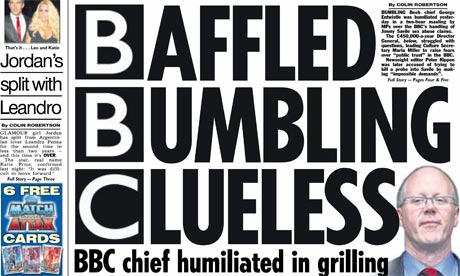
It still took quite some chutzpah for the Sun, of all papers, to splash on Entwistle's problems and describe him as baffled, bumbling and clueless.  Considering that the paper's last editor is currently awaiting trial for perverting the course of justice and conspiracy to intercept communications, a little humility would be nice.  Similarly, as we await Lord Leveson's report, perhaps Paul Dacre could reflect on what it might say about his own paper and editorship, rather than accuse the BBC of "manipulating the facts".  Or perhaps Dacre is annoyed as that's his job.

Just as opportunistic has been Maria Miller, who felt she just had to write to Chris Patten to register her concern at the BBC's ability to investigate itself, despite the media committee deciding they would allow the Pollard review to reach its own conclusions.  It's understandable she might feel aggrieved at how her predecessor nearly lost his job after acting as the minister for Murdoch, but that was hardly the BBC's doing.  Patten was entirely justified in effectively telling Miller what she could do with her concern.

All of this focus on Newsnight runs the risk of taking attention away not from why Savile got away with hiding in plain sight for so long but how.  Monday's Panorama made clear that even if not common knowledge, there were plenty of people who either suspected or had seen for themselves Savile's activities, and yet for the most part they either did nothing about it or their attempts to get it looked into floundered.  Without wanting to criticise those who must now bitterly regret not doing more, it still seems remarkable that some of those who knew didn't push harder, either going to the police or finding others with the same worries and then approaching managers to give their concerns extra weight.

This can't all be explained by the culture of the time; indeed, it was barely cited by those who've now come forward.  Certain commentators, while quick to assign blame to the liberal left either down to permissiveness, or because the abuse took place within the BBC or other state institutions, have ignored almost entirely Savile's links to other parts of the establishment. He befriended both royalty and politicians, spending Christmas at Chequers with Margaret Thatcher throughout the 80s, something the same right-wing tabloid press that worshipped the ground she walked on don't seem to want to discuss.

The greatest difficulty victims of abuse have always faced is being believed, as still shown by the failings of the police, social services and the CPS in Rochdale.  It wasn't political correctness that allowed the rape of vulnerable young girls to continue, but that the victims either weren't believed or even felt by those who should have been protecting them to be "making their own choice".  In an age before child abuse became synonymous with the darkest reaches of the internet, it often took the actual catching of a paedophile in the act for a charge to be brought and a conviction achieved.  Nick Davies wrote a whole series of articles on abuse in the late 90s that are just as applicable today, in spite of the advances in investigation that have been made.  Those in positions of power have always been able, either through connections, lawyers or influence to get their abuses either dropped or hushed up, the testimony of the weak disregarded or ridiculed.

That this now seems to have happened to a limited extent at the BBC is not surprising.  Compared to other powerful institutions that have either dragged their feet or gone into complete denial when faced with such accusations, it has acted with relative speed, albeit not swiftly enough.  What this shouldn't be allowed to become is another witch-hunt, where those who have made limited but understandable mistakes today pay the price for the much greater failings of the past (just as the News of the World should never have been sacrificed in an attempt to save Brooks and the Murdochs).  Savile is dead.  His victims and those who facilitated him are not.

Labels: , , , , , , , , ,

Share |

Monday, October 22, 2012 

The BBC leaves an open goal. Again.

It's all but impossible to overstate just what a catastrophic decision the now ex-Newsnight editor Peter Rippon made when he spiked the Jimmy Savile investigation pieced together by reporter Liz MacKean and producer Meirion Jones.  Working barely a month after Savile's death, it now seems apparent that there was just enough evidence for a report to have been broadcast. Indeed, on its own the revelation that Savile had been investigated by Surrey police, even if no charges were brought for lack of evidence, ought to have been enough to get something on the air.

Had Peter Rippon not for reasons still unknown ended the investigation, we might now be experiencing the opposite to what has happened since ITV's Exposure was broadcast at the beginning of the month.  While it's obvious that there would still be major questions about who knew what, if anything about Savile's proclivities beyond rumours, and almost certainly an investigation into the culture at Television Centre during Savile's time at the BBC, we wouldn't now be having to endure the Mail and much of the rest of the media's latent schadenfreude at the corporation's difficulties.  The BBC's coverage both of the phone hacking scandal and then the Leveson inquiry is well and truly being avenged.  It's even possible the corporation would be getting a certain amount of grudging praise for investigating itself, too late for Savile to be brought to account or not.

Quite how the BBC has managed to respond so ineffectively and poorly is a mystery.  The corporation's incredibly well paid managers really do seem to have learned absolutely nothing, whether from Sachsgate or indeed from the phone hacking debacle.  The obvious lesson from both crises, one serious and one not so much, is that you have to get your investigations, apologies and statements out as quickly as possible while at the same time making sure that they're as accurate as can be.  If you don't, then you can't possibly complain when you get turned over.  In this instance, the BBC has fallen at almost every hurdle: its initial statements were either inadequate, or as it now turns out in the case of Peter Rippon's blog post, inaccurate.  The corporation didn't apologise quick enough, nor did it set-up the independent investigations into what happened until far too late.

These failures have been exacerbated further by how it's apparent that those at the top of the BBC were aware of Newsnight's initial investigation, and yet did nothing to prepare for just such an eventuality as this one.  They must have known it was possible that the allegations would be followed up by someone else, especially when the disquiet in the newsroom at Rippon's decision was soon leaked to the press, with the Oldie even going so far as to make direct accusations against Savile.

The key question remains why Rippon decided that the broadcast could not go ahead, one which the specific investigation into Newsnight has to uncover quickly.  Highly doubtful though is the claim that Rippon either came under direct pressure from those higher-up in the BBC to drop the investigation, or that the forthcoming tributes to Savile, which hardly made up a substantial part of the BBC's Christmas schedule were thought as more important than exposing a man now being described, possibly hyperbolically, as one of the most prolific child sex offenders the country has seen.

Far more likely is that is Rippon, completely mistakenly, decided of his own accord that the story was just too potentially toxic for the amount of evidence that had been put together.  You can see his predicament: Newsnight only had on camera, in person testimony from Karin Ward, with the other statements coming from women who had been at the Duncroft approved school in the 70s who weren't prepared to appear in the film.  Ward's allegations, and I'm not doubting them here for a second, almost seem too good to be true from a journalistic point of view: she alleges that as well as being abused by Savile, she also saw Gary Glitter having sex with a girl in the alcove of Savile's dressing room.  Ward did indeed appear on a show with both Savile and Glitter, but the inclusion of the country's most notorious "celebrity" paedophile was always going to ring alarm bells.  Add in how the Crown Prosecution Service had decided not to press charges, Surrey police having spent what the Telegraph is now reporting as 2 years investigating possible abuse at Duncroft, and you can almost understand why Rippon bottled out at the last moment.

Almost, but not quite.  It reminds of the BBC's (and Newsnight's) cowardice in the Trafigura case, deciding to settle rather than contest a lawsuit from Carter-Fuck over the programme's report that Trafigura's dumping of toxic sludge in the Ivory Coast had killed rather than simply injured those who came into contact with it, despite an UN report concluding there had been deaths.  The reporter in that instance was... Liz MacKean.  No wonder that both she and her producer feel so strongly that Rippon was wrong, with Meirion Jones predicting at the time in an email that regardless of the reality, should someone else follow up the story it would be seen as a cover-up.

So it has come to pass.   Quite clearly there is the the usual amount of humbug from the press, whom with the exception of the Sunday Mirror in 1994 completely failed to investigate Savile at all, leaving it to ITV to do the hard work once Newsnight had bowed out.  It's also laughable for the Sun of all papers to take the moral high ground when News International so spectacularly failed to investigate phone hacking at the News of the World until it was forced into it at the beginning of last year, just the four years after Clive Goodman and Glenn Mulcaire were sent down.  The BBC was positively sprightly by contrast in realising the seriousness of the allegations against it.  It's also clear that the BBC can investigate itself to an extent that the rest of the media can't or won't, even if the full inquiries must be independent: tonight's Panorama is evidence of that.  Nor is it true this is the BBC's worst crisis in 50 years, even if it was John Simpson who said so.  Has everyone already forgotten the Hutton whitewash when both the director general and chairman of the BBC resigned?

The sad fact is though, as so often in the past, this is a disaster of the BBC's own making.  Some might well point to that very Hutton inquiry and to the extra compliance regulations brought in after Sachsgate as explanation as to why the BBC has been timid and overly cautious ever since, but neither stopped the corporation from broadcasting the documentaries which exposed abuse in both secure and care homes.  It may very well turn out that this is a simple case of an enormous mistake by an editor, and of a culture in the past that was all but universal, but that doesn't explain the BBC's incompetence once the allegations finally came to light.  At a time when public service broadcasting is still in peril, regardless of the collapse of the BSkyB-News Corp merger, the last thing the BBC needed was to leave an open goal for their enemies to attack.

Labels: , , , , , , , ,

Share |

Monday, January 16, 2012 

Twenty top predictions for life 100 years from now.

1. Every single one of us will be dead

sp. Likelihood 10/10.

2. Err....

3. That's it.

Labels: , ,

Share |

Tuesday, October 26, 2010 

The not so slow death of the BBC.

Rightly overshadowed last week by the far more grievous cuts being made to government spending, the surprise capping of the BBC licence fee at its current level until 2016/17 still came as a nasty shock, and one apparently foisted on the corporation by the government with little warning. We were solemnly informed that negotiations that would usually take a year of back and forth between government and managers, with input from outside interests and the public were conducted in just three drama-filled days, with everyone other than the BBC left out in the cold. Indeed, S4C, the Welsh-language channel which the BBC agreed to takeover the funding of was only told about its new erstwhile owner after the deal had been done.

While criticism was relatively muted, mainly due to how the BBC was at the bottom of most people's priorities as they tried to digest exactly what the cuts and benefit changes might mean for them, it was still apparent that the BBC had came out of the battle for the worse. The only bright spot was that it had managed to fend off having to fund the free TV-licences for over 75s introduced under Labour, which had it gone through would have meant more than £566m being sucked out of the corporation's £3.6bn yearly budget in an instant. Instead it managed to negotiate, supposedly with the help of sympathetic Liberal Democratic MPs, to take on the cost of running the World Service and BBC Monitoring from the Foreign Office, as well as the aforementioned S4C. Even saved as it was from having to impose such potentially draconian cuts to services, this still leaves the corporation having to look for further savings of £140m a year, the equivalent of a 16% cut in real terms over the duration of the fee settlement, slightly below the average 19% cut in government departments' spending.

The very making of that comparison is something that previously the BBC would have resisted. It might be funded by the taxpayer, but its independence from government always has been and supposedly remains cherished, even if it's the government that decides what the licence fee will be during each charter review. Simply involving the BBC proper in the spending review and not just its sections which it had control over was an attack on that independence. As the Guardian argues, that independence may always have been a mirage, yet it's always been and remains one which should have stayed in place. If that alone wasn't enough, then the incorporation of the World Service into the BBC's News output proper raises just as many questions and contradictions. The BBC is essentially being asked to act as the Foreign Office's limp propaganda arm whilst at the same time remaining scrupulously impartial. The public certainly wasn't asked as to whether they would like a portion of their licence fee to be spent on overseas broadcasts which have little to no relevance to them. The only real winners are those listening abroad, who can now have confidence that the message they're listening to is funded by the British taxpayer rather than the government itself, with all the massive difference that will entail.

Mark Thompson, attempting to recast the BBC's submission to becoming all but just another government department in the best possible light, deployed every favourable point in his armoury yet still failed to make a convincing case for having made the best possible deal. True, as he states, it both prevents an active cut in the licence fee itself, something much feared, and puts the BBC on a stable footing until after the next general election, outside of further political manoeuvring. That however is the best that can be said for it. Thompson claims that the BBC couldn't expect to be "untouched by the wider pressures facing the country", yet it already had been prior to the further cuts decided on the bounce at the end of the spending review, agreeing not to take up the rise in the fee which had been pencilled in under the previous government, while its "Putting Quality First" report was a retrenchment strategy before it knew it had to make any extra efficiencies. Thompson said in his MacTaggart lecture that "[A] pound out of the commissioning budget of the BBC is a pound out of UK creative economy", something which he appears to have turned full circle on in a little over two months.

The only other incredibly slight positive that can be taken from the deal is that it doesn't leave Sky in quite the massively advantageous position they must have hoped for, and which the Murdochs must have trusted on gaining in reward for their slavish adherence to Cameron during the election. Make no mistake though, come 2016-17 the difference between the still coasting BBC and its competitors is going to be massive. The BBC was already planning on cutting back its spending on both foreign imports and sports rights, and with the savings having to come from somewhere while the costs of the former increase exponentially, you can see all but the few protected events crossing to satellite. Sky has already bought up the rights to all of HBO's back catalogue, and snapped up the next series of Mad Men more recently. While it's already become apparent that many managers at the Beeb will soon be leaving their posts, finding £140m of savings a year purely from their oversized pay packets and through efficiencies is a nonsense. 6 Music, saved from closure by the BBC Trust, will almost certainly be back in the firing line, as will other services which the private sector simply can't or won't provide. With no pay rises being possible without cutbacks in programme budgets, the workforce itself will either have to be cut further or will be militantly unhappy, as it already is over the changes to the pension system.

All this bodes ill for public service broadcasting in general. The innovations that will inevitably surface between now and 2016-17 will further constrain the BBC as it finds itself unable to find extra funds to provide content for them. This, along with the all but of end of its independence is what will most hurt the corporation. Remove its ability to change with the times, abolish its defining feature of rigorous impartiality and you have something which will fade into irrelevance and simply end up all but asking to be put out of its misery, which seems to be exactly what the Conservatives had in mind from the beginning. They seem to be playing just as long a game as Thompson and friends themselves thought they were. The BBC's slow but inevitable death has just come a step closer.

Labels: , , , , , , , , ,

Share |

Thursday, September 16, 2010 

Slow start to the death of the BBC.

Just last month the Director-General of the BBC, Mark Thompson, finally did what he and the corporation should have done a long time ago: they came out fighting. During his MacTaggart lecture at the Edinburgh festival, Thompson defended the BBC's unique funding model, mocked James Murdoch and attacked Sky's increasing media dominance and failure to fund original British programming outside of sports and news, with the killer fact that despite now being the largest UK broadcaster by revenue, it spends the equivalent of ITV's entire programming budget on marketing while putting only £100m into new home-grown features, or about the same as Channel Five does despite Sky having fifteen times the turnover.

Less than three weeks later, what happens? The BBC Trust meekly submits to a zero-percent rise in the licence fee over the next two years, which even the hawkish culture secretary Jeremy Hunt finds to be thinking too far ahead, agreeing only to the first year, with a decision to be made about 2012/3 at a later date. Not that the BBC should suspect that this will change anything come the licence fee settlement to be secured in 2013: most predict that if anything, the licence fee faces being cut. The freeze is despite the last fee settlement, agreed and signed by Tessa Jowell for the last government, which pencilled in a 2% rise next year and between a 0% and 2% rise the year after.

Well, why not, some might ask. Every other publicly funded body is being asked to identify savings, ready for the cuts which are just around the corner. What's more, isn't it about time that the BBC spent the licence fee more wisely, cutting back on the highly paid executives and star talent, trimming the fat and getting into line with the current economic climate? That, it seems, is exactly the sort of argument which the BBC was anticipating and so has reacted to, avoiding any possibility of the government falling out with the corporation by not embracing the new spirit of the age. And it's true that some executives, especially on the radio side of things, have been receiving more than they probably would in the private sector, mainly thanks to how successful the BBC has long been and continues to be in that sector.

The problem is, as Mark Thompson outlined in his lecture, that the BBC has already been responding both to outside pressure and to an internal realisation that it's been spreading itself too thinly. Thousands of jobs have gone over the last six years, it's made many of its top stars take pay cuts or refused their exorbitant demands in order to stay (for which see Adrian Chiles and Christine Bleakley crossing over to ITV, although describing them as stars is perhaps pushing it), it's tackling its pensions deficit, triggering the planned strikes and it wants to go even further, as its own Putting Quality First document set out. Those cuts and changes already proposed a radically different BBC, one where it effectively emasculated itself in some areas, and also went against its very supposed principles of providing different unique content which the private sector either wouldn't or couldn't. While the BBC Trust saved 6 Music, at least for now, the Asian Network will be closed at the end of next year. Now the freeze in the licence fee effectively means the taking of a further £144m out of the corporation's current budgets. True, if the BBC was to close or privatise a couple of more worthy targets, such as either BBC3 or Radio 1, neither of which even come close to providing a unique service unavailable elsewhere, then that entire £144m could be reallocated. Sadly, those seem to be cuts which the corporation is too stubborn to even begin to consider.

If this sacrifice is intended to endear the corporation to the coalition come the next fee settlement, then it seems to be an incredibly short-sighted gesture. Mark Thompson made an argument against a cut in the fee which applies just as well to the freeze during his MacTaggart speech:

But do not believe anyone who claims that cutting the licence fee is a way of growing the creative economy or that the loss in programme investment which would follow a substantial reduction in the BBC's funding could be magically made up from somewhere else.

It just wouldn't happen. A pound out of the commissioning budget of the BBC is a pound out of UK creative economy. Once gone, it will be gone for ever.


It also reckons without the influence which Murdoch is going to wield in two years time, let alone the deal already done which led to him switching support from Labour to Cameron's Conservatives. All signs point by then to News International having swallowed Sky whole, with Vince Cable apparently unlikely to intervene. Claire Enders, the respected independent media commentator has said that this will represent a "Berlusconi moment", referring to the control which the Italian prime minister has over his country's media through his ownership of vast swathes of it. This would be even more drastic if Ofcom had been abolished or had its powers slashed, as Cameron suggested should happen prior to the election, picking on it directly as one of the quangos which should be cut down to size. While little has been said since the election, it could well be one of the targets in the general spending review. If politicians were scared of taking on News International when it owned only 39% of Sky, as they claim to have been as an explanation as for why they did next to nothing about allegations of phone-hacking at the News of the World, then the potential full spectrum dominance it will have in just a couple of years' time makes it even less likely that such abuses of power would be followed up and investigated to the fullest.

The enraging thing about the BBC is that from a position of power, with mass public support as multiple polls attest, it almost always plays the weakest hand possible. For 39p a day (approximately what £145.50 breaks down to) it represents incredible value for money, regardless of whether it's television, radio or their online content which you prefer to use, and almost everyone in the country uses on or the other and would miss it incredibly were it to slowly fade away. That's what the management essentially seems to be agreeing to, the slow death of a public service broadcaster which is too weak and pathetic to fight its own corner effectively. Perhaps in that respect it almost deserves what's coming.

Labels: , , , , , , , ,

Share |

Thursday, December 17, 2009 

The BBC is spineless, yet again.

The one thing it seems you can rely on the BBC to do, especially post-Sachsgate, is to fold completely when challenged by almost anyone on almost anything. It decides it can't broadcast Javier de Fruto's dance tribute to Diaghilev, supposedly because they stupidly agreed to transmit it pre-watershed before they discovered it contained a deformed pope, pregnant nuns and "wild sex", but also you suspect because of the outcry which would have naturally followed had they decided to do so even after 9pm; apologises for asking a stark but legitimate question concerning Ugandan legislation against homosexuality on its notorious Have Your Say boards; and now, and most, pathetically, has settled the libel claim from Trafigura over Newsnight's original broadcast on the toxic waste dumping by a contractor of the company in Ivory Coast.

The BBC report claimed that the toxic waste had caused deaths, something which the company has ferociously disputed, and it admitted no such liability when it settled with either the Ivory Coast government for $200 million or the 31,000 personally exposed to the waste, who were bought off for a pitiful £30 million. That there were deaths, contrary to Trafigura's claims, represented by the egregious Carter-Ruck, was supported by the investigation by the United Nations Special Rapporteur Prof. Okechukwu Ibeanu:

"On the basis of the above considerations and taking into account the immediate impact on public health and the proximity of some of the dumping sites to areas where affected populations reside, the Special Rapporteur considers that there seems to be strong prima facie evidence that the reported deaths and adverse health consequences are related to the dumping of the waste from the Probo Koala."

Supposedly terrified of the cost of defending the reporting, with the Guardian claiming that Carter-Fuck could at the end of the action leave the BBC with a bill for £3,000,000 (or half a Jonathan Ross), as well as the prospect of it being heard by Mr Justice Eady, the corporation caved in. Trafigura's director Eric de Turckheim meanwhile is still maintaining that the dumping of the waste was "a deplorable action which Trafigura did not and could not have foreseen", even after emails between company executives showed that they knew full well of the toxic nature of the slops they were seeking to get rid of and the specialist cleaning which was required.

Quite where this leaves the BBC's increasingly rare investigations is anyone's guess. What it does clearly do is further embolden Carter-Fuck, a law firm it seems which truly has no shame when it comes to those it chooses to represent. It failed to gag parliament and the Grauniad, but the BBC was an easier target. The question of just what the BBC increasingly is for also remains unanswered.

The original Newsnight report is still incidentally available on YouTube:


Labels: , , , , ,

Share |

Thursday, June 25, 2009 

Expenses which aren't a scandal.

As non-stories go, BBC executives claim hardly anything on expenses over five year period is a pretty high ranking one. Director-General claims for flight back to Britain to deal with manufactured newspaper scandal, as any other business would accept in an instant, creative director claims on insurance for stolen handbag, and a £100 bottle of champagne for someone regarded by many as a national treasure is about as weak as it gets. To give an idea of just how removed these are from the MPs expenses, Radio 1's controller Andy Parfitt claimed £340.43 on meals last year (PDF), the highest such claim. That's £60 less than most MPs were claiming in a single month on food. To be sure, these are high-earning individuals, spending our money when they should perhaps be forking out for it themselves. Yet these claims in any other business of a similar size would barely raise an eyebrow, as the more honest outside commentators are admitting. Prince Charles cost us £3 million last year; the BBC's executive expenses over 5 years were £363,963.83. I know in an instant which I'd plump for every time.

The BBC though is nothing if it is not self-flagellating. You can imagine the delight of the Daily Mail, responsible for the ridiculous storm over "Sachsgate" at the news that Mark Thompson claimed back on the cost of his flights to deal with the fallout from it. Hence the story has been towards the top of their news throughout the day, the top story on Newsnight, and you have Martin Bell, saint of all sleaze allegations, denouncing these more than reasonable costs as unacceptable. Perhaps the Guardian's comment sections are hardly representative, but to call the consensus being overwhelmingly towards these expenses being for the most part highly reasonable would be putting it too lightly, with Emily Bell taking rather heavy flak for her piece.

She does however have something of a point; there is a contradiction between whether the BBC is a public or private organisation. Not a single person in the country believes that Jonathan Ross is worth £6 million a year, and he would almost certainly not get a similar sum now from a truly commercial organisation, even if he would have done before. The fact remains though that for the most part the BBC does have to compete, even if ITV and CH4 claim to high heaven that they're now hardly treading water. We expect so much from the BBC, and when you have the outrages like Jonathan Ross's salary and some of the truly dreadful programmes which it occasionally produces, whether it be almost everything that BBC3 broadcasts or the likes of Hotel Babylon, it undermines the general good which the corporation radiates. It could be better: it could close down BBC3 entirely, and also perhaps do without Radio 1 which has deteriorated to such a stage that putting it down would be the kind thing to do, and reinvest the money elsewhere, but no one has yet had the temerity to suggest that the BBC should do more with less, except for those that have a very good commercial reason for saying so.

At the same time, the public themselves also don't seem to know what they want. The BBC's new guidelines, based on research conducted with a representative sample of 2,700 viewers and listeners say that the corporation should never "condone malicious intrusion, intimidation and humiliation." Presumably then that means that the Apprentice will not be returning to BBC1. While the BBC has for the most part eschewed the "talent" reality shows which ITV is now relying upon, with the exception of the late Fame Academy and the "celebrity" shows such as Strictly Come Dancing, they would also presumably now be barred by such rules. After all, what are the X Factor and Britain's Got Talent except celebrations of intimidation and humiliation of those that dare to imagine that they've got something special when they conspicuously haven't? These are the top rated shows of the last decade, and apparently the public dislike them even while lapping them up. It also simply doesn't seem to have occurred to some respondents that they can change the channel if there's swearing on one side, with the BBC now promising that strong language will only be heard in "exceptional circumstances" between 9pm and 10pm on BBC1. It wasn't that long ago when strong language didn't require any such warning before the programme began, especially later on at night, yet now there are warnings across the board, all while 46% say the standards have slipped in recent years.

Despite its strength, there is a timidity and an apologetic nature about the BBC at present, as if they seem to realise that it can't last much longer, and that it'll all be better when it is cut down to size, something which we will then bitterly regret for ever more. At a time when there is so much unaccountability, both in public and private life, the BBC is one of the more responsive and open organisations. The danger is that it'll brought down because of that rather than the opposite.

Labels: , , , , ,

Share |

Monday, January 26, 2009 

Objectivity is a lie which the DEC appeal proves.


Watching the DEC's appeal for aid donations, it's apparent why both the BBC and Sky refused to show it: it puts their own reporting to shame. In three short minutes it clearly and astutely summarises how the Palestinians in Gaza were living even before the 22-day onslaught began, without making so much as a political point throughout. It does however at the same time evocatively suggest that someone, ultimately, is responsible for this very man-made disaster, and that, without a shadow of doubt, is Israel, not Hamas.

Objectivity is, and always has been, a lie. There is no such thing as complete impartiality; there is however trying to be as neutral as you possibly can be. When a state is pounding a tiny, cut-off piece of territory where half the population are classified as children, to be completely impartial is a nonsense, just as when the response to Hurricane Katrina in New Orleans was so woeful as to be useless the reporters there noticeably became angrier at the richest nation on Earth abandoning some of its poorest citizens to their fate. That quite possibly marked the true turning point in the Bush presidency. Likewise, that the BBC (we can safely disregard Sky's decision, as Murdoch has made clear in the past that if he could he'd turn Sky News into a British version of Fox he would) somehow thinks that broadcasting an appeal for help for Gaza would damage its impartiality when its own reporters have reported on the devastation and its obvious causes is equivalent to someone who leads you on all night then slams the door in your face after taking you home. It's a snub, and a completely petty one at that. The BBC may as well, as others have done, equate all Palestinians, or all Gazans, as Hamas, and therefore not worthy of aid or trusted enough not to spend it on weapons. Its own behaviour has breached its impartiality far more than screening the ad would have done.

Labels: , , , , ,

Share |

Thursday, January 22, 2009 

The Palestinians of Gaza - not human enough, obviously.

This is shocking:

The BBC has refused to broadcast a national humanitarian appeal for Gaza, leaving aid agencies with a potential shortfall of millions of pounds in donations.

The Disasters Emergency Committee (DEC), an umbrella organisation for 13 aid charities, launched its appealtoday saying the devastation in Gaza was “so huge that British aid agencies were compelled to act”.

But the BBC made a rare breach of an agreement dating back to 1963 when it announced it would not give free airtime to the appeal. Other broadcasters then followed suit. Previously, broadcasters have agreed on the video and script to be used with the DEC, with each station choosing a presenter to front the appeal, shown after primetime news bulletins.

The BBC said it was not the first time broadcasters had refused to show a DEC appeal.

The corporation said it had been concerned about the difficulties of getting aid through to victims in a volatile situation. The BBC, which has faced criticism in the past over alleged bias in its coverage of the Middle East, said it did not want to risk public confidence in its impartiality.

The DEC’s chief executive, Brendan Gormley, said the decision could have a big impact on its appeal. “We are used to our appeal getting into every household and offering a safe and necessary way for people to respond. This time we will have to work a lot harder because we won’t have the free airtime or the powerful impact of appearing on every TV and radio station.”

...

A BBC spokesperson said: “Along with other broadcasters, the BBC has decided not to broadcast the DEC’s public appeal to raise funds for Gaza. The BBC decision was made because of question marks about the delivery of aid in a volatile situation and also to avoid any risk of compromising public confidence in the BBC’s impartiality in the context of an ongoing news story. However, the BBC will of course continue to report the humanitarian story in Gaza.”


In other words, the BBC have given in to those just waiting to grasp at the slightest hint of bias before they'd even had a chance to. It wasn't as if this was just going to be on the BBC; the other channels would have carried it as well. They've in effect decided that the Palestinians of Gaza are not as human or as equal as those who have been victims of natural disasters; it seems it would take something far worse than the man-made carnage Israel visited upon Gaza for the impoverished and hungry citizens of a tiny, cut off piece of land to be treated the same as everyone else.

I didn't think that the BBC's coverage of the assault on Gaza was that bad, or certainly not as terrible as some of those on the fringes of the left thought, judging by there being another protest outside the BBC this Saturday before the march heads to Downing Street. You get the feeling that if the BBC doesn't change its minds about this tomorrow that they'll be a hell of a lot more there than there otherwise would have been.

Labels: , , , , , , , , , ,

Share |

About

  • This is septicisle
profile

Archives

Powered by Blogger
and Blogger Templates