Where are the Voltaires of yesteryear?
James Bloodworth, via Chris, wonders where today's equivalents to Voltaire are, especially in the social networking age when tabloids and users compete as to who can be the most outraged about what someone else has either said or done. The obvious answer is they mostly died out not long after Voltaire himself; we might have had Thomas Paine, and more recently produced George Orwell, but believing in the American model of freedom of speech and expression has never been a popular pursuit in this country. You could blame the press principally for this, and the countless campaigns down the years for the public to be protected from themselves over the latest moral panic, yet it's surely more that we never got round to having a proper written constitution, the closest thing we do have being the European Convention on Human Rights, which naturally is loathed by the tabloids and right-wing politicians for "favouring" criminals and terrorists over the public.
For instance, despite how we pride ourselves on being a tolerant democracy, with our politicians occasionally going into raptures about our parliament being the mother of them all, even if it wasn't until the 19th century that the common man was able to vote (women had to wait another 60 years), there's been relatively little criticism when people have been jailed for making either off colour jokes or wearing t-shirts with offensive slogans. It was a protest by a tiny band of Luton based Islamists against the homecoming of the Royal Anglian regiment that prompted the forming of the English Defence League, as though the country needed the protection services of a bunch of wannabe football hooligans against such horror. Most seriously, two young men were sentenced to four years in prison for setting up phony event pages during the riots of August 2011, terms longer than many of those who did take part in the disorder received. Unlike Paul Chambers, neither Jordan Blackshaw or Perry Sutcliffe-Keenan received the sympathy or financial backing of celebrities in an effort to get their convictions quashed.
The thing I find really strange about the campaigns against page 3 and lads' mags is they're ran by people who consider themselves liberal who, whether they realise it or not, are echoing the exact same arguments made by the censors of the past. Just as the likes of the Mail and Mary Whitehouse claimed at the dawn of mass ownership of video recorders that horror films could deprave and corrupt the naive and innocent, so now we hear the likes of Zoo and Nuts objectify women, help to sustain a sexist culture and at their most malignant even have the potential to turn their readers into rapists. While there's no doubt they're often tasteless, and on occasion have veered off into the truly vile, the idea that simply seeing a cover of one can constitute harassment is ludicrous, and if LTLM's interpretation of the Equality Act is correct, then it quite apparently needs to be redrafted (it's worth noting the entire Caroline Criado-Perez Twitter stupidity began after she invoked the Equality Act as demanding there must be a woman on a bank note). Moreover, the idea that removing lads' mags from the shelves will achieve anything in age where sexting and revenge porn are the new cause for concern seems the equivalent of generals always fighting the last war.
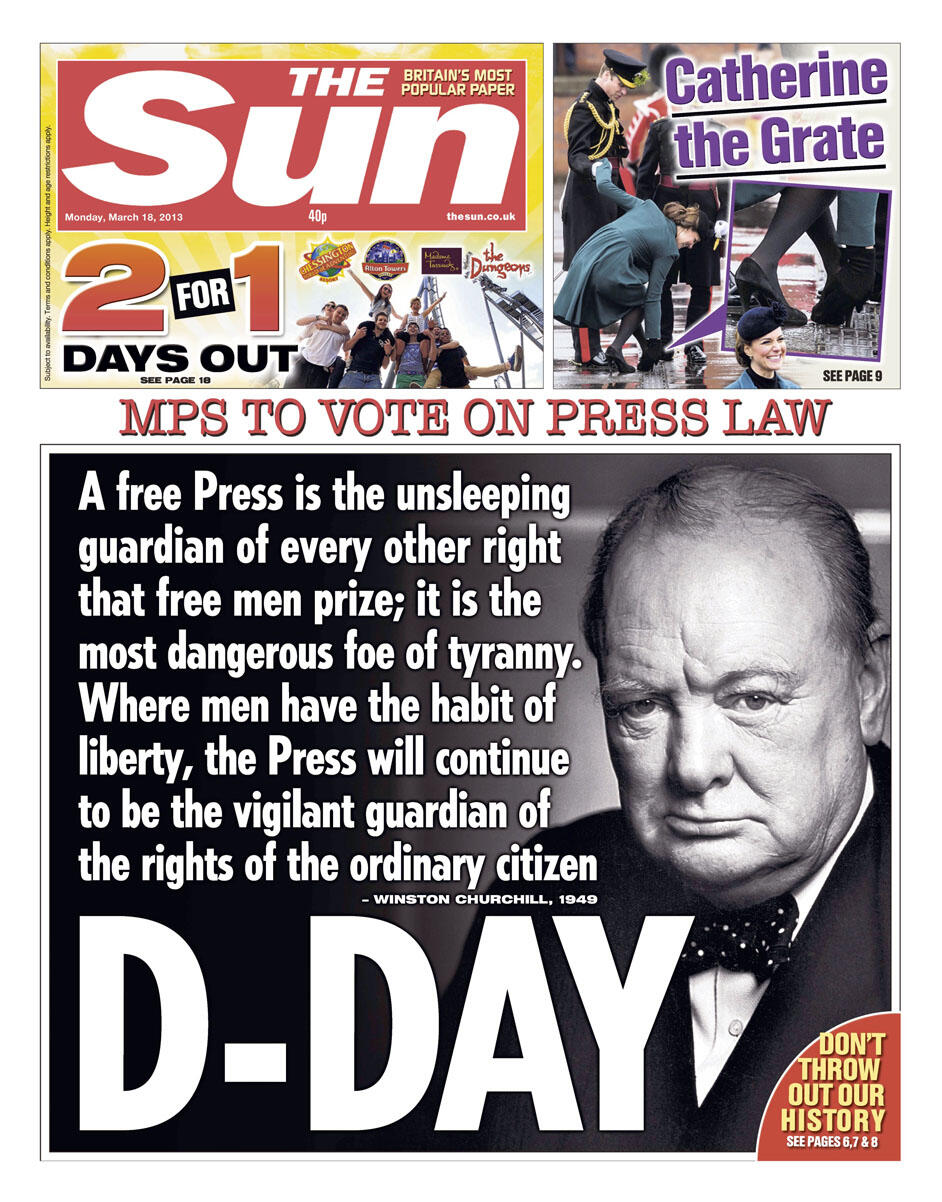
The same could be said for the stalemate over press regulation. As much as it is specious nonsense to claim the royal charter would be the end of 300 years of press freedom, such have been the attacks of the past week anyone still saying we shouldn't worry about the potential for a change to the regulator via a two-thirds majority in parliament ought to think again. Self-regulation has manifestly failed and a reconstitution of a slightly beefed up PCC needs to be resisted, yet the alternative now appears worse. Ofcom can't be trusted as far as they can be thrown, which should rule out their involvement, which leaves us with just about nothing. Perhaps the answer will be that newspapers in their current form are dying, some faster than others. With the shift towards online publishing, it could be possible to better hold the press to account such will be the reliance on advertising rather than the shifting of newsprint.
Of courser, it might just be that rather than having Voltaires, we now have contrarians, or those paid to go against the consensus view on every subject. And let's face it: no one wants to be Brendan O'Neill.
For instance, despite how we pride ourselves on being a tolerant democracy, with our politicians occasionally going into raptures about our parliament being the mother of them all, even if it wasn't until the 19th century that the common man was able to vote (women had to wait another 60 years), there's been relatively little criticism when people have been jailed for making either off colour jokes or wearing t-shirts with offensive slogans. It was a protest by a tiny band of Luton based Islamists against the homecoming of the Royal Anglian regiment that prompted the forming of the English Defence League, as though the country needed the protection services of a bunch of wannabe football hooligans against such horror. Most seriously, two young men were sentenced to four years in prison for setting up phony event pages during the riots of August 2011, terms longer than many of those who did take part in the disorder received. Unlike Paul Chambers, neither Jordan Blackshaw or Perry Sutcliffe-Keenan received the sympathy or financial backing of celebrities in an effort to get their convictions quashed.
The thing I find really strange about the campaigns against page 3 and lads' mags is they're ran by people who consider themselves liberal who, whether they realise it or not, are echoing the exact same arguments made by the censors of the past. Just as the likes of the Mail and Mary Whitehouse claimed at the dawn of mass ownership of video recorders that horror films could deprave and corrupt the naive and innocent, so now we hear the likes of Zoo and Nuts objectify women, help to sustain a sexist culture and at their most malignant even have the potential to turn their readers into rapists. While there's no doubt they're often tasteless, and on occasion have veered off into the truly vile, the idea that simply seeing a cover of one can constitute harassment is ludicrous, and if LTLM's interpretation of the Equality Act is correct, then it quite apparently needs to be redrafted (it's worth noting the entire Caroline Criado-Perez Twitter stupidity began after she invoked the Equality Act as demanding there must be a woman on a bank note). Moreover, the idea that removing lads' mags from the shelves will achieve anything in age where sexting and revenge porn are the new cause for concern seems the equivalent of generals always fighting the last war.
The same could be said for the stalemate over press regulation. As much as it is specious nonsense to claim the royal charter would be the end of 300 years of press freedom, such have been the attacks of the past week anyone still saying we shouldn't worry about the potential for a change to the regulator via a two-thirds majority in parliament ought to think again. Self-regulation has manifestly failed and a reconstitution of a slightly beefed up PCC needs to be resisted, yet the alternative now appears worse. Ofcom can't be trusted as far as they can be thrown, which should rule out their involvement, which leaves us with just about nothing. Perhaps the answer will be that newspapers in their current form are dying, some faster than others. With the shift towards online publishing, it could be possible to better hold the press to account such will be the reliance on advertising rather than the shifting of newsprint.
Of courser, it might just be that rather than having Voltaires, we now have contrarians, or those paid to go against the consensus view on every subject. And let's face it: no one wants to be Brendan O'Neill.
Labels: censorship, civil liberties, feminism, freedom of speech, media analysis, politics, press regulation
| Permalink