Thursday, January 07, 2016 

A grossly offensive pastor and a menacing, huggable convert.

It feels appropriate on the first anniversary of the Charlie Hebdo attack to consider the state of free speech in the UK.  Not, obviously, the state of free speech on university campuses, where the inestimable Flying Rodent makes a suggestion as to how those so outraged by "prissy students" and their trigger warnings can make clear their angst, but instead elsewhere.

We'll start with the case of Pastor James McConnell, cleared this week of "causing a grossly offensive message to be sent by means of a public electronic communications network".  The born again evangelical, in a sermon heard by 2,000 people in his "Tabernacle" in Belfast and by 700 others online, variously declared that "Today we see powerful evidence that more and more Muslims are putting the Koran's hatred of Christians and Jews alike into practice"; that "people say there are good Muslims in Britain. That may be so, but I don't trust them"; called Enoch Powell a "prophet" and proclaimed him to be "right"; and in a final flourish said "Today a new evil has arisen. There are cells of Muslims right throughout Britain ... Islam is heathen, Islam is satanic, Islam is a doctrine spawned in hell."

Not for a moment was Pastor McConnell suggesting Muslims themselves were heathens or worse, oh heavens no.  On the contrary, he loves every hair on their little heads.  He might not so much as trust a "good" Muslim, but it's their religion he detests, not them personally.  You might imagine that just as Pastor McConnell's identity as an individual is presumably all but inseparable from his faith, he would understand that many Muslims feel the same way.  You might think he'd see the irony of describing a belief system that shares a fair amount with his own as "satanic" and "spawned in hell", not least when he's the one accusing them of hatred.  Then again, the evangelical brand of Protestantism in Northern Ireland has not generally been noted for its nuance or for taking much notice of that old verse about motes and beams.

The McConnell case is also notable for how it dragged in then first minister Peter Robinson, who ended up apologising outside Belfast's Islamic Centre for defending a little too profusely a preacher whose congregation he occasionally attended.  Various other figures from the DUP, as well as the even more conservative Traditional Ulster Voice also spoke up for McConnell, and have been critical of the director of public prosecutions for bringing the case.

Certainly, it's difficult to see how the PPS came to the conclusion there was a realistic chance of conviction, in spite of McConnell declining to accept an "informed warning" instead.  Not only was there political backing at the highest level for McConnell, a judge or jury are always liable to err on the side of caution and give the benefit of the doubt to an established preacher, in contrast say to a ranter sermonising from a street corner.  When you then further consider the history of Northern Ireland, where Dr No himself eventually rose to be first minister, expecting a relatively mild by those standards denunciation of Islam to be declared "grossly offensive", as necessary under the Communications Act, was at best wishful thinking.

Moreover, McConnell's acquittal was the right decision.  His rhetoric would be offensive to many Muslims, but it was not the sort of speech that should ever be proscribed, falling well short of inciting hatred, if still wholly intolerant, ignorant and hypocritical.  Far more interesting were the judge's remarks on clearing McConnell, especially in the context of other cases brought under the Communications Act.  "I find myself in agreement with Lord Justice Laws in the “Chambers” case when he said that the courts need to be very careful not to criminalise speech which, however contemptible, is no more than offensive. It is not the task of the criminal law to censor offensive utterances," Judge McNally found.  Also worth relating is McNally's pointed concluding paragraph from his ruling:


Finally, having heard a great deal about Pastor McConnell’s beliefs over the course of this trial I think it appropriate to leave the last word with the Islamic scholar and poet Rumi who said: 

“Silence is the language of God, all else is poor translation.”

Which brings us to the case of Muhammad Mujahid Islam, or as he's otherwise known, Craig Wallace.  For reasons which don't seem to have been expanded on, he took an especial disliking to Conservative MP Charlotte Leslie, taking to err, the UK Truth Movement's Facebook page in the aftermath of the Syria vote to make his feelings known.  Choice selections from his postings are, all sic, "im going to smash her windows then drop a bomb on her hoyse ... YOU DIRTY FUCKING PIG SHAGGING SLUT by the way love your also fucking hideous", and "im going to find her and show herwat it is like to murder innocents dirty fucking pidg shagging whore".

Quite what Leslie did or didn't do to upset him isn't clear, not least as far from being his MP, Leslie's constituency is Bristol North West, while Wallace lives in err, Willesden.  Wallace it appears is a whole mess of contradictions: apart from taking on the most literal of alter egos a Muslim convert possibly could, when not directing abuse at an MP on the profile page of a group of conspiracy theorists, he was "protesting" outside Willesden Green tube station with a placard that read "I am Muslim ... I am labelled a terrorist ... Do you trust me enough for a hug?"

Oddly, unlike McConnell, Wallace didn't find any friends in high places to speak up for him, and was sentenced to eight weeks in prison after pleading guilty to sending a malicious communication.  While it's unarguable that Wallace's posts were clearly offensive, there are two points that can be made.  First, were they were grossly offensive, or were they menacing, as the Communications Act also proscribes?  Unlike say, in the Chambers case, where it was apparent that his tweet was meant sarcastically, Wallace's posts are not.  At the same time, would anyone feel genuinely threatened by them?  I'll admit to being rather blasé about what people say online due to the sites I frequented back in the day, but wouldn't most dismiss such talk as the kind of "online tough guy" routine often ridiculed?  That he didn't direct the comments at Leslie through her online profiles, writing them elsewhere, ought to have been taken into account.  Additionally, one person's definition of grossly offensive is always going to be different to another's, to the point where it almost seems to have left deliberately nebulous in the legislation.  Wallace's comments were so over-the-top they veer into "chinny reckon" territory, more absurd and self-defeating than offensive or menacing.

The law in this instance doesn't consider such nuances, and it probably wouldn't have been worth Wallace's legal representatives trying to argue that essentially the law is an ass, as Chambers did, while also making mitigating arguments.  One ought to have been that parliamentary votes on going to war are always going to stir passions, and not everyone is going to put their point across as an MP would in the chamber.  At a hearing prior to sentencing the judge said "What’s absolutely clear is that your language and expressions about this MP ... went beyond any sort of legitimate comment or protest on an extremely serious issue", and yet, while it's rather fell out of fashion now, swear blogging did most certainly used to be a thing.  Is there no place whatsoever for over-the-top diatribes, when while the point itself might be sincere, no harm whatsoever is truly meant to the target?  Are we not judging the online world, and individuals such as Wallace differently to the way we do certain comedians, or say pastors?

Then there's the sentence itself.  What does a further 8 weeks in prison for Wallace, who had only been released a couple of months earlier from a five-year stretch for attempted robbery, during which he converted, possibly serve him, wider society or the taxpayer?  One might have thought prison would be the worst possible place for him.  Would not instances like this where the "trolling" is not concerted and the target themselves not personally aware be better dealt with by a caution or alternatively a visit by the police, making clear they're aware and that any further abuse will result in prosecution?

Admittedly, all these are judgements made knowing that Wallace didn't have any real intention of carrying out what were still threats, however unlikely.  Others have made similarly dubious warnings, and then gone on to act them out.  If legislation such as the Communications Act is to remain statute though, and if anything might be added to considering the on-going outcry over trolling, should there not be guidance for judges making clear their room for discretion, and for taking into consideration the specifics of such cases?  While it would be lovely to assume they do already, cases like those such as Wallace's, previous ones and likely others not reported nationally more than suggest the free speech ramifications of section 127 of the communications act should be considered again.  Not everyone can rely on celebrities or politicians to defend their stupidity.

Labels: , , , , , ,

Share |

Tuesday, June 16, 2015 

This post summarised: I don't understand social media.

If there's something that never fails to raise a chuckle, it's just how many right-on folk suddenly discover they don't mind in the slightest receiving a honour created by royalty and given out by royalty making them a member of something that no longer exists.  That most would also normally blanch at the merest idea of being connected with the empire, for good reason, it's remarkable just how soon they decide otherwise once offered the chance to put some more letters after their name.

Yes, the Queen's birthday honours list was as delightful as ever, if not more so than usual.  Most of the fun comes when Private Eye bothers to look at the list in detail and finds just how many of the recipients owe their awards to their political affiliations, donations or other brown-nosing, or alternatively, to how despite or indeed down to their being bent as a nine bob note they managed to make the grade.  Some names do though jump straight out at you, like Paul Kenny, leader of the GMB union, essentially receiving a knighthood for being extraordinarily useless at representing his members.  Simon Hughes is also rewarded for his services to the coalition by getting a K, a reminder of how brilliant the next round of nominations to the Lords will also be.

Then there are the straight up juxtapositions of worthiness.  Will Pooley, one of those who volunteered to help fight Ebola in east Africa and nearly died after contracting it himself, is justly recognised with an MBE; awarded an OBE is Caroline Criado-Perez, for getting trolled on Twitter.  Alongside her is Laura Bates, behind the phenomenally successful Everyday Sexism project, who receives the resurrected by Cameron British Empire Medal.  Considering the major triumph of Everyday Sexism has been to make self-hating, insecure men even less likely to give the merest of compliments to the opposite sex for fear of it being seen as harassment while the actual sexists carry on as they always have, who could possibly object to the award?

Getting the nod for an honour is in essence the establishment recognising the recipient as not representing a threat.  At opposite ends of the pool are Benedict Bandersnatch, who complained previously about posh-bashing, getting the CBE, while Lenny Henry's push for proper representation in the media was no obstacle to his knighthood.  The awards for Criado-Perez and Bates meanwhile are just the latest evidence that the fourth-wave of feminism, if it can really be recognised as such, has been co-opted entirely by those it supposedly targets.  When Waterstone's has a specific table set aside for the works by the aforementioned and others like Caitlin Moran, as my local has, while also at the same time encompassing Bryony Gordon's fucking everyone in a pair of trousers memoir The Wrong Knickers, appropriation has mostly certain taken place.

This not being a threat doesn't mean the public at large are any more receptive or impressed by identity politics, mind.  I'm with Paul when he responds to Sunny Hundal's piece for LabourList that recognises the left-wing social media echo chamber most likely contributed to Labour's loss, in that he says speak for yourself pal.  We don't all obsess over mugs with controls on immigration plastered on them, or imagine that activism online can replace activism offline.  I've been critical of politicians beating themselves up over not talking like the public, when in fact what the complaint is about and Sunny gets is it's not how they sound and the phrases they use, it's the content.  He's wrong about Blair getting non-Labour voters in as much as Blair's great success was to come at the precise moment the Tories utterly self-destructed, but he is right about the cultural deficit.

Not that hardly anyone outside said echo chambers pays much in the way of attention to Twitter subcultures, let alone your average voter.  When issues of identity do reach the mainstream however, as they have recently with Caitlyn Jenner, Rachel Dolezal and Tim Hunt, it's far from clear it's to the benefit of those who are always the first to comment.  Jenner's transition invites cynicism because of who she is, regardless of the exact circumstances, as should the way it was presented to the world in a way those welcoming it would normally flinch from.  Rachel Dolezal is an almost perfect example of the double standards associated with racial as opposed to sexual identity, while you don't have to take the Daily Mail line to think Hunt harshly treated if still stupid, as plenty of commentators have.  Despise the way a phony image of the "metropolitan elite" has been created and instilled, as we should, it all feeds into it.  This is hardly helped when so often the sites and media associated with the left do their best to be a parody of themselves.  Some have for too long celebrated difference for its own sake rather than thought about what makes us belong, unites us.  Most pertinently, class has often been overlooked in favour of every other distinction.

It's not just the left who have given in to the lures of the echo chamber, of course, and this doesn't mean those ideals are the wrong ones.  For every person who banged on about immigration mugs, there are also those who don't think what ostensibly remains a centre-left party should have someone of the left so much as stand for leader, as that by itself shows the party is still not "serious".  They would seemingly have preferred the contest to be between three candidates with all but identical policies, none of whom seem to understand that Labour faces threats from both the left and right, with the potential for things to get worse before they get better.  Equally misguided are those who see fit to comment on the alleged hypocrisy of supposed radicals for cuddling up to the establishment, and then see fit to advise a party of the establishment and its supporters on where it's going wrong.  Oh.

Labels: , , , , , ,

Share |

Tuesday, February 10, 2015 

The internet makes you stupid.

Back in those heady web 1.0 days, there was a site called Something Awful (and there still is, just the cool kids have long since moved on).  Its tagline was and again, could still be, the internet makes you stupid.  As this was back when the net was still mainly used only by nerds, gamers, autodidacts and bored office workers rather than your grandmother and her bridge group, it was a fairly cutting if not meant entirely seriously barb at the numbskulls who read the site and populated its forums.

Jump forward all these years and a few people seem to have noticed that hey, this internet thing isn't all it's cracked up to be.  In fact, you could say that it's making people even stupider than was believed possible.  There are now so many listicle articles online that a whole section of rainforest in Brazil has been cut down to make way for the world's biggest ever server hub to host just them.  A scientific study has found that if a mouse so much as catches a glimpse of a screen displaying Buzzfeed, it causes a complete loss of spatial awareness that can last for up to 5 hours.  Likewise, YouTube's most subscribed user PewDiePie has been identified as the common factor in a whole range of pet suicides, with goldfish jumping up out of their tanks rather than listen to him scream again, their incredibly short memory no apparent protection.

Add in how Twitter is the Stasi for the Angry Birds generation (© Stewart Lee), Facebook is mostly used for talking to people you don't want to, with a sideline in slut-shaming and/or stalking your exs, as they often go hand in hand, while Instagram gives new meaning to the word narcissism, and you'd be hard-pushed to claim the net isn't a fresh hell we just like to pretend has enriched our lives.  Unless of course you're Holly Baxter, in which case you more or less accept the above, then say actually the internet is a great leveller, a meritocratic paradise as without it she wouldn't be able to pay the rent.

To which the obvious response is Baxter is indeed the very epitome of meritocracy in action, as is Pewds.  So long as you can do something reasonably competently in a specified niche, whether it be writing click-bait with a vaguely feminist edge or let's plays with the kind of commentary that entertains pre-teens and teens who've been held back a year at school, there's an extremely remote chance you can make it in this brave new media environment.  For every Baxter however there are thousands of frustrated and bitter commentators who imagined their searing political insight might lead somewhere, only to come to realise they may as well be howling at the moon.  And for every PewDiePie or Yogscast, never mind a Zoella, there are umpteen vloggers or let's players whose total views can be counted on the fingers of the participants in a Dominique Strauss-Kahn orgy.  Much of their material will also be far superior in content to their erstwhile rivals, but hey, dem's the breaks.

But, but, but I hear you spluttering, what about all the money raised thanks to the internets, the very fact it provides somewhere for subcultures to thrive, how without it we'd never have discovered that band, seen that film, gotten that STI from the one night stand made possible by Tinder?  Haven't you said before the web can be a sanctuary for those bullied and repressed, as much as it can mean there's no escape from those same oppressors?  Isn't the very idea of a life not lived online now completely alien to your average teenager, both for better and worse?  And, moreover, isn't it a bit naive if not well, stupid, to complain about the hypercapitalism of the internet and its monopolistic tendencies when it had its origins in the goddamn Department of Defense?

Duh.  The problem is the only kind of shades of grey the internet likes are contained in those Twilight fan-fiction originating books.  Everything is turned up to 11: a television journalist lies about coming under fire in Iraq, and soon he's getting photoshopped into being at the last supper, because that's funny, right?  The internet can't possibly be a bad thing, just as social networking can't possibly be a bad thing, because look it's not all trolling and celebrity inanity and identity politics and pointless arguing.  Besides, it's the old media, and the old media is always wrong and biased and wrong.

As if to prove the point, Andrew Keen's book of course recognises there will always be your Holly Baxters and Dapper Laughs and Sam Peppers, but Baxter was responding to what she thought was his argument, just as I'm responding to what I think are their arguments.  The reality is the internet reflects life in general, even if some of us use it to escape from that reality.  The key difference is the web sees far more in the way of rebellions than we do offline, as it's a whole lot easier than manning the barricades.  Just don't take that as an indication of there not being the same anger, disappointment or even apathy just below the surface at the state of the world.  Such rebellions don't though discriminate, and often shout things we don't want to hear.  Life in general is a bit shit, and so too is the internet.  And that's all there is.

Labels: , , , , ,

Share |

Wednesday, January 28, 2015 

Trapped in the echo chamber.

At times, I wonder just how it was newspapers filled their pages when they couldn't dedicate multiple anguished pieces to either actors making a poor choice of word, or alleged celebrities Twitter-shaming litterers.  Then you remember there was never a halcyon period for newspapers, regardless of what anyone will tell you: the tabloids were always full of celebrity bilge, including Hugh Cudlipp's patrician Mirror.  As for the broadsheets, they were in the main drier than downtown Jeddah on a Saturday night.  Not for nothing was the ghastly but at least readable Express the world's biggest seller for a time.

Apparently then I must defend Katie Price's right to party to claim disability benefits for her son.  First they came for one of the most loathsome personalities of recent times, and so forth.  Alternatively, I could let her get on with it, as I'm sure dear old Jordan can look after herself, surely?  Much like Benedict Bandersnatch (that is his name, isn't it?) no doubt instantly regretted saying coloured, without it being necessary for writers to assume he couldn't have much contact with black actors if he was going around doing so.  As for Kirstie Allsopp, well, as the personification of just about everything that would quickly send me completely and utterly fucking doolally, if she wants to be so petty as to put a litterer's number plate online, does it really need further comment?

Of course it does.  And of course, it takes two or indeed dozens of sad acts for these mini-ripples to get anywhere in the first place.  Reading Jon Ronson's interview with Adam Curtis, which quickly digresses onto the topic of Ronson's upcoming book on those who've found themselves at the centre of online storms, it's easy to forget these incidents would have felt that much less serious had the mainstream media decided not to join in the stupidity.

Personally, despite everything that's come since, I reckon the apogee was reached in the days after that woman put that cat in that bin.  Why put the CCTV online in the first place?  I love animals as much as the next carnivore, but let's face it, far worse than spending a night in a bin is going to happen to most cats through their own ahem, curiosity.  Why demand answers as to why she put it in the bin?  Did it matter?  Would any answer suffice?  She quite possibly had a terrible day, but rather than stroke the cat as most of us would have and probably felt just that little better, she put it in the bin.  Or perhaps she does just hate cats.  Either way, the why was irrelevant.  She will now and forever more be the cat bin lady.  Which could be preferable to being known as a cat lady when you think about it, who knows.

As you'll probably know by now, my own views on social media are roughly akin to both Ronson and Curtis's.  Yes, it can all too easily become an echo chamber, but then most of us don't like having our thoughts and opinions challenged in the first place.  Hence we buy that paper, we read that website, we turn our noses up at their rivals and so on.  Far more pernicious to me at least is not the vehemence with which a transgression against something might be pursued, so much as the effect it's had on activism.  On the one hand it's turbo-charged many campaigns, had a major role in the Arab spring, etc.  On the other, as Curtis points out, what is there to show for the vast majority of hashtag battles?  Not just the obvious examples for mocking, such as #bringbackourgirls or #kony2012, but what about #occupy?  Apart from giving us the 99%/1% identifiers, what did it really change, and is that perhaps not directly connected to the lack of real leadership there so often is behind such Twitter co-ordinated protests?

Curtis doesn't get everything right.  His remark on how in "ten years, sections of the internet will have become like the American inner cities of the 1980s" is just a little behind the times, considering how there have been subcultures online almost exactly as he describes since the late 90s, and you could probably identify similar groupings on BBSes if you so wished.  It's also something of a stretch to point towards "consumer journalism" being a recent thing - Murdoch's Sun was precisely that, long before accusations of dumbing down were bandied about, while the painting of the world as black and white is old as newspapers themselves.

What's so odd and defies explanation is just how quickly the "shaming" aspect of social media has become accepted.  Why should anyone care what a cricketer thinks about people on minimum wage for instance, and why does someone else known for their opinions on Twitter feel the need to dedicate an entire piece to it?  It tells us precisely nothing wider about ourselves, just as Emma West's rant about immigration didn't.  The answer maybe is that rather than giving everyone a voice, what social media has really done is inflate egos yet further and little else, empowering not individuals, but individualism.  This hasn't just happened to the Stuart Broads, the Allsopps, or anyone else you might care to mention, but also those whose reaction to the Sun trolling everyone last week over page 3 was to stamp their feet rather than reflect they had been too quick to assume victory.  More prosaically, another explanation is the encouragement if not active compulsion there now is to share, regardless of whether it's something that should be heard or deserves to be.  When rubbed against not the right to freedom of speech but, hilariously, the "freedom to be offended" as the headline writing sub on Jessica Valenti's latest we're putting an end to every sort of ism through making everyone check their privilege piece put it, increasingly pointless battles are the inevitable result.

As ever, most of the criticisms directed against others can be pointed directly back at myself.  Why moan about people moaning about inconsequential things?  Hasn't writing this crap for the last nigh-on 10 years been all about boosting your ego too?  Who gives a fig what you think about anything?  To which the only answer is: curses, foiled again.

Labels: , , , , , ,

Share |

Monday, October 20, 2014 

Poisoning national life? That'll be two years.

Gosh, was it really but two weeks ago some of the internet world was up in arms over the apparent suicide of Brenda Leyland, aka Sweepyface, aka one of those meanies still obsessed with the disappearance of Madeleine McCann and still insisting her parents might have had something to do with it, or at least bear some responsibility?  Unpopular opinions certainly, but not illegal, and probably not really deserving of a doorstepping from a Sky reporter.

How fast things move these days.  Just as we saw in the aftermath of the riots, when some judges took it upon themselves to hand down harsher sentences to those who didn't riot but suggested they might than to some of those who did, so now Chris Grayling promises the maximum sentence for "trolls" will be lengthened from the current six months to 2 years.  Anyone would have thought we don't have a prison system in crisis, one where the debate over whether Ched Evans should be allowed to play football again ought to have been delayed until he'd served the full 5 years he was given after being found guilty of rape, but no, space can always be found for those who "poison our national life".

Apparently Chloe Madeley was last week subjected to "online terrorism".  I say apparently as I really, truly, don't care enough to look any deeper.  One suspects the rape threats she received amounted to what they usually do, a handful of people, sometimes not even that, reaching for the most obvious weapon in their verbal arsenal, either sexual assault and/or death.  Back in the day, we called the people whose first response to getting bested in argument was to say the equivalent of "I'd beat u up m8" internet tough guys.  Because in the majority of examples, that's all they are: cocky and arrogant online but likely to shit themselves if someone took them up on the offer and arrived on their doorstep.

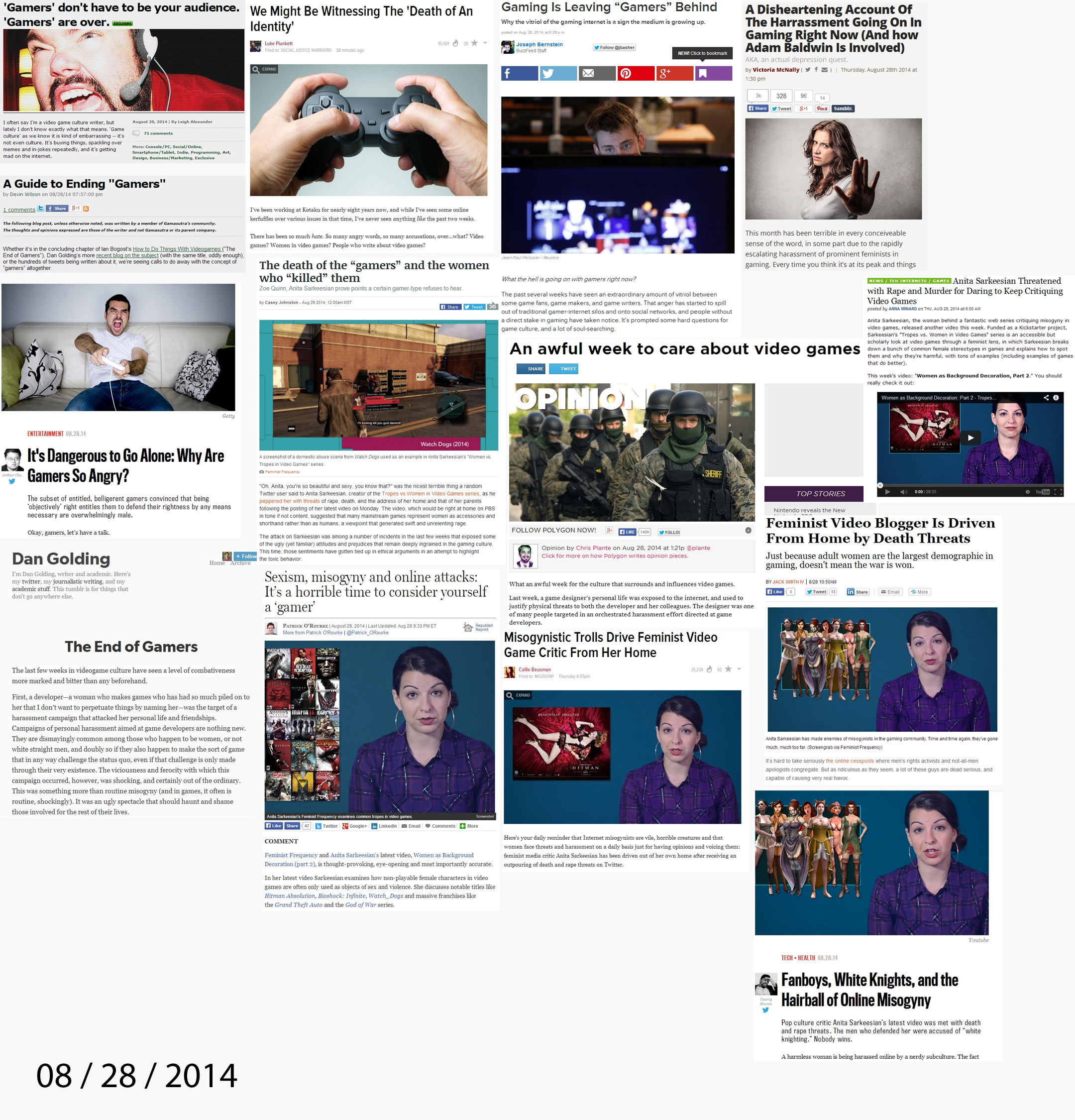
This isn't always the case, as #gamergate has (somewhat) demonstrated.  Madeley doesn't seem to have had her personal information posted online, as Zoe Quinn and Anita Sarkeesian have.  #Gamergate has also now been going for two months, an incredibly long time by internet standards for a drama to still be developing.  For those who've missed the whole farrago up to now, in microcosm #gamergate is either one of two things: a crusade against corrupt videogame journalism, or a dying, backwards community trying desperately to keep its domain in aspic, without politics, especially left-wing politics and feminism, gaining a foothold.

As you might expect, in reality it's neither.  Both sides doth protest too much: despite how gaming journalists have tried to argue there was no truth behind the claims of corruption from Quinn's ex-boyfriend, who detailed how she had slept with journalists and others in the wider industry while still in a relationship with him, there has long been a problem with cronyism at best and outright corruption at worst in gaming media.  Rather than face up to the initial outcry following the spreading of Eron Gjoni's allegations, one of the first responses came in the shape of multiple news and review sites declaring the "gamer" label itself dead, all on the same day.  You know, exactly the sort of collusion and refusing to listen the old media used to indulge in and still does, albeit on a smaller scale than before.

Then again, you can't exactly blame them considering some of the abuse directed their way.  Think the trolling of Caroline Criado-Perez et al except multiplied many times over.  Nearly everyone with even a passing role has been "doxed", items really have been sent through the post, and so on.  It has also been to a certain extent orchestrated, one internet subculture organising for all out war on another.  Their enemy is "SJWs", social justice warriors, imposing their values and standards on others whether they like it or not, and anonymous most certainly does not like it.

You'd think being something of a left-winger, believing wholeheartedly in equality and so on I would be in alliance with those criticising games and gamers for their continued Neanderthal ways.  And I would be, if that first response hadn't been so woefully constructed, the backlash against the mere asking of questions so vehement.  The reason this has gone on so long without burning itself it out is precisely because those on the side of Quinn and Saarkesian have risen to the bait over and over and over, just as Criado-Perez and those supporting her did.  Moreover, just as the coverage of the banknote campaign and its aftermath made clear how journalists themselves ramped it up due to how they knew those involved, or indeed, how they were being targeted themselves, so any semblance of objectivity went almost immediately.  It's shone a light on the vulnerabilities and insecurities of both sides, highlighting groupthink and the way narratives are constructed in this extremely new media landscape.

There is of course no defence for threats, for "doxing" people, for scaring them to the extent they feel compelled to leave their homes.  Concerted, sustained trolling has to be tackled in some way, and if that means involving the authorities, so be it.  You don't have to be a cynic however to note it's only some victims the media cares for, and there are plenty of journalists who have never taken to their writing becoming so open to criticism.  We've already seen people imprisoned for making tasteless jokes, or given community service for daring to make angry political statements. Handing judges the power to impose longer sentences for going beyond what we consider the bounds of free speech, will, as it always does, encourage them to use it, just as publicity also makes them believe they have to set an example the next time a spotty herbert with a miserable life and a hateful online alter ego appears before them.  The only people who ever truly poison national life are those in positions of power, and the vast majority of keyboard denizens have none.

Labels: , , , , , , , , ,

Share |

Monday, May 12, 2014 

The impossibility of freedom of speech.

Perhaps it's just the years spent examining my own navel, but for the most part I go out of my way not to be an appalling hypocrite, choose the easy target (yeah, right) or make the obvious riposte/joke about things.  When faced however with the fact that someone was starved enough for excitement in the first place to be listening to David Lowe's Singers and Swingers show on BBC Radio Devon, then was apparently so exercised by how the version of The Sun Has Got His Hat On he played included the original, n-word using second verse that they felt the need to complain, I find it difficult not to wonder about how desperately empty their life must be.  Those minutes spent contacting the BBC could have been used in any other way imaginable; life might not always be all we would like it to be, yet surely, surely, even the most miserable, wretched and pitiless individual could have come up with something more entertaining and intellectually nourishing to do than whinge about the content of an 82-year-old song?

No?  We are back in context land, you see folks.  I can perfectly understand the BBC cutting the Major scene from The Germans episode of Fawlty Towers, especially pre-watershed, not least when John Cleese has himself said it's not something he would write now.  When it comes to material pre-1960 though say, to cut racist dialogue or stereotyping out of either music or films is to deny history.  You're not protecting people, you're censoring something approaching the norm and which should be recognised as such precisely because we've moved on from then.  David Lowe didn't even realise the song featured the n-word, and either wouldn't have played it at all, or as would have been best, prefaced it by saying it contained some language we would view as offensive now but wasn't then.

The only reason the Mail on Sunday decided this was a front page story is obviously due to the discrepancy of treatment between Clarkson and Lowe.  Clarkson, like Lowe, offered an apology and got a final warning; Lowe offered an apology or resignation, and the BBC accepted the latter.  Who knows whether there were extenuating factors or a manager was already looking to get rid of the DJ,  off he went.  The BBC has since done a reverse ferret and offered him the show back; Lowe has declined on grounds of stress.  It looks bad, and it is bad.  Often the BBC ignores complaints on the reasonable grounds that most are from the usual suspects, either with an axe to grind, nothing better to do, or the consistently and never knowingly under-outraged.  Why they took the single complaint this seriously is anyone's guess, unless post-Sachsgate and the Savile/McAlpine disaster they've become far more proactive than previously.

Then again, they could just be entering into what seems to be the new spirit of the age.  Nearly 40 years ago newspaper editors worked themselves into a frenzy over the use of a word they no doubt heard and used multiple times every day.  In our brave new social media world, we have people who can only be described as half-wits making complaints to the police about tweets they don't like.  Rather than the police telling said half-wit to stop wasting their time with spurious politically motivated whining, they instead visit the individual targeted and ask him, despite no laws having been broken, to take the tweet down.  Everyone then duly wonders whether things can be really that slow in Cambridgeshire for two officers to find the time to make such a visit, and if perhaps we've reached a new low in the great giving and taking offence stakes.

On the surface at least, the problem is the law.  We have free speech, except we don't.  Article 10 of the ECHR allows free expression but makes reasonable exceptions, including for the prevention of disorder or crime.  Section 127 of the Communications Act 2003 duly makes it an offence to send a message that is grossly offensive (or menacing), which even by the standards of legislation that leaves it up to judges and juries to decide what can deprave or corrupt is by definition subjective.  As a result we've seen the likes of Matthew Woods jailed for three months for making unfunny, off-colour jokes, grossly offensive to some certainly, but par for the course for others.  Last week saw another victim, with Robert Riley jailed for eight weeks after tweeting in the aftermath of the murder of teacher Ann Maguire that he would have killed all of her colleagues at the school as well.  Riley was, predictably, another of those lonely people who enlivened his existence (spent as a full-time carer) by trolling, tweeting purposefully "outrageous" things in the hope of getting a response.  He had in fact as the judge noted sent other messages, including some that were racist in nature, but it was the couple about the dead teacher that resulted in Inspector Knacker getting involved.

Precisely what benefit anyone gains from sending pathetic misfits such as Woods or Riley to jail isn't clear.  It might make someone feel slightly better for a few hours, and could feasibly shock those convicted out of immaturity; it could also cause further bitterness, dare I say perhaps somewhat justifiably.  It certainly isn't a good use of resources, and yet despite the attention giving to trolling last August, the debate Keir Starmer urged nearly two years ago concerning the boundaries of free speech online hasn't really happened.  Abuse on the scale of that received by Caroline Criado-Perez is one thing; surely the despaired upon works of Woods and Riley ought to be something else.  We can't however seem to get perspective, as lazy journalists and also bloggers seek out the next comment or slight to get angry about.  We should hardly be surprised when the police and BBC management can't either.

Labels: , , , , , , , ,

Share |

Wednesday, May 07, 2014 

It gets better, despite the scaremongering.

The case of Hannah Smith is as desperately tragic as they come. The 14-year-old killed herself in August last year, writing a note found by her father asking whether her life was ever going to get any better. Her family say she had been bullied for up to three years, her personality changing markedly after going to a party where she was assaulted, her head twice hit against a wall. She became more insular and introverted, and as the inquest into her death heard, told friends on Facebook she was thinking of ending her life.

As terrible as every teenage suicide is, with the taboos around depression and mental illness still making it an exceptionally difficult topic to broach, in spite of the increased recognition of how many young people do struggle during what is already a difficult period of their lives, Smith's death wouldn't have become national news had it not been blamed in part on cyber-bullying. Coming just after the storm of media interest in the abuse meted out on Twitter to Caroline Criado-Perez and others involved in the Jane Austen banknote campaign, it looked another example of the dark side of the internet and the misuse of online anonymity by those without a care for others and no sense of responsibility.

Only as has now been confirmed at the inquest and was claimed by Ask.fm's owners within days of the story becoming front page news, the messages left on her page were not from bullies, but written by Hannah herself.  Giving evidence, investigating officer Wayne Simmons said the messages had originated from the same IP address as Hannah's, and also ruled out that the could have been spoofed.  On the balance of probabilities, she had resorted to a relatively new form of self-harm - attacking herself via different accounts, whether in an attempt to garner sympathy from friends and get them to defend her, or as just another representation of the self-loathing she felt.

The tabloids, and indeed, the prime minister, were not to know this had been the case.  Nonetheless, putting all of the blame onto Ask.fm and by turn social networking as they did, with calls for the site to be shut down and David Cameron supporting a boycott, was precisely the kind of response that hinders rather than helps with understanding how the way teenagers live has changed so radically in a little over a decade.  Cyber-bullying is certainly a problem - I for one am beyond thankful I left school behind just before the inexorable rise of social media, when the main hangout was MSN Messenger rather than sites like Ask.  Anonymous trolling or bullying by those not personally known to the victim is however very much a rarity, compared to the online continuation of torment by schoolmates, something that can make it seem as though there is absolutely no escape from your own personal hell.

This emphasis on the medium rather than message and on one specific factor as the overriding cause is to ignore most of what we know about depression and mental illness.  At times there can be one underlying reason - be it bullying, general unhappiness with life, the end of a relationship, the death of a relative or friend, but often it's a culmination of a number of things.  There are also usually warning signs, in Hannah's case both physical and mental self-harm, as well as talking about suicide.  Even if it were possible, shutting down somewhere like Ask would only result in another such site popping up in its place.  Understandable as it is to want to try and control these new apparent threats, it's just as undesirable and overbearing as doing the equivalent of wrapping children in cotton wool.

The danger is in overreaction, curtailing something that has given traditional outsiders or those being bullied precisely because they are "different" a refuge, a place where they can be reassured their interests or sexuality are not weird or character flaws.  For every teenager whose death has been blamed in some way on the internet, whether rightly or wrongly, there are hundreds of thousands, almost certainly millions whose lives have been transformed or made worth continuing with thanks to making new friends through social media or otherwise.  Without wanting to turn this into old versus new media, that's something the newspapers, always searching for the next passing frenzy, have to be forced if necessary to recognise.

Labels: , , , , , , , ,

Share |

Thursday, January 23, 2014 

Collymore and Ulrika.

I think I've made my views on trolling and Twitter pretty much clear, and don't really feel the need to repeat them again now in light of Stan Collymore's complaints about the abuse he's received for a while and which ratcheted up again at the weekend.  It should surely be noted though that unlike Caroline Criado-Perez, Collymore is in the business of making controversial comment on football and is no doubt well remunerated for doing so.  He's also pretty good at it, being the best thing on Talksport by a very long way.

Credit must nonetheless be given to both the Sun and Ulrika Jonsson for deciding this would be the perfect moment to bring up how back in 1998 Collymore attacked her and according, to Jonsson, said he "would fucking kill her".  No doubt he did.  One is also reminded however of how Jonsson's chosen way of promoting her autobiography was to focus on the allegation she made in it that she had been sexually assaulted earlier in her career, without naming the person responsible.  This, inevitably, led to speculation as to who it was, with Matthew Wright inadvertently naming John Leslie.  Jonsson chose not to cooperate with the subsequent police investigation into Leslie, with the CPS later dropping a prosecution against him at the last minute.

If we're going to bring hypocrisy into it, perhaps we should also consider the consequences of being deliberately vague and then not being prepared to pursue a case once the name of the person has become public.  As Ian Hislop said at the time, his general understanding was that you made complaints about sexual assault to the police, not the media (obviously, if the police ignore or don't act on complaints, then it certainly is legitimate to go to the media, although whether our press will treat ordinary members of the public's complaints with the same level of concern as they did someone like Jonsson, unless the individual being accused is also a celebrity, remains to be seen).  11 years on from that, and Jonsson is complaining about another incident that also resulted in no charges being brought, which Collymore apologised profusely for at the time.

Labels: , , , , , , ,

Share |

Thursday, January 09, 2014 

Revisiting the Twitter hate machine.

There has been, shall we say, an interesting response to the convictions this week of two of those who abused Caroline Criado-Perez on Twitter following her campaign for a woman to appear on a banknote.  At the time we were told repeatedly this was proof positive of how many women are treated when they dare to raise their voices in public for such causes, of the most vile misogyny, and how there needed to be a change in attitude by both social networks and the police to such incidents.  Some of us cautioned that the first two views especially seemed to ignore how trolling had developed, as well as how those who had previously been exposed as trolls tended to be rather pathetic individuals. Unlike political bloggers. Ahem.

Without saying the guilty pleas of John Nimmo and Isabella Sorley vindicate that stance, as it's evident that some of those behind the over 80 accounts who attacked Criado-Perez were motivated by little more than outright sexism, it doesn't exactly stand up the misogyny explanation either, something most of those commentating have curiously omitted from their write-ups. We shouldn't of course take the mitigating statements made by their solicitors completely at face value, but it doesn't surprise Nimmo was described as a pathetic friendless failure, whose only interaction with the outside world was to abuse public figures in an attempt to get online kudos.  Sorley meanwhile blamed her behaviour on both boredom and being drunk, the latter at least backed up by a string of convictions for being drunk and disorderly.

While you certainly can be a woman and a misogynist, Criado-Perez's explanation that our society is "so steeped in misogyny" that women joining in shouldn't be a surprise doesn't really cut it. Just as any ideology can blind you to far more prosaic explanations of behaviour, Criado-Perez's feminism seems to have stopped her from considering whether it might just be that Sorley is an immature person who's made some extremely bad decisions.  Going back through her tweets over the past six months, that certainly seems the more reasonable conclusion to draw.

Helen Lewis writes that the debate has been held back by how the abuse directed against Criado-Perez was so awful that it can't be quoted pre-watershed.  This seems a red herring: was the debate really held back?  I don't think it was; if anything, the response last July/August from the media was ridiculously over-the-top and misinformed precisely because those reporting on it were too closely linked to the people being abused.  I can more than empathise with Criado-Perez being deeply upset and changed by the nature of the worst of the abuse; a long, long time ago (we're talking over a decade ago) someone managed to find my address and threatened to come and beat me up, which even if extremely unlikely did cause me some worry.  No one deserves to be threatened in such an obscene way, yet they are just words, words delivered through a computer screen, and which are constructed precisely to garner such a reaction.  Feminists being threatened with rape or worse isn't instantly misogyny; it's pure trolling, the troll knowing that bringing rape into it is bound to result in a reaction.

Which is where I think so many have got it so wrong.  As Isabella Sorley tweeted, and I think we can take her word for it, "these people don't hate her, they are after a reaction and she is giving them one!"  The abuse went on and got worse precisely because it was bitten back against over and over, receiving such wide media attention.  Ignoring it completely obviously isn't an answer, but it's a better one than expecting either the police or Twitter to be capable of tracking down every individual who wrote something beyond the pale.  Wanting the police to investigate every instance as Criado-Perez seems to isn't just impossible, it would mean them also having to track down those who threaten racists, feminists who attack feminists, as well as those who tweet their disgust at the construct they've just witnessed on their TV screens.

Fundamentally, it does come back to the other point, the confusing of the internet you would like there to be with the one there actually is.  Some of those who took part in last summer's boycott were deeply shocked when they found that the part of the internet they occupied could be infiltrated by those from outside it.  Fact is that some users out there don't care for who you are, and are more than prepared to tell you about it.  Helen Lewis says we can't ignore what's happening and asks whether it will be enough to make us act, yet she doesn't suggest what we should do.  If that's because there is no real answer, and most of the suggestions as to how to deal with it either wouldn't work or would destroy fundamental online freedoms, as restricting anonymity would, then good.  If not, we either haven't learned anything, or simply don't want to.

Labels: , , , , ,

Share |

Monday, October 28, 2013 

Thoughts on the end of the liberal conspiracy.

Liberal Conspiracy is gone.  It's something that's clearly been approaching for a while, such has been the dwindling number of posts, but it's still rather sad.  My thanks go out to Sunny for considering my witterings to be worthy of occasionally featuring there, and I wish him luck in his future ventures.  This also seems as good a time as any for a brief interlude of introspection, so here we go.

Sunny pulling the plug on LC is indicative of where blogging has gone over the last couple of years, which is pretty much down the toilet.  Perhaps I just haven't kept up, but away from the group blogs it seems moribund.  A few are still going fairly strong, others aren't updated as regularly as before, while plenty have thrown in the towel.  Clearly, individual blogs can still grow exponentially, for which see Wings Over Scotland, it's just they need a well-defined niche.

I would say this, but for me the real explanation for the decline isn't the mainstream media coming late to the party and overtaking the amateurs, it's that most writers now spend their time on Twitter rather than blogging.  Each to their own and everything, I just don't like the format and way it inevitably leads to circle jerks, as well as the tendency it inspires in trying to one up those you disagree with, which leads absolutely nowhere.  It also seems to lead some to believe that Twitter, or rather their followers and those they follow are the internet, the culmination of which seemed to be the "boycott" of August.  I'd like to think blogging broadens rather than limits horizons, while social networking in general does the opposite.  Might just be me.

It may also be somewhat to do with how ghastly politics is and has been for the last couple of years.  People seem to have tuned out to the point where Russell Brand being his normal, half-berk half-idiot savant self inspires more comment than anything in months.  You can focus when the government of the day is doing one or two things that are spectacularly ill-advised and wrong; when the coalition seems determined to bugger things up on so many different levels, it tends to inspire apathy rather than opposition.  With so many struggling to make ends meet it also leaves you determined to make the most of the leisure time you have, and while I might be the kind of sad bastard who likes smashing out hundreds of words every day, plenty of others who might have started out before think better of it now.

All this said, I for one am still fairly happy to keep going on.  I'd be lying if I said I hadn't thought of putting an end to Obsolete/septicisle or whatever stupid name this site has quite a few times down the years, but for one reason or another I've continued.  Why stop now that the "competition" is dwindling?  Let's give it till Christmas, at least.

(Thanks to everyone who does humour me.  And if you're still reading, thank you especially.)

Labels: , , , , , ,

Share |

Thursday, August 08, 2013 

Save us from the trolls Dave!

There is growing pressure on social networking sites to do something about something tonight, as politicians and newspapers alike blame them for every single problem in the world today.

The prime minister David Cameron led the way, urging everyone to boycott ask.fm until it stopped working as any sort of service.  Speaking to Sky News, Cameron said: "These people have got to step up to the chicken basket and show some responsibility.  Simply allowing users of the site to block anonymous messages isn't good enough.  If someone makes nuisance phone calls, we obviously don't hold the caller responsible; we blame BT for allowing the call through in the first place, even if they have so-called call blocking available.  The same goes for the postal service.  If a mail bomb slips through the net and it kills someone, then obviously the postman who delivered it should be held accountable.  It's just common sense."

Expanding on his theme, Cameron continued: "Now while it's true that I hadn't heard of this ask.fm website until yesterday, that shouldn't stop me from talking about something I know absolutely nothing about.  I really do encourage a boycott, as I've also been told that the one organised by the delightful Caitlin Moran on Twitter was such a huge success last Sunday, at least until the new Doctor Who was announced.  If we stop using these sites, there's absolutely no chance whatsoever that people will simply move elsewhere, or that bullies will strike offline rather than online.  We must drain this eco-system of hate."

The tabloids meanwhile have called for more meaningful action.  Both the Sun and Daily Mail have demanded that ask.fm be banned, once again demonstrating their profound understanding of how the internet works.  Neither paper has any truck with bullies, as the comments section on the Mail website regularly demonstrates, regarded universally as a haven of informed, reasonable debate.  Likewise, columnists Richard Littlejohn and Jan Moir would never dream of writing about minorities in a prejudiced or inflammatory style.  As for the Sun, only those with extremely long memories can recall that during its campaign for Baby Peter the social workers involved with his case were urged to kill themselves by those commenting online, something that might cause a few regrets considering that two of the paper's journalists charged in connection with Operation Elveden have since had their own mental health problems.

We asked a random nerd slamming away at a keyboard for his take on these events.  "It's all a bit knee jerk, isn't it?  For a start, we don't know exactly why these four young people took their own lives.  Were they just being bullied on ask.fm, or were they being bullied offline as well?  Did they have other relationship problems, or had any relatives or friends recently been ill or died?  I've had depression myself, and I find it difficult to believe that it was just bullying online that led them to take such a drastic step.  It could have been the trigger, or the last straw certainly, but we can't just blame a website without knowing the full facts, and you would have thought anti-bullying and children's campaigners would know that."

"Besides, why is it that parental responsibility seems such a foreign concept when it comes to the internet?  Yes, it's difficult if you don't understand the technology and the slang, and when you can't have complete control due to almost every device now having net access, but clearly you have to talk with your kids about the sites they use and let them know they can always come to you if they don't feel safe.  It's no use blaming a service if you don't use the privacy settings it has available.  Those truly responsible here are the pathetic little shits who think it's hilarious to tell 14-year-old girls they're fat and ugly and should die. How about we go after the messengers rather than the message provider?"

"As for the tabloids, could you possibly tell it's the silly season? Any passing frenzy will do, even if it's likely that the internet as a whole helps those who feel excluded in real life far more than it harms those already vulnerable (just look at the It Gets Better campaign). They're also looking for anything to distract from their own far from honourable record when it comes to treating those who come to their attention with respect, especially as argument continues over the royal charter to establish the new press regulator."

A reward (a wine gum and a can of cream soda) is being offered for any information that leads to the tracking down of a Labour shadow minister.

Labels: , , , , , , , , ,

Share |

Monday, August 05, 2013 

The epitome of modern self-absorption.

Right, can we cut the crap now?  This Twitter nonsense has gone on for far, far, too long.  The trolling of Caroline Criado-Perez et al has almost nothing to do with feminism, or misogyny. What it does have to do with is a internet subculture that has been there for years, and has become most known thanks to the exploits of Anonymous, but most certainly did not originate with 4chan, or even the Something Awful forums.  Once upon a time, websites and their forums got "raided". Sometimes this happened justifiably, more often on a whim or on the basis of a deemed insult.  In essence, what would happen is that message boards would be flooded, goatse and plenty of other gross pictures would be posted, and a bad time would be had by members of the specific community.  As time has gone by, the targets have switched from being just forums to online games, and yes, social networking profiles.

From here, it's easy to understand how Anonymous broke through, although it's always surprised me that for the most part the main Anonymous grouping has had broadly left-wing political aims, as it always seemed to be the libertarians that shouted the loudest on the sites where its support sprung from.  Nonetheless, the potential has always been there for a similar grouping to emerge that while holding similar views on internet freedom to Anonymous eschews politics and instead just goes after whoever takes their fancy today.  I'm not saying this is what has happened in this instance, as it doesn't look as though the trolling is fully co-ordinated, but in the main the abuse is so obvious as to be laughable.  Some of it is plain misogyny, such as that coming from those using their own names and talking about "smashing up the arse", while talk of "all aboard the rape train" or anyone putting "lololol" or the like in their message pretty much gives the game away.

The real problem we have here then is that the likes of Caitlin Moran and all those that "boycotted" Twitter yesterday just don't understand the way the internet used to work and still does work outside of their own personal bubbles.  The only way to deal with being "raided" is to pull up the drawbridge, or ignore it.  Instead, we've had a media frenzy and surprise surprise, the abuse and rape threats keep coming.  Twitter itself has gotten the blame for something that has happened on every previous messaging platform and which they have all had difficulty dealing with.  Much of the trolling is coming from "one use" accounts, making it difficult for Twitter to do anything even if there was an easier way of reporting abuse, which itself would be a nightmare to administrate however many staff Twitter took on to do so.

It's understandable that those who have been subject to the abuse have taken it as being about men trying to silence women, about centuries of misogyny etc, but there isn't the same excuse for those who ought to know more about the wider internet.  The vast majority of those trolling won't be chauvinists but rather those who've taken exception, for whatever reason, to someone who ends up in the public eye, usually as a result of conducting themselves arrogantly.  They use insults or threats that they know will get a response, hence the emphasis on rape or death.  I might be blasé as in the past I've done my fair share of trolling and have in turned also been trolled, and threatened with getting beaten up etc, but I would have just laughed at most of the messages that have been sent. Reporting them to the police is the equivalent of a red rag to a bull, while treating it as though it's the most pressing issue for women in general is to lose all sense of proportion.

If anything, the whole debacle has just illustrated both how up themselves a hell of a lot of people are, and how they don't like it when the boot is on the other foot.  Anyone with a decent amount of followers can swiftly get anyone who criticises them, unfairly or not, an online mullering, as some have pointed out Moran and the likes of Suzanne Moore aren't above doing.  That number at the top of a profile only encourages the belief that they are an internet big shot; I have 30,000 people hanging on my every word, how can Twitter possibly cope if I simply stop enthralling every single one of those individuals?  The answer, it ought to be obvious, is that Twitter couldn't care less about political and media luvvies. It might have done a few years back before the site was embraced by celebrities, but it doesn't now when there are millions of 12-year-olds who use it only to declare their undying love for Justin Bieber or One Direction and who are the ones paying for the servers.  The idea of boycotting a free service in itself is only marginally less stupid than going on hunger strike in solidarity with those at Guantanamo, but going about it as some did just emphasised how out of touch with reality they've become.

None of this is to condone the nasty and malicious trolling Criado-Perez and Stella Creasy amongst others have been subject to. It has however revealed just how self-regarding and self-obsessed the modern media has become, and just how quickly it can find itself outside of its comfort zone. It might also highlight how little regard there is for some of them at the same time as they think they've mastered the new environment. One suspects though that this will go completely over their heads as they carry on #shoutingback.

Labels: , , , , ,

Share |

Sunday, August 04, 2013 

Internet!

A number of Twitter users say they are boycotting the website for 24 hours.

Yeah.  You know when something starts off stupid and just keeps dafter until it finally explodes due to the sheer fuckwittedness of all involved?  This is the ne plus ultra.  It's like Clockwise but without the laughs.

Labels: , , , , ,

Share |

Monday, July 29, 2013 

The Twitter hate machine.

I've come to the conclusion that Twitter is the new arsehole of the internet.  There have been many sites that have combined both the best and the worst of the internet previously, but for the most part the media ignored them.  Twitter you can't ignore: there is almost always one story on the Graun's front page about something that's happened on there, regardless of importance, precisely because it's been so adopted by the media, even more so than Facebook has.  These self-same people are in the main the ones that are so shocked that, horror of horrors, there are some really rather nasty people on the internet who enjoy making empty threats against those in the public eye.  Trolling goes back to the earliest days of BBSes; it's only really moved on in that some people are now so confident they troll or flame using their real names.

Stewart Lee couldn't have been more right when he described Twitter as "a government surveillance operation run by gullible volunteers, a Stasi for the Angry Birds generation".  Twitter both monitors and reports, and if you're one of those caught up in a periodic furore when it's decided someone completely lovely has been unfairly traduced, then watch out.  Enter Caroline Criado-Perez, who just so happens to be a freelance hack.  Following her campaign to get true feminist icon Jane Austen on the £10 note, she was subjected to some pretty par for the course abuse on Twitter.  Regardless of who you are, if you become even briefly notable, you will get flamed and trolled, however unwarranted such treatment is.  It's how the internet has always worked.  Where once we just swore at the TV, now some people swear in public via Twitter.  It isn't pleasant, but a lot of people have found there's little to do other than put up with it.  Hell, just a fraction of the criticism and abuse Lee has received makes up part of his last show, Carpet Remnant World.  Turn it to your advantage; ignore it; block people; let them get on with it; or, and this is a really scary one, try and do without the stupid thing.  You might just be able to.

Don't though claim this is a unique problem for women online, because it isn't.  Yes, it's true that women tend to be abused in a far more degrading and sexual way than men are, as just some of the tweets directed at Criado-Perez suggest.  This is mainly due to how, again surprise surprise, the vast majority of trolls are men (or often boys), and usually men whose lack of social skills has made them especially embittered towards women.  As another report currently on the Graun's front page makes clear however, men can and have received almost identical treatment.  Stan Collymore has previously highlighted the racist tweets that were being sent about Patrice Evra in the aftermath of the Suarez affair, while even the slightest digging will find people being unbelievably stupid on the site, such as those complaining about the royal baby being assigned a "gender role".

This is the problem with bringing the police into the equation.  Not only would they never be able to cope if every potentially lawbreaking tweet was reported to them, it raises fundamental questions about fairness and just how abuse in response to abuse should be treated.  As Anorak points out, plenty of people said that Emma West, the woman convicted of a racially aggravated public order offence on Croydon tram, should be raped or killed yet no one it seems was arrested for saying so.  Nor were those who called for Azhar Ahmed to be killed prosecuted, despite the fact that they went further than he did.  The courts have also so far failed to take into consideration the "disinhibition" effect the internet has when sentencing those who have been convicted of going beyond the limits of free speech online: the two Facebook "rioters" were jailed for a staggering four years, longer than many of those who actually did riot, while Matthew Woods was given a three-month sentence for posting a bad taste "joke" about April Jones.  Those who want certain kinds of trolling to be treated as criminal or online threats as equivalent to those made in public or over the phone have to be comfortable in the knowledge that similar punishments will inevitably follow.

The most obvious reason as to why Twitter doesn't have an easy report feature is that it would be endlessly abused.  Moreover, if you are being subjected to an orchestrated campaign of abuse as Criado-Perez says she was, then the police probably are the right people to turn to rather than Twitter itself.  There's trolling and flaming, and then there's bullying.  To repeat a point, there's also an off switch.  Until relatively recently we managed to go without constantly bombarding each other with messages of 140 characters or fewer.  Yes, some people on the internet probably hate you.  More importantly, some people in real life probably like you.

Labels: , , , , ,

Share |

Wednesday, June 05, 2013 

Check yourself before you wreck yourself.

Oh, the fun there clearly is to be had on Twitter if you're a member of the squabbling classes.  Somehow, I'd managed to avoid knowing about this whole "check your privilege" thing, which has apparently become err, quite the thing.  On the surface, it's a perfectly reasonable concept and is closely related to thinking before you speak, only for those who spout on about politics. Do you have personal experience of the subject you're talking about? If you don't, do you think that if you had it might change your perspective?

Only, as is the way of the internet, it's gone beyond this and turned instead into a way to shut down debate and maintain the walls between self-identifying groups, some of whom are incredibly quick to take offence at the slightest perceived insult. Think the row that blew up after Suzanne Moore's throwaway remark that women were meant to aspire to the body image of a Brazilian transsexual, which quite incredibly led to someone trying to claim that she might have further incited hatred against the already under threat transsexual community there.

Enter both Louise Mensch and Dan Hodges, neither of whom are impressed with how this phrase seems to have become popularised. Not that Hodges actually argues against it, he just mocks it, which is pretty much how he approaches everything he disagrees with.  As for Mensch commenting on privilege, wouldn't it be lovely if all of us could abandon those we'd pledged to represent for 5 years to move to the US? Her wider point, that feminists in the US organise while those over here argue on the internet, is also easily disproved.

There are though obvious problems with approaching subjects from this perspective, and these haven't been adequately answered by those defending the practice. First, that it is utterly ridiculous to expect a work of fiction to address how you specifically identify yourself. As a twenty-something white British male, I literally couldn't give a shit about a bunch of twenty-something white American upper middle class females, which is why I haven't watched Girls. When Caitlin Moran tweeted she literally couldn't give a shit about how Girls doesn't include people of colour, despite being set in Brooklyn, she wasn't being racist, just pointing out that it's incredibly difficult to write about something you have very little knowledge of.  Lena Dunham might have plenty of black friends and acquaintances, or she may not, but clearly what she knows best and can both portray and satirise in equal measure is the world that she has lived in and experienced.  Write about what you know.  It's one thing to expect a soap opera to reasonably represent the wider world we live in, since it's at least somewhat attempting to be realistic, it's another to demand it of a comedy set in a contained world, however much it purports to be commenting on how we live now.

Second is the dead end of intersectionality.  I would say this as something of an old socialist, but there is nothing that divides and also unites us as much as class.  This isn't to deny that gender, race and sexual orientation don't also have a major impact on prejudice, or that at times they don't all interrelate, it's that this compartmentalising of everything is getting us nowhere.  The emphasis on identity politics has achieved many things, but it hasn't succeeded in having an impact on overall inequality.  Nor does it help when Laurie Penny comes across as condescending of anyone who doesn't understand the theory, saying that schoolchildren have been using the term on the internet for years.  Have they? Are all schoolchildren now studying sociology at an advanced level?

Third, and most importantly, asking someone you disagree with to check their privilege doesn't work when those they're actually talking about act in ways that don't fit their own prejudices.  Consider the extremely sad case of Emma West, the woman whose rant on a tram in Croydon went viral after someone filmed it and put it on YouTube.  To say that she was demonised wouldn't be putting it too strongly; here was the reality of casual racism in modern Britain, in all its uneducated, drunken glory, or so went the majority of the responses.  Only today did we learn of West's background when she pleaded guilty to the charge of a racially aggravated public order offence: she's suffered from depression since she was 18, and had only been released from a psychiatric ward two months previously.  On the day itself she had taken a double dose of her medication, explaining why she seemed inebriated.  Since the video was posted online the hearing itself has been repeatedly postponed due to her mental health, something not helped by the fascists and racists of both the National Front and BNP wanting to befriend her.  Thankfully, the judge has indicated he will be imposing a community rather than a custodial sentence.

Whatever the original worthy intention was, the "check your privilege" meme has turned into just another example of social networks reinforcing our original views rather than challenging them.  Despite Penny writing of bloggers changing their perspective when challenged with better information, my experience is overwhelmingly of the opposite, and as Twitter is a supercharged version of a personal blog, it only exacerbates this further.  Nothing gets solved, and unnecessary antagonism and mockery are the end result. Some of which, quite frankly, is downright deserved.

Labels: , , , , , , ,

Share |

Tuesday, April 23, 2013 

Boston: new and old media equally awful.

There are occasions when a distinct minority within society temporarily lose all sense of perspective.  One such moment in this country was the death of Princess Diana, which rather than undermining the royal family when their slow response to the news was criticised seems if anything to have entrenched the institution further into public life.  Another was on the third night of the riots of August 2011, and I have to admit to being at least somewhat drawn in on that occasion, although I was hardly among those calling for the army to be brought in and for the police to start fragging the underclass, as supposedly more rational commentators were.

Thursday and Friday last week were without a doubt another example, even if it was less about ordinary people and instead those in the media and others who spend far too long on social media.  It can't be said that such a outbreak of crass stupidity and silliness hasn't been coming for a while; over here we had the media coverage of the Raoul Moat saga, while in the US, where the media has long had form in covering getaways and the aftermath of incidents of mass violence in the worst way possible, the more recent search for Christopher Dorner flagged up what was likely to happen next.

This said, it's still difficult to wrap your head around just how daft things ended up being. Last week was without a doubt an appalling one for the mainstream media, who on numerous occasions got the facts completely and utterly wrong.  It won't do however to lambast the "old" media while giving the "new" something approaching a pass, as the Graun does in its editorial and others effectively have.  Old and new have become inextricably linked; they feed off each other, which makes those who criticise one and praise the other or write off the old so short-sighted.

The most obvious example of imagining the internet and the supposed wisdom of crowds can solve almost everything was the thread on Reddit (although there were others elsewhere too) dedicated to finding the bombers by going meticulously through all the available pictures and video they could get hold of.  Once details began to emerge of how at least one of the bombers was wearing a hat and carrying a backpack, every person who could be found fitting the description was picked out.  In spite of this, and although they were considered, neither of the Tsarnaev brothers were felt likely to be the perpetrators.  Those that were picked out though were understandably terrified, especially when they were found on social networks, even if this also quickly meant they were disregarded as possibly responsible.  For all the claims that this makes such efforts "self-correcting", the damage either has or quite easily could have already been done.  The relatives of Sunil Tripathi, who in spite or rather because he had been missing for a month was at one point named as a suspect, had to take down the page dedicated to looking for him as it was being bombarded by comments.

This is far from the first time that "internet detectives" have mobilised efforts to find people or name those alleged to be responsible for certain actions, with Anonymous having recently targeted an innocent in the Amanda Todd case, but it is almost certainly the most notable incidence where it seems to have hampered the actual police investigation.  There isn't as yet a full account of why the images of the Tsarnaevs were released when they were and so we should wait before passing full judgement, yet there are plenty of suggestions that they were issued in part because of all the speculation.  This could have quite easily destroyed any chance of the two being taken into custody without the carnage that followed, although again it's just as possible that it did, alerting them to the fact the net was closing in; Dzhokhar was still using Twitter right up until it seems he fled.

Once the pair were being pursued, just how badly things could have gone became clear. We know all too well in this country what can happen when terrorists are deemed to be on the run and the police have been briefed that they could strike imminently; in Boston there was the added impetus that one of their own had been killed. If anything, it's a miracle more weren't injured or killed when so many armed police were marauding the streets with their fingers on the trigger. That it seems Dzhokhar spent most of the time the city was on lock down in the boat he was found in only underlines how differently things could have gone.

The media as a whole for their part didn't have a clue what was going on, although that certainly didn't stop them from suggesting they did. Apart from the odd moment where the BBC were all but making fun of the continuing lockdown and the Graun took to mocking Lindsey Graham, the lack of any insight whatsoever was what we've come to expect from live coverage for the sake of it.

Not that there's been a lot of it since either. In spite of the lengthy profiles on the pair written up on the basis of internet accounts and short interviews with friends and relatives, we don't have the slightest indication as yet why they did what they did. The elder brother clearly had an interest in the more extreme brand of Islam, but that doesn't begin to explain what motivated him to bomb those he previously only hadn't understood. As for Dzhokhar, no one seems to have a bad word to say about him, and rather than being the austere kind or openly religious, he's reported to have been a stoner.

The answer, ultimately, to why it is that America reacts differently to gun massacres than it does to attacks such as the one in Boston is that it's become inured to gun violence. It no longer shocks. It takes something on the level of Newtown when young children were the main victims to really shake people. It also allows everyone to look outside for answers and for something to blame rather than looking closer to home.  The response from old and new media alike since last Monday has done everything to encourage that, nor is it likely to get any better in spite of the merited criticism levelled at both.

Labels: , , , , ,

Share |

About

  • This is septicisle
profile

Archives

Powered by Blogger
and Blogger Templates