Poisoning national life? That'll be two years.
Gosh, was it really but two weeks ago some of the internet world was up in arms over the apparent suicide of Brenda Leyland, aka Sweepyface, aka one of those meanies still obsessed with the disappearance of Madeleine McCann and still insisting her parents might have had something to do with it, or at least bear some responsibility? Unpopular opinions certainly, but not illegal, and probably not really deserving of a doorstepping from a Sky reporter.
How fast things move these days. Just as we saw in the aftermath of the riots, when some judges took it upon themselves to hand down harsher sentences to those who didn't riot but suggested they might than to some of those who did, so now Chris Grayling promises the maximum sentence for "trolls" will be lengthened from the current six months to 2 years. Anyone would have thought we don't have a prison system in crisis, one where the debate over whether Ched Evans should be allowed to play football again ought to have been delayed until he'd served the full 5 years he was given after being found guilty of rape, but no, space can always be found for those who "poison our national life".
Apparently Chloe Madeley was last week subjected to "online terrorism". I say apparently as I really, truly, don't care enough to look any deeper. One suspects the rape threats she received amounted to what they usually do, a handful of people, sometimes not even that, reaching for the most obvious weapon in their verbal arsenal, either sexual assault and/or death. Back in the day, we called the people whose first response to getting bested in argument was to say the equivalent of "I'd beat u up m8" internet tough guys. Because in the majority of examples, that's all they are: cocky and arrogant online but likely to shit themselves if someone took them up on the offer and arrived on their doorstep.
This isn't always the case, as #gamergate has (somewhat) demonstrated. Madeley doesn't seem to have had her personal information posted online, as Zoe Quinn and Anita Sarkeesian have. #Gamergate has also now been going for two months, an incredibly long time by internet standards for a drama to still be developing. For those who've missed the whole farrago up to now, in microcosm #gamergate is either one of two things: a crusade against corrupt videogame journalism, or a dying, backwards community trying desperately to keep its domain in aspic, without politics, especially left-wing politics and feminism, gaining a foothold.
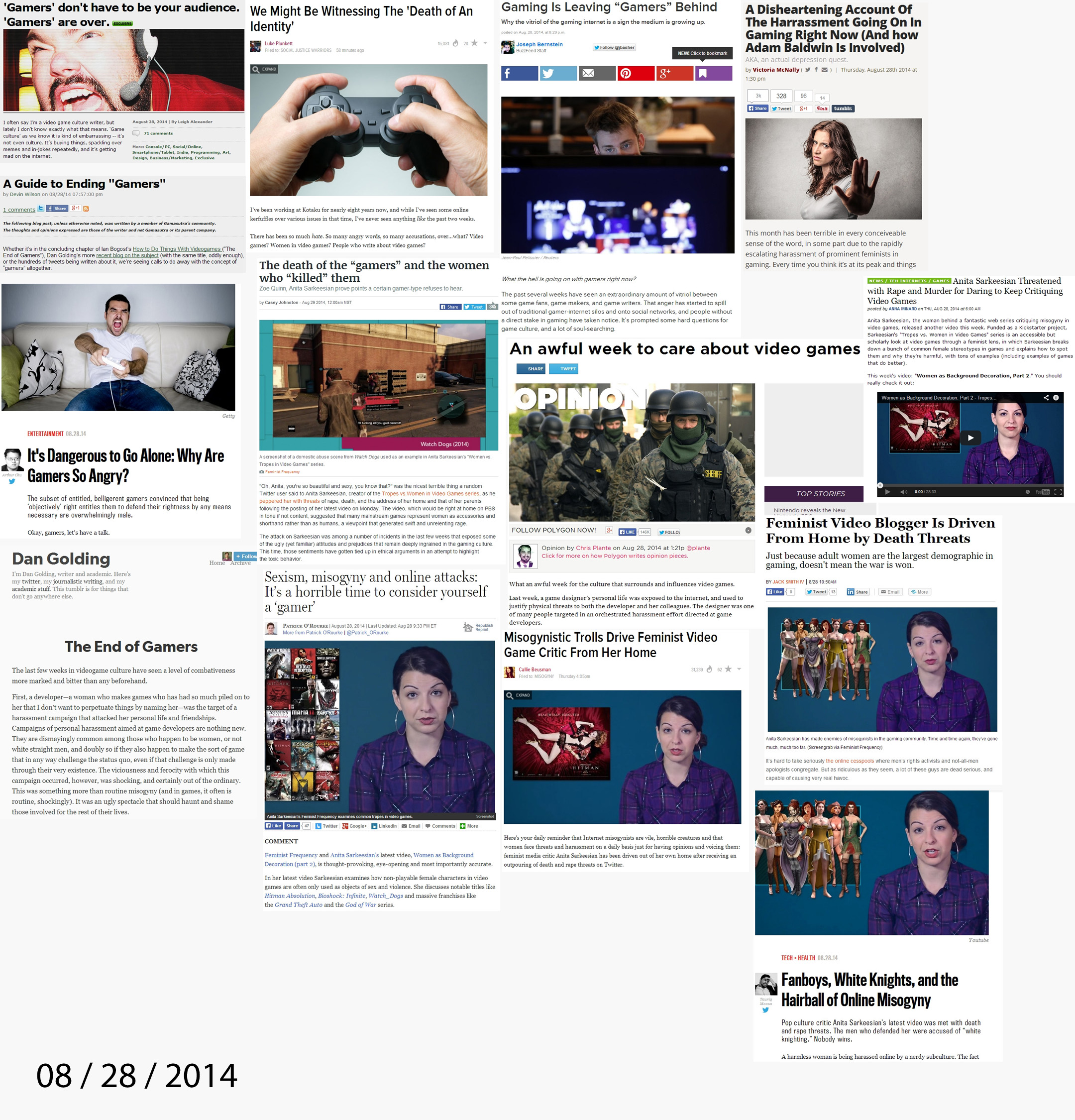
As you might expect, in reality it's neither. Both sides doth protest too much: despite how gaming journalists have tried to argue there was no truth behind the claims of corruption from Quinn's ex-boyfriend, who detailed how she had slept with journalists and others in the wider industry while still in a relationship with him, there has long been a problem with cronyism at best and outright corruption at worst in gaming media. Rather than face up to the initial outcry following the spreading of Eron Gjoni's allegations, one of the first responses came in the shape of multiple news and review sites declaring the "gamer" label itself dead, all on the same day. You know, exactly the sort of collusion and refusing to listen the old media used to indulge in and still does, albeit on a smaller scale than before.
Then again, you can't exactly blame them considering some of the abuse directed their way. Think the trolling of Caroline Criado-Perez et al except multiplied many times over. Nearly everyone with even a passing role has been "doxed", items really have been sent through the post, and so on. It has also been to a certain extent orchestrated, one internet subculture organising for all out war on another. Their enemy is "SJWs", social justice warriors, imposing their values and standards on others whether they like it or not, and anonymous most certainly does not like it.
You'd think being something of a left-winger, believing wholeheartedly in equality and so on I would be in alliance with those criticising games and gamers for their continued Neanderthal ways. And I would be, if that first response hadn't been so woefully constructed, the backlash against the mere asking of questions so vehement. The reason this has gone on so long without burning itself it out is precisely because those on the side of Quinn and Saarkesian have risen to the bait over and over and over, just as Criado-Perez and those supporting her did. Moreover, just as the coverage of the banknote campaign and its aftermath made clear how journalists themselves ramped it up due to how they knew those involved, or indeed, how they were being targeted themselves, so any semblance of objectivity went almost immediately. It's shone a light on the vulnerabilities and insecurities of both sides, highlighting groupthink and the way narratives are constructed in this extremely new media landscape.
There is of course no defence for threats, for "doxing" people, for scaring them to the extent they feel compelled to leave their homes. Concerted, sustained trolling has to be tackled in some way, and if that means involving the authorities, so be it. You don't have to be a cynic however to note it's only some victims the media cares for, and there are plenty of journalists who have never taken to their writing becoming so open to criticism. We've already seen people imprisoned for making tasteless jokes, or given community service for daring to make angry political statements. Handing judges the power to impose longer sentences for going beyond what we consider the bounds of free speech, will, as it always does, encourage them to use it, just as publicity also makes them believe they have to set an example the next time a spotty herbert with a miserable life and a hateful online alter ego appears before them. The only people who ever truly poison national life are those in positions of power, and the vast majority of keyboard denizens have none.
How fast things move these days. Just as we saw in the aftermath of the riots, when some judges took it upon themselves to hand down harsher sentences to those who didn't riot but suggested they might than to some of those who did, so now Chris Grayling promises the maximum sentence for "trolls" will be lengthened from the current six months to 2 years. Anyone would have thought we don't have a prison system in crisis, one where the debate over whether Ched Evans should be allowed to play football again ought to have been delayed until he'd served the full 5 years he was given after being found guilty of rape, but no, space can always be found for those who "poison our national life".
Apparently Chloe Madeley was last week subjected to "online terrorism". I say apparently as I really, truly, don't care enough to look any deeper. One suspects the rape threats she received amounted to what they usually do, a handful of people, sometimes not even that, reaching for the most obvious weapon in their verbal arsenal, either sexual assault and/or death. Back in the day, we called the people whose first response to getting bested in argument was to say the equivalent of "I'd beat u up m8" internet tough guys. Because in the majority of examples, that's all they are: cocky and arrogant online but likely to shit themselves if someone took them up on the offer and arrived on their doorstep.
This isn't always the case, as #gamergate has (somewhat) demonstrated. Madeley doesn't seem to have had her personal information posted online, as Zoe Quinn and Anita Sarkeesian have. #Gamergate has also now been going for two months, an incredibly long time by internet standards for a drama to still be developing. For those who've missed the whole farrago up to now, in microcosm #gamergate is either one of two things: a crusade against corrupt videogame journalism, or a dying, backwards community trying desperately to keep its domain in aspic, without politics, especially left-wing politics and feminism, gaining a foothold.
As you might expect, in reality it's neither. Both sides doth protest too much: despite how gaming journalists have tried to argue there was no truth behind the claims of corruption from Quinn's ex-boyfriend, who detailed how she had slept with journalists and others in the wider industry while still in a relationship with him, there has long been a problem with cronyism at best and outright corruption at worst in gaming media. Rather than face up to the initial outcry following the spreading of Eron Gjoni's allegations, one of the first responses came in the shape of multiple news and review sites declaring the "gamer" label itself dead, all on the same day. You know, exactly the sort of collusion and refusing to listen the old media used to indulge in and still does, albeit on a smaller scale than before.
Then again, you can't exactly blame them considering some of the abuse directed their way. Think the trolling of Caroline Criado-Perez et al except multiplied many times over. Nearly everyone with even a passing role has been "doxed", items really have been sent through the post, and so on. It has also been to a certain extent orchestrated, one internet subculture organising for all out war on another. Their enemy is "SJWs", social justice warriors, imposing their values and standards on others whether they like it or not, and anonymous most certainly does not like it.
You'd think being something of a left-winger, believing wholeheartedly in equality and so on I would be in alliance with those criticising games and gamers for their continued Neanderthal ways. And I would be, if that first response hadn't been so woefully constructed, the backlash against the mere asking of questions so vehement. The reason this has gone on so long without burning itself it out is precisely because those on the side of Quinn and Saarkesian have risen to the bait over and over and over, just as Criado-Perez and those supporting her did. Moreover, just as the coverage of the banknote campaign and its aftermath made clear how journalists themselves ramped it up due to how they knew those involved, or indeed, how they were being targeted themselves, so any semblance of objectivity went almost immediately. It's shone a light on the vulnerabilities and insecurities of both sides, highlighting groupthink and the way narratives are constructed in this extremely new media landscape.
There is of course no defence for threats, for "doxing" people, for scaring them to the extent they feel compelled to leave their homes. Concerted, sustained trolling has to be tackled in some way, and if that means involving the authorities, so be it. You don't have to be a cynic however to note it's only some victims the media cares for, and there are plenty of journalists who have never taken to their writing becoming so open to criticism. We've already seen people imprisoned for making tasteless jokes, or given community service for daring to make angry political statements. Handing judges the power to impose longer sentences for going beyond what we consider the bounds of free speech, will, as it always does, encourage them to use it, just as publicity also makes them believe they have to set an example the next time a spotty herbert with a miserable life and a hateful online alter ego appears before them. The only people who ever truly poison national life are those in positions of power, and the vast majority of keyboard denizens have none.
Labels: #gamergate, bloggocks, Caroline Criado-Perez, Chloe Madeley, Chris Grayling, feminism, media analysis, social networking websites, trolling, Twitter
| Permalink