Thursday, November 12, 2015 

Cameron has always been the PR man. Osborne isn't.

The much commented on, if not as widely reported exchange of letters between David Cameron and Oxfordshire council leader Ian Hudspeth is unquestionably brilliant.  It's not often a prime minister is treated like an especially boneheaded teenager might be by an exasperated teacher, with Hudspeth having to explain one more time exactly why it is that he cannot follow the "best practice" of other Conservative councils as Dave suggests.  Oxfordshire has already made back office savings, dispensed with "surplus assets", cut everything other than social care.  Spending has not increased, Hudspeth makes clear, and the council has not cut only a mere £242m so far.  £242m was not a cumulative figure, as Dave wrote, the cumulative figure in fact being £626m.

As Rick says, the prime minister's advice is the equivalent of a quack applying more leeches to a dying patient.  He seems to believe the same solutions as were proposed back in 2010 are still valid now.  He's far from alone in this of course, with Theresa May crowing about how the cuts to the police have proved once and for all that more can be done with less, at the same time as forces consider sponsorship deals to bring in cash and as residents in rural areas are employing private security to patrol.  Just today the sports minister Tracey Crouch advised people having difficulties making ends meet to cancel their Sky subscriptions.  Some doubtless would regard giving up Sky as a breach of their fundamental human rights, but the idea many living on the breadline, relying on food banks or worrying about cuts to their tax credits are paying their dues to Rupert Murdoch doesn't fly.  Many of those people would be in an even worse position if they couldn't access the internet, something satellite and cable providers also happen to provide.

While some in the government might be oblivious or ignorant as to exactly what it is they're asking of both their colleagues at the local level and of the very people they've been elected to represent, there's also those who are very much aware.  George Osborne for instance, who earlier in the week celebrated those departments that have already outlined the amount they can save two weeks ahead of his comprehensive spending review.  Should his attempt to cut tax credits be scuppered or the amount due to be saved fall in the effort to soften the blow, that money will have to be found elsewhere.  With the triple-lock on pensions, all the ring-fenced departments and tax rises verboten, although not as a result of the public being opposed as Ken Clarke claims, rather due to politicians refusing to make the political case for doing so, the only areas left to target are those cut to the bone already.

Indeed, the "impossible constraints" Clarke talked about are entirely of Osborne's own devising.  Running a surplus is a choice, rather than an imperative central to our economic security as the chancellor claims.  As the Guardian's leader today argues, it's true Osborne is not the crude neo-Thatcherite as he is sometimes painted.  He has been more flexible than that, and has stolen Labour and Liberal Democrat policies when it's suited him.  He has also though presided over a hollowing out of the state, to the point where it looks to be perilously close to collapsing in on itself.  Hudspeth is far from the only council leader worrying about where it is he's going to make further savings from, not least when raising council tax above 2% requires a local referendum to be held.  Asking for cuts of 30% on top of a reduction in funding which has amounted to 37% so far, according to the National Audit Office, can mean the only place left to make savings is by cutting the frontline.  So far, in part thanks to how Labour did "fix the roof while the sun was shining", most services have held together.  You wouldn't bet on the same being the case come 2020.

Rest assured however that as the NAO report also found, the Department for Communities and Local Government is on the case.  The DCLG in their words has a "a limited understanding of the financial sustainability of local authorities and the extent to which they may be at risk of financial failure" and also "does not monitor the impact of funding reductions on services in a coordinated way."  Like the prime minister, they haven't got a clue.  Still, by 2020 all things going well Osborne will be our new overlord, primed and ready to explain why absolutely nothing is his or the Tories' fault.

Labels: , , , , , ,

Share |

Tuesday, September 15, 2015 

The sensible party, or the stupid party?

Never underestimate the Conservative party's innate stupidity.  If there is only one lesson to be drawn from today's vote on cutting tax credits, it's that the Tories haven't properly grasped the whole party of "working people" thing, despite their laughable rhetoric.  Here they are, presented with an opposition leader they couldn't have imagined in their wildest dreams, going to the TUC and praising strikers, attacking them as "poverty deniers", and what do they do?  Err, carry on with a policy which even they accept will take money away from those on low wages, money which will not be made up by either the "national living wage", or by any increases in the income tax threshold.

How many Tories rebelled against this remarkably dense act of hubris, which Labour will now be able to exploit from now until the election, even if voters don't notice immediately and it instead only dawns on them how much the government is fucking them over come next year when the change becomes apparent?  Two.  Yep.  Two Conservative MPs saw this cut for the disaster it is guaranteed to become, of a piece with Gordon Brown's cack-handed removal of the 10p tax band.  David Davis, who despite being a serial rebel and Cameron loather knows an act of idiocy when he sees one, and Stephen McPartland.  There were probably a few more who abstained, but I think we now know what happens to those who abstain.

You can at least somewhat understand George Osborne's line of thinking.  Do something this self-defeating now and it'll be forgotten come 2020, when all anyone will recall is they're getting £9 an hour thanks to him.  The media is currently far more interested in how Jeremy Corbyn refuses to do things their way, like not buttoning his shirt all the way up to the top and declining to sing the national anthem, both crimes against nature and politics that must be eradicated from public life, so there's plenty of distraction from the reality.  He's also gambling the level of antipathy to benefits in general has reached the point where to be claiming anything is a source of shame, and that a small thing like losing £750 a year on average will be reflected on in relation to the apparent desire of voters to reduce the welfare bill overall.

Who knows, perhaps if Corbyn is still Labour leader come 2020 then we'll see a re-run of the last election with knobs on.  Regardless of everything the coalition had done, including their worst instincts being somewhat tempered by the Lib Dems, forced to choose between Miliband and Cameron there turned out to be no choice.  There are therefore two ways the Tories can respond to Corbyn and Labour.  Call them the sensible, and the stupid.  The sensible way would be to let Corbyn get on with taking Labour to the left, not least because this entirely vacates the centre ground.  The Tories won in May not because there was even the slightest real affection for them, but as they were in many people's eyes the least worst option.  Few believed the Tories meant it when they said £12bn in welfare cuts and promised further eye-watering cutbacks, thinking they were bargaining positions in coalition negotiations.  Why then carry on with cuts that look and feel ideological when Labour will oppose them regardless?  Truly be that moderate, one nation party, rather than leaving it as a risible soundbite.

Alternatively, there is the stupid approach.  Regard Corbyn as such a liability and lightweight that no one could possibly consider voting for him, and just carry on as before.  Remake the British state in the 21st century Tory party image, with trade unions cut even further down to size, the welfare system reduced to not so much a safety net as a half empty bucket of water, and public services deprived of resources to the point where crisis is permanent rather than seasonal.  Favour those who vote over those who don't, featherbed the retiring boomers while actively penalising their children and grandchildren, and hope against hope they'll continue to blame those below them rather than those above.  The Tories might think they'll be able to get away with it, not least when the media is so overwhelmingly on their side.

Forget Corbyn though for a second.  The media eventually tires of letting governments off the hook, whether of the right or left.  When the Tories were going through their useless stage during the first two Blair terms, the press stepped into the breach.  There's no guarantee that if their readers start hurting, as they will, that they won't start to consider themselves the true opposition just as they did previously.  There are only so many times the same brown-nosing served up in response to the last two budgets can be reprinted.

Especially when the Tories seem set on acting with the same level of arrogance as New Labour did at its height.  Apparently parliament cannot be informed of so much as the gist of the legal advice given by the attorney general Jeremy Wright over the killing of Reyaad Khan in Syria, as this would undermine cabinet collective responsibility or possibly deter law officers from giving their "full and frank" opinions.  That this might just be a cover for how the legal advice seems to amount to that briefed last week, that Khan had to be killed because he was the mastermind behind imminent plots against events that had passed without incident is of no apparent concern to a government convinced it can do as it likes.  When it has the nerve to demand that strike ballots must have the support of at least 40%, having won only 37% itself, still intends to criminalise "legal highs" across the board, regardless of whether that has the unfortunate effect of making other drugs similarly prohibited, and continues to cuddle up to and sell weapons to the Saudis, currently trying its best to make Yemen as uninhabitable as Syria, a fall is going to come sooner rather than later.  Underestimating Corbyn is one thing; playing into his hands is another.

Labels: , , , , , ,

Share |

Tuesday, July 21, 2015 

Violent sexual imagery: the only way to respond to that abstention.

There's an episode of The Thick of It where, enraged by that day's disasters, Malcolm informs Nicola and Terri that he will be using an awful lot of "violent sexual imagery" in order to make them fully understand the level of his unhappiness.

Labour at the moment needs a Malcolm.  It needs someone to set out in the most uncompromising terms just how suicidal yesterday's decision to abstain on the welfare bill was, and how incredibly, mindblowingly fucking stupid it is being in general.  Some at the very top of the party have been so mindfucked by the combination of losing the election, the glee of the right-wing press at that loss and their analysis as to why, and George Osborne's frankly pitiful efforts to "trap" them that they seem to have forgotten the very reason the party came into existence.  If Labour does not stand up for the interests of the ordinary working man, it may as well announce its dissolution.

The party leadership has no excuse then for its failure to vote against the welfare bill.  The act explicitly redistributes money from the working poor to the wealthy in order to pay for the all but abolition of inheritance tax.  It paves the way for the social cleansing of not just London but whole areas of the country, as the new lower cap on benefits makes those places unaffordable for the low paid and temporarily out of work.  It breaks Cameron's twin promises not to cut the benefits of the disabled and sick, as it reduces the payments of those in the work related activity group of ESA to the same as JSA, and to not touch child tax credits.  It makes clear that the end result of these changes will be a rise in child poverty, as the government is at the same time abandoning the target to reduce it by 2020.  It demands sacrifices only from those of working age, rather than asking any from those whom most of the social security budget is spent on, pensioners.  It makes clear the Conservatives don't wish only to play divide and rule between the unemployed and those in work, but between the working poor whom have their wages topped up by tax credits, and those in work who are lucky enough not to need to claim anything.  It says some families are worth less than others, that having a third child is always an active choice, and so it's perfectly acceptable for that child to be denied the same support their siblings received.  It is one of the most regressive, most reprehensible pieces of legislation to go through parliament in a very long time.

You might have thought yesterday's op/ed by George Osborne in the Graun would have concentrated a few minds.  Rarely is there a piece by a government minister that is quite so brazen in the number of outright lies, distortions and misleading statistics it contains.  Cutting an "unsustainable" welfare system is according to the chancellor a progressive measure, and welfare reform is not just about saving money, but transforming lives and social justice.  Let's be clear: this isn't a trap, this is one step up from the very lowest grade of trolling.  You don't respond to trolling, you ignore it.  If you must respond to it, what you most certainly don't do is accept the troll is making a legitimate argument.

And yet somehow, unconscionably, only 48 Labour MPs went through the no lobby last night.  Whatever it was Harriet Harman tried to achieve by saying Labour couldn't afford to ignore what she claimed was the will of the public in both giving the Conservatives a majority and twice rejecting her party, to act in such a cowardly, incoherent way is near to being unforgivable.  The Democratic Unionists, yes, some of the most unpleasant and antediluvian of all the MPs in the Commons, voted against it.  The SNP voted against it.  The Liberal Democrats, fresh from propping up the Tories for five years, voted against it.

Abstaining when you know precisely what a bill will do to those you were supposedly sent to Westminster to represent is a betrayal.  That's what it is.  Not only is it a betrayal of those who will suffer as a result, it's a betrayal of everyone who argued that a vote for Labour still meant something.  That Labour was a vote for a fairer, more equal society, in spite of all the snide remarks, disbelief and cynicism.  It's a betrayal of those who faced down the SNP, with all its claims of being the true progressive, radical force, or who criticised the luvvies who say Labour left them, not the other way around, and did so right at the moment the party needed them the most.

If anything was ever going to legitimise the SNP's claims of being the official opposition, prove Mhairi Black right, or drive those who have long flirted with the Greens fully into their arms, this was it.  Those currently leading the party, or rather not leading it have convinced themselves that only they have the answers, that only they are the responsible ones, and that to merely oppose for the sake of opposing is to not listen to "the very strong message sent by the electorate".  They have convinced themselves that elections are not won or lost during the last year of a parliament, but by how the opposition responds in the immediate aftermath of a defeat.  This is to completely misread what happened in the summer of 2010, as the coalition set out to prove the size of the deficit and the state of the economy were entirely the fault of Labour, rather than a global economic crisis.  This was achieved not through acts of parliament, but by how the message dominated everything the coalition did.  Labour's failure was to not respond ferociously, to fight the accusation, to debunk the lie.  Instead they accepted it.  The party leadership is repeating the mistake.

Only this time it's far more serious.  Labour has never seemed more divided between the "realists", epitomised by Chuka Umunna describing those disagreeing with his and the "modernisers" analysis as the equivalent of petulant children, and those daring to believe that Labour has to be, must be more than just the Conservatives with a kinder face.  The view that nothing can be achieved without power is spineless rubbish.  Rare is it that a government just falls apart, and even when they do it's not certain the opposition will automatically benefit: nothing more affects a government's authority than a failure to be able to pass legislation.  To give up even the pretence of opposing a government's worst excesses this early is an astonishing act of capitulation, a failure of belief that demands those responsible be held accountable.  That no one has said Harriet Harman has clearly lost the confidence of her own MPs in a matter of weeks is equally surprising.

It's not as though any of this is difficult.  The welfare bill is about making the poorest poorer, the working poor poorer, and the sick and disabled poorer.  Indeed, it's about making anyone who claims tax credits poorer.  This is not in dispute: Osborne is painting it as being fair and fixing a broken system but not denying the end result, whatever the claims made about the increase in the minimum wage.  Labour has somehow managed through sheer incompetence and the beyond moronic idea that being "sensible" at this stage will win dividends later to make the story not about the Tories doing what the Tories do, but about Labour being split over the most basic of issues.  As Flying Rodent has it, Labour is more afraid of not being shitty and vindictive enough, so convinced has it become that you only gain respect and win back votes through being "tough", than it is of going too far.  The leadership still seems to believe that it can ignore the wishes of its supporters and core voters as they have nowhere else to go.  The election results, the same ones that have apparently convinced them of the wisdom of this masochism strategy, prove the opposite is the case.

So yes, Labour needs a Malcolm to get through the otherwise most impenetrable of skulls just where such an approach will lead, and it most certainly isn't to victory.  It also though needs someone to soothe it, to reinforce that its heart is in the right place, and that it hasn't lost its values.  It needs someone like, oh, Alan Johnson, to play more of a role, to argue against the more out there ideas some on the left do have, like how an EU exit wouldn't be all that bad really.  Failing that, it's difficult to see where the party goes from here.  Under siege from all sides, some prefer surrender to carrying on the fight.

Labels: , , , , , , , , , ,

Share |

Monday, July 13, 2015 

Voters are often wrong. Politicians need to tell them so.

There is, I would argue, an extremely big difference between being exceptionally cynical about almost everything, and just straight up indulging in conspiracy theories.  Would the government really for instance suddenly declare Tunisia to be a no-go area just to distract attention from how the budget was falling apart, especially when it had been received in such raptures from the press?  Would it really decide to wreck the holidays of thousands of people on completely spurious grounds, and not come up with a better explanation than saying intelligence suggested there was a very high chance of another attack, despite there err, being no specific intelligence?  Would it really send the message that in actual fact, terrorism does pay, and that already struggling countries should buck their ideas up, despite it being you know, sort of our fault Libya is now a failed state?

Probably not, but never underestimate a government's propensity for being completely and utterly stupid.  Tunisia it seems should follow our lead: hold a few more training exercises, put a few more bollards in front of buildings to prevent a truck or car bombing, despite jihadists' major problem long having been their failure to obtain explosives in any sort of quantity, and you're laughing.  There's not much you can do to prevent an attack by a lone gunman with an assault rifle and (possibly) some grenades other than putting more armed police and security guards on the streets and increasing surveillance, policies that might in fact cause more problems than they solve, but such measures are not apparently good enough for us Brits.  Fine for the French and Germans, but not us.

Was then Harriet Harman in fact being rather sneaky in her interviews yesterday, saying the party she is temporarily leading could not oppose cuts to child tax credits and the new lower benefit cap, as to do so would be to ignore the voters who have now twice rejected that party?  Again, probably not.  It has though had the twin effects of riling up the usual people on Twitter who spent plenty of time during the election campaign complaining about that mug, and has also redirected attention onto the interminable leadership election, with yet another hustings held today.  The Liberal Democrats, incidentally, are to announce whether Tim Farron or Norman Lamb is to be the party's new leader on Thursday.  The reasoning behind Labour going for a longer contest was supposedly about confronting why the party had taken such a mauling, only for all  the candidates to have concluded why within hours of the defeat.  The "debate" since has focused on repeating those positions, and predictably there's been nastiness happening behind the scenes as a result.

You can of course if you want interpret the Tories' win as being a thumbs-up for their policies as a whole, just as if you like you can believe people voted UKIP because they wanted a referendum on EU membership, or SNP because they thought Nicola Sturgeon was a fresh, inspiring leader.  Except, oh, that last one probably is something approaching the truth.  Equally, you can take Labour's defeat however you want, and if you really want to believe it was because Labour wasn't either left-wing or right-wing enough, that's fine too.  The real lesson of the election was in fact what happened to the aforementioned Lib Dems.  The party that had previously meant all things to all people, acting as both a protest vote that wasn't entirely wasted and as a leftish alternative to Labour collapsed once everyone realised there was little to no difference between them and their coalition partner.  This doesn't mean they wouldn't be making something of a difference if they were still in government, as they almost certainly would.  They wouldn't though alter the overall tenor, just as Osborne stealing the best melodies from Labour's song book can't cover up the discordant screeching of his compositions.

The most convincing overarching reason for why Labour lost is Ed Miliband was not seen as a realistic prime minister and in turn was not trusted with the economy.  It's as simple as that.  Could Ed Miliband have been seen as a realistic prime minister and trusted with the economy had the party fought harder against the caricature of spending too much, crashing the economy and leaving behind no money?  I think so.  Then again, I still think Miliband would be a better leader than any of the 4 now on offer, and that time will prove him to be another of those best prime ministers we didn't have, so you can safely ignore me.

This is not to deny there is an awful lot of seething, if not outright detestation of benefits claimants.  If there wasn't there wouldn't be those TV shows, there wouldn't be the support for the cap which takes absolutely no account of exceptional, temporary, individual circumstances, or for little things like a family having lived for generations in an area they are now told they can't afford.  All that's seen is that figure of £20,000 or £23,000, rather than how a hefty proportion of that will be going straight to a landlord rather than for the family to spend on huge screen TVs or iPads.  Those women who apparently told Harriet Harman and the others that they didn't think they could afford to have more children while those less careful just had them anyway, which is to put about the nicest possible gloss on it, seemed to be more justifying not having more children to themselves rather than making a realistic case about the state rewarding the feckless instead of the striving.  When the cuts start affecting real people though, as we've seen with the bedroom tax, or when they specifically target children, it doesn't take much for what was once seen as sensible to begin unravelling.

Politicians cannot however tell voters they are wrong, unless it involves bombing yet another Middle Eastern country.  They can tell their own parties they're wrong, but never that the public is.  It doesn't matter how wrong the public is: whether it be the obvious lesson to take from the tube strike, which is that stronger unions and collective bargaining result in higher wages, while moaning and complaining about how because you don't want to waste time with that nonsense no one should results in nothing; or in Greece, where the people want to stay in a currency that condemns them to unending, self-defeating austerity, rather than face the temporary uncertainty of a default and return to the drachma; to argue with the apparent reached consensus is a sign of madness.

Arguing against something that has become an orthodoxy is all the harder when you're faced with a media so unutterably biased against you, it's true.  When the press either swallows its pride about Osborne's further restrictions on non-domiciled status, having denounced it as leftist lunacy when suggested by Labour, or actively welcomes policies it criticised in the harshest terms mere weeks ago, it's always going to be a struggle to win back the initiative.  This doesn't mean it can't be done.  If Labour had any sense, they would be contrasting the manifest unfairness of the raising of the threshold of inheritance tax with the losses of income those on tax credits will face under Osborne's plans.  They should be making clear how companies that already do their best to avoid corporation tax are being rewarded for doing so with a further cut while the working poor are having their benefits raided to fund it.  They should be making short YouTube videos about it, hiring billboards, running poster campaigns.

Instead, the party keeps apologising, or drawing the wrong lessons.  Andy Burnham today accepted the deficit was too high in 2007; it wasn't.  Even if it was, these cuts are being made out of choice, not because they are necessary to reduce the deficit.  Not opposing the harshest budget in a generation out of the belief it's what the public voted for is nonsensical.  Osborne thinks he has Labour trapped; Harman's response is the equivalent of jumping straight into a spiked pit.  The only people who will remember in 2020 whether Labour opposed the cuts are precisely those it cannot afford to lose.  If the party truly is existentially threatened, and the lesson from the continent is traditional centre-left parties are, the worst thing it can possibly do is tell its sympathisers and supporters they're wrong.  Take on the public, not the grassroots.  It might just work.

Labels: , , , , , , , , ,

Share |

Thursday, July 09, 2015 

All hail the new Tories.

If it wasn't for how it demonstrated beyond doubt just how pointless the Labour party has made itself in such a short time, yesterday's cognitive dissonance at George Osborne's theft of large parts of the Labour manifesto would have been hysterical.  The same document only Andy Burnham and Jeremy Corbyn have seen fit to defend as everyone else, Blairites especially have all but blamed it for the defeat was used in a (futile) attempt to make up for the use of the very worst parts of the Tory manifesto.  Alistair Darling has said Labour's disarray is a result of the failure to articulate a coherent economic policy, except err, in large part Osborne took Labour's apparently incoherent economic aims and made them his own.  Ed Balls' promise was to balance the budget as soon as possible; voters might not have believed it, but that was the policy.  Osborne accordingly put back by a year his surplus plan, reduced the amount to be raised through cuts in departmental spending and also, most shockingly, is borrowing more.  An Ed Balls budget would have obviously done things much differently overall, but he would have without doubt followed the same basic themes.

Osborne's budget was not of course an even vaguely left-wing one.  Nor, however, was it an out and out Thatcherite one.  How Osborne achieved this hasn't really been acknowledged enough.  Most chancellors after all go into elections promising jam tomorrow and then clobber everyone once re-elected.  Osborne by contrast was completely open about how everyone voting Tory would end up being shafted, not expecting for a moment that he would be delivering the first sole Conservative budget in 19 years less than 4 months later.  Both the March budget and the Tory manifesto were put together in the expectation of another coalition.  They were bargaining chips, as proved by allowing the Liberal Democrats to set out what their priorities would be from the dispatch box.  Amazed to be handed a slight majority, the problem was how to not alienate those who voted Tory but had done so for reasons very much other than the contents of the manifesto.

Most in the circumstances would have blanched at going ahead with the £12bn in welfare cuts.  It was never a serious commitment, until it was decided it was, and for the opportunity it provided.  Despite not thinking it would get them a majority, the Tory electoral plan was simple: ensure those most likely to vote, i.e. pensioners and the boomers coming up to retirement age were overwhelmingly on their side by promising not to touch their perks, emphasise the risk everyone would be taking with a unreconstructed Labour party, and then hope something else would turn up.  It did, in the form of the SNP, and it just about took them over the line, thanks mainly to the utter collapse of the Lib Dems.  This targeting has duly become the party's raison d'etre: for all the talk of blue collar Conservatism, one nation and all the other rot, the Tories seem to have come to believe they can remain in power in perpetuity so long as they keep the upper middle, the wealthy, and the old on side.

Yesterday's budget was put together with this at its core.  Not for Osborne or Cameron's Tories the old Thatcherite belief in social mobility, or at least not without pulling yourself up by your bootstraps, as hardly anyone who made it truly did.  No, instead their aim is for society to remain almost completely in aspic: why else would they as Jonathan Portes notes, removed the very incentives to work and earn more that were there in the tax credit system and were already affected negatively by universal credit?  Why else would they continue to do absolutely nothing about the dire shortage of housing?  If anything, their aim seems to be further inflate the bubble; buy-to-let landlords rightly come in for much criticism, but as the IFS points out, the lack of supply is not going to be helped by reducing their tax incentives while allowing property owners to pass their estates on tax free.  Why else remove the grants for poor students?  Why else generally treat the disadvantaged young disgracefully, whether by removing their access to housing benefit, or capping child tax credit at two children for new applicants?  Potentially helping youth unemployment by not extending the "national living wage" to the under-25s doesn't even begin to make up for it.

Going on alongside this targeting and othering, as that's what it is, are disinterred Victorian notions of morality and poverty.  Tim Montgomerie, now of the Times, tweeted his support for Iain Duncan Smith's "rejection of the Left's materialistic idea of poverty for broader understanding of basis of a good life" last week in response to the moving of the goalposts on child poverty.  Rarely is so much explained about a world view in so short a sentence.  It shouldn't shock then when a close reading of the budget red book shows Treasury officials will allow rape victims made pregnant by their attacker to keep their child tax credits if they decide not to abort the baby and already have two children, as clearly in such an instance the mother is blameless.  Having a third child in any other circumstances when already not well off is clearly a choice, and a choice that has to be punished.  No other factors come into it, not least that the child itself is blameless.  To be on benefits is also a choice; ask not what you can claim, but what it is you can do.  Hence why those who cannot work currently, but might be able to shortly will from now on get the same pittance as those on JSA.  Claiming anything, even being employed by the state, is to be inferior: 1% extra a year is all such people are worth.  Don't argue this isn't still a generous safety net: the same politician yesterday pumping his fists as the rebranded minimum wage was announced says it's so.

This point couldn't have been reached thanks solely to an election victory, naturally.  We've arrived here thanks to what always happens following an economic crash: the public biting downwards, rather than up.  The poor are to be envied for the little they have, asked why it is they get something for nothing, equally fetishised and demonised.  Just this week Channel 4 brought us a new series of How to Get a Council House, where the deserving and undeserving are neatly boxed and delineated, while Channel 5 showed Benefits by the Sea: Jaywick.  The Sun, most of whose readers will be receiving tax credits and duly face losses in the region of hundreds of pounds thanks to yesterday's budget are told this is a "WELL FAIR STATE", while the Mail depicts Osborne as no less a saint than the mythical George himself, slaying dragons.  And again, the fact is a majority, albeit a slim one of those who bothered to vote, signed up for this.  You're not supposed to blame the electorate, but it's not as though the Tories hid their intentions.  Like it or not, they wanted it, they've got it.


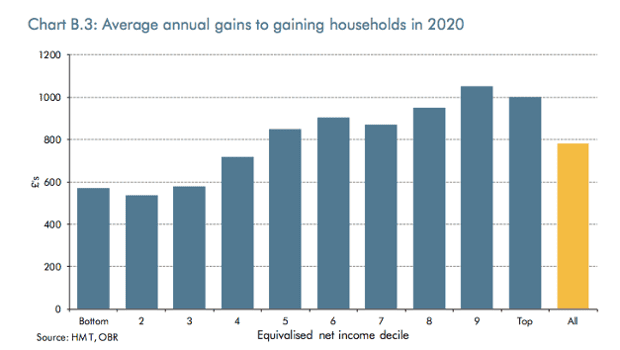
Contained in the IFS's analysis of the impact of yesterday's budget reforms is the starkest of truths: the only people to gain are those in income decile group one removed from the richest.  Those right there are the people the Conservatives are governing for, the only people they imagine they need to govern for, as everyone else is either stuck with them or written off.  The poor either don't vote or vote Labour or UKIP; public sector workers vote Labour; the young either don't vote or vote Labour or Green; they're all lost causes.  Everyone else, well, why would they vote for a Labour party that only represents those people?  Such is the new Conservative way of thinking.  Such is the space a Labour party that has taken all the wrong lessons from its election defeat has left its opponent to move into.  If they won't defend their manifesto, we'll take it.  Osborne isn't a genius, he's an opportunist and a strategist.  Shrinking the state is secondary to winning.  Ideology helps to explain, but doesn't tell the full story.

All hail the new Tories.

Labels: , , , , , , ,

Share |

Wednesday, July 08, 2015 

The rat and the rabbit.

After all the leaks, the raid on the BBC, the talk of how this one nation Conservative party would be creating a low tax, low welfare, high wage economy, there was only one real question left to be answered by George Osborne's wholly unnecessary second budget in three months: what's the fucking rabbit going to be?

First though, if on presentation and build-up only, today's budget is difficult to fault.  Almost all the nasty stuff was briefed about in advance, from the swingeing cuts to both tax credits and child tax credits, the reduced benefit cap and the abolition of inheritance tax for all properties under £1m.  There were still some extremely devious measures that weren't announced beforehand, like the abolition of grants for the poorest students, to be replaced with loans, but in the main all the changes to welfare were expected, leaving the way open for Osborne's surprise to dominate the headlines.

This budget was then all about him.  That Osborne is an exceptionally overrated politician, and unlike some of those also lauded by the press and commentators, believes his own hype, matters little.  Despite loathing him, he is more than the heir to Gordon Brown, only unlike Brown he hopes to make a success of taking over from his predecessor.  The difference is that whereas Brown and Osborne are remarkably similar beasts in how they always put personal political advantage ahead of everything else, Brown had the nous to recognise when he had gone too far, and also to act in a crisis.  Osborne by contrast just keeps on pushing ahead regardless, covering up his mistakes as he goes along, hoping no one will notice.

That something would materialise to sugar the pill was then apparent; not even with the backing of the majority of the press, a cowed opposition and a BBC in disarray would Osborne have got away with making the poorest undeniably poorer while cutting inheritance tax and raising the 40% threshold.  That Osborne decided to steal almost directly from Ed Miliband's Labour manifesto, the one that apparently no one can defend such was its rancidity, ought to have surprised no one.  Rather than abolish non-dom status outright though, perhaps the most obvious choice, Osborne opted to filch Miliband's minimum wage rise policy instead.  Only he went even further, promising that whereas Miliband outlined a rise to £8 an hour by 2020, Osborne's new "national living wage" will be £9 an hour by then.

Except, of course, Miliband's proposed rise in the minimum wage was meant to operate alongside the living wage, with sweeteners for businesses that opted to pay the latter.  Osborne's national living wage is nothing of the kind, for a whole host of reasons.  First, the living wage in London is already calculated to be £9.15 an hour.  Second, the living wage has always taken into account tax credits; remove them entirely or cut them viciously, as Osborne has done, and it would need to be even higher.  Third, as the IFS has already pointed out, not all businesses, especially small ones, can afford to pay the living wage, or at least not without raising their prices dramatically.  The further cuts in corporation tax will not help them one jot.  Workers over 25 will either have to be replaced with younger ones still on the lower rate, or another slew of smaller retail businesses are likely to be forced to close, or break the law to survive.

The distributional analysis from the Office for Budget Responsibility lays it bare: just as with the continued rises in the personal allowance, those who will gain the most are once again the already comfortably off.  The end result is that regardless of the rise, the cuts to tax credits will mean the vast majority will still be worse off, albeit by perhaps half as much as they otherwise would have been.  The poorest in society are in effect being asked to subsidise what David Cameron described as the "most basic, human and natural instinct", i.e., to pass on what even they themselves may have received entirely tax-free, at a cost estimated at £940m by 2020.  This truly is, as Chris said, the something for nothing culture in action, and as Rick argues, sets the Conservatives out not as defenders of wealth creators, but those who buy a commodity and do nothing with it other than just watch it grow in value.

Much the same thinking is presumably behind the cutting of rents in social housing by 1%.  What looks on the surface to be about helping the low paid is more than counteracted by how the OBR points out this is likely to reduce further the building of social housing.  Combined with the government policy of extending the right to buy to housing associations, this seems destined to further inflate the housing market bubble, and indeed in turn, the housing benefit bill, despite the motive being the opposite.  The new lower benefits cap will also have an effect, and is likely to lead to more landlords rejecting housing benefit claimants outright.  That buy-to-let mortgages will only be able to be offset against the basic rate rather than higher rate of tax is also likely to lead to a race to do so before the measure kicks in in 2017, further overheating the market.

Underneath all the wounding cuts to benefits and the rise in the minimum wage is the fact this was a tax-raising, rather than a tax-cutting budget.  With the major taxes off-limits, as promised and set to be legislated upon so they cannot be touched, Osborne has resorted to the stealth taxes Gordon Brown was so pilloried over.  The big money raisers are the tax on dividends, forecast to be bringing in nearly £2bn a year by the end of this parliament, a rise in the tax on insurance premiums, which should raise £1.5bn a year, and the changes to vehicle excise duty, meant to gain the Treasury by a similar amount.  Some of this though is going straight back out the door thanks to the further, unexpected cut in corporation tax to 18%, estimated to cost almost £2.5bn by 2020.  As Aditya Chakrabortty has been setting out in the Graun, this is in spite of the estimated £93bn a year given out in corporate welfare.

Osborne has then all but abandoned the plans he set out in March, opting instead for a smoother path to his idealised surplus, coming a year later than planned.  The cuts to government departments will not be quite as severe as anticipated, almost certainly down to how there's so little meat left to cut.  £18bn will nonetheless still have to be found, and with the defence budget now also protected, that leaves one area less from where money will be taken.  This has also only been achieved thanks to overall savings in welfare of £34.9bn, the difference made up by the continued freeze on yearly increases to benefits of 1%, and changes to universal benefit before it has even been introduced.  All this is predicated on Osborne's savings and cuts being achieved: when £5bn is again meant to come in from clamping down on tax avoidance and evasion, this looks extremely dubious.  The OBR also rates the chances of most of Osborne's tax rises raising what the Treasury says they will as having a "very high" uncertainty.  Should they not, will Osborne again postpone reaching his surplus, raise the taxes he's legislated not to, or cut benefits even further?  Take a wild guess.

George Osborne's task today was relatively simple, despite all the talk of how clever he's been and the boost to his chances of taking over from David Cameron.  All he needed to do was get the pain out of the way, disguise it as best he could and hope that by 2020 what voters remember is not how he picked their pockets, but how their wages have now increased thanks to his living wage.  The fact is Osborne has been a remarkably lucky chancellor: the "omnishambles" budget would have been the downfall of other politicians, as would his abysmal failure to eliminate the deficit in a single parliament, or indeed how he cut too far and fast in the first couple of years and stalled the recovery.  Thanks to a very friendly press, a weak Labour party and the Liberal Democrats covering for him, he's still in place.  Moreover, he's only implementing what the Tory manifesto promised.  Those who voted Tory might not have expressly wanted a crueller, smaller state, where everyone who earns below the 40% threshold can essentially go hang, and the aim is to ensure the moneyed and propertied stay that way, the drawbridge permanently raised up, but that's what they've got.  The only thing that can blow Osborne off course now is another downturn, and the further suffering that would entail hardly bears thinking about.  Such is the position of strength an exceptionally weak government finds itself in.  Such has been the failure of all opposition to austerity.

Labels: , , , , , , , ,

Share |

Wednesday, July 01, 2015 

Oh for an incompetent government.

Government, we tend to think, is at its worst when it's either incompetent, or obtuse.  Well, excepting those who really do believe, as the Gipper put it, the nine most terrifying words in the English language are "I'm from the government and I'm here to help"Philip Hammond wringing his hands about how the Tunisian gunman Seifeddine Rezgui was likely trained in the "ungoverned spaces" of Libya and then in his next breath defending the intervention that led to that very space being ungoverned is pretty much par for the course.  We expect government to defend itself despite knowing full well it had more than a hand in how the current situation came about.  It's just how it works.

The same goes for the foisting of the legal requirement on schools, hospitals and prisons to prevent extremism, and the ridiculous official definition of what constitutes "extremism" ("the vocal or active opposition to fundamental British values, including democracy, the rule of law, individual liberty and the mutual respect and tolerance of different faiths and beliefs").  The path to radicalisation is different in almost every case, and the idea that a teacher reporting up the chain that one child has an exceptionally negative view of homosexuality could ever prevent something further down the line is completely absurd; the government knows this.  Nonetheless, Nicky Morgan, forever looking as though she's just put a hot chip in her mouth seconds before being dazzled by studio lights, must go on television to insist that black is in fact white, as government has to be seen to be doing something.  It isn't simple coincidence this has the effect of putting more responsibility on the shoulders of teachers, transforming them yet further into social workers, as it couldn't be clearer the Tories hate the entire profession with a passion, but it's a happy side effect.  The government approach to radicalisation seems to be that so much as discussing what might lead to it in schools is tantamount to a betrayal of British values, and if you don't talk about it, clearly it doesn't exist.  Job sorted, now we can get back to putting the blame wholly on Muslims as though they're a homogeneous entity?

No, government is most definitely at its worst when completely and utterly open about what it's doing, and yet still lies about it.  George Osborne's second budget of the year, now only a week away, should finally start to set out precisely where the £12bn in welfare cuts are going to be found.  As has been apparent for quite some time, if you're going to protect pensioners, the disabled and not cut child benefit, the only possible way to get close to that figure is to do something very drastic indeed to both tax credits and housing benefit, both of which are mainly claimed by those in-work.  David Cameron started the softening up process last week with his deeply disingenuous speech about putting an end to the "merry-go-round" of those on low incomes being taxed only to then be handed the money straight back.  It didn't seem to matter that's how the tax system in general works: you are taxed, and services are there as and when you need them.

The obvious problem with cutting child tax credits back to the level they were introduced at back in 2003, one of the most efficient ways of clawing back £5bn, as identified by the IFS, is that you're not hitting the nasty undeserving poor, the scummy mummies and the perpetually drunk, but the strivers at the heart of the "one nation" the Tories have suddenly discovered they stand for.  Even worse, there is or rather was the small problem of the 2020 child poverty target that Gordon Brown managed to get enshrined in law in the dying days of the last Labour government.  One of the targets, long criticised by Iain Duncan Smith, was the aim to reduce relative child poverty, defined as family income 60% below the median, to less than 10%.

What to do?  Even at this point rethink the cuts?  Perhaps not sell off RBS until the share price means the taxpayer won't lose the equivalent of £13bn, as Osborne wants to?  Don't be silly.  No, you just scrap the target entirely, as IDS has today done.  You see, the aim of reducing relative child poverty has led to "unintended consequences for good reasons", namely the increase in tax credits.  And this hasn't really had the effect of dealing with poverty; after all, if you're only £1 better off than the 60% below benchmark, you're still damn poor, aren't you?  Besides, there are the perverse side effects of the target, such as how when everyone is worse off, such as after a recession, it means there are supposedly fewer paupers than there were before.  Or if the government puts pensions up, the opposite becomes true.

Instead the government will focus entirely on getting social mobility going.  Measured will be worklessness and family breakdown, as well as debt and drug dependency.  IDS has long been obsessed with worklessness, and for good reason: as Rick pointed out, and recent studies by the Resolution Foundation have found, worklessness, let alone the long-term worklessness the Tories have so often identified as being the root of all evil in the benefits system, barely exists any more.  There are more people in work in poverty than not, for the reason that work has become that much more insecure and low paid.  Tax credits have duly gone up to compensate.  As commentators pointed out after David Cameron's speech last week, it was Ed Miliband who tried to flesh out an alternative with his clumsy predistribution.  Now the Tories have their majority they don't need to bother to find that alternative: they can just cut tax credits as a whole, say you voted for this, and argue their great economic plan will see everyone's wages go up.  Eventually.  IDS getting rid of the child poverty target was simply the final hurdle.  He's been completely open about why he's done it, while still putting in place a diversion.

Next week the government will announce that the poorest are about to get poorer.  It won't of course be presented like that, and no doubt another rise in the income tax threshold will come alongside it, which will mainly benefit those on middle incomes but will look as though it's helping those on low wages.  The blame will be put not on those who caused the crash, who might in fact be rewarded with another cut in the top rate of income tax, but the Labour party.  Labour in turn might find the remaining fire in its belly, but the leadership contest so far has revolved around accepting the narrative set by the Tories and the right-wing press, so it's unlikely to last long.  Besides, summer's here, parliament's about to go into recess, and by the time it returns it's practically time for the conferences.  Osborne and Cameron some say aren't ideological, that the cock-up version of history is always more convincing the conspiratorial one.  Even if true, it doesn't alter the fact the Tories are doing this because they want to, not because it's the best, let alone fairest way to reduce the deficit.  Give me incompetent government over this any day.

Labels: , , , , , , , ,

Share |

Wednesday, June 10, 2015 

The intoxication of power, via the Simpsons.

You know what we haven't done for a while?  Quoted from the Simpsons, so let's remedy that.  In the New Kid on the Block episode, Bart foolishly asks Homer for advice on the opposite sex.  "A woman is a lot like a beer.  They smell good, they look good, you'd step over your own mother just to get one.  But you can't stop at one, you want to drink another woman!"

Homer could just have easily been talking about the intoxicating effects of power.  Only it wouldn't have been funny or made anything approaching sense, so would have came from a more recent season of the show.  Yes, I just made a the Simpsons ain't what it used to be joke.  Another philosopher, arguably one not quite on the level of Homer but thereabouts, wrote the slave begins by demanding justice and ends by wanting to wear a crown.

Very few once they have tasted power find it within themselves to either give it away or relinquish it, at least not without a fight (The War Nerd in his latest post wonders if the Soviet Union is the only empire to have collapsed without a shot being fired, although that's a questionable version of 1989-91).  Politicians for decades have promised to devolve power to cities and local communities, only to decide not to once they themselves have power, or find those they want to empower in fact don't really like the idea of mayors or regional assemblies much.  London and Scotland are the exceptions that prove the rule, and as we have seen, once given demands for further powers only increase. 

A case in point is the attempt to force a by-election in Orkney and Shetland, under the specious reasoning that Alistair Carmichael lying about not leaking the comments supposedly made by Nicola Sturgeon to the French ambassador means the contest should be rerun.  It's a campaign ran by SNP supporters, but obviously the SNP themselves have nothing to do with it.  56 seats out of 59 just isn't enough when they could they have 57 instead.  Not that it's fair to pick just on the SNP, or the Tories with their legislation on trade unions designed to damage Labour, or the likely at some point boundary review.  All parties are determined to make life as difficult as possible for their opponents, only realising too late that domination builds resentment and the seeds of eventual downfall. 

What is a new tactic is the use of legislation to bind a future government to the same path of righteousness as the current one.  It's an innovation of especial vanity, an attempt to retain control when the people who put them there in the first place might well have slung them out.  It's also, as with so much of our politics now, little more than a gesture when the law can so only easily be repealed by that new government, but it remains a gesture designed to trip up the opposing side in the most petty of fashions.

No surprise then that a man as clearly petty as George Osborne is so keen on the mechanism, having pinched it from that other petty man, Gordon Brown.  First he attempted to trap Labour by legislating for the next government to be required to cap spending on social security.  Then during the election campaign the brilliant idea of making it illegal to raise income tax, VAT or national insurance before 2020 was come up with.  Now Osborne has decided it's a wicked wheeze to go one step further with his deficit reduction fetishism and require all future governments to follow his plan to run a budget surplus, or at least so long as the economy's growing, as he's not a complete bastard.

Cynics might think it takes some chutzpah for the chancellor who failed to eliminate the deficit in a single parliamentary term as promised to propose to tie the hands of his successors.  Considering we're still to be informed also of precisely how the sunlit uplands of the surplus is to be arrived at, demanding all do as Osborne says could be thought of as breathtakingly arrogant.  Nothing though is off the table when it comes to continuing to pin the economically incontinent tail on the soiled old Labour donkey, which is of course the real point of Osborne's jape.  With some of the Labour leadership candidates now accepting the utterly risible idea that they overspent when in government, the obvious riposte to which is to ask exactly what they would have spent less on, and if they answer welfare you reply with a baseball bat with a nail through the top, all the better to demand they sign up to Osborne's completely sensible surplus plan.  And if they won't, as the less self-hating ones won't, you carry on lambasting them for not accepting all this austerity is their fault.

Everyone's a winner, except for oh, the people who will suffer as a result of the shrinking of the state necessary to reach such a perpetual surplus.  The otherwise excellent Flip Chart Rick argues that despite the caricature from some on the left, Osborne and Cameron are not ideological state-shrinkers.  When it comes to Cameron he could be right, mainly because there's never been the sense Cameron believes in anything.  With Osborne, it's becoming ever more difficult to think otherwise.  As Rick has pointed out, both the IMF and the OECD have changed their tune of late, advising governments that are not Greece they can dial down the deficit reduction, especially if the proposed cuts have the potential to affect growth.  Coupled with how everyone assumed that the £12bn in cuts to welfare were to be negotiated away in the coalition talks, Osborne if he wanted has had more than enough opportunities to step back from his surplus now and surplus forever mantra.  Instead, he's gone one step beyond that into the realm of the completely gibberingly stupid.  


That £12bn in cuts to welfare looks unachievable is besides the point: Osborne looks set to try and reach for the top regardless.  The difference between playing political games and acting out of ideological purity is a fine one at the best of times.  The chancellor has surely now shown his true, somehow even ghastlier face to the world.

Labels: , , , , ,

Share |

Thursday, March 19, 2015 

An epic day in politics.

"I almost spilt my coffee."  Yes, of course you did George.  While the rest of the country was trying to work out how the Sun could possibly have thought ripping off an already dire advert was a good idea, the chancellor was failing to hang on to his latte, his jaw having dropped.  It would be a difficult story to believe even if Osborne wasn't the type of person who strikes you as the kind liable to stand in front of a mirror, imagining himself all rippling muscles and shit-eating grin, a veritable gift to women.  Osborne does after all think calling someone an idiot to be devastating wit, as evidenced by his past braying reaction to Cameron's description of Ed Balls.  More indeed.

You can then see the low base from which Osborne's subsequent remark, of the Sun's genius, came from.  Only the unbelievably easy to please and those tasked with finding something, anything to crow about from yesterday's budget could have presented it as such an unvarnished triumph, let alone an "epic strut".  Do the kids still use the word epic, you imagine the Sun's hacks asking, after high-fiving each other for coming up with the take on the Money Supermarket ad in the first place.  Epic fail!  Guh-ugh-uh.

Osborne does at least if nothing else retain some self-respect.  Whoever came up with the idea for the Liberal Democrats to present their own imaginary budget, complete with hastily painted yellow box, you can but hope they've got an up to date CV.  Danny Alexander, the coalition's answer to a question that was never posed in the first place duly came out of the Treasury, rather than you know, Number 11, holding up his lunch for the approval of the interns sent along on the off chance there's a sliver of space to fill somewhere in tomorrow's paper.

Of all the various attempts at differentiation the Liberal Democrats have tried, this has to rank as both the most absurd and bizarre, and just as strange was why both the speaker and the civil service went along with it.  Alexander's presented figures for how a Liberal Democrat government would manage the public finances were even more of a farce than Osborne's actual ones, not least because his party has stopped pretending it has any chance of winning the election rather than forming another coalition.  When you can no longer deny that inevitability, how can you possibly maintain there's even a cat's chance in hell of the plans forming anything like the basis of the next government's economic strategy?  The only realistic answer to why this was signed off has to be pity for poor old Danny's chances of retaining his seat, with the SNP likely to win in Inverness.  Too bad that concern came at the expense of the rest of us.

Still, it could be worse: we could be Jack Monroe.  I have to admit to getting incredibly tired of the feel my woe school of political journalism, where those getting well remunerated for their writing or other work start out by saying how terrible it is to be abused for simply doing what they do.  All Monroe did was say I'm joining the Green party, and what do you know, the accusations of being a traitor started and the reactionaries came flooding in.  She was looking for importance to be placed on a national health service, public transport, sustainable energy and fair pay for pay work, all values which Labour under Ed Miliband have abandoned.  No, she hasn't left the Labour party, the Labour party has left her.  Vote Green and get Tories they say.  But we get Tories whoever vote for!

Well, yes, it's called democracy.  Oh for PR she writes; except we couldn't even get the alternative vote when the option was given.  Yes, she appeared in a Labour election broadcast and they supported the food bank petition, but so too did the Greens.  That some would launch attacks rather than consider why it is those like Monroe are leaving says all you need to know.  The idea they might be perturbed by how a popular figure with a following publicly abandons a party on the eve of an election on fairly spurious grounds, which are frankly what they are, doesn't seem to have occurred.  With friends like these, who needs enemies, Monroe tweeted.  Quite, Labour will no doubt reflect.

Labels: , , , , , , , ,

Share |

Wednesday, March 18, 2015 

Hubris and the wait for nemesis.

You can't help but get a sense of the way the election campaign looks set to pan out from the way the broadcasters have utterly capitulated to David Cameron and the Tories over the debates.  Thanks in part to ITV's apparent desperation to once again host the first debate, with all the bragging rights and ratings that go with it, Dave has made the extremely minor sacrifice of agreeing to one debate with 6 other party leaders at the very start of April.  While the precise format of the replacements for the other two debates haven't been finalised, they're likely to involve interviews with Paxman and a Dimbleby hosted Question Time-athon, each leader lightly grilled by the same audience separately.  Cameron has thus ensured he won't be shown up too much by Farage, while Miliband will be boxed in by both Natalie Bennett and Nicola Sturgeon during the one unwieldy session. He's avoided the ignominy of being "empty chaired", nor will he face off one on one against the "despicable, weak" upstart with two kitchens.  As was predictable, the commercial need to broadcast something, anything with the prime minister overcame the principle of refusing to bow to his demands.

Little wonder George Osborne felt able to act with such hubris in his final (God, please let it be his last) budget.  Few other politicians in his position would have with a straight face claimed living standards are higher now than in 2010, not least when the claim rests on a single cherry-picked statistic, itself reliant on the massive drop in inflation due to the oil price halving.  He insisted that, albeit a year later than planned, the debt-to-GDP ratio is falling, the second of his major economic promises made in 2010.  The Office for Budget Responsibility later pointed out this will only happen thanks to a mammoth £20bn in asset sales.  We heard once again the phrases designed to be used as soundbites, "Britain walking tall again", "the comeback country", liable to please the same little minds his previous "march of the makers" and "aspiration nation" did while washing over the rest of us.

There was not to be even the slightest nod to the all too obvious mistakes of this unbelievably overrated in every sense chancellor.  Plan A had long since been abandoned, but so also have we become inured to the prospect of a further 4 years of austerity.  With as little fanfare as he could get away with, Osborne rejigged the spending plans of the autumn statement that set out those "colossal" spending cuts, the same ones he thought wouldn't attract such attention.  He did this not by sensibly spreading out the extra money found down the back of Number 11's sofa in the past four months, loosening the squeeze up to 2018, but setting out a splurge in the final year of the next parliament, equivalent to the entire defence budget.  The ridiculous surplus of £23bn planned for 2020 is thus a slightly less fantastical £7bn.

Except of course these figures are illusionary.  Regardless of the make-up of the government at the next budget, the chance of anything like these plans being set out again is minute.  As the Institute for Fiscal Studies was quick to make clear, they're reliant on the further £12bn in welfare cuts Osborne has long talked about being found, alongside an equally difficult to believe £5bn being raised through clamping down on tax avoidance and evasion.  We're no closer to knowing where the hatchet will fall in the case of the former, no doubt precisely because there is no more fat to trim.  It's an utterly absurd way to run anything, let alone a state, to cut services as harshly as Osborne plans only then to ratchet spending back up again two years later, and he would have to be a complete moron to so much as contemplate doing so.

Osborne is many things, but a complete moron is not one of them.  For this was a budget less about giving activists something to base a case around than making things as difficult as possible for Labour.  Gone is the mess of Osborne's making, the back to the 30s jibe, to be replaced instead by a return to the day to day spending of 1964 instead.  Spent is some of the money earmarked for Labour's daft in any case reduction in tuition fees, Ed Balls saying it would be found elsewhere.  And then we had the "jokes" courtesy of Danny Finkelstein, only accompanied by fatuous policies in order to shoehorn them in, the most desperate of which had to be the non-gag about bands of brothers and Agincourt, at the cost of a million to commemorate it.

With that out of the way, all that was left were the priorities we've become used to from this government and chancellor.  A further lifting of the income tax threshold, which benefits middle earners the most; allowing pensioners to trade in annuities for cash, boosting the Treasury's coffers at the same time; a "Help to Buy" ISA the government will top up, without any further announcements on building the damn houses in the first place; and a new savings allowance, with the first £1,000 tax free, projected to cost £1bn in the first year.  As for those who can't afford to save, or who probably won't be able to reach the £1,000 figure, be glad you got away with your sweet FA.  It also makes ISAs less attractive as a whole, but seeing as the aim probably was for Osborne to be pictured on the front page of the Mail with the sun shining out of his arse, it's doubtful he'll give it a second thought.

Hubris can after all mask anxiety.  This wasn't a budget to win over voters so much as to yet again consolidate the party's core vote.  Bribe after bribe has been thrown at those most likely to turn out, and still the election remains too close to call.  By this point a Tory lead was meant to have developed, only for the polls to continue to suggest a dead heat.  With Osborne having done his bit, with there being little reason to expect a leap post-Budget bounce from what he unveiled, the onus is back on Cameron to haul the Tories over the line.  Thank goodness the broadcasters stood firm then, eh?

Labels: , , , , , , , ,

Share |

Monday, December 15, 2014 

Oh the joy (of the next 5 months).

There are a couple of reasons why l spend inordinate amounts of time slamming away at a keyboard instead of advising the Labour party.  First off, I'm not American, nor have I been parachuted into a safe seat, more's the pity.  Second, I cannot for the life of me work out why you would effectively launch your general election campaign in the middle of fricking December when most people's minds are even further away from politics than usual.  Presumably, and I'm really clutching at straws here, the idea is to get a head start on the other parties and begin the process of drilling the 5 key pledges Labour has decided upon into everyone's skulls.  Come May, all concerned will march to the polling station, their minds focused on controlling immigration fairly and cutting the deficit every year while securing the future of the NHS.

The words under and whelming come to mind, as they so often do when the topic shifts to Labour.  If you wanted to be extremely charitable, you could say it's an indication of just how spectacularly the coalition has failed that Labour seems to have pinched wholesale two of the Conservatives' pledges from 2010.  Alternatively, you could point out it's spectacularly unimaginative and an indication of Labour's chronic lack of ambition for it to be defining itself in the exact same way as the hated Tories did.  5 fricking years ago.

Again, to be fair, we're promised Labour is getting the less pleasant of its pledges out first, with the more unique ones to follow, defined by those all time classic Labour values.  Quite why Labour has decided upon the pledge approach in the first place is a difficult one to ascertain: presumably modelled on the 1997 pledge cards (and Christ alive, the photo of Tone on the card is easily as terrifying as this year's Christmas effort), is it meant to bring to mind the good old days when Labour could win a vast majority on the most vacuous of aspirations?  They're not even pithy, as the actual pledges amount to three sentences of deathly prose.  Cutting the deficit every year while protecting the NHS would be great, if the exact same message hadn't been plastered around the country accompanied by Cameron's suspiciously taut forehead.

Dear old Ed today gave what must rank as one of the briefest speeches of his career, outlining the second pledge, emphasising how he wouldn't repeat Cameron's promise of getting migration down to a specific point, only that Labour would control it, and fairly, that distinction apparently intended for both those pro and anti to interpret as they see fit.  Call me picky, but saying you'll control something you cannot still makes you a hostage to fortune in my book.  Miliband's audience helped by moving the debate swiftly on, similarly to how the campaigning against UKIP document leaked to the Torygraph suggested Labour candidates do when the topic is broached on the doorstep.

As pointed out by Andrew Sparrow, the briefing paper is about the most sensible thing Labour has said about immigration in months if not years, recognising they're not going to win over the virulently opposed while also suggesting for most immigration is "used as a means to express other concerns".  Except as it sort of implies people aren't steaming about immigration directly, and the party for whatever reason has decided to so much as suggest this is the equivalent of not taking legitimate concerns seriously, shadow ministers have all but disowned their own strategy.  It's also meant the media can talk about the distraction rather than a boring old policy Labour are only re-announcing anyway.

Still, what a jolly 5 month long general election campaign we have to look forward to.  Already the dividing lines are set between Labour, Tories and Liberal Democrats on the economy and the deficit, and they are of course the most absurd caricatures of actual stated policy imaginable.  Special marks for dishonesty must go to David Cameron, who managed to scaremonger about a difference between his party and Labour of about £25bn in borrowing terms in the most hyperbolic way possible.  Just imagine if there was another crash and Labour was once again racking up the debt!  Except, err, if there's another crash and borrowing is only falling by as much as the Tories are projecting it will, there will still be problems, although nothing as compared to elsewhere.

Labour meanwhile is making as much as possible out of the 1930s comparison on everyday spending, which is technically correct, again if the Tories mean what they say, just not particularly illuminating.  A better approach would be, as Ed Miliband somewhat tried last Thursday, to set out exactly what sort of state it is most people want.  If George Osborne carries through and magics into existence his surplus, parts of government will be left barely functioning, which really isn't to scaremonger: cutting the budgets of departments other than health, education and foreign aid (which surely won't continue to be ringfenced) by as much as needed doesn't look remotely plausible.  When the best minds are baffled by what the chancellor is up to, apart from mischief, it deserves highlighting.

Even if we look at Labour's plans in the most flattering light, Ed Balls is still promising to run a surplus as soon as possible, not because it's good economics but as a result of the way the debate has been framed.  Doing so is still going to require huge cuts, savings which the party has done the least of the main three to outline.  In the grand scheme of things, as Chris and Alex Marsh have so persuasively argued, this doesn't really matter.  The real issues affecting the economy are the collapse in productivity, and with it the decline in wages growth.  We are though operating in a climate where the difference is between "colossal" and merely "eye-watering" cuts, where the Tories claim to have succeeded on the basis they've more or less reduced the deficit to the level Alistair Darling pledged to, except they've done so on the backs of the poorest, and where it seems personal taxes will never have to rise again, despite government having apparently decided not to bother taxing companies properly either.

There's a third reason I'm not advising Labour.  I'd be even worse at it than the current lot.

Labels: , , , , , , , ,

Share |

Thursday, December 04, 2014 

You're talking hyperbollocks.

It must be awful being George Osborne.  There you are, making gags in the Commons that would frankly disgrace those £1 packs of crackers (gosh, Ed Miliband looks a bit like Wallace, how original, and rich, coming from someone whose nose more than resembles an arse), the right-wing press mostly lapping it up, and then you have to go on the BBC after Norman Smith dares to suggest that if you scratch beneath the surface you quickly find the cuts projected amount to a "book of doom".  Perhaps even Road to Wigan Pier-esque.

Hyperbolic, raves George, expressing much the same line of faux indignation as regularly voiced by Iain Duncan Smith.  Why, the BBC were saying exactly the same thing back in 2010, and has the sky fallen?  No, we're on the way back to the sunlit uplands, the public services have not collapsed, and if anything they're more highly regarded than ever.  The NHS only needs an extra £8bn a year, which no party has yet come near to explaining how they'll find, despite agreeing with Simon Stevens on how necessary it is, and well, who cares about how beds can't be found for 16-year-olds with mental health problems, instead forced to spend an entire weekend in a police cell?  As for actual lags, prison is meant to be about punishment.  If you don't want to spend 22 hours in a cell every day, don't do the crime in the first place.  Chris Grayling knows what he's doing.

Osborne and Downing Street's ire couldn't possibly be connected to how the BBC's journalists were for once bothering to do their jobs properly.  I even filched the title for yesterday's post from Nick Robinson, who himself had stolen it from elsewhere.  The harsh reality is Osborne's cuts are unachievable, as he knows all too well.  When the Institute for Fiscal Studies describes them as "colossal" and if put in place will by necessity force a "fundamental re-imagining of the state", the kind of statements the IFS simply doesn't make unless the situation is that stark, he really shouldn't have anywhere to hide.

The truth is Osborne can't be straight on just how tough the economic situation will be after the election as it would expose his deficit reduction fetish, undermine his insistence on "trapping" Labour, and worst of all, be to admit his own failure.  The best option would be to push back further the point where the structural deficit will be eliminated, as the markets show not the slightest indication of putting up borrowing costs any time soon, not least when Europe slumps once again into recession, and to bring the cuts/tax increases ratio to something approaching parity.  He can't and won't as Cameron has already insisted on promising the very opposite as soon as the magical surplus is achieved.  Labour, rather than pointing out the impossibility of Osborne's plans, continue to insist they will do things slightly fairer and in much the same time scale.  How and why they don't explain.  As for the Lib Dems, what more can be said about a party whose leader was elsewhere as the statement he agreed to was delivered?  Vince Cable meanwhile whines and moans in the same way as he's done for the past four years, while continuing to stay in government with people he considers to be economically insane.  With politicians like these, is it any wonder so many are looking at the only slightly loopier option?

Labels: , , , , , , ,

Share |

About

  • This is septicisle
profile

Archives

Powered by Blogger
and Blogger Templates