Tuesday, July 21, 2015 

Violent sexual imagery: the only way to respond to that abstention.

There's an episode of The Thick of It where, enraged by that day's disasters, Malcolm informs Nicola and Terri that he will be using an awful lot of "violent sexual imagery" in order to make them fully understand the level of his unhappiness.

Labour at the moment needs a Malcolm.  It needs someone to set out in the most uncompromising terms just how suicidal yesterday's decision to abstain on the welfare bill was, and how incredibly, mindblowingly fucking stupid it is being in general.  Some at the very top of the party have been so mindfucked by the combination of losing the election, the glee of the right-wing press at that loss and their analysis as to why, and George Osborne's frankly pitiful efforts to "trap" them that they seem to have forgotten the very reason the party came into existence.  If Labour does not stand up for the interests of the ordinary working man, it may as well announce its dissolution.

The party leadership has no excuse then for its failure to vote against the welfare bill.  The act explicitly redistributes money from the working poor to the wealthy in order to pay for the all but abolition of inheritance tax.  It paves the way for the social cleansing of not just London but whole areas of the country, as the new lower cap on benefits makes those places unaffordable for the low paid and temporarily out of work.  It breaks Cameron's twin promises not to cut the benefits of the disabled and sick, as it reduces the payments of those in the work related activity group of ESA to the same as JSA, and to not touch child tax credits.  It makes clear that the end result of these changes will be a rise in child poverty, as the government is at the same time abandoning the target to reduce it by 2020.  It demands sacrifices only from those of working age, rather than asking any from those whom most of the social security budget is spent on, pensioners.  It makes clear the Conservatives don't wish only to play divide and rule between the unemployed and those in work, but between the working poor whom have their wages topped up by tax credits, and those in work who are lucky enough not to need to claim anything.  It says some families are worth less than others, that having a third child is always an active choice, and so it's perfectly acceptable for that child to be denied the same support their siblings received.  It is one of the most regressive, most reprehensible pieces of legislation to go through parliament in a very long time.

You might have thought yesterday's op/ed by George Osborne in the Graun would have concentrated a few minds.  Rarely is there a piece by a government minister that is quite so brazen in the number of outright lies, distortions and misleading statistics it contains.  Cutting an "unsustainable" welfare system is according to the chancellor a progressive measure, and welfare reform is not just about saving money, but transforming lives and social justice.  Let's be clear: this isn't a trap, this is one step up from the very lowest grade of trolling.  You don't respond to trolling, you ignore it.  If you must respond to it, what you most certainly don't do is accept the troll is making a legitimate argument.

And yet somehow, unconscionably, only 48 Labour MPs went through the no lobby last night.  Whatever it was Harriet Harman tried to achieve by saying Labour couldn't afford to ignore what she claimed was the will of the public in both giving the Conservatives a majority and twice rejecting her party, to act in such a cowardly, incoherent way is near to being unforgivable.  The Democratic Unionists, yes, some of the most unpleasant and antediluvian of all the MPs in the Commons, voted against it.  The SNP voted against it.  The Liberal Democrats, fresh from propping up the Tories for five years, voted against it.

Abstaining when you know precisely what a bill will do to those you were supposedly sent to Westminster to represent is a betrayal.  That's what it is.  Not only is it a betrayal of those who will suffer as a result, it's a betrayal of everyone who argued that a vote for Labour still meant something.  That Labour was a vote for a fairer, more equal society, in spite of all the snide remarks, disbelief and cynicism.  It's a betrayal of those who faced down the SNP, with all its claims of being the true progressive, radical force, or who criticised the luvvies who say Labour left them, not the other way around, and did so right at the moment the party needed them the most.

If anything was ever going to legitimise the SNP's claims of being the official opposition, prove Mhairi Black right, or drive those who have long flirted with the Greens fully into their arms, this was it.  Those currently leading the party, or rather not leading it have convinced themselves that only they have the answers, that only they are the responsible ones, and that to merely oppose for the sake of opposing is to not listen to "the very strong message sent by the electorate".  They have convinced themselves that elections are not won or lost during the last year of a parliament, but by how the opposition responds in the immediate aftermath of a defeat.  This is to completely misread what happened in the summer of 2010, as the coalition set out to prove the size of the deficit and the state of the economy were entirely the fault of Labour, rather than a global economic crisis.  This was achieved not through acts of parliament, but by how the message dominated everything the coalition did.  Labour's failure was to not respond ferociously, to fight the accusation, to debunk the lie.  Instead they accepted it.  The party leadership is repeating the mistake.

Only this time it's far more serious.  Labour has never seemed more divided between the "realists", epitomised by Chuka Umunna describing those disagreeing with his and the "modernisers" analysis as the equivalent of petulant children, and those daring to believe that Labour has to be, must be more than just the Conservatives with a kinder face.  The view that nothing can be achieved without power is spineless rubbish.  Rare is it that a government just falls apart, and even when they do it's not certain the opposition will automatically benefit: nothing more affects a government's authority than a failure to be able to pass legislation.  To give up even the pretence of opposing a government's worst excesses this early is an astonishing act of capitulation, a failure of belief that demands those responsible be held accountable.  That no one has said Harriet Harman has clearly lost the confidence of her own MPs in a matter of weeks is equally surprising.

It's not as though any of this is difficult.  The welfare bill is about making the poorest poorer, the working poor poorer, and the sick and disabled poorer.  Indeed, it's about making anyone who claims tax credits poorer.  This is not in dispute: Osborne is painting it as being fair and fixing a broken system but not denying the end result, whatever the claims made about the increase in the minimum wage.  Labour has somehow managed through sheer incompetence and the beyond moronic idea that being "sensible" at this stage will win dividends later to make the story not about the Tories doing what the Tories do, but about Labour being split over the most basic of issues.  As Flying Rodent has it, Labour is more afraid of not being shitty and vindictive enough, so convinced has it become that you only gain respect and win back votes through being "tough", than it is of going too far.  The leadership still seems to believe that it can ignore the wishes of its supporters and core voters as they have nowhere else to go.  The election results, the same ones that have apparently convinced them of the wisdom of this masochism strategy, prove the opposite is the case.

So yes, Labour needs a Malcolm to get through the otherwise most impenetrable of skulls just where such an approach will lead, and it most certainly isn't to victory.  It also though needs someone to soothe it, to reinforce that its heart is in the right place, and that it hasn't lost its values.  It needs someone like, oh, Alan Johnson, to play more of a role, to argue against the more out there ideas some on the left do have, like how an EU exit wouldn't be all that bad really.  Failing that, it's difficult to see where the party goes from here.  Under siege from all sides, some prefer surrender to carrying on the fight.

Labels: , , , , , , , , , ,

Share |

Monday, July 13, 2015 

Voters are often wrong. Politicians need to tell them so.

There is, I would argue, an extremely big difference between being exceptionally cynical about almost everything, and just straight up indulging in conspiracy theories.  Would the government really for instance suddenly declare Tunisia to be a no-go area just to distract attention from how the budget was falling apart, especially when it had been received in such raptures from the press?  Would it really decide to wreck the holidays of thousands of people on completely spurious grounds, and not come up with a better explanation than saying intelligence suggested there was a very high chance of another attack, despite there err, being no specific intelligence?  Would it really send the message that in actual fact, terrorism does pay, and that already struggling countries should buck their ideas up, despite it being you know, sort of our fault Libya is now a failed state?

Probably not, but never underestimate a government's propensity for being completely and utterly stupid.  Tunisia it seems should follow our lead: hold a few more training exercises, put a few more bollards in front of buildings to prevent a truck or car bombing, despite jihadists' major problem long having been their failure to obtain explosives in any sort of quantity, and you're laughing.  There's not much you can do to prevent an attack by a lone gunman with an assault rifle and (possibly) some grenades other than putting more armed police and security guards on the streets and increasing surveillance, policies that might in fact cause more problems than they solve, but such measures are not apparently good enough for us Brits.  Fine for the French and Germans, but not us.

Was then Harriet Harman in fact being rather sneaky in her interviews yesterday, saying the party she is temporarily leading could not oppose cuts to child tax credits and the new lower benefit cap, as to do so would be to ignore the voters who have now twice rejected that party?  Again, probably not.  It has though had the twin effects of riling up the usual people on Twitter who spent plenty of time during the election campaign complaining about that mug, and has also redirected attention onto the interminable leadership election, with yet another hustings held today.  The Liberal Democrats, incidentally, are to announce whether Tim Farron or Norman Lamb is to be the party's new leader on Thursday.  The reasoning behind Labour going for a longer contest was supposedly about confronting why the party had taken such a mauling, only for all  the candidates to have concluded why within hours of the defeat.  The "debate" since has focused on repeating those positions, and predictably there's been nastiness happening behind the scenes as a result.

You can of course if you want interpret the Tories' win as being a thumbs-up for their policies as a whole, just as if you like you can believe people voted UKIP because they wanted a referendum on EU membership, or SNP because they thought Nicola Sturgeon was a fresh, inspiring leader.  Except, oh, that last one probably is something approaching the truth.  Equally, you can take Labour's defeat however you want, and if you really want to believe it was because Labour wasn't either left-wing or right-wing enough, that's fine too.  The real lesson of the election was in fact what happened to the aforementioned Lib Dems.  The party that had previously meant all things to all people, acting as both a protest vote that wasn't entirely wasted and as a leftish alternative to Labour collapsed once everyone realised there was little to no difference between them and their coalition partner.  This doesn't mean they wouldn't be making something of a difference if they were still in government, as they almost certainly would.  They wouldn't though alter the overall tenor, just as Osborne stealing the best melodies from Labour's song book can't cover up the discordant screeching of his compositions.

The most convincing overarching reason for why Labour lost is Ed Miliband was not seen as a realistic prime minister and in turn was not trusted with the economy.  It's as simple as that.  Could Ed Miliband have been seen as a realistic prime minister and trusted with the economy had the party fought harder against the caricature of spending too much, crashing the economy and leaving behind no money?  I think so.  Then again, I still think Miliband would be a better leader than any of the 4 now on offer, and that time will prove him to be another of those best prime ministers we didn't have, so you can safely ignore me.

This is not to deny there is an awful lot of seething, if not outright detestation of benefits claimants.  If there wasn't there wouldn't be those TV shows, there wouldn't be the support for the cap which takes absolutely no account of exceptional, temporary, individual circumstances, or for little things like a family having lived for generations in an area they are now told they can't afford.  All that's seen is that figure of £20,000 or £23,000, rather than how a hefty proportion of that will be going straight to a landlord rather than for the family to spend on huge screen TVs or iPads.  Those women who apparently told Harriet Harman and the others that they didn't think they could afford to have more children while those less careful just had them anyway, which is to put about the nicest possible gloss on it, seemed to be more justifying not having more children to themselves rather than making a realistic case about the state rewarding the feckless instead of the striving.  When the cuts start affecting real people though, as we've seen with the bedroom tax, or when they specifically target children, it doesn't take much for what was once seen as sensible to begin unravelling.

Politicians cannot however tell voters they are wrong, unless it involves bombing yet another Middle Eastern country.  They can tell their own parties they're wrong, but never that the public is.  It doesn't matter how wrong the public is: whether it be the obvious lesson to take from the tube strike, which is that stronger unions and collective bargaining result in higher wages, while moaning and complaining about how because you don't want to waste time with that nonsense no one should results in nothing; or in Greece, where the people want to stay in a currency that condemns them to unending, self-defeating austerity, rather than face the temporary uncertainty of a default and return to the drachma; to argue with the apparent reached consensus is a sign of madness.

Arguing against something that has become an orthodoxy is all the harder when you're faced with a media so unutterably biased against you, it's true.  When the press either swallows its pride about Osborne's further restrictions on non-domiciled status, having denounced it as leftist lunacy when suggested by Labour, or actively welcomes policies it criticised in the harshest terms mere weeks ago, it's always going to be a struggle to win back the initiative.  This doesn't mean it can't be done.  If Labour had any sense, they would be contrasting the manifest unfairness of the raising of the threshold of inheritance tax with the losses of income those on tax credits will face under Osborne's plans.  They should be making clear how companies that already do their best to avoid corporation tax are being rewarded for doing so with a further cut while the working poor are having their benefits raided to fund it.  They should be making short YouTube videos about it, hiring billboards, running poster campaigns.

Instead, the party keeps apologising, or drawing the wrong lessons.  Andy Burnham today accepted the deficit was too high in 2007; it wasn't.  Even if it was, these cuts are being made out of choice, not because they are necessary to reduce the deficit.  Not opposing the harshest budget in a generation out of the belief it's what the public voted for is nonsensical.  Osborne thinks he has Labour trapped; Harman's response is the equivalent of jumping straight into a spiked pit.  The only people who will remember in 2020 whether Labour opposed the cuts are precisely those it cannot afford to lose.  If the party truly is existentially threatened, and the lesson from the continent is traditional centre-left parties are, the worst thing it can possibly do is tell its sympathisers and supporters they're wrong.  Take on the public, not the grassroots.  It might just work.

Labels: , , , , , , , , ,

Share |

Thursday, July 09, 2015 

All hail the new Tories.

If it wasn't for how it demonstrated beyond doubt just how pointless the Labour party has made itself in such a short time, yesterday's cognitive dissonance at George Osborne's theft of large parts of the Labour manifesto would have been hysterical.  The same document only Andy Burnham and Jeremy Corbyn have seen fit to defend as everyone else, Blairites especially have all but blamed it for the defeat was used in a (futile) attempt to make up for the use of the very worst parts of the Tory manifesto.  Alistair Darling has said Labour's disarray is a result of the failure to articulate a coherent economic policy, except err, in large part Osborne took Labour's apparently incoherent economic aims and made them his own.  Ed Balls' promise was to balance the budget as soon as possible; voters might not have believed it, but that was the policy.  Osborne accordingly put back by a year his surplus plan, reduced the amount to be raised through cuts in departmental spending and also, most shockingly, is borrowing more.  An Ed Balls budget would have obviously done things much differently overall, but he would have without doubt followed the same basic themes.

Osborne's budget was not of course an even vaguely left-wing one.  Nor, however, was it an out and out Thatcherite one.  How Osborne achieved this hasn't really been acknowledged enough.  Most chancellors after all go into elections promising jam tomorrow and then clobber everyone once re-elected.  Osborne by contrast was completely open about how everyone voting Tory would end up being shafted, not expecting for a moment that he would be delivering the first sole Conservative budget in 19 years less than 4 months later.  Both the March budget and the Tory manifesto were put together in the expectation of another coalition.  They were bargaining chips, as proved by allowing the Liberal Democrats to set out what their priorities would be from the dispatch box.  Amazed to be handed a slight majority, the problem was how to not alienate those who voted Tory but had done so for reasons very much other than the contents of the manifesto.

Most in the circumstances would have blanched at going ahead with the £12bn in welfare cuts.  It was never a serious commitment, until it was decided it was, and for the opportunity it provided.  Despite not thinking it would get them a majority, the Tory electoral plan was simple: ensure those most likely to vote, i.e. pensioners and the boomers coming up to retirement age were overwhelmingly on their side by promising not to touch their perks, emphasise the risk everyone would be taking with a unreconstructed Labour party, and then hope something else would turn up.  It did, in the form of the SNP, and it just about took them over the line, thanks mainly to the utter collapse of the Lib Dems.  This targeting has duly become the party's raison d'etre: for all the talk of blue collar Conservatism, one nation and all the other rot, the Tories seem to have come to believe they can remain in power in perpetuity so long as they keep the upper middle, the wealthy, and the old on side.

Yesterday's budget was put together with this at its core.  Not for Osborne or Cameron's Tories the old Thatcherite belief in social mobility, or at least not without pulling yourself up by your bootstraps, as hardly anyone who made it truly did.  No, instead their aim is for society to remain almost completely in aspic: why else would they as Jonathan Portes notes, removed the very incentives to work and earn more that were there in the tax credit system and were already affected negatively by universal credit?  Why else would they continue to do absolutely nothing about the dire shortage of housing?  If anything, their aim seems to be further inflate the bubble; buy-to-let landlords rightly come in for much criticism, but as the IFS points out, the lack of supply is not going to be helped by reducing their tax incentives while allowing property owners to pass their estates on tax free.  Why else remove the grants for poor students?  Why else generally treat the disadvantaged young disgracefully, whether by removing their access to housing benefit, or capping child tax credit at two children for new applicants?  Potentially helping youth unemployment by not extending the "national living wage" to the under-25s doesn't even begin to make up for it.

Going on alongside this targeting and othering, as that's what it is, are disinterred Victorian notions of morality and poverty.  Tim Montgomerie, now of the Times, tweeted his support for Iain Duncan Smith's "rejection of the Left's materialistic idea of poverty for broader understanding of basis of a good life" last week in response to the moving of the goalposts on child poverty.  Rarely is so much explained about a world view in so short a sentence.  It shouldn't shock then when a close reading of the budget red book shows Treasury officials will allow rape victims made pregnant by their attacker to keep their child tax credits if they decide not to abort the baby and already have two children, as clearly in such an instance the mother is blameless.  Having a third child in any other circumstances when already not well off is clearly a choice, and a choice that has to be punished.  No other factors come into it, not least that the child itself is blameless.  To be on benefits is also a choice; ask not what you can claim, but what it is you can do.  Hence why those who cannot work currently, but might be able to shortly will from now on get the same pittance as those on JSA.  Claiming anything, even being employed by the state, is to be inferior: 1% extra a year is all such people are worth.  Don't argue this isn't still a generous safety net: the same politician yesterday pumping his fists as the rebranded minimum wage was announced says it's so.

This point couldn't have been reached thanks solely to an election victory, naturally.  We've arrived here thanks to what always happens following an economic crash: the public biting downwards, rather than up.  The poor are to be envied for the little they have, asked why it is they get something for nothing, equally fetishised and demonised.  Just this week Channel 4 brought us a new series of How to Get a Council House, where the deserving and undeserving are neatly boxed and delineated, while Channel 5 showed Benefits by the Sea: Jaywick.  The Sun, most of whose readers will be receiving tax credits and duly face losses in the region of hundreds of pounds thanks to yesterday's budget are told this is a "WELL FAIR STATE", while the Mail depicts Osborne as no less a saint than the mythical George himself, slaying dragons.  And again, the fact is a majority, albeit a slim one of those who bothered to vote, signed up for this.  You're not supposed to blame the electorate, but it's not as though the Tories hid their intentions.  Like it or not, they wanted it, they've got it.


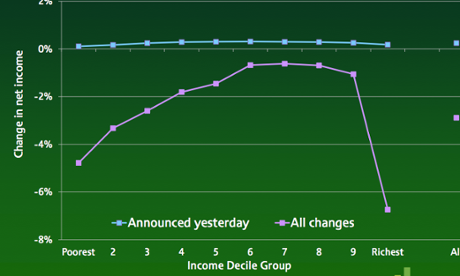
Contained in the IFS's analysis of the impact of yesterday's budget reforms is the starkest of truths: the only people to gain are those in income decile group one removed from the richest.  Those right there are the people the Conservatives are governing for, the only people they imagine they need to govern for, as everyone else is either stuck with them or written off.  The poor either don't vote or vote Labour or UKIP; public sector workers vote Labour; the young either don't vote or vote Labour or Green; they're all lost causes.  Everyone else, well, why would they vote for a Labour party that only represents those people?  Such is the new Conservative way of thinking.  Such is the space a Labour party that has taken all the wrong lessons from its election defeat has left its opponent to move into.  If they won't defend their manifesto, we'll take it.  Osborne isn't a genius, he's an opportunist and a strategist.  Shrinking the state is secondary to winning.  Ideology helps to explain, but doesn't tell the full story.

All hail the new Tories.

Labels: , , , , , , ,

Share |

Wednesday, July 08, 2015 

The rat and the rabbit.

After all the leaks, the raid on the BBC, the talk of how this one nation Conservative party would be creating a low tax, low welfare, high wage economy, there was only one real question left to be answered by George Osborne's wholly unnecessary second budget in three months: what's the fucking rabbit going to be?

First though, if on presentation and build-up only, today's budget is difficult to fault.  Almost all the nasty stuff was briefed about in advance, from the swingeing cuts to both tax credits and child tax credits, the reduced benefit cap and the abolition of inheritance tax for all properties under £1m.  There were still some extremely devious measures that weren't announced beforehand, like the abolition of grants for the poorest students, to be replaced with loans, but in the main all the changes to welfare were expected, leaving the way open for Osborne's surprise to dominate the headlines.

This budget was then all about him.  That Osborne is an exceptionally overrated politician, and unlike some of those also lauded by the press and commentators, believes his own hype, matters little.  Despite loathing him, he is more than the heir to Gordon Brown, only unlike Brown he hopes to make a success of taking over from his predecessor.  The difference is that whereas Brown and Osborne are remarkably similar beasts in how they always put personal political advantage ahead of everything else, Brown had the nous to recognise when he had gone too far, and also to act in a crisis.  Osborne by contrast just keeps on pushing ahead regardless, covering up his mistakes as he goes along, hoping no one will notice.

That something would materialise to sugar the pill was then apparent; not even with the backing of the majority of the press, a cowed opposition and a BBC in disarray would Osborne have got away with making the poorest undeniably poorer while cutting inheritance tax and raising the 40% threshold.  That Osborne decided to steal almost directly from Ed Miliband's Labour manifesto, the one that apparently no one can defend such was its rancidity, ought to have surprised no one.  Rather than abolish non-dom status outright though, perhaps the most obvious choice, Osborne opted to filch Miliband's minimum wage rise policy instead.  Only he went even further, promising that whereas Miliband outlined a rise to £8 an hour by 2020, Osborne's new "national living wage" will be £9 an hour by then.

Except, of course, Miliband's proposed rise in the minimum wage was meant to operate alongside the living wage, with sweeteners for businesses that opted to pay the latter.  Osborne's national living wage is nothing of the kind, for a whole host of reasons.  First, the living wage in London is already calculated to be £9.15 an hour.  Second, the living wage has always taken into account tax credits; remove them entirely or cut them viciously, as Osborne has done, and it would need to be even higher.  Third, as the IFS has already pointed out, not all businesses, especially small ones, can afford to pay the living wage, or at least not without raising their prices dramatically.  The further cuts in corporation tax will not help them one jot.  Workers over 25 will either have to be replaced with younger ones still on the lower rate, or another slew of smaller retail businesses are likely to be forced to close, or break the law to survive.

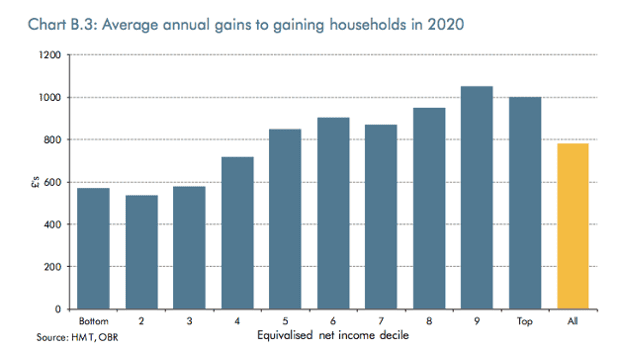
The distributional analysis from the Office for Budget Responsibility lays it bare: just as with the continued rises in the personal allowance, those who will gain the most are once again the already comfortably off.  The end result is that regardless of the rise, the cuts to tax credits will mean the vast majority will still be worse off, albeit by perhaps half as much as they otherwise would have been.  The poorest in society are in effect being asked to subsidise what David Cameron described as the "most basic, human and natural instinct", i.e., to pass on what even they themselves may have received entirely tax-free, at a cost estimated at £940m by 2020.  This truly is, as Chris said, the something for nothing culture in action, and as Rick argues, sets the Conservatives out not as defenders of wealth creators, but those who buy a commodity and do nothing with it other than just watch it grow in value.

Much the same thinking is presumably behind the cutting of rents in social housing by 1%.  What looks on the surface to be about helping the low paid is more than counteracted by how the OBR points out this is likely to reduce further the building of social housing.  Combined with the government policy of extending the right to buy to housing associations, this seems destined to further inflate the housing market bubble, and indeed in turn, the housing benefit bill, despite the motive being the opposite.  The new lower benefits cap will also have an effect, and is likely to lead to more landlords rejecting housing benefit claimants outright.  That buy-to-let mortgages will only be able to be offset against the basic rate rather than higher rate of tax is also likely to lead to a race to do so before the measure kicks in in 2017, further overheating the market.

Underneath all the wounding cuts to benefits and the rise in the minimum wage is the fact this was a tax-raising, rather than a tax-cutting budget.  With the major taxes off-limits, as promised and set to be legislated upon so they cannot be touched, Osborne has resorted to the stealth taxes Gordon Brown was so pilloried over.  The big money raisers are the tax on dividends, forecast to be bringing in nearly £2bn a year by the end of this parliament, a rise in the tax on insurance premiums, which should raise £1.5bn a year, and the changes to vehicle excise duty, meant to gain the Treasury by a similar amount.  Some of this though is going straight back out the door thanks to the further, unexpected cut in corporation tax to 18%, estimated to cost almost £2.5bn by 2020.  As Aditya Chakrabortty has been setting out in the Graun, this is in spite of the estimated £93bn a year given out in corporate welfare.

Osborne has then all but abandoned the plans he set out in March, opting instead for a smoother path to his idealised surplus, coming a year later than planned.  The cuts to government departments will not be quite as severe as anticipated, almost certainly down to how there's so little meat left to cut.  £18bn will nonetheless still have to be found, and with the defence budget now also protected, that leaves one area less from where money will be taken.  This has also only been achieved thanks to overall savings in welfare of £34.9bn, the difference made up by the continued freeze on yearly increases to benefits of 1%, and changes to universal benefit before it has even been introduced.  All this is predicated on Osborne's savings and cuts being achieved: when £5bn is again meant to come in from clamping down on tax avoidance and evasion, this looks extremely dubious.  The OBR also rates the chances of most of Osborne's tax rises raising what the Treasury says they will as having a "very high" uncertainty.  Should they not, will Osborne again postpone reaching his surplus, raise the taxes he's legislated not to, or cut benefits even further?  Take a wild guess.

George Osborne's task today was relatively simple, despite all the talk of how clever he's been and the boost to his chances of taking over from David Cameron.  All he needed to do was get the pain out of the way, disguise it as best he could and hope that by 2020 what voters remember is not how he picked their pockets, but how their wages have now increased thanks to his living wage.  The fact is Osborne has been a remarkably lucky chancellor: the "omnishambles" budget would have been the downfall of other politicians, as would his abysmal failure to eliminate the deficit in a single parliament, or indeed how he cut too far and fast in the first couple of years and stalled the recovery.  Thanks to a very friendly press, a weak Labour party and the Liberal Democrats covering for him, he's still in place.  Moreover, he's only implementing what the Tory manifesto promised.  Those who voted Tory might not have expressly wanted a crueller, smaller state, where everyone who earns below the 40% threshold can essentially go hang, and the aim is to ensure the moneyed and propertied stay that way, the drawbridge permanently raised up, but that's what they've got.  The only thing that can blow Osborne off course now is another downturn, and the further suffering that would entail hardly bears thinking about.  Such is the position of strength an exceptionally weak government finds itself in.  Such has been the failure of all opposition to austerity.

Labels: , , , , , , , ,

Share |

Thursday, March 19, 2015 

An epic day in politics.

"I almost spilt my coffee."  Yes, of course you did George.  While the rest of the country was trying to work out how the Sun could possibly have thought ripping off an already dire advert was a good idea, the chancellor was failing to hang on to his latte, his jaw having dropped.  It would be a difficult story to believe even if Osborne wasn't the type of person who strikes you as the kind liable to stand in front of a mirror, imagining himself all rippling muscles and shit-eating grin, a veritable gift to women.  Osborne does after all think calling someone an idiot to be devastating wit, as evidenced by his past braying reaction to Cameron's description of Ed Balls.  More indeed.

You can then see the low base from which Osborne's subsequent remark, of the Sun's genius, came from.  Only the unbelievably easy to please and those tasked with finding something, anything to crow about from yesterday's budget could have presented it as such an unvarnished triumph, let alone an "epic strut".  Do the kids still use the word epic, you imagine the Sun's hacks asking, after high-fiving each other for coming up with the take on the Money Supermarket ad in the first place.  Epic fail!  Guh-ugh-uh.

Osborne does at least if nothing else retain some self-respect.  Whoever came up with the idea for the Liberal Democrats to present their own imaginary budget, complete with hastily painted yellow box, you can but hope they've got an up to date CV.  Danny Alexander, the coalition's answer to a question that was never posed in the first place duly came out of the Treasury, rather than you know, Number 11, holding up his lunch for the approval of the interns sent along on the off chance there's a sliver of space to fill somewhere in tomorrow's paper.

Of all the various attempts at differentiation the Liberal Democrats have tried, this has to rank as both the most absurd and bizarre, and just as strange was why both the speaker and the civil service went along with it.  Alexander's presented figures for how a Liberal Democrat government would manage the public finances were even more of a farce than Osborne's actual ones, not least because his party has stopped pretending it has any chance of winning the election rather than forming another coalition.  When you can no longer deny that inevitability, how can you possibly maintain there's even a cat's chance in hell of the plans forming anything like the basis of the next government's economic strategy?  The only realistic answer to why this was signed off has to be pity for poor old Danny's chances of retaining his seat, with the SNP likely to win in Inverness.  Too bad that concern came at the expense of the rest of us.

Still, it could be worse: we could be Jack Monroe.  I have to admit to getting incredibly tired of the feel my woe school of political journalism, where those getting well remunerated for their writing or other work start out by saying how terrible it is to be abused for simply doing what they do.  All Monroe did was say I'm joining the Green party, and what do you know, the accusations of being a traitor started and the reactionaries came flooding in.  She was looking for importance to be placed on a national health service, public transport, sustainable energy and fair pay for pay work, all values which Labour under Ed Miliband have abandoned.  No, she hasn't left the Labour party, the Labour party has left her.  Vote Green and get Tories they say.  But we get Tories whoever vote for!

Well, yes, it's called democracy.  Oh for PR she writes; except we couldn't even get the alternative vote when the option was given.  Yes, she appeared in a Labour election broadcast and they supported the food bank petition, but so too did the Greens.  That some would launch attacks rather than consider why it is those like Monroe are leaving says all you need to know.  The idea they might be perturbed by how a popular figure with a following publicly abandons a party on the eve of an election on fairly spurious grounds, which are frankly what they are, doesn't seem to have occurred.  With friends like these, who needs enemies, Monroe tweeted.  Quite, Labour will no doubt reflect.

Labels: , , , , , , , ,

Share |

Wednesday, March 18, 2015 

Hubris and the wait for nemesis.

You can't help but get a sense of the way the election campaign looks set to pan out from the way the broadcasters have utterly capitulated to David Cameron and the Tories over the debates.  Thanks in part to ITV's apparent desperation to once again host the first debate, with all the bragging rights and ratings that go with it, Dave has made the extremely minor sacrifice of agreeing to one debate with 6 other party leaders at the very start of April.  While the precise format of the replacements for the other two debates haven't been finalised, they're likely to involve interviews with Paxman and a Dimbleby hosted Question Time-athon, each leader lightly grilled by the same audience separately.  Cameron has thus ensured he won't be shown up too much by Farage, while Miliband will be boxed in by both Natalie Bennett and Nicola Sturgeon during the one unwieldy session. He's avoided the ignominy of being "empty chaired", nor will he face off one on one against the "despicable, weak" upstart with two kitchens.  As was predictable, the commercial need to broadcast something, anything with the prime minister overcame the principle of refusing to bow to his demands.

Little wonder George Osborne felt able to act with such hubris in his final (God, please let it be his last) budget.  Few other politicians in his position would have with a straight face claimed living standards are higher now than in 2010, not least when the claim rests on a single cherry-picked statistic, itself reliant on the massive drop in inflation due to the oil price halving.  He insisted that, albeit a year later than planned, the debt-to-GDP ratio is falling, the second of his major economic promises made in 2010.  The Office for Budget Responsibility later pointed out this will only happen thanks to a mammoth £20bn in asset sales.  We heard once again the phrases designed to be used as soundbites, "Britain walking tall again", "the comeback country", liable to please the same little minds his previous "march of the makers" and "aspiration nation" did while washing over the rest of us.

There was not to be even the slightest nod to the all too obvious mistakes of this unbelievably overrated in every sense chancellor.  Plan A had long since been abandoned, but so also have we become inured to the prospect of a further 4 years of austerity.  With as little fanfare as he could get away with, Osborne rejigged the spending plans of the autumn statement that set out those "colossal" spending cuts, the same ones he thought wouldn't attract such attention.  He did this not by sensibly spreading out the extra money found down the back of Number 11's sofa in the past four months, loosening the squeeze up to 2018, but setting out a splurge in the final year of the next parliament, equivalent to the entire defence budget.  The ridiculous surplus of £23bn planned for 2020 is thus a slightly less fantastical £7bn.

Except of course these figures are illusionary.  Regardless of the make-up of the government at the next budget, the chance of anything like these plans being set out again is minute.  As the Institute for Fiscal Studies was quick to make clear, they're reliant on the further £12bn in welfare cuts Osborne has long talked about being found, alongside an equally difficult to believe £5bn being raised through clamping down on tax avoidance and evasion.  We're no closer to knowing where the hatchet will fall in the case of the former, no doubt precisely because there is no more fat to trim.  It's an utterly absurd way to run anything, let alone a state, to cut services as harshly as Osborne plans only then to ratchet spending back up again two years later, and he would have to be a complete moron to so much as contemplate doing so.

Osborne is many things, but a complete moron is not one of them.  For this was a budget less about giving activists something to base a case around than making things as difficult as possible for Labour.  Gone is the mess of Osborne's making, the back to the 30s jibe, to be replaced instead by a return to the day to day spending of 1964 instead.  Spent is some of the money earmarked for Labour's daft in any case reduction in tuition fees, Ed Balls saying it would be found elsewhere.  And then we had the "jokes" courtesy of Danny Finkelstein, only accompanied by fatuous policies in order to shoehorn them in, the most desperate of which had to be the non-gag about bands of brothers and Agincourt, at the cost of a million to commemorate it.

With that out of the way, all that was left were the priorities we've become used to from this government and chancellor.  A further lifting of the income tax threshold, which benefits middle earners the most; allowing pensioners to trade in annuities for cash, boosting the Treasury's coffers at the same time; a "Help to Buy" ISA the government will top up, without any further announcements on building the damn houses in the first place; and a new savings allowance, with the first £1,000 tax free, projected to cost £1bn in the first year.  As for those who can't afford to save, or who probably won't be able to reach the £1,000 figure, be glad you got away with your sweet FA.  It also makes ISAs less attractive as a whole, but seeing as the aim probably was for Osborne to be pictured on the front page of the Mail with the sun shining out of his arse, it's doubtful he'll give it a second thought.

Hubris can after all mask anxiety.  This wasn't a budget to win over voters so much as to yet again consolidate the party's core vote.  Bribe after bribe has been thrown at those most likely to turn out, and still the election remains too close to call.  By this point a Tory lead was meant to have developed, only for the polls to continue to suggest a dead heat.  With Osborne having done his bit, with there being little reason to expect a leap post-Budget bounce from what he unveiled, the onus is back on Cameron to haul the Tories over the line.  Thank goodness the broadcasters stood firm then, eh?

Labels: , , , , , , , ,

Share |

Tuesday, March 25, 2014 

This blog is fully in favour of fundamentally disrupting power relations and reframing the debate to make a good society both feasible and desirable.*

Within hours of the budget last week, the Labour Uncut blog had a post up quoting a anonymous backbencher as saying such was Ed Miliband's response to George Osborne's pensions gambit, the way things were going the party would need a Devon Loch scenario to win a majority come the election.  For those under the age of 70 or who aren't much interested in the annual flogging a live horse round a deadly obstacle course soiree at Aintree, Devon Loch did a Bambi while just yards from the finishing post in the Grand National.  This rather strained metaphor ignores that for some time it's been Labour out in the front, not the Tories, but still.

Such is the way some of those on the right of the party have long responded to even the slightest of setbacks, or in this case less than that. Absolutely no one remembers the responses to budgets, and as it seems the coalition declined to provide Labour with the traditional redacted version of Osborne's speech in advance, Miliband would only have been able to respond to the specifics off the cuff.  Instead he went for a general critique, and while it wasn't great, it was nowhere near as poor as has been made out.

Nor is the rise in support for the Tories since the budget anything approaching a surprise. Osborne succeeded in presenting it as a giveaway, albeit "fiscally neutral", and reined in the austerity masochism as far as he could. There were no further painful cuts outlined, although whether they might well be needed when Osborne is spending money he hasn't properly allocated as the IFS pointed out remains to be seen.   Precision geared towards those already more likely to vote Tory, in effect bribing them with their own money, exactly the claim they used to throw at Gordon Brown, add on the changes to pensions and the bounce ought to have been expected.  The real question is whether the uptick remains over time, as it did for Labour long after the omnishambles of 2012.  As yet there's nothing so much as approaching an indication this will turn out to be the case.

For Dan Hodges and his ilk though this is the final proof Miliband is a loser, or rather, "isn't working".  Hodges has been pushing his the only way to win is to out-Tory the Tories shtick for so long now it's stopped being entertaining in the same way as watching a film that's so bad it's good is, and has just become incredibly boring.  Nonetheless, Hodges' line into the soul of the party is John Mann, who urges Ed to speak the language not of a Hampstead academic but of the average resident of Bassetlaw.  These would presumably be the same people telling Mann that what the country desperately needs is a vote on our membership of the European Union, a cause he insisted was top of their agendas just a couple of weeks back.

Thankfully for all concerned who should enter the fray at this precise moment other than a horde of think-tankers with their own views on how Labour should fight the 2015 election.  Or, as they describe themselves, "members of the progressive community".  Think my writing is turgid, highfalutin, unnecessarily verbose and arch?  You should try this unholy alliance, who take Birtspeak to extremes.  They want Labour to make all powerful institutions accountable to their "stakeholders", action on the causes of "our social, environmental, physical and mental health problems", something that requires a "holistic" approach, and obviously, the "empowerment of everybody".  Not aiming too high there, are you lads?  Apparently the time of politicians doing things to people are over (or at least prospective Lib Dem candidates must hope this to be the case), while the era of "building the capacity and platforms for people to do things for themselves, together is now upon us".  Translated, this essentially means they are in favour of devolution and localism, and while it all sounds suspiciously like the Big Society all over again, only rebooted for the crowdsourcing Twitter and Wikis can solve like, everything, man age, it isn't meant as a cover for cuts.  Only there's no money to pay for anything, so sisters people doing it for themselves does help matters immensely.

If like me you can recall the times when Luke Akehurst seemed to embody everything that was wrong with the Blairite tendency within Labour, it comes as a deep shock when his is the voice of reason.  He notes how the letter seems to leave room open for another coalition, suggesting everyone should just forget how the Lib Dems have rejoiced in ripping the state to shreds over the past 5 years, and more pertinently, that as much as localism excites a certain section of politicos, it's mostly deeply unpopular or treated with deserved suspicion by the voters.  Unlike the Hodges/Labour Uncut sect, he even suggests 5 policies which aren't the same old triangulation, nor are they obvious pipe dreams fluffed by arcane language.

All this is to rather ignore just how the Tories seem likely to fight the election.  When they tire of the country is saved thanks to us routine, they fall back on policies that are deeply divisive.  See Cameron returning to the theme of cutting inheritance tax, the coalition having wisely not touched it during this parliament.  The Conservatives have become a party that is openly in favour of oligarchy, the passing down of unearned wealth from generation to generation.  The Mail naturally thinks this is a huge vote winner, while anyone with half a brain can see that you simply can't go on saying you're the party of aspiration while doing everything in your power to screw over those who don't have comfortably off parents.  If Cameron couldn't win outright in 2010 on a centre-right ticket against Liability Brown, what makes him think they can do so on a right-wing ticket in 2015?  The obvious answer is that they can't.  Miliband and his ministers do need to flesh out many of their their policies, but to panic at this point or take advice from either extremely dubious faction would be a misstep.  The budget bounce will dissipate.  Everything is still to play for.

*Yes, that really is how the thinktank alliance conclude their letter to the Graun.

Labels: , , , , , , ,

Share |

Thursday, March 20, 2014 

The return of the stupid party.


There is only one thing to draw from the Tories' BINGO! ad, as tweeted by Michael Green Grant Shapps, and it's not that the party itself has a pretty dim view of those it's attempting to appeal to, as we already knew that. It's rather that the party's advisers and advertising partners seem to be similarly crass and thoughtless. Is this really the same party that, regardless of what you thought of it, could at least be relied on in the past to commission effective, even iconic campaigns? Compare it to the viral video released by Labour a few weeks back, which used the template of Facebook's otherwise deeply creepy auto-generated history videos to look back on the coalition's four years in an both amusing and critical manner.  Forget patronising, Shapps' tweet was downright stupid, the only surprise being it hasn't been deleted.

Thankfully, we don't just have to rely on the Tories' own chairman to show up the coalition, as the Institute for Fiscal Studies has once again cast their eye over the budget. As last year, they condemn George Osborne in wonderfully understated language, as he continues to find money for tax cuts and spending without it being made clear where the money's going to come from.  "A Chancellor focussed on sound management of the public finances over the long tern would not make a habit of repeating these sort of manoeuvres," Paul Johnson said (PDF), but then it's been clear for some time that Osborne is no more focussed on the future beyond the next election than Gordon Brown ever was. The IFS notes there was again not even the slightest reflection on whether the scale of cuts required from non-protected departments are achievable, as they and many others doubt. Such shocks, whether they be tax rises, further cuts or both are to be left until after 2015.

Nor were the more widely praised changes to pensions spared. Despite the best efforts of the coalition and their supporters in the press to say so, it is not patronising to ask whether some will underestimate the amount they'll need to live on come retirement, nor whether the result will be a rise in the cost of annuities for those who do want them.  As Paul Johnson also pointed out, the Treasury expects the amount brought in from allowing people to cash out their pension pots if they so wish to increase in the short term, then reduce over time.  The real worry is not that those approaching retirement age will run out and buy Lamborghinis and then rely on the topped up state pension to live on, but as Tode says, it will spark a further round of buying to let, further limiting the opportunity of those on low incomes to purchase their own home.  Having already made it almost a right for parents to pass their homes on to their children, now it seems they'll be able to bequest their property portfolio as well.

Not that everything is entirely rosy for the comfortably off.  The additional 2 million who have found themselves dragged into the 40p tax band since 2010 have but one person to blame: the chancellor who has slashed corporation tax and abolished the 50p rate for the mega rich, meaning the shortfall has had to be made up somewhere.  Even so, the IFS makes clear whom has suffered the most under the coalition, and it sure isn't middle earners: with the exception of the top decile, who can more than shoulder their share, the poorest have been hit hardest.  It's worth remembering that this was Alistair Darling's plan for closing the deficit, almost the model of progression.  The coalition by contrast has assaulted the poor and got away with it, helped along by those who've focused on Benefits Street rather than the Square Mile.  Still, "they" can be bought off with beer and bingo, right?

Labels: , , , , , , , , , , ,

Share |

Wednesday, March 19, 2014 

Very much a country for old men.

Well, now we know.  The Conservative plan to get re-elected is devastatingly simple: bribe older people, bribe them now, and bribe them often.

To give George Osborne some credit, today's budget was far smarter than just throwing money in the general direction of the 55+ vote.  It was also the work of a politician who still wears the scars on his back from the 2012 omnishambles, when he put into action almost every old suggestion made by the civil service, many previously rejected by Labour as being either a nightmare to enforce or liable to result in an almighty backlash.  Add on the scrapping of the 50p rate, something most people aren't attached to in the long run but was symbolic of the well off needing to pay their fair share, and the Tories still haven't fully recovered.

Whether it will have the desired effect is far more difficult to predict.  Where Osborne gives with one hand, he takes with the other.  He makes much of his new "pensioner bonds", where those over 65 can wedge a cool 10k of their savings and on a three-year deal expect a return of 4%, while those who want to take advantage of his doing away with the need to take out an annuity and instead take a cash lump sum will be heavily taxed for the privilege, a measure predicted to raise a very handy £1.2bn by 2018/19.  This is especially clever for the reason that it looks as though everyone with a pension or significant savings is a winner: as Rick pointed out last week, it's arguable that in some areas it's been spending by pensioners keeping whole towns afloat.  Making this cash even easier to access makes sense, at least in the short term, especially when the much trumpeted recovery has been been reliant (so far) on consumer spending.  That simply can't continue for too long, unless you make it attractive for those who previously haven't splashed out to do so.  Little wonder the more cautious are expressing concern at how this could mean the state having to step in should things go wrong, but this obviously doesn't worry Osborne when he's relying on an immediate gain.

Then there were the utterly shameless measures.  There's very little reason why the tax on bingo should be reduced by 10% while that on fixed odds betting machines should be increased to 25%, unless we're falling for the out of date stereotype that only little old ladies play bingo while just those who can't afford to shove their pounds into slot machines.  There's an arguable case that bingo halls offer a wider community benefit, but this ignores how most will now offer both side by side. By the same measure, it also bewilders why the alcohol duty escalator is being scrapped while the one on tobacco remains, especially when counterfeit tabs and tobacco are far more abundant than knocked off booze. Taking another penny off beer is the kind of gesture that costs money while not being passed on to the consumer, making it worse than useless. Makes for a good headline, though.  Just as dubious is yet another scrapped rise in fuel duty, making it all but unthinkable the next government could restore the polluter pays principle.

For pretty much everyone else there was very little to cheer in George Osborne's screed. We heard once again about how this was a budget for the makers, the march of the mallards makers previously announced having not yet materialised, with the Office for Budget Responsibility later setting out how the sector was likely to continue to decline. A further, belated £2bn was found for investment, the coalition having first cut it, without it being explained where the money was coming from. Welfare spending excluding pensions, JSA and linked housing benefit is to be capped at £119bn, rising with inflation, which while not as draconian as feared is only likely to be the first assault on tax credits and housing benefit for those in work, the Tory proposal to exclude the under-25s from claiming it a spectre in the background.

Unless Osborne is planning something truly spectacular for next year, by which point many will have already made up their minds, the reasons for why the young and the low to moderately paid should even consider voting for either coalition party continues to diminish. The reality is unless you're married, have children, you both work and can afford to save you might as well not exist in Osborne's "resilient" economy, as any gain from the further rise in the personal allowance is swiftly snatched back through the withdrawal of tax credits, while middle earners gain more. The Lib Dems seem to have realised their cherished policy isn't all it's cracked up to be, just too late to do anything about it.  There was nothing to help ease the housing crisis, just re-announced old pledges to build. Any hope the much heralded "surprise" would be cutting VAT was soon dashed.

Which leaves just the recovery itself. Delayed thanks to Osborne's austerity fetish, we are still 5 years from the elimination of the deficit he promised by the end of this parliament. As welcome as the continued drop in unemployment is, it masks how those on the various workfare schemes are counted as in work, while those sanctioned are removed from the JSA figures. What it can't hide is the massive rise in self-employment, which far from suggesting entrepreneurial zeal suggests desperation, as well as exploitation on the part of companies, locking new workers out from the usual benefits. 60% of the cuts are still to come, ones which look all but impossible in the timescale without the collapse of services, and while there are reasons to doubt Labour's figures, there's probably much truth in their claim that most people will be worse off in real terms come the election.

Who then can blame the Tories' gambit? It ought to be their only hope. The fear has to be of the most likely alternative: another hung parliament, another coalition. 5 more years of the Lib Dems pretending not to love the cuts. Should it happen, can someone please put me out of my misery?

Labels: , , , , , , , ,

Share |

Thursday, March 21, 2013 

The depression must continue. And continue.

The usual way budgets pan is out that they begin to fall apart the day after.  Last year, Osborne's wheezes were so shambolic and leaked so thoroughly beforehand that it was clear on the day what a disaster it was.  This year we've had the spectacle of the chancellor himself making clear just how the figures were fixed to meet his objective.

Osborne then admitted this morning as was suggested yesterday that he had specifically asked departments to underspend so he could still meet his aim of reducing borrowing year on year.  As the IFS has since made clear, the underspend in total was £10.9bn (PDF), more than double the average of the last five years.  This includes a £2.2bn underspend on the NHS, further giving the lie to the claim from Cameron that spending on the health service is rising in real terms.

This is the kind of manoeuvring that during Gordon Brown's time as chancellor would have resulted in the Tories and the right-wing press throwing a fit.  The IFS sums up the aim of reducing borrowing year on year as "economically unimportant" which it is, but that spending time and effort to achieve it "could have had real economic costs".  In other words, Osborne would rather be proved right about the politics than the economics, which is just about as brutal a criticism of a chancellor as the IFS is likely to make.

Incredibly, it gets worse.  The IFS also forecasts that to fill the hole created by the various giveaways yesterday, come 2016 we face even more cuts, or more likely, significant tax rises. As spending on the NHS, education and international aid is due to remain protected till at least then, this puts all the more pressure on the other departments, and it's difficult to see how welfare won't be raided again.  Pledging to protect certain departments may have been good politics originally, but it's exceptionally daft now that budgets are falling in real terms anyway.

All this only underlines what a disaster Osborne's tenure has been. The inheritance the next government can look forward to will be even worse than the one the coalition had in 2010, when there were plenty of alternative policies that could have been pursued. The options available are either tax rises, when wages will still not have recovered, or cuts across the board.  As none of the parties are likely to make clear just how unpleasant these choices will be, the next government is bound to be unpopular from the very start as they are forced to row back on election promises.  And all because of Osborne's continuing refusal to change his mind when the facts have.

Labels: , , , , , , ,

Share |

Wednesday, March 20, 2013 

The depression must continue.

How then has austerity been working out for you?  Are you enjoying the umpteenth year of a cut in pay in real terms?  Does life seem to be getting progressively more miserable and onerous with each passing month?  Aren't you at least somewhat appeased by how all this will be worth it in the long run?

George Osborne must certainly be hoping that you are, as today's budget does next to nothing to ease the pain at any level.  Indeed, if you're a public sector worker, he's just announced another year where your pay won't meet the rate of inflation.  As for everyone else, he's managed to find some money from somewhere through the usual tricks to be able to abolish the beer duty escalator altogether, as well as reducing the price of a pint by one single new penny.  Also cancelled was the planned rise in fuel duty in September, although anyone who imagined it was going to go ahead when it's been apparent for some time now that the lobby against is just too powerful is living in a country only slightly adjacent from the one Osborne occupies.

For this was the budget that spelled out plain and clear that his plan hasn't only failed, it's done so catastrophically.  The economy has effectively not grown since the coalition came to power; growth last year was 0.2%, all of which was down to the Olympics and counting the sale of the tickets in the third quarter.  The Office for Budget Responsibility forecast at the budget last year that the economy would grow in 2013 by 2%; at the time of the autumn statement they downgraded this to 1.2%; now they predict growth of a pathetic 0.6%, and some of that will depend on the economy not slipping into a triple dip in the current quarter, which will be very touch and go.  Osborne claims that the deficit has been cut by a third, yet as Duncan Weldon points out, on a like for like basis excluding the taking on of the Post Office pension book and the receipts from quantitative easing, it has in fact not even fell by the much lauded quarter, rather by 22.5%. Moreover, over the next two years the OBR predicts it will barely move, remaining around the £100bn level, rather than coming down to £37bn as the OBR originally predicted following Osborne's "emergency" budget of 2010.

Similar smoke and mirrors tactics seem to be at work when it comes to Osborne managing to avoid borrowing actually increasing this year compared to last.  He's only succeeded thanks to departmental underspends, as tax revenue fell £5bn short of what was expected.  Whether as Faisal Islam suggests this was down to Osborne ordering departments to hold back we can't know, but it certainly looks suspicious that his figures are only £100m away from there being no change.  Those same departments are now being called upon to make further cuts to finance the £3bn increase in infrastructure spending, which isn't going to kick in until 2015 anyway.  Little wonder that the OBR suggests that broadly this was a budget that will do absolutely nothing to encourage growth, something Jonathan Portes concurs with.

Whether there are any nasty surprises lurking will doubtless be confirmed by the IFS tomorrow, but what's apparent today is that Osborne is once again betting that a gamble will pay off in order to ensure the budget is "fiscally neutral".  The almost £5bn being spent on reducing beer duty and cancelling the fuel price rise is all to be made up through dealing with tax evasion, something which is notoriously difficult.  Last time he counted on the 4G auction to pay for his spending, and only just about managed to get out of the bind when it brought in less than was expected.  This time there may well be no escape.

Otherwise, this was the usual nakedly political budget we've come to expect from Osborne, who despite loathing Gordon Brown seems to have learned everything he knows from the son of the manse.  This was a budget for an "aspiration nation", or to put it more bluntly, the middle classes, as long as you fit the new Tory notion of what the middle classes are.  You must want "to get on in life", work even if you have children, either own your own home or want to, not earn quite enough to fall into the 40% income tax bracket, not claim benefits, not work in the public sector, and you must drive to work and swill beer rather than any other alcoholic beverage.  There were a couple of sops to those outside these arbitrary confines, such as the raising of the personal allowance to £10,000 a year ahead of schedule, but then that also helps the middle more than it does the poorest.

All this pampering of the middle and continued codifying of business with a further cut in corporation tax for those who bother to pay it, does, after all, come at a price.  While there were no extra cuts to welfare announced this time round, it seems likely further reductions will be coming in 2015, with Osborne due to target "annually managed expenditure".  The effects of the current cuts are already there to be seen: the poorest are continuing to take a pounding, while the richest, despite possibly paying more in tax now than they did under Labour, are barely affected, not least thanks to Osborne's abolition of the 50p rate.

If Osborne's ultimate aim was, as the Guardian reports, to "avoid fucking up", then at the moment he seems to have just about managed it.  What he most certainly hasn't done is shift away from Plan A, regardless of how many people or publications urge him to drop his refusal to borrow to invest.  The one move today which may well have some effect is the £2,000 cut in employers' national insurance contributions, which could encourage small businesses to take on more workers.  Otherwise, he's relying on the Bank of England to inflate away the debt, something which is asking for trouble when wages already can't maintain pace.  Osborne's major problem is that as a recent poll showed, his unpopularity poisons his policies regardless of whether the public agree with him or not.  Nothing announced today is going to change that.  Nor will it even begin to get us out of the depression the coalition has helped to plunge us into.

Labels: , , , , , , ,

Share |

Thursday, March 22, 2012 

Picking over the bones.

The tradition of the last few years under both Labour and the coalition has been for the budget to only come under proper scrutiny on the day after the night before. This time round, thanks both to the unprecedented amount of leaking (or spinning) and the coalition apparently giving up even the pretence of fairness it was mostly filleted yesterday.

As a consequence we've been left with mainly bones to pick over. It was already apparent yesterday that the removal of the 50p top rate of tax was a purely ideological move, rather than one based on evidence, so more interesting was the Institute of Fiscal Studies' verdict on whether the other tax changes on the rich yesterday would raise the amount Osborne claimed they would. To no one's great surprise they regard it as extremely doubtful, and they quite rightly deride the rise in stamp duty to 7% on houses worth over £2m. Keep in mind the continuing claims today (including from Vince Cable) that the 50p rate raised almost nothing when it in fact pulled in about £1bn, despite massive one-time only avoidance, when it's announced that the "mansion tax-lite" really does bring in almost nothing.

The other major point raised by the IFS was the ever increasing numbers who will find themselves in the 40p tax bracket. With Osborne slashing corporation tax and deciding that millionaires need to be incentivised further in order to get the economy growing, the shortfall has to be found from somewhere. Welfare can't be cut by much more, neither Labour or the Tories will hear of cutting back on defence and abandoning the pretence we're still a world power, and the NHS and education are also sacred cows. What Osborne and the Lib Dems therefore give with one hand through the raising of the personal tax allowance has to be taken away with the other, and the (upper) middle classes are the ones footing the bill. With big business and the City having such a stranglehold over politicians regardless of party, crying that they'll go wherever they're taxed the most competitively, it's something they're going to have to get used to. Don't like the prospect? Start organising, stop complaining about the "scroungers" at the bottom and take on the boss class. Stop laughing at the back.

Encouraging is that while the Times was probably the most positive paper of all about the budget, the Sun was only slightly less critical than the Mirror. Where previously you would have thought the paper would have applauded such openly Thatcherite measures, it wasn't impressed one iota by the dropping of the 50p rate. Yes, it cheers the dropping of the corporation tax rate (can't think why) and does the usual moan about EU regulation, but otherwise it gives Osborne a kicking in return for the one the paper says he administered to its readers. Add in the likely response to tomorrow's brought forward announcement that booze will shortly have a 40p a unit minimum price, and this might just be the point at which the tide begins to properly turn against the coalition, as the first poll after the budget suggests. We can but hope.

Labels: , , , , , , , ,

Share |

Wednesday, March 21, 2012 

The shafting commences.

Today George Osborne spent just about an hour delivering the budget. He could, had he wanted, summed it up in two short sentences and saved his breath. "For all those earning more than £150,000, I'm going to cut the amount of tax you pay by 5p in the pound, despite having said last year that while those less off are being asked to make sacrifices it would not be the right time to reduce it. As for the rest of you, just how hard and how fast would you like to be shafted?"

For all the supposed deals and battles within the "quad" (the unfab four, as they won't be known) over what and wouldn't be in the budget, this was about as ghastly it gets. It was also completely and utterly underwhelming as almost every major detail had been leaked and briefed, to the point where you wonder whether they really were "leaks" and battles being fought in public or instead a week long spin operation, designed to ensure that once the "bad news" was broken that almost everything that could be said against the rises and cuts had already been gone through endlessly. The one major change that wasn't announced prior to today was the end of tax allowances for new pensioners, which Osborne incredibly dressed up as being a positive change, with poor old dears no longer having to fill in complicated forms every year. You could call it Brownian, but not even Gordon Brown, 75p pension rise taken into account, was as contemptuous and patronising as Osborne was today.

It also doesn't get more ideological than the incredible rush to ditch the 50p rate. Four months ago, as the Graun points out, Osborne gave no indication that one of the major factors holding the economy back was that after the first £150,000, half of what you earn goes to the Treasury. Osborne is basing his entire policy on just the data from the very first year of the tax's operation, when as it's become clear a large percentage of those about to be hit moved windfalls forward a year as to avoid it, something they won't be able to do again. It's true it's still given their accountants plenty of time to come up with new dodges, but anyone who was genuinely interested in seeing if it will bring in more money than the £1bn it did in the first year would have stuck with it.

Moreover, if Osborne had replaced it with something equally totemic, or even just additional tax rises that are certain to bring in the same amount as the 50p rate was projected to, it would have softened the blow. Instead what he's done is close to being laughable, and far easier to sidestep: increasing stamp duty to 7% on houses over £2m is only going to affect the stupidly wealthy, and those who simply have to live in London, as Chris points out. Will it raise as much as the Treasury hopes? If we continue to attract oligarchs who want to sue each other in our courts, possibly. If we don't, it's going to fall dismally short. The other measures on tax avoidance, while laudatory, are fairly minor and it's impossible to forecast how much they'll bring in.

All this is to raise the money needed for the pet Liberal Democrat policy, the raising of the income tax personal allowance to (eventually) £10,000. As has now been repeatedly pointed out, what on the surface does look to be a truly admirable idea, taking the lowest paid out of tax altogether, has the additional effect of giving the most back to middle earners. If you want to specifically help the lowest paid, there are two main ways to do it: either you target them, as Labour did, with tax credits, or you can cut VAT, as those on lower incomes spend more than they save. Tax credits is (very arguably) the preferred way, as cutting VAT also helps out those on high incomes who spend equally high amounts. The coalition rejects the idea of cutting VAT, possibly exactly because it's exactly what Labour having been calling for, while from April you'll have to work at least 24 hours a week before you can claim tax credits, something that single parents are finding especially difficult.

We have then a well-meaning but fundamentally flawed policy that is meant, somehow, to make up for a nakedly ideological one. Osborne's thinking, as further developed elsewhere in this budget and last year's is that by further cutting corporation tax, slashing regulation, reforming the planning laws, setting up enterprise zones and handing out cash to teenagers with entrepreneurial inklings, doing everything he possibly can to encourage business, he'll create the growth we need to bring down the deficit and eventually, in his dreams, share the proceeds of it as the Tories originally said they would. And frankly, it will be amazing if all of this doesn't generate growth, even if it's completely unsustainable and will simply set up the next crash; the problem is that it's going to take time, time he doesn't necessarily have. The OBR's growth prediction for this year has been re-estimated at 0.8%, which is pitiful. Next year, supposedly, it's going to be 2%. The Eurozone, meanwhile, will shrink by 0.3%. All the growth therefore has to come from exports and investment, as private consumption is overall going to fall slightly. Is this going to happen? Probably yes, in the long term. Is it going to start in earnest next year? Extremely doubtful.

This, as before, is what happens in the best possible circumstances. It's more than a possibility that either this year or next Israel, or the US and almost certainly ourselves will launch an attack on Iran's nuclear programme. Even if Iran doesn't then shut the Strait of Hormuz or retaliate against Israel, the effect on the price of oil can only be guessed at. While a Greek default has been averted for now, the idea that Greece can be kept inside the Eurozone for much longer is a fantasy. Osborne has put all his money on a recovery led by the already rich, incentivising them beyond their wildest dreams, while at the other end of the scale he's doing the exact opposite. Anything that spooks the former will kill growth stone dead.


Incredibly, the Liberal Democrats have gone along with it. Nick Clegg and Danny Alexander must know they're propping up a Conservative party that is relying on the same old failed voodoo economics that got us in this mess and that the "concessions" they've extracted are pitiful. Why are they carrying on regardless? They're terrified that if the coalition breaks down that they'll be wiped out in an election, and they're probably right. They must also know though that a Conservative victory is hardly assured. The party should be thinking tonight about what it wants to do: does it want to continue to be the fig leaf for the Conservatives, and for the most regressive agenda since the 1980s? Or would it rather take the chance of stopping this in its tracks now, and potentially going into a new coalition with a party closer to its values? Fraught with risk as such a break is, it has to be better than waiting until 2015 and the same end result.

Labels: , , , , , , ,

Share |

About

  • This is septicisle
profile

Archives

Powered by Blogger
and Blogger Templates