Thursday, June 12, 2014 

A (slightly) shorter John McTernan.

Aren't the Kurds fantastic?  Shame about the Sunni and Shiites, eh?

You see, the real reason why Iraq is currently descending into the abyss is because we left too early.  We were selfish.  We should have stayed for as long as was needed, as long as it took Saddam to destroy the place.  He did it all, you see.

We have a responsibility to go back there right now and start killing more Iraqis.  Let's face it, if there's one thing we've been world class at over the past decade, it's killing Iraqis.  To be fair, we can't take all the credit.  Most of the actual smiting has been by the Iraqis themselves, we just lit the torch paper by having not a solitary fucking clue of what to do after we completely and utterly destroyed the Ba'athist state for the sheer sake of it.

As for all you cynics and stoppers, muttering under your breath about how al-Qaida didn't exist in Iraq prior to our kicking the door in, you're bloodless, amoral cowards.  You might as well say "Saddam may have been a fascist who inflicted genocide on the Kurds at the same time as we supported his war against Iran and sold him weapons", oh, sorry, got a bit confused there.  Wasn't the war about WMD? I've forgotten.

The truth is if we don't act now, we will have to act later.  We have to go back to Iraq to rescue a democracy that isn't working because the politicians won't share power.  Isn't that right, Tony?

P.S. As a very special treat, here's a shorter Owen Jones:

I have encountered no sense of vindication, no "I told you so", among veterans of the anti-war protest of 15 February 2003 in response to the events in Iraq.  That's why I'm writing this.

Labels: , , , , , , , ,

Share |

Wednesday, June 11, 2014 

The taking of Mosul isn't our fault. Well, OK, partly it is.

The panic (by politicians and the media, not by the people of Mosul themselves, who know all too well what ISIS is capable of) at the seizing of Mosul by the Islamic State of Iraq and Syria (or al-Sham, or the Levant, or whatever you want to call them) is a little curious. After all, for a good couple of years between around 06 and 08 the then mere Islamic State of Iraq had the run of if not control of the so-called Sunni Triangle, with Mosul for a long time forming one of their strongholds.  Then though it was the Americans they were principally fighting and winning against. It was only once the Americans joined forces with the Awakening groups, formed after local tribal leaders grew tired of the brutality and fanaticism of ISI that the group was beaten back, and while never defeated, certainly brought to the brink.

Whether or not those who've taken Mosul and also now Tikrit are ISIS fighters in the true sense or a conglomeration of former jihadis including ISIS as some are suggesting, it does nonetheless signal the group's arguable usurping of al-Qaida as the world's pre-eminent jihadist organisation. This is all the more remarkable considering how earlier in the year Ayman al-Zawihiri removed ISIS's  affiliate/franchise status, following its refusal to patch up its differences with the al-Nusra front in Syria, itself originally an offshoot of... ISI.  Its success in Iraq and Syria also comes in spite of criticism from some of the most influential and respected jihadi thinkers, including Abu Qatada and Abu Muhammad al-Maqdisi, both of whom urged support for al-Nusra.

How far this is a victory for ISIS as opposed to a humiliation for Iraqi prime minister Nouri al-Maliki is as yet too early to tell.  ISIS without doubt has some battle-hardened, well-trained and deadly fighters, as is proved by their tightly edited and designed to terrify propaganda videos.  As for how many of their fighters in total have that level of experience and skill is anyone's guess, although it certainly doesn't come close to the 5,000 or so they are estimated to have in Iraq.  Something they do have both in Iraq and Syria is a constant stream of volunteers willing to become suicide bombers, regardless it seems also of whether the target, as in Syria, is their fellow jihadis.  The Iraqi forces, part out of fear, part out of lack of training and part out of lack of loyalty to a Shia-dominated government that has never tried to properly reconcile with the Sunni north since the civil war seem to have mostly melted away, leaving only a police force that soon also abandoned its posts.  Paul Mutter suggests the majority of the functioning Iraqi army is currently trying and failing to dislodge ISIS and other Sunni militias from around Fallujah, making it even less likely Mosul will be able to be retaken soon.

Indeed, as Maliki is apparently encouraging the arming of people's militias, he also seems to doubt whether it can be achieved.  The real key will be ISIS's strategy from here on out.  Where once the group was set on fomenting civil war, relying on holding just a few safe zones and then often under the hospitality of tribal groups rather than through strength, it now de facto controls swathes of both Iraq and Syria, with an even wider operational presence.  In the short-term the aim may well be to recapture some of the territory lost in Syria, with the materiel captured from the Iraqi security forces put into use against the rival rebel groupings there.  Also a major factor will be how the group intends to govern those who haven't fled their advance: promises given that they will not be looking to impose the kind of justice seen in Raqqa are wholly unlikely to convince given the group's propensity for killing first and asking questions later.

Where this leaves foreign policy in the region, or at least should is equally uncertain.  As Juan Cole writes, ISIS could not have survived without the wealthy benefactors in Kuwait, Saudi Arabia and elsewhere in the Gulf who have no qualms about the funding of murderous fanatics if it means the weakening of Iran's allies.  Correspondingly, both the United States and our good selves are now in the position of propping up and supplying a Shia-dominated government in Iraq in its fight against ISIS, while at the same time supplying "moderate" Sunni rebels in their fight against both Assad and ISIS.  We welcome the farcical election of Abdel Fatah al-Sisi in Egypt (in the words of Patrick Cockburn, he couldn't even rig the vote properly), while denouncing the farcical re-election of Assad in Syria.  We try not to mention Libya at all, while politicians who have spent the past decade telling us we've been fighting in Afghanistan to prevent terrorism here can be safe in the knowledge a group too extreme for al-Qaida now controls much of northern Iraq and a good chunk of Syria, both of which are hell of a lot closer to Europe than Afghanistan is.  And of course, we can also be happy about how ISIS didn't exist prior to the Iraq war. 

Other than that, things seem to be going pretty well.  Sleep tight.

Labels: , , , , , ,

Share |

Wednesday, February 12, 2014 

Exaggeration and British jihadis in Syria.

Much excitement, and it has to be described as excitement at how one of our very own has succeeded in blowing himself sky high (literally, in the whole "martyrdom operation" means instant entry to paradise belief of jihadists) in Syria, going where others have previously feared to tread.  It's difficult to know exactly whether it is the intelligence agencies that are so concerned at the potential for those who have gone to Syria to fight, the majority of whom it has to be presumed have gone to join up with the jihadis, to then come back here and plot attacks, or whether it's the media exaggerating those fears in line with how Michael Adebolajo had gone to Kenya looking to join al-Shabaab before returning here.

Whichever it is, and considering how proactive Theresa May has been in removing British citizenship from those of dual nationality who've travelled to Syria the former is just as plausible, it seems a little strange that much of the coverage has been on how those who do go out are likely to be further radicalised.  The obvious historical parallel most have reached for is the Spanish civil war, which I don't think is exactly analogous for the reason that whatever Syria is, it's not a fight about ideology.  The very reason those who joined the International Brigades went to fight was they saw the war as being about putting a halt to the march of fascism across Europe.  Although not universal, many of those who went to fight in Spain returned disullisoned, most notably George Orwell.

It's difficult not to think many will experience the same in Syria, especially as the infighting among the rebel groups has intensified.  Moreover, to have made the decision to travel to Syria in the first place suggests almost all will have been what we'd describe as radical in the first place.  Again, as most seem to be ending up with either al-Nusra or ISIS, the two most hardline jihadist groups rather than with the more "moderate" FSA battalions is indicative of that.  One fact that mitigates against the potential for those who have specifically gone to Syria to fight the Assad government to return and plot is that this is the first time in a decade that a British citizen has carried out a suicide attack in a foreign country.  There have been no such examples of a Brit going to Iraq and becoming a suicide bomber, or in Afghanistan or Pakistan for that matter.  Indeed, there is only one disputed case of someone linked with a group other than al-Shabaab or al-Qaida central returning and carrying out an attack, that of Bilal Abdullah, who had at the least a tenuous connection with the aforementioned Islamic State of Iraq.

The reason for this is obvious: ISIS and other groups, including the Taliban, are far more focused on their own internal conflicts than on attacking the West, unlike al-Qaida central.  ISI did notoriously carry out an attack in Jordan, and it resulted in a backlash.  Those who are more inclined towards the belief that the whole world is a battlefield understandably gravitate towards the likes of al-Qaida, or the increasingly ambitious al-Shabaab.  This isn't a universal rule, as we know that the ringleader of the 7/7 attackers, Mohammad Sidique Khan, travelled to Pakistan with the intention of training and fighting either there or in Afghanistan, only for his plans to change.

Without wanting to say the threat is being completely overblown, you can't help but feel the only reason the the head of counter-terrorism at the CPS is saying those who do travel will be charged on their return is precisely because they are Muslims, and likely to have fought alongside those we consider to be terrorists.  Fighting for a cause you believe in is despite Sue Hemming's reading of the 2006 Terrorism Act not illegal, nor should it be.  Some of those who have gone out to Syria have done so with the very best of intentions; the majority perhaps not so much.  They don't however deserve to be stripped of their citizenship without recourse, nor treated as criminals or terrorists universally.

Labels: , , , , , , , ,

Share |

Tuesday, March 06, 2012 

Wading knee-deep through the jihadist media sewer.

I don't pay anywhere near as much attention as I once did to jihadist media. This is for a number of reasons: English sources for it have almost completely dried up, with the main site I used to find it on long gone; the insurgency in Iraq, similarly, essentially no longer exists, and so the insight the propaganda of the groups there provided into how the occupation was going and into jihadist strategy and thinking in general has likewise disappeared; the law has been tightened to such a ridiculous extent that the simple possession of one issue of Inspire magazine, the unintentionally hilarious in-house journal of al-Qaida in the Arabian Peninsula can result in a 16-month prison sentence; and also, there are only so many videos of fireworks going off under vehicles supposedly occupied either by the Americans, the CIA or the collaborators while the person filming shouts "ALLAH AKBAR!" over and over you can watch.

From the very meagre access I now have to the videos emanating from these various groups, not all of whom are necessarily Salafist, I've noticed something rather curious. While the Arab spring has thoroughly discombobulated al-Qaida central, with both bin Laden and Ayman al-Zawahiri imagining that it would be their victories against the Americans that would inspire the Arabs to rise up against their Western-backed rulers, rather than liberal and leftist campaigners who would quickly be joined by those across class, religious and political boundaries, other Salafists have turned to the ballot box where previously they eschewed it, most notably in Egypt.

In Libya and Syria it's a different story entirely. Despite the claims of many that some of the Libyan militias were either veterans of Iraq or had at the very least jihadi sympathies, something backed up by the prominent role of Abdel Hakim Belhaj, formerly of the Libyan Islamic Fighting Group, it now looks as though some jihadis are fighting back against the NTC under the Gaddafi green banner, however bizarre that might sound. Difficult as it is to verify exactly what their reasoning is, or whether this might be to assign Salafi influence to tribal infighting, that such videos are being posted on the same forums mainly used by jihadis is instructive in itself.

In Syria, more predictable is that the Free Syrian Army, a misnomer if there ever was one as it has nothing approaching a central command, has "brigades" that are quite openly veterans of Iraq. As Angry Arab has noted, they even have a tendency to name themselves after either Qatari or Saudi politicians, or alternatively historical Islamic figures, including ones that are regarded with open disdain by Shia Muslims. Already there are groups releasing long videos with decent production values, including this one that claims to show a suicide bombing in Damascus. The Assad regime has of course been squealing since the uprising began that they're fighting back against terrorists, and so accordingly it's right to be suspicious of such videos, it hardly being beyond the remit of the Syrian security services to produce such material; it does though give some credence to the view of the US military that at least some of the bombings have been carried out by jihadists.

What's so odd is that there doesn't seem to be any reason as to why jihadists would want to ally themselves, however briefly, with those yearning for the bad old days under Gaddafi rather than give the NTC a try. In Syria, the reasoning is obvious: Sunni Muslims being persecuted by a relatively small sect for demanding their rights, even if the situation has since changed fundamentally. The potential involvement of al-Qaida in Syria is worrying precisely because of the record of al-Qaida in Iraq, which quickly turned to sectarian bloodshed as a tactic, the ultimate aim being to drive the Americans out. In Syria this might hasten the fall of Assad, but at a massive cost for all involved. There is still then something to be learned from keeping an eye on jihadi propaganda, however bleak the world it promotes would be.

Labels: , , , , , , , , ,

Share |

Monday, December 13, 2010 

Those deadly gas canisters strike again.

Taimour Abdulwahab al-Abdaly's failed attack in Stockholm, as many have already noted, was remarkably similar in execution to the assault launched by our old friends Bilal Abdullah and Kafeel Ahmed (aka Abu Beavis and Abu Butthead) against the Tiger Tiger nightclub and Glasgow airport back in 2007 and not just because al-Abdaly was the only one to die.

As with their attack, al-Abdaly seems to have either been trained to use gas canisters as part of his makeshift bomb or decided upon using them as obtaining explosives in the necessary quantities for a truly spectacular detonation was just too difficult. The really key connection, as yet unconfirmed and still somewhat disputed in the case of Abdullah, is that both seem to have at least some connection with the self-proclaimed Islamic State of Iraq, the jihadist umbrella group mainly made up of the remnants of what was once al-Qaida in Iraq. The ISI claimed midway through Abdullah's trial that he had been a member and was trained by the group, only for the attack to go wrong due to his incompetence. While they haven't yet claimed responsibility for al-Abdaly's strike, the ISI have released a statement praising him and expressing approval.

Quite why, if al-Abdaly does turn out to have even tenuous connections with the ISI, they seem so set on encouraging the use of gas canisters is difficult to ascertain. While they might make up a part of the bombs used in Iraq, the notion that you can just heat up or pierce gas canisters and the end result will be a deadly explosion is a silly one,
as this article from the Register made clear back in 2007. You might, as the footage from Sweden showed, get a somewhat impressive looking fire going and create a fireball which could conceivably hurt or even kill people if you're lucky, or you might, as in London and New York (Faisal Shahzad, hilariously, is charged with attempted use of a "weapon of mass destruction") spark absolutely nothing at all. Either our Islamic extremist friends are getting something very wrong indeed once they're back in the West, or they're being actively trained to fail, as unlikely as that sounds. Jihadist thinking seems to have moved on from cells producing "spectaculars" to individual actions, where even if they fail they're still frightening people and showing that this is a war without apparent end, with the only option being to get the troops home. Conversely, it also means the authorities can keep on intensifying security whilst continuing to justify the lunacy of the war in Afghanistan. Everyone wins, except us.

Labels: , , , , , , ,

Share |

Monday, April 19, 2010 

Iraq, the insurgency, and the death of Omar al-Baghdadi.

To get an indication of just how many times it's been claimed that either Abu Omar al-Baghdadi, now apparently positively identified as Hamid Dawud Muhammad Khalil al-Zawi, and Abu Ayyub al-Masri, the two key leaders of al-Qaida in Iraq, more properly known now as the self-proclaimed Islamic State of Iraq, have been killed or captured, you could do worse than look at my post from April last year commenting on the apparent arrest of, err, Abu Omar al-Baghdadi. The Iraqi government claimed at the time that it was definitely al-Baghdadi, or al-Zawi, but today's press conference by none other than Nouri al-Maliki himself, along with the usual tasteful images of the corpses of those killed, and the approving comments from Joe Biden, suggests that this time they actually have been assassinated.

If the insurgency in Iraq was in decline in April of last year, buffeted both by the surge but far more effectively by the Awakening councils, which both revolted against the Sharia law based tyranny which the "Islamic state" imposed on the areas under its control, as well as its fratricidal nature, turning on other insurgent groups which it had once worked alongside, then a year on the position for the most extreme group of jihadis is even worse. It has to be remembered that at the height of its power, al-Qaida in Iraq, as it was relatively briefly properly known, had all but a stranglehold on the "Sunni triangle", control of major parts of Baghdad, and tentacles stretching right up to the northern city of Mosul. While it is probably still the most active Sunni insurgent group in the country, it has now been reduced down to a rump, forced back into a few remaining strongholds, and able only to carry out the multiple, coordinated suicide bombings it became infamous for, especially in Baghdad, mercifully, on far fewer occasions.

The reasons for this are not just that the Iraqi security forces have been increasingly growing in strength, coupled with the surge and Awakening councils, but also that the stench of defeat has been in the air ever since the insurgency turned decisively against the "Islamic State" back in 2008. While the other Sunni insurgency groups, especially the Islamic Army, prided themselves in being wholly Iraqi in origin and were mainly nationalist in ideology, the "Islamic State" depended on foreign jihadis to make up the majority of their willing suicide attackers, or as jihadists prefer to call the result, martyrdom operations. Compared with other areas where the jihad appears to going relatively well, such as Afghanistan, Yemen or Somalia, Iraq suddenly doesn't seem to be such an attractive proposition. Fighting what appears to be a lost cause, even if the end result is still the much yearned for martyrdom, discourages potential jihadis across the board.

Likely to be seen as the leading cause of the eventual downfall of what had been by far the most successful al-Qaida "franchise" was that al-Zarqawi's notorious brutality left the Islamic State with few allies, almost all of whom were absorbed into the "State" itself, but dozens of enemies. His determination to foment a civil war, by declaring all but total war on the Iraqi Shia, symbolised by the bombing of the al-Askari Mosque, apparently even caused Ayman al-Zawahiri himself to blanch. After his own death at the hands of the Americans, rather than change strategy, the leadership of the now formed "Islamic State" continued with the suicide bombings and sectarian killings, as well as imposing the strictest form of Sharia law on the areas they controlled and finally, turning on the erstwhile insurgent allies who had helped them into the position of strength they had at the beginning of 2007.

Just as al-Zarqawi's death did nothing to stop the insurgency, the killing of both main leaders of the "Islamic State" is hardly going to stop it dead in its tracks. Far more effective has been the political process itself, with the number of Sunnis voting in the elections earlier in the year, having mainly boycotted the vote back in 2005 vastly increased. If the US Army is to be believed then Hamid Dawud Muhammad Khalil al-Zawi in any case was only an attempt by al-Qaida central to give the "Islamic State" an Iraqi face, al-Masri being an Egyptian protege of al-Zawahiri and the State's true leader, identified previously as the State's war minister.

Just as al-Zarqawi was replaced, so will Masri and Zawi. The problem remains to be the Salafi jihadi ideology itself and the narrative which it provides, not the leaders that espouse it, however important bin Laden and Zawahiri have been in the past and will remain. The ultimate victory of 9/11 was not that it was a spectacularly successful attack, but that the Americans and ourselves walked straight into the trap of permanent potential involvement in Afghanistan, and as it seemed for a time, Iraq as well, radicalising a whole new generation in the process. The battle remains against the ideology itself, which we are still nowhere near being able to counteract effectively, just as much as it is those preaching it.

Labels: , , , , , , ,

Share |

Thursday, April 23, 2009 

Iraq, the insurgency, and the capture of Omar al-Baghdadi.

There have been many false dawns in Iraq since the 2003 invasion, none more so than the killing of Abu Musab al-Zarqawi, the leader of al-Qaida in Iraq, although the group was more properly known as the Mujahideen Shura Council at the time. Although the insurgency in Iraq was always far more varied than just involving Zarqawi's group, which was renamed al-Qaida in Iraq after he pledged allegiance to Osama bin Laden, having formerly dreamt of building his own rival terror organisation, over-the-top media coverage and Zarqawi's brutal tactics, especially the beheading of foreign hostages, some of which he supposedly carried out himself, meant that his death was given far more significance than it was probably due. Reports of the capture of al-Zarqawi's self-proclaimed successor, Abu Omar al-Baghdadi, do little other than suggest that there will still be life in the Iraqi insurgency for some time yet.

Like with Zarqawi and with the other man who may well be the real leader of the self-proclaimed Islamic State of Iraq, Abu Hamza al-Muhajir, Baghdadi has been presumed both dead and captured before, but for now it does seem as if he has been arrested. This itself may come as a surprise to some within the US army, who have claimed repeatedly that Baghdadi does not actually exist, instead a phantom that gives an Iraqi leadership to a group which has always been regarded by others in the insurgency as being of foreign origin, but photographs of the man have supposedly previously emerged, showing someone who looks to be suffering from pattern baldness.

How much influence or control Baghdadi actually had over the organisation is impossible to know. Apart from irregular audio messages issued as videos, none of which Baghdadi has formally appeared in, unlike the gregarious al-Zarqawi, all of which give credence to the idea that he is simply a puppet to the formal "Minister for War" al-Muhajir, he doesn't seem to have done anything other than contribute to the war of words which ultimately led to the split between the insurgent groups and with it the rise of the Awakening councils, almost completely composed of former insurgents, although few were members of al-Qaida, or the ISI. The recent rise in violence in the country, although nowhere near the levels of 2004 to mid-2007, attributed by some to the dissolution of the Awakening councils in certain areas, reflects the difficulty with which those who have been ostensibly fighting for the last six years will be reintegrated into Iraqi society. Contributing to the problems is that a Shia government is simply not trusted by the Sunni fighters; their sudden dissolution threatens to be a repeat of the disbanding of the Iraqi army, almost certainly the biggest factor behind the rise of the insurgency.

From controlling almost all of the so-called "Sunni Triangle" at one point, the Islamic State of Iraq has been pushed back into the provinces of Diyala and Mosul, where the Salafist jihadist groups, which also includes Ansar al-Islam, are still reasonably strong. It's difficult to know just how much of an effect al-Baghdadi's arrest might have on the groups and their supporters, especially considering how unknown his power has been, and while al-Zarqawi's death was actively mourned by jihadists, it will still be some sort of a setback to the group. The suicide bombings today, which are almost certainly coincidences rather than the group striking back, show that the ISI still has the capability to carry out devastating attacks, but on a far reduced scale. The insurgency in general, which has been in decline since its high point at the heighth of the civil war which al-Qaida in Iraq did much to foment, seems to be shifting up a gear, if the number of videos released by the groups is a measure to go by. The real problem in Iraq though remains reconciliation between the Sunni and Shia, which despite some reasonably encouraging results in the recent elections, where secularists appeared to win out against the religious parties, seems as far away as ever. Al-Baghdadi's arrest will do nothing whatsoever to alter that.

Labels: , , , , , ,

Share |

Wednesday, December 17, 2008 

Abu Beavis does prison (having already done al-Qaida in Iraq?)

There seems to be a surprising lack of comment regarding Bilal Abdulla, convicted yesterday of his role as Abu Beavis in the Beavis and Abu Butthead do jihad plot and today sentenced to 32 years in prison. Surprising because, on the surface at least, Abdulla is the first verifiable example of genuine blowback against this country as a result of our involvement in the war against Iraq.

Unlike the 7/7 bombers and others since who have blamed their actions on foreign policy, Abdulla is the only actual Iraqi to have so far played any discernible part in terrorism plots in this country. Born here, but having gone back to live in Saddam's Iraq when he was 5, he personally witnessed the sanctions regime which crippled the country, resulting in the deaths arguably of 500,000 children, a figure which the US secretary of state at the time, Madeleine Albright, described as worth it. It doesn't seem however that he was fully radicalised until the invasion in 2003, losing at least one friend from university in the sectarian violence which emerged in the anarchy created by the development of the insurgency. He blamed not just the Americans, but the Shia also, according to one of his friends in Cambridge being fully supportive of sectarian warfare, as long as it targeted Iraq's long subjugated majority.

At the end of 2004 he came to study, as mentioned above, in Cambridge. Here's where it's difficult to know when his full radicalisation took place: it's known that he was a member or at least associated with the radical Islamist group Hizb-ut-Tahrir, but HuT usually serves as a stepping stone between the caliphate which HuT supports and the murderous, worldwide caliphate which appeals to the takfirists of al-Qaida. In any event, it was in Cambridge that he met Kafeel Ahmed, an Indian born Muslim also apparently radicalised, but more by the usual methods of alienation and anger over the perceived treatment of Muslims worldwide, as well as the inequality and injustice often served to the Muslim minority in his homeland. Together they would they come up with the plot to target the Tiger Tiger nightclub, using incredibly amateurish bombs that failed to detonate, in one case because it lacked an oxidiser and in another because the wiring had come loose. When that failed, they settled on an apparent suicide mission which succeeded in as much as Ahmed died, but sadly for their chances of receiving the much debated 72 virgins, without killing anyone else.

Most of interest here though is just what links Abdulla had with the self-proclaimed Islamic State of Iraq, or as it was formerly known, al-Qaida in Iraq. Accounts seem to differ: the Guardian and BBC seem to discount the idea that Abdulla had anything more than a passing acquittance with the group, apparently in contact with some representatives of it online, and who might have helped, while the Times, quoting those all important security sources, claims that Abdulla during his time at Baghdad University came into contact with the forebears of al-Qaida in Iraq, even fighting with them before he left to come to Cambridge. This seems less believable: al-Qaida in Iraq at the time was still establishing itself, by no means yet the group which managed up until the middle of last year to control vast swathes of the "Sunni Triangle", still mostly a sect centred around Abu Musab al-Zarqawi. His group did not pledge allegiance to Osama bin Laden until late 2004, just the time that Abdulla was leaving to come to this country.

More feasible was the prosecution evidence that in May 2006 Abdulla had returned to Iraq and stayed there for three months. Their case was that it was during this time that he joined up with the now far more powerful al-Qaida in Iraq, known at the time as the Mujahideen Shura Council. Again, there is conflicting stories of just how involved he was: the Guardian reports that Scotland Yard found little evidence he was personally involved in the insurgency, while the Times' sources suggest that he had planned to be a suicide bomber, only for his handlers to decide that with his qualifications and passport he should instead target this country. The evidence that he was the first member of al-Qaida in Iraq to attack this country rests mainly on his will, which was directed to the "Soldiers of the Islamic State of Iraq", and on an audiotape, released only a couple of months back featuring the leader of the Islamic State of Iraq, in which the group very belatedly claimed responsibility for the London and Glasgow failed attacks, even ascribing the failure to a mistake made by the bomb-maker, which, as it turns out, is in at least one of the cases eerily accurate. At the time I was suspicious that the group should so belatedly, and mid-trial claim responsibility for the attack, especially as the ISI has been so emasculated over the last year, reduced to only a fraction of its former power. With the additional evidence now though, the claim looks far more credible.

Worth mentioning at this point is the fact that Abdulla was a doctor and Ahmed was an engineer, something that attracted more comment than it probably should have. While few of those dedicated to al-Qaida's ideological bent are as well qualified or with such bright potential prospects as Abdulla and Ahmed, poverty and poor qualifications are not generally good signifers of radicalisation, as the leaked MI5 document suggested. As Majjid Nawaz of the Quilliam Foundation pointed out on Newsnight, Osama bin Laden is an engineer, following in his father's footsteps, while Ayman al-Zahawiri is a doctor. Intellectuals with similar interests to Abdulla and Ahmed have often been well represented in the jihadi movement, it's just that as is often the case in other armies and terrorist groups, it tends to be those considered expendable that do the actual fighting. Hence Abdulla was considered too good to be a suicide bomber, or at least in Iraq, especially when at that point there was still more than enough willing young "martyrdom seekers" without such credentials.

Regardless of Abdulla's alleged links to al-Qaida in Iraq, it seems he received little in actual funding, if any, from the group itself. Nor did he apparently learn to make bombs whilst there; it was Ahmed instead who apparently set himself that task, experimenting in India. The bombs were originally described as similar to those used by AQI, but this was erroneous; AQI had resources far removed from patio gas canisters, hence their horrific and continued success at car and suicide bombs, and considering how unlikely it was that Abdulla would get his hands on actual explosives, it would probably have been wasted anyway. They instead settled on a plan which was always going to be difficult to pull off, and as a demonstration by the BBC's resident explosives expert showed, even if the bombs had gone off, it seems hardly likely that they would have resulted in the carnage which the prosecution itself claimed, let alone the "thousands" of deaths even more sensational press coverage has suggested. If they had succeeded in getting the 4x4 into Glasgow Airport, and the car bomb had successfully ignited, there could have been a very dangerous fire which could have quickly raged out of control. People could have died in the panic and smoke, but most likely not in the numbers claimed. This was a suicide mission where those most likely to die were the two men in the car, as it so proved.

There will obviously be debate about whether Abdulla did have links with AQI prior to coming to Britain, and where and when he moved beyond simple anger and hatred of American and Britons, from being a passive Islamic radical to being a radicalised jihadist prepared to kill people, but no one is denying that our role in Iraq had a substantial role in his radicalisation, perhaps even providing the catalyst that persuaded him that violence and murder could be justified as revenge for the calamity that Iraq was between 2004 and mid-2007 when he launched his assault. This should not be seen as being an argument for not involving ourselves in action like that in Iraq again, or as a veto on action because terrorists might attack us as a result, but as the evidence that has long been disputed by those in power who ignored those, both outside government and inside it who warned that the invasion of Iraq would result in more insecurity and more terrorism, not less, and that al-Qaida itself would win a massive propaganda victory, with more recruits than it could ever than have imagined. That has long been their modus operandi: they know they cannot possibly defeat this country or the United States, but what they can do is draw us in where they can attack and kill the "infidels" and "crusaders" far easier than they can ever manage in our own countries. Prior to the invasion of Iraq, al-Qaida in that country did not exist. We created it just as much as Abu Musab al-Zarqawi did.

The good or bad news, depending on your perspective, is that Abdulla, if he was involved with AQI, was poorly trained and that he picked a partner in jihad whose bomb making skills were just as poor. Undoubtedly however other Brits have fought with AQI, and might well have already returned, far better "educated" in the "university of terrorism" than they were, also potentially without wider links to al-Qaida central or other known extremists. While the threat remains often exaggerated, what is clear is that those who apparently slip through the net such as Abdulla are potentially far more dangerous than those trained in Pakistan/Afghanistan and known about. We cannot be blamed for the situation in Pakistan, however much grievance you imbibe; we can for what we have created in Iraq. Abdulla may be a one off; he might be just the beginning.

Labels: , , , , , , , , , , ,

Share |

Monday, October 27, 2008 

Islamic State of Iraq 4 Abu Beavis and Abu Butthead?

Something which seems to have gone almost completely uncommented on, perhaps for good reason, is that al-Qaida in Iraq has very belatedly claimed that it was behind Abu Beavis and Abu Butthead doing jihad:

The leader of al Qaeda in Iraq claimed in an audio statement posted online today that his group was behind the June 2007 bomb plots in London and Glasgow. Abu Ayyub al Masri, who is also known as Abu Hamza al Muhajer, claimed that al Qaeda in Iraq carried out a number of operations, specifically mentioning the 2007 Glasgow plot and claiming that the operation failed due to a mistake by one of the militants, who made a phone call a few days before the operation advising that the attack was about to take place.

It seems a very strange time to suddenly announce the "Islamic State's" involvement, especially during the men's trial, although whether al Masri knows about that is perhaps open to question, and it could have been recorded before it began. He's also horribly wrong that the operation failed due to a mistake by the militants; it failed because they didn't even go through car-bombing 101, as the Register put it (although another blogger suggests Masri was referring to a different plot, not the Glasgow one).

The question does have to be though, why announce it now? Even if the ISI did have some involvement in the bombing, and there has been no evidence presented at the trial so far to suggest that they did, with the funding allegedly provided by one of the men also charged, it seems intuitive that they were too embarrassed with the results to say at the time they were involved. Why then now? Maybe because ISI are doing so abysmally currently in Iraq, with even themselves admitting that they have lost land and that they face unprecedented problems in launching attacks. The ISI has long relied on irrational online support from the true believers in the forums, completely divorced from the brutal reality on the ground where ISI was in control, and even when the conditions were brought to their attention, they continued and continue to excuse the wholesale murder which was often involved or put it down to anti-ISI propaganda. This might then have been one of its last gasps, trying to pretend that it is still relevant, and not just a threat within Iraq but beyond its borders. That the other attack linked to ISI/AQI, the suicide bombing of a Jordan hotel which resulted in public opinion in that country turning drastically against the jihadists, doesn't seem to have affected the thinking this time round.

Some will doubtless be relieved that a main group has claimed to have been involved, for the reason that it dispels the idea that those without any major link to a jihadist organisation or apparent training are likely to rise up and launch attacks entirely of their own accord, as these apparently did, although they did have links with Hizb-ut-Tahir as others have had. It still however doesn't explain Nicky Reilly, allegedly "radicalised" by individuals overseas. The main threat though remains those who return from the "universities of terrorism" imbued both with the zeal of their experience and the means with which to carry out atrocities, who can be definitively linked with organised groups. Abu Beavis and Abu Butthead most certainly were not.

Labels: , , , , , ,

Share |

Friday, September 26, 2008 

On the jihad in Iraq and online.

By almost all accounts, the extreme-Salafist takfiri jihad in Iraq is not going well. Down mainly to the Awakening movement, which started when the Sunni tribes tired of the sectarian bloodshed, indiscriminate murder and imposition of the most harsh and ridiculous interpretation of Sharia law rose against the Islamic State of Iraq (formerly al-Qaida in Iraq and the Mujahideen Shura Council) and its allies, over time attracting other former insurgents, and to on a much lesser level, the US troop surge, the few remaining sanctuaries are Mosul in the north and Diyala province in the centre of the country. Along with the continuing ceasefire by the Mahdi army (and its eventual dissolution), which for a time had been the main cause of casualties to US troops in and around Baghdad, combined with the effective ghettoisation of the capital into sectarian enclaves, the drop in violence has resulted in the number of troop deaths falling to its lowest since the start of the war, with just 13 killed in July. Civilian deaths are still though rarely below three figures a week, even if the suicide bombings which were once a daily occurrence in the capital have fallen significantly.

Away from the real war, the online propaganda war is also, if you listen to some of the hyperbolic jihad watchers, in trouble. The most prominent jihadi forum, al-ehklass.net, has been down for almost two weeks, and its front page currently resolves to a domain bought place holder. Also down, or at least were, were three of the main four forum sites, with only the most exclusive, al-Hesbah, remaining up, but even that at the moment appears to be down. Why they are down, or rather, who is responsible is equally unclear; those who have formerly and continue to involve themselves in removing jihadi material from the web have refused to comment or denied it. The main point of taking down the forums was to deny as-Sahab, al-Qaida's media arm, from being able to distribute their yearly video marking September the 11th. Not only was this successful, but when the video was eventually posted for distribution and mirrored across the net, the password to the archive was wrong, further delaying and disillusioning those waiting for it.

The Islamic State of Iraq would still presumably prefer to be in as-Sahab's position. As it becomes apparent even to the most deluded and dedicated of its supporters that it faces a battle for its very survival, even if still clinging on in Diyala and Mosul, its media releases are increasingly being derided. Their "Two Years with an Islamic State" video claimed that they had chemical warheads capable of reaching Israel, something which not even the most die-hard supporter of the group or most swivel-eyed jihad watcher could possibly believe.

For as ISI declines, a group that had existed in Iraq long before al-Zarqawi's organisation pledged allegiance to Osama bin Laden continues to punch well above its apparent weight. Ansar al-Islam, first formed in 2001 and active in the autonomous Kurdish north, and which may well have sheltered Zarqawi before he moved south and established the forerunners of the ISI, continues to impress (if that's the right word) both those in the "online jihadi community" and observers of it. While sharing almost exactly the same ideology as the ISI, the same brand of extreme Salafi Islam which led it to carry out one of the most notorious atrocities of the insurgency, the execution of 12 Nepalese hostages, it has never allied with the group, even if they have often carried out operations together. More recently the group, previously known as Ansar al-Sunnah, reverted to its original name, and with it established a media arm based on both As-Sahab and al-Furqan, al-Ansar. Their latest video, The Earth Rain, is even by the high production standards of those two "media organisations" especially ambitious: featuring a host, translated, apparently non-Googlish English subtitles and credits at the end, it attempts to document last year's American "Arrowhead Ripper" operation in Diyala province. Whether Ansar al-Islam with this new approach intends to become a rival to al-Qaida in general remains to be seen, but the aspiration appears to be there.

The bringing down of the jihadi forums though, however satisfying for those in the short-term who seem to imagine that doing so is striking a blow against the movement in its entirety, is by no means necessarily a good thing. Putting matters of censorship aside, it not only makes things more difficult for those on them, but also for those with the equally important task of monitoring the forums. Whilst doubtless the intelligence agencies have moles on the inside and at probably the very highest levels of the administration on them, not every activity on them can be monitored by the security services, which is why civilian organisations that do so have sprung up. While these tend to be rabid and completely overstate the level of threat from takfirist jihadists, their role is still a noble one. It isn't just the monitoring of them for potential threats though which is important, they're also a goldmine for the also vital research into who exactly it is that is most likely to become a jihadi sympathiser. As the leaked document from MI5 showed, this is an area in which the stereotypes generally don't apply. Only through delving into more backgrounds and the lives of those on these forums might we improve our ways of targeting and stopping radicalisation before it takes place. Just knocking the suppliers down while not targeting the source itself will do nothing to help in that.

Labels: , , , , , , , ,

Share |

Thursday, April 03, 2008 

The pompous windbag shows up - again.

It's a hard life having to traipse from one safe-haven to another, all the while knowing that at any moment a predator drone could come along and blow you into a decent number of pieces, but somehow Ayman al-Zawahiri manages it. In fact, not only can he avoid the Crusader-Zionist alliance's laser guided missiles, but he can answer questions from the jihadist forums at the same time, as yesterday saw al-Qaida's media arm, As-Sahab, release the first part of al-Zawahiri's response to over 100 questions posed to him back in December.

That of course doesn't stop him from being a pompous, self-righteous cowardly windbag who likes the sound of his own voice, but you can't expect everything from the second-in-command of a terrorist organisation. Most of the reports have picked up on Zawahiri's denunication of the United Nations, but that's hardly news. Far more interesting is Zawahiri's typical politicians' response to the question of why al-Qaida, or rather its Iraqi linked arm, the Islamic State of Iraq, massacres dozens of their own people in marketplaces, even if they are ostensibly aimed at killing the Shia:

My reply to Mudarris Jughrafiya is that we haven’t killed the innocents, not in Baghdad, nor in Morocco, nor in Algeria, nor anywhere else. And if there is any innocent who was killed in the Mujahideen’s operations, then it was either an unintentional error, or out of necessity as in cases of al-Tatarrus [taking of human shields by the enemy].

My, that sounds remarkably similar to what politicians and armies say in cases of "collateral damage", doesn't it? Zawahiri elaborates slightly:

Were we insane killers of innocents as the questioner claims, it would be possible for us to kill thousands of them in the crowded markets, but we are confronting the enemies of the Muslim Ummah and targeting them, and it may be the case that during this, an innocent might fall unintentionally or unavoidably, and the Mujahideen have warned repeatedly the Muslims in general that they are in a war with the senior criminals – the Americans and Jews and their allies and agents – and that they must keep away from the places where these enemies gather.

Whoops! Did Zawahiri nearly just "misspeak"? The ISI has killed thousands of "them" in crowded markets, and generally "the Americans and Jews and their allies and agents" don't hang around the bazaars. Al-Qaida's message to Iraqis: keep away from the markets, as you don't know when we might decide that some of the people there are part of the Crusader alliance, who we'll be perfectly justified in killing along with dozens of innocents. Still, I suppose they'll be off to al-Firdaws, right, which means they'll be in a better place. Just dead.

All of which makes the following rather amusing. Both Zawahiri and the supposed leader of the Islamic State of Iraq, Abu Omar al-Baghdadi (widely believed to actually be Abu Ayyub al-Masri, an Egyptian jihadi, posing as an Iraqi native to gain more widespread support) have increasingly denounced Hamas for making concessions, namely signing the temporary agreement reached with Fatah that ended the in-fighting between the two last year with both going into a sort-of coalition government, not imposing Sharia law and generally not resisting Israel as fiercely as the brave jihadis leading al-Qaida would. In response to this question, which incidentally doesn't even mention Hamas, Zawahiri rants:

3/1: The questioner I’laamiyyah [Informational] says, “1 – Does the doctor have assurance that those who were killed in the Algeria operations were unbelievers? And what is it that makes legitimate the spilling of the blood of even one Muslim?

I think I have responded to the sister I’laamiyyah’s first question previously. But in turn, I ask her: and what is HAMAS’s justification for killing those whose killing is not permitted from the children in the Israeli colonies with the blessed Qassam rockets which don’t differentiate between a child and an adult, and moreover, perhaps [don’t differentiate] between the Jews and the Arabs and Muslims working in those colonies or in the streets and markets of Occupied Palestine, even though the Shari’ah forbids their killing. I request the sister I’laamiyyah to refer to the eight and ninth chapter of the second part of The Exoneration.

Strictly speaking, Zawahiri is quite right: the Qassam rockets are completely indiscriminate, a waste of time, and achieve nothing but the deaths of more innocents on all sides. Coming however from a man in charge of an organisation which indiscriminately slaughtered individuals from over 90 different nationalities on September the 11th, which has condoned the vicious sectarian tactics in Iraq which have killed thousands, if not tens of thousands, and which whose main weapon of intimidation when they took control of towns in Iraq was to behead those who opposed them and leave the remains out in the open as a warning for others, this is just ever so slightly rich.

One thing As-Sahab clearly doesn't want for is a decent translator. This is just the first part of the release, and included is a 46-page PDF document with the entire audio recording transcribed in perfect grammatical English, without an apparent mistake anywhere in sight. The great shame is that whomever produced it is wasted on translating such bile, such hypocrisy and such irrelevance from a man who apparently seeks martyrdom but instead sends his footsoldiers to attain it for him. When that Hellfire missile does eventually reach Zawahiri, it'll be hard to stifle anything other than pleasure, even if he takes yet more innocents with him.

Labels: , , , , , , ,

Share |

Thursday, February 07, 2008 

Propaganda, children and war in Iraq.


Children can often be the most visible and silent of the victims of war. Visible in that when they are killed, the outrage and mourning is all the more apparent, the young cut down in their prime and before they had even so much as experienced life as adults will; silent in that the mental scars conflict leaves behind are beyond ordinary perception, and only later manifest themselves fully, creating damaged individuals that often never recover.

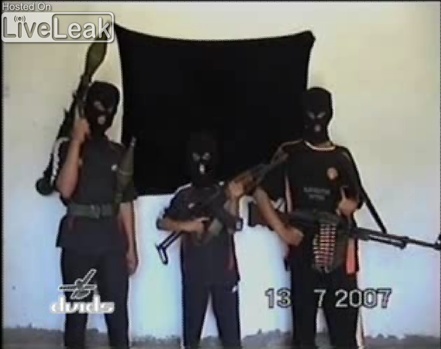
The effects then that videos such as those captured by the US and Iraqi forces that apparently showchildren between around 10 and 12 years old running around with guns and rocket propelled grenades while masked, conducting mock hostage taking and practicing raiding houses then is manifold. One is that they're being corrupted, making adult decisions before their time. Another is shock: that adults are apparently prepared to use children in such a way, anathema to our proud Western values. Then there's the realisation that when children are involved in such actions, it's intuitive to think that a new low has been reached, or that those training the children are themselves resorting to desperate measures.

All of the above is probably to some extent true in this case. It still pays however to pay closer detail to actually what has been filmed, what's been presented and the agenda of both sides, those who originally recorded it, and those who are releasing it now that it's been captured.

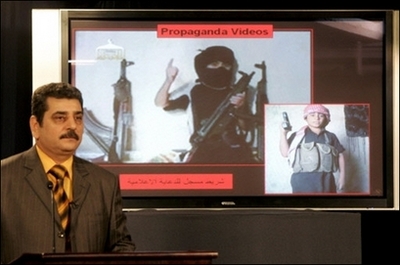
On one point, the video certainly does look numerous productions released by various jihadist/nationalist insurgent groups in Iraq, except with the adult fighters featured in those replaced by children. Because it's been captured in its raw form before it was cleaned up, edited and presented with the relevant logo of the group behind it, it's impossible to know exactly who did film it. The US army has naturally said that it's the work of al-Qaida in Iraq, or as the group is now known, the Islamic State of Iraq, but there's nothing in the video to suggest this is most definitely the case. The flag which the children are standing in front of at one point is not the Islamic State's standard; rather a simple black flag. They might have decided not to have used it, or didn't have one to hand, but most of the groups when using their flag at least have some sort of Arabic script on them that identifies them. The one image released that certainly does show evidence of the involvement of the ISI is an apparently separate image (shown above) that clearly shows the al-Furqan logo, ISI's media production arm. That image is apparently taken from one of their major releases from last year, "The Astray Arrow", which did feature children, although not in the way that these captured tapes do.

Indeed, this is hardly really anything new, although there hasn't been much on the scale of this previously released to my knowledge. Children have been featured a number of insurgent videos, not just by the Sunni jihadist/nationalist groupings, but also by the main Sufi armed group in the country. There have been allegations made in the past that the Shiite Mahdi army, helmed by Moqtada al-Sadr, but also to a degree autonomous of his command, has made use of children as young as 13.

The propaganda agenda of the video, and of both who made it and the US decision to release it to the media at large are obvious. While the army claims that it was designed at attracting new recruits, that seems highly unlikely. Rather, whoever or whomever made the video's main point was to say that even if you kill all of us adults, the children themselves, whether now or later, will continue to fight. The US army's point is also clear: that it both shows the desperation of al-Qaida and the moral depths to which the movement is willing to plunge, as if massacring Shias in markets with suicide attacks wasn't low enough.

Intelligence officials, loud-mouthed bloggers and some politicians often speak alarmingly of how we're losing the propaganda war, and on the evidence of this they might have a point, not because the video is especially effective, but because the US's argument is so weak. To begin with, the footage was shot in the summer of last year, not now when the Americans and others are daring to start to crow again that the insurgency has been broken and that the surge has worked, with last week's suicide attacks allegedly carried out by women with Down's Syndrome the mark of how desperate they were. We still haven't had confirmation that was in actual fact the case, with conflicting coverage since. If you can stomach it, footage supposedly showing the severed head of one of the bombers has been leaked onto the net, and it's as inconclusive as the reports were.

Secondly, we don't know what these children themselves have been through. The Guardian reported at the beginning of last year of how so many were showing signs of major psychological stress, and that of the others many had a favourite game: playing out mock executions, splitting off into groups and taking on the roles of al-Qaida and the Mahdi army, Sunni and Shia, reliving their own experiences of the sectarian warfare which was dominating and dividing their country. These children might have lost their parents, or had older siblings who had joined the insurgency killed, or even been killed accidentally by coalition forces; to pretend that they're definitely being manipulated by al-Qaida or even being used as anything other than pawns in a game is to make a series of assumptions based on your own prejudices. The same is the case when women carry out suicide bombings; they're not regarded as usually those most susceptible to join jihadists or kill in such a way. This ignores how the overwhelming number of suicide attacks by women have taken part in Chechnya and Russia, where they were members of a special brigade called the Black Widows. All had their husbands or relatives killed by Russian forces, and even if they had been manipulated, driven by their grief or just simply thirsty for revenge, you can at least understand why, if not even start to accept the reasoning behind what they did.

It goes without saying that use of child soldiers, which isn't potentially what was depicted here, is abhorrent and illegal under international law. It's hardly a new occurrence though: their use across Africa has been endemic, while some others have pointed to how the Hitler Youth were conscripted in the dying days of Nazi Germany to pretend the fatherland from the marauding and fast encroaching Soviets, but this also seems to be influenced by those who want to believe that the war in Iraq, if not over, is reaching some sort of conclusion, and that the insurgents are getting desperate. They might have been beaten back to their strongholds, but we all know what happened with Fallujah: those who wanted to fight stayed behind and mostly died, while everyone else got out and dispersed across the country. History could certainly yet repeat. Moreover, the Americans have the Awakening councils, mostly made out of the tribes and insurgents which previously welcomed and worked alongside al-Qaida before they decided that the Americans were the lesser of the two evils, to thank more than anything else. They themselves are fragile coalitions, and they've been armed and paid by the Americans. What happens if they break apart, or if they later again decide to turn on the Shia? The ceasefire the Mahdi army has been observing over the last six months, which has also helped bring down the violence levels, is also weak. The passing of the very limited reversal of the de-Ba'athification laws originally signed by Viceroy Bremer is also only the start of the efforts towards reconciliation that Washington has demanded be acceded to. As sad as it is, the disaster that we set in motion is still going to be playing out for years to come, and the children of Iraq are unlikely once they reach adulthood to thank us for the intervention that only the most optimistic believed would result in a quickly established beacon of democracy in a region we've been manipulating for decades.

Labels: , , , , , , ,

Share |

About

  • This is septicisle
profile

Archives

Powered by Blogger
and Blogger Templates