Thursday, April 30, 2015 

A return to Savile row.

All but buried by election coverage and the news from Nepal, yesterday saw the publication of the long-awaited report (PDF) into the allegations of sexual abuse by Jimmy Savile at the Duncroft approved school.  As you probably won't remember, Duncroft was where it all began: it was the investigation by Meirion Jones and Liz MacKean into Savile's visits to Duncroft for Newsnight, a report that editor Peter Rippon spiked for lack of evidence, that eventually led to ITV's Exposure documentary helmed by Mark William-Thomas.  Everything that has followed since, Operation Yewtree, the claims about Bryn Estyn, the Elm Guest House, Dolphin Square etc essentially began with Duncroft.

It might then surprise you that the report detailing Operation Outreach's investigation amounts to a whole 17 pages; some of the reports into a single allegation of abuse by Savile have been longer.  It might equally surprise you the report confirms that Savile did not start visiting Duncroft until 1974, a mere 9 years after one of the women claiming to have been abused by Savile said she was attacked.  Indeed, the report in effect makes clear that the vast majority if not all of the allegations against Savile that would have been featured in Newsnight's pitched investigation are unsubstantiated.

The report does however set out the allegations made about Savile after 1974, up until 1979 when he stopped visiting.  Except these are not allegations; per the report from the NSPCC and the Metropolitan police, Giving Victims a Voice, Surrey police have not so much investigated the accounts given to them but accepted the information provided in interviews and statements as fact, or rather "not unproven allegations".  This is despite their now accepting that the allegations made to Operation Yewtree about Savile at Duncroft prior to 1974 were, for whatever reason, false.

It also stands in contrast to the account provided to the Anna Raccoon blog by Susan, the girl who effectively introduced Savile to Duncroft.  Susan was 15 at the time, and met Savile while helping her mother at a party just before Christmas 1973.  She maintains that as soon as she informed Savile she was 15, rather than 18 as he believed, as well as how she had taken a small amount of LSD prior to meeting him on her own for the first time, he immediately put a halt to the way their meet-up was progressing.  Anna Raccoon was herself a pupil at Duncroft in 1965, at the same time as Savile was meant to have visited and abused a fellow pupil, and it was her incredulity at the allegations and apparent failure of memory over this celebrity visitor that led her to question so much of what was being presented as fact.

There are further reasons to doubt some of the accounts given about Savile at Duncroft post-1974.  Karin Ward, who while not featured in the Exposure documentary was in the BBC's Panorama on Savile and Newsnight, is being sued by Freddie Starr over the allegations she made about him.  According to Anna Raccoon, Ward made contact with a group of women on Friends Reunited who helped to jog her memory on what went on at Duncroft.  Ward's subsequent online account of abuse, which named one of her attackers as "JS", is likely to have been one of the threads picked up on by Meiron Jones.  Also of note is the forged letter, supposedly from Surrey police, which claimed the investigation into Savile had been dropped because of his "ill health and senility".  This was in the possession of Fiona, featured in the Exposure documentary.  How this letter came into existence is a mystery.  The CPS for its part, as the report itself sets out, decided not to proceed with a prosecution against two of the Duncroft staff some of the victims said they had informed of their abuse.  This was not though as a result of the police or CPS coming to the conclusion anyone had "given a false account of offences" against them.

Jimmy Savile was without question a serial sex abuser.  The real quandary remains over just how prolific he was, and whether there are any lessons to be learned from how he so successfully exploited the power and authority he gained from his position at the BBC and at Stoke Mandeville hospital to name but two institutions where the allegations against him have been substantiated.  Accepting every allegation made as "not unproven", regardless of its veracity, as the various inquiries into Savile have so far done is not the way to go about doing so.  Yesterday's report proves without doubt that for whatever reason, and it is not necessarily because the people in question have lied, not every account of abuse can be accepted at face value.  Some of the girls at Duncroft were without doubt damaged further by their time there, while others like Anna Raccoon say it in fact helped them put their life back together.  Memory plays tricks, and trauma can be such, as we saw with Steve Messham, that mistakes can be made.  


While it is certainly the case that many historic allegations of abuse cannot be proven to the standards required by a court of law when the accused is dead, or in case of Lord Janner, incapacitated, to accept every accusation as essentially true is not just to besmirch the reputation of the dead, it affects their surviving friends and relatives also.  The last few years have demonstrated that victims have at times been ignored or wrongly had their complaints rejected, yet to go wholly in the other direction purely because the person accused can no longer answer for themselves goes too far also.  Whether a balance will be found by the Goddard inquiry remains to be seen.

Labels: , , , , ,

Share |

Monday, March 02, 2015 

Of Savile and Emwazi: the "monsters" in our midst.

There are times when it's difficult to judge how flippant, snarky and blasé to be about the everyday horrors of the news.  Comments which to a friend are made in the context of a shared antipathy to the routine stupidity of the media look awful when shorn of it, as they can on a blog to someone unfamiliar with its general style.  Ripping on coverage or the often self-appointed voices of the voiceless can easily fall into being criticism of those who are seeking justice, or most certainly ends up looking that way.

With that in mind, I honestly can't think of a few days of media coverage so utterly lacking in apparent wider awareness as the ones we've just been through.  It's a toss-up as to the most evil person to have ever lived: is it Jimmy Savile, apparently the most prolific and depraved sex offender of all time, and whom despite his proclivities being so widely known, whether by hospital staff, journalists who couldn't get their exposes past lawyers or just through rumours, managed to escape justice? Or is it "Jihadi John" (the last time I am ever going to refer to him as such), aka Mohammed Emwazi, Islamic State's propaganda executioner de jour, at last unmasked so we can know every last detail of his utterly banal life and attempt to pinpoint just when it was he decided he wanted to behead aid workers for a living as opposed to continue his career in IT?

The weight of evidence against Savile being an abuser at places where he was in a position of authority is overwhelming, as proved by the report into his activities at Stoke Mandeville hospital.  What has most certainly not been proved is that he acted the same way wherever he went, as documented by Anna Raccoon bothering to read all the other reports produced by various NHS trusts, and which the media have bunched together as being similarly damning.  Even taking into consideration how faulty memory is, not least when the events under investigation took place anything up to 50 years ago, the lack of almost anything turned up by the various people behind the reports suggests Savile was a very ordinary sex offender, just one given extraordinary opportunities by his fame, charity work and patronage by politicians and royals among other powerful figures.  He attacked the vulnerable when he was certain of not being caught, or when he knew others would cover for him, in the exact same way as the vast majority of sex offenders have and always will.

Clearly though such findings aren't what's required when Savile has been worked up to be the monster to end all monsters.  The Stoke Mandeville report shamefully reproduces the rumours about Savile not just being content with the living but also going after the dead, as obviously such a man with access to the mortuary couldn't have a simple fascination with death as opposed to wanting something else.  His reported time spent with his mother's corpse could similarly only be about one thing.  The Guardian, in what has to be one of the most ridiculous editorials the paper has ever published, reflects it is "difficult to comprehend the existence of such a completely unrestrained id".  Well yes, it might be if half of what has been written or claimed is true, as opposed to the febrile imaginations of journalists taking the already shocking and deciding the ante has to be upped.

And so the editorial goes on, in what can be taken as being the general tenor of much of the coverage.  The writer manages to weave in the exhumation of the judges who condemned Charles the II's father to death, obviously primitive behaviour to us now "but the savage, theatrical desecration captures and discharges something of the rage that Savile’s wickedness inspires today", before moving on to mention Pol Pot, who oblivion is also too good for.  One way of addressing the need for closure or something like it robbed of us by Savile's death could be a "public ceremony of what used to be called commination, a ritual expression of public condemnation and disgust".  Or we could just let the nation's hacks carry on as they have been and leave it at that.

From a larger than life monster we move to one previously identifiable only by his gravelly London accent.  If making Savile out to be evil incarnate is daft or rather distraction, when no one seems to really want to inquire into how it was Margaret Thatcher and Prince Charles were taken in by his charms, especially curious when the likes of Leon Brittan are cast to the dogs without a scintilla of evidence being presented against them, then the frotting of Emwazi, as that's what it's been, has been jaw dropping in its stupidity.  In the space of four days nearly every aspect of Emwazi's life prior to his joining Islamic State has been set out, no detail being too slight to be ignored.  He went to school with Tulisa, didn't have any social media accounts, worked in Kuwait where he was a model employee, was a "beautiful man", had a collision with a goal post, played Duke Nukem, joined a gang, was bullied, had bad breath, "borderline stalked" a girl he was supposedly infatuated with, used both drink and drugs, was "painfully shy", has a Chelsea tattoo on the back of his neck, was allegedly choked by an MI5 officer, played five-a-side football, got a second from the University of Westminster, and took anger management courses as a teenager.

That I've only made one of the above things up is testament to how unrestrained by any notion of well, sanity the detailing of Emwazi's past has been.  Some of it has no doubt been prompted by how up till now he has been the face of Islamic State, and the obvious shock that comes from someone who grew up in Britain killing on camera out of political-cum-religious motivation, but all the same.  Emwazi is not the Islamic State; he most probably is not even above a middle ranking position in the organisation; he's a propaganda prop, utterly disposable, and that's it.  He's a tool (in more ways than one), just as the cadres of extremist organisations in the past have carried out the orders of their leaders.  Making him out to be something more is to fall completely into the gaping trap of turning him into a hero for bedroom jihadis and other fellow travellers, which is of course precisely what IS wants.  It's why he was the centrepoint of the mass beheading of Syrian officers, with other foreign fighters at his side, why the camera zoomed on his face as he carried out the act.  What the media hasn't reported is the fear in those eyes, instead of the defiance and belligerence they were meant to convey.

There is next to no need to understand how he came to be Islamic State's chief prop.  Perhaps there's something in the stories of his time at school, but equally perhaps there's not.  The important facts are the all too familiar ones: he was part of a wider group of extremists who no doubt reinforced each other's beliefs; they were known to the security services; they had some contact with him; he ended up going to Syria.  Exactly how he came to be radicalised is of slight interest, but only slight.  Maybe it somewhat happened at university, perhaps he was already going down that path.  Perhaps the bull in a china shop actions of MI5 had some influence on his decisions, perhaps they didn't.  If there are questions deserving answers, it's on just how serious MI5 is when it suggests to those it encounters they become informants, as it does seem to have been offered to almost every individual who has subsequently launched an attack.  Does it ever work?  How does MI5 know it isn't being played?  Has it really, honestly, prevented attacks?

All too predictably with the election coming, much hay is being made by all parties over just who can best protect the nation from such people.  The Tories say they know better than universities who should and shouldn't be allowed to speak on campus, the Lib Dems say no, they do, and Labour says control orders should be brought back, as they were just as big a success as TPIMs.  The reality is no one has the first fucking idea on how we can stop more Emwazis, only they're a massive threat and something ought to be done.  Instead it's easier to detail Emwazi's life up to now in much the same vein as a MTV "behind the music" docu would, only in this instance everyone's looking "behind the terror".  Because it couldn't be there just isn't anything to find, could it?

Labels: , , , , ,

Share |

Monday, July 07, 2014 

Celebrity betrayal and a revived frenzy.

Last century promised so much.  Now all our heroes are dead or corrupt.

As a sprog, one of my favourite, if not absolute favourite TV programmes was Rolf's Cartoon Time, later Rolf's Cartoon Club after he shifted to ITV.  I even joined the club, as there was one attached to the show (really?), and could well still have somewhere the paraphernalia sent every so many months.  In truth Harris wasn't a great artist, and while I detest the snobbery that greeted his commission to paint the Queen, there were obviously dozens, hundreds, thousands of others far more deserving of being given the publicity of doing so.  Rolf's amateurishness was however part of the point: just as with Neil Buchanan and Tony Hart to name but two other presenters, their enthusiasm was meant to inspire kids to be creative themselves, to nurture the belief they could think out and do something as impressive (at least to a child) as one of Art Attack's on a grand scale collages.

Reading the latest outburst of being wise after the guilty verdict comment, just as there would have been an outburst of why was he even prosecuted comment had he been found innocent, it's hard not to agree with Dominic Lawson in the Sunday Times and be thoroughly dispirited at the uniform reaction.  Rolf Harris didn't betray me, as so many others are convinced he did them just by existing and not admitting he was in private a different, sad and extremely flawed man.  The only people he betrayed are those whom put personal trust in him and those whose innocence he stole.  As an adult he's never meant anything to me; all I have is those childhood memories of a much simpler time.  I bear him no ill, and feel sorry for him, just as I also feel desperately sorry for his victims.  Rather than the sentence being too lenient, I thought it too harsh, lack of guilt or regret notwithstanding.  Some of the reporting on his supposed child porn stash has also been extremely dubious, with it being most likely he sought out images of young looking but over the age of 18 women.

As Lawson wrote, there really doesn't seem to be any room for grey when it comes to celebrities in this hellish second decade of the 2000s.  They are either at the very peak of their powers or in crisis; they are either globe trotting behemoths or once again piling on the pounds; they are either heroes, or they are villains.  We, or at least most seem to find it intolerable for anything of someone convicted of offences against children to continue to exist, or at least be consumed in public.  It's not just lobbing plaques down the memory hole or the refusal to host sales of artwork, it's the rubbing out of a person's existence in substitute for not being able to do so literally.  Everyone else's brand must be protected.

You can also forget about rehabilitation: look at Chris Langham, acquitted on charges of sexual assault but found guilty of possession of child pornography.  A great comic actor bedevilled by alcoholism and himself abused as a child, he's barely worked since (he appears alongside Leslie Grantham in The Factory, Grantham's conviction for murder not having affected his career as much as his later "sex scandal" did).  A fitting punishment?  Only with death is there the opportunity for release: those stations that had rarely if ever played Michael Jackson's music after his trials suddenly found it was again permissible to fill the airwaves with his oeuvre.  Once gone from our midst we can start to put things in context, despising Wagner's rabid anti-Semitism while adoring his operas, concerned about Lewis Carroll's fascination with young girls while still enthralled by his Alice.

Nor do we learn anything from past events.  Was it only 18 months ago we had the McAlpine fiasco, Philip Schofield brandishing a list of names dug up via Google at David Cameron, demanding they be investigated?  Can it only be last February when Operation Yewtree was being criticised after the initial prosecutions had all failed?  Now with some of the press in full cry we have Theresa May announcing a Hillsborough-type inquiry into the potential covering up of child abuse across almost every sector, whether it be government, churches, or broadcasters.  This has been principally sparked by the sudden rediscovery of how Geoffrey Dickens, a Conservative MP, had presented the then home secretary Leon Brittan with a "dossier" on child abuse by establishment figures, which may or may not be connected with the investigation into the Elm Guest House, a brothel frequented by among others, Cyril Smith.

That 114 papers connected with Dickens' dossier have either gone missing or been destroyed simply has to mean this is a cover-up, or will be seen as such.  So insists Simon Danczuk, billed by some as having "exposed" Cyril Smith, ignoring the Rochdale Alternative Paper and Private Eye, just as they were ignored when they printed the original allegations against Smith.  It couldn't possibly be the whole thing was mostly if not entirely bollocks, Dickens being perhaps the original rent-a-gob MP, mates with Mary Whitehouse, hitting one target and then never able to repeat the trick.  Towards the end of the 80s, along with a distinct minority of social workers, Dickens was convinced children were being ritually and Satanically abused, that great witch-hunt where witches really were sought and none discovered, families broken apart in an attempt to prove one of the great recent myths and panics.

If there is a case for an over-arching inquiry, it's to put all the allegations that have surfaced or resurfaced since Jimmy Savile's abuse came to light to both the test and to get them out in the open.  One aspect barely covered has been what the security services were up to or knew about the likes of Savile, apparently unconcerned as they were at his forming relationships with the royals and Margaret Thatcher.  Were they too taken in, or not bothered by his predilections?  Did they perhaps have some sort of involvement with Cyril Smith, as has been hinted at, hence why he wasn't brought down after RAP and Private Eye first printed the claims about him?  While suggestions of a massive cover-up aren't completely unbelievable, especially when you consider what the likes of say Tom Driberg got away with through having friends in high places, it does stretch credulity to the limit.  It seems all too similar to the wild conspiracy theories that have floated around the internet for years; moreover, if the likes of Private Eye had thought there was something to Dickens' dossier, they certainly would have ran with it.  Before Newsnight took Steve Messham at his word over Lord McAlpine, the magazine was also burned by his understandable failures of memory.

Such an inquiry must not though be a place for allegations to be looked at but not seriously investigated, then reported as being proof of the depravity of those accused.  As Anna Raccoon has been painstakingly pointing out (I must stress I wonder about her motives and think the number of allegations against Savile means he definitely was an abuser, albeit not on the scale as has been suggested) by actually reading the NHS report into Savile's access to the estate, not a lot of them stand up to scrutiny.  Faded memories are one thing, giving credence to dubious in the extreme claims something else entirely.  The appointment of the head of the NSPCC to lead a separate inquiry into last year's government search for files, an organisation that has made some of the most hyperbolic claims about Savile, therefore raises concerns.  It all smacks of the government acting because there have been days of tabloid front pages rather than because it truly believes there's something in the claims.  Also helpful is the main inquiry's report will be published in the next parliament rather than this one.

There's another subtext here.  Focusing on the establishment, the politicians, the BBC, it all shifts the glare away from the rest of the media.  The conviction of Harris at almost the exact same time as that of Andy Coulson and the rest of the phone hacking gang helped superbly in distracting attention from the former tabloid editor, while few have wondered just why it is our supposedly free press never managed to catch any of these abusers, focusing instead on the small timers.  The silence on Max Clifford was understandable, as they were so hand in glove with one another; on Harris it's more difficult to think why it is nothing was found out before now.  Harris wasn't influential, and didn't court those in high places to the extent of a Savile.  He also admitted to suffering from depression, failing to be there for his daughter, to having a darker side.  Nothing came of it.   


Watching the "debate" on Newsnight just now, I felt like throwing myself out the window, the sound and fury adding to the impression pitchforks are being sharpened over something that failed to get attention three decades ago for the reason there wasn't anything there to begin with.

And what did become of us? A borrowed intellect and a stolen pose.

Labels: , , , , , , , , ,

Share |

Wednesday, December 19, 2012 

Newsnight and Duncroft: still far from the full story.

The Pollard inquiry into the entire Newsnight affair has, as recent reports have been wont to do, reached pretty much the conclusions it was expected it would.  Nick Pollard, formerly of Sky News, dismisses the notion that there was managerial pressure to drop the investigation into Savile's alleged activities at the Duncroft approved school, while finding that Newsnight's now ex-editor Peter Rippon made the wrong decision, mainly on the grounds that the CPS had investigated one of the claims about Duncroft and decided there was insufficient evidence to bring charges, to spike Meirion Jones and Liz MacKean's story.

It most certainly doesn't end there though, and there are more than enough uncertainties in the report for those suitably inclined to reach the conclusion that there was in fact pressure put on Rippon.  Both Jones and MacKean certainly believed there was, although Jones has since admitted he had no evidence for claiming at the time that this was the case.  


Key to the entire chain of events is a series of emails between Rippon and Stephen Mitchell, the deputy head of news, on the 29th of November last year (paragraph 91, page 68 onwards).  In the first, Rippon outlined the investigation and when Newsnight was planning to transmit the story, along with a request as to whether he could talk to Mitchell in more depth on the phone later.  As Pollard notes, this email and its follow-up are positive about the story, without any indication that Rippon at this stage was having doubts.  Remarkably, both men are uncertain as to whether the proposed phone call took place; Mitchell cannot remember it, with Pollard noting acidly that he "found the frequency with which Mr Mitchell's memory failed him surprising" at a different point in the report, while Rippon believes he "probably did" talk with Mitchell.

Whether it did or not, this was the point at which Rippon began to properly voice his doubts.  The following morning he emailed Jones, shifting the onus onto establishing that the CPS "did drop the case for the reason the women say", that Savile was too old and infirm to be charged.  Rippon's explanation for his change of heart, given to the inquiry, was that he felt the report as it stood relied too much on the evidence of Karin Ward, referred to throughout as [R1], how the interviews with the other victims had been conducted over the phone by an inexperienced trainee reporter, and how the evidence could be undermined by how some of the women had shared and discussed their experiences among themselves previously on a social networking site (paragraph 100, page 72).


Pollard examines three explanations for Rippon's shift: that he had been very keen on the story but something happened overnight to change his mind, influenced by Mitchell; that he changed his mind based purely on his "pondering it overnight"; or that he had overstated the story to Mitchell in his emails, despite having doubts, which had now come fully to the fore.  Pollard concludes that the first explanation is the most likely, that a conversation did take place, and that it was something Mitchell said that made him re-examine what his team had so far put together.  He doesn't believe, however, that what Mitchell said was "inappropriate or that it was influenced by any wish on Mr Mitchell's part to protect the Savile tribute programmes".

We are then dealing with hypotheticals, leaving more than enough room for doubt to creep in.  Add how Pollard accepts that Rippon made comments to Jones and MacKean along the lines of how if the "bosses weren't happy" [it couldn't go ahead] and "he could not go to the wall on this one", even if again, he found no evidence that he was being put under pressure, with Helen Boaden, the head of news, saying she thought it could have "arse-covering" on his part, putting the blame elsewhere, and it isn't the clean bill of health it looks at first sight.  My opinion remains, as it was at the outset, that this was almost certainly an editor deciding on his own that there wasn't enough evidence, but I don't blame anyone for suspecting there was more going on than has come out even now.  It still doesn't explain fully though why Rippon spiked the report rather than urge his team to investigate further, or indeed why Jones believed that it was either drop the story, or "leave the BBC".  He has instead decamped to Panorama.  Lack of resources, as Rippon claimed, just doesn't cut it, savage cuts to Newsnight or not.

Pollard's other main conclusion on the initial Newsnight investigation, that Rippon's decision was wrong and that Newsnight should have broken the story about Savile being an abuser 11 months before ITV did, also looks strong on the surface.  After all, Exposure used more or less the same evidence as collected by Jones and MacKean, which has in turn lead to over 400 people coming forward with allegations about Savile.  There are reasons though to suspect that at the time, Rippon was perfectly within his rights not to proceed with transmission, and one which has came to light since.  His reasons for having doubts, although undoubtedly expressed more lucidly through hindsight, are more than respectable: the only on camera interview they had was with Ward; they didn't have any corroborating evidence from those who worked at the school; the interviews with the other women, should, ideally, have been conducted in person,  and without there being any possibility of their being led; and some of the other women had discussed their experiences on Friends Reunited, increasing the possibility of the allegations becoming blurred.

Since then we've learned that the letter from Surrey police, which Newsnight knew of but never saw, saying the case was dropped because of Savile's age and infirmity, was a forgeryAnna Racoon has also, in a series of blog posts, raised a number of doubts about some of the testimony.  A resident at Duncroft herself during the mid 60s, she denies that Savile ever visited the school while she was there, refuting the allegations made by one woman there at the same time.  She also maintains that Karin Ward must have been 16 when she appeared on Clunk Click, even if all her other claims are true.  Raccoon, regardless of being suckered in by the Libertarian Party previously, seems to be highly credible.  She may well be utterly wrong, but there are doubts there, and while the police had not previously investigated Ward's allegations, they had some of the other claims made by the others who had made contact on FR, deciding there wasn't enough evidence to pursue them.  It is almost certainly the case, as Raccoon notes, that Savile was a child abuser, an ephebophile (or at least attracted to post-pubescent children) if not a paedophile, but it has not yet been proven that he committed any offences either at Duncroft or with girls from the school.

These doubts bring us into some very uncertain territory.  Even if the Duncroft allegations are exaggerated, it's certainly the case that some of the claims made against Savile have to be accurate.  It's also unlocked memories which many have either struggled with ever since or tried to forget, casting the 60s and 70s in a different light.  While some of this will have had a negative effect on those who rather wouldn't have been reminded of what happened to them or what they got up to, for many talking about it, perhaps for the first time, will have resulted in the opposite.  As someone who struggles with his own past, I can't present opening up about everything as being wholly positive, or always for the best.  For many though it will have helped to exorcise demons, or been the first time they thought they might have been believed.  Negatives as there will have been, I would wager the positives will have outweighed them.

You can then respect Rippon entirely for the decision he made, even if you can't agree with it knowing now how it would have played out.  It would certainly have saved the BBC from the nightmare it's gone through over the last couple of months, one which Pollard finds it brought entirely on itself.  If anything, the BBC's management structure is even more Byzantine than we first thought: it takes him 11 pages (9-21) to describe it and the managed programmes list.  Away from Newsnight, one of the biggest failures he found was that the Savile investigation was moved off of this list, a list set-up in the aftermath of Hutton through which any controversial programmes or ones with risk to the BBC could be known about and shared across the organisation.  Stephen Mitchell decided it should be taken off the list, although he couldn't explain why to Pollard.  Pollard decides it was because Mitchell believed it was so sensitive that it shouldn't be widely known with the BBC, something that led in turn to the disasters that followed.

Also pilloried is George Entwistle, who if he hadn't been forced out would have had to resign now.  Pollard criticises him for taking no action after being warned by Helen Boaden about the Savile investigation, when it would have been the obvious opportunity to postpone the planned tributes until more was known.  He also didn't inquire further when told by the head of "knowledge commissioning", asking about whether they should start on a obituary programme, that he "saw the real truth", having worked with Savile as his first job at the BBC.  He was also at fault over the blog from Rippon which came to be seen within the BBC almost as gospel, despite the inaccuracies in it which MacKean and Jones pointed out almost immediately, failing to address it quickly enough, and then using it effectively to shield himself from criticism, putting it all on Rippon.

Pollard's recommendations are just as predictable.  He thinks the role of the director general as editor-in-chief is outdated, requiring they take responsibility while being unable to step in and make a difference.  The well known problem of too many managers and too rigid an adherence to going up one rung on the ladder at a time needs to be sorted once and for all, although Pollard suggests getting rid of the deputy director general was a mistake.  He sees no reason why there should continue to be "Chinese Walls", such as how Entwistle insisted it was no business of his knowing any more detail about the Savile investigation than what Helen Boaden told him.  He also wonders whether part of the problem might be that almost all of those involved had spent more or less their whole careers at the Beeb; this can and will be overstated, but it certainly wouldn't hurt if the BBC cast its net wider in the search for new recruits.

More important than these is Pollard's advice as a journalist: to be ready to collect more evidence if what is gathered is not enough, and to be prepared to hand over a story to another programme if it needs more work.  Rippon could have asked Jones and MacKean to do more work, rather than spiking what they had, or he could have suggested giving what they had to Panorama to see what they could do with it.  He did neither.  The same is true of the McAlpine affair, except in reverse.  As with so often in the past, these were avoidable mistakes which were made worse by mismanagement.  Whether it will have a long-term impact on a corporation which is still leagues ahead of almost all its journalistic competitors remains to be seen.  For now, deputy heads have rolled again.

Labels: , , , , , , , ,

Share |

Monday, November 12, 2012 

Through the media looking glass.

Where to even begin? It's as though over the weekend we fell through the looking glass, into an eerily familiar yet entirely different world. It's one where the Sun, yes, the Sun, can accuse both the BBC and the Guardian of "paedophile hysteria". It's one where spectres of the past can re-emerge and be regarded as wise sages, where newspaper editors that ignored or played down their own failings can cheer the bloodshed at a rival and demand more, and one where there's always something or someone else that can be blamed.

We must though start with Newsnight. We could, as the report by Ken Macquarrie has done, put the majority of the blame on the fact that the programme was in disarray following the "stepping aside" of numerous editors and managers while the various inquiries into the failings over Savile are taking place. It certainly explains somewhat how the report on the abuse at Bryn Estyn came to be broadcast within a week of the investigation being authorised. It doesn't however even begin to make clear how the journalists responsible for the piece justified it to themselves: this was a story that would have disgraced most blogs. Believing that by not naming the senior former Tory politician they were accusing they had protected themselves, they didn't so much as show Steve Messham a photograph of Lord McAlpine, nor did they contact McAlpine for comment. Rather than trace the other source who backed Messham's account, they simply ran with it. The first rule of investigative journalism is that you check the facts repeatedly, and then you check once again for good measure.

As has since become clear, Messham has spent the last twenty years wrongly believing that Lord McAlpine was one of his abusers. It seems to be an honest mistake based on more than understandable confusion, but it was one that would have fallen apart had this been a proper investigation.  Most importantly, as the Graun's piece on Friday reported, the Waterhouse inquiry discounted the possibility McAlpine was involved in the abuse as Messham's evidence was inconclusive.  Also key was that Messham believed his abuser was dead at the time of the inquiry, while McAlpine is still very much alive now.  Moreover, this isn't the first time Messham has taken his allegations to the media: there was as the Heresiarch notes a BBC documentary on Bryn Estyn in 1999; Private Eye according to reports discounted the possibility of McAlpine's involvement; and, fatefully, the long defunct Scallywag magazine ran the claims back in the early 90s.

Those reports from Scallywag, reprinted by the truly credible son of God David Icke, have been doing the rounds on the internet for years.  Often featured alongside the thoroughly debunked claims of a establishment paedophile ring in Scotland and Tony Blair's slapping of a D-Notice on Peter Mandelson's involvement in child abuse (reports which ignore entirely how the D-Notice committee works), they've become a conspiracy staple.  That the BBC, of all organisations, either didn't know of how long-standing these allegations were and how dubious those pushing them are, or simply wasn't aware is inexcusable.  As much as you can understand Newsnight's apparent determination to get back on the front foot as soon as it could, alarm bells should have rang from the outset.  Is it possible the journalists responsible, including those from the Bureau of Investigative Journalism, felt this was a way to get back at all those, the Conservative party among them, who had criticised the BBC by pointing the finger straight back at them?

Whether it was or not, George Entwistle was right to resign.  Scapegoat or otherwise, his not being aware of the Graun's report on the accuracy of Newsnight's story as he was preparing to give a speech spoke of someone out of the loop, unable or unwilling to get a grip.  The decision by the acting director-general Tim Davie to set out exactly who is in a position of responsibility is a good start, but it must be a very temporary situation: if possible, the Pollard review should be accelerated so that those who've "stepped aside" can either return to their jobs or replacements can be made forthwith.  Equally clear is that the BBC's management structure needs an urgent overhaul; the BBC Trust, acting as both regulator and defender cannot continue to exist in its current state.  An wholly independent trust is now needed.  Likewise, the director-general simply cannot remain as editor-in-chief of news, expected to be aware of every investigative report, while also running an organisation as large as the BBC has become (and it should be stressed, should more or less remain).

Some perspective is nonetheless sorely needed.  Ever since the Exposure programme on Savile, what's happened is a classic instance of a moral panic.  To say this helps absolutely no one is an understatement: we've gone from one extreme, that of silence, to one where allegations about almost anyone famous during the 70s so much as hugging someone young a little too tightly have been sprayed about like deodorant by a malodorous hormonal teenager.  With the collapse of Newsnight's credibility, there's the potential that we'll go back to the original position.  If that happens, the BBC is hardly the only organisation to blame.  The Sun last week ran a series of utterly ludicrous articles linking Savile to the Yorkshire Ripper, based on little more than how the body of one of Peter Sutcliffe's victims was found near to Savile's flat in Leeds.  Considering how quickly Savile has gone from charity fundraiser to "one of those most prolific child sex offenders" the country has seen, as well as potential necrophile, murderer was bound to come up sooner or later.  The Daily Star meanwhile has ran a Savile story on its front page every day for the past two weeks.

Even those who should know better, such as George Monbiot, have found themselves caught up in this storm of paedophile finding.  When a mood like this takes over, it's often the case that those who previously were rightly ignored and ridiculed find their imaginings are seen in a different light.  All it takes is a tweet from someone with a decent number of followers, and the damage can be done.  When we then get Philip Schofield presenting the prime minister with a whole series of names his researchers have dug up via a Google search, asking that he speak with them, it's the equivalent of taking seriously the proclamations of street preachers.

It's also a wonderful opportunity for the settling of scores.  The press as a whole is terrified that Leveson's shortly to be revealed recommendations for reform of regulation will involve some variety of statutory underpinning, and it sees this as a great chance to prove that everyone is equally guilty.  The Sun's attack today on Chris Patten is remarkable for its brutality, and it is of course in no way influenced by the way Patten showed how Murdoch caved into the Chinese authorities by refusing to publish his book on his time as last governor of Hong Kong.  Its linking of the Guardian to the BBC is also utterly transparent, on Saturday picking on Monbiot without mentioning it was the Graun that debunked the Newsnight report, while today it describes the BBC "[A]s the broadcasting arm of the muck-raking Guardian newspaper".  Would that be the same muck-raking Guardian newspaper that exposed the phone hacking scandal by any chance, and the same scandal that the Sun's former editor is awaiting criminal trial over?  The Mail meanwhile could hardly be banging the drum harder against more rigorous regulation, with Paul Dacre in apparent terror of Leveson's personal judgement on him, at least according to Private Eye.

None of this is to understate the BBC's failings.  The resignations forced by Lord Hutton's report into the sexed up Iraq dossier were one thing; this has been a disaster entirely of the BBC's own making.  What needs to happen now is a further opening up of the corporation, with cutbacks made not to programmes or journalists as has been the pattern of the last few years but to the layers of management that so singularly failed to prevent this travesty.  Only then can a fightback begin, both to regain lost trust and beat back those who wish for an end to the licence fee altogether.

Labels: , , , , , , , , , ,

Share |

Monday, October 29, 2012 

Sex quiz, hot shot!

There is without a shadow of a doubt an art to writing tabloid headlines.  They might make you groan, laugh or despair (hi), but you can't deny there's a certain talent to constructing a pithy, informative summation of a larger article in a highly limited space.

At times though this lack of room means they can get it terribly wrong.  The Sun was criticised a few years back for splashing on "BONKERS BRUNO LOCKED UP", both for the lack of understanding of mental health problems, but also because people rather like Frank Bruno.  The other problem is that despite the heyday of the tabloids being long gone, they insist on continuing to use archaic language which makes little sense when hardly any one uses it in everyday conversation.  


In tabloid parlance professors or scientists are boffins, women under 50 are girls, those sent to prison are caged, a child who commits any kind of offence, criminal or not, is a yob, and probably also evil, while a celebrity on a beach in a bikini photographed by a paparazzo is invariably showing off her curves or leaving little to the imagination.  Taste or respect also rarely enter into the equation: witness the Daily Star's front page treatment of a notorious murder case, the paper going with the legend "MY SEX WITH SALLY ANNE'S DEAD BODY", as though it was just another arrogant boast from a minor celebrity of their latest conquest.

Today's Sun front page then informs us of "GLITTER's 10-HOUR SEX QUIZ".  The paper presumably isn't implying that the police spent almost half a day asking him questions about sex in general and then awarding him points for the ones he got right, and yet that seems to be exactly what it's saying.  This isn't about taking things too literally, but that only a tabloid newspaper would ever describe a police interrogation as a "quiz", which rather underplays the seriousness of the arrest, just as only a tabloid or a satirist would use "grill" as a synonym for question, as the Sun does in the sub-heading underneath.  Most of the information required is in fact in the first heading: ex-pop star arrested.  Beyond that, all it needs to present is who and why as succinctly as possible, and arguably even the why isn't necessary when the story's been in the news for a day already.  Both the Mirror (Glitter: first of many) and the Star (Get dressed Glitter.. You're nicked!) managed it, in language easily understandable, even if the use of "nicked" by the Star comes across as more than a bit 70s.
 

This isn't to ignore the argument that this colourful language is all part of the charm and culture of a sub-set of the press, and that readers in general understand it perfectly well and even like it.  If though the BBC (or indeed ITN or Sky) were to suddenly decide to start asking their broadcast journalists to send in reports using similar terminology, the very same papers that abuse language in such a way would be the first to complain about dumbing down and the dreadful message being sent to our youngsters, not yet inculcated in how to like talk proper.  The point surely ought to be that it's perfectly possible to write with brevity and skill while not traducing a language which, fabulously flexible and constantly evolving as it is, can only be stretched so far before it breaks entirely.

Labels: , , , , ,

Share |

Wednesday, October 24, 2012 

In danger, as ever, of forgetting the real victims.

There's something almost touching about the way the vast majority of the media gave George Entwistle a kicking for his performance in front of the parliamentary media committee yesterday.  Far from the image of hacks, and editors especially being grizzled, tough and all but impervious individuals, it turns out that their feelings are really rather easily hurt.  Why else would they have been so hysterically critical of the BBC's new director general, only just over a month into the job, if they hadn't been so scarred by their own appearances before the Leveson inquiry?

This isn't to say that Entwistle was convincing yesterday, as on a number of issues he clearly wasn't.  To start with, he most certainly should have been better prepared.  His lack of inquiry into why exactly Jimmy Savile was being investigated by Newsnight when he was told of the potential problem by Helen Boaden is not adequately explained by his stated refusal to interfere in matters outside of his remit.  Postponing the planned tributes to Savile until after the investigation was completed would have a perfectly reasonable precaution to take.  Likewise, his failure to delve deeper into whether Peter Rippon's blog post was completely accurate despite being warned that it was misleading by the producer of Newsnight's spiked report is both perplexing and worrying.  Also in need of clarification is a report in today's Times which suggests Boaden may well have had more input into the investigation than has previously been stated.

Some of the questioning was though both irrelevant and completely over-the-top.  What point exactly was served by Philip Davies inquiring about the names of those who authorised the transporting of young girls to Savile's shows, and then allowed them to stay on afterwards?  Entwistle didn't know because he doesn't need to know; as long as none of those involved are still working at the BBC, which is highly unlikely, it's now a matter both for the police and for the inquiry he's set-up rather than the director general.  Just as off the mark was Therese Coffey's highlighting of a comment by Rippon in an email that the sources they had were "just the women", taking it as proof they weren't being believed.  Rather than challenging her interpretation, pointing out that this is more likely a reference to how they should also question those working on the programmes at the time, he demurred.  Later on, Entwistle was compared to James Murdoch, as though his failings are in some way comparable to the man in charge of running an company that the media committee itself said seemed to be suffering from "collective amnesia" and which Murdoch senior later admitted had instigated a cover-up.

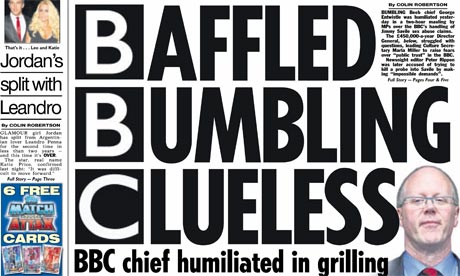
It still took quite some chutzpah for the Sun, of all papers, to splash on Entwistle's problems and describe him as baffled, bumbling and clueless.  Considering that the paper's last editor is currently awaiting trial for perverting the course of justice and conspiracy to intercept communications, a little humility would be nice.  Similarly, as we await Lord Leveson's report, perhaps Paul Dacre could reflect on what it might say about his own paper and editorship, rather than accuse the BBC of "manipulating the facts".  Or perhaps Dacre is annoyed as that's his job.

Just as opportunistic has been Maria Miller, who felt she just had to write to Chris Patten to register her concern at the BBC's ability to investigate itself, despite the media committee deciding they would allow the Pollard review to reach its own conclusions.  It's understandable she might feel aggrieved at how her predecessor nearly lost his job after acting as the minister for Murdoch, but that was hardly the BBC's doing.  Patten was entirely justified in effectively telling Miller what she could do with her concern.

All of this focus on Newsnight runs the risk of taking attention away not from why Savile got away with hiding in plain sight for so long but how.  Monday's Panorama made clear that even if not common knowledge, there were plenty of people who either suspected or had seen for themselves Savile's activities, and yet for the most part they either did nothing about it or their attempts to get it looked into floundered.  Without wanting to criticise those who must now bitterly regret not doing more, it still seems remarkable that some of those who knew didn't push harder, either going to the police or finding others with the same worries and then approaching managers to give their concerns extra weight.

This can't all be explained by the culture of the time; indeed, it was barely cited by those who've now come forward.  Certain commentators, while quick to assign blame to the liberal left either down to permissiveness, or because the abuse took place within the BBC or other state institutions, have ignored almost entirely Savile's links to other parts of the establishment. He befriended both royalty and politicians, spending Christmas at Chequers with Margaret Thatcher throughout the 80s, something the same right-wing tabloid press that worshipped the ground she walked on don't seem to want to discuss.

The greatest difficulty victims of abuse have always faced is being believed, as still shown by the failings of the police, social services and the CPS in Rochdale.  It wasn't political correctness that allowed the rape of vulnerable young girls to continue, but that the victims either weren't believed or even felt by those who should have been protecting them to be "making their own choice".  In an age before child abuse became synonymous with the darkest reaches of the internet, it often took the actual catching of a paedophile in the act for a charge to be brought and a conviction achieved.  Nick Davies wrote a whole series of articles on abuse in the late 90s that are just as applicable today, in spite of the advances in investigation that have been made.  Those in positions of power have always been able, either through connections, lawyers or influence to get their abuses either dropped or hushed up, the testimony of the weak disregarded or ridiculed.

That this now seems to have happened to a limited extent at the BBC is not surprising.  Compared to other powerful institutions that have either dragged their feet or gone into complete denial when faced with such accusations, it has acted with relative speed, albeit not swiftly enough.  What this shouldn't be allowed to become is another witch-hunt, where those who have made limited but understandable mistakes today pay the price for the much greater failings of the past (just as the News of the World should never have been sacrificed in an attempt to save Brooks and the Murdochs).  Savile is dead.  His victims and those who facilitated him are not.

Labels: , , , , , , , , ,

Share |

Monday, October 22, 2012 

The BBC leaves an open goal. Again.

It's all but impossible to overstate just what a catastrophic decision the now ex-Newsnight editor Peter Rippon made when he spiked the Jimmy Savile investigation pieced together by reporter Liz MacKean and producer Meirion Jones.  Working barely a month after Savile's death, it now seems apparent that there was just enough evidence for a report to have been broadcast. Indeed, on its own the revelation that Savile had been investigated by Surrey police, even if no charges were brought for lack of evidence, ought to have been enough to get something on the air.

Had Peter Rippon not for reasons still unknown ended the investigation, we might now be experiencing the opposite to what has happened since ITV's Exposure was broadcast at the beginning of the month.  While it's obvious that there would still be major questions about who knew what, if anything about Savile's proclivities beyond rumours, and almost certainly an investigation into the culture at Television Centre during Savile's time at the BBC, we wouldn't now be having to endure the Mail and much of the rest of the media's latent schadenfreude at the corporation's difficulties.  The BBC's coverage both of the phone hacking scandal and then the Leveson inquiry is well and truly being avenged.  It's even possible the corporation would be getting a certain amount of grudging praise for investigating itself, too late for Savile to be brought to account or not.

Quite how the BBC has managed to respond so ineffectively and poorly is a mystery.  The corporation's incredibly well paid managers really do seem to have learned absolutely nothing, whether from Sachsgate or indeed from the phone hacking debacle.  The obvious lesson from both crises, one serious and one not so much, is that you have to get your investigations, apologies and statements out as quickly as possible while at the same time making sure that they're as accurate as can be.  If you don't, then you can't possibly complain when you get turned over.  In this instance, the BBC has fallen at almost every hurdle: its initial statements were either inadequate, or as it now turns out in the case of Peter Rippon's blog post, inaccurate.  The corporation didn't apologise quick enough, nor did it set-up the independent investigations into what happened until far too late.

These failures have been exacerbated further by how it's apparent that those at the top of the BBC were aware of Newsnight's initial investigation, and yet did nothing to prepare for just such an eventuality as this one.  They must have known it was possible that the allegations would be followed up by someone else, especially when the disquiet in the newsroom at Rippon's decision was soon leaked to the press, with the Oldie even going so far as to make direct accusations against Savile.

The key question remains why Rippon decided that the broadcast could not go ahead, one which the specific investigation into Newsnight has to uncover quickly.  Highly doubtful though is the claim that Rippon either came under direct pressure from those higher-up in the BBC to drop the investigation, or that the forthcoming tributes to Savile, which hardly made up a substantial part of the BBC's Christmas schedule were thought as more important than exposing a man now being described, possibly hyperbolically, as one of the most prolific child sex offenders the country has seen.

Far more likely is that is Rippon, completely mistakenly, decided of his own accord that the story was just too potentially toxic for the amount of evidence that had been put together.  You can see his predicament: Newsnight only had on camera, in person testimony from Karin Ward, with the other statements coming from women who had been at the Duncroft approved school in the 70s who weren't prepared to appear in the film.  Ward's allegations, and I'm not doubting them here for a second, almost seem too good to be true from a journalistic point of view: she alleges that as well as being abused by Savile, she also saw Gary Glitter having sex with a girl in the alcove of Savile's dressing room.  Ward did indeed appear on a show with both Savile and Glitter, but the inclusion of the country's most notorious "celebrity" paedophile was always going to ring alarm bells.  Add in how the Crown Prosecution Service had decided not to press charges, Surrey police having spent what the Telegraph is now reporting as 2 years investigating possible abuse at Duncroft, and you can almost understand why Rippon bottled out at the last moment.

Almost, but not quite.  It reminds of the BBC's (and Newsnight's) cowardice in the Trafigura case, deciding to settle rather than contest a lawsuit from Carter-Fuck over the programme's report that Trafigura's dumping of toxic sludge in the Ivory Coast had killed rather than simply injured those who came into contact with it, despite an UN report concluding there had been deaths.  The reporter in that instance was... Liz MacKean.  No wonder that both she and her producer feel so strongly that Rippon was wrong, with Meirion Jones predicting at the time in an email that regardless of the reality, should someone else follow up the story it would be seen as a cover-up.

So it has come to pass.   Quite clearly there is the the usual amount of humbug from the press, whom with the exception of the Sunday Mirror in 1994 completely failed to investigate Savile at all, leaving it to ITV to do the hard work once Newsnight had bowed out.  It's also laughable for the Sun of all papers to take the moral high ground when News International so spectacularly failed to investigate phone hacking at the News of the World until it was forced into it at the beginning of last year, just the four years after Clive Goodman and Glenn Mulcaire were sent down.  The BBC was positively sprightly by contrast in realising the seriousness of the allegations against it.  It's also clear that the BBC can investigate itself to an extent that the rest of the media can't or won't, even if the full inquiries must be independent: tonight's Panorama is evidence of that.  Nor is it true this is the BBC's worst crisis in 50 years, even if it was John Simpson who said so.  Has everyone already forgotten the Hutton whitewash when both the director general and chairman of the BBC resigned?

The sad fact is though, as so often in the past, this is a disaster of the BBC's own making.  Some might well point to that very Hutton inquiry and to the extra compliance regulations brought in after Sachsgate as explanation as to why the BBC has been timid and overly cautious ever since, but neither stopped the corporation from broadcasting the documentaries which exposed abuse in both secure and care homes.  It may very well turn out that this is a simple case of an enormous mistake by an editor, and of a culture in the past that was all but universal, but that doesn't explain the BBC's incompetence once the allegations finally came to light.  At a time when public service broadcasting is still in peril, regardless of the collapse of the BSkyB-News Corp merger, the last thing the BBC needed was to leave an open goal for their enemies to attack.

Labels: , , , , , , , ,

Share |

About

  • This is septicisle
profile

Archives

Powered by Blogger
and Blogger Templates