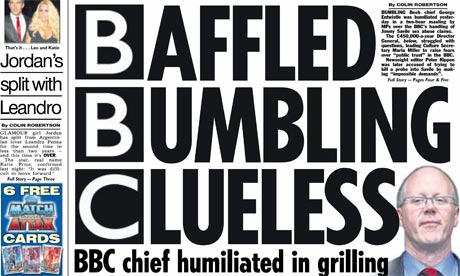
Newsnight and Duncroft: still far from the full story.
The Pollard inquiry into the entire Newsnight affair has, as recent reports have been wont to do, reached pretty much the conclusions it was expected it would. Nick Pollard, formerly of Sky News, dismisses the notion that there was managerial pressure to drop the investigation into Savile's alleged activities at the Duncroft approved school, while finding that Newsnight's now ex-editor Peter Rippon made the wrong decision, mainly on the grounds that the CPS had investigated one of the claims about Duncroft and decided there was insufficient evidence to bring charges, to spike Meirion Jones and Liz MacKean's story.
It most certainly doesn't end there though, and there are more than enough uncertainties in the report for those suitably inclined to reach the conclusion that there was in fact pressure put on Rippon. Both Jones and MacKean certainly believed there was, although Jones has since admitted he had no evidence for claiming at the time that this was the case.
Key to the entire chain of events is a series of emails between Rippon and Stephen Mitchell, the deputy head of news, on the 29th of November last year (paragraph 91, page 68 onwards). In the first, Rippon outlined the investigation and when Newsnight was planning to transmit the story, along with a request as to whether he could talk to Mitchell in more depth on the phone later. As Pollard notes, this email and its follow-up are positive about the story, without any indication that Rippon at this stage was having doubts. Remarkably, both men are uncertain as to whether the proposed phone call took place; Mitchell cannot remember it, with Pollard noting acidly that he "found the frequency with which Mr Mitchell's memory failed him surprising" at a different point in the report, while Rippon believes he "probably did" talk with Mitchell.
Whether it did or not, this was the point at which Rippon began to properly voice his doubts. The following morning he emailed Jones, shifting the onus onto establishing that the CPS "did drop the case for the reason the women say", that Savile was too old and infirm to be charged. Rippon's explanation for his change of heart, given to the inquiry, was that he felt the report as it stood relied too much on the evidence of Karin Ward, referred to throughout as [R1], how the interviews with the other victims had been conducted over the phone by an inexperienced trainee reporter, and how the evidence could be undermined by how some of the women had shared and discussed their experiences among themselves previously on a social networking site (paragraph 100, page 72).
Pollard examines three explanations for Rippon's shift: that he had been very keen on the story but something happened overnight to change his mind, influenced by Mitchell; that he changed his mind based purely on his "pondering it overnight"; or that he had overstated the story to Mitchell in his emails, despite having doubts, which had now come fully to the fore. Pollard concludes that the first explanation is the most likely, that a conversation did take place, and that it was something Mitchell said that made him re-examine what his team had so far put together. He doesn't believe, however, that what Mitchell said was "inappropriate or that it was influenced by any wish on Mr Mitchell's part to protect the Savile tribute programmes".
We are then dealing with hypotheticals, leaving more than enough room for doubt to creep in. Add how Pollard accepts that Rippon made comments to Jones and MacKean along the lines of how if the "bosses weren't happy" [it couldn't go ahead] and "he could not go to the wall on this one", even if again, he found no evidence that he was being put under pressure, with Helen Boaden, the head of news, saying she thought it could have "arse-covering" on his part, putting the blame elsewhere, and it isn't the clean bill of health it looks at first sight. My opinion remains, as it was at the outset, that this was almost certainly an editor deciding on his own that there wasn't enough evidence, but I don't blame anyone for suspecting there was more going on than has come out even now. It still doesn't explain fully though why Rippon spiked the report rather than urge his team to investigate further, or indeed why Jones believed that it was either drop the story, or "leave the BBC". He has instead decamped to Panorama. Lack of resources, as Rippon claimed, just doesn't cut it, savage cuts to Newsnight or not.
Pollard's other main conclusion on the initial Newsnight investigation, that Rippon's decision was wrong and that Newsnight should have broken the story about Savile being an abuser 11 months before ITV did, also looks strong on the surface. After all, Exposure used more or less the same evidence as collected by Jones and MacKean, which has in turn lead to over 400 people coming forward with allegations about Savile. There are reasons though to suspect that at the time, Rippon was perfectly within his rights not to proceed with transmission, and one which has came to light since. His reasons for having doubts, although undoubtedly expressed more lucidly through hindsight, are more than respectable: the only on camera interview they had was with Ward; they didn't have any corroborating evidence from those who worked at the school; the interviews with the other women, should, ideally, have been conducted in person, and without there being any possibility of their being led; and some of the other women had discussed their experiences on Friends Reunited, increasing the possibility of the allegations becoming blurred.
Since then we've learned that the letter from Surrey police, which Newsnight knew of but never saw, saying the case was dropped because of Savile's age and infirmity, was a forgery. Anna Racoon has also, in a series of blog posts, raised a number of doubts about some of the testimony. A resident at Duncroft herself during the mid 60s, she denies that Savile ever visited the school while she was there, refuting the allegations made by one woman there at the same time. She also maintains that Karin Ward must have been 16 when she appeared on Clunk Click, even if all her other claims are true. Raccoon, regardless of being suckered in by the Libertarian Party previously, seems to be highly credible. She may well be utterly wrong, but there are doubts there, and while the police had not previously investigated Ward's allegations, they had some of the other claims made by the others who had made contact on FR, deciding there wasn't enough evidence to pursue them. It is almost certainly the case, as Raccoon notes, that Savile was a child abuser, an ephebophile (or at least attracted to post-pubescent children) if not a paedophile, but it has not yet been proven that he committed any offences either at Duncroft or with girls from the school.
These doubts bring us into some very uncertain territory. Even if the Duncroft allegations are exaggerated, it's certainly the case that some of the claims made against Savile have to be accurate. It's also unlocked memories which many have either struggled with ever since or tried to forget, casting the 60s and 70s in a different light. While some of this will have had a negative effect on those who rather wouldn't have been reminded of what happened to them or what they got up to, for many talking about it, perhaps for the first time, will have resulted in the opposite. As someone who struggles with his own past, I can't present opening up about everything as being wholly positive, or always for the best. For many though it will have helped to exorcise demons, or been the first time they thought they might have been believed. Negatives as there will have been, I would wager the positives will have outweighed them.
You can then respect Rippon entirely for the decision he made, even if you can't agree with it knowing now how it would have played out. It would certainly have saved the BBC from the nightmare it's gone through over the last couple of months, one which Pollard finds it brought entirely on itself. If anything, the BBC's management structure is even more Byzantine than we first thought: it takes him 11 pages (9-21) to describe it and the managed programmes list. Away from Newsnight, one of the biggest failures he found was that the Savile investigation was moved off of this list, a list set-up in the aftermath of Hutton through which any controversial programmes or ones with risk to the BBC could be known about and shared across the organisation. Stephen Mitchell decided it should be taken off the list, although he couldn't explain why to Pollard. Pollard decides it was because Mitchell believed it was so sensitive that it shouldn't be widely known with the BBC, something that led in turn to the disasters that followed.
Also pilloried is George Entwistle, who if he hadn't been forced out would have had to resign now. Pollard criticises him for taking no action after being warned by Helen Boaden about the Savile investigation, when it would have been the obvious opportunity to postpone the planned tributes until more was known. He also didn't inquire further when told by the head of "knowledge commissioning", asking about whether they should start on a obituary programme, that he "saw the real truth", having worked with Savile as his first job at the BBC. He was also at fault over the blog from Rippon which came to be seen within the BBC almost as gospel, despite the inaccuracies in it which MacKean and Jones pointed out almost immediately, failing to address it quickly enough, and then using it effectively to shield himself from criticism, putting it all on Rippon.
Pollard's recommendations are just as predictable. He thinks the role of the director general as editor-in-chief is outdated, requiring they take responsibility while being unable to step in and make a difference. The well known problem of too many managers and too rigid an adherence to going up one rung on the ladder at a time needs to be sorted once and for all, although Pollard suggests getting rid of the deputy director general was a mistake. He sees no reason why there should continue to be "Chinese Walls", such as how Entwistle insisted it was no business of his knowing any more detail about the Savile investigation than what Helen Boaden told him. He also wonders whether part of the problem might be that almost all of those involved had spent more or less their whole careers at the Beeb; this can and will be overstated, but it certainly wouldn't hurt if the BBC cast its net wider in the search for new recruits.
More important than these is Pollard's advice as a journalist: to be ready to collect more evidence if what is gathered is not enough, and to be prepared to hand over a story to another programme if it needs more work. Rippon could have asked Jones and MacKean to do more work, rather than spiking what they had, or he could have suggested giving what they had to Panorama to see what they could do with it. He did neither. The same is true of the McAlpine affair, except in reverse. As with so often in the past, these were avoidable mistakes which were made worse by mismanagement. Whether it will have a long-term impact on a corporation which is still leagues ahead of almost all its journalistic competitors remains to be seen. For now, deputy heads have rolled again.
Labels: BBC, BBC idiocy, child abuse, Jimmy Savile, journalism, media analysis, Newsnight, Peter Rippon, Pollard report
| Permalink