Thursday, October 27, 2011 

Clarke should resign and truly break the cycle.

The usual tendency in politics is to offer much before you win power, then to do very little, if not the direct opposite to that you promised once you're in it. Ken Clarke and the Conservatives seemed for a time to have got it backwards. Despite their manifesto making the usual noises on law and order, with mandatory jail sentences for those committing a crime using a knife and a pledge to "redevelop" the prison estate to ensure early release wasn't necessary again, Clarke was swiftly given the authority to almost completely ignore the hardback blue tome. Helped along by the cuts being made to his budget, Clarke quickly proposed measures that would have resulted in a drop in the prison population of around 6,500, while there were to be further sentence discounts for early guilty pleas.

As quickly as this surprise was sprung on us, it's been taken away. Clarke, it has to be said, didn't make things easy for himself. With the tabloids always likely to oppose even the slightest changes to a system they have had a major part in imposing upon us, he had to watch his every step and take a softly softly approach. His unfortunate performance during a 5 Live interview presented them with a massive open goal, which they took advantage of gleefully. Since then we've had the riots, and with so much else the government is doing becoming increasingly unpopular, Ken has been fighting a losing battle. First went his sentence discount plans and call for more community sentences, and now his opposition to mandatory terms with the exception of those convicted of murder has also been overruled.

Whether this has any connection to the battle between Clarke and Theresa May over that darn cat, or if indeed the apparent animosity had surfaced before then is difficult to tell. May has never really come across as a populist, so maybe it's simple cynicism: doing what the tabloids want in an attempt to get them to back off elsewhere. Certainly, Cameron could hardly have been comforted by the continual attacks from the Sun over his dropped promise on knife crime. To them, anyone carrying a knife is a savage, regardless of whether they're doing it out of fear or youthful stupidity, and so deserves to spend at least four months in prison. Rather than allowing a judge or magistrate to make their own decision based on the circumstances of each individual case, the government must intervene and take the matter out of their hands.

Clarke did at least fight his corner. Even on Tuesday he was arguing in front of the home affairs select committee that it would be a "bit of a leap for the British justice system" for the government to demand a court send a 13-year old first time offender to a secure home. Yesterday he was left to stand up in the Commons and announce that while he had managed to prevent that from happening, 16 and 17-year-olds would face a mandatory term should they use a knife or other offensive weapon to "threaten or endanger", which essentially means waving it around even if they have no intention of actually doing anything with it. The option of using restorative justice in such a case, or community service, something that might bring home to a young person both more effectively and cheaply the gravity of their foolishness is to be withheld. This is the exact kind of pseudo tough policy making that has failed us for the past 17 years.

Much the same is true, although less objectionably, of the proposed mandatory life term for those committing a second "most serious sexual or violent offence". Clarke himself said this would most likely only apply to those who commit two "probably near-murderous attacks" and only affect around 20 people a year, but this is much the same that was said about Labour's indeterminate public protection regime, with subsequently over 6,000 receiving them, many languishing in prison past their minimum term unable to access the courses necessary to prove they're no longer a risk. One thing to welcome is the abolition of IPPs, although this is also tempered by the proposed replacement, the extended determinate sentence. This looks to be the equivalent of a life sentence in all but name, with the difference being that parole can be applied for once two-thirds of the term has been served. Once released they will then remain on licence for up to 8 years, or 10 for the most serious offenders. One suspects this will shortly become the standard sentence for almost all "serious" offenders, putting extra pressure on the prison estate and then in turn probation (receiving heavy cuts) for possibly little overall benefit.

Apart from how these massive changes to current practice have been left to be inserted into the legal aid, sentencing and punishment bill as amendments at the very last minute, with no time for consultation, the most troubling thing for Clarke must be the effect they'll have on his actual prison reform programme. To be able to have any chance of reducing re-offending, prisoners must have access to the work, training and therapy programmes he's been proposing. This is next to impossible to provide when some prisons are forced through overcrowding to lock up prisoners for 23 hours a day. Without bringing the population down to a sustainable level, the whole cause looks lost.

When the Sun then asks where Clarke goes from here, with their suggestion being that his time is up, it's difficult to disagree even if it's for an entirely different reason to the one they set out. Why continue as justice secretary when he's clearly lost the support he initially had for thinking somewhat radically? He should resign now and let those truly responsible take the blame when the attempt to "break the cycle" miserably fails.

Labels: , , , , , , , , ,

Share |

Tuesday, June 21, 2011 

And yet again, the tabloids win.

Who could possibly have wanted to be Ken Clarke over the past few weeks? At least when John Reid, David Blunkett or Jacqui Smith found themselves in the temporary eye of a tabloid storm over crime it was primarily a result of their failing to live up to the very image they had courted of themselves as common sense, salt of the earth hard liners, in tune with what the editors of the Daily Mail and Sun said was the prevailing public attitude towards criminals. He was certainly foolish to not quickly clarify his comments on rape, even if he was mainly responding to the utterly inaccurate claim that rapists could end up only serving 15 months of a sentence in prison if they pleaded guilty at the earliest possible opportunity under his proposals. Almost completely unreported went the meeting he had with Gabrielle Browne, the woman he spoke to on the initial 5 Live interview, who accepted his argument once he set out how the policy was part meant to prevent victims in the future from going through the additional trauma she suffered in court.

As it turns out, Clarke's real adversary hasn't been the tabloids but David Cameron. Having allowed Clarke to set out his reforms to the criminal justice system in last December's green paper, optimistically titled Breaking the Cycle, he's abandoned him at the last minute. This is becoming a habit of Cameron's: he's done it in quick succession to Caroline Spelman, Andrew Lansley and now his justice secretary. On each occasion the policy has passed through the cabinet, been given the apparent go ahead, and then the individual minister has been left to take either the entirety of the blame or almost all of it. On selling off the forests and reforming the NHS the "u-turns" have delivered slightly better, if still highly flawed policies; the exact opposite is the case this time round.

Indeed, there's few individuals or interested parties who believe that we can carry on locking people up at the rate we have ever since Michael Howard made his infamous declaration to the Conservative party conference. Those few include Michael Howard (natch), the Tory right, certain sections of the Labour party who still believe fervently in triangulation, and the right-wing press. Not only does it cost an astonishing amount of money, with £45,000 being the often stated cost of a year's imprisonment (the Prison Reform Trust's Bromley report agrees (PDF)), it only works in the sense that it contains the relatively few who need to be locked away either permanently or for long periods to protect the public and gives a temporary respite to communities from those other few who commit a majority of the "low-level" crime. It punishes, but it doesn't rehabilitate. It fails miserably in getting addicts on the path to recovery, and does little to help those with mental health problems get the individual care and therapy they need.

Clarke had firmly grasped this, and partially using the necessity to make cuts in the budget of the Ministry of Justice, had proposed some baby steps towards reducing the overall prison population, encouraging more use of community sentences, giving sentence discounts to those who admitted their guilt at the first possible opportunity, saving the cost of a prosecution, and making prison regimes more rigorous through work schemes which together with improved education opportunities could help begin to bring re-offending rates down. The majority of this has now cast aside almost entirely by Cameron, with Clarke left to make a brave, affable face in the Commons on what's left of his original plans.

Out then has gone any aim to cut the prison population, even if only by around a mooted 6,500, which now stands close to 85,000. At best the number will stabilise, although more likely is that it will increase thanks to the other changes introduced without warning by Cameron. Completely dropped has been any further discount for early guilty pleas, even for less serious offences. Community sentences will not be suggested as an alternative to short prison terms, with Clarke hiding behind the reasoning that "more than 10%" currently only involve a supervision requirement, generally a fortnightly meeting with a probation officer, even while the proposed bill makes the other nearly 90% more onerous, with a longer working day and week for those on "community payback" schemes. Where the Tories were thinking so radically to begin with that they suggested prisoners could earn something approaching a reasonable wage while behind bars, now the plan is to take more away from the tiny amount those working can earn to give to victim support groups. If the notion is sound, questionable on its own, then it becomes less so when the average weekly wage in prison is £9.60. Even those few working for private firms - Policy Exchange recently highlighted a highly lucrative scheme where DHL pays prisoners £30 a week for 30 hours work - are paid so little that any taken away only further disincentives those who choose to work.

The original proposals which do remain, such as drug recovery wings, are undermined when the bill pledges to "increase security measures to reduce the supply", plans which will doubtless further target visitors rather than the main source of such substances, corrupt prison officers. Anyone who has had to go through the deeply unpleasant experience of visiting a high security prison in the last couple of years will be delighted by any further tightening in the process of getting in to see a relative. To be welcomed is the softly stated promise to "ensure offenders with mental health problems receive treatment in the most appropriate and the most secure setting necessary", which should hopefully direct the sick and vulnerable away from prison, as is the emphasis given to restorative justice, the proposals for which may just eventually build a further alternative or supplement to short sentences or fines.

Most destructive of all though are the Cameron imposed "get tough" headline policies, exactly those that have failed in the past on all counts and which it was hoped had disappeared with New Labour. Having given a manifesto pledge to jail anyone caught with a knife, Cameron's given in to pressure from the Sun and insisted upon a mandatory sentence of at least six months for anyone who threatens someone else with a blade, removing a judge's discretion and ignoring the individual circumstances of each case. Clarke's planned reforms to the scandal of indeterminate sentences, where thousands of prisoners cannot even access the scheme necessary to prove that they are no longer a risk to public will instead be replaced by "even tougher" determinate sentences, helping no one. As for making squatting illegal and putting down in legislation the already unwritten rule that property owners who use "reasonable force" to defend themselves will not be prosecuted, gestures are already being resorted to.

With the savings then having to come from somewhere other than reducing the number of prisoners, everything else will take an additional walloping. Probation, the very thing that protects the public once offenders are released will face additional cuts, as will legal aid, already being slashed. What's more, it signals an end to any illusion that this government on criminal justice if nothing else would live up to its billing as being of a liberal conservative bent. Having called for the abolition of short sentences completely, Nick Clegg and the Liberal Democrats did nothing whatsoever to support Clarke when the crunch came. Finally, it shows Cameron will be just as beholden to the tabloids as New Labour was, creating new offences and indulging in legislating for effect the second they kick up a stink, the very things he said he would put an end to. Clarke could resign in protest, but it wouldn't achieve anything, and someone worse would simply be put in his place. Having had his reforms crippled, the only thing he and we can hope is that the good remaining parts work. There might then just be something to build on if Labour finally decides to stop playing the desperately destructive "who can be toughest" game.

Labels: , , , , , , , , ,

Share |

Tuesday, December 07, 2010 

Failing to break out of the cycle.


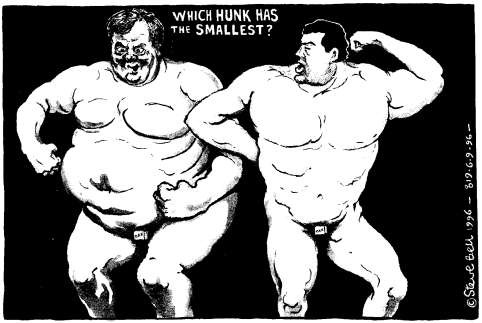
Ken with his long-legged, grey-haired Russian research assistant.


For those under the impression that the Liberal Democrats are in a class of their own when it comes to broken promises over policies featured in election manifestos, a quick reread of the section on crime in the Conservatives' already seminal "Invitation to join the government of Britain" tome should also amuse. While the contents have not been quite as turned on their head as the Lib Dem policy on tuition fees has become, two fairly unambiguous pledges have been shelved (from pages 56 and 57):

Today, almost four out of every five found guilty of a knife crime escape jail. We have to send a serious, unambiguous that carrying a knife is totally unacceptable, so we will make it clear that anyone convicted of a knife crime can expect to face a prison sentence.

...

In the last three years, 80,000 criminals have been released early from prison because the government failed to build enough places. We are determined that early release will not be introduced again, so we will redevelop the prison estate and increase capacity as necessary to stop it.

In actual fact, the Conservative manifesto was fairly tame when it came to criminal justice policy. This was surprising at the time for the reason that the Tories had up to then competed actively with Labour over who could issue the most reactionary rhetoric, repeatedly arguing that violent offences were out of control on the basis of a one-sided reading of the statistics, while damning the early release scheme in uncompromising language (including in a personal election attack billboard ad on Gordon Brown) even though it only released prisoners two weeks earlier than they otherwise would have been.

Whether this is a sign that had the Tories won an outright majority they would now be implementing much the same policies as outlined in today's green paper on sentencing and rehabilitation is impossible to know for certain. What is clear is that the Liberal Democrats, as in so much else, seem to have had absolutely no role whatsoever in the framing of the change in policy. Instead, it seems to have simply been their presence in government which helped effect the change; with Vince Cable becoming business secretary, the evergreen Ken Clarke, having shadowed the position for the Tories instead became justice secretary, helped along by Chris Grayling, the party's shadow home secretary commenting unhelpfully just prior to the election on bed and breakfasts' right to refuse gay couples from sharing a bed. With Grayling demoted to Iain Duncan Smith's underling at work and pensions, the far more liberal pairing of Theresa May and Clarke has apparently been given relative freedom to craft their own policies, although for the most part they are in tune with those outlined in the Tory manifesto.

In almost an instant the consensus that has dominated British politics ever since the murder of James Bulger, that prison works and that an ever increasing prison population is an unquestionably good thing has been broken. A trend started by the Conservatives was unquestionably followed by Labour, so terrified for so long of being seen to be "soft" on crime that it in effect handed over the helming of law and order policy to the right-wing tabloids, especially the Sun. This triangulation failed not only because such policies were self-defeating, but also because each time Labour gave in and adopted a panic measure in response to the day's passing frenzy, it simply encouraged the likes of the Sun to keep on demanding more. When successive home secretaries failed to live up to the image they had first presented, they were torn apart, John Reid memorably appearing on the front page of the nation's biggest selling newspaper minus his brain.

Whether or not the Conservatives were watching this and while playing the same game in public were planning to put an end to it should they be elected is difficult to know for sure. Certainly, the Sun's influence was still being firmly felt within spitting distance of the election: Dominic Grieve, hastily made shadow home secretary after David Davis's resignation over 42 days was apparently moved from the position after he had the temerity while dining with former Sun editor Rebekah Brooks (nee Wade) to critique the paper's coverage of crime, something she complained bitterly about to Cameron, saying they couldn't support the Tories while he remained on the front bench. With Brooks now moved upstairs at News International, perhaps the way was clear for the change in position to be made.

Whatever the case, no one is denying that Ken Clarke has had a major role in the change of policy. Where in the party's manifesto they committed to continuing the insanity of Labour's prison building programme, where additional spaces added to the state were filled almost as soon as they were opened for use, Clarke now actively wants to reduce the prison population, if only by a relatively tiny 3,000. The obvious problem with trying to do so is that he faces the twin difficulties of record rates of re-offending and that for the last 17 years, whether the public or the tabloids believe it or not, ever higher numbers of offenders have been going to prison for ever longer periods of time.

Both are almost certain to conspire against him. Clarke protests in his introduction to the green paper that he will not be disallowing magistrates from using short sentences, merely trying to make the alternatives to time in prison more effective for the offender and more attractive to those passing judgement. While no government was ever going to abolish short sentences in their entirety, even if the Liberal Democrats all but pledged to do so, it's still difficult to see magistrates being dissuaded from using them sufficiently to bring the population down significantly. Clarke's plans will then almost entirely rely on his mooted "rehabilitation revolution", to be achieved within the prison system itself through the development of more "working prisons", where the inmates will be expected to be either in work or education for up to 40 hours a week. Quite how this will work in practice is anyone's guess: the current working prisons mainly cater for inmates either on short sentences or reaching the end of a longer stretch, often as preparation for release. Prisons can't undercut other businesses through lower costs or reduce the number of jobs available as a consequence to law-abiding citizens, which limits even further the work which can be done. There is also no further punishment mentioned for those who refuse to work, which raises the question of how exactly the aim of engaging prisoners in challenging and meaningful work can be achieved.

Much of the burden of reducing re-offending will then fall on the new providers to be brought into the system. Again, quite how this will work is by no means certain: the first pilot, operated by St Giles Trust in Peterborough was only launched in September, and a further four projects will be established by August of next year. As yet there is not even an accepted model as to how the payments will be made, nor is it clear whether they will be any actual savings made for the taxpayer, which is surely just as key as reducing recidivism, once those providing the services have been paid. As Left Foot Forward points out, it's obvious as to why these partners will need to be brought in regardless of Clarke's aims at fostering a "rehabilitation revolution": 9,940 staff currently working for the National Offender Management Scheme are about to lose their jobs. It's also difficult to disagree with Harry Fletcher of Napo that rather than just being about reducing the prison population this is just as much about the privatisation of the current probation system, regardless of the possible effects that could well have on the re-offending rate with the introduction of completely untested new private sector providers.

Clarke then seems to be setting himself up to fail just as much as his Labour predecessors did. Unlike them, he's also had the benefit of outlining his reforms while the media for the most part, especially the tabloid sector which so did for Labour, is either supportive or making few trenchant criticisms. The worst he received today was over his party's broken promise on jailing knife carriers, with the Sun calling it a gamble with people's lives. Whether we like or not, especially when it comes to the dubious involvement of the private and third sectors in rehabilitation, those of us on the left who have repeatedly called for prison reform and an end to the authoritarian approach to crime will find our own alternatives judged on the basis of Clarke's success, a grim irony as we will so many other of the coalition's policies to fail.

Labels: , , , , , , , ,

Share |

Wednesday, June 30, 2010 

Unconnected events, Ken Clarke and the breaking of an orthodoxy.

Very occasionally, a series of otherwise unconnected events lead to something which would otherwise almost certainly not have happened. For all the explanations so far put forward for the very sudden rejection by the Tories of the past 17 years' orthodoxy on prison policy, none on their own are really satisfying. Even with the cuts which are going to have to be made across all departments outside of those "ring-fenced", it's hard to imagine if Chris Grayling had become home secretary, as most presumed he would, that we'd now hear him (or his colleague as justice secretary) expressing his doubts about whether the constant increase in the prison population had actually reduced crime or saved money in the long run.

There was after all nothing in the Tory manifesto about doing away with short-term sentences, and indeed, David Cameron during the leader debates argued against Nick Clegg when he called for them to be abolished in favour of punishment within the community, citing his mother's work as a magistrate for how they worked. If anything, the plans in their manifesto would have almost certainly meant the need for even more prison places, dedicated as they were to ending the early release scheme without explaining how they were going to provide the extra places necessary to do so. In any event, Labour ended it just before the election, claiming there was now available capacity to do so; the "operational capacity" as of now is 88,000, with 3,000 supposed places currently available (DOC), although that almost certainly involves overcrowding to the point of inciting protests and riots if maintained for long.

Undoubtedly then there has been that otherwise difficult to detect Liberal Democrat influence, although the major credit has to be given to Ken Clarke himself. If the Tories had won a overall majority, it's difficult to see him as doing any job other than than the one he was in the shadow cabinet, as business secretary. Instead Vince Cable has taken that, and with Chris Grayling apparently punished for his comments on gays and bed and breakfasts, the more liberal pairing of Theresa May and Clarke as home secretary and justice secretary have taken control. We're told that Downing Street is "concerned" by Clarke's eagerness to break with the past, yet Clarke has apparently won Cameron's tentative backing.

Again, this is no mean feat. As the Heresiarch argues, the cutting of your department's budget by anything between a quarter and a third concentrates the mind wonderfully, but with the head-banging right-wing of the Tory party already making its voice heard, and the tabloid press that Clarke even takes a swipe at in his speech such a major influence over law and order policy, it would have been all to easy to make another exception for the prison estate in order to "protect the public". Instead we've had the first, somewhat cautious, but nonetheless important break with the "prison works!" orthodoxy from a government of either of the two main parties for 17 years.

By any measure, Labour should be ashamed of its record in so vastly expanding the size of the prison estate. Clarke himself claims to be "amazed" and "astonished" at how the number currently in prison has doubled since he was home secretary back in the early 90s, before the murder of James Bulger had such a mesmerising influence on his successor Michael Howard, the opposition, the fourth estate and apparently also public opinion. Where both Clarke and before him Douglas Hurd had attempted to look at the alternatives to prison, suddenly the prime minister himself declared that we ought to "condemn a little more and understand a little less". David Cameron was after all mocked and ridiculed when he suggested something approaching the opposite of that just a few short years ago, calling for teenagers in trouble with the law to be "shown a lot more love", crudely translated by both the tabloids and Labour as "hug-a-hoody".

It's no surprise then that both Howard and his spiritual successor, Jack Straw, have been out defending their record in the face of Clarke's heresy. Clarke cuts straight to the point in his speech, attacking the "numbers game" which political debate on law and order had become:

The measure of success has been solely about whether a Government has spent more public money and locked up more people for longer than its predecessor in the previous years.

In fact, it had become even more debased than this. During the election campaign Labour attacked the Tories for being "soft on crime" over their almost indistinguishable policies on DNA retention, claiming they would be the "burglar's friend". Jack Straw had even suggested, despite all the evidence to the contrary, that the "criminal justice lobby" had an undue influence over policy.

Clarke's heresy doesn't end there however: he goes on to argue that in our "worst prisons" our policies on crime and punishment produce "tougher criminals", coming out drug dependent or making new "hardened criminal friends". Moreover, re-offending rates have been rising in recent years, and nearly half of offenders sent to prison are re-convicted within a year. As Clarke said:

"It is virtually impossible to do anything productive with prisoners on short sentences. And many of them end up losing their jobs, their homes and their families during their short term inside"

The problem with all this fine talk, welcome as it is, is that the solutions, away from "rigorously enforced community sentences", are so familiar. As with everything else that the coalition seems to be doing, much of the leg work will be left with the "voluntary and private sectors", who'll be paid by their results in reducing re-offending. As Dave Semple points out, if the private sector doesn't see a profit, and recidivism is a notoriously difficult thing to correct, it isn't interested. Moreover, as with the welfare system, are there really going to be savings at the end of the process even if everything goes well, considering the extra costs of helping former prisoners once they're on the outside and the paying of the third sector for their success? It certainly isn't clear that there will be. And besides, what of the prisons that presumably will be left empty if the numbers are actually cut? Will it be the old buildings in the estate sold or the new, often PFI-built prisons by private companies closed, with all the costs that will entail?

There's the same problems inherent with Clarke's suggestions on reforming sentencing. He's right that sentencing at the moment is not properly understood, with most only serving half of the sentence they are actually given with the rest spent out on probation, yet his proposed solution is equally full of holes. He brings up the possibility of judges giving a minimum term which must be served before there is any possibility of release, and a maximum which will be served unless the prisoner "earns" their release prior to that. This is almost to a point the current system which it comes to indeterminate sentencing, which is becoming such a strain on the prison system. The judge passes a minimum term which has to be served, but after that it's up to the prisoner to prove that they are no longer a risk to the public. This has resulted in the press screaming blue murder at the mere thought that the likes of notorious criminals such as the mother of Baby Peter could be released in "just 3 years", even when there's next to no chance that they will be. The media, or at least the tabloid half would all but ignore the "maximum" term and instead focus on the minimum as it does now, and the apparent laxity of the judge in such serious cases.

Clarke does however deserve praise for this paragraph, which it's impossible to fault:

I think it’s fair to say I’ve got rather more confidence in judicial discretion than my predecessors. The difference between a judge and a member of the public or a politician is that judges listen to hours and hours of evidence before they make a decision. They know far more about the detail of a case and the evil of the particular offender than we ever could just by reading the red tops.

And for this as well:

I want to hear the views of the judiciary and the citizen JPs who dispense justice in our magistrates’ courts.

When you have handed out community penalties, have you found them to be effective? If so, which ones? If not, why not? What was wrong with them?

Are all the orders you would like to impose available in your area? Which ones would you like to see more of? And which have you found to be most effective?


Actually asking the judiciary themselves for what works?! How novel and controversial!

It remains to be seen whether Clarke will continue to win the battle against the tabloids, the backbenchers and the knuckleheads in Labour, yet even making this first step is more than the latter ever dared to try. Much as there is already to condemn the coalition for, the truly perverse thing is that it's the Labour party that remains wedded to the failures of the past while the supposed authoritarians and throwbacks in the Conservatives are prepared to challenge what seemed like the unshakeable status quo we were stuck with. The ultimate test will be whether the prison population drops below that figure of 80,000, and then even further; only then might Clarke deserve plaudits to go with the praise.

Labels: , , , , , , ,

Share |

Wednesday, January 21, 2009 

A welcome back to Ken Clarke.

Probably the most astonishing thing about the last few months politically has been one of the things that has been barely touched on: just how badly the Conservatives have been doing when they should be, by rights, decimating Labour in the polls and potentially getting ready for government. By badly we have to keep things in perspective: at no point has Labour actually regained the lead in the opinion polls, although it has come strikingly close to it in some. Looking back historically however, Labour after the 92 election consistently led the Conservatives in the polls, sometimes by ludicrous figures of 25%+. The Conservatives for a while managed comparable figures in the middle of last year, before the second Brown bounce after the bail out took full effect.

Things have since improved, the gloom of January, the ever rising toll of job losses, and now increasingly the beleaguered nature of both Brown and Darling, no longer looking like they know what they're doing, or rather at least not radiating the confidence which infected the former during the initial stages of the banking crisis, all coming into effect.

Less immediate will be the impact of the bringing back of Ken Clarke, a move long mooted and encouraged but which still seemed unlikely. Looking at the Conservative front bench today, excepting Clarke, it was impossible not to see a group of grey men, one which you'd find it difficult to have any confidence in. The wider Conservative reshuffle, and Cameron's strange refusal to bring back the irascible David Davis, still apparently smarting from his decision to resign and fight for a principle, said much the same: for all the boasts that Cameron's shadow cabinet now contains more women than Brown's, all, except for perhaps Theresa May, moved to Shadow Work and Pensions, are in the jobs which rarely result in them appearing on our screens. Similarly mystifying was the move of Chris Grayling, a true grey, underwhelming man if ever there was one, to shadow home secretary. When we have a government which is so apparently wedded to the casual dilution, even evaporation of our civil liberties, you want someone in the seat opposite to have something approaching credentials for fighting against such policies. Say what you will about Davis's support for capital punishment and hard-line approach to immigration, you knew where he stood on ID cards, 42 days and everything in-between. His first replacement Dominic Grieve, moved back to his former job as shadow justice secretary, was never likely to live up to Davis's success in outliving, even bringing down consecutive home secretaries, but apart from his supposed libertarian leanings he made truly abysmal speeches and comments on the Human Rights Act and came across as having been promoted above his competence.

All the immediate comparisons regarding Clarke's re-entry to the shadow cabinet were to Brown's far more surprising offering of a job to Mandelson, to whom Clarke will shadow, but to compare the two any further than that is more than a disservice to Ken. Both might be widely disliked amongst the parties' respective core supporters, but Clarke is lovable, affable and endearing when Mandelson is a person you suspect only a mother could truly love. Doubtless that is part of the reason why Mandelson succeeded in most of what he did outside of his resignations; even those that loathed him seem to have a grudging respect. Clarke on the other hand has always been, along with Alan Duncan, regardless of his involvement with Vitoil, the "acceptable" Conservative, the ones that don't instantly set your teeth on edge. Compared to George Osborne, supposedly having lessons in how not to make people resort to violence on hearing or seeing him, there simply isn't a contest. It helps also that as Cameron retorted at PMQs today, he has something of a shining record as the last Conservative chancellor.

It might well have been coincidence, but today was also the first PMQs for quite some time when Cameron comprehensively scored a victory. Brown was so desperate to change the subject away from the economy that he brought up the completely irrelevant fact of Clarke's differences with most of his Tory colleagues on Europe, when surely more damaging would have been Clarke's also apparent agreement with Brown on the need for a stimulus, that the VAT cut wasn't completely idiotic or a "bombshell" as the Conservatives portrayed it, and that anyone going into the next election promising tax cuts was asking for trouble. For someone who appeared to be finally getting better at the dispatch box, it was embarrassing, and the silence on the Labour benches was eerily apparent.

When criticising Conservative politicians you can't of course ignore the fact that there are much the same problems on the Labour benches, with the added disadvantage that these less than promising individuals are actually in power. The only consolation is that we know the Conservatives would introduce even more swingeing reforms of benefits than James Purnell is proposing; there is however no one quite as pompous or over-promoted on the opposite side as Geoff "Buff" Hoon, and that only Harriet Harman could possibly be so utterly stupid as to try to block freedom of information requests on MP's spending in the current economic situation. Not that the Tory shadows would be much better in the same jobs, and indeed, the idea of George Osborne being chancellor is terrifying in the extreme. Likewise, Eric Pickles, the new party chairman, who is doubtless very popular with the Tory grassroots, seems such a throwback to Thatcherite days that he appears to have the exact same bulk as the pre-diet Nigel Lawson.

The bringing back of Clarke bears further comparison to Brown's strategy for a further reason: while Brown has been apparently desperate to put back together the original New Labour coalition, sans Blair, with the equally dislikable Alan Milburn also brought back into the fold, Clarke is from an even earlier era. The difference is that his stretches in Thatcher's government, and spell as, however humourously aesthetically, health secretary, have been all but forgotten. We instead remember him as chancellor, as the successive leadership challenger that could have restored the Tories' fortunes earlier if only he could have closed the chasm between himself and the rest of the party over Europe. Mandelson and the rest just remind us, quite rightly, of spin and the decadence now in retrospect of the early New Labour years. He might well be, as Lord Tebbit characterised him, lazy, but his laziness might just be the thing that convinces those uncertain of the economics of Osborne that there is something of substance there after all.

Labels: , , , , , , ,

Share |

Wednesday, July 02, 2008 

The undemocratic task force.

In a way, it's almost verging on chutzpah for Kenneth Clarke, former member of the Conservative government which foisted so many unpopular and regressive policies on Scotland first as an experiment to now be offering solutions to a problem which he had a hand in cultivating in the first place. One of the main reasons why Scotland finally achieved devolution and a parliament was undoubtedly the poll tax, levered first on the nation which had steadfastly refused to become a part of the Thatcherite revolution and therefore deserved the contempt with which it was treated, but we should perhaps let bygones be bygones. On the whole, Clarke and his "Democracy Task Force's" paper (PDF) on the West Lothian question is worthy of praise, praise of which more in the final paragraph. It's just that it comes to such a simpering compromise in its conclusion that's unlikely to be accepted, and that will do very little to staunch the sense of grievance which some feel about where the power now lies in the UK.

First though the conundrum itself. Devolution in Scotland has left the unhelpful constitutional problem of Scottish MPs being able to vote on legalisation that affects only England and/or Wales, the Welsh assembly not currently having the same powers which have been devolved to Scotland. This problem wouldn't be so bad if the MPs in Scotland were spread more equally across all parties, but the Labour party has overwhelmingly had Scotland as its personal fiefdom for quite some time. This is gradually starting to be broken, with both the Scottish Nationalists themselves and the Liberal Democrats making gains, and could be much extended at the next election with Labour's collapse in popularity and with the SNP in power in Edinburgh, but at the last election Labour had 29 Scottish MPs, the LDs 12, the SNP 6 and the Tories a very lonely 1. Added into the problem is that most of the Scottish Labour MPs are either one of two things: mostly completely loyal and therefore unlikely to rebel against the Labour whip; or either ministers or former ministers, not to mention the prime minister himself. This has led to bills affecting only England, such as the votes on tutition fees and foundation hospitals being carried only by Scottish Labour MP votes. With the Tories likely to sweep the board in England at the next election, but with certain victory still in doubt, it's feasibly possible that Labour could still cling on to a majority but only through their Scottish seats, with the Tories the defacto party in power in England.

One of the other factors which the Clarke report doesn't touch on much is that the Conservatives already have won the popular vote in England, as they did at the last election, yet because of first-past-the-post still received 100 fewer seats than Labour. This will undoubtedly be even more pronounced at the next election, with the Tories likely to wipe out Labour almost completely south of a decent chunk of the Midlands (London is a different matter), yet the Conservatives continue to oppose proportional representation because they realise that even though the system works against them, they'll still be able to get a decent majority if they win well, let alone if they win big. This was more defendable when the vast majority voted for either Labour or Conservative, but that is no longer the case when the Liberal Democrats won over 22% of the vote last time round, not to mention the votes the other minor parties received despite there being next to no chance that any of the candidates would actually win any seats. The report however meekly dismisses proportional representation out of hand, with the simple response that "[W]e do not favour either practice [PR or US-style separation of powers] in the UK as British political culture would take a very long time to adapt to either practice." This simply isn't good enough.

The Clarke solution is instead of pure "English votes for English laws" a poor substitution for it that would make very little overall difference. Rather than simply barring Scottish MPs from voting on legislation which doesn't concern their own constituencies, the task force proposes that Scottish MPs would be barred from taking part in the committee stages and report stages of a relevant bill, while being allowed to vote on both on the second and third readings. This would still however leave non-English MPs with the ability to vote down a bill at the crucial third stage. Clarke is rather pleased that this would still leave the UK government with an effective veto if it felt that the bill damaged UK interests as a whole by urging its members to vote down the amendments made to it in committee stages at the third reading.

If this sounds complicated, then it is. If you're reading this in the first place then you're likely to have some sort of remedial interest in politics, but for those out there that don't this is about as confusing as it gets, like attempting to explain what colour something is to a blind person. It also falls down because it ignores the simplest solution, if we're also going to reject PR: that English votes for English laws makes the most sense and would be easy to institute. The other argument made by some is for an English parliament, or full English devolution, but this isn't a solution or option which I've ever been tempted by: what's the point of establishing yet another devolved instutition when we have a perfectly acceptable one already in use, if only it can be acceptably modified to make it work both more fairly and better than it currently does? The break-up of the union this also might herald is also a red herring; Scotland still seems unlikely to go independent any time soon, however much some both north and south of the border might like it to, and any changes on the constitutional level over the West Lothian question are hardly likely going to be the straw that breaks the camel's back.

It is of course Labour that is stalling any solution on either front. It didn't shoot down Clarke's "solution" for the exact reason that it keeps their strangehold on Scotland and also potentially England in tact. It's the best of all worlds in short-term polticial terms: the West Lothian question has been answered, but things carry on as before. That this trickery won't trick English voters themselves doesn't seem to enter into the equation. It's strange however why the Conservatives are still so mealy-mouthed with their policy. They could have proposed something that would have made everyone except the Labour party immensly happy, yet they've done the opposite. You can understand why they reject PR, as they fear that it could keep Labour and the Lib Dems in a coalition for potentially all-time, especially when they can still win big as long as they're slightly more popular than Labour under FPTP, yet on this they have potentially everything to lose. The best thing that can in fact be said for Clarke's task force's report is that it's short and to the point, unlike so many other policy documents. That it took four years to produce rather dampens down even that accolade.


Related posts:
OurKingdom - The Madness of Ken Clarke
OurKingdom - Cameron wanted English nationalism, not the West Lothian question, answered
Paul Kingsnorth - A radical answer to the West Lothian question

Labels: , , , , , , , , ,

Share |

About

  • This is septicisle
profile

Archives

Powered by Blogger
and Blogger Templates