Thursday, April 18, 2013 

Unacceptable in the 80s.

Seeing as we've spent pretty much the last ten days going over old wounds, it seems a shame to break the pattern now.  Let's strike a slightly different note though: of all the myriad of things that Thatcher and Reagan inflicted on their respective countries, one thing neither did was authorise or condone the use of torture.  While it's certainly true that Reagan for one had no qualms about participating in the most dirty, even treasonous (as would be alleged by the opposite side if it was the other way round; they almost got Clinton impeached for having his dick sucked, for comparison's sake) underhand dealings, as evidenced by his administration's funding of the Contras by the secret selling of arms to Iran, 25 years ago today the US signed the UN Convention Against Torture.  On sending it to the Senate a month later, Reagan commented that the treaty "clearly express[es] United States opposition to torture, an abhorrent practice unfortunately still prevalent in the world today".

Quarter of a century on, the record of Thatcher and Reagan's heirs is starting to be laid bare.  We already knew much about the extraordinary rendition programme and how "enhanced interrogation techniques" were authorised in the aftermath of 9/11, but the Task Force on Detainee Treatment report, commissioned by the Constitution Project, is the best effort yet to draw together how the policy progressed and was instituted, starting with the opening of Guantanamo and following on to its practice in Iraq.  Their key finding is that "it is indisputable that the United States engaged in the practice of torture".  No fudging, no moving of the goal posts; torture, whether directly authorised or not, was used.  Nor do they shy away from the argument of some that such harsh techniques had results.  They conclude that there is "substantial evidence that much of the information adduced from the use of such techniques was not useful or reliable".  Views are mixed as to whether the film Zero Dark Thirty actively suggests that the testimony given by one tortured detainee helped the CIA find Osama bin Laden (the report says that it does; I haven't seen it so can't judge), but it most certainly is not the "first draft of history" as claimed by Kathryn Bigelow.

The Constitution Project set up its own panel to investigate the treatment of detainees after the Obama administration decided not to take any further action or open any investigation into what went on during the first phase of the "war on terror".  Back here in Blighty, where there is nothing to suggest that torture was ever sanctioned by a minister but plenty of evidence that collusion with the US in the rendition programme most certainly was authorised, the Gibson inquiry was meant to provide answers.  Instead it was unceremoniously abandoned, ostensibly on the grounds that the police needed to investigate the involvement of the security services and ministers in the rendition to Libya of two former members of the LIFG, which had links to al-Qaida, although one suspects the boycott by human rights groups at the limited scope of the inquiry also had something to do with it.

Nonetheless, Gibson and his team wrote up a report on the evidence they had sifted through and handed it over to the government.  That was nine months ago, and there is as yet no indication as to when it might be published.  Seen alongside the fight over the closed material procedures section of the justice and security act, designed to stop the courts from ever releasing material such as that which confirmed the security services knew about the torture of British resident Binyam Mohamed and did nothing to stop it, it more than implies that the coalition, having been lobbied extensively by both MI5 and SIS, has now decided upon a similar course to that of the US.

We could undoubtedly give too much credit to both Reagan and Thatcher over their stance, although Simon Jenkins was right yesterday to highlight how the latter's response to nearly being killed by the IRA was to carry on almost as if nothing had happened.  Both cuddled up to regimes that most certainly did and continue to torture their own citizens, while at the funeral yesterday were such noted humanitarians as Henry Kissinger, Dick Cheney (arch defender of waterboarding) and Benjamin Netanyahu. There can be little doubt however as to which administrations will be judged most harshly on their foreign policies by history.

Labels: , , , , , , , ,

Share |

Wednesday, April 17, 2013 

We are all bourgeois now.

As unhappy coincidences go, today's announced rise in unemployment seems as fitting a tribute to Maggie as anything else.  We all Thatcherites now, says David Cameron, and while you can't level the accusation against him that he believes unemployment an acceptable price to pay for his overall reforms, especially considering no government since has believed in full employment, his government is going way beyond Thatcher's obstinacy on economics.  She after all did relent to an extent when monetarism sent the economy into free fall; Cameron and Osborne seem likely to ignore the advice of the highest priests of neoliberalism, the IMF, to scale back on austerity, such is the way they've made it impossible to do so without humiliating themselves.

Just as I didn't watch the royal wedding (and why on earth would anyone, for that matter?), I somehow managed to avoid the funeral.  Quite why so many find something to admire in our ability to put on pageantry when required equally escapes me; authoritarian nations also tend to be pretty good at putting on a show, and yet with the exception of the opening ceremony at the Beijing Olympics, we usually make fun of them precisely on that basis.  Just as the only reasonable reaction to goose-stepping soldiers is to laugh at them, so the pomp and circumstance that surrounds the monarchy and also now the chosen few regarded as being the equivalent of royalty ought to be mocked.  It is utterly ridiculous, almost everyone except for the dewy-eyed few know it to be ridiculous, and so undoubtedly this ridiculous tradition will continue to be rolled out for every major state event, such are our ways.

If nothing else, today has at least been revealing of how politicians regard each other in private.  Both Tony Blair and Gordon Brown were first elected to parliament in 1983 on "the longest suicide note in history" manifesto, but neither it seems had any objection to Thatcher being given a quasi-state funeral.  Indeed, it seems the only major thing the Tories added to the plans drawn up under the last government was the military aspect.  They might not have known that the right would take the opportunity of her death to attempt to portray her as second only to Churchill in the great national figure stakes, yet if they've had any such concerns since they certainly weren't on display today.  Nor has the week of hype and eulogising left the Mail drained; if anything, it's reached such a peak that you doubt they'll be able to top it when Liz pops her clogs.  "A journey's end", the front page read, while below they claim up to 250,000 were lining the route of the procession (since changed to a more realistic 50,000).  Just as you have to multiple the figures given by the police for any demonstration other than one by the Countryside Alliance by the power of 4, so it now seems you have to divide the numbers given by the Mail by the same amount.

Nor was the ceremony itself beyond critique.  Today wasn't the time and place to discuss her politics, said the Bishop of London, Richard Chatres, who then decided at the end that it actually was as he defended her over the infamous "no such thing as society" comments.  She did believe in society, and the interdependence of people, he said, which is almost certainly true; what went unsaid was that however you read her remarks, she clearly said people shouldn't even expect to be housed by the state. I don't think anyone disputes that first and foremost our responsibility is to look after ourselves; it's that a majority of us still believe that the state should provide an adequate safety net, whether that be in housing or benefits. Society is not the state, as the Tories said at the last election, but Thatcher's government did more to fray the threads that tie communities together and make up society than any since the war.

The real irony of today is that for all their tributes to her, not to forget George Osborne's solitary tear, Cameron spent his first years as Conservative leader trying to repair the damage her overthrow did to the party. Arguable as his overall success has been, the last week has been a reminder to everyone that her legacy is still inescapable.  To suggest this is unlikely to go down well in those places that the Tories need to win to get a majority next time out is to put it too lightly.  The overwhelming mood might be apathy rather than anger, such as that in Leeds and Edinburgh rather than Goldthorpe, yet you shouldn't bet against Labour using a few of the images of the past week come in 2015, hypocritical in the extreme or not.

This said, Cameron was right in saying we are all Thatcherites now.  At least he was if he was meant the political class, as they clearly are all Thatcherite in one sense or another.  A significant number of the population by contrast remain in favour of an alternative, it's just they aren't so much as offered one. Nor are they likely to be. And eventually, something is going to break.

Labels: , , , , , , ,

Share |

Monday, April 15, 2013 

A small, ridiculous gesture for a massive, undignifed death jamboree.

One of the problems that comes from Labour deciding to just let the Tories have their week of mourning/deification with the very minimum of criticism is that you let the likes of George Galloway represent what a significant amount of people are thinking.  It was an utterly absurd, cowardly move for the BBC to not play Ding Dong in full, instead opting for the typical compromise that pleased neither side.  I really thought we'd moved past the point at which things that were in poor taste were banned/censored due to outside pressure, not least when it comes to music.  There's plenty of music in the top 40 that's offensive in terms of how objectively awful it is, but if people buy it, it gets played.  It's how the system works.  Start altering that and it renders the entire exercise even more completely and utterly pointless than it already is.  Also, regardless of what Guido or the Mail think, for 52,000 people to buy a song in one week purely as a protest only underlines how the attempts to claim Thatcher as our greatest peacetime prime minister are a step too far.

And so now Big Ben is to be silenced for the duration of Saint Margaret's funeral.  It's a small, ridiculous gesture for what is turning into a massive, undignified summation of how for all Thatcher's rolling back of the state, the parts that were in most need of trimming are still fully functioning.  Turning your back on the entire charade really does seem to be the best possible way to register discontent with what has been a fully fledged political campaign from the moment the news of her death came through.

Labels: , , , , , , ,

Share |

Thursday, April 11, 2013 

A political Queen.

Writing about Thatcher (and politicians in general), it's easy to forget that behind the often harsh, apparently uncaring exterior, there was a real, feeling woman who clearly was capable of great kindness as well as denouncing her opponents in the strongest of terms.  One of the more myth-squashing anecdotes from yesterday's Commons and Lords sessions was Lord Butler's retelling of how a student challenged her on referring to children as "illegitimate", despite their parentage not being something they had any control over.  Thatcher responded that it was better than calling them the alternative (bastard), yet later she reflected to Butler that having thought about it, the student had been right.  Looking at the photograph taken of her in Battersea Park only last month, I was reminded of my grandmother's passing last year, who also spent her final years battling with dementia.  Regardless of what we do with our lives, at the end every single one of us dies the same way, alone.

All the more reason why we shouldn't let Thatcher be remade into what is effectively political royalty.  The way Tory MPs tried to shout down both David Winnick and Glenda Jackson yesterday may well be typical Commons behaviour which all sides are often guilty of, yet it was surely inappropriate when so many of their colleagues made tributes that went far beyond the sycophantic and instead into the most slavering hero worship.  The idea she had any role in the fall of the Soviet Union beyond her early picking out of Gorbachev is absurd, as is her much overstated love of freedom.  She believed in it for those under Communism, not so much those under authoritarian regimes that were British allies.

Fair enough, David Cameron clearly admires her deeply, and so his rhetorical flourishes can be forgiven.  Ed Miliband also acquitted himself well, making a well-judged speech that covered both the good and the bad without riling either side. It's also unclear just how much of the planning for the funeral was done by which government: we now know Operation True Blue dates back to around 2006, indicating that some sort of public remembrance was going to take place regardless of who was in power. Which would have been fine. A ceremonial funeral goes well beyond that, giving her the same status as a royal, ignoring how one of the reasons we continue to grudgingly put up with Brenda is that she has stayed resolutely above politics.

The comparison is apt, because much as any criticism of Liz is treated as being akin to a modern form of blasphemy, so it seems the likes of the Mail now want Maggie to get the same treatment. As predictable as the outrage was from the usual suspects at those not treating their heroine's death with the due amount of respect, the Mail's pursuit of those behind one such death party is incredibly petty. Splashing two days in a row on the opponents rather than celebrating Thatcher's life and legacy seems a really odd way to go about things.

Then again, perhaps the Mail thinks focusing on the beastliness of some is the only way to win over those it would normally consider its natural allies.  To judge by the ratings the tribute programmes hastily screen on Monday picked up (3 million) and the number of views news stories on the major websites have received since, Thatcher's demise and the circus that has followed since might be fascinating the politics nerds (guilty), but it doesn't seem to be transfixing many others.

And why should it?  Those born on the day she left office are now 22, while the passing of time for those older appears to have dulled both the interests and opinions of the majority.  Moreover, we can either bemoan or celebrate her legacy, but none of the mainstream political parties want to truly break with it.  The battles she fought appear to be all but over, while her main disciple is urging Ed Miliband to not so much as inch leftwards.  Looks as though, yet again, it's up to the next generation to break the spell Thatcher cast over British politics.

Labels: , , , , , , , ,

Share |

Tuesday, April 09, 2013 

Thatcher's victories.

The only appropriate response yesterday seemed to be to mock.  Thatcher had become and will remain a myth, for both right and left.  For her most devoted followers on the right, and for an example of the loopiness she has on even those usually most staid of academics, historians, one only need read the Graun's interviews with Michael Burleigh and Andrew Roberts, she was a giant who will never be equalled.  It doesn't matter to them how many communities her policies ripped the heart out of, how many lost their jobs as an effect of her repudiation of the attempts to maintain full employment of the post-war years and were thereafter bought off with incapacity benefit, or how the ultimate effect of the castration of the unions was the soaring inequality we have today (or if it does, they rationalise it as unavoidable collateral damage).  They really, genuinely, believe that she saved the country as David Cameron said yesterday.

Equally, for some on the left, Thatcher became the ultimate depiction of the nasty, heartless, even evil Tory.  There is no such thing as society, she said, and that quote came to symbolise how they felt she cared nothing for the working man who wanted little more than a secure job and a roof over his head.  If he wanted to buy that house, then that was different, he became "one of us".  All the rest could be disregarded, or if they were actively hostile, they could be characterised as the "enemy within".  The previous solidarity of local communities and workplaces was broken down through such rhetoric, while the police were used, whether against the miners or the strikers at Wapping as her effective line of enforcement.

As you might expect, my own view on Thatcher is closer to that of the latter rather than the former.  It's difficult to draw such a broad conclusion though when she resigned as prime minister 5 days shy of my 6th birthday.  Indeed, one of the many absurdities of yesterday was that so many of my generation and younger were either celebrating or certainly not feeling the slightest bit sad about the death of someone they could either barely remember as being in power or had resigned years before they were even born.  I don't have very solid memories of much before I was about 7, although I can extremely vaguely recall the news of the poll tax riots.  As for her political passing, there's just a blank.  I might be a child of Thatcher, but actually remember her time? I certainly don't.

Britain in 2013 is nonetheless still her country.  It's undoubtedly a more socially liberal and multiracial place than it was in the dying days of 1990, but economically it resembles it more closely than it has in years previous.  Enterprise zones, straight out of the Thatcherite handbook are back, as is the language of there being no alternative. George Osborne even lifted directly from her for his budget slogan, that it was one for those who want to "work hard and get on", as tactless a message as we've come to expect from the sledgehammer chancellor.

It's here where a certain section of the left's demonisation of Thatcher begins to fall apart.  To understand what she achieved, you don't just have to be aware that not a single one of her privatisations, financial reforms or trade union laws was unpicked by Labour between 97 and 2010, but also that support for her was so total from the vast majority of the media that it forced everyone that has come since into trying to ride the press tiger.  All have tried, and all have failed, although John Major refused to play the game to anywhere near the extent that Blair, Brown and Cameron did.  It's been said repeatedly that New Labour was Thatcher's greatest achievement (including by herself), and it's one of those rare cases when such a widely shared view is probably right.  In fact, New Labour didn't just keep to her settlement, it expanded on it: one of Gordon Brown's very first acts as chancellor was to give away the only remaining power that the Treasury had kept, that of raising and lowering interest rates.  The free market was triumphant.  That Labour would have almost certainly won in 97 regardless of Tony Blair's transformation of the party is now just another of those what if scenarios.

Although I disagree with plenty of the Heresiarch's analysis, he's right to note that the most fundamental difference between the New Labour machine and that of Thatcher was language.  New Labour (initially at least) spoke compassionately and continued to denounce the evils of Conservatism while going far further than she had dared in many areas.  Whereas she may not have cared two hoots for the NHS, she didn't introduce privatisation, as New Labour did; nor were the unemployed or others on benefits denounced in anywhere near the terms that became familiar in the final years under Labour (Tebbit's "on yer bike" anecdote about his father aside, although the denunciation of single mothers wasn't many moons away).  The use of the private finance initiative boomed, while the City was allowed to do whatever it liked, and duly did.  Thatcher undoubtedly wanted as many as possible to get rich, but she never said anything amounting to the immortal line uttered by Peter Mandelson.  She also might have loathed anything that wasn't bourgeois while having no interest in wider culture whatsoever, but she didn't expand the prison estate in the way her successor and then Labour did, or impose the restrictions on civil liberties Labour did in the aftermath of 9/11, despite almost being murdered by the IRA.

While then it was at least nice to hear one alternative voice yesterday, and it's difficult to disagree with Ken Livingstone that Thatcher's reforms set the political failures on housing and the City we're living with today into motion, his opponents were also right when they stated back that his party did nothing to change them and in some cases have ended up exacerbating the problems.  Just then as Thatcher lay the foundations for New Labour, so too did New Labour set the foundations for David Cameron's Tories and the coalition.  David Cameron's attempt to rebrand the Tories has undoubtedly been more spin and less substance than the remaking of Labour was, yet it just about worked.  That in power almost all of the fluffiness has fallen away and been replaced by some incredibly harsh rhetoric isn't just a mirror on the 80s, it's also how Blair and Brown operated when they thought they had to.

You can't imagine though that when either Blair or Brown go there will be impromptu street parties to mark the occasion.  Thatcher wasn't just divisive, as has been admitted even by Cameron, she polarised the country.  Apparently capable of great charm and kindness in private as well as rudeness, her public demeanour inspired hatred.  You were either with her or against her, a position only Tony Blair has since invoked.  For all the claims of how she was an inspiration for people in the Soviet bloc and had a passion for freedom, this only went so far.  If you were unlucky enough to be under the yoke of a dictatorship of a British ally, whether in Chile, Indonesia or Saudi Arabia to name but three, then hard luck.  The same went for the ANC in South Africa; she may well have opposed apartheid, but she continued to refer to Nelson Mandela as a terrorist and refused to impose sanctions on the regime.

All the more reason why yesterday we should have heard more widely from those who opposed her at the time.  The closest the mainstream came to acknowledging the depth of feeling of some, not to mention what was happening online were the one or two interviews with miners, with Red Ken and Shirley Williams turning up on Newsnight, alongside the odd reference to George Galloway's tweeting.  The 80s were hardly a sanitised era, and Thatcher herself was ruthless in her attacks on the media when they refused to follow the Conservative line, particularly the BBC, although perhaps most notoriously when Thames broadcast Death on the Rock.  Nor was there much, if any comment on the continuing censorship during her decade in power: the video nasty panic and the influence of Mary Whitehouse on Thatcher went unremarked upon.

Nor should it have been decided so swiftly that she would receive a ceremonial, if not state funeral, although the difference is frankly semantic.  Regardless of what you think of Churchill as a politician both before and after the war, his leadership during the conflict demanded that he receive full state honours when he died.  He worked to unite the nation and give it the belief to fight on.  Thatcher did the opposite of the former, while indirectly promoting a class conflict that continues to this day.  If the family wanted a public event, then by all means they could have either paid for it themselves (as they are doing in part) or had it privately funded.  Those pushing for a full state funeral should note that if Thatcher deserves one, then when Blair goes he will also surely merit such recognition.  It will also inevitably attract much protest, which raises the question of how it's going to be policed.

The ultimate conclusion to draw is that as always, it's the victors that end up writing the history.  Where the left has arguably succeeded socially (although there is much still to do) the right has most definitely triumphed economically.  What Thatcher and Reagan instituted in the 80s ought to have been exposed by the crash of 07/08 and the depression that has followed.  Instead, after a initial bout of Keynesianism, neoliberalism has re-emerged if anything stronger than ever.  There is, we are told, no alternative.  They're right, as the left has completely failed to set out that alternative.  Thatcher won then, and her successors are doing so now.

Labels: , , , , , , ,

Share |

Monday, April 08, 2013 

Death to penguins!

  • GREATEST WOMAN TO HAVE EVER LIVED, DECLARE BLAIRITES
  • GREATEST WOMAN TO HAVE EVER LIVED, DECLARE LABOUR MPS TOLD TO BE ON BEST BEHAVIOUR
  • WHO'S JOSEPHINE STARCHER, ASKS EVERYONE UNDER 16

Madam Josephine Starcher, the first and so far only female British prime minister has died at the age of 106, her chief propagandist Lord Ho Ho has announced.

Struggling to hold back the tears and dressed entirely in black, the normally jovial Ho Ho delivered his message to the massed ranks of the British press, knowing that this was a truly historic moment.  "This is a truly historic moment.  Madam Starcher is dead.  She choked on a Ritz cracker.  Mark and Carol Starcher have asked for the utmost media intrusion at this time.  As a supporter of a free press, it's what their mother would have wanted."

From humble upbringings, born into a family of fish gutters, Madam Starcher rose to be one of the defining political personalities of the 20th century.  Abandoning a career in turning the windmill round at the local crazy golf course, she joined the Conservative party, influenced heavily by the political philosophy of the German panel beater Herman von Paddle Steamer.  Realising that his aquatic based economics were rather antediluvian, she soon settled on the far more sensible writings of Fredrich von Hayek.

First selected by the Tories to contest the safe Silly Party seat of Luton, she nonetheless succeeded in reducing their majority by first 10 and then a further 5 votes.  It was not until 8 years later that she finally entered parliament, having won the London seat of Finchley thanks to a mistake on the ballot which listed her as the Ayn Rand Continuity party candidate.  The electorate were rather miffed at first to have elected someone so moderate, but soon took Starcher to their hearts.

Starcher's first taste of real power was as education secretary in the Conservative government of 1970.  Given the position by noted sailor and bon vivant Samuel O' Beckett, who approved of her past flirtation with the works of von Paddle Steamer, she excelled in the job, with her decision to introduce Turkey Twizzlers onto the lunch menu of every school in the country welcomed by all, especially newspaper owner Sir Bernard Matthews.

Rising to become leader of the party after O' Beckett mysteriously fell off a barge into the Grand Union Canal, she fought both sexism and the patronising mentality within the Conservatives, many of whom kept mistaking her for the charwoman right up until her resignation in 1990.  She nonetheless led the Conservatives to victory in 79, the Labour party's policy of discounting tents for summer holidays having been a unmitigated disaster for the country.

Once ensconced in Downing Street, she set about introducing reforms which were controversial from the outset.  At first, it seemed as though her policy of "Voucherism", whereby money was abolished and vouchers given out instead was leading Britain towards ruin, as unemployment increased by 25 million and a 6 hour week had to be put in place.  Criticised and cajoled by the "damps" in her cabinet, she gradually reintroduced money and later claimed that she had never supported voucherism at all.

Despite this set back, her first term came to be defined by the Rockall war.  The tiny island was invaded in 1982 by penguins who declared a socialist state, much to the dismay of the local population of British gannets.  Intervening on the side of the gannets, who she believed shared her political philosophy, the war lasted 30 minutes and cost the lives of approximately 59 penguins.  1 British soldier took a peck to the groin.  The successful action came to be the seen as the turning point in the government's fortunes, and the slogan "death to penguins" was a rallying cry for young Conservatives everywhere during the 83 election campaign.

Her second term was dominated at first by a strike by sewage workers, whose campaign of civil disobedience came to a head when they almost killed Starcher with a massive "shit cannon" blast in Brighton.  After defeating their leader Captain Crabs, she set about privatising much of the country's infrastructure, starting with the state owned glass eye maker.  Her victory in the 87 election assured, concerns began to be raised that power had gone to her head.  Her edict that every man, woman and the child in the country with the exception of nuns and the insane had to cut off their left ear, legislation that became known as the "ear tax", resulted in riots in Victory Square.  Challenged for the leadership of the party by Didbin Jane, she failed to win on the first ballot and was persuaded to stand down, leaving Number 10 with noticeably wet armpits.

In a sign of the unanimity of feeling across the political spectrum, a joint statement on Starcher's death has been issued on behalf of David Cameron, Ed Miliband, Nick Griffin and Nigel Farage:

"Truly, Starcher was the queen of hearts.  She cured the blind, healed the sick, and only once did she call for everyone to cut off their left ear.  Her successes were numerous, and the country was transformed from the hell hole it was in 79 to the paradise it continues to be today.  She literally single-handedly defeated the Soviet Union, the evil empire collapsing like a pack of cards with one swish of her right hook, while she also established the enterprise culture that today means anyone can take out a payday loan on an APR rate of 600,000%.  We hope that all will join us in saying one last time, death to penguins!"

Nick Clegg was unavailable.

The response elsewhere has been mixed.  In Scotland, where many of her policies were first tested out, a mass event appears to be taking place in Glasgow's George Square, although reports are unclear about whether or not the mass drinking is usual for a Monday.  Also indifferent it seems are the young, many of whom appear to be unaware of the legacy left for the country by Starcher.  One 15-year-old asked for his opinion merely grunted and then walked off, while a 17-year-old left the following message on Twitter:

"Everyone in politics is a fucking fag."

Labels: , , , ,

Share |

Tuesday, May 05, 2009 

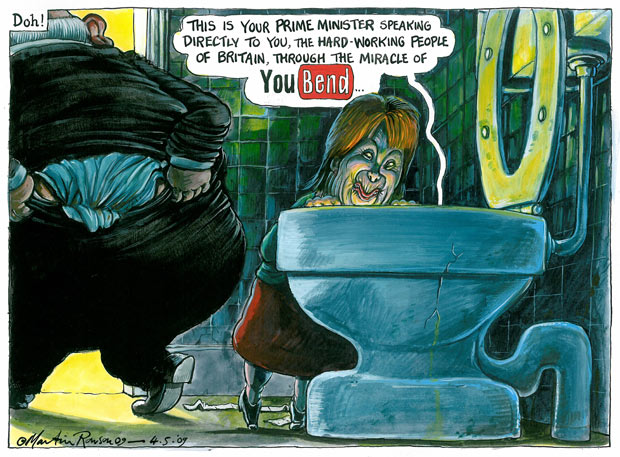
Hazel Blears? She's just like Thatcher...

Apropos of yesterday's post, I was fairly confident that the Graun's leader which featured Hazel Blears had been written by Martin Kettle, who used to be one of the main leader writers, and who now fills in occasionally, but because I wasn't completely certain didn't directly attribute it to him. Today Mr Kettle devotes an even more stupendous column to comparing and contrasting Blears and... Margaret Thatcher, which rather does confirm it. His main argument is that Thatcher, having first been patronised, proved everyone wrong. His penultimate paragraph:

Yet if you look at the Labour party today and try to imagine a current minister of either sex with unchallengeably authentic political roots, an aspirational life story that image makers dream of, a clear sense of where she's coming from, an irresistible confidence in her own instincts, a clear set of convictions, and the potential to turn herself into an iconic political figurehead, you don't find many better candidates than Blears.

In one sense, you have to admire both Kettle and Blears: few are so deluded about either their greatness or someone else's potential to be great; that's impressive in its own right.

The problem with this view of Blears is obvious upon watching George Monbiot's eye-opening interview with her. This came about after Blears responded to a Monbiot column, which wasn't one of his best, which attacked politicians as a whole. Blears, for her part, put in an even more poorly argued reply, which brazenly claimed that those who have never stood for political office shouldn't criticise the great work which politicians are doing. After Monbiot ripped Blears to shreds in his riposte, she rather pathetically asked him to visit her constituency to see the great things that she and Labour have achieved, presumably thinking that he wouldn't take her up on the offer. He did.

This took place before Blears' weekend article in the Observer, which set the slavering Kettle off on his Thatcher riff, but after watching it you couldn't possibly mistake Blears for even the most shallow Thatcher follower. Whatever you think about Thatcher, she was undoubtedly a leader. Blears, despite her pretensions to become deputy leader, where she was humiliated by coming dead last, is not a leader. She's a follower. Monbiot dismisses the distinctions between Blairites and Brownites and just describes Blears as a career politician, which certainly also is accurate, but the Blairite description still holds, because she undoubtedly shares Blair's terrifying sense of self-assurance, his ability to believe two contradictory things at once, which Orwell famously called double-think, and also to argue regardless that of any changes in policy, everything they have ever done has been the right thing, even if the right thing at the time turned out to be the wrong thing and the opposite had to be done to make it the right thing. Brownites, for their sins, have never been so self-assured, and have recognised they have made mistakes. Blairites, however, only believe they made one mistake, and that was acquiescing to Gordon Brown's unopposed ascent to the leadership.

There really is no other way to describe Blears's view that despite hundreds of thousands of Iraqis dying, which, she insultingly says, is a tragedy, that it was the right thing to do and that it was made in good faith, as bordering on madness. It has to be asked: what possibly could have made it the "wrong thing" to do if the deaths of hundreds of thousands didn't? The answer is that there is no answer; regardless of whether the entire population had died, nothing could alter the fact that Blears would still defend it. She knows no other way than absolute and utter loyalty, and as Monbiot repeatedly prods her, you can start to see the desperation and even the loneliness of her position in her eyes: secretly, and deep within the recesses of her mind, she knows that she's wrong, but that she can't find it within herself to admit that either she or the party she quite clearly dearly loves, even if it doesn't love her, can be wrong.

Once you understand this, then her Observer article isn't in fact an act of disloyalty, or an attack on Gordon Brown, but rather concern that the party, which is more important than the leader, even if she thinks the party stands for things which the members themselves don't believe in, is in peril. Although Kettle mentions that Blears prior to 97 was a lawyer, that she's been ostensibly a minister or working for one since 1998 suggests that she can no longer imagine not being in government. Blears clearly has no interest in being a politician who has no power, despite her protestations that she's doing everything she can for her constituents, although her belief in that is doubtless sincere and motivates her. Such a situation can lead to what would normally be drastic action.

The only other thing Monbiot gets wrong is that he admires Blears' engagement and the way she answers questions when others wouldn't. This isn't always the case, as an encounter with Jeremy Paxman a few years back showed. The very problem is that the way Blears responds is what turns people off: if you're not prepared to admit that you've ever got anything wrong, that everything you've done even if it subsequently turns out to be wrong was right at the time, and that the party is always right, you're better off not engaging because it just frustrates and and angers. At least with Thatcher you could channel your hatred against her, because she didn't try to be liked; Blears, on the other hand, desperately wants to be loved while being just as obdurate. Thatcher inspired a generation of those who believed there was another politics possible despite there being no alternative; Blears is inspiring a generation who genuinely do believe there is no alternative. In this sense, New Labour is turning out to be far more destructive than the Tories were.

Labels: , , , , , , , ,

Share |

About

  • This is septicisle
profile

Archives

Powered by Blogger
and Blogger Templates