Thursday, March 20, 2014 

The return of the stupid party.


There is only one thing to draw from the Tories' BINGO! ad, as tweeted by Michael Green Grant Shapps, and it's not that the party itself has a pretty dim view of those it's attempting to appeal to, as we already knew that. It's rather that the party's advisers and advertising partners seem to be similarly crass and thoughtless. Is this really the same party that, regardless of what you thought of it, could at least be relied on in the past to commission effective, even iconic campaigns? Compare it to the viral video released by Labour a few weeks back, which used the template of Facebook's otherwise deeply creepy auto-generated history videos to look back on the coalition's four years in an both amusing and critical manner.  Forget patronising, Shapps' tweet was downright stupid, the only surprise being it hasn't been deleted.

Thankfully, we don't just have to rely on the Tories' own chairman to show up the coalition, as the Institute for Fiscal Studies has once again cast their eye over the budget. As last year, they condemn George Osborne in wonderfully understated language, as he continues to find money for tax cuts and spending without it being made clear where the money's going to come from.  "A Chancellor focussed on sound management of the public finances over the long tern would not make a habit of repeating these sort of manoeuvres," Paul Johnson said (PDF), but then it's been clear for some time that Osborne is no more focussed on the future beyond the next election than Gordon Brown ever was. The IFS notes there was again not even the slightest reflection on whether the scale of cuts required from non-protected departments are achievable, as they and many others doubt. Such shocks, whether they be tax rises, further cuts or both are to be left until after 2015.

Nor were the more widely praised changes to pensions spared. Despite the best efforts of the coalition and their supporters in the press to say so, it is not patronising to ask whether some will underestimate the amount they'll need to live on come retirement, nor whether the result will be a rise in the cost of annuities for those who do want them.  As Paul Johnson also pointed out, the Treasury expects the amount brought in from allowing people to cash out their pension pots if they so wish to increase in the short term, then reduce over time.  The real worry is not that those approaching retirement age will run out and buy Lamborghinis and then rely on the topped up state pension to live on, but as Tode says, it will spark a further round of buying to let, further limiting the opportunity of those on low incomes to purchase their own home.  Having already made it almost a right for parents to pass their homes on to their children, now it seems they'll be able to bequest their property portfolio as well.

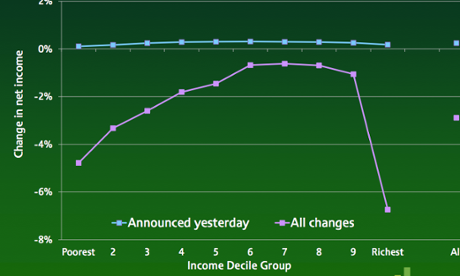
Not that everything is entirely rosy for the comfortably off.  The additional 2 million who have found themselves dragged into the 40p tax band since 2010 have but one person to blame: the chancellor who has slashed corporation tax and abolished the 50p rate for the mega rich, meaning the shortfall has had to be made up somewhere.  Even so, the IFS makes clear whom has suffered the most under the coalition, and it sure isn't middle earners: with the exception of the top decile, who can more than shoulder their share, the poorest have been hit hardest.  It's worth remembering that this was Alistair Darling's plan for closing the deficit, almost the model of progression.  The coalition by contrast has assaulted the poor and got away with it, helped along by those who've focused on Benefits Street rather than the Square Mile.  Still, "they" can be bought off with beer and bingo, right?

Labels: , , , , , , , , , , ,

Share |

Monday, July 15, 2013 

Well, you can prove anything with facts.

Usually, it's in opposition that politicians have the most opportunity to mislead with statistics.  The Tories repeatedly claimed that violent crime had increased massively under Labour, disregarding the fact that they were comparing statistics that err, couldn't be in real sense as the recording method had been changed so drastically, from the police deciding what was a violent crime to the victim saying whether or not they felt the incident they had been involved in was violent.  Labour, meanwhile, were repeatedly accused of fiddling statistics, often precisely because the change in recording methods meant that the old statistics weren't comparable.  Now the Tories are in power they naturally never miss a chance to trump how crime continues to fall under their watch, as though they had always recognised it had done so under Labour's stewardship.

The coalition has succeeded though where Labour failed in misleading with statistics, if only down to how it doesn't seem that anyone's prepared to stand up for benefit claimants.  Despite being criticised by the head of the UK Statistics Authority when he last claimed that 8,000 of those told they were likely to be hit by the benefit cap had suddenly found work, when as Declan Gaffney and Jonathan Portes pointed out the document his remarks were based on said that the figures couldn't be used in this way, Iain Duncan Smith today upped the number further to 12,000.  Things like facts don't matter to IDS it seems, as long as he has "a belief" that he's the one in the right.  Besides, we can't "disprove" that he's wrong in his belief, despite the fact that you "cannot absolutely prove" the connection between the introduction of the benefit cap and the number who would have been affected finding work.

The BBC for their part are reporting IDS's assertion as fact, not mentioning in their piece that he was previously told not to make such claims.  Benefit cap 'encourages job seekers' is their headline, the only indication that they're not swallowing the line from the DWP completely being those quotation marks.  Coming as it does on the same day as a report suggests that those earning under £22,000 a year are finding it more and more difficult to afford private rented accommodation, you might have thought the BBC would have looked into the DWP's claims more deeply.

It seems instead that when it comes to a policy that is popular, despite the fact it's estimated the cap will save a relatively minor £110m in its first year when around £95bn is currently paid out in benefits to those of working age, that the usual critical faculties don't apply.  Indeed, they don't seem to come into play at all when it comes to ministers commenting on their anti-scrounger policies.  Quite why the media takes Grant Shapps, aka Michael Green seriously at all is a mystery, let alone when he claimed that hundreds of thousands were dropping their claims for ESA rather than go through the work capability assessment, completely ignoring the natural churn between applying or being moved onto the new benefit and the WCA being carried out.

Little wonder then that as we saw last week, the public have hugely inflated notions of the number cheating the system as well as the amounts spent on out of work benefits.  If the media aren't prepared to take on ministers when they at best mislead and worst outright lie, something they used to get highly excised about, what hope is there of those outside the politics bubble having an accurate picture of the state?

Labels: , , , , , , ,

Share |

About

  • This is septicisle
profile

Archives

Powered by Blogger
and Blogger Templates