Thursday, October 15, 2015 

Us and them.

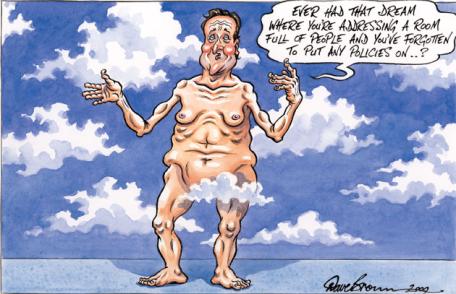
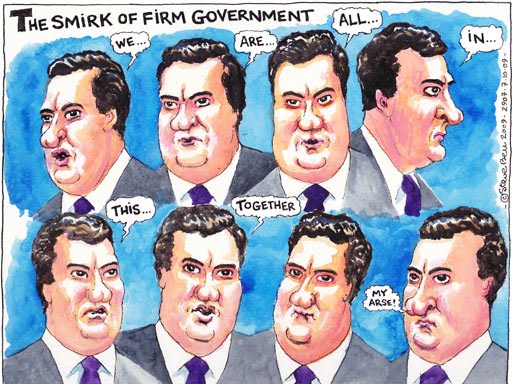
Being away last week I missed the fun of the Conservative party conference.  Opening with the grand spectacle of the hoi polloi daring to invade the personal space of Tories and journalists, and closing with David Cameron's 5th reuse of the speech he first gave to the conference in 2010 as prime minister, it went almost exactly as expected.  Theresa May set about trying to banish memories of the days when she thought her party could use some lessons in detoxification by out nastying those she once lectured, Boris Johnson once again enthralled his audience by doing everything other than whipping his cock out and stroking it right in front of them, and George Osborne was, well, George Osborne.

It was all in all very comforting for both the delegates and media.  Getting eggs thrown at them, being spat at and denounced as "Tory scum" means they're doing something right, at least in their eyes.  The usual suspects immediately demanded that Jeremy Corbyn condemn anyone who so much as gave evils in the general direction of right-wing sixth formers in their first suits, because obviously the left, and these protesters were demonstrably of the left, are all one and the same.  It was rather strange then that the hacks couldn't seem to get their heads round why it was they were subject to the same treatment as the people they were covering; perhaps their disgust influenced their subsequent reports of the speeches, which were almost entirely positive, some even adulatory.  Perhaps they genuinely thought that Osborne and Cameron meant what they said about becoming the true party of working people, Cameron claiming that he would be spending the rest of his time as prime minister trying to force social reform.

Alternatively, they might have seen right through it, as anyone with the slightest knowledge of what the Tories have spent the last five years doing, what their manifesto promised to and what their policies currently going through parliament will do did, and just barely bothered to point it out anyway.  Cameron's address was all but a carbon copy of his past conference speeches, and yet no one felt it polite to say so.  It was all there: the faux-furious denunciation of Labour for daring to consider itself the protectors of the poor, the terrible jokes, the claims to being the true believers in equality and drivers of social mobility, just slightly updated and with the added attack on Corbyn hating his own country.

The myriad contradictions in the speech, from how in one breath Cameron lambasted continuing discrimination, especially against Muslims, then in practically the next went on about madrasas and FGM, as though the latter is in some way a religious rather than a cultural problem, were deemed unimportant.  The BBC didn't so much as bother to point out Cameron's quote of Corbyn's statement on the death of bin Laden was only part of what he said; that was left to Have I Got News for You.  Also few and far between was any reference to how Cameron didn't so much as mention tax credits, despite Boris Johnson having alluded to the controversy over the cuts the previous day.  Anyone expecting a repeat of the deservedly sniffy reaction to Corbyn's speech was to be disappointed, with any criticism mainly focusing on Theresa May's claims about immigration.

You could call it the Ian Hislop deficiency: there he was on HIGNFY, outraged that Lord Ashcroft's smear on David Cameron had been the subject of such mirth and frivolity, rather than treated as a despicable piece of score settling.  He didn't seem to understand that it was as much a reaction to how there had been months of smears and personal attacks on first Ed Miliband and then Corbyn; hypocrisy mattered less to the boot finally being on the other foot.  That it was the hated Mail that had serialised Ashcroft's book only made it all the sweeter, rather than making it less believable.

The fact is that as Ian Dunt recognises, the relationship between the media and the consumer has fundamentally shifted.  No longer are many prepared to remain passive when it's so easy to let journalists know precisely how they feel; that they tend to target not the "enemy", as it were, but hacks ostensibly on the same side, or those who are required to be impartial, is down to how they feel they aren't playing the role they should be.

This is not by any means an entirely positive development.  Demagogues can quicker than ever whip up the sort of atmosphere that leads to marches like the one seen against BBC Scotland, orchestrated by Alex Salmond.  Intimidation is still intimidation regardless of whether it's a self-styled anti-Westminster movement doing it or the government.  The effect is the same.  The rise in the number of those who are wilfully blind to "their" side's deficiencies, or alternatively spend much time rebutting that there is anything remiss at all is as worrying as it is discombobulating.  The response it invites is not one of reconsideration on the part of the target, but of doubling down.  Unless of course it's a broadcaster like the BBC, which is damned if it is and damned if it doesn't.

Nonetheless, it's easy to understand why this is happening now, particularly to members of the commentariat, when you read articles like yesterday's by Rafael Behr in the Graun.  Superciliousness, complacency and snobbery drip from every paragraph.  Behr sneers at amateurs, specifically Nigel Farage, who in Behr's view was seen off by Cameron in the same way as Miliband.  Farage failed as "enough people recognised that the limit of his capabilities was channelling anger not crafting solutions".  And it's true, in terms of actually winning his own parliamentary seat or UKIP making the same breakthrough as it did at the European elections a year earlier, Farage did fail.

Except on practically every other measure, far from being a failure Farage has succeeded beyond his wildest dreams.  Behr is so set on making the point that it's professionals who play by the approved rules who win in the end that he refuses to see how Farage pulled the Tories and the political centre ground to the right.  Without Farage, the wider UKIP threat and the constant need to appease his backbenchers as a result Cameron would not have been forced into promising a referendum on our membership of the EU, a referendum it is by no means certain the remain campaign can win.  The debate on immigration has been made all the more toxic by UKIP's unanswerable point that we simply cannot control the numbers that come here from the EU, exacerbated further by the Tories' ridiculous decision not to drop their unachievable tens of thousands target.  Moreover, as though it needs stating again, UKIP won 4 million votes at the general election, a remarkable performance that only didn't result in substantial representation in parliament because of the bankruptcy of our electoral system.  Farage lost, and yet was victorious.

Rather than look at the two biggest shocks of this year, the Tories winning a majority and Jeremy Corbyn becoming Labour leader, neither of which almost any commentator predicted, and seeing if there isn't something they've missed, the response on the whole has been to carry on regardless.  We're not wrong, it's politics at the moment that it is in flux, and very shortly the equilibrium will be restored.  Perhaps it will.  Alternatively, the changes that have been threatened since the crash coupled with the retreat into personal echo chambers on social media might have altered the landscape if not permanently, then for years to come.  The best, like John Harris, at the same as noting that something new is happening are asking whether it can be sustained or if the approach taken by Corbyn and his supporters can truly work.  As for the rest, if nothing else there will always be a need for someone to cheer on our current overlords.

Labels: , , , , , , ,

Share |

Wednesday, October 01, 2014 

The Tory cult of insincerity.

At the very first opportunity, the language of modern warfare descends into euphemism.  It has to, such is the mundane, horrific reality it hides.  Places where fighters might be sheltering become "command and control centres"; "a heavy weapon position", which could mean a tank or more likely, some form of artillery, is "engaged"; reports that civilians may have been caught up in the bombing are always "being looked into", while raids are invariably "intelligence led", as opposed to being carried out on the off chance.  War is a business, and since 9/11 business has been extremely good: how can it not be when a single Brimstone missile, used yesterday by the RAF to destroy an "Isis armed pickup truck" costs over £100,000?

War all the time, all of the time.  Our enemy is always intractable, impossible to negotiate with.  Always we try every possible step first, always we go into combat with a heavy heart.  Always those who rightly become ever more indignant with each new conflict are mocked, shouted down, asked what their solution is, have their arguments misrepresented.  It takes a lot for me to agree with George Galloway these days, but every single thing he said in the Commons on Friday was right.  Islamic State could not have established itself in either Syria or Iraq without the support of some of those it operates alongside; he wasn't claiming for a moment the Yazidis, Christians or Kurds were quiescent in the face of their onslaught.  The Obama strategy, our strategy, offers no solution except a fantasy one where a mythical "moderate" force in Syria overcomes IS while the Kurdish peshmerga and Shia militas that are now the de facto Iraqi "army" make nice over the border.  The one realistic option, a truce between the Syrian rebels and Assad, is off the table, such is the Syrian president's lack of "legitimacy".  As compared to what, exactly?

As for matters closer to home, the threat will once again be used to justify otherwise unthinkable restrictions on free speech and liberty.  Give credit to Theresa May: she coated her speech to the Tory conference yesterday with so many platitudes and doths of the cap to liberalism you could have almost missed she was proposing the equivalent of 19th century controls on activists and political campaigners.  If necessary she would legislate to enforce the limiting of stop and search; she quoted from the Quran in an effort to prove that the Islamic State is not Islamic (which is a completely baffling line of argument: no, IS is not in any way representative of Muslims, but to claim it has no connection whatsoever to Islam is just as ludicrous, and seems as much as anything a way of distracting from how our friends in Saudi Arabia are most responsible for spreading the Wahhabism IS and al-Qaida are indebted to); and even at times seemed to be coming near to criticising her party's own foreign policy.  "We can't just remove dictators and assume liberal democracy will follow," she said, to which you almost felt she was dying to add, like we did in Libya.

Only later did it emerge quite what her "banning orders" and "extremism disruption orders" would amount to in practice.  Banning orders the Tories have banged on about for years, constantly threatening to outlaw the likes of Hizb-ut-Tahrir without ever going through with it.  May's extremism disruption orders by contrast seem to have been designed to deal with the Anjem Choudary "problem": i.e. the gobshites who just about stay on the right side of the law and whom the media love to quote for their own purposes.  The police, suitably empowered, will able to apply for an order against someone judged to be a "threat to the functioning of democracy" or as little as "causing alarm or distress", almost exactly the standard currently in place that has resulted in evangelical Christians being arrested under section 5 of the public order act.  If granted, those sanctioned would then have to submit any online communications to the police in advance, and would also be barred from taking part in protests.

Ostensibly targeted against the far-right as well as Islamists, so broadly drawn are the plans they're an authoritarian wet dream, capable of being used against protesters of almost every conceivable hue.  Rather than being out of character, the proposals are of a piece with the Lobbying Act's crackdown on charities daring to poke their noses into politics, epitomised by Brooks Newmark's comments on how they should concentrate on their knitting.  Little wonder the Conservatives are set on repealing the Human Rights Act, knowing full well the orders would be judged to breach it.

David Cameron for his part insisted getting rid of the HRA was all about sticking two fingers up at Strasbourg, "the country that wrote Magna Carta" needing no lectures about human rights.  Not that he mentioned leaving the European Convention itself, meaning those not satisfied with the replacement "British" Bill of Rights could presumably still go to the ECHR, just at far greater expense than at present.  Perhaps the family of Trevor Philpott would like to ask if their action against Essex police would still have gone ahead under the replacement act, or indeed which rights it is exactly the HRA provides the replacement won't have, a question left unanswered before.

Considering just how low the bar was set by Ed Miliband, forgetting the deficit aside, it was always likely Cameron's speech would be seen as a success by comparison.  That doesn't however absolve the media from failing to notice Cameron has delivered essentially the same address three years in a row now.  Last year he contrived to answer the sneering of a Russian politician by pointing out how we battled fascism; this year he related his experience in Normandy with a D-Day veteran, "how when people have seen our flag - in some of the most desperate times in history - they have known what it stands for".  Well, quite.  Last year, as he has repeatedly, he built himself up into a fit of faux righteous indignation over some slight from Labour; this year he did it twice, over Labour daring to suggest the NHS isn't safe in his hands and over Labour's plans to deal with the deficit, or lack thereof.

It was nonsense, but it was nonsense decreed acceptable whereas Labour's nonsense is pounced upon.  Cameron's plea for a majority government isn't so much you've had four years of us and hated every minute, it's either me for another 5 or it's Ed Miliband, as it is I'm a bit shit, you're a bit shit, don't put your trust in someone completely shit.  As Larry Elliott points out, Cameron's tax promises today now make them the party without a plan for cutting the deficit: if cuts of £25bn already look next to impossible without certain parts of government shutting down completely, how can a further £7.2bn worth be found to finance cutting taxes for middle earners?  Just as Cameron says he's a relatively simple man, it simply can't be done, unless that is he gives with one hand and takes with the other.  Which is precisely what he's doing by raising the income tax threshold to £12,500 at the same time as freezing tax credits, hoping the lowest paid won't notice his sleight of hand, or how the continuously rising threshold helps middle earners the most.

For all its manifold, myriad faults, Cameron and the Conservatives have a vision.  It's a vision that ignores the inexorable rise of food banks, the penalising of the most vulnerable through a "spare room subsidy", the fact living standards have fallen and show no sign of recovering despite inflation coming in below 2%, and instead emphasises things could be worse.  You can only be sure of continuing mediocrity with the Conservatives, so long as you're upper middle class like they are.  Everyone just needs to work harder, do the right thing, and they'll get the same rewards.  It's the natural order.  Should they win, they'll make life even harder for those whom continue to oppose them.

Labour, meanwhile, doesn't have anything resembling a vision.  Yet still on choice of party if nothing else it retains the edge.  That's how beatable the Tories are, should be, how people want a vision of something better that isn't cod-Thatcherism from a politician who can only remind you of how much better Tony Blair was at insincerity.  You believed Blair's insincerity.  Cameron can't even pull that off.

Labels: , , , , , , , ,

Share |

Tuesday, September 30, 2014 

Shorter Theresa May.

We have to destroy the town in order to save it.

(More tomorrow once the nicer effects of an anaesthetic wear off.  Don't ask.)

Labels: , , , , ,

Share |

Monday, September 29, 2014 

I chose not to choose Osborne.

If his actions hadn't been so unfathomably stupid, you could almost feel sorry for Brooks Newmark.  Chris Bryant is still constantly reminded of his posing in a pair of y-fronts for his Gaydar profile (and I, err, seem to have also just brought it up again), but at least he kept his pants on.  Newmark, being the archetypal Tory rather than a wannabe vicar turned MP, was just a touch more classy in his exposing.  Not by deciding upon a sepia filter or anything though, which might have been trying just a little too hard.  Instead he flopped the old johnson out of his dark blue and red paisley pyjamas, apparently convinced this would ignite fires of passion in his correspondent on Twitter.  Who just happened to be a freelance hack trying his luck with the old honeypot ploy, rather than Sophie Wittams, blonde Tory PR bombshell.

Cue many complaints about entrapment and all the rest of it, moans which were few and far between when Mazher Mahmood finally met his match in Tulisa.  Admittedly, they have a point: rather than a targeted operation against someone known to be liberal in their sending of private images, this seems to have been a fishing expedition, with "Wittams" contacting a number of Tory MPs.  All the same, I can't be the only one thinking it wasn't so long back Lord Rennard was being denounced for his (alleged) threatening sexual behaviour and touching of prospective Lib Dem MPs.  Even if this was a consensual exchange of pictures, should an MP be doing such things in any case, or indeed, shouldn't it be seen as indicative of a lack of judgement?

Newmark being ensnared by the Sunday Mirror would have been bad enough for the Tories on the eve of their conference, only for Mark Reckless to join his compadre Douglas Carswell in defecting to UKIP.  Much as we could just defer to nominative determinism on this one, as many others have, it says much about the state the Conservatives find themselves in that Nigel Farage's merry band has proved more attractive to not just one but two Tory MPs with healthy majorities.  Reckless could no longer stand being in a party apparently doomed to defeat at the next election, so he's joined one that's err, even more doomed to defeat at the next election.  Still, at least he can now be happier in his own skin, no longer forced to defend his party to those in Rochester who believe themselves to be "over taxed" and "over regulated", those key complaints on the doors.  As for the cost to the taxpayer of his decision to resign and seek re-election when he could have waited a few months and done exactly the same thing at the time of the general election, more important is the Farage bandwagon.  Quite how this is championing his constituents' interests rather than his new party's isn't clear, but no doubt he can justify it to himself somehow.

Yesterday in Birmingham then felt more like a conference of a far-left sect than it did that of the main governing party, with Reckless being denounced from the platform for his lies and betrayal.  Not that you could ever imagine Grant Shapps, aka Michael Green, aka Sebastian Fox being a leftie agitator, mainly as he comes across as far too dim.  Nothing is too obvious for Shapps, no sentiment too trite, no soundbite too overcooked.  If all else fails he can perhaps look for work at GCHQ, as the Tories now do a sideline in recording phone calls without the other person's knowledge and then playing them to all and sundry.  More the actions of an authoritarian one party state than the Tories of old, but needs apparently must when it comes to exposing the double dealings of those who are Reckless.

It was still preferable to what's become the Monday ritual, the delivering of the George Osborne gospel.  Worth keeping in mind is by some difference Osborne is now the most popular and also the most successful of all the coalition's ministers: that he's been a miserable failure when judged by the goals set by err, George Osborne doesn't matter when the competition is even worse.  By any real measure Michael Gove would rank as most successful such has been his impact on education, only for his charms to be deemed just too offensive to teachers and in turn voters.  Osborne by contrast, who must inspire thoughts of doing a Mantel in many, remains in place and dividing and ruling the same as ever.

Having got off relatively lightly of late, one would hope due to the Tories realising just how unpopular the bedroom tax has become, those on benefits whether in or out of work are due to cop it once again.  Should the Tories get a majority the under 21s will face the equivalent of "community payback" once they've claimed JSA for 6 months, while they also won't be able to get housing benefit.  The benefit cap as a whole will be lowered to £23,000, while only those in the support group of ESA will see their payments rise in line with inflation for a further two years.  Meanwhile, those under 40 who can afford to buy their own home could potentially get a 20% discount whether they need one or not, and another "death tax" will be abolished, with what's left of a pension pot no longer taxed at 55%.  It really couldn't be any more stark: if you're "one of us", aspiring to own your home, wanting to pass on money to your kids, Osborne and pals will be more than glad to help.  If you're struggling to make ends meet, claiming anything from the government whatsoever (with the exception of those able to jump through the hoops of the work capability assessment and everyone lucky enough to be 65+), you're on your own.  We hear that nice Mr Miliband, the same one who couldn't even remember the deficit, instantly disqualifying him from entering the room of the Very Serious People, will be happy to have you.

You could understand Osborne's gambit more if the £3bn estimated to be saved by these changes went a lot of the way to making the savings Osborne claims they will.  The problem is this is just £3bn of the £12bn total from welfare, with another £13bn to come from savings from the non-protected government departments.  Neither figure seems likely to be achieved without extreme pain, nor does it seem realistic taxes won't have to rise in some way, despite all of Osborne's fine words, if that is he means what he says about running a surplus.  It could be just as he's failed miserably to get rid of the deficit in a single term, he could relent once the election has been won.  Equally, he could raise taxes straight away to get it out of the way, even if it was to break his promises.  Or it could be he means what he says, and to hell with the consequences.  Whichever it is, there's no evidence making his stand now will win the support he believes it will from those who favour the Tories on the economy.  Keen as he apparently is on paraphrasing Trainspotting, no doubt to Irvine Welsh's ire, he and the Tories shouldn't be surprised if we decide to choose something else.

Labels: , , , , , , , ,

Share |

Wednesday, October 02, 2013 

Land of misopportunity and Tory.

If there's just one thing to be taken from this year's Tory conference, it's that the supposed natural party of government is stuck in a quandary.  Far from the predictions this week would see one half of the coalition in a buoyant mood, the economy finally growing in what looks to be a sustainable manner, if anything the Lib Dems had a more enjoyable week up in Glasgow, which is really saying something.  Having installed Lynton Crosby as pedlar of lowest common denominator Conservatism and statements of the bleeding obvious, for which see the highly questionable "achievements" plastered all over the walls in Manchester, the more thoughtful are quite rightly wondering how resorting to a core vote strategy this early in the electoral cycle is going to win the party the increased share of the vote they need to form a majority government in 2015.  It didn't work in 2005, exactly the reason why Cameron tried to shift his party towards the centre in 2010.

Regardless of the show they put on for the cameras, the party is also clearly worried about Ed Miliband and Labour.  After the party's wretched summer, they didn't expect Miliband to pull the energy prize freeze policy out from seemingly nowhere.  Nor was the party helped when the big six then spat their dummies out, their pathetically petulant outbursts threatening blackouts persuading no one, while the fact the markets fell due to the potential for a cut in their profits made clear they regard a Labour victory in less than 2 years a very real possibility.  Whether or not the policy would work in practice doesn't matter for now, just as it didn't matter when Osborne pulled his inheritance tax stunt back in 2007 as Gordon Brown dithered over calling a snap election.  Thanks to the Mail's startlingly cackhanded attempts to do the Tories' dirty work for them, Miliband's battle with the paper has also overshadowed their big week, leading bulletins while their turgid mastications have been well down the running order.

Just how many of the continuous attacks on Labour emanating from the platform were written well in advance and how many were hastily pasted in after the opposition's successful week in Brighton is difficult to tell.  The vicious and entirely partisan nature of the relentless assaults have though taken even me by surprise: every single main speaker has either peppered their entire address with screeds of blame, or dedicated at least one section to doing so.  According to Jeremy Hunt, everything that went wrong with the NHS during Labour's last term was the fault of Andy Burnham, even as the coalition kept on the NHS chief executive who actually was in charge during the crisis in care at Mid Staffs hospital.  Eric Pickles found it hilarious to create a parallel universe in which Labour had gone into coalition with the Lib Dems, except instead of the "land of opportunity" we're now entering, in this opposite dimension the country was, naturally, in rack and ruin.  George Osborne meanwhile, when not setting out how he'd run a budget surplus despite failing to succeed in eliminating the deficit in the timescale Alistair Darling initially planned to, was blaming Labour entirely for the crash, not mentioning how he and his party pledged to match the government's spending plans they now maintain caused it in the first place.

The prime minister's speechwriters however saved the worst for last.  No one quite seems to want to say it, but regardless of how incongruous it sounds (and is, considering his £139 bread maker), Cameron's conference addresses mark him out as the poor man's Tony Blair.  Blair's great skill was in making in either a mediocre or dreary speech sound good; everyone had forgotten everything in it the next day, but it worked at the time.  Cameron can't even reach those levels, as his speeches are erased from the memory within minutes; I had to look up what he said last year to recall any of it.  Compare that with Miliband, who has improved his delivery and message year on year, while you can actually remember what he said (predatory capitalism; one nation; Britain can do better than this) and it rather shows the prime minister up.
 

Indeed, it's as if he wasn't even trying.  Two thirds of the speech can be summed up as "The Evil That Labour Did", which three and a half years in is really getting tiresome.  The other third was boilerplate Thatcherism, Britain is booming, land of hope and Tory, very well alone self-improvement aspirational heard it all before claptrap.  Cameron doesn't come across so much as a prime minister as Bob the Builder crossed with Tom Cruise's character from Magnolia.  Can we build a land of opportunity? Well, it'll be tough, but together we can tame the cunt!

A case in point is how for the second time Cameron felt he needed to respond to a Russian minister describing Britain "as a small island that no-one pays any attention to." Anyone truly comfortable with our position in the world would ignore such petty cat-calling from an authoritarian state; Cameron by contrast reeled off a point by point rebuttal, and as per spouted bullshit back, seeming to suggest we were the first to introduce women's suffrage (we weren't) and that we offered "blood, toil, tears and sweat" when "freedom was in peril".  The Russians may not have been fighting for their own freedom, but they sacrificed more than any other nation state to destroy the Nazi war machine.

His real failure though was that he had no answer to Miliband. The leader of the one time party of small business misrepresented his opponent's espousal of cutting their tax by putting up corporation tax on large corporations by a whole one percent, claiming it would make them look elsewhere, while he didn't so much as attempt to defend the "spare room subsidy" or that his global race is one straight to the bottom. There was nothing for those struggling to make ends meet in his glorious land of opportunity other than the same empty aspiration he's resorted to before.  That he then pretty much abandoned the under-25 vote by presenting further conditions and an end to housing benefit as "tough love, learn or earn" exemplifies how far removed his party has become from the young.

For all the talk of Miliband shifting Labour to the left, which is extremely questionable when he's signed up to the coalition's spending plans for the first two years after the election, the real story ought to be how far the Tories have attempted to take the country to the right, and certainly would given the opportunity.  Despite their denials, the only way to get a surplus would be either further cuts or tax rises. While the latter can hardly be ruled out when the IFS suggests the deficit can't be reduced without either lifting the ring fences or doing just that, the lie was given today with the announcement on housing benefit.  Combined with the pledge to repeal the human rights act, and presumably withdraw from the ECHR, the use of old racist sentiments on billboards, the commitment to never-ending workfare for the unemployed and the open pursuit of a housing bubble for short-term political gain, the spectre of a Conservative win in 2015 ought to chill the marrow.  Thankfully, and precisely because of the strategy the party is pursuing, that looks just as unlikely as before.

Labels: , , , , , , , , ,

Share |

Wednesday, October 10, 2012 

No responsibility.

Well, that was a perfectly workable speech by the leader of the opposition.

What do you mean, David Cameron's the prime minister and has been for the last two and a half years?  How can he possibly be?  How can you have been in power for that period of time and still be blaming every single problem you face on either the previous government or on other outside forces apparently conspiring against you?  How can someone who praises the virtues of taking responsibility be so completely unwilling to accept it himself?  How can someone with such intellect be so wilfully obtuse?  Or is it that intellect, that apparent belief that all you need to do is aspire and work hard and you'll achieve greatness, in the face of all the evidence that it is still overwhelmingly privilege or lack of it that defines where you'll end up in life, that makes Cameron such a dull boy?

To get away from answering my own questions for a second, we should give Cameron some credit.  Most party leaders lay off the blatant untruths until they're at least a tenth of the way through their conference speech.  Not Cameron: 60 words in and he claims that he came into office with the challenge of making an insolvent country solvent again.  Now, you can play around with what the true definition of insolvent is, but by most reasonable measures we are not and were not insolvent: even if we class insolvent as needing a bail-out, we have not needed one, and would not have needed one regardless of which party won the election.  As pointed out yesterday, George Osborne is now thanks to his superb management of the economy going to eliminate the deficit later than Alistair Darling planned to.  Despite this, the markets have not decided we can't pay our way in the same way they have Spain or Greece.  Half-way through the current parliament, it really is about time that the coalition dropped the act that it's thanks to them we've avoid bankruptcy.

Not that this is even close to crucial when neither George Osborne or David Cameron can bring themselves to admit that there has been no economic growth for the past nine months.  The word recession has not so much has crossed their lips.  Instead Cameron can't "tell us that all is well"; all he can say is that "the damage was worse than we thought, and it's taking longer than we hoped".  All our woes were placed squarely on the Eurozone crisis, down to how Ireland, Spain and Italy aren't buying as much from us as before.  As for who got us in this mess, it was Labour.  Yes, it was Gordon Brown who personally and purposefully crashed the economy.  It wasn't anything to do with the popping of a bubble that politicians of all parties and stripes encouraged, or the sub-prime crisis in America, or the neoliberalism of the past 30 years finally collapsing under its own contradictions, it was Labour.  Labour, Labour, Labour.

And now what do Labour propose, even though they shouldn't be so much as allowed to continue to exist as a party considering what they did to us all?  They want us to borrow more.  It's their solution to everything.  It doesn't of course matter that the coalition is borrowing far more than it planned because of the unmentionable recession to pay for out of work benefits, in spite of which we still have the phenomenally low interest rates the Tories never stop raving about, if we were to so much as deviate from austerity even slightly it could mean our doom.  It also doesn't matter that the high priests of austerity, the IMF, on Monday admitted they'd completely underestimated the effect of cutting government spending and that it was now really time to consider a Plan B, Cameron and Osborne know better.  As for the IMF's prediction that there will be negative growth of 0.4% this year, should that be proved correct it will obviously Labour's fault as well.

When a political party is in trouble, it can do one of three things.  It can change its leader, it can do a thorough analysis of where it's going wrong and why it isn't appealing to voters in the same way as it used to and act on it, or, as the Tories under Cameron are doing, they can just reprise their old tunes and hope it works.  Yesterday it was murder a burglar; today from Cameron it was aspiration, aspiration, aspiration,  the supposed magic ingredient that propelled Thatcher and Blair to successive terms of office once again being turned to.  The problem is, most people only dream and aspire to more when they're comfortably off, when the support's there to help them realise their aims.  The vast majority at the moment are struggling to make ends meet, they're not saving, they're paying off their debts.  And how is the government itself trying to inspire workers?  By telling them to give up their rights in exchange for shares.  Truly empowering stuff.

At its heart, this was a truly with us or against us speech.  Cameron portrayed everyone who disagreed with his policies as either wreckers, snobs, sneerers, scroungers, or comfortable with under achievement.  The section on welfare especially was a disgrace, not just a tissue but a fabric of lies, claiming that some actively made a choice not to get on in life from their very earliest days, not bothering to try at school as they could live on the dole instead, get a free house or flat and laugh at all the strivers doing the right thing, looking in on them as the hard workers look "out of the window dreaming of a place of their own".  He mentioned families claiming 40, 50 or £60,000 a year in housing benefit, when even the slightest attempt at checking found that 99% of claims are under 15k a year, with 0.0025% over 50k.  And yet again there was no recognition that the overwhelming majority of new housing benefit claims are from those in work.  As for the work programme and Cameron's hyping of it, it simply isn't working.  But then how can it when there are simply not enough jobs out there, and when Cameron himself uses such dodgy statistics to claim that under the coalition there have already been more private sector jobs created than under 10 years of Labour?

It wasn't all bad, however.  While it was nothing like the old days under Blair when almost every year saw him all but launching an attack on his own party, Cameron did all but accept it was often his own natural supporters that block new housing developments with nimby or banana attitudes, urging them to accept we need to build more.  


That was though more or less it, and there were so many egregious sections that anything even slightly conciliatory was completely overwhelmed.  Like giving all the credit to Theresa May for the deportation of Abu Hamza, as though it wasn't a legal process that started under the last government simply reaching  its conclusion.  Or hilariously claiming that the Queen is the best head of state in the world. Or telling blatant lies about the coalition's stewardship of the NHS, while not so much as mentioning the reform bill.  Or not so much as mentioning the police after Plebgate, although considering the walloping every other section of the public sector received just for existing, perhaps that was a merciful decision.  It wasn't then so much a flat speech as the final confirmation that Cameron hasn't adjusted to being a leader of the country rather than just a leader of a party, and we're the ones paying for it.

Labels: , , , , , , ,

Share |

Tuesday, October 09, 2012 

Osborne delivers in the race to the bottom.

One of the best positions to start from in politics is that if almost everyone agrees on something, either they or the principle itself is wrong.  Obviously, this isn't universal; all the mainstream political parties are opposed to capital punishment, or making abortion illegal, even if there's disagreement on the limitations on the latter, which is a Very Good Thing.  All the mainstream parties are though at least ostensibly in favour of continuing both the war on drugs and the war in Afghanistan, and these are Very Bad Things indeed.

Which brings us in a very round about way to saying that Ed Miliband last week was rather good, despite everyone agreeing that he was.  I do find the whole making a speech without notes and wandering about the stage thing rather tiresome, the equivalent of riding a bike without using your hands, something that is easy to do with plenty of practice, but it was a very decent speech by a man who has been the victim as much of an ever more impatient media and also party than someone clearly not up to the job.  He started off slowly, it's true, but he's been improving ever since.  Derided by the right-wing press last year for his "predator capitalism" speech, which was shaky in both content and delivery yet soon being ripped off by the coalition, there was even less actual content this year and and yet it was lapped up universally.

Once he'd finally finished labouring on about his comprehensive (yes, Ed, most of us went to them as well and were equally scarred by the process) and finally got to the One Nation bit it was perfectly fine.  It was though just a little underwhelming; yes, the Tories have moved so far to the right that they've vacated their old one nation territory and therefore there's plenty of space for Labour to move into, but it isn't much of a rallying cry.  The fact is that most of those old one nation people have shifted to the right with the Tories, and therefore they aren't going to move back. Where then does that leave those of us on the left who want a redistributing but non-nanny state, an adequate safety net without the likes of ATOS deciding who's deserving or not, a publicly owned and controlled NHS and a foreign policy that doesn't involve us either directly funding armed gangs or intervening on their side?  Inside the tent certainly, but with only slightly more say than we had under Blair.

All this though is for another day, as indeed are any definite policies.  Which is fine, as it's utterly pointless for Labour to say what they'd do if they won in 2015 when the coalition doesn't know what it's doing tomorrow.  The contrast between last week's conference and this week's Tory soiree in Birmingham is stark: one was a party finding its feet again as a direct consequence of the coalition's disastrous policies, while the other is, err, a party uncertain of what's to come as a direct consequence of their disastrous policies.  


The old classic of conference time is, if in doubt, bring out the batter a burglar policy.  New Labour did it countless times, briefing to the ever gullible right-wing press that this time they really would be changing the "reasonable force" law to one which would allow you to carry out the most vile torture imaginable on an intruder without PC Plod (or should that be Pleb?) laying a finger on you.  Every time the answer came back that the "reasonable force" rule was working perfectly fine as it already allows you to do anything other than lie in wait for and then shoot burglars in the back as they run away (or alternatively, calling up your friends and family and then battering your assailants to within an inch of their lives once they've reached the road outside your house) and nothing changed.  Regardless of the ever more ridiculous headlines ("new right to attack burglars", says Torygraph), I'm willing to wager that once again nothing will come of Chris Grayling's wheeze.

If only the same could be said for the ordure presented for the conference's delectation by George Osborne.  Osborne is a fairly unique politician in that he actually seems to enjoy being hated: some thought they saw in the Paralympics booing clip his anger and bewilderment at being even less popular than John Terry and Ashley Cole combined.  My view was that his cackle and then laugh was the sign of him loving it.  Osborne wants to be loathed, as in his mind that means his medicine is working; short-term pain will turn into long-term gain.  Not for him the namby-pamby nonsense from of all people, Tim Montgomerie of ConservativeHome, who recommends an end to the attacks on the poorest as they're the real reason why the party is disliked.  


No, here comes another £16bn of welfare cuts, apparently agreed by Iain Duncan Smith, and directed straight at the children of the unemployed, as though those out of work don't think exactly the same way about having another child as those in work do and whether they can afford it, as though the extra child benefit payment they receive somehow make all the difference.  The same applies to restricting housing benefit to the over 25s, as though everyone under that age claiming it is out of work when the latest figures suggest that 50% are not.  Osborne asked how anyone could justify the incomes of those out of work rising faster than those in work; simple, George.  When those out of work are struggling by on their £70 a week through no fault of their own, a rise in line with inflation is more than justifiable when the average full-time working wage last year was £26,200.  5% of not a lot is still not a lot, while 1.6% of considerably more is, err, considerably more.

Much of it was all too predictable.   Osborne didn't so much as deign to mention growth, or recognise that there had been a double-dip recession, or even that there was such a thing as the unemployed as opposed to scroungers, all while at the same time criticising Ed Miliband for not mentioning the deficit.  That Alistair Darling's plan for reducing the deficit would have eliminated it before Osborne will now manage also went by the by.  Instead we got not reheated old Thatcherism, but the equivalent of pie in the sky: workers of the world hand over your rights and don't unite!  £2,000 in worthless shares in exchange for complete job insecurity; who could possibly object to such a scheme, except, oh, perhaps anyone with half a brain or the European Union?  The only way in which Osborne's brainwave could possibly be attractive is if there isn't any other option, and with the prospect of low to non-existent growth and the introduction of the universal credit, which it seems will demand that part-time workers find full-time jobs or else, desperation might well win out.  


It really isn't over the top to suggest this is like something out of Atlas Shrugged: according to Osborne and the Adrian Beecrofts of the world, it's the John Galts, the strivers and the creators, not the humble workers without whom the business wouldn't be able to function that are deserving of reward and rights.  Britain can deliver, but only it seems in the race to the bottom.

Labels: , , , , , , , , , ,

Share |

Wednesday, October 06, 2010 

Fairness and fatutity.

If you were to use one word to describe David Cameron's speech to the Conservative party conference, and there are a good few choice ones which would be almost equally apposite, then it would have to be fatuous. Fairness was meant to be the theme, yet apart from the few paragraphs given to the media in advance, it hardly got a look in. Instead Cameron treated us, once again, to his vision of the "big society", which was, once again, so lamely sketched out as to be laughable.

Let's put it this way: compared to Ed Miliband's speech last week, large parts of which must have been thrown together at the last moment following his "surprise" victory and which inevitably suffered as a result, his could be a case study in both honesty and humility. It for the most part struck the right tone, and did what had to be done, even if I ripped into parts of it. Cameron, despite knowing just how much anxiety there is throughout the country at the cuts to come, said relatively little to calm nerves, although when the party has already so botched the child benefit cut this week that might well be either unsurprising or surprising according to your view.

In there among an especially ill-thought out attack on Labour for more or less everything they ever did, one which resembled one of the more impenetrable rants left on a website comment thread rather than a critique from a prime minister was a denunciation of spin. Say what you like about Alastair Campbell, at least he was almost always good at what he did, even if the end results were ignoble. He or someone else in New Labour's inner circle would have spotted the obvious problems with Cameron's "your country needs you" motif which must have passed Coulson and Hilton by. Not just that in the most famous case of the government declaring that it needed you personally the reality behind the slogan was the establishment sending off a generation to needless suffering and slaughter in the trenches, although that ought to have stopped them immediately in their tracks. It also isn't just that next week the government is going to be declaring loudly and clearly that it doesn't need tens of thousands of current state employees, told in no uncertain terms that their country doesn't need their services in the Conservative-Liberal Democrat imposed age of austerity.

More than anything, it's that for millions either unemployed or currently on almost any kind of benefit, it's never been more apparent that they are surplus to requirements. Despite this Tory conference being dominated by talk of work and how those willing to work will be rewarded for not sitting on their sofas as in Cameron's distasteful remark on responsibility, talk of jobs or growth has been almost wholly absent. Cameron mentioned the former word just 5 times, and all but one of those uses was in a context other than the creation of them; two of them were in the terms of the government cutting them. You can change the welfare system as much as you like, it's not going to make a scrap of difference when there are simply not enough jobs for those who are on jobseeker's allowance, let alone on the sickness benefits which Iain Duncan Smith is determined to get so many off of. Much is instead being left to the "wealth creators", as window cleaners are now to be known if we take Cameron at his word. The unemployed will get access to an "enterprise allowance" to start up their own business, yet for many who find themselves out of work that will be the last rather than the first resort, when such start-ups require further capital which they either can't borrow or which they don't have. These are the real people who are going to suffer even more when the cuts begin to bite, and the prime minister is offering them the opportunity to join in the "big society spirit" to take their mind off it.

The fatuity was in far too many places to deal with them all (although Left Foot Forward has given it a go). Even by the standards of certain sections of the speech though, talking of the "selfishness" of the Labour years and "unchecked individualism" takes a whole lot of chutzpah for a Conservative leader and prime minister. Labour at least believed in equality, and even if it achieved it almost through stealth, the redistribution it managed mainly through tax credits stopped the poorest from completely falling off the scale. It wasn't enough, yet now David Cameron wants us to not just measure fairness through "the size of the cheque given" but "by the chance we give", one of which is, of course, those elusive jobs. Seeing as most of those cheques are going to be reduced vastly thanks to the various cuts and caps to be imposed, this makes perfect political sense. Cynicism certainly wasn't one of the things Cameron identified as characterising Labour's time in power.

Much else was drearily familiar. No alternative to cutting now, however much Cameron wished there was. Greece beckoned if action hadn't been taken immediately. Everyone agrees with the Tory-Lib Dem position, even the EU, that august economic body much respected amongst Conservatives. Except, oh, Ken Clarke, who admitted there was a possibility of a double dip recession. Ireland certainly didn't merit a mention, despite taking much the same medicine as we're about to and also with the backing of everyone. The debt and deficit a disaster of Labour's making, despite the Tories having supported the government's actions up until mid-way through 2008. A crisis of the private sector transformed into one of the public sector, with those with broadest shoulders sharing the most burden, even when the budget showed it will be the poorest hit the hardest.

If we take Cameron at his word, he wants to build a country defined not by what we consume but what we contribute, something he'll hopefully remember should that dreaded double dip become a reality. Rather than eating cake, he wants us to eat optimism, all in this together, our country needs us, sunshine winning the day all over again. It leaves only one question: will next year Cameron tell us it hasn't been raining despite pissing on us for 12 months?

Labels: , , , , , ,

Share |

Tuesday, October 05, 2010 

Where are the other parties in all of this?

Amusing as it undoubtedly is to watch the Tories panicking in such a way on the very first occasion in government that they've done something to upset their base and media supporters, isn't it rather odd that we've heard almost nothing from the Liberal Democrats about what they think of the higher rate taxpayer child benefit cut? True, the Tories didn't make much comment during their conference and the Lib Dems may well just be returning the favour, yet as Paxman's failure to get a straight answer out of Theresa May on when she knew about the cut showed (YouTube undoubtedly coming soon), it's quite possible that many of them were also kept out of the loop. While David Cameron is now apologising for not having the cut in the Tory manifesto, although considering large chunks of it were immediately cast aside in the coalition agreement it was hardly ever a concrete guide, there most certainly wasn't anything in the Liberal Democrat manifesto about one either, even if they proposed "reforming" tax credits, also a potential minefield.

Similarly invisible has been Labour. There might well be good reasons for this: after all, when an opposition policy is imploding in such a magnificent fashion it can sometimes be best to simply let it happen without distracting from the spectacle. Also apparent is that to be credible Labour has to get its deficit reduction plan right very quickly indeed, and by making rash promises about keeping certain benefits or opposing certain cuts it makes that all the more difficult. Even so, capitalising on the Tory difficulties ought to be an open goal: not only do they remove child benefit from higher earners supposedly to save £1 billion a year, but a day later they then make clear that they'll give some of that back eventually by introducing a transferable tax allowance for married couples, including apparently those that they've already argued don't need such help from the state. One day they're saying that higher earners no longer qualify for help from the state for raising the next generation; the next they're saying that those who simply get married do deserve special treatment. It's not just perverse; it's close to being politically bankrupt.

What's more, what does this say about all of the other cuts which the government is so determined to introduce in the national interest, as the Tory conference slogan currently has it? Could they similarly be blown off course by a backlash should they touch the backs of the good burghers of middle England more than they realised they would? Unlikely, yet certainly not unthinkable. Either way, distracted by the shadow cabinet elections or not, Labour ought to be pointing all of these contradictions out, and so far seems to have spurned the opportunity to do so.

Labels: , , , , , , , ,

Share |

Monday, October 04, 2010 

The not quite Blairite stupidity of the coalition's child benefit cut.

Of all the announcements, interviews and speeches over the weekend, only one was really essential to understanding how the the Conservatives intend to govern, even if constrained by the Liberal Democrats:

Michael Gove jumps out of his armchair, rushes over to his desk and lovingly picks up a copy of a well-thumbed tome that has pride of place in his office at the education department, overlooking Westminster Abbey.

"I love A Journey, I have never read a book like it," the education secretary says of Tony Blair's bestselling memoirs. Gove opens it at his favourite page to read out, in a slow and admiring tone, Blair's conclusion that opposition to public service reform can be beaten.


Undoubtedly, not all of the Conservatives within the cabinet have a similarly throbbing erection for the former great leader. They have however clearly taken to heart one of Blair's regrets: that he almost entirely "wasted" his first term on policies other than the public sector reform which energised him, and had to compromise, often thanks to Gordon Brown's opposition and interventions, in the second and first two years of the third. This partially explains why they seem to be in such a mad rush when it comes to reorganising the NHS, despite pledging in the coalition agreement not to indulge in top-down reforms without consultation as Labour repeatedly did, in making changes to the academy system and then introducing free schools, and now also in almost ripping up the welfare system and starting again. The other likely reason for why they're operating at such breakneck speed, even if they won't admit it, is due to how they firstly don't know whether the coalition will survive and secondly as they also aren't certain on whether they'll get a second term.

For while it's true that much of the mood music accompanying the opening of the Conservative conference is distinctly old Tory, what with Gove announcing an end to rules which don't exist, Lord Young fulminating against often similarly imaginary elf 'n' safety outrages and Boris Johnson along with the CBI demanding at least a 40% participation threshold before strikes are allowed to take place, even when they'd never apply the same rationale to elections to parliament, the cut in child benefit which has now overshadowed all of the above seems to be similarly Blairite in motive. Similarly Blairite in motive for the reason that despite all the well thumbing of A Journey, it seems to be based on a fundamental misreading of how Blair repeatedly challenged Labour's so-called comfort zone.

On the surface, it looks to be right out of the Blair textbook. By taking on your own party over something they should instinctively oppose, it sends a message to the press that you're a strong leader and will take on your own vested interests, at the same time impressing the voters themselves, whether they agree or not. The key difference is that Blair did it on things which either didn't directly affect the public, didn't affect too many, or didn't affect those that were likely to campaign and protest vigorously, and was also helped enormously by the fairly benign economic backdrop and by having an opposition which was either a shambles, simply not a viable alternative or which actively supported him. Media support or acquiescence also had a strong supporting role. When Blair did it on foundation hospitals, academies, tuition fees and on Iraq (to name but four examples), one or more of these factors ensured that the measures went through and that he went on being leader. True, it was Iraq that eventually had a major role in his downfall, yet his initial "success" cannot be denied.

Where the Tories have gone wrong is manifold. Firstly, it's not at all clear that the party itself opposes universal benefit cuts; there's disgruntlement, sure, yet not outright opposition from the outset then gradual persuasion or loyalist support of the line coming down from the leadership.

Second is that this clearly affects exactly those who are natural Tory voters and does it right in the wallet, by far the most painful place.

Third, while some Tories might consider it a good thing to annoy the Daily Mail in the same way that Blair thought it wasn't a bad idea to at times to piss off the Guardian et al, the Daily Mail has both far more power, influence and readership.

Fourth, it's the manifest unfairness and stupidity of the measure, as well as it how it contradicts some of their family policy. While I personally don't agree with the argument that "services for the poor will always be poor services", and find it difficult not to sneer at how those earning almost twice the average wage can claim to be "stretched" already with little disposable income, the blatant idiocy of how a single parent earning over £45,000 a year will receive nothing while a couple earning £86,000 in total will still get the benefit is so transparent it's close to unbelievable that it was agreed upon. The Mail has splashed on how it'll impact on families with "stay at home" mums, something always close to their 1950s halcyon view of the perfect British society and associated nuclear family, with the husband off earning the wage while the little woman looks after the children, and it's difficult to believe that it won't be altered in some way before it comes into effect. If anything ever comes of the supposed "aspiration" to recognise marriage in the tax system it'll offset some of the loss, but almost certainly not all of it.

Fifth, while Labour is still somewhat in flux over what cuts it is and isn't going to oppose/defend, it looks likely they'll oppose any shift from a universal benefits system. They may not perhaps win many votes from those who'll lose out, and I think it'd be best to support the principle of the cut, just not the way the government's implementing it in such a cack-handed, regressive fashion, but opposition it will still be.

Finally, and while not alluded to above, it also breaches the Blairite tenet that you don't do anything which affects the aspirational middle classes which this directly does, right to the extent that it will mean those earning just below the threshold not taking a rise as they'll actually lose out through the loss of benefits.

While then it's hardly going to lead to an uprising, it is a clear example of how the government is already getting things wrong and how its debt to Blairism is already leading to difficulties, even if based on a misreading of how Blair operated. Certainly, it could be an attempt to put into action Osborne's otherwise ludicrous soundbite of how "we're all in this together", and also a first example of how the cuts are going to hit all sections of society, not just the poorest (although the benefits cap will certainly do that, and seems almost designed to lead to the evacuation of those on housing benefit from the inner cities of the south especially, also coincidentally where Labour still has support), yet you get the feeling this isn't going to be the start of a habit of aggravating the "base" for little overall benefit. It ought more than anything to give a post-Blair Labour party hope: the country desperately needs an alternative to the triangulation of his and Brown's era, and also to the gone off half-cocked tribute attempt from the new Blairites. Ed Miliband has to be able to provide one.

Labels: , , , , , , , ,

Share |

Thursday, October 08, 2009 

The shape of the Tories to come part 2.

The plan for the Tory conference has been both obvious and has worked: ensure that Osborne and Cameron get all the coverage and limelight and hope that the underlings stay in the shadows, or at best don't make any horrendous gaffes. This was clearly what was in action yesterday, hoping that only the faithful or interested would notice that both Michael Gove and Chris Grayling were making speeches on their specific areas and announcing either new or somewhat new policies. As it turned out, this was further helped when Grayling himself gaffed by describing the appointment of General Dannatt as an adviser as potentially a gimmick, not realising that it was err, his side, not Labour, that had done so.

It was Gove's proposals though which were clearly the more ghastly. Alix Mortimer thinks of him as a prep school teacher circa 1965 and it's clearly a description which fits. His proposals for what should be in and out of education when the Tories come in are so overblown it reads like a an old reactionary's wish-list. What's wrong with our school system, it seems, is that the kids aren't dressed archaically enough. Just as much of the rest of society decides that suit, blazer and tie aren't perhaps the most practical or comfortable of clothes, in comes Gove, who thinks that as adults are giving up on it, children should wear it instead. His other great wheeze, setting by ability, is just as old and hoary. Listening to Gove you'd think that state schools haven't so much as tried such a thing. I hate to break it to him, but at my bog-standard, at times failing comprehensive we had setting by ability, and all it did was further entrench those in the particular sets at that level of knowledge, not stretching them or helping them, just leaving them to get on with it, failing everyone. Adding to the sense of nostalgia, rote learning was the next thing to be mentioned. He also wants "the narrative of British history" taught, without mentioning whether or not history will be made compulsory post-14, and which in any case Alix Mortimer demolishes. Just when you think it couldn't get any worse, he also wants soldiers to be brought into instil discipline, which is just the thing that we need in general in schools: ex-military personnel with a high opinion of themselves thinking that all the children of today need is regimentalism and a shared bond which develops in the line of fire.

Chris Grayling didn't have much of a chance of living up to such a litany of pure bollocks. He did though have a go, further broadening the mind-bogglingly stupid policy of taxing strong lager and cider as well as "alcopops" because of their link to anti-social behaviour. There is a case for taxing the likes of Special Brew and the ultra-strong ciders which have never seen an apple for the simple reason that the only people who drink them are alcoholics and those looking to get drunk as quickly as possible, but the downsides are obvious: when an ordinary can of Wife-Beater isn't going to cost any more, you might as well just downgrade slightly, and it's what people will do. You have to challenge the behaviour, not the drink itself. I've also lost count of the number of times I've said it here, but it needs stating yet again: those meant to be targeted by this tax do not drink alcopops. The people who do are those might get drunk, but are not those who specifically go out looking for trouble; it can be best described as a tax on those who don't like the taste of other drinks. Despite all the mocking, Grayling also still believes in the "21st century clip round the ear", now examining "grounding" as an "instant punishment". We laughed when New Labour proposed taking yobs to ATMs; now the Tories, that party of the family, wants police officers to take over parenting. Finally, once again the Tories want to ban Hizb-ut-Tahrir, a group which although reprehensible and may have incited hatred in the past, most certainly does not incite violence. If we're going to ban every group alleged to do both, why focus on HuT and not the BNP or EDL, who are the number one current threat to community cohesion? Answer came there none.

All everyone was interested in though was the main event. There is one thing to be said for Cameron's speech, and that's at least that it was a speech rather than just a series of connected thoughts, as both Brown and Clegg's attempts were. It was also a good speech in another sense: that it at least partially showed what Cameron does believe and think, and quite how wrong his interpretation is of what has gone wrong, primarily with the economy:

And here is the big argument in British politics today, put plainly and simply. Labour say that to solve the country's problems, we need more government.

Don't they see? It is more government that got us into this mess.

Why is our economy broken? Not just because Labour wrongly thought they'd abolished boom and bust. But because government got too big, spent too much and doubled the national debt.


It is indeed putting it simply, and also not accurately. Labour may have massively increased the size and scope of the state, but to break this down to saying that Labour's only solution is more government is nonsense. If it was, it wouldn't have spent the last 12 years trying to insert the private sector into every public service or continued with the horrendously wasteful private finance initiative, to give but two examples. More gob-smacking though is that Cameron seems to be suggesting that the reason our economy's broken is because of the size of government and because it spent too much: this isn't just wrong, it's politically bankrupt. The reason the economy's broken is primarily because there was too little regulation of the financial sector, not too much. Even if we had saved for that "rainy day", we'd still be in the same recession even if the deficit could be dealt with quicker, and considering that the Tories would have hardly done anything different on the economy to Labour until very recently, this is hindsight of the lowest order. He continues:

Why is our society broken? Because government got too big, did too much and undermined responsibility.

This is even more nonsense. Even if you accept that big government has and does undermine responsibility, and even if you accept that society is broken, the real thing that broke it was the undermining and even open destruction of economic communities over 20 years ago. Labour has tried and mostly failed with its initiatives, but at least it has tried. All Cameron offers, and continues to offer in this speech, is the firm smack of responsibility and the recognition of marriage in the tax system, something just bound to cure problems at a stroke and not just provide the middle classes with a helpful cut. And so it goes on:

Why are our politics broken? Because government got too big, promised too much and pretended it had all the answers.

Cameron on the other hand doesn't pretend to have answers, as he doesn't offer any specific reform of politics in this speech except for the cutting of some ministerial salaries. All the talk of a new politics has completely evaporated, and who could possibly be surprised? Cameron doesn't need to change anything to win, and so the status quo is far more attractive.

Again, like Osborne on Tuesday, Cameron also offers precisely nothing on economic recovery. It's presumably just going to happen magically, while all we need to worry about is getting the deficit down. As Chris Dillow and an increasing numbers of others are now arguing, the preoccupation with the deficit is potentially dangerous when there are other threats and decisions to be taken. The Tories have focused on the deficit because this is one of their very few selling points, yet it's also a point on which they could be attacked if Labour was reasonably sure of itself, with even the potential to turn everything back around. While trying not to be triumphalist, what is clear is that the Tories themselves are now absolutely certain of their return to power. From his mention of Afghanistan at the very beginning to the condemnation of the EU at the end, this was also a speech written to touch every hot button on which the Sun newspaper has recently focused. Nothing is being left to chance. The irony of it all is that on the one thing that the Tories are significantly at odds with Labour on, they're wrong. The sad thing is that it seems it won't make any difference.

Labels: , , , , , , , , ,

Share |

Wednesday, October 07, 2009 

Ready for the same old dishonesty.

Like Craig Murray, I had to wonder whether I was on the same planet yesterday as some of the hacks who were clearly incredibly close to falling in love with George Osborne and his "massive electoral gamble", as Nick Robinson put it. Robinson was so over the top in his clear adoration of Osborne on the 10 O'Clock News that the only thing he didn't do was film himself shooting off while listening to the speech as a result of his excitement. If the BBC turned over and fell for New Labour, then the same seems to be happening now that the Tories are on the way in. Even the Graun described Osborne's gambit as their biggest political gamble in a generation.

Osborne's explanation of just what his new and doubtless "tough and tender" interpretation of austerity will entail left as many questions as it did answers. To start with, this is a very funny sort of austerity: let's accept for a second that the cuts and wage freezes which Osborne announced yesterday result in the £7 billion saving which he claims they will. Undoubtedly, these cuts will cause suffering, and they fall mainly on the middle, which is usually anathema to his party. All the same, this is as Robert Chote described it, nothing more than a dent in the actual deficit. Over a parliament it should save £35 billion. This year alone we've already borrowed over £175 billion. This isn't even going to begin to cut the deficit by half by 2014, as Labour have promised, with the Tories, although not being specific, saying they will act faster.

This therefore fails Osborne's own honesty test. He might not have said that these are going to be the only cuts, and he hasn't specifically ruled out tax rises, but many will get the impression that this will be the Tories' main prospectus for bringing down the deficit. Instead, this will only be the very, very beginning, as the Tories themselves must know if they are serious about reducing the deficit, and considering that it now seems to be their only real economic policy, it seems safe to assume that they are. Nick Clegg might have regretted talking about "savage cuts", but it's the closest description to what can be expected will be the order of the day once the Tories do seize the reins of power.

For this was just as fantastical a speech and lacking in any real integrity as Gordon Brown's was last week. Does anyone seriously believe that Osborne's repeated dirge that "we're all in this together"? I didn't even watch the speech in full, but the number of times he repeated the ridiculous phrase left me wanting to cram it down his throat. Indeed, it's fantastically clear from the very policies promised that we're not all in this together. Magnanimously, Osborne decided that he couldn't possibly repeal the 50p tax band for those earning over £150,000 a year while we're in the current mess, he's had to put the inheritance tax threshold raise on the backburner, although it's still a commitment during their first term, and if the bankers continue to award themselves ludicrous bonuses, he will step in to tax them, but apart from that there was nothing here that would shift the burden of bringing down the deficit to those who got us into this mess from those at both the bottom and the middle. Anyone earning over £18,000 in the public sector will have a year's pay freeze. The full-time median wage is £25,123. What is interesting is what both the Tories and Labour are prioritising: the military will not have to undergo any such pay restraint, meaning that if you're trained to kill people rather than trained to save people you're currently the more highly valued. To go off on a tangent for a second, it's also instructive that no party has considered getting out of Afghanistan to save money, but then that sort of thinking would make too much sense.

Just to highlight further how we're not all in this together, it's hard not to detect something afoot in the demand that no one in the public sector should earn more than the prime minister. Fair enough, but why not extend it completely? After all, just who is exactly worth more than just under £200,000 a year? Clearly, no one should earn more than David Cameron will, and if anyone suggests this isn't about all making a contribution and rather about envy, which is of course a Labour trait, then the Bullingdon might be paying you a visit.

Not everything that Osborne proposed was instantly objectionable. I'm one of those lefties who believes that only those who need the state's help should get it: why on earth were those earning over £50,000 a year getting tax credits in the first place when those at the bottom could have been receiving more (indeed, tax credits have always seemed a poor alternative to a guaranteed citizen's basic income and taking the lowest paid out of tax altogether)? I'm not as certain on the abolition of the child trust funds for all but the poorest third, as anything that encourages saving is welcome, but it may well be one of those cuts which we have to accept in the circumstances.

Most offensive is just the sheer disingenuousness of most of the speech. Osborne complains at one point that all Labour did last week was announce yet more spending; Osborne's party would never be so crass in committing to spending increases and tax cuts at a time when the books are so in the red. All they're doing is reversing Gordon Brown's tax raid on pensions, which won't cost much, probably only 3 to 5 billion, wiping out all but 2 billion of the savings so far announced. That's to add to the pledge that those going into care homes will no longer have to sell their houses, changes to the tax system to "support marriage", the freeze in council tax for two years, the decision not to introduce the rise in national insurance contributions Labour has pencilled in, and also now the promise not to tax new businesses for their first ten employees.

The most amazing hole though is that not once does Osborne broach the one thing that is more important than the size of the deficit: the recovery. He attacks Gordon Brown for not mentioning borrowing, then takes for granted that the recovery is already on the way and that he doesn't need to anything to stimulate it further. Indeed, he again claims to be right in not supporting the VAT cut. He scaremongers that our creditworthiness is being brought into doubt while Chris Dillow points out that in fact the yields on index-linked gilts have fallen to record lows, the bond markets never so keen to lend to us. Osborne's soundbite that we need to return to being a saving society might be right in the long-term, but not when we're not even certain that growth has started again. Osborne isn't going to be chancellor until at least May, it's true, by which time if we're not back in growth we really will be worrying, but even then we're going to need investment as well as cuts and tax rises.

We have to make allowances for the fact that no politician is going to give us their budget for after they win the election the year before it even happens, but that Osborne will only "not rule out additional tax rises" is simply not credible. Either you're serious about bringing down the deficit or you're not. It's one thing to be in denial as Labour arguably are, but it's something else entirely to be as dishonest as the Conservatives have been this week. Everyone knows that they are going to be cuts, and there are going to be tax rises, even if they don't like the idea. The real "massive electoral gamble" would be to set out what they are likely to be now. Only then will we be able to decide later whether or not a party was elected on a false prospectus.

Labels: , , , , , , ,

Share |

About

  • This is septicisle
profile

Archives

Powered by Blogger
and Blogger Templates