Monday, September 17, 2012 

All stand for the arrival of the Gove level.

Far too much of politics, it's impossible not to notice, is vanity. For a couple of years we heard of little other than Tony Blair's legacy, and how he was desperately trying for it to be something other than a 4-letter proper noun. This mania isn't just limited to leaders though, as Justine Greening recently inadvertently made clear: told she was being moved from transport to international development, she apparently exclaimed that she hadn't gone into politics to distribute money to the third world. Quite what she did go into politics for she didn't say, but one suspects it was the exact opposite, with perhaps a side-project in not concreting over the rest of the London area.

Which brings us to Michael Gove. Not content with having already established his free schools project, as well as vastly increasing the number of academies, he's now managed to come to an agreement with the Liberal Democrats over what was meant to be his replacement of GCSEs with a return to something resembling the old O-Levels. Except, thanks to the intervention of Nicholas Clegg, there now won't be a return to the old system of one set of exams for the bright kids and another for the thickos. This, we are told, will make all the difference.

Except this rather raises the question of why bother to introduce an entirely new set of exams at all. Already this summer we saw the heavy influence of Gove over Ofqual, who in turn brought pressure to bear on one exam board to shift the grade boundaries so that the marks that got a C grade in January only brought a D six months later. If the motive is purely to raise standards, as we are told, then there's no reason whatsoever why GCSEs can't be revamped accordingly, the modules Gove so despises abolished, and just the one exam board established. This makes far more sense than effectively starting again in 2015 with another new qualification, further confusing employers and further education establishments when they already have to differentiate between GCSEs, the international GCSE, the international baccalaureate, highers, AS-Levels, A-Levels and so on.

Quite what it is that Gove has against a module based curriculum other than how under the current system you can do a unlimited number of resits is in any case unclear, as Labour years ago heralded a shift away from coursework. Modules have long been the standard at university, and we're often told of how important it is for universities to provide their expertise to schools, but not apparently when it comes to structuring the school year. Rather than meaning the end of teaching to the test, the current situation which for years has reduced teaching to not much more than the endless parroting of key facts and figures until they've finally sunk in to even the most solid of skulls, having a single exam at the end of a 2-year course will put more emphasis than ever on finding out what's likely to appear and teaching little more than that. As Eoin Clarke also points out, having just a single exam rewards cramming, and ignores how teenagers develop at different speeds. It additionally makes things even more difficult for those who go through significant personal problems right before the final exam: when it's all or nothing, with just the one apparent opportunity for a resit, many are going to come away with that nothing.

It's also unclear where vocational education is going to fit into all this. Mike Tomlinson's report, which called for an all encompassing diploma, looked to have found the solution, ensuring that the different and often undervalued qualifications for practical training would add up in the end to a new whole. With Gove-levels, or whatever they'll officially be known as (English Baccalaureate Certificates, apparently) the gap looks to be widening even further. Moreover, forgotten in all of this has been the fact the changes will require a new curriculum, and we know all about Michael Gove's preference for "traditional" teaching, a fact that belies his repeated references to and supposed belief in innovation and best practices. The proposed changes are already worrying teachers, especially those who are going to follow this year's Year 7s through their time at secondary school, with the unlucky sods destined to be Gove's guinea pigs.

Not disputed is that despite Blair's mantra of education, education, education, Labour failed to challenge the brightest and continued to let too many underachieve. At least they succeeded in raising standards overall though, despite what Gove and the right-wing press claim, and the academy system for its many flaws was aimed at improving schools in the most challenging areas. Everything the coalition has done since it came to power with the exception of the all but meaningless "pupil premium" has been to undermine that work, encouraging elitism for its own sake rather than as a means to improve standards overall, while antagonising teachers for little reason other than the right long ago took against them. And don't believe for a second that should Labour win in 2015 they'll move quickly to repudiate Gove's legacy: Andrew Adonis's polemic for academies, written up so dutifully by Martin Kettle in the Graun last week, shows just how little room for manoeuvre the once uber-Blairite Stephen Twigg has. Gove-levels are likely to be here to stay, improvement or not.

Labels: , , , , , , ,

Share |

Monday, January 17, 2011 

Thatcherism, Blairism, Blameronism?

There's something seriously odd about the Conservative half of this government. British politics ever since the breakdown of the post-war, nominally social democratic, one nation consensus has been dominated by two all but interlocking personalities and philosophies: Thatcherism and Blairism, to the extent that both overwhelmed their successors. If the pattern is to continue, then Cameron has to start setting out his own related, but still distinct brand of governance.

While it isn't so strange that Cameron has shown no signs of beginning to do so, what is unique is that he's so clearly wedded to continuing and building on the public service reforms started by Blair and in their view, frustrated by "vested interests", for which read trade unions, never the public sector workers which make up those organisations, and Gordon Brown. Even taking into account the seven year gap between Thatcher and Blair, it would have been electoral and political suicide for him to openly state his allegiance to her methods of doing things. Cameron today did the diametric opposite: he name-checked Blair twice, said he had read his "intriguing" memoir and made clear the lesson he had drawn was that he needed to act both quickly and forcefully in pushing through reform.

To be sure, this isn't the first time it's been apparent just how closely the Cameron set has been following the Blairite book of politics. The child benefit cut was arguably an attempt at playing the party off to the benefit of the leader, although one which was flawed. Michael Gove has also long made clear his, as far as we know, unrequited lust for Blair. Never before though has Cameron been so completely transparent in where his inspiration and influence is coming from, not from past Conservative heroes, but from the most successful "Labour" leader of all time, at least in terms of winning elections. His entire speech today could have conceivably been given by Blair at any point during his first term; while it lacks his trademark verb-less sentences and other ticks, it makes up for it in the sheer belief which to the cynical looks like rank insincerity and to seemingly everyone else as evidence of the passion it requires to change obdurate and unyielding bureaucracies. He even uses the term globalisation to describe the pressures facing the British economy, a neologism which has somewhat fallen out of favour over the last few years.

Cameron's trick to define him and the coalition as different is to compare and contrast the approaches of the last Conservative and Labour governments, without doing so terribly accurately. He stereotypes Thatcher and Major as introducing choice and competition to public services without respecting their ethos, while Blair and Brown overemphasised the state and relied on bureaucracy and targets for their improvements. Naturally this leaves Cameron to insert his pet "big society" into the middle, a concept now so voluminous as to encompass private sector providers of healthcare within it. This is nothing more than cover for the extension of Blairite policies without New Labour's way of measuring their effectiveness - the targets which in healthcare the coalition has already gone some way towards abolishing. New initiatives meanwhile, such as Gove's oxymoronic English baccalaureate, have been imposed with the same level of contempt and lack of warning which characterised the worst Blairite interventions in policy.

The key difference is that Blair's reforms took place as spending was inexorably rising - now Cameron is proposing to do even more just as austerity bites, indeed even claiming that he will be focused on getting more for less in our public services. That old impossibility is already becoming a reality in those NHS trusts which are banning operations they can't afford to perform, something that goes unmentioned underneath the rhetoric of liberation for the workers and competition for the companies who have long wanted to get a slice of the NHS pie. Cameron's evidence of how everyone wants this is just as weak as Blair's ever was: it's not exactly surprising that high-performing schools have signed up for the increased freedoms of the academy system when it was originally designed to turned failing schools around, nor is it overwhelming that so many GPs have already organised themselves into consortia when if they don't the government will do it for them in a couple of years' time.

Also missing, even if Cameron refers to the coalition six times, is any real mention of the Liberal Democrats. Vince Cable referred to some of the proposed reforms in his unofficial interview with the Telegraph "as a kind of Maoist revolution ... they haven't thought them through ... [W]e should be putting a brake on it." Even if there aren't immediate signs of more mass mutinies such as the one over tuition fees in the offing, it's clear the party has far less electoral authority than the Conservatives with which to introduce such dramatic reforms; their manifesto was vague or opposed across the board to such measures. Nothing however quite equals the chutzpah of Cameron, trying to avoid recognising the coalition has broken their promise on top-down reorganisations of the health service, claiming that turning commissioning over to GPs is in fact a reform from the bottom-up. It was enough to wonder whether he had been given verbal diarrhoea due to a doctor somewhere similarly confusing which end to put the suppository in.

There is one thing that Cameron and his cohort of Blair fanciers haven't factored in, just as Blair himself didn't, and that's the public themselves. No amount of persuasion is going to convince some that these reforms are about people's lives, rather than the ideology or theory, and should they go as wrong as Iraq did then the fallout will be even more far reaching. It took seven years before Blair's certainty, messianic tendencies and ever more ridiculous rhetorical flights of fancy began to bring him down. Cameron seems prepared to emulate just those mistakes in record time.

Labels: , , , , , ,

Share |

Monday, October 04, 2010 

The not quite Blairite stupidity of the coalition's child benefit cut.

Of all the announcements, interviews and speeches over the weekend, only one was really essential to understanding how the the Conservatives intend to govern, even if constrained by the Liberal Democrats:

Michael Gove jumps out of his armchair, rushes over to his desk and lovingly picks up a copy of a well-thumbed tome that has pride of place in his office at the education department, overlooking Westminster Abbey.

"I love A Journey, I have never read a book like it," the education secretary says of Tony Blair's bestselling memoirs. Gove opens it at his favourite page to read out, in a slow and admiring tone, Blair's conclusion that opposition to public service reform can be beaten.


Undoubtedly, not all of the Conservatives within the cabinet have a similarly throbbing erection for the former great leader. They have however clearly taken to heart one of Blair's regrets: that he almost entirely "wasted" his first term on policies other than the public sector reform which energised him, and had to compromise, often thanks to Gordon Brown's opposition and interventions, in the second and first two years of the third. This partially explains why they seem to be in such a mad rush when it comes to reorganising the NHS, despite pledging in the coalition agreement not to indulge in top-down reforms without consultation as Labour repeatedly did, in making changes to the academy system and then introducing free schools, and now also in almost ripping up the welfare system and starting again. The other likely reason for why they're operating at such breakneck speed, even if they won't admit it, is due to how they firstly don't know whether the coalition will survive and secondly as they also aren't certain on whether they'll get a second term.

For while it's true that much of the mood music accompanying the opening of the Conservative conference is distinctly old Tory, what with Gove announcing an end to rules which don't exist, Lord Young fulminating against often similarly imaginary elf 'n' safety outrages and Boris Johnson along with the CBI demanding at least a 40% participation threshold before strikes are allowed to take place, even when they'd never apply the same rationale to elections to parliament, the cut in child benefit which has now overshadowed all of the above seems to be similarly Blairite in motive. Similarly Blairite in motive for the reason that despite all the well thumbing of A Journey, it seems to be based on a fundamental misreading of how Blair repeatedly challenged Labour's so-called comfort zone.

On the surface, it looks to be right out of the Blair textbook. By taking on your own party over something they should instinctively oppose, it sends a message to the press that you're a strong leader and will take on your own vested interests, at the same time impressing the voters themselves, whether they agree or not. The key difference is that Blair did it on things which either didn't directly affect the public, didn't affect too many, or didn't affect those that were likely to campaign and protest vigorously, and was also helped enormously by the fairly benign economic backdrop and by having an opposition which was either a shambles, simply not a viable alternative or which actively supported him. Media support or acquiescence also had a strong supporting role. When Blair did it on foundation hospitals, academies, tuition fees and on Iraq (to name but four examples), one or more of these factors ensured that the measures went through and that he went on being leader. True, it was Iraq that eventually had a major role in his downfall, yet his initial "success" cannot be denied.

Where the Tories have gone wrong is manifold. Firstly, it's not at all clear that the party itself opposes universal benefit cuts; there's disgruntlement, sure, yet not outright opposition from the outset then gradual persuasion or loyalist support of the line coming down from the leadership.

Second is that this clearly affects exactly those who are natural Tory voters and does it right in the wallet, by far the most painful place.

Third, while some Tories might consider it a good thing to annoy the Daily Mail in the same way that Blair thought it wasn't a bad idea to at times to piss off the Guardian et al, the Daily Mail has both far more power, influence and readership.

Fourth, it's the manifest unfairness and stupidity of the measure, as well as it how it contradicts some of their family policy. While I personally don't agree with the argument that "services for the poor will always be poor services", and find it difficult not to sneer at how those earning almost twice the average wage can claim to be "stretched" already with little disposable income, the blatant idiocy of how a single parent earning over £45,000 a year will receive nothing while a couple earning £86,000 in total will still get the benefit is so transparent it's close to unbelievable that it was agreed upon. The Mail has splashed on how it'll impact on families with "stay at home" mums, something always close to their 1950s halcyon view of the perfect British society and associated nuclear family, with the husband off earning the wage while the little woman looks after the children, and it's difficult to believe that it won't be altered in some way before it comes into effect. If anything ever comes of the supposed "aspiration" to recognise marriage in the tax system it'll offset some of the loss, but almost certainly not all of it.

Fifth, while Labour is still somewhat in flux over what cuts it is and isn't going to oppose/defend, it looks likely they'll oppose any shift from a universal benefits system. They may not perhaps win many votes from those who'll lose out, and I think it'd be best to support the principle of the cut, just not the way the government's implementing it in such a cack-handed, regressive fashion, but opposition it will still be.

Finally, and while not alluded to above, it also breaches the Blairite tenet that you don't do anything which affects the aspirational middle classes which this directly does, right to the extent that it will mean those earning just below the threshold not taking a rise as they'll actually lose out through the loss of benefits.

While then it's hardly going to lead to an uprising, it is a clear example of how the government is already getting things wrong and how its debt to Blairism is already leading to difficulties, even if based on a misreading of how Blair operated. Certainly, it could be an attempt to put into action Osborne's otherwise ludicrous soundbite of how "we're all in this together", and also a first example of how the cuts are going to hit all sections of society, not just the poorest (although the benefits cap will certainly do that, and seems almost designed to lead to the evacuation of those on housing benefit from the inner cities of the south especially, also coincidentally where Labour still has support), yet you get the feeling this isn't going to be the start of a habit of aggravating the "base" for little overall benefit. It ought more than anything to give a post-Blair Labour party hope: the country desperately needs an alternative to the triangulation of his and Brown's era, and also to the gone off half-cocked tribute attempt from the new Blairites. Ed Miliband has to be able to provide one.

Labels: , , , , , , , ,

Share |

Tuesday, September 21, 2010 

The true meaning of Blairism.

For those still wavering over who to support for Labour leader, you could do worse than take a second to listen to the poison Peter Mandelson has been spitting about Ed Miliband:

In his most direct attack on the younger Miliband brother, the former business secretary mocked him for distancing himself from a work he produced.

"Nobody else authored the manifesto," Mandelson told Radio 4. "It was done by Gordon and Ed."

The ex-business secretary said the manifesto was designed to appeal to readers of the Guardian and "offered nothing to people worried about immigration, housing and welfare scroungers".

He described the document as "a lowest common denominator manifesto, a crowd-pleasing Guardianista manifesto that completely passed by that vast swath of the population who weren't natural Labour voters".


Mandelson at the time described the manifesto as "Blairplus", which presumably was a compliment, even though Ed Miliband quite reasonably said he didn't understand exactly what Mandelson meant. It does however say something about just how deranged the Blairites have become that they could possibly portray the dour, timid and pessimistic document produced by Ed and Gordon as anything even close to "Guardianista pleasing". While it might not have said much to those worried about immigration, housing and welfare scroungers, it did imply that crime and immigration were all but the same subject, marrying them into one section, not the most liberal-leftie pleasing of decisions, as well as not using the word liberty once, and only mentioning civil liberties to hilariously claim to be proud of their record in maintaining them (surely destroying them?).

All this time I think we've been underestimating exactly what Blairism is. While it certainly isn't as encompassing and defining a political orthodoxy as Thatcherism has become, we can't really continue to deride it as being either meaningless or not an ideology at all. Blair's recent diagnosis of why Labour lost, along with Mandelson's continued interventions to fight back against even the slightest deviation from the New Labour line show that even when it ought to be in terminal decline as it's clearly failed to change with the times it remains a distinct if small school of thought within not just Labour, but also within the Conservatives, with whom Blair and Mandelson's real support ought to be based on their views. Blairism, in short, puts the creation of wealth, or the possibility of creating it before everything else. As long as the potential was there to get incredibly rich, and this potential was open to the middle classes, everything else followed. Hence Blair's derision for how Brown introduced the 50p tax on those earning over £150,000, and also for his "identifying banks as the malfeasants" of the economic crisis, as if they somehow weren't. That's the other aspect of Blairism: ignoring what is staring you in the face. For the incredible political vision Blair is meant to have shown, he and Mandelson could also be complete dunderheads, and it's only now that just how incredibly ignorant and stupid they are is becoming clear. Should Ed Miliband or someone other than his brother become leader, we'll soon get to experience just how petulant the Blairites can be.

Labels: , , , , , ,

Share |

Wednesday, July 29, 2009 

How the Cameroons will govern.

It says something about just how low most assume Labour's chances of victory are at the next election that we're already moving on to wondering how Cameron's Conservatives will govern and whom they'll govern for, although even Peter Mandelson is now admitting that Labour are the "underdogs" as far as next year is concerned. Partially this has been sparked by Simon Heffer, why-oh-whying as he is wont to do, about how Cameron isn't up to snuff as far as he's concerned on his true blue convictions. Both Bob Piper and Dave Osler agree, the latter summing it up with his observation, based on Norwich North last weekend, that the party is submitting to "Chloeification", fairly bog standard Conservatism with a nicer, smoother face. Chris Paul on the other hand, is unsure whether Heffer is being used by Coulson or whether he doesn't mean it, doing the same thing as those who complained that Blair wasn't a socialist, hence nothing to be scared of: if the high priest of Thatcherism says that Cameron isn't a Tory, then there's nothing to be scared of, right? Unconnected but related was Geoffrey Wheatcroft on Monday who thought there something wrong with these Tories, which Jamie says means we're going to have more of a succession next year than an election.

The Blair comparison is apposite, because as Jamie also quotes, we know full well that many of the highest Cameroons, and the other architects of "change" within the Conservatives also deeply admired Blair. They admired him because he won elections, because he wasn't beholden to his party, and because for a time he meant all things to all people. He was Teflon Tony. They even adored his wars, and still do to an extent, especially the true believers like Michael Gove, who share what you can either call his neo-conservative leanings, or his "liberal interventionism", which in the case of both Afghanistan and Iraq was nothing of the sort. The Labour party became so desperate, so the orthodoxy goes, that it turned to someone who was never a natural Labour politician to lead them to victory. The Conservatives, also desperate for victory, have equally turned to someone, who although has an unimpeachable Tory background, doesn't have the natural Tory face, who can do the compassion which Thatcher never had, and who isn't (yet) a laughing stock as John Major became.

As Dave Osler points out though, the Toryism which Simon Heffer yearns for only came into existence in the late 70s, being constantly built upon during the 80s. Whether you call it Thatcherism, Reaganonomics, neo-liberalism, the belief in supply-side economics and the associated trickle down theory, this was what truly made the break from the One Nation Toryism which the post-war party had up till then espoused. The real success of Thatcherism etc is that everyone in the West has pretty much adopted it, or at least the economic side of it. Even now that the ultimate conclusion to Thatcherism has been reached, with the worst recession since the great depression, and when those bastions of neo-liberalism, the banks, have had to be bailed out and either nationalised or nationalised in all but name, all still worship it, as the feeble attempts at reforming regulation shows.

We should however be clear that there was an almost Faustian pact between New Labour and the City. The banks and the hyper-economy provided the tax revenues which overwhelmingly funded the surge in spending on the NHS and education, as well as the sly, feeble attempts at redistribution that made some headway, then failed. Business could do business with Labour, and in return they funded their spending, even if they complained and tried every trick in the book at avoiding the taxman as much as they could. At the last election this philosophy had triumphed so successfully that the Tories were quibbling about amounts of money that Boris Johnson would describe as "chicken-feed". It was on other things, such as immigration and crime on which they was something resembling a difference between the two parties, although doubtless if Michael Howard had won there may well have been a drift from the manifesto, written by someone called David Cameron.

Now we're faced with much the same situation but in reverse. Whoever wins, cuts will have to be made, it's just where and how deep that the argument is over, even if Gordon Brown and others try to deny it. The Tories' promise that both health and international aid will be protected, with possibly education and maybe defence also joining the party. The other promises made were that inheritance tax would be raised from its current threshold to £1 million, and that marriage would be recognised in the tax system, helping to fix our "broken society", but even those now look uncertain, with Cameron maintaining it might well be difficult to achieve. Both of those things are naturally Conservative policies which the left would and should oppose, especially the former when inheritance tax ought to be one of the weapons used in bringing down the deficit. Dave Osler notes that the "Chloe" generation of New Tories tend to defend the NHS in its current state, and there's little to suggest otherwise from a survey the Guardian conducted with 66 prospective candidates in September last year, although it's slightly out of date due to the economic crisis then not being fully developed. What is noticeable though is their social Conservatism: while it has always been Labour that has led social liberalisation, whether it be on abortion, the legalisation of homosexuality etc, the Conservatives have come to accept the changes over time.

What exactly are we facing then, come next June perhaps? To begin with, there probably won't be much difference. They might, as suggested, have an emergency budget with 40 days and bring in cuts quicker than Labour would. What does begin to chill the blood however though is the promise of "austerity", as used by George Osborne, which only brings echoes of the post-war years and the early 50s. Why it should chill is because you know full well that Osborne and Cameron will not be those experiencing their "austerity", just as they have never experienced it before. Secretly, it's difficult not to feel that the Tories are gleeful at getting the opportunity to take a sword to public spending. Like with New Labour, they're unlikely to really hammer away for the first couple of years, but after that it's anyone's guess as to what they'll do, let alone if they get a second term. On crime and law and order, Chris Grayling's recent "nick their sim card and bike" gimmickry reminded everyone of New Labour's similar ideas which were derided. With welfare, they've promised much the same as Labour's plans again, except with bells on. We shouldn't imagine that we're going to return to Victorian values or back to basics, but what we are going to experience is new Blairism, as argued before. The Labour party was there to try to contain Blair's worst excesses, even if it failed miserably most of the time. With Cameron, and with a media already licking its lips in anticipation at the Tories returning, there will be no constraints upon Cameron. With Blair, we had an "ethical" foreign policy, a sop to "wets" like Robin Cook. William Hague has already made clear that they intend to return to realpolitik, and relegate human rights somewhat in their dealings with the likes of the Saudis and China, and with Liam Fox and Michael Gove in tow, it's difficult not to imagine that neo-conservatism proper won't rear its ugly head. We've already seen that Cameron has joined up with homophobes from Poland and other assorted oddballs in the European parliament; if that doesn't embarrass him, what will?

Heffer then is wrong. Cameron and his party will be Conservatives, but then we've had much the same under Brown and Blair. Cameron and co will just turn everything up a notch. It probably won't please the hardline Tory faithful, but they'll get used to it, just as Labour supporters hoping for a turn left did. The challenge will be for the left to create a truly alternative vision, which does offer a difference, something which for now is nowhere in sight, even as the best opportunity ever to make the case for it has appeared and also now seemingly, disappeared just as quickly.

Labels: , , , , , ,

Share |

Tuesday, May 26, 2009 

From expenses to going soft in the head.

After taking an age to respond, with Labour still yet to make anything like the stand which the Conservatives have, you have to wonder whether what began as a crisis in politicians rather than necessarily in parliament itself has started to get out of hand. Not because the proposals for more general reform, especially those set out today by David Cameron, are too radical, but instead because they don't seem to be actually targeting what enraged the public in the first place: personal enrichment rather than general democratic failings.

One of the things that few commentators seem to have attempted to adequately answer is why the expenses debacle, rather than other recent general failures, whether you include the Iraq war, the previous loans for coronets scandal, or more recently the banking collapse and with it the breakdown of what had been a consensus of how the country could be run, has been the straw that broke the camel's back. The former and the latter have cost and will cost sums that dwarf the money which MPs have claimed for second houses, duck houses or duck a l'orange, while our involvement in Iraq has directly cost the lives of thousands, and indirectly hundreds of thousands, and from which it will take our reputation decades to recover.

Certainly, part of it is just a logical progression from the rage that was briefly directed at bankers, although again their greed puts MPs' second home allowances and other perks into stark contrast, albeit bankers were then not using public money for their bonuses. Recessions often are cathartic, and the anger and bitterness that come with the sudden change in circumstances has to be directed somewhere, but at MPs as a whole rather than just at a set of individuals within a party or at one party in particular is something new. Admittedly, this has been building for some time, as more and more, again admittedly with some justice, have started decrying politicians as all the same. Still though this alone doesn't quite explain why the loathing has reached such a crescendo. We seem to want our MPs both to be above the kind of temptations which befall many of us mere mortals, while also being as normal as politicians can be. When it turns out that MPs are, unsurprisingly, just as liable to bend the rules as far as they can go as the rest of us are, for which they should nontheless be condemned, it still seems completely disproportionate for them to come in for the savaging which has been raining down on their heads now for close to 3 weeks.

From this has spawned the obvious look for quick fixes to a system which has been broken for quite some time. The real demand though seems to be far more simple: everyone out, and everyone out now. This is something that the current politicians are hardly likely to accede to, and so there has to be an alternative found. Those who have long sought reform for principles both pure and personal have also found a perfect opportunity to perhaps finally get their way, echoing the Rahm Emanuel quote that you should not let a good crisis go to waste. All this though seems to be ignoring what the public themselves want: they mostly don't seem to care about the inner workings of parliamentary committees or what votes are whipped and which aren't; they just want the rotten out and a new lot in and to let them work it out.

All of us are however making numerous assumptions here. Fact is, we simply don't know how this is going to pan out; it might yet peter out as the Telegraph's revelations eventually do, or it might keep going until an election has to sort it out. This is why the most attractive proposal of all so far has been Alan Johnson's, for a referendum on proportional representation to be held at the same time as that election. That will fundamentally answer the question on whether the thirst for reform is long lasting and thoughtful or short and ugly.

It's also instructive that proportional representation is one of the few things that David Cameron has actively ruled out, in what has been variously described as either the most radical thing ever, "the spirit of Glasnost", as Cameron's Guardian article rather pompously puts it, or more plausiably, as politics having gone soft in the head. Instructive in that it's one of the few things that genuinely would change the way politics is run, while Cameron's other lauded promises, or not even that, potential aspirations are tinkering at the edge. Some of his proposals are simply laughable, such as the idea that the person who currently employs Andy Coulson as his chief spin doctor is going to be the one that puts an end to sofa government, promised by Brown and also broken. He wants to end the quangocracy without naming a single one which he actually plans to abolish, as so do many others who rant against them. He wants to tackle the power grabs by the EU and judges, without leaving Europe and without withdrawing presumably from the ECHR, making the ripping up of the Human Rights Act and its replacement with a British bill of rights an utter waste of time. Then there is just the madness of ultra-Blairism still writ large within the Cameroons: ending the "state monopoly" in education, which is in actual fact local authority control, giving parents the power to set up their own schools, as if they have the time or will to do so. The similar powers on housing seem to be a recipe for banana-ism: build absolutely nothing anywhere near anything, while on policing seem destined to result in the futility of "bobbies on the beat" while politicising the organisation. He meanwhile has nothing whatsoever to say on Lords reform, the monarchy or on the anachronisms of Westminster itself which seem to be kept only so that tourists can experience the quaint old-worldiness of the mother of all parliaments.

Cynicism is easy, but it's difficult not to be when you reflect of how many in opposition have promised reform along these lines only for it not to materialise once power has been grabbed and when such changes are no longer so attractive. You can't help but think all we might eventually get from Cameron's changes are the schools and parliamentary debate on YouTube; that again though, might all be the public themselves want. It's difficult not to reflect that the old adage we get the politicians and politics we deserve still rings as true as ever.

Labels: , , , , , , , ,

Share |

Monday, March 16, 2009 

Tory logo.

The site where you can create your own Conservative party logo slogan sadly seems to have collapsed under the weight of use, but not before I managed to create my own, not really humorous, more poignantly cynically honest version:

Labels: ,

Share |

Monday, February 23, 2009 

Grayling's Conservatives: somehow worse than New Labour.

For those of us who are now becoming resigned to the sad fact that there is very real little difference between Labour and the Conservatives, and that even on some measures Tory policies are incredibly, conceivably to the left of Labour's, it sometimes takes a speech like today's by Chris Grayling, the latest non-entity to fill David Davis's rightful position, to bring you back to earth with a bump.

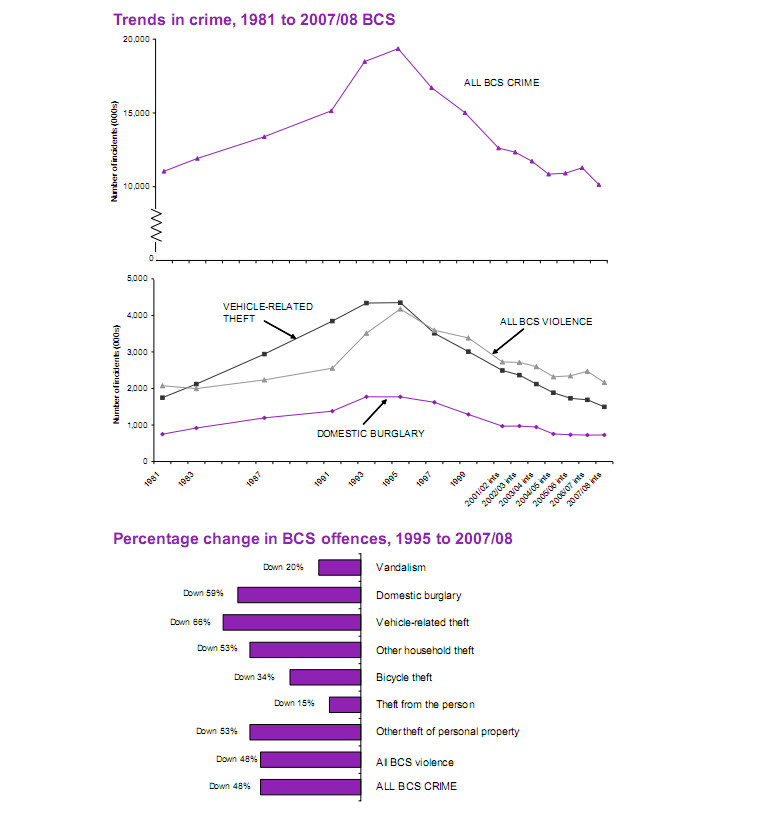
Unsurprisingly, the issue is crime/law and order. Ever since the death of James Bulger, which New Labour at the time shamelessly exploited, just as the Conservatives today equally shamelessly claim that the country is broken, there has been a devastatingly destructive war on who can be seen to be tougher. This war has delivered in Labour's approaching 12 years in power over 3,000 new offences and over 80,000 now locked up in prisons which are bursting at the seams. This has came against the backdrop of what is an unprecedented drop in crime (PDF) (with only a very few rejecting both the British Crime Survey and police's separate findings), the reasons for which are not clear, although the influence of policy itself is probably relatively minor when compared to demographic changes, especially an ageing population and an increase in general prosperity, hence the concern about a rise as we enter what looks like being a lengthy recession.

At the same time as this drop, the coverage of everyday disturbances and random, violent, vicious attacks has increased exponentially. Violent crime, for example, according to the BCS, peaked in 1995 and has been falling ever since; paradoxically, the police have recorded, since the statistics changed in 2002/03 and became incomparable with the previous ones, that violence has increased by 25%, hence the terrifying claims by politicians (including Grayling) that violent crime has risen by something like 80%, which it may have done if you're reasonably selective with the specific police figures. By any reasonable measure, Labour has lived up to its promise to be tough on crime; it has failed miserably, however, to be tough on its causes. To be fair, one is reasonably easy while the other is reasonably difficult. No prizes for guessing which is which.

Grayling is intent on being both, but if he does indeed become Home Secretary, you can be sure that it'll be the former that he'll implement and the latter which he will disregard, if indeed the Tories' policies on curing our "broken society" don't in fact make things worse. In any event, he begins with an example:

Let me tell you a story about life in Britain today. It was told me by the father of a serving soldier, who will be risking his life for us in Afghanistan this spring.

He was home on leave and was out in his local town centre when he was the victim of an unprovoked attack from behind by two youths. He was able to hold them off and the police were called.

He was left badly bruised after what was a completely unpremeditated attack.

The two young men were arrested, but then extraordinarily they were let off with a caution.

That's life in Britain today.

A nation where we appear so used to a violent assault of this kind that police only deem it fit for a caution.

And where the incidence of an attack like this is routine and not a rare exception.


Well, no, it isn't really extraordinary. You can quibble, but we don't know the exact circumstances of what happened here: this may well have been a first offence for both men; first offences invariably result in cautions, and as the only injury they seem to have inflicted was bad bruising, this doesn't really seem that outlandish or outrageous. It may be to the victim, but in all of these cases either the police or the Crown Prosecution Service will have decided whether it was in the public interest or not to bring the matter to court; they decided it wasn't. Grayling can want every such incident to be prosecuted, but he might decide otherwise when the court system becomes even further clogged up, when the prison population rises, and by the effect it has on those who find themselves with a criminal record and automatically excluded from an increasing number of jobs for what might have been a completely out of character incident influenced by alcohol or drugs. This is why prison and prosecuting need to be incredibly carefully considered: to declare across the board that everyone who does something should automatically be charged and if found guilty sent to prison, with the exception of the most serious crimes, is to ignore the nuances and multiple reasons for the original offence.

The real cause for concern comes very early on, and sets the tone for the rest:

It's time we dealt with the wrongs against society - not just the rights of their perpetrators.

Fewer rights, more wrongs.


Doubtless Grayling just intends this as a flippant, populist remark, not intended to be taken as a statement of intent. Yet a time where few deny that we are facing an unprecedented reduction of liberty and where rights are being routinely curtailed at the expense of supposed security, this is a truly dangerous statement to make, and also seems to completely miss the current mood.

Next Grayling tries to paint a picture of a country disentegrating:

Another snapshot of a broken society.

Where antisocial behaviour is endemic.

Where violence has become a norm.

Where the offenders don't seem to give a damn.

Where carrying weapons is increasingly the norm.

Where families can be terrorised by teenage gangs.

Where pensioners are in fear of their safety from the troublemakers outside their houses.

Where too many communities are being disrupted by things that just shouldn't be happening.


On almost every one of these measures, the figures tend to suggest things are in fact improving; whether that continues during a recession is of course uncertain. This is of no concern to a politician who has a point to make, but such febrile exaggeration, which itself further scares people into imagining they will be victims of such behaviour, is unhelpful in the extreme. Grayling goes further by challenging the whole nature of what is defined as anti-social instead of criminal:

Worse still, many of the things that disrupt our society are now treated as almost a norm.

That's not good enough.

I call it crime - when somebody vandalises a bus stop - that's not anti-social it's criminal.


Indeed it is, and it's recorded as a crime.

When somebody shouts at an old person in the street and leaves them shaking and scared - that's not antisocial behaviour - that's criminal.

Err, no it isn't. As unpleasant as it might be, no crime has been committed, unless we intend to make shouting in the street an offence. What would the punishment be for committing this transgression?

When a teenager jumps on a car bonnet - that's not antisocial behaviour - it's criminal.

Not unless the jumping on the bonnet causes damage to the car - are we going to create a specific offence of jumping on a car bonnet to cover it?

This behaviour is far worse than being anti-social, it's anti-society.

And so Grayling adds even further to the Unspeak of political language. What exactly does anti-society mean? Can someone jumping on a car bonnet really be said to want to destroy society, which would be the presumed meaning of such a term?

The infuriating thing about Grayling's speech is that some of the analysis is spot-on - much of the passage about the causes of crime is accurate, although I would demure from his claim that it's a deep rooted issue affecting almost all of the country, which is bordering on being nonsense on stilts. It's just in the policy, which is of course crucial, where he falls completely down. He states that the government doesn't know what to do about it, but the truth is that no one does. He can only claim to know, without knowing what effect those policies he wants will in actuality have. He also, as previously noted, selectively uses crime figures to paint an alarming, inaccurate picture, such as here:

Violent crime is up almost 80% under Labour. Nearly 1.1 million violent crimes were recorded last year - half a million more than in 1998-99.

Robbery is up 27% under Labour.

Criminal damage is up past 1 million offences - that's nearly 3000 incidents each day.

There are over 400 serious knife crimes a week - 22,000 in one year.

Fatal stabbings up by a third.

Gun crime has nearly doubled under Labour - a gun crime was committed every hour in England and Wales in 2007-8.

Injuries from gun crime are up almost four fold.

And how has the Government responded?

By being soft on crime.


This is a page of diagrams and charts from the 2007/08 BCS which handily deals with some of these claims. The BCS, based on around 50,000 interviews, is regarded as more authoritative than the police figures which Grayling seems to be mainly relying on:

What then are Grayling's solutions? Almost uniquely a step in the wrong direction:

Letting people out of prison early - that's soft on crime

Since Gordon Brown came to power 47,000 people have been released on early release, including 9,000 convicted of violence against the person.

Nearly 1000 crimes have been committed by criminals who have been released early.


Grayling doesn't offer an alternative to letting them out on early release, presumably for the reason that there isn't one. We cannot build ourselves out of an overcrowding crisis, or at least not quickly enough. 1,000 crimes committed by over 47,000 released early in fact seems to be an incredibly low figure, going by the re-offending figures which suggest that over half re-offend. There is very little here about actual prison reform, which could have an effect on crime levels and help to increase genuine rehabilitation, but that doesn't make for as good rhetoric as being tough on crime will.

Rejects our calls for a presumption of prison for those carrying a knife.

Lets five out of six offenders convicted of knife possession off without a jail sentence.


Automatically sending thos caught carrying a knife to prison is probably the worst use of jail that could possibly be envisaged, and designed to further embitter those who carry it out of fear that just one time, who find themselves being made an example of in the very worst case of "sending a message". The less direct restrictions on a judge's personal discretion the better.

After a couple of old Blair quotes, we have something approaching Grayling's thoughts on what to do on targeting the causes of crime:

In true backstreet fashion, Gordon Brown took all four wheels off welfare reform back in the 1990s when he disagreed with Frank Field thinking the unthinkable. He left it on four piles of bricks for a decade, and only now have we persuaded them to start to be as radical as is needed. Even so, we've still only had words and not action.

Is there any evidence that Purnell's or the Tories' welfare reform will have any great impact on crime? Not much, unless you consider that it might in fact increase it when you effectively impoverish a distinct minority as may well happen, especially to the young people that Grayling previously proposed should form "chain gangs" if they couldn't find a job within 3 months or actively refused one. Prison looks attractive by comparison. Then there's a piece of evidence which directly contradicts the entire Conservative message on the "broken society":

Recent analysis suggests that around 2% of families - or 140,000 families across Britain - experience complex and multiple problems. When parents experience difficulties in their own lives, it can have a serious and lasting effect on both their and their families lives. The consequences of family breakdown can influence the rest of peoples individual lives and may also carry significant costs for public services and the wider community.

That 2% undoubtedly affects a far larger proportion than it actually makes up, but 2% does not a broken society make. Again though, that simply wouldn't make for effective rhetoric. 2% of our society is broken doesn't have the same ring to it.

The area which stands as a totem of Labour's failures to get to grips with the causes of crime is drugs.

UK drug abuse is the worst in Europe. A report by the UK Drug Policy Commission found that the UK has the highest level of problem drug use and the second highest level of drug-related deaths in Europe.

The UK is the cocaine capital of Europe. A report by the European Monitoring Centre for Drugs and Addiction, which compared drug use in 28 countries in Europe, revealed that the UK has the highest proportion of cocaine users amongst adults and 15 and 16 years olds.

The UK has the third highest teenage cannabis use in the OECD.

Half of prisoners are drug addicts - some prisons report up to 80% of inmates testing positive for class A drugs on reception.

Drug offences are up 68% - there were 228,958 recorded drug offences in 2007-8 - that's more than 600 per day.


He states all this, but he doesn't ask why. Why are we so dependent on drugs, in comparison to the rest of Europe? Is it something wrong with our work-life balance? And then there's the whole message which this also gives: prohibition has comprehensively failed. It's time that we tried legalisation, yet that is completely anathema to the Conservatives, more so even than it is to the evidence-ignoring New Labour. Having addressed the causes, or rather listed them rather than addressed them, he cops out completely:

But tackling the causes of crime was a key part of my last job. If I am Home Secretary after the next election, my job is very simple - to be tough on crime.

A good soundbite, but a staggering lack of aspiration and ambition, those very things that government constantly wants to inculcate, for any politician.

We are then onto supposed concrete policies. A more sorry bunch could not be dreamt up, starting with some complete nonsense:

The first is to find a 21st century alternative to what would once have been a clip around the ear from the local bobby.

Plenty of teenagers stray off the straight and narrow sometimes.

But today there are no consequences when they do.


Really? No consequences whatsoever? Even if this were the case, shouldn't we be encouraging parents to put in consequences rather than relying on the law instead?

All too often if you look at the case of a fifteen or sixteen year old who is starting to commit serious crimes, you find a story of years of minor misdemeanours that have all too often gone unpunished.

That just can't be right.

I don't want to criminalise children - but I do want our police and our society to be able firmly to say No. Before those young people get used to flouting the law.

...

Ministers are now even proposing measures to move on ten year olds if they are causing trouble in the evenings. I don't think we should be shifting ten year olds out of their home areas - I think we should be sending them home to bed.

So I will instruct our police to remove young troublemakers from our streets altogether, not just move them on to disrupt a different street.

If police find young people doing something stupid out in their communities, I think we should give them the power, sometimes, to take them back to the Police Station and make their parents come and get them. For their own safety and protection as much as anything.

We're exploring the best way of making this possible but it's got to be the right thing in some cases.


This seems to be a recipe for ridding children and the young from the streets when no crime or otherwise has been committed, on the whim of the officers themselves. "Something stupid" - I can see that looking good in the legislation.

Our police should have powers to go straight to a magistrate and get an order against that troublemaker confining them to their homes for up to a month - except for during school hours. And if they break that curfew order they should expect to find themselves in the cells.

Grayling then doesn't want to criminalise children... except he does. He's talking about potentially "grounding" troublemakers, not potentially anyone who has ever committed any crime, with those who then break that order being sent to the cells. There is not just huge potential here for abuse and casual victimisation, but also again it's riding roughshod over parental responsibilities. They should be the ones grounding the child, not the courts, if indeed there are grounds to "grind" them in the first place. This is taking ASBOs and making them even worse.


In my own constituency, I've learned two lessons on tackling antisocial
behaviour from the local police.... that's when they've got it right.

A clash between two gangs of youths a few years ago was dealt with by thirty police, dogs and a helicopter overhead. The trouble has never been repeated.


Grayling is MP for the mean streets of Epsom and Ewell. That there was no repeat doesn't mean that it was the police action which halted it; it might well have been an isolated incident which was patched up regardless of it. This is hardly evidence-based policy making.

There is now a strong case to end Labour's twenty-four hour drinking regime. It has not created a continental café culture - it has just made things worse in many town and city centres.

Except this is the opposite of the truth, as John Band noted. We do have a drinking problem, but again we have to examine why that is rather than go back to ridiculous previous laws which failed just as much.

The third thing we need to do is to stop the ridiculous system of cautions that has built up even for serious offences.

Remember that young soldier, beaten up by local hoodlums.

Why did the police choose to caution the offenders?

Because issuing a caution means case closed - a tick in the box - a crime solved for the official figures to be sent to the Home Office.

And avoiding the danger that the Crown Prosecution Service will say - three young men, a fight - too difficult to prove so we won't bother.

That's just not good enough.


Some cautions are undoubtedly down to a lack of imagination or lack of belief that it's worth going through the rigmarole of a court case, but for the most part they are actually usually the right punishment. Politicians shouldn't second guess police into ordering them to not issue cautions - that's just as bad as Labour's myriad of targets. If the Conservatives want to free police to do their jobs as much as possible, then they shouldn't put other restrictions on them either.

The fourth change we desperately need is that oldest political of political chestnuts. More police on the streets. More bobbies on the beat.

May as well stop it here, as again, the evidence suggests that "bobbies on the beat" is an incredibly bad way of using police resources. Nick Davies wrote a whole series on this back in 2003 which effectively debunked the entire idea. It still though remains the simplest and easiest way to win press and popular support.

Grayling finishes with a flourish:

The Conservatives are the party of law and order - law and order based on common sense, strong families and communities and a system which places the victim above the criminal.

Labour has had eleven years and they have collectively failed - their musical chairs based system of Home Secretaries has left Britain a more dangerous, less civilised place to live in.


Two more nonsensical paragraphs would be difficult to come up with. Anyone who makes allusions to common sense should be considered suspicious, when "common sense" is often the actual inverse of it, just as how if you say the reverse of what you've just said it probably tells you it isn't worth saying. The idea though that Labour's lack of continuous Home Secretaries has somehow made the country more dangerous and less civilised is hilarious: more accurate is that they've made the country less civilised through their criminal justice policies; getting rid of the lot of them and not having one at all could have undoubted beneficial effects. One thing however is clear from this dire, dismal, predictable speech: Chris Grayling and the Conservatives have the potential to be even worse than New Labour.

Labels: , , , , , , , ,

Share |

Tuesday, December 16, 2008 

Do we really want Labour to win the next election?

As critical as this blog often is of piss-poor journalism which makes assumptions based on the "facts" as they currently are, such group-think obviously occurs on blogs as well. No one supposedly saw the financial crisis coming, apart from a few Cassandras, just as no one saw 9/11 coming. Likewise, ever since the end of Gordon Brown's so-called "honeymoon", blogs and political journalists, including this one, have been almost unanimous in their conclusion that New Labour is finished and that the Conservatives are going to form the next government, although the size of their win is what has prompted the most debate. Some, it must be said, still favoured the idea that we were heading for a hung parliament, but the opinion polls which suggested leads at some points of up to 20 points for the Tories dampened down even that.

Here we are then, having declared the downfall of Labour, and yet thanks almost solely to the bleak economic outlook and the perceived handling of it so far by Brown and Darling, Labour are back within touching distance of the Conservatives, with tomorrow's ICM poll for the Grauniad, which only last month showed a 12-point Tory lead, now suggesting that Labour are just five points off. All things considered, it's still difficult to imagine Labour getting a result at the next election which doesn't either reduce their majority down to almost single figures or wipe it out completely, and we are after all just heading into the recession rather than coming out of it, when it will be the bleakness of January and February rather than the slightly more upbeat feeling of approaching Christmas which might finally prompt some to more squarely place the blame for the recession rather than just side with those who they think will best steer us through it. An awful lot can also yet happen before Brown has to call the election in 2010, but the possibility of a fourth consecutive Labour term is now much higher than it seemed to be just six months ago.

Thing is, because we assumed that the Conservatives were going to win, we put more thought into how bad they would be as the new government than we have into the idea of just how awful a fourth Labour term might turn out to be. After all, it's not as if the third term has exactly been a resounding success, is it? Fair enough, going by the first two terms with Blair in change we ought to be grateful that we haven't been plunged into another war, but having had two on the go, both intractable with our troops providing little more than target practice for insurgents of all stripes in both Iraq and Afghanistan, things haven't exactly improved on that score. If anything, we seem ever further bogged down in Afghanistan, the casualties exponentially multiplying, with no one having the apparent slightest idea how we're meant to progress from here, dealing with a corrupt government that barely exists outside Kabul and an insurgency which we're not prepared to talk to, whilst that self-same insurgency gains ever more presence in the country itself. Elsewhere in foreign policy, the hope that Brown's ascendancy might mean the end to the almost open encouragement of force such as in Lebanon in 06 was rather blown away by the open siding with Georgia during this summer's conflict, which achieved exactly zilch.

On the home front, the best that can be said is that for the most part the money invested in the public services hasn't been wasted as some on the right would like to portray it. Waiting times in the NHS are right down, and while the Darzi report was presented, most of the reorganisation that defined the Blair era is either over or has been jettisoned. Education is less rosy: still almost half fail to get 5 "good" GCSEs, and the government's policy of raising the leaving age to 18 will do nothing to help on that score. Also chilling has been the growth of the academies where the joy of learning itself seems to have been completely forgotten, instead replaced by dull conformity that seems more at home in an old dystopian novel than in the here and now. The pace of reform has been much the same as in the NHS, and again, there's little to show for it.

The other biggest growth industry under Labour has been the prison population, now permanently above 80,000, with "titan prisons" proposed; the "good news" to counter-act that has been, unless you completely distrust the figures, that crime has almost fallen off a precipice. Ignoring the debate over whether violent crime has increased or decreased, where you can rely on either set of stats to defend your case, the risk of being a victim of crime is at its lowest since the British Crime Survey began, yet no one believes it, partially because the authoritarian triangulation on crime has not ceased. At the same time the picture on civil liberties has never looked bleaker: ID cards, 42 days detention without charge probably only temporarily postponed, demonstrating within a mile of parliament still banned without permission, databases galore waiting in the wings, the largest number of CCTV cameras in the world, the largest DNA database in the world and much more besides.

It's the economy where for once this is an actual distinct choice for perhaps the first time in 14 years. Either a fiscal stimulus of some variety with either Labour or the Liberal Democrats, in either case adding up to more borrowing, or the Conservative policy of getting the banks lending again as the main priority. If in power, the Tories would probably be doing something similar to what Labour is, but instead they can stand on something resembling the moral high-ground. Likewise, their plans are no longer to match Labour's spending, but similarly they still haven't decided whether they're going to cut taxes straight away or not, apparently not. Combined with this has been irresponsible scaremongering from the Tories of the country going bankrupt, or facing ruin through borrowing more, when almost every economic talking head believes the current level of borrowing, astronomical as it is, to be manageable.

If Labour got back in, we could expect the continuation of much of this, potentially with knobs on. However much those of us on the erstwhile left have been critical of the Labour, we've still mostly held the belief that the Tories would be worse, myself making the argument repeatedly that they represent the new Blairites, who once in power would do the sort of things that Blair wanted to do but was prevented from by backbench rebellion and opposition from the likes of Brown, holding the purse strings and his influence over domestic policy. The question has to be asked with Labour's chances of winning the next election increasing whether this is still the case. Is Labour honestly any better than the Tories would be? The differences, despite the economic upheaval, still seem to be approaching the marginal. As ghastly as the idea is of George Osborne being chancellor, of Nadine Dorries being any sort of minister at all, would we in the end note any great difference? Remarkably, you would never have imagined the Tories as being the party of civil liberties up until recently, opposed to ID cards and the petty surveillance that has become the norm. That, on its own however, especially when you certainly consider that much of the opposition would probably flake away once in power, is not enough to make the thought any less encouraging, especially when combined with their policies on "fixing" the "broken society" and the return to the open bribing of the middle classes. It would of course be nice if neither could form the next government, but the closest we could feasibly manage would be a Lib Dem-Labour or Tory coalition, where their influence might well lessen the blow but then also corrupt those who see them as some sort of alternative, however laughable that also seems.

Getting tired or bored of a government after three terms is to be expected, but it's only when that government itself becomes tired or bored of being the government that it falls. This was what happened after 1992 to the Tories, and did seem to be happening to Labour, yet the recession which should have buried the chancellor who claimed to have abolished boom and bust has instead energised the zombie that was shambling towards the bullet. Let's not kid ourselves that Labour has been in any way genuinely refreshed by it, but it does now still have a purpose which it perhaps didn't prior to September this year. It can still win a fourth term. It's whether it deserves to, and frankly, it doesn't. But neither do the Conservatives deserve to form a government. We the electorate seem to be stuck between a rock and a hard place, or rather between two parties only distinguishable almost by their sameness. Some might say we deserve better; I wonder if we do. Perhaps only when we have become fed-up with the offerings of both will we deserve better, and that still seems some way off. Perhaps we can flip a coin in the meantime. For now, we probably would be better off with the devil we know, but by the torturous way I've come to that statement through this post hopefully suggests just how conflicted I am, someone who ought to be a natural Labour supporter. Labour might not be finished just quite yet after all.

Labels: , , , , ,

Share |

Thursday, September 11, 2008 

Those new Tories.


All this week the Guardian has been treating us to a series of articles on the "new Tories". It's very tempting to dismiss the entire idea immediately out of hand, as has been New Labour's execrable policy, and to go by the briefing from such socialist luminaries as James Purnell, this is still the emphasis which the party is going to continue with. It's true that by no means has the Conservative party had anything approaching the reflective soul-searching which resulted in the New Labour project, nor has there been such a decisive if shallow message that the party has changed akin to the abandoning of Clause 4.

Such gestures however have not been necessary because of Labour's incompetence and failure to learn from its mistakes. When considering the new Conservatives, what has to be remembered first of all is that it was a very old Conservative policy, the promise to abolish tax on inheritance for all but the very richest estates which catapulted the Conservatives back into the opinion poll lead, bringing Gordon Brown's short-lived honeymoon to an abrupt end. Ever since it has been one disaster and fiasco following another, combined with the economic downturn which has made Labour so incredibly unpopular. While many now see David Cameron as the best man to lead the country, what has not been shown is that same country is in any sense agreeing with the party's solutions - rather, they have become fed up to the back-teeth with a Labour party that has become socially authoritarian, economically illiterate and which has abandoned any attempts at deciding what it stands for or, more pertinently, who it stands for.

The tension, disengagement and pessimism which this has cast on whom should be the party's natural supporters was evident at this week's TUC conference. The unions are now according to some reports funding the party by up to 90% - accordingly, you would imagine that such influence would be causing the party to shift leftwards. Instead, if anything, the party is more craven and broken when it comes to addressing big business than it has ever been. While I personally do not believe that the case for a windfall tax on the energy companies' gross profits has been made, you would have expected that the party could have wrung far more concessions from them than they actually did. Instead what Brown has delivered has been little more feeble than the supposed attempt to get the housing market restarted. While that was a futile exercise, no one can possibly describe reducing the bills of the poorest and elderly this winter in such a way. Really sticking in the claw though is that there is both mass public and media support for taking on the energy companies - whilst the Daily Mail might not have supported a windfall tax, it has been just as angry if not angrier than papers on the left as what it sees as the obscene profiteering and greed in the City, and would have been livid if the companies had attempted to pass the costs back onto the consumer. With Brown's proposals, any chance of there being a simply response if they do exactly that is unlikely to say the least.

There was though another incident at the TUC conference that did show that the Conservative attempt to sell itself as new is only worth so much, and that was Harriet Harman's announcement of yet another quango to investigate social mobility. It wasn't that though but rather than an article went round beforehand which used the "c" word which so exercised Theresa May. You can expect the Torygraph to start screeching about class war, but for Theresa May to do so in almost the exact same language when her own party is currently trying to sell the idea that it believes in greater equality and is the real "progressive" party was pure chutzpah. The real issue is that Labour has long since abandoned calling a spade a spade; whilst the Mail, as Dave Osler points out shouts from the roof-tops about the middle class and the Torygraph invents the "coping classes" to laughably describe its readers, mention or allude to the working class and suddenly we're back to the class war. This is partly because all the main political parties have liked to pretend for some time that we are all bourgeois now, or come up with euphemisms or other identifying features to target voters, but it's also because few of them even seem to want the working class vote, or if they do, to say that they do. Class, above gender, race, sexual orientation or anything else is the main signifier of how you will get on in life and where you will get in it. Labour has demonstratively failed to improve social mobility, but for May then to suggest that Harman also hasn't done anything to tackle gender inequality when she only recently announced plans for positive discrimination, even if you don't agree with it, is plainly churlish.

This is where the idea of the new Tories so falls down. It's not that Cameron and his supporters don't mean what they say - they plainly do, and it's not that he's a shallow salesman, which he is, but then so was Blair. It's that their ideas are contradictory, flawed and less likely to work than Labour's. Jonathan Rutherford and Jon Cruddas have effortlessly identified this in their "Is the future Conservative?" essay from the pamphlet of the same name (PDF). First Cameron repudiated Thatcher by saying there is such a thing as society - it's just not the same thing as the state, then they moved on past questioning the economic position of society, which was not in the position it is now, to instead challenge the breakdown in society, or as they call it, the broken society. In fact, the Conservatives have hardly anything approaching an economic policy, with their only real commitment to "share the proceeds of growth". When Northern Rock failed, the Conservatives didn't have any idea how to respond, except to oppose nationalisation and attempt to paint Labour's delayed decision to as another throwback to Old Labour. Along with this has been their supposed commitment to "making education an adventure, giving children ‘the chance to take risks, push boundaries and test themselves outside their comfort zone’", whilst supporting the academy project which in most areas is doing the exact opposite of this with their almost regimental emphasis on discipline, curriculum, uniform and conformity. Just read the horrifying description of the Evelyn Grace academy in Brixton in today's Grauniad, which sounds almost Orwellian with its slogans of "excellence, endeavour and self-discipline" on posters on the walls. Their decision to recognise marriage in the tax system, with up to £20 a week being the mooted break being given, is both cynical and an incredibly simple non-solution to what is an incredibly complex problem. They have also increasingly moved from so-called compassionate conservatism or Cameron's own description of himself as a liberal Conservative to the old hectoring against the feckless and overweight, whether from Cameron himself or even less subtly from Andrew Lansley. And finally, whilst trying to suggest that they are the new progressives, the new intake of Conservative candidates for parliament are profoundly socially conservative, with their solutions to the "broken society" also being even more punitive than Labour's criminal justice policies.

Cameron has succeeded because he has adopted the language of empathy, of insecurity and of change. He has abandoned the "Continuity IDS" faction while still managing to take them along with him, much like Blair took the wider left along with him in their desire for power. The comparison is apt because rather than being genuinely new Tories, Cameron's Conservatives are instead the unapologetic new Blairites, able to do what only Blair and the even more Blair than Blair Blairites dreamed of doing. The only point on which I disagree with Rutherford and Cruddas is that they suggest the future is for the left to lose. On the contrary, the left has already lost. The Labour party has shifted so far to the right, and indeed, is controlled by those on the centre-right that it is simply impossible to believe that it could ever readjust to the policies which Cruddas and Rutherford propose in response to the new Conservatives. The sooner that the left realises that the Labour party is dead the sooner it will be able to challenge the new consensus which exists between the old new Labour and the new Blairite Conservatives.

Labels: , , , , , , ,

Share |

About

  • This is septicisle
profile

Archives

Powered by Blogger
and Blogger Templates