Wednesday, September 05, 2012 

On the road to nowhere.

I can't say that Hopi Sen is someone I always find myself in agreement with, but his analysis of the state of the Tories after the reshuffle is pretty much spot on. It has to be kept in mind that to a ridiculous extent David Cameron and George Osborne based their rebranding of the Conservatives on that process Labour went through after the death of John Smith, with the difference being that they never followed all the way through. Cameron may have hugged huskies etc, but there was no Clause 4 moment. More to the point, despite many believing that once in office New Labour would return to the left, the opposite was the case; Tony Blair repeatedly picked fights with his own party, effectively appointed the Sun newspaper as home secretary and after 9/11 was in cahoots with the most right-wing US administration in history.

With the Tories, Cameron's claim to be a liberal Conservative hasn't been borne out. True, with Ken Clarke as justice secretary the party hasn't been anywhere near as draconian on law and order as their manifesto suggested they would be, but this is about the only area in which this has been the case. Policies which featured in neither the Conservative or Liberal Democrat manifestos, such as the NHS reforms and "free" schools were implemented almost immediately. Cameron spoke often of the need to mend our "broken society", and yet with the exception of in the aftermath of the riots, barely a squeak has been heard about it since. Indeed, the measures taken by the coalition have if anything widened the gaps: the cuts to welfare and the failure to get the economy moving have helped towards Save the Children today launching its first campaign on child poverty in this country. Rather than waiting for proper evidence on the 50p top rate of tax, George Osborne abolished it at almost the first opportunity.

As hopeless as Sayeeda Warsi was, bless her, when she argued her case for why she should stay as party co-chairman she put her finger on exactly who the Conservatives need to appeal to if they're ever going to win a majority, let alone win one in 2015:

If you look at the demographics, at where we need to be at the next election, we need more people in the North voting for us, more of what they call here 'blue collar’ workers and I call the white working class. We need more people from urban areas voting for us, more people who are not white and more women.

That she went on to describe herself as working class we'll gloss over, as her main point is backed up by Lord Ashcroft's studies for the party. Everything that the Conservatives have done so far is almost the exact opposite of what they need to be doing to appeal to those voters. Some will probably find the prospect of Chris Grayling at justice more appealing than the liberal Ken Clarke, but other than that the reshuffle will have said absolutely nothing to them whatsoever. At prime minister's questions today David Cameron was once again bested by Ed Miliband, who was left relying on a piece of Daily Mail fluff about Miliband supposedly having to always buy the coffee for the other Ed. "Not very assertive and butch of the leader of the opposition, is it?", to loud laughter from Miliband. Quite apart from the irony of Cameron suggesting someone else is a bit submissive and effeminate, it was but a distraction from his fundamental failure to explain where growth is going to come from. His biggest failure is to be unable to decide what he and his party are fundamentally for other than cutting the deficit, something that without growth they can't do. And without such leadership, there's even less chance those needed voters will come into the fold in 2015.

Labels: , , , , , , , ,

Share |

Monday, October 04, 2010 

The not quite Blairite stupidity of the coalition's child benefit cut.

Of all the announcements, interviews and speeches over the weekend, only one was really essential to understanding how the the Conservatives intend to govern, even if constrained by the Liberal Democrats:

Michael Gove jumps out of his armchair, rushes over to his desk and lovingly picks up a copy of a well-thumbed tome that has pride of place in his office at the education department, overlooking Westminster Abbey.

"I love A Journey, I have never read a book like it," the education secretary says of Tony Blair's bestselling memoirs. Gove opens it at his favourite page to read out, in a slow and admiring tone, Blair's conclusion that opposition to public service reform can be beaten.


Undoubtedly, not all of the Conservatives within the cabinet have a similarly throbbing erection for the former great leader. They have however clearly taken to heart one of Blair's regrets: that he almost entirely "wasted" his first term on policies other than the public sector reform which energised him, and had to compromise, often thanks to Gordon Brown's opposition and interventions, in the second and first two years of the third. This partially explains why they seem to be in such a mad rush when it comes to reorganising the NHS, despite pledging in the coalition agreement not to indulge in top-down reforms without consultation as Labour repeatedly did, in making changes to the academy system and then introducing free schools, and now also in almost ripping up the welfare system and starting again. The other likely reason for why they're operating at such breakneck speed, even if they won't admit it, is due to how they firstly don't know whether the coalition will survive and secondly as they also aren't certain on whether they'll get a second term.

For while it's true that much of the mood music accompanying the opening of the Conservative conference is distinctly old Tory, what with Gove announcing an end to rules which don't exist, Lord Young fulminating against often similarly imaginary elf 'n' safety outrages and Boris Johnson along with the CBI demanding at least a 40% participation threshold before strikes are allowed to take place, even when they'd never apply the same rationale to elections to parliament, the cut in child benefit which has now overshadowed all of the above seems to be similarly Blairite in motive. Similarly Blairite in motive for the reason that despite all the well thumbing of A Journey, it seems to be based on a fundamental misreading of how Blair repeatedly challenged Labour's so-called comfort zone.

On the surface, it looks to be right out of the Blair textbook. By taking on your own party over something they should instinctively oppose, it sends a message to the press that you're a strong leader and will take on your own vested interests, at the same time impressing the voters themselves, whether they agree or not. The key difference is that Blair did it on things which either didn't directly affect the public, didn't affect too many, or didn't affect those that were likely to campaign and protest vigorously, and was also helped enormously by the fairly benign economic backdrop and by having an opposition which was either a shambles, simply not a viable alternative or which actively supported him. Media support or acquiescence also had a strong supporting role. When Blair did it on foundation hospitals, academies, tuition fees and on Iraq (to name but four examples), one or more of these factors ensured that the measures went through and that he went on being leader. True, it was Iraq that eventually had a major role in his downfall, yet his initial "success" cannot be denied.

Where the Tories have gone wrong is manifold. Firstly, it's not at all clear that the party itself opposes universal benefit cuts; there's disgruntlement, sure, yet not outright opposition from the outset then gradual persuasion or loyalist support of the line coming down from the leadership.

Second is that this clearly affects exactly those who are natural Tory voters and does it right in the wallet, by far the most painful place.

Third, while some Tories might consider it a good thing to annoy the Daily Mail in the same way that Blair thought it wasn't a bad idea to at times to piss off the Guardian et al, the Daily Mail has both far more power, influence and readership.

Fourth, it's the manifest unfairness and stupidity of the measure, as well as it how it contradicts some of their family policy. While I personally don't agree with the argument that "services for the poor will always be poor services", and find it difficult not to sneer at how those earning almost twice the average wage can claim to be "stretched" already with little disposable income, the blatant idiocy of how a single parent earning over £45,000 a year will receive nothing while a couple earning £86,000 in total will still get the benefit is so transparent it's close to unbelievable that it was agreed upon. The Mail has splashed on how it'll impact on families with "stay at home" mums, something always close to their 1950s halcyon view of the perfect British society and associated nuclear family, with the husband off earning the wage while the little woman looks after the children, and it's difficult to believe that it won't be altered in some way before it comes into effect. If anything ever comes of the supposed "aspiration" to recognise marriage in the tax system it'll offset some of the loss, but almost certainly not all of it.

Fifth, while Labour is still somewhat in flux over what cuts it is and isn't going to oppose/defend, it looks likely they'll oppose any shift from a universal benefits system. They may not perhaps win many votes from those who'll lose out, and I think it'd be best to support the principle of the cut, just not the way the government's implementing it in such a cack-handed, regressive fashion, but opposition it will still be.

Finally, and while not alluded to above, it also breaches the Blairite tenet that you don't do anything which affects the aspirational middle classes which this directly does, right to the extent that it will mean those earning just below the threshold not taking a rise as they'll actually lose out through the loss of benefits.

While then it's hardly going to lead to an uprising, it is a clear example of how the government is already getting things wrong and how its debt to Blairism is already leading to difficulties, even if based on a misreading of how Blair operated. Certainly, it could be an attempt to put into action Osborne's otherwise ludicrous soundbite of how "we're all in this together", and also a first example of how the cuts are going to hit all sections of society, not just the poorest (although the benefits cap will certainly do that, and seems almost designed to lead to the evacuation of those on housing benefit from the inner cities of the south especially, also coincidentally where Labour still has support), yet you get the feeling this isn't going to be the start of a habit of aggravating the "base" for little overall benefit. It ought more than anything to give a post-Blair Labour party hope: the country desperately needs an alternative to the triangulation of his and Brown's era, and also to the gone off half-cocked tribute attempt from the new Blairites. Ed Miliband has to be able to provide one.

Labels: , , , , , , , ,

Share |

Tuesday, August 10, 2010 

Grim Conservative and political futures.

The inestimable Laurie Penny took upon herself the grim task of "infiltrating" a Conservative Future bash hosted by the Young Britons' Foundation and found, shockingly, that those in attendance tended to be of a right-wing bent, approving of Margaret Thatcher and perhaps a trifle strange. As unpleasant as I'm sure it was, I do sometimes wonder what the overall point of such articles is: deliberate head-on collisions of such strongly held political views are never likely to result in a meeting of minds, or an exploration of values shared by both rather than the heightening of the differences. Without wanting to question Laurie's journalistic integrity, you also can't help but wonder whether when you go into something with an already pre-determined level of contempt for those you're about to meet, you're looking from the outset for confirmation of your view. That said, having your leg stroked and your bottom pinched by your social betters is hardly likely to make you reassess your initial verdict.

Perhaps though we're holding the young Tories to too high a standard. After all, such behaviour would hardly be out of place at say, a dismal chain club such as Oceana; far worse would be considered almost de rigeur. Should they really know better, or do they in the first place? It's not just young Tories that are slightly weird; youth political organisations across the board are nerdish, the participants not wholly certain of themselves, almost embarrassed at how they're spending their time. This, it has to be remembered, is when politics itself is almost inherently leftfield, attracting the Milibands, the Heaths, the Browns, the Majors. Only rarely do the Blairs, the Obamas, the Reagans, the Clintons come along, and they often also bring a neurosis which only shows itself after a period of time. Hell, I'm happy to admit that having written this blog for the past five years is quite spectacularly weird; I
am weird. Politics and youth only occasionally connect in a good way, and that's almost always uniquely been at protests and within protest movements, whether against Vietnam, during '68 or back in 2003. Far too often it instead comes across as trying too hard, of over active earnestness, precociousness. No one in their right mind wants to be William Hague at the Conservative conference all those years ago.

It's often said that youth is wasted on the young, and it's certainly being exceptionally wasted by these members of Conservative Future. What's the point of being young and politically motivated if you're not radical with it? The Federation of Conservative Students of the 80s wanted to hang Nelson Mandela; the closest the current class has is calling for the left to be vilified in the same way as they vilified Thatcher. They even bemoaned how "progressive" when used in a political context is meaningless, which it is, while casting aspersions on the "Big Society", which is meant to be our job. Even this though is a reflection of where politics currently is and has been heading for some time: to a safety zone stretching from the centre to the centre-right, where anything outside of those parameters is derided, ridiculed and belittled. It therefore seems especially churlish to really lay into the young Cameroons; after all, their time has come, hasn't it? It's what we're going to do about it that really matters, in our undoubtedly insecure and uncertain way.

Labels: , , , ,

Share |

Tuesday, April 13, 2010 

The Conservative manifesto.


If
yesterday's Labour manifesto cover was superficially reminiscent of socialist realism, or at least socialist realism in the age of Photoshop and when the artist was instructed to forget subtlety, at least it was colourful and stood out without being garish; the Tory manifesto by comparison, looks austere and stern in its dead blue hardback bounding, although the already mercilessly mocked invitation to "join the government" somewhat lowers the tone. It's doubtful whether when they were putting it together they were deliberately thinking of modelling it on Margaret Thatcher, but it has all her qualities as can be expressed in book form; you can almost imagine her using it to smack an unruly member of her cabinet around the head.

The shadow of Thatcher continues to overshadow politics in this country to a far greater extent than Reagan say does in America, almost certainly for the reason that we continue to be riven as a nation as to her legacy, something not mirrored to quite the same extent in the States. The Conservative manifesto released today can be seen as an attempt to meld the smaller government philosophy of Thatcherism with the repugnance felt by many towards the extremes of individualism which were also flaunted during that same era; the refrain throughout is the Cameron attempt to put the infamous quote "there is no such thing as society" into a thoroughly modern Conservative context, that there is, it's just not the same thing as the state.

Credit has to be given to the Conservatives for trying to mould together what would seem to be two competing value systems: the individualism of Thatcherism with the co-operative, communitarian philosophy of helping each other to help themselves in the hope of creating something unique, perhaps something which might one day be identified as "Cameronism". It is however the naturally contradictory nature of the two, combined with the gaping holes in the manifesto itself and the unmentioned fact that they've wanted to do this because it's cheaper rather than necessarily better that undermine the in places fine words which litter the document.

To fully understand the manifesto you also have to chart how Conservative thinking has changed since David Cameron became leader. While much has been said about the now almost clichéd "detoxifying the brand", it still remains for the most part the same old Tory party underneath, even if the advisers are new. Cameron himself meanwhile has gone from calling for sunshine to win the day, urging the public to vote blue to go green, to decrying our broken society and now, finally, to wanting to build the "big society". In his foreword, which reads like an especially heavy-handed attempt to inspire ala Barack Obama's "yes we can" speeches, he claims that "if we can [insert list of fixing everything together] do that, we can do anything. Yes, we can do anything." It's really difficult not to sneer and giggle at just how weak that repeating of the mantra is, almost as if Cameron himself is trying to convince himself of it, rather than doing so for emphasis. It's this uncertainty that reflects just how suddenly this change in Conservative thinking, and it is a huge change, has come about, and makes you wonder just how real the belief in it is.

For this sudden "empowerment" agenda is almost inimical to the values that arguably, if we have a broken society, caused it to fracture. Many nodding their heads at the idea of communities working together, such groups running public services and public sector workers being their own bosses will be thinking: well, isn't this same party that rejoiced and continues to rejoice at the smashing of the trade unions and thinks that they should be consigned entirely to history? Isn't it the party that helped to atomise communities where their work was either the most important or one of the most important parts of their identity? Well, yes, it is, but then these groups which the Tories are suddenly so keen on devolving powers to must seemingly be either apolitical, or share the Conservative philosophy on cutting costs while not believing in the state's ability to do so. What happens if these groups become the "vested interests" which the Tories are so convinced need to be challenged? What if they demand changes which the Tories are ideologically opposed to? Where or when exactly will they intervene if they decide that these groups and the schools they might set up or the hospitals they might run either fail themselves or rather attempt to go against the Tory grain in what they provide? Will they truly be free or is this empowerment agenda simply the bogus attempt to marry two contradictory values and provide something "different"?

After all, the aforementioned refrain of society not being the same thing as the state is the classic straw man. Those critics of Thatcher never claimed that the state and society are one and the same thing; rather, that her formulation was the classic example of how the Conservatives rewarded a very constrained individualism while being actively hostile towards difference. This continues to be reflected in the Conservative party today and in the manifesto which it has produced. It claims that we're all in this together and for us to come together despite our differences, yet the policies within it make clear those who are most deserving, those that are more equal than others in Orwell's classic formulation. Married couples, especially it seems those where one of the partners doesn't work are more deserving, as shown by the promised tax allowance, while rather than everyone having to pay their fair share, it remains Tory policy for the inheritance tax threshold to rise in effect to £2m. This same confused approach to cutting the deficit is also reflected in their refusal to countenance the planned national insurance rise for next year, instead almost certainly deciding upon a VAT increase which will disproportionately impact on the poorest, those who have to spend and whom simply can't afford to save.

It's also instructive just how quickly the manifesto seems to imagine we can suddenly move from the "broken society" to the "big society". It claims that it's "the size, scope and role of government" which is now "inhibiting ... the progressive aims of reducing poverty, fighting inequality and increasing general well-being." This is so wrong as to be close to criminal. While inequality and poverty have either increased or stayed roughly the same by most measures, the very fact that they haven't got even worse is directly down to Labour's almost silent attempts at redistribution. The actual section on fixing society itself rather than public services along the lines of the "big society" is woefully thin, being dedicated almost entirely to neighbourhood groups, and even this involves further reform of the local services rather than the transforming of local communities as whole. Then there's just utter gibberish, such as this last point on how to "stimulate social action further":

develop a measure of well-being that encapsulates the social value of state action.

Would someone perhaps like to explain exactly what that means and how such a thing could be measured?

Strip away the choice to focus on the "big society" and devolution which may well never arrive, and you have much the same Conservative policies which have been there since time immemorial, crime being the most instructive. They're still dedicated to repealing the Human Rights Act, without explaining how a "British Bill or Rights" will be any different or what the point will be when those who want to claim or challenge under the HRA will still be able to go to Strasbourg, still want to crackdown on teenagers drinking at all rather than challenging the actual behaviour, and still want to stigmatise the drinks which those drinking to get drunk don't touch, or won't touch after they've put the tax up. They still want to send every knife carrier to jail, no exceptions, without bothering to understand why some do so. They still want to elect local police commissioners, without learning the lessons from America of how this politicises the police and makes corruption endemic. They still want to build even more prisons, and would turn the probations service over to the private sector. They want more drug rehabilitation orders to be abstinence-based, a recipe for disaster which I've witnessed personally over the last year.

If Labour's manifesto showed how 13 years of government has made the party tired and complacent, then the Conservative document released today should have been brimming with ideas and the lust for power, the "natural party of government" riding to the rescue yet again to save us from bankruptcy at the hands of Labour. The latter is much in evidence; the former, away from the attempt to create a dividing line over the role of the state, the attempt to fuse together individualism and small government with strong, well-funded public services and community action, has been abandoned. The same old heart of the "stupid party" remains, covered up by veneer of progressive politics which will be forgotten or actively abandoned at the first possible opportunity. It's impossible to deny that the Conservatives have changed since they were last in power; the problem is that they haven't changed anywhere near enough.

Labels: , , , , , , ,

Share |

Monday, April 05, 2010 

The freedom to be a horrible bigot.

Somewhat predictably, Chris Grayling's secretly recorded comments on how he felt that the owners of B&Bs should be allowed to freely discriminate against anyone they don't like the look of have caused, in that newspaper cliché, a pre-election storm.

As it goes, this is probably one of the less stupid of Grayling's gaffes, his past greatest hits involving describing parts of our septic isle as reminiscent of the Wire, manipulation of violent crime statistics in an effort to claim that it has sky-rocketed under Labour when the British Crime Survey says the opposite, and his policies on law and order in general (with the exception, for the most part, of the Tories' stance on civil liberties such as the DNA database, ID cards etc). Most embarrassing is that he's been found out to not be in tune with Cameron's "some of my best friends are gays" policy, trying to banish all those memories of far more insidious anti-gay legislation like Section 28, which Cameron himself voted in favour of keeping.

The coverage is also somewhat unfair because it is clearly only Grayling's personal view, having voted for the legislation in question when it came before parliament. That does make him a terrific hypocrite, but at least a honest one when questioned on it and he doesn't think the media's around. Doubly though, Grayling has something approaching a point: while he would doubtless not make the full libertarian argument for why the owners of a bed and breakfast should be allowed to refuse entry to a gay couple, there's one freedom that has been increasingly encroached upon in recent years, and that's the freedom to be a horrible bigot. Iain Dale and Claude both argue as to why you shouldn't be allowed to discriminate on such grounds, Dale saying that you're providing a service and that your house ceases to be public once you invite paying guests into it, Claude comparing the ban to health and safety legislation. Devil's Kitchen however makes what I think to be the best comparison: the smoking ban. While it's difficult to argue that the smoking ban hasn't been a general success and that it's lovely to come back from either a pub or club and not have your clothes absolutely reek of tobacco fumes, I see absolutely no reason why certain establishments shouldn't be allowed to deign themselves as places where you are allowed to smoke, and that if you don't wish to breathe it in, then you can go elsewhere.

The same should be able to apply to small businesses like B&Bs. If you're such a horrendous bigot that your conscience won't allow you to permit entry to two gay men, presumably on the grounds that as they're gay men and all gay men are sex mad and can't possibly resist the temptation to indulge in anal intercourse in-between your clean white sheets, then you should be perfectly within your rights to do so. The general public however though will then be perfectly within their rights to be told about your petty little irrational prejudices at every possible opportunity, hopefully resulting in your business either failing or only similarly clean-minded Christians or members of other religions patronising you. Would this result in, as some have also mentioned, the return of the likes of "no blacks, no Irish, no dogs" signs? Possibly. Can we seriously though not handle that returning, and not actually further put it down to their ignorance and let them get on with it, with perhaps similar consequences to the above? In any case, we already have establishments where it's well known that certain people are either not welcome or conversely are welcome, and that few not belonging to those cliques therefore venture to them. At least with this option we have open discrimination rather than covering it with a veil; let the bigots be bigots and let everyone else mock them. Perhaps we can start with, err, Chris Grayling?

Labels: , , , , , ,

Share |

Tuesday, March 30, 2010 

In defence (somewhat) of George Osborne.

The best, and therefore almost certainly inaccurate story about George Osborne's formative years concerns his entrance to the now world famous Bullingdon club. His initiation, so legend has it, involved his both being called "oik", allegedly because rather than attending Eton or Harrow he instead had patronised the only slightly less posh and exclusive, not to mention less expensive St. Paul's, and him being held upside down, his head being bashed into the floor until he uttered the required words: "I am a despicable cunt".

As initiations go, not just to the Bullingdon but to other similar clubs, one suspects that was actually fairly tame. While the referring to him as "oik" was probably more of a joke than meant seriously, it probably reflects the attitudes which Osborne has encountered for most of his life. Far too upper class for the vast majority of the population to instantly warm to him, yet still not rarefied enough for him to be automatically welcomed into the even more exclusive establishments. You only have to look at how the City, where you'll never come across such a wide variety of stuffed shirts, has reacted towards him: with something approaching utter horror, despite the fact we currently have a Labour chancellor, a member of a party whom they've been taught all their lives to instinctively loathe. Admittedly, this might partly be down to New Labour's complete subservience to the financial sector, for which they have been rewarded in kind, yet you'd still think that getting back to what they know best would be attractive.

The class warrior in me wants to loathe Osborne for all the reasons which have been outlined ever since he became shadow chancellor, almost none of which are based on actual substance. The Heresiarch, writing on why David Cameron should get rid of Osborne while he still has a chance, openly admits that at least partly his reasoning is based on Osborne's manner and appearance. When natural Conservatives feel this way, you can't even begin to imagine what the general public thinks. In the Graun today both Lucy Mangan and Michael White, commenting not entirely seriously, but as the old saying (or cliché) goes, there's many a truth spoken in jest, voice just some of the unveiled insults thrown Osborne's way. Mangan suggests that he's a "walking justification for all the schoolyard bullying there ever was, is, or ever shall be", which is an especially unpleasant comment, not least for those who have suffered from bullying, for which there is never any justification. White, meanwhile, went instead for a startling funny joke about how this was the most momentous day for him since he "was first allowed to travel alone on the school bus". Never mind that you suspect Osborne has never had to travel on a school bus, which rather undermines the gag, it's just another riff on Osborne being a boy amongst men.

To be fair, I have myself slipped into this casual abuse, as in this post from a couple of years back:
Take as a further example George Osborne, who ought to be on an absolute hiding to nothing. He's young, resembles a caricature of the smarmy, upper-class snob that spent his tender years smashing up restaurants when he wasn't shovelling white powder up his nostrils, with a face so punchable it's a marvel that he hasn't got a broken nose and a good number of teeth missing, knows next to nothing about economics, and has all the charm (to this writer at least) of a self-portrait of Kate Moss drawn in lipstick and Pete Doherty's blood.

This is though partially what the objection to Osborne rests on. That he's young, and therefore inexperienced, something which isn't said anywhere near as often about Cameron despite the Tory leader only being a few years older, that what he did as a young man matters when it categorically shouldn't, even if he did indulge in taking wanker powder and may have used escorts as the more lurid allegations have it, and that he should be judged on what he looks like, which can't be helped, and on how much charisma he radiates, which is very little. Osborne's main problem with relating to voters is that he does seem too much of the toff, that he comes across as patronising, and that he just has that eminently punchable quality mentioned above. None of these things are barriers to being a "successful" politician; just look at the far more patronising Patricia Hewitt and Margaret Beckett, both of whom have had decent careers, even if they're not exactly the individuals Osborne himself would like to be compared to. He has absolutely nothing in the "toff" stakes compared to the offspring of William Rees-Mogg, both of whom are trying to be elected (Cameron supposedly asked whether Annunziata would consider calling herself "Nancy" in a bid to get down with the proles) as Conservative MPs, nor those featured in that now notorious issue of Tatler, and as for punchable, well, I personally would much rather lamp the egregious Phil Woolas, perhaps the most disgusting politician to have emerged from the Labour party in recent times.


When it comes to challenging Osborne on substance, the case against him is much slimmer. Yes, he was a distant third in the chancellor's debate yesterday, but he wasn't a disaster either, and he was always likely to find it difficult to compete with the sainted Vince Cable and the currently supremely confident Alistair Darling. It has to be remembered that it was Osborne's wheeze on inheritance tax three years ago which almost certainly stopped Gordon Brown from calling a snap election; that policy sticks in my personal political craw, and it was a promise which was only so popular because "middle England" thinks that IHT is going to hit them when it almost certainly won't, but it did the business. Yesterday's pledge to not raise national insurance contributions was hardly the most robust policy, exposed completely by Vince Cable in the debate as being costed by even more inefficiency savings, the same ones Osborne had lambasted the previous week, but that must have been debated at far more senior levels of the party and OKed rather just being Osborne's initiative.

The question then if Osborne was to be removed is who would replace him. The obvious answer is Ken Clarke, but the reasons for why he hasn't been given a post more senior than business secretary are apparent: the Cameroons don't trust him, and he's not prepared to temper his own views on Europe and even IHT enough to be given a more senior role without even more unwelcome stories on splits being written. Apart from Ken, just who is there ready to step in? It's not as if Osborne is also the only weak link in the Tory front bench line-up. What about the gaffe prone Chris Grayling, who when he isn't claiming that parts of Britain are like the Wire is defending using completely inaccurate crime statistics, and whose department claimed that 54% of teenage girls in the most deprived areas were getting pregnant when the true figure was 5.4%? Then there's Michael Gove at education, another eminently punchable figure, whose campaign against Unite's involvement with Labour plumbed new depths of union-baiting, is a confirmed Tony Blair lover, an unapologetic foreign policy neo-conservative and rubs people up the wrong way just as much as Osborne. Osborne may be unloved, and that might even be justifiable, but to move him now would be a sign of absolute weakness on the part of Cameron, which would be rightly seized on by the other parties. Ultimately, Cameron and Osborne were promoted together, and they should fall together.

Labels: , , , , ,

Share |

Monday, March 01, 2010 

Patriotic duty and Michael Ashcroft.

Yesterday David Cameron said that it was the party's "patriotic duty" to to win the general election. Strange then that this patriotic duty doesn't actually extend to the party's deputy chairman paying his full dues in this country, despite the Tories' then leader William Hague promising back in 2000 that he would become a "permanent resident" in order to ascend to the Lords. Here's Billy with another pearl:

This decision will cost him (and benefit the Treasury) tens of millions a year in tax, yet he considers it worthwhile.

How much has Lord Ashcroft in reality paid to the Treasury thanks to his non-domiciled status since 2000? One suspects next to nothing.

There is some truly exceptional spin going on here: it turns out that when Ashcroft said he would become a "permanent resident", he actually meant that he was only going to become a "long-term resident". This seems to be somewhat different to the assurances which were given to the Lords' scrutiny committee, which asked Downing Street to ensure that Ashcroft became a resident before he could become a peer, and indeed the statement that Downing Street issued after his ennoblement was confirmed, which said they had been given a "clear and unequivocal assurance" that he would take up "permanent residence". Either Ashcroft at the time had a completely different definition of what "permanent residence" meant, or he had no intention whatsoever of keeping his promises.

Ignore the obsfucatory nonsense being raised by the Tories about donations to Labour or the Liberal Democrat donations from non-domiciles. None of them gave such cast-iron assurances that they would become permanent residents in order to enter the Lords. Neither have they ascended to such positions of personal influence over the parties they've donated to, as Ashcroft has. Ashcroft for a time was essentially keeping the Tories afloat with his donations and loans, the latter of which were almost as large as the total amount he's donated over the years, at one point as high as £3.6m. When he isn't funnelling money to the party, then he's personally transporting the party's nobility around in his private jet, via his Flying Lion company, registered, typically, in Bermuda. Compare and contrast the treatment of Ashcroft with that of Zac Goldsmith, who also admitted recently that he was a non-dom: Goldsmith was quickly slapped down and told to become a UK taxpayer as "rapidly as can be done", while Ashcroft, despite promising almost 10 years ago that he was going to become a permanent resident is only now getting around to it, all while the Tories have been repeatedly saying in response to any questions that Ashcroft's tax status was a private matter between him and HMRC. Did Cameron know that Ashcroft was a non-dom, or did he purposefully ensure that he didn't know until very recently? Sir George Young said a month back on Newsnight that Ashcroft had the same status as some Labour peers, with Tory sources later saying that Young had "misspoke". Misspoke in the sense that he had inadvertently told the truth when he wasn't meant to.

If it hadn't been for the freedom of information request that forced Ashcroft into making today's statement, would Cameron have actually followed through on his sudden conversion to parliamentarians of both varieties being fully domiciled for tax purposes by ensuring that his deputy chairman was resident here? It doesn't seem so, to judge by his strange refusal to accept, even now, that Ashcroft's tax status is a matter for anyone other than himself. All the parties may be guilty in accepting funds from donors who are not full taxpayers, but none have elevated those individuals to such a position of power and authority in the party. It's this kind of cynicism, of double standards, of turning a blind eye, that so angers the public and turns them off politics. And who can blame them when someone like Ashcroft decides "permanent residency" means something entirely different to what everyone else does and essentially lives a lie for almost a whole decade?

Labels: , , , , , , ,

Share |

Thursday, February 18, 2010 

Your new overlord has been overcome.

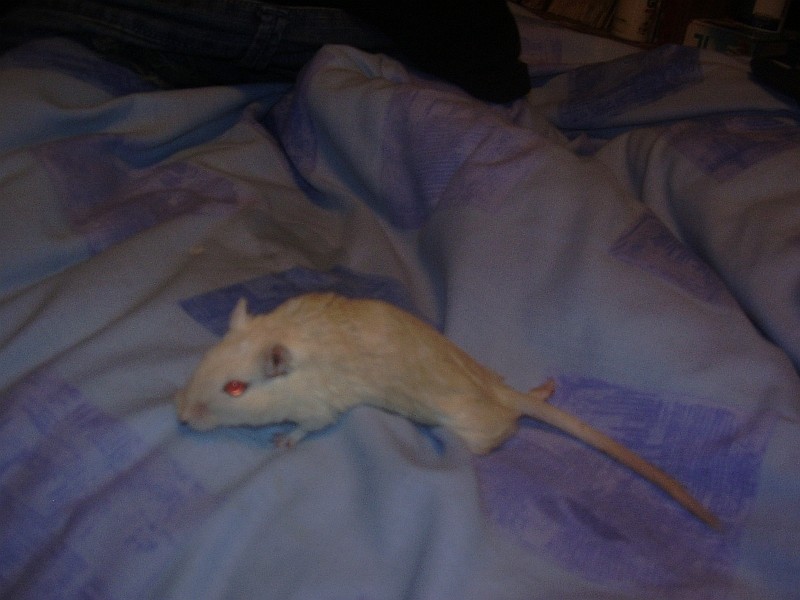
I have to announce the sad news that Stumpy the Gerbil, who put himself forward as a Conservative candidate for the next election after David Cameron's appeal for those who shared his values to join the party, will be unable to take part in the long promised debate with Katie the Dog as he has, as rodents tend to do with depressing regularity, died.

For a rodent who lost the use of his back limbs after an apparent accident in a wheel, he lived to a fine old age of over 3, and as I can't quite recall in which litter he was born, he was either between 3 years and 5 months or 3 years and 2 months old, outliving all but two of his brothers and sisters. He simply crawled into the wheel in his cage, curled up, and died peacefully, leaving his father who he had lived with all his life as the only remaining occupant. Thankfully, as he had no estate, he will not be liable for any form of death tax, which he would have doubtlessly been pleased about considering his long-held Conservative value system.

I again don't know whether this photo actually features Stumpy as a pup, but hey, it's cute, and there isn't nearly enough cute stuff on this blog:

RIP Stump. You will be missed.

Labels: , , , , , ,

Share |

Tuesday, February 16, 2010 

You know it's a slow news day when...

the hot breaking story is that Tutankhamun is dead, Mark Lawson has an opinion piece in the Guardian on what 25 years of EastEnders tells us about politics, and the main political story is about what a bunch of puffed up egomaniacs on Twitter may or may not have called each other. Oh, and just to cap off a truly fantastic and memorable day, Oasis have just won the Best British Album of the last 30 years for What's The Story (Morning Glory).

In the spirit of all this then, here's yet more hilariously unfunny Tory spoof adverts, because there clearly isn't enough already, helped along by there now being an online generator. And seeing as I'm out to equally offend everyone, there's two versions of the most explicit one:


Labels: , , , , ,

Share |

Monday, February 15, 2010 

The hung parliament hypotheticals.

There seems to be a distinctly strange air to politics at the moment. Despite parliament likely rising in around two months for the dreaded general election campaign, it's still as though it's an incredibly long time away, even though business itself is hardly bustling. Only the Tories seem to be keeping themselves visibly busy, and in doing so keep making more and more gaffes. If the David Cameron personal poster campaign was disastrous, or at least it was with the Twitterati (ugh) and the chattering classes, while the policy flip-flops on marriage tax and public spending cuts were more expected but no less damaging, then the almost radio silence from Labour and the Liberal Democrats, the former only seemingly making any noise when the Tories make such execrable (if not deliberate) mistakes as miscalculating 54% for 5.4%, is not doing much to capitalise on it.

On the Lib Dem front, part of this reticence might be due to the strategising going on behind the scenes in the event of a hung parliament. With the polls either predicting one or a slight Tory majority, even if one suspects that come the day the Tories will get a large enough share of the vote to be able to comfortably govern, it is nonetheless the closest the party is likely to come to grabbing some semblance of nationwide power since David Steel infamously told the party to return to their constituencies and prepare for government. Even if similar plans were made prior to 1997, the polls leading up to the election, although narrowing at one point, never suggested anything other than a significant Labour victory.

The apparent insight into the party's thinking that we're given in today's Graun is suitably significant. Rather than seeking a coalition, Nick Clegg is instead mulling over propping up a minority government through supporting a party's program of legislation, as long as certain Liberal Democrat policies are incorporated in it. Just how many will be needed to be implemented is seemingly elastic, with four policies up for immediate discussion, although just two might also be considered. While you could imagine that Labour would be open to debate on any of the four mentioned, the "pupil premium", tax reform, a greener economy and constitutional reform, it's difficult to imagine that the Tories would be malleable on the proposal for capital gains and income tax to be levied at the same rate, or on electoral reform, which they have consistently opposed.

You can see why they're thinking in this way: propping up a defeated Labour party through a coalition is likely to breed only resentment and disdain, even if say, Vince Cable or Clegg became chancellor and the deal involved Gordon Brown stepping down, although another "unelected" prime minister would hardly help matters either. At the same time however it's difficult to see just how much difference there would be in not getting fully into bed with Labour; is the public really going to live with a minority Labour government passing its legislation with Lib Dem support if it's the same old party rejected at the ballot box with a very slight yellow tinge? At the same time you can't see a minority Tory administration being prepared to give way on proportional representation in exchange only for short-term support; why not simply force a second election or, if Labour and the Lib Dems then attempt to from some sort of alliance, simply stand completely against and preach about its illegitimacy and wait for the inevitable breakdown in relations to take full advantage?

The disheartening thing about the likely manoeuvring in the event of an inconclusive election is that this is probably the only way in which the four stated policies on which the Lib Dems would negotiate, all of which are worthy of support, would ever be implemented. Those voting for the third party are always aware that while their vote is all important on a constituency level, it's not going to change much on a national level, even if they would like to see a Lib Dem government. The irony here is that were the hung parliament to become reality, with a Labour-Lib Dem deal, the party itself would almost certainly lose support as a result. While it would be worth it were some form of PR to be introduced as a result, it could also end the possibility of the party holding any rein of power for another generation. While all of this is based upon multiple hypotheticals, there is just as much to be lost from a hung parliament as there is to be gained. We may want a weaker government after 13 years of the opposite, but our system as it stands with the politics we are currently blessed with seems determined to destroy any possibility of it.

Labels: , , , , , ,

Share |


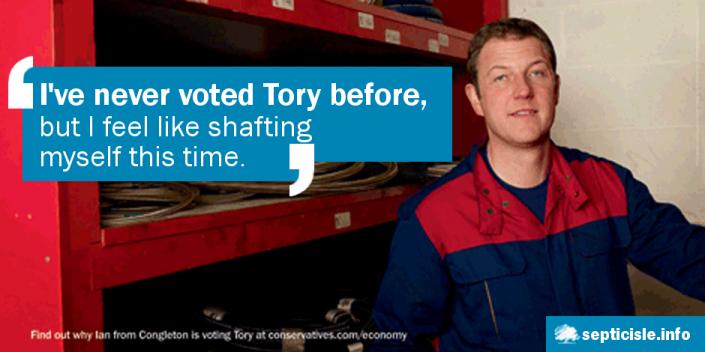
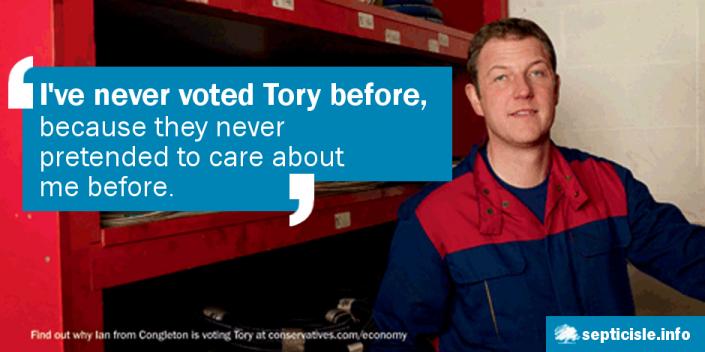
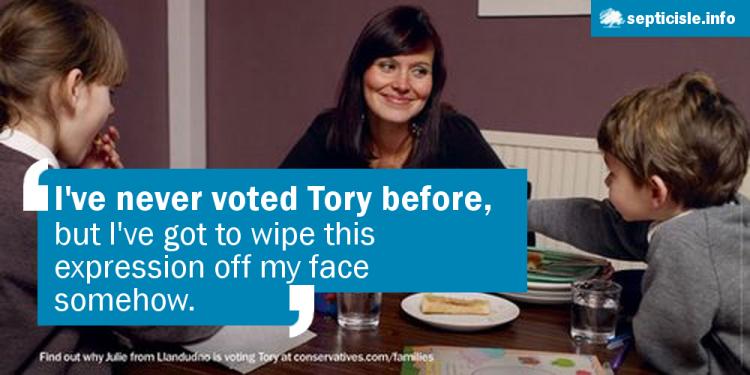
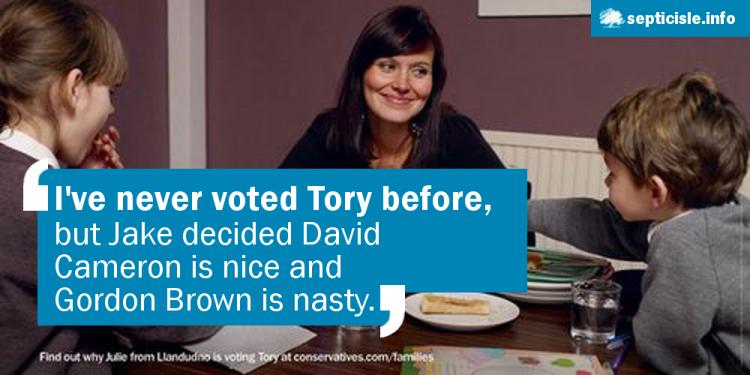
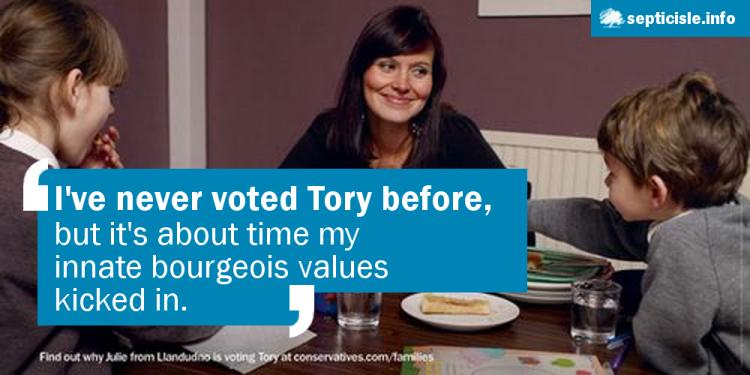
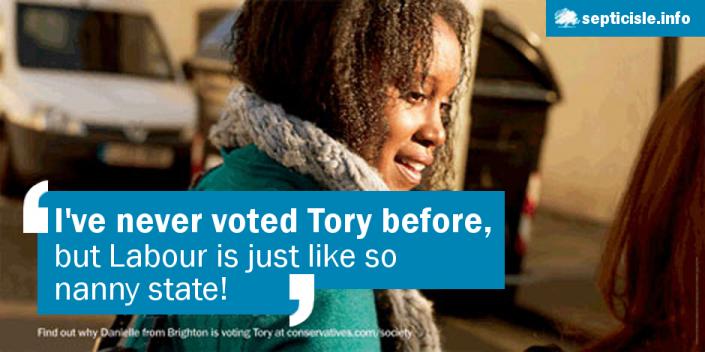
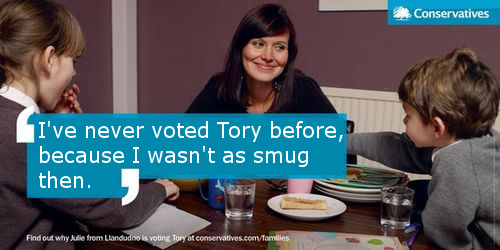
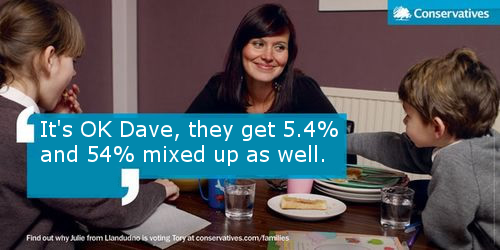
I've never voted Tory...

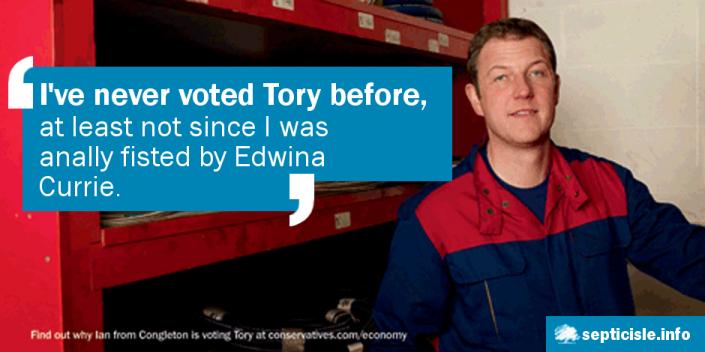
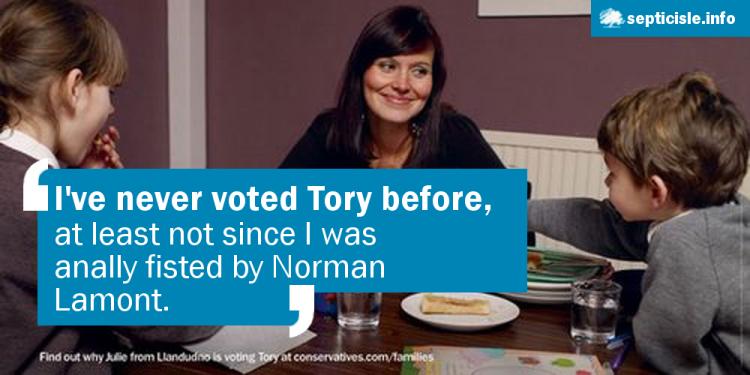
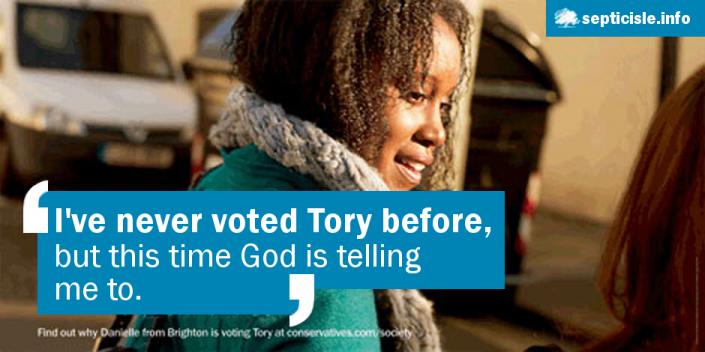
You just can't keep a bad thing down. These are incidentally the best Tory adverts so far, although that's not exactly difficult given how terrible the last two have been. Almost makes you wonder whether they went with the "ordinary people" angle mainly because it makes them far more difficult to deface without insulting those in the adverts personally. Not that that's stopped me. Templates over at mydavidcameron.com as usual. Also I know the fonts aren't right, but I haven't the foggiest what the originals were and they don't look too bad anyway. Good ol' Verdana:


Labels: , , , ,

Share |

Wednesday, February 10, 2010 

Tory tombstones.

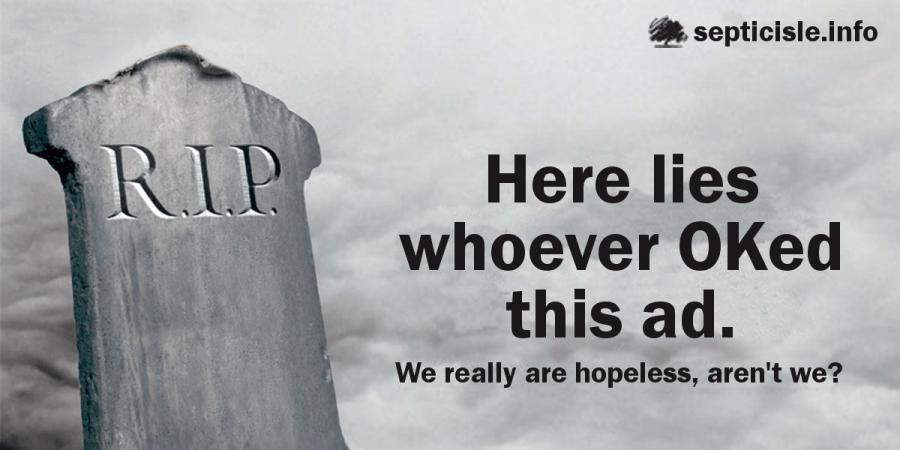
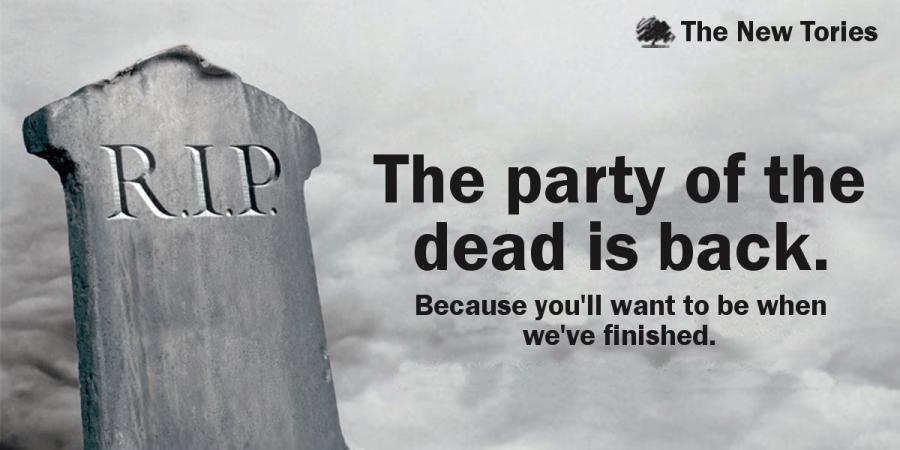
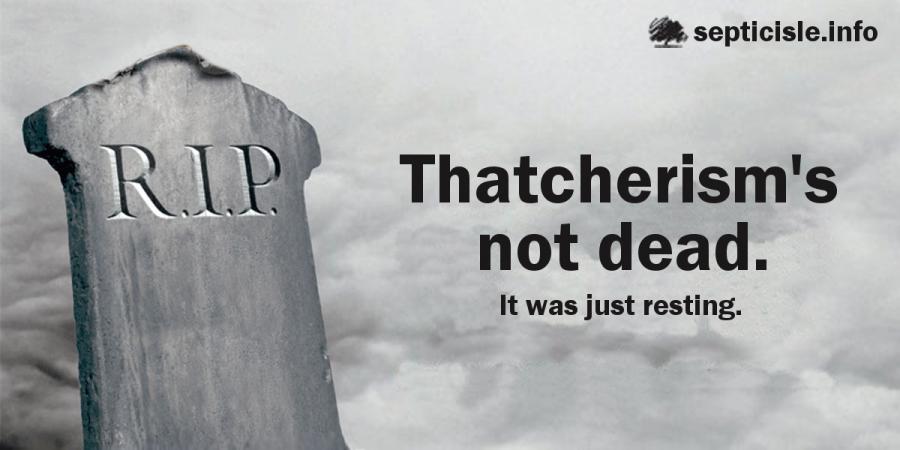
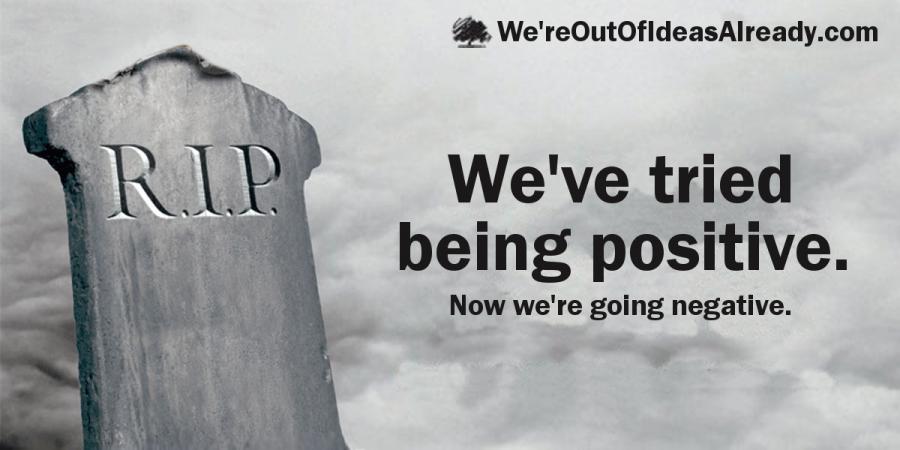
Here are my feeble attempts at spoofing the latest Conservative advertising failure, which I'm sure you couldn't possibly have lived without:


Labels: , ,

Share |

Thursday, January 28, 2010 

The party's over.

Unlike a lot of other teenage revolutionaries, I successfully resisted the temptation to join one of the random far-left groupings that still, despite everything, manage to keep themselves going even as the members doubtless inexorably age. It isn't difficult though to still find affection for groups that believe the shrinking proletariat will, despite all the signs to the contrary, eventually become a revolutionary vanguard with the power and means to overthrow the ruling class. Whether a dictatorship of the proletariat will then follow remains to be seen; that's one of those things that modern Trotskyists never manage to agree upon.

Reading Dave Osler's survey of the potential for a far-left breakthrough at the general election is to re-read the annals of socialist sect history over more or less the last 20 years. Without placing the blame at any particular grouping, the failures are obvious: a complete inability to work together when only an alliance could so much as begin to threaten the Labour party, a shocking lack of leadership material, and that which there is tends to be egotistical and controlling beyond belief, an obsession with fighting yesterday's battles while ignoring the changing nature of modern British society, and most importantly of all, thinking that the electorate will connect with you rather than you having to connect with them.

The spectre which once only haunted the socialist left is now hanging over the left as a whole. The left has just failed to take the greatest opportunity to be handed to it in a generation: a crash which many predicted but which it has been unable to take advantage of. Even as governments turned to Keynes, the left's response has been either muted or non-existent. Just when an alternative has been most needed, as those who have never experienced a recession have had to get used to the feeling of being surplus to requirements, the explanation for why this cycle is doomed to repeat has been almost wholly lacking. Left economists may have been those whose advice has been turned to, but no grouping has built upon this to turn it into a critique of where we went wrong and what has to be changed to even limit the effects should it happen again.

Undoubtedly we can put some of the blame upon a Labour party which has never looked so moribund. It seems determined to spend its few remaining days in power, when not sulking about still being lead by Gordon Brown, showing the poverty of thinking which has condemned it to its current position. All it offers now is the chance for you to keep up with the Joneses, the shallowest, most limited vision of aspiration imaginable. This isn't just down to Brown's intellectual inadequacy when he moves off economics, failing to articulate the "good society" which Blair in flashes painted in his famous verb-less speeches. It's a direct result of Labour's obsession with the dead centre, the triangulation which inhibits its every statement.

Who though is waiting for their chance to prove they could do better? Alan Johnson? One of the Miliband brothers? Harriet Harman? Peter Mandelson? Every single one is dedicated to the continuation of the current policies, with slight changes at the edges. This is the biggest problem facing not just Labour, but the left at large: there are no new potential leaders waiting for their opportunity, rather just the same old bunch of either politicos, trade union dinosaurs or uninspiring if competent incumbents.

Take, just as an example, the "Progressive London" conference being held this weekend. Not content with continuing to use the word "progressive" as if it still means something, it's Ken Livingstone also failing to realise that despite all he's done, for which he deserves praise, he's now yesterday's man and ought to put his dreams of returning to the Mayorship behind him. Look at the panel on "the cost of war" and try not to either smash your monitor or throw up on it: what can Galloway, the political editor of the fucking Morning Star, CND and the Stop the War Coalition say which they haven't already and which hasn't already driven away those who once protested? To take one gathering which isn't completely shooting fish in a barrel, there's Stopping the BNP - no concession to the far right, which features such luminaries as that guy out of that band which made that "Heavyweight Champion of the World" song, alongside an union regional secretary and someone from Love Music Hate Racism. When perhaps discussion on why people vote for the BNP should be foremost in the minds of the left, and how to win back supporters that have crossed the political divides, the first people I know I'd turn to would be someone from a good cause which everyone can get behind but which changes nothing and a guy who's made one hit record. There are a couple of promising panels, such as the one on electoral reform and homes and planning for London's future, something which is actually practical, but the rest is the left banging on about the same old things without ever moving forward, which, unless I'm much mistaken, is what progressive is actually meant to mean.

Even if the left and the Labour party separated some time ago, the massive victories of 97 and 2001 resulted in a lengthy period in which minds went unfocused and everyone pretended that much was fine. Since then it has, quite reasonably, focused on foreign affairs but in doing so allowed domestic politics to rot away. The biggest indictment of the left, if over anything, has been the continuing rise of the BNP, and through its refusal, both to even countenance debating the organisation but also in accepting the new orthodoxy that immigration was fine before but it is out of control now and needs to be tackled. The response at this year's European elections to the biggest far-right electoral threat of modern times? To split the vote away from the Greens, with Bob Crow's hopeless and reactionary No2EU organisation and the 80s throwbacks the Socialist Labour Party both on the ballot alongside all the other non-entities. Just when it needed to come together to fight the greater enemy it fractured just as it has in the past.

Where does the left go from here? The best case scenario is that it gets the rude awakening of its life come 6th of May; although a Conservative majority of the size of Labour's first and second terms thankfully seems unlikely, a victory which is large enough to concentrate thinking is the best possible outcome. It doesn't just need to rebuild; it needs to examine whether it has to demolish and start again. The party's over, and whether it starts again depends entirely on the reaction in the coming months. If, as Chris so accurately describes the prospect, of a government run by the children of the rich for the children of the rich doesn't reanimate the corpse of a dying ideological bent, nothing will.

Labels: , , , , ,

Share |

Monday, January 18, 2010 

The Tory education class war.

At the weekend Peter Oborne treated us to a treatise on how the Conservatives have put together the most radical program for government since Oliver Cromwell, or words similar to that effect. Cameron is far more prepared for government than Blair ever was, and he'd make Margaret Thatcher look like an, err, Conservative by comparison.

Back here in the real world, when you can put a cigarette paper between Labour and the Conservatives, it's invariably the Tories that have the more stomach-turning ideas, as well as those which are simply wrong-headed, or indeed those that are openly reactionary, somewhat strange for a party that claims to now espouse liberal conservatism, whatever that is. Hence we have the pledge to openly redistribute from the single, engaged and everyone else to the married, those who are truly the most in need. Or as today's launch of the party's education policies showed, somehow managing to be even worse than Labour at reforming our benighted education system.

After all, it really ought to be an open goal. Even after almost 13 years under New Labour, still barely 50% manage to get 5 "good GCSEs", a record so appalling that it can't be stressed often enough. There have been improvements made, although considering the amount of money pumped in it would be incredible if there hadn't been, and diplomas as introduced by Ed Balls with the mixture of vocational and academic work contained within is one of the few reforms which has been a step in the right direction, but on the whole Labour has been too focused on the league tables, the incessant examination of students and the continued reforming of schools purely it's seemed at times for the sake of it, with academies being the obvious example, which in equal measure have failed to raise standards while at the same time imposing the kind of discipline and rigidity which seems to actively sexually arouse certain individuals pining for the corporal punishment and being seen and not heard of their own childhood. Oh, and the lessons in working in call-centres, the kind of aspirational teaching that the Conservatives seemingly want to build on.

When Cameron then immediately decides that the most important thing which will decide whether or not a child succeeds is not their background, the curricula, the type of school or the amount of funding it receives but the person who teaches them, he's on the verge of talking nonsense on stilts, with Chris linking to some research which is in disagreement with that which Cameron quotes. Ignore that for a second though, and just consider Cameron's thought process: because the teacher is so important, only the very finest should be funded. How are we judging whether the teacher will be any good or not? On the basis of err, the university which they received their degree from and on the grade on the paper they received at their graduation. Surely if the type of school isn't important from the start, it also shouldn't matter which university the degree came from? Obviously not.

For a party which has been crying about Labour's piss-poor supposed class war, the thinking behind the proposed education policy is openly elitist, and also openly discriminatory in favour of the middle and upper classes: when only the top 20 colleges are likely to be considered good enough for those applying for the funding scheme and for their student loan to be paid off, colleges which are overwhelmingly populated by former private school students and which most state school applicants are actively discouraged from applying to for that very reason, this is the Tories' very own class war, their prejudices writ large in the same way as they claim Labour's to be. Even then it's contradictory: only a few months back Michael Gove wanted ex-service personnel to be fast-tracked into schools; now only the "best professionals with the best qualifications" need apply.

Others have pointed out that there is no correlation between the degree you get and the ability you have to teach. In fact, as Chris again suggests, the most academically gifted can potentially make things worse for those with lesser ability. I'd go as far to suggest that there are three groups of teachers out there: those that know what they're doing, those that can connect with those they're teaching, and that far rarer group, those that can do both. The exam results you get in your early twenties are no indication of how good you'll be at either of those things.

Not that the contradictions stop there: on discipline the Tories want to hand all the power over to the teachers themselves, ensuring that they can't be overruled by independent panels on exclusions, while at the same time wanting to ensure that schools can be held to account. Except on the former presumably? Alongside this, we have all the usual promises on cutting bureaucracy, on defeating waste, empowering everyone and all, as is likely, under the constraints imposed by cutting the deficit. Missing, as always, is the realisation that the number one thing parents want is a good local school which they can just send their offspring to in the knowledge that they will receive a good education, not the option to set-up a new one if it isn't good enough or they decide it isn't good enough. This however simply won't float when you can instead introduce your own pet projects, or prove to the newspapers that you're going to do something through even further shake-ups. Just letting the current system settle isn't an option when you've got to put your own imprint onto it, and if anything is likely to make things worse, Cameron's prescription is likely to be it.

Labels: , , , , ,

Share |

Wednesday, December 23, 2009 

Shorter David Willetts.

(With apologies to Don Paskini.)

"As only 270,000 people married last year, it's clear that marriage is in danger of becoming the preserve of the middle classes. This obviously has nothing whatsoever to do with the ever increasing cost of getting married, but instead to do with the fact that there is no recognition of marriage in the tax system. By recognising the institution in the tax system (and putting the state to work to help couples stay together, but we'll make sure that we keep this relatively under our hats) we will at a shot vastly increase the number of couples who will tie the knot and live happily ever after. That this will also be a massive tax break for the already married, overwhelmingly middle and upper class that traditionally vote for us is neither here nor there. Nor is it an example of Conservative class war. Only the despicable Labour party does that."

(P.S. My eldest brother was due to get married this year to his long-term fiancée. They called it off, not because they would be penalised for getting married by the tax system, but because they could no longer justify the cost of the ceremony and reception etc, something which Willetts completely dismisses as an issue.)

Labels: , , , , , ,

Share |

Tuesday, November 24, 2009 

How very strange...

Having been "cleared" by the PCC's ludicrous non-investigation into the Guardian's allegations of widespread phone hacking at the News of the World, editor at the time and now chief Tory spin doctor Andy Coulson must have thought that was an end to any controversy concerning his tabloid past. The only blot on the horizon was Matt Driscoll, a former sports reporter on the Screws, who Coulson sacked while he was off sick for stress-related depression. Driscoll, quite understandably, took News International to a tribunal, alleging that the route cause of his illness was due to the bullying he had suffered at the paper, led by none other than Coulson.

The tribunal decided back in December that Driscoll had been both unfairly dismissed and discriminated against on the grounds of disability, but only yesterday did the amount of compensation which Driscoll was awarded come to light. The tribunal decided upon a quite staggering £792,736, which with legal costs will probably amount to a total bill to News International of around a million. Adding in the costs of settling with Gordon Taylor and two others over the phone hacking allegations, Coulson has cost Murdoch in total around £2,000,000. For someone who despite being fabulously wealthy is remarkably parsimonious when it comes to others spending his money, Murdoch senior (and doubtless also junior) will be seething.

Not of course that you would know any of this if you read a paper other than the Grauniad. Neither the Times nor the Telegraph has so much has mentioned, either now or back in December that Coulson had been found to be bully in chief as well as editor in chief. On the one hand, it's not exactly a revelation that tabloid editors are not often the most sympathetic and understanding of individuals, and that while it's probably not as bad as it was when the pressures were much bigger back during the tabloid hey-day of the 80s, newsrooms aren't exactly the most enlightened of offices. On the other, what's most instructive, both of the battle of egos in such workplaces, and also potentially of Coulson's own character, is the petty way the bullying of Driscoll started. Driscoll failed to stand up a rumour that Arsenal were planning to play their last season at Highbury before moving to their new stadium in purple, commemorative shirts, rather than their traditional red and white, with the scoop instead being stolen by, of all papers, the Sun. You could perhaps understand Coulson's apparent ire more if Driscoll had failed to stand up a rumour on the equivalent of say, Ronaldo moving to Real Madrid for £80 million. A fairly poxy story about Arsenal playing in a different kit seems rather inconsequential, but not apparently to Coulson.

Again, you can perhaps understand why the tribunal's ruling was never going to lead to David Cameron giving Coulson the heave-ho. After all, one of the major parts of spin doctoring is in effect bullying and cajoling journalists, not to mention politicians, and that's without wondering whether there's any truth behind the more wildly fictional antics of Malcolm Tucker. Coulson has of course become even more useful as News International has drifted away from New Labour and over to the New Tories; few doubt that Coulson has been at the heart, not just of the discussions behind the Sun switching support to Cameron, but also at the far more significant negotiations concerning the almost wholesale adoption of policies to the benefit of News International, whether it be the quick abolition of Ofcom, one of the few quangos to be directly identified by Cameron as to be hurled onto the bonfire, the attacks on the BBC or the removal of the fuddy-duddy idea that television news has to be impartial, swiftly leading to the transformation of Sky News into a version of Fox News which America knows and loves and which Murdoch senior has long wanted to do. Also likely to be dismantled are the rules on media ownership, with Murdoch probably swallowing ITV whole, although the Sun seems to treat the channel as part of the family already regardless (although the Sky shareholding of 17.9% helps).

Even so, the worst that could be said of Alastair Campbell before he became Tony Blair's chief press officer was that he always treated his bosses, regardless of who they were, with unstinting loyalty, never more exemplified than when he punched Michael White after he made a joke about Robert Maxwell shortly after his death. He certainly wasn't accused by a tribunal of leading the bullying of a vulnerable, sick man he had ultimate authority over. It's worth remembering that back during the "Smeargate" storm in a teacup, when we suddenly discovered, horror of horrors, that spin doctors say unpleasant and sometimes untrue things to others, the impression we received that it was only nasty New Labour that did spin, and spin which brought politics into disrepute in itself. Coulson though now bears the distinction of being notorious for all the wrong reasons before he even gets near to running the media operation of a political party in actual power. The real spinning, it seems, has not even begun.

Labels: , , , , , , ,

Share |

Wednesday, November 18, 2009 

The Queen's last gasp.

The obvious response to the Queen's speech would to be to class it as the last gasp gesture of a government on its death bed; the sole remaining embers of a cigarette burnt down to the very end, offering not even the slightest nicotine kick; the last words of the condemned before being dropped through the trapdoor. For once, the obvious response is also the right one, although not necessarily for the reasons detailed by either Cameron or Clegg.

Clegg, in the increasingly hysterical fashion in which he seems to be deciding is the best way to lead his party, declared that the entire speech should have been cancelled so that politics could be "fixed". Cameron too, complained that "the biggest omission" was the cleaning up of expenses. Considering that the proposals from Sir Christopher Kelly in the main do not change anything with any great immediacy, except for the intake at the next election, the only real reason for urgency is to prove who has the hairiest shirt, as it was before. Clegg at least has purer motives in wanting the changing of the way we do politics as a whole, but the emphasis which both are continuing to place on the expenses scandal only encourages the view that nothing has changed, when it simply isn't the case. True, the complete changing of our system which some rather hopefully imagined might happen has not arrived, but then neither Labour and especially not the Tories have it in their interests to implement the likes of electoral reform. We're going to have to make do with what we have for now, and further alienating politics from the majority is not going to have a happy ending.

That said, there's not exactly anything to inspire absolutely anyone in this final dirge of bills. Labour has, unless it's saving the big hitters for the election, finally ran out of any remaining ideas it had. Cameron's ridiculously hyperbolic claim that this was the "most divisive, short-termist and shamelessly self-serving Queen's speech in living memory" was wrong, not because it's divisive, self-serving or short-termist, but because it serves absolutely no one, certainly not Labour themselves. The Tories will obviously claim that the commitment to end child poverty by 2020 is meant to embarrass them once they take over, but it would embarrass whoever's in power. Can anyone seriously believe that child poverty in its entirety will be ended at any point in time, let alone in 11 short years, without corners being cut or pledges being subtlety altered? Capitalism itself ensures that there will always be winners and losers; the poor, as the Bible earnestly predicted, will always be with us. It is, like Nick Clegg said while criticising the fiscal responsibility bill with its equivalent pledge of halving the deficit within 4 years, like legislating the pledge to get up in the morning, an empty gesture.

Empty gestures were however the order of the day, as Jenni Russell ruthlessly exposed in her critique of the "pupil and parent guarantees" in the education bill. Politics by magic wand is though increasingly popular: it's the exact same nonsense as "sending a message", whether it's through foreign policy or on drugs, somehow imagining that by raising cannabis back up to Class B the kids will realise that this isn't a safe drug after all and so reject it in favour of those other legal highs, the ones which the government isn't also attempting to criminalise. There was yet another in the Equality Bill, with the public sector having a duty to narrow the gap between rich and poor. Will this be done by cutting the ridiculous salaries which some chief executives on councils and other managerial types take home and "redistributing" them to the lower paid in the public sector? I somehow doubt it.

We should perhaps be grateful for small mercies. While there is an umpteenth crime bill, making it even easier for the police to carry stop and searches, which is simply guaranteed to cut crime at a stroke and have no negative consequences whatsoever, there is no new immigration bill. Missing though was the health bill, which was odd enough to prompt Cameron to ask where it was, even while he was lambasting the government for being addicted to "more big government and spending" and also the housing bill, both of which would have been popular with core Labour supporters. Perhaps they're being saved for the manifesto, but it does show that for Cameron's claim that this was all about electioneering (politics, in a Queen's speech, as Martin Kettle notes, how horrible!) Labour still hasn't brought out the really big guns as yet.

It did however make you wonder what the point of the entire exercise was. How many of these bills will actually make it to the statute book is impossible to know. That there are only 33 legislative days in the Lords though between January and when an election is likely to be called suggests that it won't be many, if any. Everyone in essence was going through the motions, gearing up for the real fight, which is still some distance away. Perhaps the Queen and Duke of Edinburgh could have been given the day off and some random individuals pulled off the street, put in fancy dress and lead in to read the interminable goatskin vellum. It would have been a sight more authentic than Cameron and Brown pretending to talk to each other as they walked into the Lords.

Labels: , , , , , ,

Share |

About

  • This is septicisle
profile

Archives

Powered by Blogger
and Blogger Templates