Monday, January 27, 2014 

Walking into Osborne's man trap.

It isn't always the case, but generally if you get a whole section of industry spitting tacks and issuing threats when you announce a new policy, it's generally a sign that you're doing something right.  It happened when Ed Miliband announced his intention to cap energy bills, when the big six squealed that preventing them from raising the cost of energy for 20 months would result in blackouts and a collapse in investment, and regardless of the merits of specifically capping bills, it focused attention on a monopoly that needs breaking up.

The fact that the usual suspects have been decrying Ed Balls' announcement he will bring back the 50p top rate of income tax should Labour win the next election, while being exactly what you would expect, also suggests that there's something in it.  It can't be that it'll raise almost no money while driving away business or cause those fabled wealth creators to flee due to having to pay an extra 5p in the pound.  Of course, it might raise hardly anything due to the fact that so many will use various dodges to avoid paying it, but that isn't the same thing.  The Institute for Fiscal Studies, while agreeing with the government that the £10bn Balls quoted isn't associated with the 50p rate, accepts that the evidence for how much it could raise or cost is uncertain.  The best insight is from HMRC itself, and associated with the 50p rate the coalition inherited and quickly binned.  Plenty of those who knew they were about to be affected gave themselves a windfall the year before it was introduced, while Osborne's announced abolition of the rate enabled them to repeat the procedure, only delaying it by a year instead.  The only way to know how much it raises is to give it a few years without messing around with the rate.  As Chris also points out, much of the reaction is just nonsense: top rates of 80p or more up until the 80s didn't affect the overall growth rate.

As much of a break with the past 20 years it will be for Labour to have an election manifesto that promises to put up income tax, it's insignificant compared to Balls' other announcement, that the party would ape the Conservatives and also aim to run a budget surplus come the end of the next parliament.  There was one important caveat, that unlike George Osborne Balls would seek to borrow to invest, and so only day-to-day spending would be capped rather than spending overall.  The Graun suggests it's the other way round, as budget surpluses have only been ran briefly in the past half century and are as it puts it, unnecessary.  Hopi Sen by contrast agrees with me.

The Graun is surely right when it calls Osborne's promise a hollow one.  To achieve the reduction in spending needed for his surplus the cuts would have to go far beyond anything the coalition has attempted so far, and even if the Tories manage to get a majority at the next election, you just can't see the politics being acceptable, even after the shit-kicking the poor and sick have received over the past few years.  When Osborne delays his fiscal consolidation even further, as he almost certainly will, the only people calling him on it will be Labour.  Just as no one has taken any notice of how Osborne has comprehensively failed to achieve even the reduction of the deficit foreseen by Alistair Darling, the same plan denounced by Osborne as being no plan at all and which would lead to us following Greece towards bankruptcy, so will everyone ignore the coming failure.

Should Labour win the next election though, the Tories and the right-wing press will constantly remind Balls of his rash promise.  We all knew there were going to be cuts, but to pledge to follow Osborne's lead, even while leaving himself more wriggle room was to walk straight into Osborne's trap.  Even if Balls were to call an emergency budget immediately after the election and row back completely on his pledge, getting the "bad" news out of the way straight off and setting out how he would really be aiming to reduce the deficit, such as through a more balanced mixture of cuts and tax rises, it's dubious as to how such a strategy would would play out.  The dishonest approach at the moment is to give the indication that you can make these drastic reductions in spending without it hurting when it simply isn't possible.  Better to set out how you would get the deficit down in time, in a realistic fashion.  It's surely a better option than getting involved in a game of who can make the most ridiculous gesture with Osborne when someone is going to lose horribly.  Despite everything, it still remains unlikely to be the chancellor.

Labels: , , , , , , , ,

Share |

Monday, August 12, 2013 

August is hell.

Simon Jenkins is right: August politics is hell.  Anyone with even the slightest amount of sense (or a life) is paying even less attention than normal, which gives free rein to the worriers and the bitter to whine about how their party is doomed to defeat.  Earlier in the year it was the Tories that were staring into the abyss, riven by Europe, embattled by UKIP, staring a triple dip recession in the face.  Little more than 3 months later, and things are looking brighter for the party, although nowhere near as good as their chances of winning the next election are being portrayed in certain areas of the Tory press.

Naturally then, it's now Labour and their hangers-on that are having an attack of the jitters.  Quite why is difficult to ascertain: it's not as though things have changed dramatically.  The party still has a lead in the opinion polls, even if it has been somewhat reduced; the economic recovery, such as it is, is hardly secured, and for now is likely a mirage outside of the south east; and despite the best efforts of the Tories, no one out in the real world gave a toss about the supposed selection scandal involving Unite up in Falkirk.  The problem more than anything is that Labour has been relying on both the economy remaining stagnant, despite Ed Balls having accepted there would be growth by the time of the next election, and the Tories remaining about as popular as they are, difference being they're the ones in government.

True, there's more than something in the criticisms from the few backbenchers who say the party doesn't seem to know what it's for, isn't offering an alternative, or managing to make the agenda.  Nor though for the most part is the government doing the latter; when it does, such as with the "go home" campaign, it's also far from clear as to whether or not the effect has been positive.  Policy is stuck in a groove: the Tories characterise it as Labour opposing every cut, while in actuality it tends to be "we wouldn't be doing this if we were in government now but most likely won't alter it if we win the next election".  It's opposition in spirit only, while still taking a hit.

The odd thing is that on the whole, Ed Miliband has set out the general themes that the party needs to be focusing on.  The squeezed middle might be the least well defined social grouping in history, but living standards will undoubtedly dominate come 2015.  He set out a critique of predator capitalism, for which he was widely mocked by the media at the time, and yet tax avoidance by multinational corporations has become an issue as never before, while the spread of zero-hour contracts has exposed what a nonsense it is that employment law is in some way holding business back.  One Nation Labour has not been explained quite as well, but the potential is still there, especially as the Tories look set to go for a doctrinaire right-wing manifesto come 2015.  Should Scotland vote no next year, it certainly won't be due to gratitude for the coalition government.

Labour's problem isn't then just due to indecision within the party itself, it also reflects the sad state of politics more widely in the country.  We're told endlessly that politicians are all the same, yet present the electorate with an alternative and they don't want that either.  Up until very recently they thought cuts were unfair and harming the economy, but they didn't want to take the risk of loosening up, reflected through the lack of anything approaching street opposition as austerity as has been seen elsewhere in Europe.  The closest they've come to approving of an outsider is Nigel Farage for goodness sake, about as alternative as John Bishop is to Michael McIntyre.  This is where some of the criticism of Labour's current position gets silly: John Harris bemoans how Labour has missed the digital revolution, as though "a viral video" or a few more tweets from Balls and Miliband could make the difference.  You might have thought it would have been cleaved into a few skulls by now that only politics nerds and journalists are interested in passing Twitter frenzies, let alone such pointless campaigns as trying to ban page 3, but apparently not.

In effect, the main reason behind the whinges is that Labour isn't doing quite as well as it was.  It's not anything more deep seated than that.  How could it be?  Despite the despair of the likes of Dan Hodges or the equivalent from the opposite side by Owen Jones, the party remains where it is because it doesn't think the general public wants it any further left or right than where it currently is.  What's more, the opinion polls back them up.  Hardly any MPs voice outrage at what the coalition is doing to the welfare state, how Serco and G4S are not that far off from running the country or how the Tories seemed to have settled on creating growth through encouraging another housing bubble, for the precise reason that it's exactly what they would do if they were suddenly foisted into power.  Sure, they might do things ever so slightly differently, but not massively.  The most anger we've heard from a Labour MP recently has been Stella Creasy, and that was about fucking Twitter again.

More pertinently, why make the effort when the next election will be decided in such a small number of seats again?  For the Tories to win a majority they have to increase their share of the vote, something a party in government hasn't managed in a very long time.  They seem to think they can achieve this feat through repeating the same Lynton Crosby-honed themes over and over for the next two years: Labour is weak; Labour got us in this mess; Labour are the welfare party. Given a shorter timescale it might work, but keep it up for too long and it'll just become tiresome, even for those who don't pay attention.  The result we might have to face is another hung parliament, another five years of conglomeration and drift.  And the sad thing is, no one seems particularly upset by the prospect so long as they've got some hold on power.

Labels: , , , , , , , ,

Share |

Thursday, June 06, 2013 

Just as expected.

I can't help but have mixed feelings about Ed Miliband's big welfare speech, as it's been trailed all week.  The pragmatist in me thinks it was about as good as it was ever likely to be.  It makes some concessions to the way the Tories have attempted to depict everyone on benefits, regardless of what they're claiming, as a scrounger, but for the most part it takes the argument back to them.  This is what we would do to bring the social security (as Miliband repeatedly referred to) bill down, even if it takes time: by reducing unemployment through a job guarantee, building houses, allowing councils to negotiate with landlords on the behalf of tenants, encouraging employers to increase wages through giving them tax breaks via the money saved on tax credits.  What would the Tories do, other than keep eulogising about work while condemning those who are desperate for it?

Obviously designed as an attempt to win back the support of those who think they are the only ones deserving of benefits while everyone else is gaming the system while also fighting back against the myths the Tories and the right-wing press have propagated, it does seem to have been mostly successful.  If we were to judge by the Tory response, which has been to say the entire thing was vacuous or the same old nonsense from a party that has opposed every welfare cut the coalition has imposed (which isn't true, but never mind), then it seems to have hit the target.  Rather than engage, all they've responded with is ad hominems.  It also seems to have in the main gone down well with both right and left within the party itself, which considering the worry there was that Miliband was going to essentially adopt the coalition's policies is a reasonable achievement.

My idealist side, however, feels this was exactly what we'd feared.  It's one thing to suggest that it appears that some people get something for nothing out of the system while others get nothing for something, it's then quite another to accept that there are a "minority who should be working and don't want to", and then repeat that sentiment again and again.  It would be to deny reality to say there isn't anyone out there on benefits who is able to work but doesn't, but the numbers we're talking about are incredibly slight, so tightened has the system become.

You also have to worry that the party has walked straight into George Osborne's trap by accepting a cap on overall spending.  Miliband said that it would be structural, rather than cyclical, yet this is hardly set in stone.  When Osborne outlines what his cap will be and the benefits it will cover, the demand will be for Labour to accept that as well.  After all, the party has effectively said they'll abide by the overall amount of spending come 2015/16, just not the specific items.  Why should it be any different on this?

Nor was he convincing when it came to ensuring that the most vulnerable are properly protected.  There was no apology or recognition of the damage caused by the work capability assessment, rather Miliband said he'd wished the last government had reformed incapacity benefit sooner.  Yes, there was recognition that the system still isn't working despite changes under the coalition, and that there needs to further changes so that the test recognises what you can do rather than just what you can't, but we've heard all this before.  The sad reality is likely to be that this "tailored help", should it even arrive, will be the same as those on the work programme are receiving, where the stick comes first and the carrot second.  Much the same can be expected for those called into the Jobcentre once their child reaches the age of 3.

There's also little to recommend the section on low wages.  Rather than action, all Miliband promises is more persuasion.  While it's understandable that Labour doesn't want to promise a large increase in the minimum wage towards a living one when the effect could potentially be devastating on some small businesses, that doesn't excuse the failure to act to stop large employers from paying wages that still leave workers in poverty.  Condemning zero hour contracts and brutish work places is meaningless if Labour is unwilling to do something about them.  As welcome as the message is that work isn't always an end in itself, Miliband said nothing that so much as suggests the party knows how to stop business from reling on the state to top up poor pay.

Then again, why should we have expected anything else?  Rather than challenging public perceptions or media narratives, the modern politician accepts them as gospel and adapts their message accordingly.  It was Labour that began this race to the bottom, and now it's desperately trying to catch up.  In those terms, the speech worked.  If it does convince a few that Labour are worth trusting again, great.  Clearly, we should worry about what it means for the welfare state as we know it another day.

Labels: , , , , , , , , ,

Share |

Tuesday, June 04, 2013 

Breaking out of the Tory trap.

Trying to get your head around where Labour stands less than two years away from the election isn't easy. In theory, the party looks to be in decent shape: ahead in the polls, Ed Miliband the most secure main party leader, however strange that seems, and proven right about austerity choking off growth, as even the EU has now acknowledged.

And yet, things could clearly be better. The poll lead is shallow to say the least, Ed Miliband's ratings are as bad as Cameron's, and the party isn't trusted on the economy, despite the coalition's abject failings. Labour Uncut at times reads like a journal of despair. The pessimists know how difficult it is to defeat a government after a single term, even one as unconventional as our unholy coalition, while the optimists cling to the fact that the governing party hasn't succeeded in increasing their share of the vote at the next election since 1974.

If there is one message coming through loud and clear from the electorate at the moment, it's contempt for politicians in general. Nor is this surprising when the economy's lousy, wages are falling in real terms and when there isn't any real alternative on offer from the opposition, let alone the promise of something better to come. It doesn't exactly inspire then when Ed Balls comes out and all but commits to keeping to the level of spending set out by the coalition for 2015/16 should Labour win the election.

For that was the real story to come out of the speech Balls made yesterday morning.  This wasn't the first time that Balls had all but suggested the party would do so, only the last time he did there was such a (justified) outcry from the unions that the subject wasn't broached again.  Yesterday, apart from a few noises from the GMB union, there was no such protest.  Partially, that's down to how things have changed since and how catastrophic the coalition's helming of the economy has been.  An economy that was beginning to recover in 2010 has since stagnated, making the next government's inheritance potentially even worse than the one the coalition had in 2010 and which they have made so much of ever since.  It's also a recognition though that regardless of widespread discontent, there hasn't been anything approaching a unified protest against austerity, unlike on the continent.

It's exceptionally close to being a paradox.  The often heard complaint is that politicians are all the same, and it's certainly true that on most domestic measures there's little real difference between the main three.  At the same time though voters tell pollsters they don't trust a party that's offering a subtle but significant difference to the government's economic policy, leading that party to move to reassure voters they can be trusted by signing up to their overall spending plan.  That doesn't mean they'll spend on the same things, just that the same overall amount will be splashed out.  This, Labour's thinking goes, will be the message that gets through.

Except as we saw, through also looking for specific spending to cut in an attempt to respond to Tory jibes about opposing everything, the media focused on means testing winter fuel payments.  Balls also suggested stopping free schools from opening in areas where there's plenty of secondary capacity already, abolishing police commissioners and cancelling "titan" prisons as other areas where savings could be made, but these strangely didn't have the same impact as stopping payments to well-off pensioners.  Much nonsense was spoken about how this could be the beginning of the end of universal benefits, or how the Tories might exploit Labour's change of position, when it's clear this was designed to be a gesture and little more.

Deserving of far more concern is that Balls floated the idea of having an overall welfare cap that differs according to the cost of housing around the country, meaning effectively it should be higher in London where prices are silliest, very one nation, and that on Thursday Ed Miliband is due to give a speech that is being briefed as Labour agreeing with the Tories on the need for a "structural" cap on welfare spending.  There's no point whatsoever in saving £100m by stopping payments to comfortable pensioners if there are then further cuts to working age benefits that have already been so squeezed by the coalition, as the IFS today made clear.

All this feeds into Labour's biggest problem: the party hasn't worked out where it intends to stand and fight come the election.  Despite the sloganising, Miliband still has failed to set out exactly how he intends to tame predator capitalism, nor has he attempted to define what he means by One Nation Labour.  He and Balls have said they want to bring back the 10p tax rate, but not explained how that would fit in with changes made under the coalition.  The party rightly opposed the 1% freeze on benefits, yet now seems to have decided to give in and ape the Tories.  With the rise of UKIP politics is undoubtedly being pulled further towards the right, and there are plenty within Labour who are perfectly happen to continue with the old policy of triangulation, epitomised by the murmurings over allying with the Tories to get the communications bill through in the face of Lib Dem opposition.


Needed most of all is a vision that contradicts the Tory myth of being in a global race where the only way to compete is by slashing hard won rights and protections.  We already know how the Tories intend to fight in 2015: attack Miliband as a creature of the unions, say all Labour want to do is borrow more, and claim they are incapable of taking tough decisions.  The best possible answer to that is for Miliband to set out how he intends to govern, as the knowledge that he couldn't possibly be as terrible at it as the coalition isn't going to cut it.  Nor is Ed Balls' message that the answer to too much is austerity is more austerity going to suffice.  Labour can win in 2015, but will fail miserably if the best the two Eds can offer is that they'll be the Tories with a kinder face.

Labels: , , , , , , ,

Share |

Thursday, July 05, 2012 

The fix is in.

Well, we certainly learned a lot from today's parliamentary debate. Ed Balls, for one, has mad staring eyes when riled, whereas George Osborne has an upper lip that curls when he knows he's been caught out in a lie. Quite why Osborne thought that he could accuse Balls of being involved in trying to get the Libor rate lower when as it now seems he had no evidence whatsoever and get away with it is unclear, unless the omnishambles has unfathomably failed to put a dent in his hubris. It wasn't a case of the Labour party never being so rattled, as Osborne claimed, as it was Balls and others being outraged by false accusations, and as so often in politics, it's not the real examples of suffering that MPs could do something about that really motivate them, but rather personal so-called smears, even those that never happened.

The other fix then is in. Partially down to how Cameron had his fingers burned when he was bounced by Ed Miliband into setting up the Leveson inquiry, and partially down to his adherence to George's wheeze to blame everything on Labour, we have a parliamentary rather than an independent inquiry. Sure, they'll apparently take evidence under oath and will be "briefed" by QCs, but anyone who claims this isn't a poor substitute for a judge-led inquiry is lying to themselves. As Labour managed to dredge up, back when the boot was on the other foot the Tories were of course calling for an independent inquiry into banking as a whole, one they didn't get at the time. Now with the opportunity to launch one, they've ducked it.

All the stranger is that while Cameron was always likely to regret Leveson, having continued to employ Andy Coulson for reasons known only to himself, they are on the whole pretty clean on banking. Yes, they've been funded by the City, but then they always have been, and yes, they warned about excessive regulation when Ed Balls was in charge of making sure it was "light touch", but they can hardly be linked to the Libor fixing or the disasters that led to the bail outs. At worst they can share some of the blame for delaying the full nationalisation of Northern Rock, having disingenuously claimed it would take us back to the 70s, something that rattled Brown and Darling to the point of doing everything other than obvious, but that's a fairly minor point in the debacle. If Cameron and Osborne really believe that Shriti Vadera or whoever else was involved in telling the banks to set Libor lower so that they looked more secure than they were, then who's more likely to get to the truth, a judge and a QC or a cross-party group of MPs and Lords?

Osborne's gamble was that by linking Libor to Balls and friends it would therefore damage Labour's standing in the polls for economic credibility. If anything, it seems likely to have the opposite effect. All today's clusterfuck will have done is convince people that politicians, as ever, will fight amongst themselves and duck the big decisions when it has the potential to damage them personally. They'll have noticed this is just another exercise in blaming the last government for the mess everything's in, something they'll only put up with for so long, and about two years into a parliament as we now are is the limit. We already knew that Osborne is a tool whose powers of political strategy, if they were ever as impressive as claimed, have currently deserted him. More surprising is that Cameron was just as daft in going along with it.

Labels: , , , , , , , ,

Share |

Wednesday, January 25, 2012 

Something must break - again.

Politics at the moment seems to be even more a mess of contradictions than it ordinarily is. Just take a look at the current opinion polls - by rights, the Conservatives ought to be in deep trouble. Today's GDP figures for the last quarter all but vindicate the position of Ed Balls and Labour, that cutting too far and too fast would choke off the recovery. With the cuts not really beginning in earnest until April last year, this is the first real evidence of the effects of George Osborne's austerity, and the results have been all too predictable. Left with only the Eurozone crisis to blame, the responsibility for an 0.2% economic contraction can be levelled squarely at the government.

To be fair to those who don't really deserve the benefit of the doubt, some of the coalition's policies aimed at boosting growth haven't yet got off the ground, such as enterprise zones announced in the budget and the credit easing programme trailed prior to the autumn statement. They could yet have an effect. This though is to overlook two of Osborne's other policies which have failed to work: first, that there would be a "march of the makers", the clunky soundbite to end all clunky soundbites, and second that the private sector would be able to absorb those losing their jobs in the public sector. One of the main reasons for the negative figure is that manufacturing and construction output both fell sharply in the last quarter, while the latest unemployment figures (PDF) showed a staggering loss of 67,000 jobs in the public sector, with only 5,000 created in the private.

Why is it then that Labour can't even stay neck and neck in the polls with the Tories? The reliable ICM poll for the Graun gave the Conservatives a 3% lead over Labour, while YouGov for the Sunday Times found they had a 5% lead. Even more worrying is that Ed Miliband, perhaps not surprisingly considering the unbelievably hostile coverage he continues to receive in the Tory press, is continuing to plumb the depths in the personal ratings. Quite why this sudden lead has appeared in some of the polls is frankly a mystery: the last couple of weeks of carnage in the House of Lords over the welfare reform bill can't have irked the public that much, the Daily Mail's attempt to go nuclear over the injustice of bishops suggesting that child benefit shouldn't be included in the cap aside. It's not just the economy, either: the NHS reform bill is even more unpopular than both Nick Clegg and Ed Miliband put together, and Cameron's speech on responsible capitalism last week was piss weak.

It could just be that these are blip polls that will soon be corrected, and ICM's 3% is only just outside the margin of error. According to UK Polling Report, under the provisional new constituency boundaries Labour needs a lead of at least 4.3% over the Tories to win a majority. This is hardly an unattainable figure, but at the moment it certainly looks that way, especially down to the party's catastrophic economic credibility figures. Attempting to change this was behind the shift in recognising that the party could not promise to reverse any of the cuts made should it win the next election. Ed Balls will continue to call for a slowdown in the austerity package, as they would implement should a snap election be called tomorrow and they win it. The obvious problem with this policy is not just that it's a little too subtle, it's also just as slippery as Labour have been ever since the election. It essentially means that nothing in practice will change.

No surprise then is that for now at least it's been welcomed with the same enthusiasm as a fake Gary Glitter account was on Twitter. Beyond the trade union anger at Labour going along with the coalition's freeze on public sector pay, the real reason why it was so short-sighted is that even Standard and Poor's and the IMF, two of the great prophets of neo-liberalism, have now both made clear that austerity on its own is only going to make deficits worse. Through making such a fetish of removing the structural deficit by 2015, something which Osborne admitted back in November was now unachievable, alongside hubristic claims like the country was a safe haven, the coalition invited the kicking it ought to now be receiving. Labour, rather than ramming their point home and pointing out how they said this would happen, is now left in the position where most of the public thinks they wouldn't be doing anything differently.

Ever the optimist (on this only), I still think there's plenty of time for the public mood to change, especially if the next quarter also delivers negative growth. While avoiding the usual complaints of talking down the economy, Miliband and Balls have to keep repeating and ridiculing the promises that Osborne and Cameron made. The current contradictions simply cannot last; something must break. It has to be the coalition.

Labels: , , , , , , ,

Share |

Friday, October 08, 2010 

Labour's new generation part deux.

When you're blessed with such a surfeit of talent as Ed Miliband was in the shadow cabinet elections, there's always going to be a great difficulty in pleasing everyone when picking the jobs to place them in, and so it has proved. Frankly though, there was never much of Ed Balls becoming shadow chancellor; as effective as he might well have been in facing George Osborne, he both has a "reputation" as Gordon Brown's main protege and spent large parts of his leadership campaign all but denying that any cuts were going to have to be made.

This said, putting Alan Johnson in the position instead is potentially a gamble. As much as I'm inclined to agree with the ten reasons put forward by Martin Kettle for why he'll do a good job, all too noticeable by their absence is any actual economic credentials. True, George Osborne didn't and doesn't have any either and it's done little harm to his position apart from the occasional jibe about inexperience from the City, yet Yvette Cooper was surely the best compromise figure. It might as some have suggested led to another soap opera between her and Balls as to whether they agree and to as to how much influence her husband potentially has over her, but she clearly has experience on her side having both been an economist (researcher and journalist) before becoming an MP as well as formerly chief secretary to the Treasury.

Balls as shadow home secretary is also hardly ideal, again as we know little on his actual views outside of immigration - on which the party seems likely to move even further to the right following the major impact it had on the leadership election. It was however impossible for Johnson to stay in his position having in effect criticised Ed Miliband for saying the party had got it wrong on civil liberties, not being able to remember a "single issue" where it had got the balance wrong. Also constricting Miliband was that he had to consider the leadership contenders' relative placings; Balls might have best suited to his post while in government at education, yet his high profile and share of the vote meant he had little choice but to promote him, with either shadow home or foreign secretary the choices as chancellor was out. Somehow you just can't imagine Balls as foreign secretary, although how Cooper will perform there is equally open to question, even if as Sunder Katwala suggests she was moving towards a closer position to the new leader's one on Iraq three years ago.

Outside of those choices, the only other one worthy of critique is perhaps Miliband's choice of defence secretary. John Denham would have been a good choice, considering his opposition to the Iraq war, signifying a break with the past, although whether he would have wanted the job is open to question. It has to be hoped that some of the more lowly shadow ministerial positions will go to some of the new intake - the true next generation, unencumbered by having previously supported such destructive and disastrous policies as almost the entirety of the new shadow cabinet.

Labels: , , , , , , , , ,

Share |

Saturday, September 25, 2010 

Worst possible way to win.

Having already been branded "Red Ed" by the tabloids and the Blairites (however laughably), for the younger Miliband to win the Labour leadership on essentially the votes of the unions is not exactly the most auspicious of starts. Least worst option as he was and still is, he's going to be reminded of his debt to the unions, both by his opponents and by the likes of Unite until he wins the support of the public themselves.

(Incidentally, the number of spoilt union ballots was huge, as the breakdown shows. More in Unite spoilt their votes than plumped for Ed Balls and Andy Burnham combined. Whether those are protests or not understanding the voting system is open to question.)

Hardly any better is his winning statement as being distributed by the party:

"Today a new generation has stepped forward to change our party. We are united in our mission to transform Labour so that, once again, we stand up for the hardworking majority who play by the rules and want a less divided and more prosperous Britain. I know we have a lot of work to do. The journey starts today.

It really doesn't get much more Blairite than that. Those of us seeking someone who is prepared to put the case for the indolent minority who sometimes err on the wrong side of the law must go on searching.

Labels: , , , , , , , ,

Share |

Wednesday, September 22, 2010 

New Labour's dead cat bounce.

At long last, the seemingly unending Labour leadership contest has gasped its last, with only the ballots left to count. Congratulations must go to all five candidates: it must take a truly superhuman effort to keep repeating yourself over and over again daily for such an extended period of time and not find yourself going slowly but surely insane (Whoops, I seem to have just inadvertently insulted myself and all bloggers). Expectations at the outset were low, both for the standard of debate and for the potential for full, painstaking examination of why the party lost, and those expectations were more than exceeded. The party has essentially just spent the last three months travelling the country conducting a navel-gazing exercise that hasn't even begun to scratch the surface of how and why it lost, and in Ed Balls has someone who is just as myopic to the changing of the political tide as any of the deeply deluded Blairites. When it's Andy Burnham dropping truth bombs, trying desperately to make Balls realise that some cuts are going to have to be necessary and would have been made by Labour had it remained in power, even if not this year, you know the party's in a bad way.

In fact, Burnham has been the surprise candidate in that he's at least tried to think differently even if still within the Blairite prism: his "aspirational socialism" might be risible intellectually and in practice, yet using the "s" word in the current climate when Vince Cable gets derided for daring to make even the slightest critique of capitalism takes a certain amount of bottle. Embarrassing by contrast has been Diane Abbott, who's ran an invisible campaign and seemingly treated the entire thing as a joke. We have to make an allowance for how it takes money to do anything political these days and she's had almost none pledged in her direction, but that's no excuse for not even seeming to put an ounce of her heart in it. It has to be remembered that John McDonnell stood down in favour of her, who just might have managed to drag the debate leftwards and make the party's apparatus think about those who have been systematically abandoned and marginalised by New Labour. Instead Abbott's acted as the party's false conscience, sitting in yet contributing nothing. When Abbott is the face of the Labour left, that section of the party shouldn't be surprised when it finds itself derided and ridiculed.

The fear from the beginning was that it would be personalities rather than policies which would be the main topic of debate and so it has proved. Admittedly, when the two main candidates are brothers it's always likely that the media, already about as interested in the leadership contest as it has been with the floods in Pakistan, was going to focus on that to the detriment of everything else; the problem has been that it's been their camps which have been playing it up more than anyone else. Their relationship might well have turned poisonous if we're to believe Neil Kinnock, and the interventions by Blair and Mandelson have hardly helped, yet still the entire fixation on it has been dispiriting.

What then, if despite all the speculation surrounding his brother and second preference votes, it does turn out to be David Miliband who becomes Labour leader on Saturday? Having been anointed as the only apparent successor to Blair and Brown, it would be a vote for a continuation of the New Labour project, even in its current decrepit state. Moreover, it would be an endorsement of all that Miliband stood for while he was a cabinet minister, and especially his record as foreign secretary. While much has been made during the campaign of how the elder Miliband continues to support the Iraq war in the obfuscatory Blairite fashion of having made the right decision at the time while Ed apparently opposed it, that ought to be the least of concerns. Far more significant is how he didn't just frustrate the attempts by Binyam Mohamed to find out the contents of the "seven paragraphs", which detailed that MI5 were fully aware of how he was being mistreated by the Americans and their proxies, he authorised Jonathan Sumption to criticise the legal opinion of Lord Neuberger for getting far too close to the truth.

Some of Miliband's actions in blocking the Binyam Mohamed case may have been down to protecting our relationship with the US, supposedly in danger due to our breaching of the "control" principle, whereby another country does not reveal intelligence shared with it without authorisation. The same cannot be said for Miliband's apparent authorisation of intelligence-gathering operations in countries with atrocious human rights records, as revealed by the Guardian today. For Miliband to have apparently returned to the Foreign Office to revisit his decisions is an indication of how serious he himself considers the allegations. It's one thing to defend the actions of your predecessors and the intelligence services they were responsible for at the time; it's something else to potentially give the OK for MI6 to seek access to information obtained via torture.

At the outset of the leadership contest it was clear that Ed Miliband was the best realistic option for leader, as in the potential to actually win, and absolutely nothing has changed since then. None of the candidates has shown a real willingness to take the few things that New Labour achieved and build upon them by revitalising the party's relationship both with its members and the public at large, and none has yet demonstrated anything even resembling a real alternative to the cuts agenda as articulated by the coalition. Ed has done the bare minimum required to deserve to lead the party, as Labour itself so often did when it was in power. Whichever brother triumphs, 2015 remains a year which the party and indeed the country should fear rather than look forward to.

Labels: , , , , , , , , ,

Share |

Wednesday, June 09, 2010 

Postponing the inevitable.

It seems that I should make rash predictions more often: after expelling nigh on 1,800 words centred on neither of the "left" candidates getting the required nominations to run for the Labour leadership, Diane Abbott duly did scrape together the 33 required, although only after it seems a number of former ministers felt they had to support her to ensure that they themselves weren't heavily criticised for all but silencing the entire left of the party.

Diane nonetheless wouldn't have got on the ballot if it hadn't been for John McDonnell stepping down, something which, as usual, he doesn't seem to be getting enough credit for. If anything, it was Abbott who should have stood down having 11 nominations at the beginning of the morning to McDonnell's 16, just one of the things which Dave Semple is quite rightly bitter about, but McDonnell perceived, almost certainly rightly, that Abbott's support wouldn't then back him.

You can either view these last gasps from such notable socialists as Chris Bryant, Denis MacShane, Jack Straw and Phil Woolas as noble attempts to allow the left the say, even as they have vehemently disagreed with it in the past and even attempted to crush it, or as a simple way to show that the parliamentary Labour party is representative and a wide church after all, despite all the naysaying. And we shouldn't completely dismiss Abbott as the token candidate. As Don Paskins argues convincingly, it's more likely that Andy Burnham will come last than Abbott will, and it's even possible she could come ahead of Ed Balls, neither of whom have anywhere near the appeal or mass support of the two Milibands, nor are they likely to gain much support from the trade unions. It will also ensure that this will not completely be a leadership election based around the politics and policies of the centre-right, as Diane will inevitably pull the debate leftwards.

None of this will however make up for the fact that yet again a genuine socialist voice with real grassroots support has been completely excluded from the wider leadership debate. It's almost as if the party hierarchy is frightened of even the mention of the "s" word, let alone someone representing those values. As welcome as Diane Abbott's inclusion on the ballot is, and how she will definitely energise it far beyond how it would have been if it was the four white Oxbridge educated middle aged males, there's no getting away from the fact that she's become a media luvvie who is now on the left of the soft left rather than in the ever dwindling socialist grouping. We needed a true left voice with the nous and real courage to take on and attack those only interested in the status quo, as was evidenced by the tensions at the hustings on Monday when McDonnell and the elder Miliband clashed.

We may well have been saved from a debate along the terms of that outlined by John Denham in a speech to the Fabians last night, which was an even harsher and even more deluded take on why Labour lost the election - namely, that through not turning the welfare state into a social insurance scheme Labour lost the support of the comfortably well-off, the "aspirational" voters who were outraged by the inequities of the benefits system, of those beneath them getting something for nothing, of the eastern Europeans claiming tiny amounts of child benefit as is required under EU regulations, when obviously it should be them the state should be helping. Labour is often accused by the right-wing press of envy politics, yet Denham seems to be suggesting that the party should take up the class war waged by the Mail and Telegraph in favour of the middle classes. Equally though, we shouldn't pretend this won't be the ultimate result. The best realistic result we can hope for is Ed Miliband to triumph rather than his brother. All the party has done is postpone the inevitable.

Labels: , , , , , , , , ,

Share |

Tuesday, June 08, 2010 

New Labour is dead. Long live New Labour.

The nominations for the Labour leadership close at 12:30 tomorrow. At the moment, neither Diane Abbot or John McDonnell is even close to gaining enough support from their parliamentary colleagues to stand; whether one or the other decides to acknowledge defeat before then, giving the opportunity for their nominees to swap to the other is uncertain. Even if they do, it's still up in the air whether or not they'll garner the 33 required, as they'll still need another six even if every single nominee changes sides. It's worth remembering that in 2007 Michael Meacher's supporters didn't decamp en masse once he stood down, leaving McDonnell 16 short of the number he needed, with Gordon Brown therefore elected unopposed, in what everyone now acknowledges was little short of a disaster.

To make a rash prediction, my gut feeling is that the same will happen this time, and with Andy Burnham only two nominations from the amount he needs, it seems all but certain that while we will have a contest, it will be a contest based on personalities foremost and policies a very distant second, with the winner almost equally certainly sharing a surname with another candidate. Not, it should be acknowledged, is this much different from what's happened in Labour leadership elections since the fateful 1980 vote which resulted in Michael Foot becoming leader of the opposition. Every contest since then has either been a foregone conclusion, with one candidate winning an overwhelming majority, or has involved a battle of egos rather than beliefs. The key difference is that the Labour party itself then had far more of an influence over policy than it does now, with conferences that mattered rather than being merely either a rubber-stamping session or an opportunity to express a grievance which was then completely ignored by the leadership.

In one sense, the party clearly has no one else to blame than itself for this state of affairs. Despite everything, the parliamentary party is still a relatively wide church: you have the Socialist Campaign Group on the left, the softer left Compass grouping, which if it had wanted to could clearly have stood a candidate whom would have found it much easier to get the nominations required, either a Jon Cruddas or even though he's outside it John Denham; the centrists such as Ed Miliband and maybe Ed Balls if you were pushing it, then the centre-right "Progress" style grouping which encompasses both David Miliband and Andy Burnham. If they had really meant what they'd said, they could have easily decided to tactically vote for someone so that it wasn't just the centre and centre-right of the party yet again monopolising opinion and then making clear that any dissension was back to the 1980s Militant-style bolshiness that simply won't wash in 2010.

The elder Miliband, despite initial murmurings about how much he wanted a wide selection of possible candidates has since shown his clear Blaritie centralising tendencies in his contempt yesterday for John McDonnell at a hustings, while none of the other three have put their words into action. In any case, the debate which has so energised the four likely to be on the ballot has not been about why Labour lost the election and attempting to understand the reasons why the party received 2 million less votes than the Conservatives; the reasons why have already been set in stone. It wasn't seemingly the recession itself, Gordon Brown, the general feeling that it was time for a change, or the stewardship of the economy, let alone Iraq or anything as crass as civil libertarian concerns, but rather immigration first and foremost and which all four have been determined to talk about as much as possible now the election's over, along with anti-social behaviour and the welfare state. Ed Balls went so far at the weekend to criticise his former master and indeed the person that he personally advised on immigration, while also penning a mea culpa that Labour was wrong to impose no controls on the A8 eastern European accession states, which led to the huge flow of migrant workers, arguing in addition that the European Union needs to drop its open borders policy when it comes to unskilled labour.

Even if we accept that immigration was, as Dave Osler says, the number one issue on the doorstep, it still didn't lose Labour the election on its own. If this was the case then the party would have almost certainly lost Rochdale after the Gillian Duffy incident and many other of the seats which it held onto. As has been pointed out so astutely by Jon Cruddas and Jonathan Rutherford, concern about immigration wasn't borne of hatred of foreigners or about the country being full to bursting, but instead because Labour failed to acknowledge the problems which go hand in hand with it, by ignoring the dismal state which social housing was in, by failing to make the minimum wage a living wage, and by letting agency workers undercut those at the bottom by not regularising them, failing as it did to implement the EU agency workers directive, something even Ed Balls now admits was a mistake.

Coupled with these failures were related ones, such as not explaining in simple terms where, as Mrs Duffy put it, all these eastern Europeans were coming from. There was not some grand conspiracy to open the borders and turn Britain into a multicultural paradise where immigration powered economic growth at the expense of the working class, but rather the far more benign mistake of assuming the the other EU countries would open their borders immediately as well, which with the exceptions of Ireland and Spain they didn't. This failure of explanation went along with the refusal to defend the decision. Lastly, the government failed to respond and defend itself against the repeated onslaughts from the tabloids on both immigration and the asylum system, so often packed with falsehoods and distortions; indeed, on numerous occasions it either colluded with them or agreed, regardless of the facts, further encouraging them while leading the readers to believe the absolute worst even if they didn't recognise the picture painted on their own patch. It decided that it couldn't beat them, so it joined them, with the appointment of the ghastly political thug Phil Woolas as immigration minister, whose only regret was that he didn't push the "points system" hard enough.

Through the emphasis on immigration it's all too clear where the leadership debate, or rather lack of it is going to head. Some of this is reflected in Neal Lawson's comment piece for the Guardian tomorrow, although it has to be remembered that Lawson, even if he's since moved somewhat to the left, was just as much a part of New Labour from the beginning as all four of the candidates were. He's right that Labour has lost its purpose, but it lost that long ago; where he's wrong is that the party has not yet hit bottom. We have to separate the party from the leadership, for the crucial reason that despite everything, Labour won councils and increased its number of local government seats last month, something pitifully under-reported. There is still life in the party, just as there always has been; it's the leadership and its refusal to integrate itself into local communities, which was the difference between winning in places like Birmingham Edgbaston and Tooting and losing in broadly similar seats. He says Labour didn't become the nasty party, but that it did become lumbering and arrogant; I beg to differ. It did become nasty, not because it had to, but because it wanted to and because New Labour knew nothing other than triangulation and reacting to headlines. Even now it doesn't know how to react to the new political landscape, where a new government is actually attempting to be something other than rigidly authoritarian, even if it no longer defends ID cards. As Diane Abbott despaired, how did it ever in the first place move to the right of the Conservatives on civil liberties? For the simple reason that it felt it it had to do, because the Sun said so, and because it's fell into the belief that only the chattering middle classes care about such things, not those C2s more concerned with the loutish teenagers hanging around on street corners than their damned right to do so.

More than anything, the real reason to despair at these four men and the contest which awaits is because as could have predicted, even with the Liberal Democrats in tow, the government is already moving to start the slashing and burning in the public sector as soon as is feasibly possible. David Cameron's speech yesterday was what we're going to have to get used to now, Labour being blamed for everything with no regard for what the Conservatives would have done differently had they been in the same position, the public sector being the enemy rather than the private sector which caused the crisis, the "economically inactive" being lined up to take the pain while the originators of the crisis continue to be amazed at how they're getting away all but scot free, first bailed out and then being readied to restart the cycle, while lip service is paid to "rebalancing" the economy, as if Cameron had even the first idea about strengthening manufacturing, when those jobs have sadly gone for good. To be fair, Liam Byrne and Alistair Darling's responses yesterday and today have been reasonably good, but we need the potential leaders of the party to be raising their voices and signalling their opposition to ideologically inclined cuts. We've heard nothing about the cuts, but plenty about irrelevancies.

The reality is that the party itself and its leadership, as well as some of the parliamentary party, are all but completely different entities. If neither McDonnell or Abbott get the required nominees, then they must finally realise that if the MPs won't allow their voices to be heard, it's not because they have nothing to say or offer, but because the elected representatives are actively ignoring the views of the activists that get them elected. As Diane Abbott has again so accurately put it, for a party that is so diverse to be ultimately represented by one of four individuals from the "narrowest gene pool in history" is a joke that simply isn't funny any more. New Labour crushed dissent and centralised itself to such an absurd degree because it felt it had to in order to get itself elected again. As the 97 and 01 results showed, it would have won if its leader had been the clichéd donkey or monkey pinned with a red rosette. Despite this, because it had become so wedded to control freakery and spin it believed had brought it to power, it never let go, and the ultimate conclusion is the four candidates before us today.

Those of us on the left thought we could support the Liberal Democrats as an alternative to a party which had abandoned so many of its principles; now we're effectively disenfranchised, unless Labour changes its ways. It shows every sign of doing the exact opposite. The tragedy is not just one of representation, but also for any real alternative to the current consensus. New Labour is dead. Long live New Labour.

Labels: , , , , , , , , ,

Share |

Saturday, May 22, 2010 

The Labour leadership contest: This is Yesterday.

I know you don't want to, but take a good, hard look at the four main Labour leadership candidates. Go on, force yourself. Like it or not, one of these fine upstanding gentlemen is going to become the focal point of opposition to the shotgun marriage of the Conservative and Liberal Democrats. OK, you can turn away now. Dispiriting, isn't it, to say the least? I'm reminded of both high and slightly lower culture: of Ozymandias by Shelley, looking on their works and despairing, but also of the last ever episode of Blackadder, where Melchett visits the western front and comments on the nature of the troops he will soon be sending to their deaths, to which Blackadder responds with "Yes sir - shortly to become fine bodies of men".

For all the platitudes, especially from the two Milibands, about wanting the widest possible field of candidates, this line-up is the logical endgame of New Labour, the equivalent of a policy akin to Stalin's socialism in one country. Having suffocated all dissent, centralised the party to a ridiculous extent, micro-managed the selections process to parachute in favoured, endlessly loyal apparatchiks and luvvies, these four are the perfect representation of the New Labour project, while also being the finest imaginable illustration of just how the party can no longer even begin to pretend to be representative of the country at large. It's also indicative of just how limited politics in this country has become, another of the ultimate successes of the Blair era: don't like the fact that all three of the party leaders will be male 40-somethings from the white, upper middle classes? Tough.

Just like the Conservatives toiled and struggled to escape from the shadow of Margaret Thatcher, so now will Labour desperately flail in a bid to remove themselves from the legacies of both Blair and Brown. In fact, this process was already started somewhat during the deputy leadership contest back in 2007, when Hazel Blears resorted to claiming that there was no longer any distinction between Blairites and Brownites, there was just Labour. As risible as it was then, it has something approaching a smidgen of truth now: the last three years showed just how few real differences there were between two, but then that also just shows their triumph; having all but completely recreated the party in their own image. As much as David Miliband wants to leave behind the Blairite and Brownite labels, thinking only of "Next Labour", if you remove their adherences and preferences to the two separate leaders then there are even fewer ways of explaining the differences between David, the two Eds and Andy.

In any case, if you want to show that the party has moved on, then you have to come up with policies that are genuinely different and show that you've learned from your defeat. The task facing Labour is nowhere near as unforgiving as the one the Tories woke up to on the 2nd of May 1997, and that itself seems to be shaping the party's incredibly limited post-election thinking. So wedded has the party become to the triangulation strategy it pursued without mercy or hesitation in those 13 years of power that it still believes it only failed at the ballot box because it wasn't right-wing enough on immigration, "anti-social behaviour" and on those omnipresent welfare malingerers. They've adopted the excellent class-based analysis of Jon Cruddas without endorsing his solutions of giving protection to agency workers, introducing a living rather than a minimum wage and a full social housing programme. Instead they still to seem to think the only reason the public didn't appreciate their policies was because they didn't explain them well enough, as Andy Burnham, Ed Balls and ghastly Phil Woolas have all claimed. There's an element of truth in this, but far more damaging was the failure to even begin to challenge the repeated lies and misinformation which was bellowed from the tabloids on an almost daily basis on the subject. Coupled with the decision to not even begin to defend the scale of immigration, which the public will always give credit for even if they don't agree with you, it allowed a whole series of myths to develop which will be all but impossible to shift.

One of the biggest insights into just how warped the party's thinking has become is provided by the continuing obsession with middle class benefits, as elucidated by the supposed left-leaning Ed Miliband and also by Burnham. Rather than being concerned with those losing their jobs, who could presumably be depended upon to vote Labour regardless, they instead worry about the falling disposable income of those in work, embittered that those "who weren't doing the right thing" were being "rewarded" while they had to cut back ever so slightly. Rather than dismiss this as an unreasonable grievance during a recession when everyone's spending power diminishes, the party always seems to believe that the state should do more, regardless of the cost. Labour has become caught in its own trap: why vote for a party that has moved so far to the right on so many policies when you can instead plump for the real thing in the shape of the Tories?

My initial conclusion after the election was that at last Labour could have a real debate, both with itself and the country at large about where it had gone so wrong during its time in office. Instead, it seems to have already decided that rather than oppose the Con-Dem coalition from the left, it's far easier to do so from the right. The party was always going to defend its policies on crime and civil liberties, the latter of which the two opposition parties were always to the left of Labour on, yet the all the other noises being made so far have been in much the same vein. This was where Jon Cruddas could have made such a valuable impact had he decided to stand: he may have been a loyalist with a poor voting record, but he would have pushed the leadership debate leftwards without his candidacy being dismissed as irrelevant or doomed to inevitable failure. As refreshing as Diane Abbott's candidacy is, and important as her rebuttal of the consensus on how immigration lost Labour the election also was, she's now split the left vote just as Meacher and McDonnell did back in 07, making it less likely either herself or John will end up on the final ballot paper.

Labour lost on May the 6th because of a whole myriad of factors: Gordon Brown, the recession, the sheer amount of people wanting a change, and only then because of individual policies. To limit the inquiry to just the same, familiar number of issues which the party so often focused on is a sign of how it has yet to come to terms with the defeat, let alone with how it brought so much of it upon itself through its authoritarian stance on almost any dissent or difference of internal opinion. Only by being open with itself and with its supporters about all of this can it even begin to start the rebuilding work necessary. Not a single one of the four candidates with a chance has expressed anything even resembling such doubt; and as the Con-Dem coalition looks to be far more stable than anyone could ever have imagined it would be, the time the party could have to spend in the wilderness might be far longer than the five years or less which some first thought. The party desperately needs a realistic candidate without the baggage of being a Blair or Brown supporter; it doesn't look as if it's going to get one. Next Labour looks to be a very long way in the future.

Labels: , , , , , , , ,

Share |

Saturday, April 03, 2010 

It's all just a little bit of history repeating.

It looks increasingly likely that we have a repeat of the whole "sexing up" scandal waiting in the wings, this time not over intelligence concerning Iraq's non-existent weapons of mass destruction but instead the evidence of incompetence and failings that led to the sacking of Sharon Shoesmith, head of children's services at Haringey council when Peter Connelly was killed by those meant to be caring for him. While at least part of the drafting of the September intelligence dossier was done in-house by the government, Ofsted, which is meant to be at least quasi-autonomous, appears to have surrendered to the demands being made of it by Ed Balls and the Department for Children, Schools and Families, and ensured that Sharon Shoesmith was to be the ultimate sacrificial lamb, after it was made clear to them that Balls wanted "clear attribution of responsibility".

Balls himself was similarly under pressure at the time, the Sun leading a campaign which was demanding the equivalent of heads on pikes, calling repeatedly for the sacking of all those involved, regardless of whether or not there was any conclusive evidence that their failures had led to the death of Baby Peter. The opprobrium that was poured down on the heads of social workers in general led to a culture of risk aversion that is still continuing now, while Shoesmith herself was the witch that justified the hunt. While the judge in the case is yet to make his ruling, one has to wonder whether or not this time round it might be decided that Balls' influence on Ofsted was more than just subconscious, as Lord Hutton so memorably described Alastair Campbell's attempts to "beef up" the September dossier.

Labels: , , , , , ,

Share |

Thursday, November 19, 2009 

Dumbing down Michael Gove style.

I'm not the biggest fan of Ed Balls, but anything that makes Michael Gove look like an utter tit is fine by me, via John B:


While over at Lib Con we're promised a series of articles on immigration, which look set to be essential reading.

Labels: , , , ,

Share |

Tuesday, November 04, 2008 

Labour isn't working.

When your default world-view is cynicism, not much tends to shock you. Even by the modern standards of the Labour party, this is little short of astonishing:

Ed Balls, the children's secretary, and Yvette Cooper, the chief secretary to the Treasury, have launched an attack on the so-called London living wage – the £7.45 an hour recommended minimum for all workers in the capital. They claim it would be "artificial, inflationary" and not "necessary or appropriate."

...

But the children's ministry, which is a signatory to the Child Poverty Pledge, said: "An artificial 'living wage for London' could distort labour markets and prove poor value for money. Moreover, in seeking to reflect perceptions of the cost of living, this proposal could also raise inflation expectations at a time when increased vigilance is needed on inflationary risks. We do not believe it is necessary or appropriate."

This is, not to put too fine a point on it, utter crap. The real danger at the moment as has been argued by David Blancheflower and others is not inflationary pressures but unemployment and if anything, deflation (not stagflation, obviously. durrr).

Who on earth is New Labour attempting to appease with this in effect two fingers to the working poor? Why, that would be the CBI, the same organisation which opposed the minimum wage from the very beginning and complains every time the government dares to raise it.

To try and get your head around just how foolish this is, even the Tories support the living wage, or at the moment at least pay lip service towards it, as do the Liberal Democrats. Why then would any person in London or other major city on the minimum wage vote Labour when they don't even pretend to be on their side, and make such utterly dismal arguments to defend the indefensible?

The irony is that this comes just as Labour has attempted to mount a defence of its record on social mobility - which the Cabinet Office's report suggests has improved, at least very slightly, since 2000. Pollyanna Toynbee naturally noted this and swiftly determined that the Tories would it wreck this slight improvement should they come to power. This is on top of a recent report from the OECD which found that also, since 2000, inequality had declined. The criticism isn't that the government hasn't tried, it has, although it has often tried to do so without soliciting attention, but that it hasn't done anywhere near enough. For all the spending on tax credits, notoriously complicated, open to fraud and only available to those over 25, the benefits have been slight. This is why increasing attention is being paid to the citizen's basic income, along with the proposal to lift the lowest paid out of tax altogether. To do so though would mean taxing the higher paid a higher rate, and to judge by the complete lack of backbone being displayed towards the bankers that we now own a share of, there simply isn't the political will for any such drastic changes to be made. When a Labour government seems to be abandoning the very basic foundations of what the party was built around, you have to wonder whether there ought to be a prosecution attempted against it under the Trades Descriptions Act.

Labels: , , , , , , ,

Share |

Wednesday, July 16, 2008 

The youth crime action plan.

After the understandable explosion of coverage over the weekend after the deaths of 4 men in London alone on the same day, including the 20th teenager to have been killed in the city this year, the reaction to the actual Youth Crime Plan itself, which has been long in the drawing up, has been almost entirely muted.

Partly this was because over the weekend the government managed to yet again get itself in a frightful muddle of its own making. Spurred into action by the immediate howling that something must be done from the newspapers, and also to respond to the Tories' pledge that anyone caught carrying a knife would be sent to prison, Jacqui Smith toured the studios on the Sunday making clear what the tough community punishments would be, as opposed to locking the miscreants up for God knows how long. This would involve restorative justice sessions, taking teenagers into hospitals to see victims of violent crime, face to face meetings with victims, and community sentences of up to 300 hours to be carried out on Friday and Saturday nights. Because Jacqui Smith was suitably vague, doubtless because all these measures had been thought up incredibly quickly, she gave the impression that teenagers were going to be taken into accident and emergency wards to see victims almost as soon as they had been wheeled into be patched up. The media ran with this, and then also got a father who had lost a child to knife crime in one instance saying that he would have nothing to do with seeing the perpetrators of his son's death face to face. It was apparent this wasn't what the government was suggesting, with them instead giving the possibility that offenders would be taken onto normal wards to see victims of violent crime, and only then if it was agreed with the individuals themselves and the doctors, and that only those who wanted to take part in such restorative face to face schemes with those who had carried knives would be considered for such sessions, but the media screamed U-TURN when Jacqui Smith stood up on Monday and gave a more substantial account of the proposals.

The whole avoidable escapade overshadowed the fact that this was actually a far better and more likely to work scheme than the blunt instrument of the Tory prison for anyone who carries a knife nonsense. No one challenged the Conservatives over the very basics of such a plan: with prisons already overcrowded and close to total capacity, how on earth would they provide the spaces needed for such a draconian policy? The completely useless answer to this is that the Tories plan to sell off some of the Victorian prisons and build new ones (as originally proposed by our friends at Policy Exchange). That this doesn't solve the problem at all, makes you wonder who wants to buy the prisons in the first place, especially in the current climate, and is in the neverland realm of time doesn't seem to matter. How exactly would prison solve anything anyway? We already know that prison for the young either doesn't work, or in fact equips them for an entire life of crime rather than deliver the sharp shock that might be necessary to get them out of carrying a knife, but it's a populist, easy proposal which you can make in opposition and not get called upon for.

The Youth Action Plan generally seems to have understood for the first real time under New Labour that the tough talking, eternal crackdowns and constant new initiatives have not worked. All they have done is just wetted the appetite for more of the same, and given the consistent impression that it's what we're going to get. This change in tact is almost certainly the work of Ed Balls, who's managed to persuade, with the Supreme Leader's help, the more Blair-inclined Smith and Straw of the virtues of a welfare based approach. Out has gone the distraction that was the ABSO, first introduced by Straw but not really used habitually until David Blunkett was home secretary, and in has come the view that targeting of those most at risk of turning to crime, the crucial involvement of parents and the setting up of dedicated local youth offending teams, involving all the local services, from the police to the social services to the schools, all involved in monitoring progress and intervening if necessary.

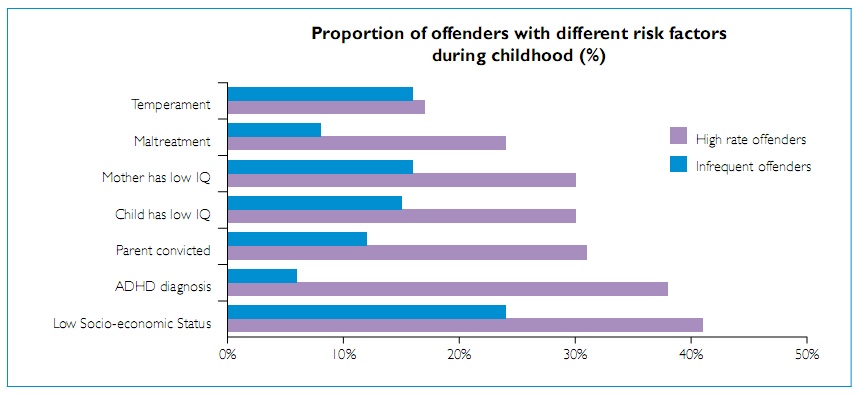
As identified by Mark Easton, the real heart of the report itself is not in the new measures proposed, but in the research behind it to back up its own suppositions. Hence 5% of youth offenders make up 50% of the actual crime committed, the hard core that do so much to give the vast majority a bad name. Equally, it identifies the factors that so increase the chances of someone being a prolific offender rather than one who might get in trouble once or twice during their childhood. Predictably, being a member of a "delinquent" group vastly increases the chances of offending; what doesn't however is a person's temperament, with both infrequent and prolific (high rate) offenders having broadly the same chance. What does make the difference is maltreatment as a child, if a parent is convicted of a crime, ADHD diagnosis, and low socio-economic status. Nothing ground breaking there either, but it has the useful effect of confirming what you already think that you know. This might be where specific targeting and targets can get over their deservedly bad name: specifically intervening where there is potential trouble ahead can in this instance make all the difference. Understandably, this does raise concerns about the nanny state, interfering in the family structure and the potential demonising of individuals; if however we are to make progress and as a result stop the mindless impression that everything is permanently getting worse and that the next generation are going to bring us all down, it might well be a necessary evil.

There are, as Lee Griffin especially has noted, some of the more harebrained ideas still in the plan. The eviction of families from council houses should they consistently fail to comply with successive orders, parenting ones as well as ASBOs, is a barmy idea which either just puts the problem somewhere or potentially makes the family homeless which makes a bad outcome even more likely. It simply isn't going to happen, and is probably only in there for the benefit of the tabloids and to make the whole deal same harsher than it otherwise is. Lee also objects to "unpaid work in the community" on Friday and Saturday night for child criminals, which I think is actually not so bad an idea. It's clearly just another harsher way of saying community service, and carrying it out on the nights when most teenagers go out will be the sort of punishment that might just get through to the minority that if they decide to act like morons or plague people to death that they'll have their leisure time to do so taken away. The only problem is just who will supervise it and given up their own weekends. Where I do agree with Lee and others is on the completely disproportionate mass curfew orders which the government is encouraging, which stigmatise youth as a whole rather than dealing with those who are a pain. Most the time it's not even that they're actually committing any sort of offence, it's that they're daring to be on a street corner or outside at all. There was a local news report the other week about anti-social behaviour where one guy who didn't want to be identified's chief complaint was that some of the youths had "called him names"; for fuck's sake people, grow some sort of a backbone. Especially illiberal is the Redruth saga, where kids who dare to be outside after 9pm during the school holidays are to be marched back home and their parents potentially given orders to keep them inside and otherwise, when they haven't broken any rule but have transgressed over the threshold of being young and outside at night.

On the whole however, the plan is mostly sensible, level-headed, backed up by evidence and might just well actually confront some of the most intransigent problems in some communities that we face today. It's a break with the tough on crime without being tough on the causes sense that has blighted policy for the last decade. The real tragedy is that it's likely to be thrown out the window by the Conservatives before it's even had a chance to work.

Labels: , , , , , , ,

Share |

About

  • This is septicisle
profile

Archives

Powered by Blogger
and Blogger Templates